
Microservices vs. Monolith: When Each Actually Makes Sense

In this article
- What each one actually is
- The real tradeoff: microservices buy team independence, at a price
- Why most teams should start with a monolith
- When microservices actually make sense
- The hidden cost of microservices too early
- The middle path: a modular monolith
- How AI and cheap cloud changed the math
- Frequently asked questions
- The bottom line
Most teams reach for microservices too early, because that’s what the big companies use and that’s what the conference talks are about, and they spend the next two years paying for an architecture built to solve a problem they don’t have yet. The same judgment drives good cloud-native application development: use the pattern that fits the problem, not the one that looks modern. That choice is one piece of a broader legacy application modernization decision.
I’ve built both. I scaled VinSolutions, the number one CRM in automotive, to $35 million in annual recurring revenue on what was essentially a monolith. At Full Scale we work inside a lot of client backends, and I see the same over-correction constantly: five engineers maintaining fifteen services because someone decided on day one that they were building the next Google.
Here’s the honest version of the tradeoff, when each one actually makes sense, and why the answer for most teams is the one nobody brags about.
What each one actually is
Quick definitions so we’re talking about the same thing.
| Monolith | Microservices | |
|---|---|---|
| Structure | One codebase, one deployable application | Many small services, each deployed on its own |
| Communication | In-process function calls | Network calls between services |
| Best when | One team, early or mid stage, fast iteration | Many teams, large org, genuinely independent components |
| Main cost | Can get tangled as it grows | Operational complexity from day one |
The key thing that list hides: a monolith’s costs show up later, and microservices’ costs show up immediately. That timing is the whole decision.
The real tradeoff: microservices buy team independence, at a price
Here’s what most explainers miss. Microservices are an answer to an organizational problem, not a technical one.
The thing microservices actually buy you is team independence. When you have a hundred engineers across a dozen teams, having each team own a service they can deploy without coordinating with everyone else is genuinely valuable. The architecture matches the org chart, and that’s the point.
What microservices cost you is operational complexity, and you pay it on day one. Now you have network calls that can fail between every component, distributed transactions, service discovery, more deployment pipelines, and a debugging story where a single request hops through six services and any of them can be the problem. A monolith has none of that. You call a function and it either works or throws, right there in one place you can step through.
So the real question is whether you have the organizational problem microservices solve, and whether you can afford the complexity they cost. For most teams the honest answer is no and no.
Why most teams should start with a monolith
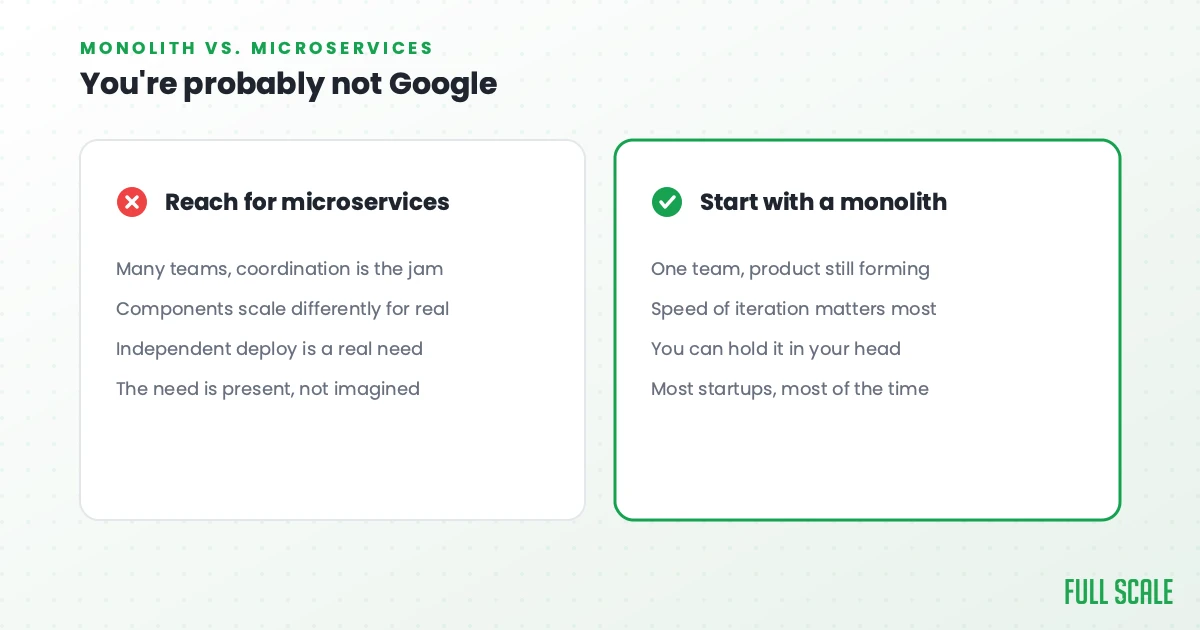
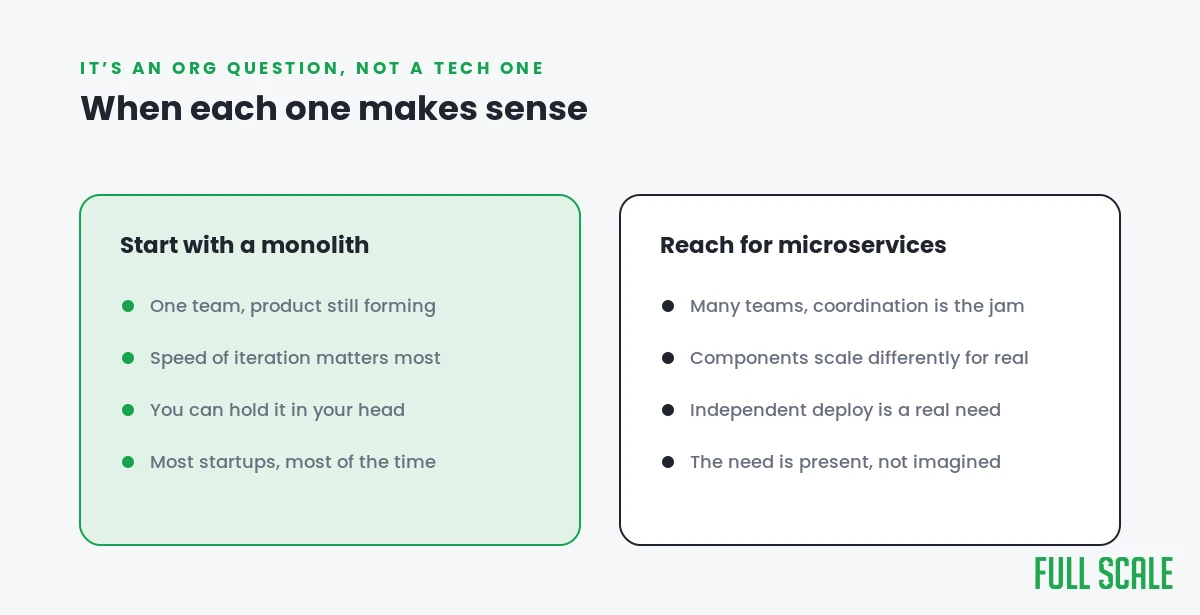
If you have one team and you’re still figuring out the product, start with a monolith. Almost always.
I’ll give you the receipt. VinSolutions scaled to a nine-figure exit on essentially one big database server, a maxed-out Dell, plus read replicas, with the application as a monolith. Plenty of smart people would have told us to break it into services. We didn’t, because we were a small team moving fast, and a monolith let us ship features instead of maintaining infrastructure. The simplicity was the advantage, not a limitation we were tolerating.
When you’re small, a monolith is faster to build, faster to debug, and faster to change. You can hold the whole thing in your head. You deploy one thing. When something breaks, it broke in one place. All the energy you’d spend on the plumbing between services goes into the product instead. That’s the same lesson I keep coming back to in my book, Product Driven: put your effort into what the customer feels, not into architecture nobody asked for.
The “but we need to scale” objection is usually wrong, too, and I’ll come back to why in the AI and cloud section.
When microservices actually make sense
I’m not anti-microservices. There’s a real point where they’re the right call, and it’s worth naming clearly so you know it when you see it.
Your org is big enough that coordination is the bottleneck. When you have many teams stepping on each other in one codebase and deploys are a traffic jam, splitting into services that teams own independently is worth the complexity. This is the real trigger, and it’s organizational.
Components have genuinely different scaling needs. When one part of your system needs to scale completely differently from the rest, breaking it out can make sense. At Stackify, we ran around 2,000 sharded SQL Server databases to ingest application and performance data at a volume no single database could hold. That was a real, specific scaling wall, and the architecture had to match it. The key word is real. We hit the wall before we built for it, not the other way around.
You need independent deployment and fault isolation for real reasons. If a failure in one component genuinely must not take down another, and you can prove that need, services give you that isolation.
The pattern in all three: the need is concrete and present, not imagined and future. If you’re justifying microservices with “someday we’ll be huge,” that’s not a reason. That’s the trap.
The hidden cost of microservices too early
Adopting microservices before you need them is one of the most expensive mistakes I see in the backend, and it’s invisible until it hurts.
You take a five-person team and ask them to operate the infrastructure of a fifty-person team. Every feature now touches multiple services and multiple deploys. A simple change becomes a distributed-systems problem. Debugging takes longer because the bug could be in any service or in the network between them. You’ve added all the cost of microservices and captured none of the benefit, because you don’t have the teams to make independent deployment matter.
I’ve run the kind of scale that actually justifies microservices, and it’s worth knowing what you’re signing up for. At Stackify we had around 50 servers powering a single API endpoint that ingested monitoring data. A routine deploy turned into a real event, because if those instances dropped for even a few minutes, data backed up behind them and we were suddenly trying to process five times our normal volume on infrastructure built for normal volume. Systems like that are invisible when they work. The hard part is catching back up when they don’t, and that’s the real cost of operating at this scale.
And this is exactly where hiring the cheapest available engineer makes it worse. A developer optimizing for their resume will happily build you a microservices architecture for your 200 users, because it’s more fun and looks better on LinkedIn. That’s cheapshoring in architecture form, and it can saddle you with complexity you’ll be paying down for years. The first architecture decision is the most expensive one on the project, which is the same point I made about what backend development really costs: the rate is cheap, the judgment is everything.
The middle path: a modular monolith
You don’t have to choose between a tangled monolith and a sprawl of services. The answer for a lot of growing teams is a modular monolith.
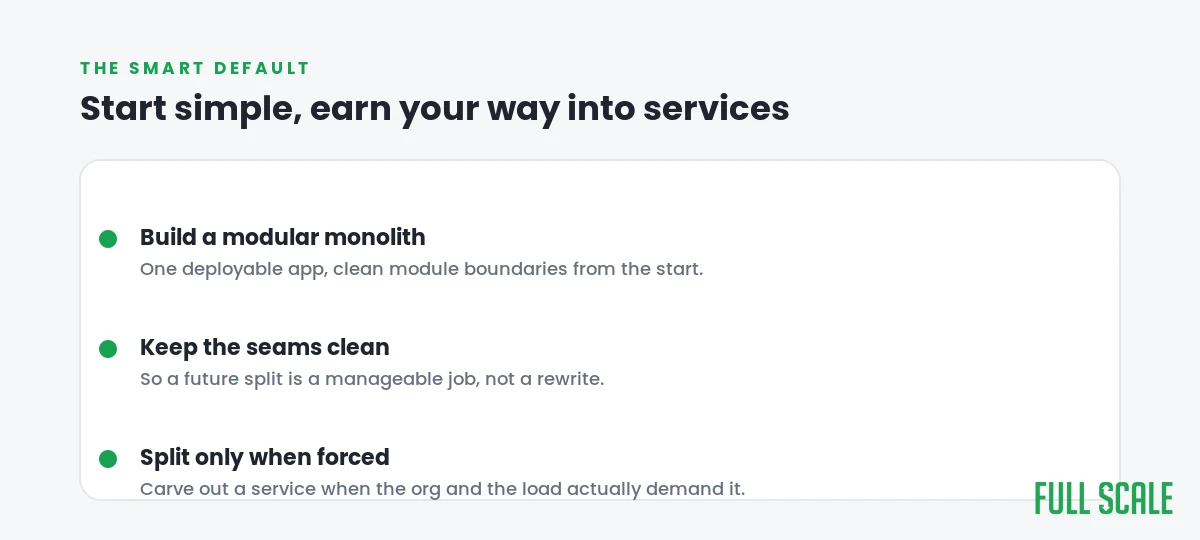
Keep one deployable application, but organize it into clean modules with clear boundaries, as if each module could one day become a service. You get the simplicity of a monolith now, and you make the future split cheap if you ever genuinely need it. When the org grows to the point where team independence matters, you carve a module out into a service, and because the boundary was already clean, it’s a manageable job instead of a rewrite. If you ever do face that bigger restructuring, the rules for doing it safely are the same ones in our piece on when your backend needs a rebuild. Whether to carve and rebuild a piece or refactor it in place is its own call, covered in refactor vs rewrite.
This is the path I’d point most teams toward. Start simple, keep the seams clean, and earn your way into services. The same default applies to SQL vs NoSQL: start relational, add specialized stores on purpose.
How AI and cheap cloud changed the math
Two shifts make the “start with a monolith” case stronger in 2026, not weaker.
Cloud scaling got cheap and easy. Worldwide public cloud spending hit $723 billion in 2025, and the reason it’s that big is that on-demand infrastructure scaling is now a commodity. A well-built monolith can scale further than people assume by just adding bigger or more instances behind a load balancer. The old “we need microservices to scale” argument was always half about scaling and half about org structure, and the scaling half got much weaker.
The pendulum is even swinging back for some companies. 37signals, the maker of Basecamp, pulled its applications out of AWS and back onto its own hardware, and reported cutting its cloud bill by around $2 million a year, with total infrastructure spend dropping from roughly $3.2 million to well under a million. They did that on a fleet of their own servers, not a sprawl of microservices. None of that means you should leave the cloud. It means the architecture and the bill are decisions you make, not defaults you inherit from whoever happens to be the biggest company in the room.
AI made simplicity more valuable, not less. AI coding tools are best at working inside a clear, contained codebase a human can supervise. As the DORA 2025 report found, AI amplifies what’s already there: point it at a clean monolith and it helps a lot, point it at a tangle of fifteen services and it adds confusion faster. Architectural simplicity is now also an AI-readiness decision.

Frequently asked questions
What’s the difference between a monolith and microservices?
A monolith is one codebase deployed as a single application, where components talk to each other through in-process function calls. Microservices split the system into many small services that each deploy independently and communicate over the network. The monolith is simpler to build and debug but can tangle as it grows; microservices give teams independence at the cost of operational complexity you pay from day one.
Should a startup use microservices or a monolith?
Almost always a monolith. A startup has one small team still figuring out the product, which is exactly the situation a monolith suits: faster to build, faster to debug, and faster to change. Microservices solve an organizational coordination problem that startups don’t have yet, so adopting them early means paying all the complexity cost and capturing none of the benefit.
When do microservices actually make sense?
When the need is concrete and present, not imagined. The real triggers are an organization large enough that teams coordinating in one codebase has become the bottleneck, components with genuinely different scaling needs, or a real requirement for independent deployment and fault isolation. If the justification is “someday we’ll be huge,” that’s a sign you’re not there yet.
Is a monolith bad for scaling?
No. A well-built monolith scales much further than people assume, especially now that cloud infrastructure scaling is a cheap, on-demand commodity. Plenty of large products run on monoliths. The “we need microservices to scale” argument was always partly about organization rather than raw capacity, and the pure-scaling part of it is weaker than ever.
What is a modular monolith?
A modular monolith is a single deployable application organized into clean, well-bounded modules, as if each module could later become its own service. It gives you the simplicity of a monolith now while keeping a future split to microservices cheap if you ever truly need it. For most growing teams it’s the smartest middle path: start simple, keep the seams clean, and earn your way into services.
The bottom line
The monolith vs microservices decision is mostly a question about your organization, not your technology. If you have one team and a product still finding its feet, start with a monolith, keep the modules clean, and migrate to services only when the org and the load actually force it. Microservices are the right answer to a problem most teams don’t have yet, and building for that problem before it arrives is the most common over-engineering mistake in the backend.
If you want senior engineers who can make this call with you, and build whichever one your situation actually calls for, schedule a call with us.