
What a Senior Backend Engineer Actually Does (and How to Vet One)

In this article
- What a senior backend engineer actually does, day to day
- The real difference: judgment and ownership
- Why the AI era made a senior backend engineer more valuable, not less
- What looks senior vs. what is senior
- How to vet a senior backend engineer
- What a senior backend engineer costs (and the cheapshoring trap)
- Frequently asked questions
Quick Answer: A senior backend engineer in the US costs about $150,000-$185,000 in base salary, roughly $200,000 a year fully loaded. A vetted senior offshore engineer through Full Scale runs about $35/hr fully loaded, senior judgment without the US price tag, as long as the vetting is real. The rate is the cheap part; the judgment is the expensive part, and paying a low rate for low judgment is the most expensive choice of all.
A senior backend engineer is not a mid-level developer who writes more code. That’s the mistake most job descriptions make, and it’s why so many companies pay a senior salary for mid-level work. The same gap shows up by framework: if your stack is Python, you want to hire a dedicated Django developer who has run Django in production, not someone who listed it on a resume.
The real difference is judgment and ownership, not speed or output. A senior backend engineer prevents the expensive mistakes you never see, the bad data model, the security hole, the architecture that can’t scale, and owns the outcome instead of just closing the ticket. That’s worth a premium, and it’s also hard to spot in an interview, which is why so many bad senior hires happen.
I’ve hired and managed backend engineers for 20 years, at Full Scale, Stackify, and VinSolutions. Here’s what a senior backend engineer actually does, how to tell real seniority from a title, and how to vet one so you don’t overpay for the label.
What a senior backend engineer actually does, day to day
The visible work looks similar to what a mid-level engineer does. The difference is in the decisions underneath it.
| Area | What a senior backend engineer actually does |
|---|---|
| Architecture | Decides how the system is structured so it survives the next three years, not just this sprint |
| Data modeling | Shapes the data so future features are easy instead of painful |
| Code review | Catches the bug, the security gap, and the shortcut before it ships |
| Mentorship | Makes the engineers around them better, multiplying their own value |
| Tradeoffs | Knows what to build now, what to skip, and what will hurt later |
| Incident response | Is the person you want online when production breaks at 2 a.m. |
Notice that almost none of this is “writes more endpoints.” A senior backend engineer’s value is in the decisions that don’t show up in a demo and don’t break until much later.
The real difference: judgment and ownership
The best backend engineer I ever worked with had the title “senior developer,” but he didn’t act like one. He acted like an owner.
At Stackify, he was in charge of our monitoring support across Java, Node.js, PHP, and Python. He decided which languages and frameworks we’d support and what “done” meant for each. Nobody handed him a spec. He operated like a product manager and a leader, and the result was better than anything a more narrowly-scoped engineer would have produced. His seniority came from owning the outcome, not from his title or his years.
I’ve seen the same thing from the other direction. I hired a guy named Brian Kellogg onto the support team at VinSolutions, and he climbed from support to level-two support to junior developer to senior developer, and then went on to co-found VINCUE in automotive software. What moved him up was taking ownership at every level, not tenure. I think VinCue ends up being a bigger exit for him than VinSolutions was for me.
That’s the thing to internalize: seniority is a mindset, not a tenure count. A developer with twelve years who only does what the ticket says is mid-level. A developer with five years who owns the outcome and makes everyone around them better is senior. It’s an idea I keep coming back to in my book, Product Driven: the people who think like owners are worth far more than the people who just execute.
Here’s where that judgment actually comes from: experience, and the mistakes you learn from along the way. A senior has solved more problems, seen more things break, and crashed production enough times to know what not to do. That scar tissue is the point, but it has a trap. A junior is often less afraid, so they’ll just try things, while a senior who has seen every horror story can get too slow and too cautious. The engineer you want has the wisdom without the cynicism: they apply what they’ve learned to make smarter calls, but they haven’t talked themselves out of acting.
I learned this from the other side. My first week at my first programming job, at a company selling concert tickets, I ran a SQL update with no where clause and changed every ticket on the site to look like it was for the band A Perfect Circle. I was sure I’d be fired. My boss just said everybody makes mistakes, you learn from yours and move on. That’s what being a junior is for, and I haven’t made that one since. The teams that treat mistakes as part of how someone grows into a senior are the ones that actually produce seniors, instead of training people to be too scared to try anything.
Why the AI era made a senior backend engineer more valuable, not less
You might think AI writing the code would shrink the gap between senior and mid. It did the opposite.
When the typing is cheap, the value moves entirely to the judgment, and judgment is exactly what makes someone senior. It is the judgment behind calls like monolith vs microservices. Google’s CEO said about 75 percent of the company’s new code is now AI-generated, and every line is still reviewed by an engineer. The senior is the one doing the reviewing that matters.
The risk side proves the point. A 2025 Veracode study found 45 percent of AI-generated code carried a known security flaw, and Stack Overflow found 66 percent of developers say their biggest AI frustration is code that’s almost right but not quite. Catching that “not quite” before it reaches production is exactly the judgment you’re paying a senior for, and it’s the thing a less experienced engineer tends to miss. The DORA 2025 report put it well: AI amplifies what’s already there. Aimed at a senior it’s a force multiplier; with no experienced hand guiding it, it just produces more bugs, faster.
So in 2026 the senior backend engineer is the person who makes AI-assisted development safe.
What looks senior vs. what is senior
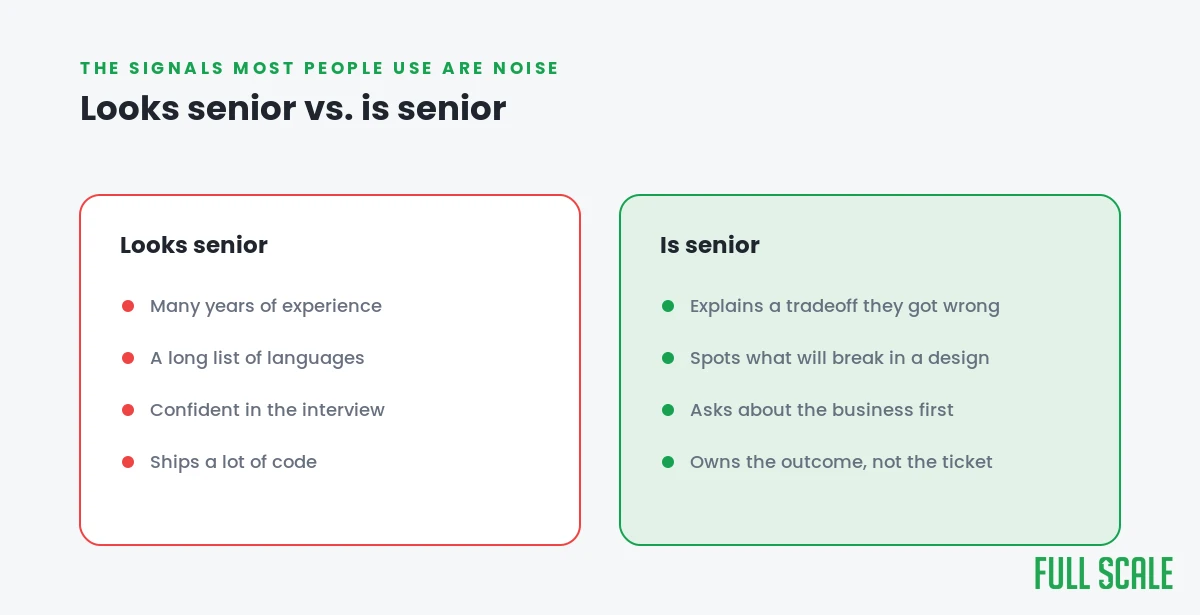
The hard part of hiring is that the signals people use for seniority are mostly noise.
Years of experience look senior and often aren’t. Plenty of engineers have one year of experience repeated ten times. A long list of languages looks senior and isn’t either; breadth without depth is a tell. A confident interview presence looks senior and tells you nothing about whether their code is safe.
What actually signals seniority is harder to fake. Can they explain a tradeoff they got wrong and what they learned? Can they look at a flawed design and tell you what will break? Do they ask about the business problem before reaching for a solution? Those are the tells, and they map directly onto the backend developer skills worth hiring for.
How to vet a senior backend engineer
Stop testing for the things AI made cheap, and test for judgment directly.
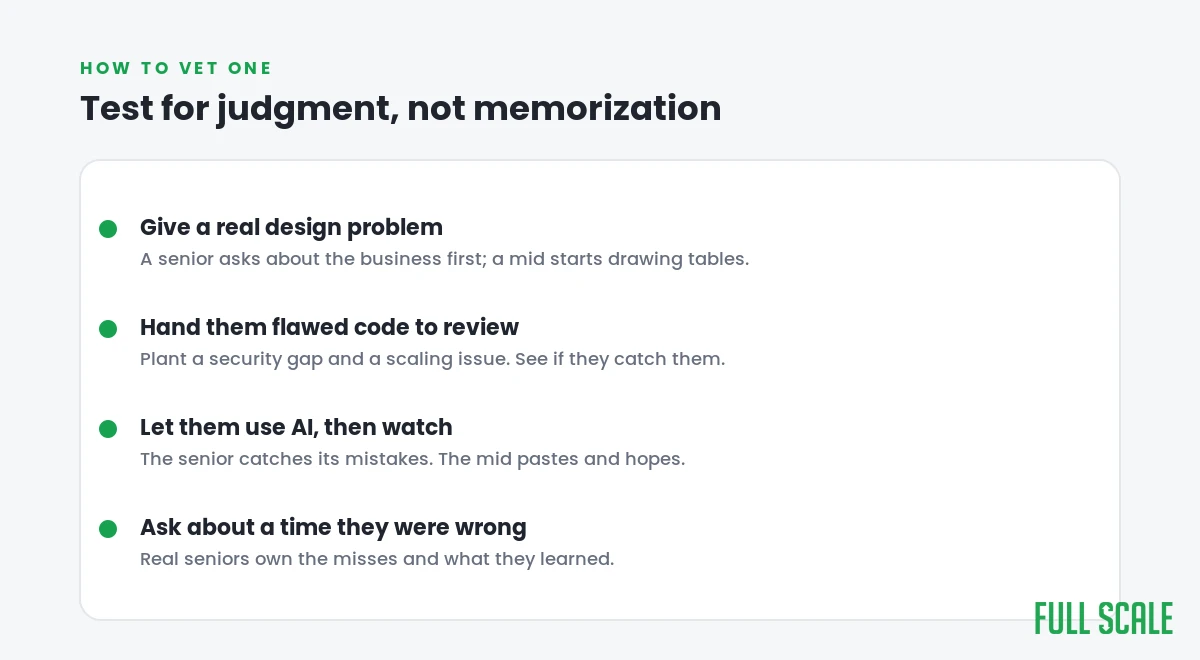
Give them a real design problem. A favorite is the data model, which is also the heart of the SQL vs NoSQL decision. “Design the data model and API for this feature, and walk me through the tradeoffs.” A senior asks clarifying questions about the business before drawing a single table.
Hand them flawed code and ask them to review it. Seniority is the ability to spot what’s wrong, not just to write something new. Plant a security gap and a scaling problem and see if they catch them.
Let them use AI and watch how. The engineer you want uses it to move faster and still catches its mistakes, instead of pasting whatever it produces and hoping. As I argued in the piece on whether your backend needs a rebuild, the highest-judgment moments in software are exactly where you want a senior, and they’re easy to probe in an interview if you ask the right questions.
Ask about a time they were wrong. A real senior will have a clear story about a decision that didn’t work and what it taught them. Ownership includes owning the misses.
What a senior backend engineer costs (and the cheapshoring trap)
A senior backend engineer in the US costs about $150,000 to $185,000 in base salary, and roughly $200,000 a year once you load in benefits, recruiting, and overhead. That’s a real premium over a mid-level, and it’s usually worth it, because the senior’s judgment prevents mistakes that cost far more than the salary difference.
Where companies go wrong is trying to get senior judgment at a junior rate. Hiring for the lowest number is what I call cheapshoring, and the backend is where it bites hardest, because a cheap engineer’s bad architecture decision is invisible until it’s expensive. This is the same point as what backend development actually costs: the rate is the cheap part, the judgment is the expensive part, and paying a low rate for low judgment is the most expensive choice of all.
The better path is a vetted senior engineer at a sustainable rate. Our engineers average more than seven years of experience, we accept under 3 percent of applicants, and the fully-loaded rate is around $35 an hour. That’s how you get senior judgment without the US senior price tag, as long as the vetting is real.
If you want a vetted senior backend engineer who owns their work on your team, schedule a call with us.
Frequently asked questions
What does a senior backend engineer do?
A senior backend engineer makes the high-stakes decisions underneath the code: the architecture, the data model, the security review, and the tradeoffs about what to build and what to skip. They also mentor other engineers and lead incident response. The visible coding work looks similar to a mid-level engineer’s, but the value is in the judgment that prevents expensive mistakes you won’t see until much later.
What’s the difference between a mid-level and a senior backend engineer?
Judgment and ownership, not speed or output. A mid-level engineer does what the ticket says and writes correct code. A senior backend engineer owns the outcome, anticipates what will break, shapes the system so future work is easier, and makes the people around them better. Seniority is a mindset, which is why some engineers with five years are senior and some with twelve are not. It is the same reason upskilling developers to own the whole loop matters more than teaching another framework.
How do I vet a senior backend engineer?
Test for judgment rather than memorization. Give a real design problem and see if they ask about the business before drawing tables, hand them flawed code and see if they catch the security and scaling issues, let them use AI and watch whether they catch its mistakes, and ask about a decision they got wrong. These reveal real seniority better than years of experience or a list of languages. Better still, ask for a profile that names real systems they have shipped, so you can check the specifics before the call.
Why is a senior backend engineer more valuable in the AI era?
Because when AI writes most of the code, the value moves to judgment, which is exactly what makes someone senior. A large share of AI-generated code contains flaws and security issues, and a senior is the one who catches them before they ship. AI amplifies whoever is directing it, so a senior gets far more out of it while a junior without oversight just ships more problems faster. That gap is exactly what we score developers on, instead of trying to read seniority off output.
How much does a senior backend engineer cost?
In the US, roughly $150,000 to $185,000 in base salary and about $200,000 a year fully loaded with benefits, recruiting, and overhead. The premium over a mid-level is usually worth it because senior judgment prevents far more expensive mistakes. A vetted senior offshore engineer through a team model can deliver the same judgment at a fraction of the rate, around $35 an hour fully loaded, as long as the vetting is genuine.
Does a senior offshore engineer’s rate vary by region?
Yes, and it tracks cost of living more than skill. A senior offshore engineer in the Philippines runs about $30-40/hr fully loaded through a staffing partner like Full Scale. Eastern Europe and Latin America typically run higher on a fully-loaded basis, since their cost of living is higher, though both still undercut a US hire. See our Latin America vs. Philippines cost comparison for the region-by-region breakdown.