
SQL vs. NoSQL: Choosing a Database for Your Product

In this article
- What each one actually is
- The real difference: a schema you enforce vs flexibility you manage
- Why most products should start with SQL
- When NoSQL actually makes sense
- The “we need NoSQL to scale” myth
- You can use both, and most mature products do
- How this ties to your architecture and your cost
- Frequently asked questions
For most products, the SQL vs NoSQL decision has a boring answer: start with SQL. Specifically, start with Postgres, and don’t reach for anything else until you have a concrete reason you can name.
That sounds like a cop-out. It isn’t. It’s the same lesson as picking a monolith over microservices: most teams choose the more complicated option to solve a problem they don’t have yet, and then pay for that complexity every day after.
I’ve run both at real scale. At VinSolutions I built the number one CRM in automotive on SQL Server. At Full Scale we work inside client backends on both kinds of databases, and at Stackify I ran around 2,000 SQL databases at a volume most people assume requires something exotic. So let me give you the honest version of the SQL vs NoSQL decision: what each is actually good at, why SQL is the right default, and the specific cases where NoSQL earns its place. Most of these calls sit with your backend engineers, so when you hire senior ASP.NET developers, make sure they reason about data access, not just controllers.
What each one actually is
Quick definitions, then the part that matters.
| SQL (relational) | NoSQL (non-relational) | |
|---|---|---|
| Data model | Tables with rows and columns, a defined schema | Documents, key-value, wide-column, or graph |
| Schema | Enforced up front | Flexible, enforced in your app instead |
| Relationships | Joins across tables, built in | Usually denormalized or handled in code |
| Examples | Postgres, MySQL, SQL Server | MongoDB, DynamoDB, Cassandra, Redis |
| Strength | Consistency, complex queries, integrity | Specific scale and access patterns, flexible shapes |
The headline difference everyone repeats is “structured vs flexible.” The difference that actually bites you is something else.
The real difference: a schema you enforce vs flexibility you manage
The honest tradeoff is about where the discipline lives.
With SQL, the database enforces the rules. The schema says this field is required, this is a number, this row must point to a real customer, and the database refuses to let you break that. That feels rigid until the day it saves you from corrupting your own data.
With NoSQL, that flexibility didn’t disappear. It moved into your application code, where you now have to enforce it yourself. “Schema-less” really means “the schema lives in your code and in your head instead of in the database.” For a small team moving fast, that’s usually a worse place for it, because the database never forgets a rule and your code under deadline does.
So the real question comes down to whether you want the database guarding your data’s integrity, or whether you have a specific reason to take that job on yourself.
Why most products should start with SQL
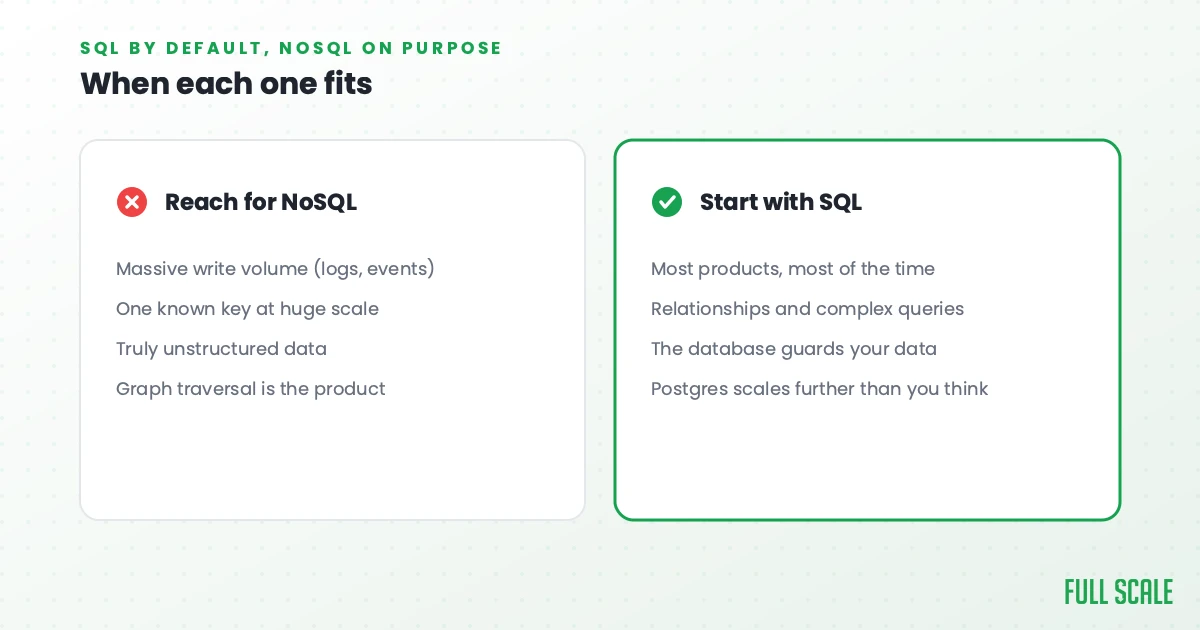
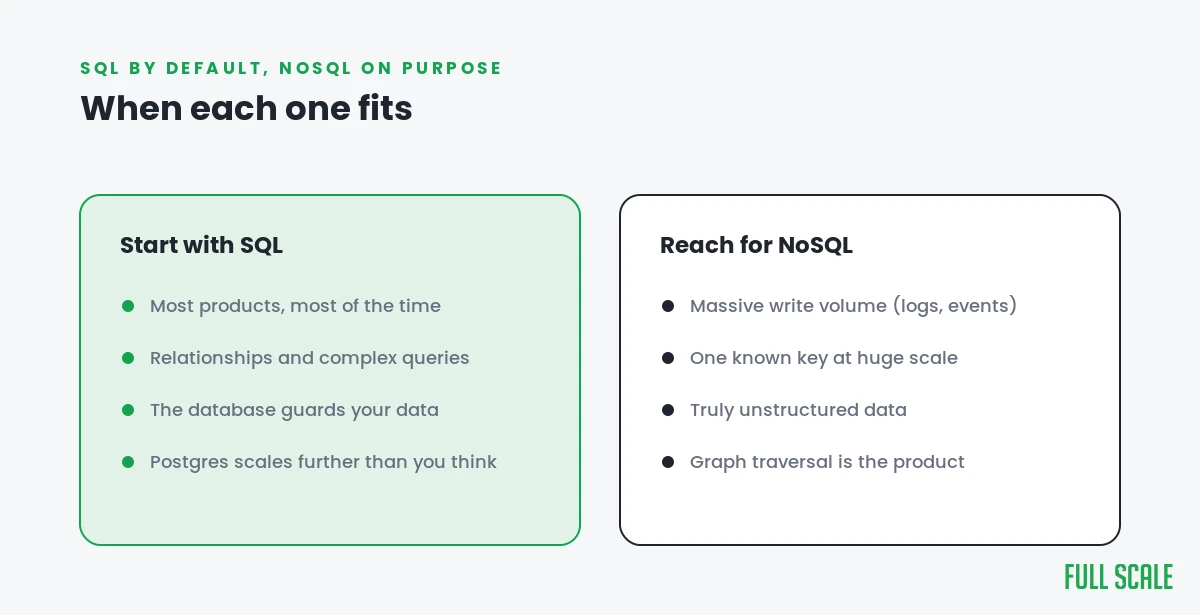
For most products, you want the database doing the guarding. Start with SQL.
A relational database handles the things most applications actually need: customers linked to orders, orders linked to items, queries that join all three and ask a real business question. Postgres in particular is free, battle-tested, runs anywhere, and now does a lot of what people used to switch to NoSQL for, including JSON document storage when you genuinely need a flexible field.
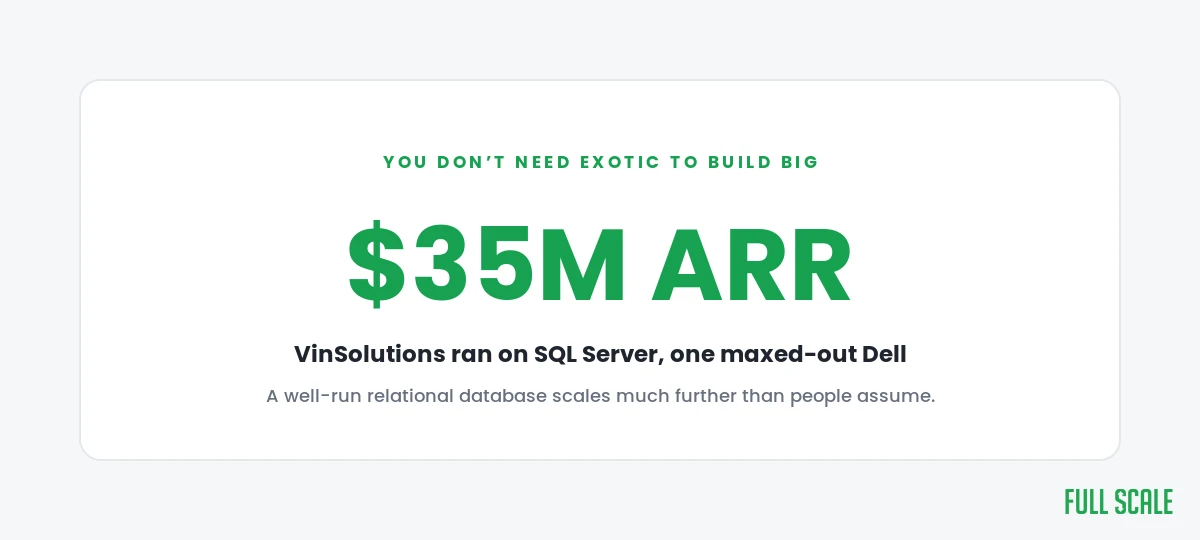
The scale objection is usually wrong, and I have the receipt. VinSolutions ran to $35 million in annual recurring revenue on SQL Server, on essentially one big database server, a maxed-out Dell, plus read replicas. We didn’t need anything exotic to build a nine-figure company. A well-run SQL database scales much further than people assume, especially now that managed databases and on-demand cloud capacity are cheap commodities. Worldwide public cloud spending hit $723 billion in 2025 precisely because scaling infrastructure stopped being the hard part.
It’s worth saying how rare the real version of this problem is. In my experience, well over 90% of the applications anyone builds never need to run on more than one server. Most teams never touch a high-scale problem at all, which is the same point experienced engineers keep making when they remind each other that you don’t have to run like Google.
Starting with SQL keeps your options open, keeps your data honest, and lets you put your effort into the product instead of the plumbing. That’s the same principle I keep coming back to in my book, Product Driven: spend the complexity budget on what the customer feels, not on infrastructure nobody asked for.
When NoSQL actually makes sense
I’m not anti-NoSQL. There are real cases where it’s the right call, and they share a pattern: you have a specific, present problem that a relational database genuinely struggles with.
Massive write volume of similar records. This is the clearest case, and it’s the one I lived. At Stackify we ingested application logs and performance data at a volume no single relational database could hold, which is exactly the kind of high-throughput, append-heavy workload that purpose-built and non-relational stores are designed for. When you’re writing billions of similar events and rarely updating them, the relational model’s strengths matter less and its overhead matters more.
A known, simple access pattern at huge scale. If you only ever look data up by one key, and you need that to be instant across enormous volume, a key-value store like DynamoDB or Redis is built for exactly that. The tradeoff is you give up flexible querying, so this only works when you truly know the access pattern in advance.
Genuinely unstructured or wildly varying data. When records legitimately don’t share a shape, a document store can fit better than forcing everything into columns. But be honest about whether your data is really unstructured or just not modeled yet. Most “unstructured” data turns out to have structure you haven’t named.
Graph relationships as the core feature. If traversing relationships is the product, a social graph, a recommendation engine, a graph database earns its place.
The common thread: the need is concrete and you can point to it today. If you’re reaching for NoSQL because of what might happen someday, that’s the trap, not the reason.
The “we need NoSQL to scale” myth
The most common bad reason to choose NoSQL is “it scales better.” This is mostly a myth, and it’s the database version of premature microservices.
Modern SQL databases scale to volumes that cover the overwhelming majority of products, through bigger instances, read replicas, connection pooling, and when you truly need it, sharding. The companies that genuinely outgrew SQL were operating at a scale you’ll know you’ve reached, because you’ll have hit a specific wall, not because you read that a giant tech company uses Cassandra. As the DORA 2025 report keeps finding, the teams that succeed match their tools to their actual problems rather than to the problems of companies a thousand times their size.
I’ve lived the sharding version of this. When I built Stackify, I sharded the database by client from day one, so every customer had their own database, and we ran around 2,000 of them. A Microsoft Azure engineer gave me the framing that stuck: they didn’t have a database that performed like a Ferrari, but I could have an unlimited fleet of Hondas. It scaled. It also became its own full-time job, because with thousands of databases you’re tracking performance across all of them, pushing every schema change to all of them, and running maintenance and data purges every week. Sharding is a real architecture you commit to on purpose, not a setting you flip to make the scaling problem disappear.
Choosing NoSQL for imagined scale costs you real things today: harder queries, weaker data integrity, a smaller hiring pool, and more code to maintain. You pay all of that now for a scaling benefit you may never need. If you do hit a real wall later, migrating a specific hot path to a specialized store is a manageable project, and a far better bet than building your whole product on the harder foundation from day one. The rules for that kind of later migration are the same ones in our piece on when your backend needs a rebuild.
You can use both, and most mature products do
This isn’t a religious war, and you don’t have to pick one forever. Most mature systems end up using both, each for what it’s good at.
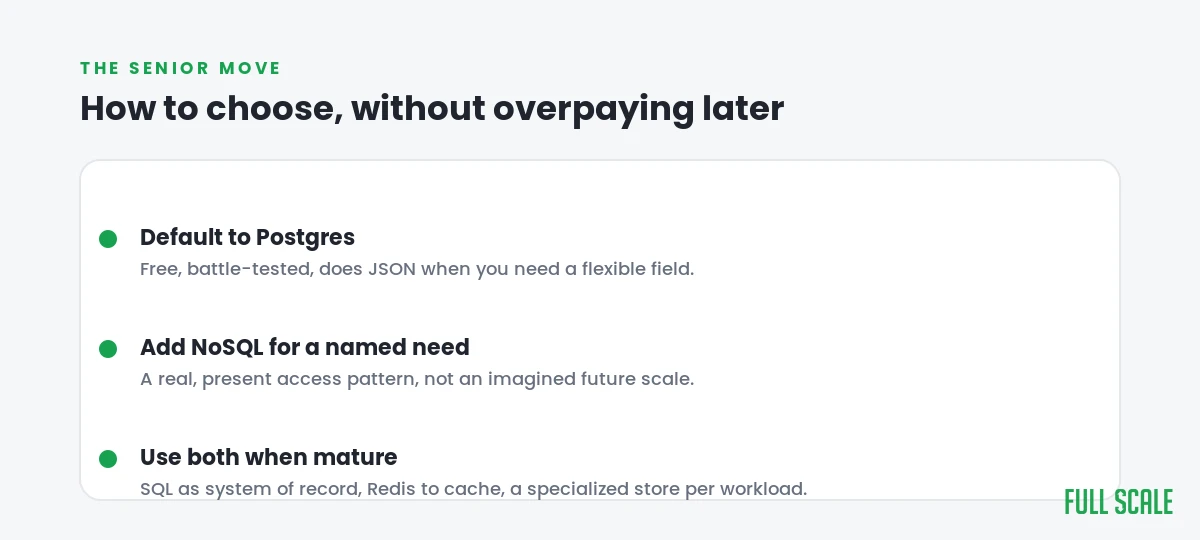
A typical shape: Postgres as the system of record for your core business data, Redis in front of it for caching and sessions, and maybe a specialized store for one specific workload like search or logs. You start with SQL as the foundation, and you add a NoSQL store when a specific need shows up, pointed at exactly that need. That’s the healthy version of the decision: SQL by default, NoSQL on purpose.
How this ties to your architecture and your cost
The database choice isn’t isolated. It’s part of the same family of early architecture decisions that set your costs for years, alongside the monolith-versus-microservices call and your overall stack.
Get it wrong in the expensive direction, reaching for distributed NoSQL complexity before you need it, and you’ve raised your backend development cost and shrunk the pool of engineers who can work on it. This is also where hiring the cheapest available developer hurts you, because a junior engineer chasing a resume-friendly database will happily saddle you with operational complexity you can’t maintain. That’s cheapshoring applied to your data layer, and the data layer is the worst place to learn that lesson.
The senior move is almost always the boring one: start with Postgres, keep your data honest, and add specialized stores when, and only when, a real need appears.
If you want senior engineers who can make this call with you and build it right, schedule a call with us.
Frequently asked questions
What’s the difference between SQL and NoSQL?
SQL databases store data in tables with a defined schema the database enforces, and they handle relationships through joins, which makes them strong at consistency and complex queries. NoSQL databases store data as documents, key-value pairs, wide columns, or graphs with a flexible schema your application manages instead. The practical difference is where the discipline lives: SQL makes the database guard your data’s integrity, while NoSQL puts that responsibility in your code.
Should I use SQL or NoSQL for my product?
For most products, start with SQL, specifically Postgres. It enforces data integrity, handles the relationships most applications need, scales further than people assume, and keeps your options open. Choose NoSQL only when you have a specific, present reason, such as massive write volume of similar records, a known simple access pattern at huge scale, or genuinely unstructured data. Picking NoSQL for imagined future scale is a common and expensive mistake.
Is NoSQL better than SQL for scaling?
Usually not in the way people think. Modern SQL databases scale to volumes that cover the vast majority of products through bigger instances, read replicas, and sharding. The companies that truly outgrew SQL hit a specific wall they could name. Choosing NoSQL for scale you only imagine costs you harder queries, weaker integrity, a smaller hiring pool, and more code today, in exchange for a benefit you may never need.
When should you use a NoSQL database?
Use NoSQL when you have a concrete problem a relational database struggles with: ingesting massive volumes of similar records like logs or events, looking data up by a single key at enormous scale, storing genuinely unstructured data, or making graph relationships the core feature. The test is whether the need is real and present today, not something that might happen someday.
Can you use both SQL and NoSQL together?
Yes, and most mature systems do. A common pattern is Postgres as the system of record for core business data, Redis for caching and sessions, and a specialized store for one specific workload like search or logs. The healthy approach is SQL by default as the foundation, then adding a NoSQL store on purpose when a specific need appears, rather than choosing one for everything.