
Software Testing Services in the Philippines: The Do’s and Don’ts

In this article
- Why everyone underrates QA, and why AI just raised the stakes
- Do: Understand why the Philippines works for software testing
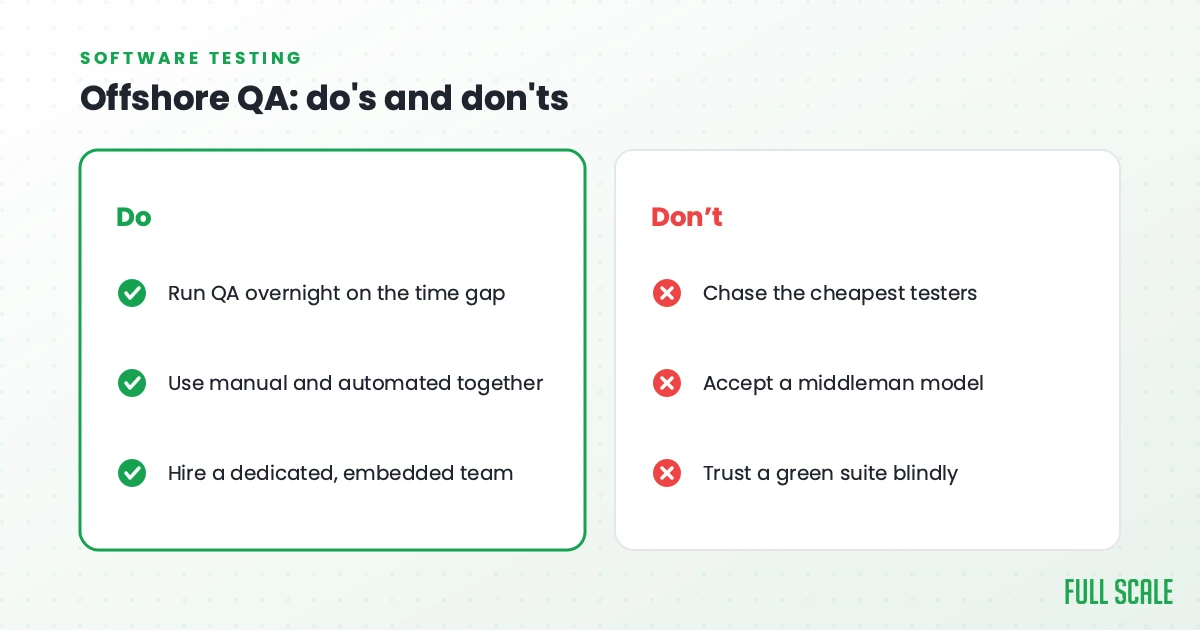
- Do: Use the time zone gap to run QA overnight
- Do: Use both manual and automated testing
- Do: Hire a dedicated team that sits inside your own
- Don’t: Chase the cheapest testers you can find
- Don’t: Accept the middleman model
- Don’t: Trust a green test suite or let developers be the only testers
- Don’t: Build automation you won’t maintain, or offshore a process you can’t define
- What good QA people look like
- How to vet an offshore QA partner
- What good QA actually costs
- The bottom line
- Frequently asked questions
A friend of mine runs a startup with 16 developers in Pakistan. He’s a smart guy with a real product and paying customers. He has one problem he can’t seem to shake: his software breaks all the time. Something is always on fire.
Here’s the part that gets me. He brags about it.
He’ll tell you how great his team is at putting out fires, and he means it as a compliment.
What he never says is that his team of 16 developers doesn’t include a single person doing quality assurance. Nobody owns testing. So bugs ship, customers find them, and his developers drop everything to fix what should have been caught a week earlier. He’s not running an engineering team, he’s running a fire department, and he’s proud of the response time. That reactive scramble is what proper application support services exist to prevent, by catching problems before they reach production. For the full picture on the models, risks, and how to choose a partner, see our offshore software testing guide. That is what happens without a real plan for deciding what to test and what to skip. That pressure keeps growing, because AI made testing a bigger job, not a smaller one.
I think about that a lot, because almost nobody plans for QA until it hurts. It’s the easiest function to skip when you’re moving fast and watching your budget. And it has never been a worse time to skip it.
Why everyone underrates QA, and why AI just raised the stakes
We’re all writing code faster now. AI assistants spit out functions in seconds, and teams are shipping more code than they ever have. That feels like a win until you remember a simple truth: when you ship more code, you ship more bugs, and you ship them faster than anyone can check them.
The data backs this up. A 2025 study from GitClear looked at 211 million changed lines and found that copy-pasted, cloned code jumped from 8.3% of lines in 2021 to 12.3% in 2024, while the kind of careful refactoring that keeps a codebase healthy dropped by more than half. Code that got reverted within two weeks went up too. AI is great at producing code. It is not great at producing code you can trust without checking.
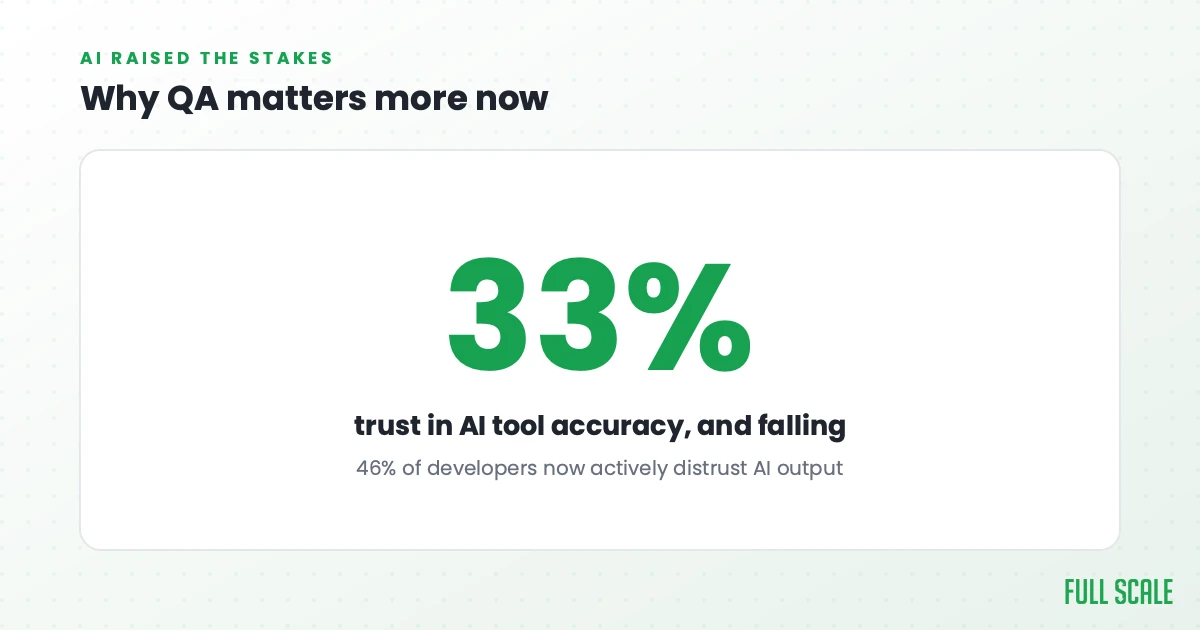
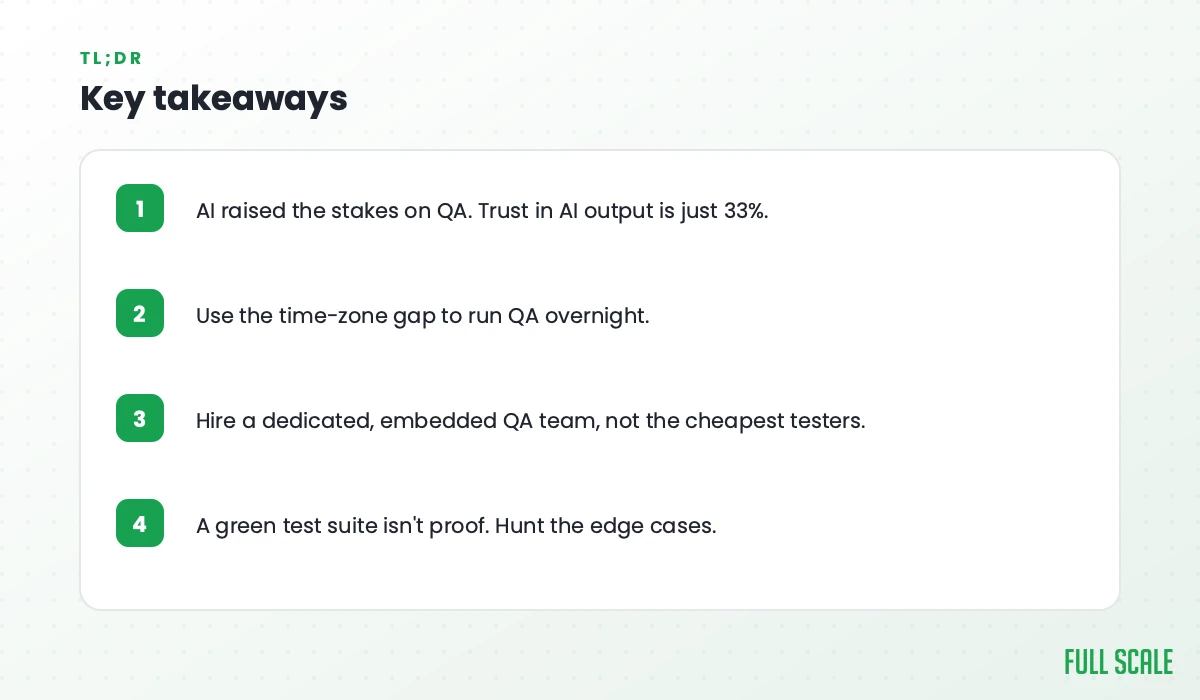
Developers know it. In the 2025 Stack Overflow Developer Survey, trust in the accuracy of AI tools fell to 33%, while 46% of developers now actively distrust it, and the single biggest frustration was AI output that is “almost right, but not quite.” Almost right is the most dangerous kind of wrong, because it sails through a quick glance and blows up in production.
And production bugs are expensive. The Consortium for Information & Software Quality found that poor software quality cost US companies about $2.41 trillion in 2022. There’s an old engineering rule of thumb, often credited to the IBM Systems Sciences Institute, that a defect caught after release costs up to 100 times more to fix than one caught during design. The number moves around, the lesson holds: the bug you don’t catch gets more expensive every day it lives.
QA is what turns all that AI speed into something worth having. Without it, you’re just generating fires faster, like my friend in Pakistan.
So if you’re an engineering leader thinking about where testing fits, the Philippines is one of the best places in the world for software testing. I’ve done it. But there’s a right way and a wrong way, and the wrong way is how most people end up swearing off offshore for good. Here are the do’s and don’ts.
Do: Understand why the Philippines works for software testing
I started building a team in the Philippines for Stackify back in 2018. It grew to more than 20 developers, it helped get us to an exit, and it eventually became Full Scale. I’ve spent the better part of a decade building and running offshore teams there, so none of this is theory to me.
Two things make the Philippines work for software testing specifically.
The first is communication. QA is a communication job before it’s a technical one. A tester’s whole value is in writing a bug report a developer can actually act on, and that falls apart fast when there’s a language barrier. The Philippines is the third-largest English-speaking country in the world, and it ranks second in Asia for English proficiency on the 2025 EF English Proficiency Index. Filipino engineers don’t just speak English, they grew up inside American culture, so the back-and-forth that QA lives on actually works. I broke down how to write a bug report that gets fixed instead of bounced back, and it’s the first thing I’d train any new tester on.
The second is cost, and I want to be careful here. Hiring in the Philippines is cheaper, but it’s cheaper because of the cost of living there. You’re paying less because rent and groceries cost less in Manila than in San Francisco, not because the engineers are any less capable. I’ll get into the real numbers later, but the savings don’t cost you skill.
That second point is also where most people get into trouble. But before we get to the ways this goes wrong, here’s the single best reason to put your QA team a dozen time zones away.
Do: Use the time zone gap to run QA overnight
People treat the time difference as a problem to manage. Run it right and it’s one of the biggest advantages you’ll get.
Here’s how it works in practice. Your US developers commit their code at the end of their day. While they sleep, your team in the Philippines is wide awake, running the full regression suite, exploring the new features, and filing detailed bug reports. By the time your developers sit down with coffee the next morning, there’s a triaged list of exactly what broke waiting for them.
You’ve effectively added a second shift to your day without asking anyone to work nights. The test-and-fix loop that used to take two days now turns over while the office is empty. That’s the kind of thing a brochure calls “follow-the-sun” and never explains. It’s real, and it’s the reason I’d put a QA team in this time zone on purpose.
There’s a catch, and it’s a don’t: don’t take the overnight cycle so far that you never actually talk. You still need a few hours of daily overlap for handoffs and questions, or “QA runs at night” quietly becomes “QA is a black box I never see.” A few hours of shared time is plenty. Most of our clients find a half-day overlap covers everything.
Do: Use both manual and automated testing
There’s a tired debate about manual versus automated testing, as if you have to pick. You don’t. You need both, and AI hasn’t changed that. If anything it’s made QA a bigger job, which I dug into in a separate piece on manual versus automated testing.
Automation is for the repetitive, predictable checks: regression suites, smoke tests, the hundreds of paths that have to keep working release after release. Tools like Playwright, Cypress, Selenium, and Postman do that work. Manual testing is for the things a human notices and a script never will, like a flow that technically works but feels broken, or an edge case nobody wrote a test for. The manual testers worth having think like product owners, not button-clickers. Their job is to judge whether the product is actually right, not just whether the code does what a ticket said. That judgment is the last line of defense before your customer is the one who finds the bug.
A good offshore QA team gives you both. A dedicated automation engineer who can write and maintain a real test suite runs about $35 an hour all in through us, which is a rounding error against the cost of one bad release. If you want the deeper taxonomy of what to test and how, we cover the main software testing methodologies separately.
There’s a newer wrinkle worth naming, because the hot thing in testing right now is agentic QA: AI agents that read your requirements, generate test cases, run them, and even try to repair the ones they break. Some of it is genuinely useful, and it will write far more tests than any human could. But it doesn’t remove the need for QA, it moves it. Someone still has to decide what “quality” means for your product, judge whether the generated tests are checking the right things, and catch the agent when it’s confidently wrong, which is the same “almost right, but not quite” problem we started with. The tooling keeps changing, but the need for a person who owns quality stays exactly where it was.
One honest caveat, since this is a do’s and don’ts. The part of testing I just praised, the human who notices a flow that feels broken, is also the part most exposed to distance. If you’re building a US consumer product, a tester in Manila might miss the small cultural cues a US user would feel right away. I don’t think that’s a reason to keep QA onshore, because Filipino engineers grew up steeped in American culture and catch more than you’d expect. But for genuinely culture-bound usability work, pair your offshore team with a product owner on your side who lives in the user’s world, and keep the most culture-specific exploratory testing close to home. Use the Philippines for the heavy lifting, and stay close to your actual user.
Do: Hire a dedicated team that sits inside your own
The biggest “do” of all: hire testers who work as part of your team instead of a vendor you toss requirements at over a wall. The model that gets this right is an embedded team, not a vendor,, where you add dedicated engineers to your own team instead of handing a project to an outside shop and hoping for the best.
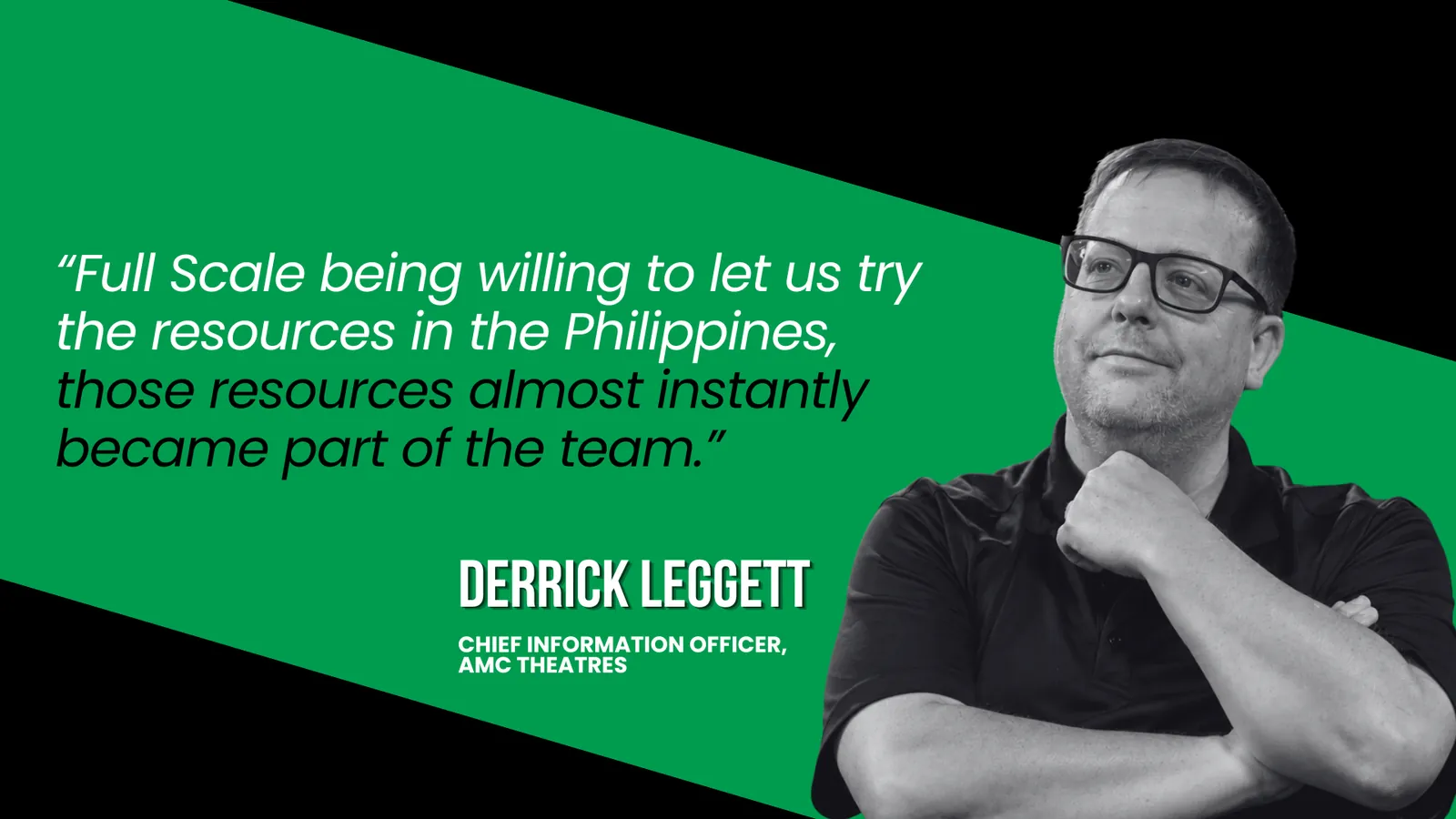
When AMC Theatres talks about their offshore engineers, their CIO Derrick Leggett describes it this way: “It’s a fully integrated team. It’s just some of the people happen to be living in the Philippines.” That’s the whole model. The testers join your standups, they learn your product, they own quality alongside your developers. There’s no separate vendor with its own agenda.
Testery is a good example of how this plays out for testing specifically. They build an automated testing platform, so their bar for QA engineering is about as high as it gets. Their founder, Chris Harbert, and I first connected on my podcast, and they ended up building a team with us because they needed engineers who could craft serious automated tests rather than bodies to throw at a backlog. The way Chris put it: “Working with Sean and the team felt less like outsourcing and more like teaming up with allies who genuinely cared about our project as much as we did.”
This is also where my offshore philosophy lives, which I’d boil down to communication over cost over country. Filter for people who communicate well first, worry about the rate second, and let the country fall out of those two. It’s the same idea behind Product Driven, the book I wrote about building engineering teams that own outcomes instead of just taking tickets.
This is exactly how AG Mednet runs its QA. Jason Flowers, Head of Software Engineering and DevOps, staffs Full Scale testers inside his own team, and the line between in-house and offshore disappeared:
Other than the fact that they’re not physically here with us, you would think that they’ve always been working with us.
Jason Flowers, Head of Software Engineering and DevOps at AG Mednet, on working with Full Scale
Don’t: Chase the cheapest testers you can find
Now the don’ts, starting with the one that sinks most offshore experiments.
If saving money is the only reason you’re going offshore, you’ll buy the cheapest thing on the menu, and the cheapest thing is a freelancer who vanishes mid-sprint or a body shop that bills for ten testers while three do the work. I call this cheapshoring, and it’s how good companies end up burned and convinced offshore doesn’t work.
Affordable is not the same as cheap. Offshore QA costs less because rent and groceries cost less, while the engineers are every bit as good. The goal is a senior tester in a lower-cost market, not the lowest bidder you can find anywhere.
Cost is a fine reason to hire in the Philippines. Cost as the only reason is the trap, because you stop asking whether these people can actually communicate, whether they’ll stick around, and whether anyone is managing them. A QA hire who can’t write a clear bug report, or who quits in nine months and takes all their product knowledge with them, isn’t a deal at any price.
The cheapest tester is usually the most expensive one you’ll hire.
Don’t: Accept the middleman model
A lot of offshore shops sell you a “team” you can never actually reach. You talk to one technical project manager, and every real developer and tester hides behind that person. You ask a question, it goes through the middleman, an answer comes back a day later.
That’s not a team. That’s a wall with a phone number.
You want direct access to the people doing the testing. You want to hear from the QA engineer who found the bug, not a status summary filtered through someone whose job is to keep you happy. If a provider won’t let you talk to your own testers, that tells you everything about how the engagement will go.
Don’t: Trust a green test suite or let developers be the only testers
Two technical don’ts that cost teams more than they realize.
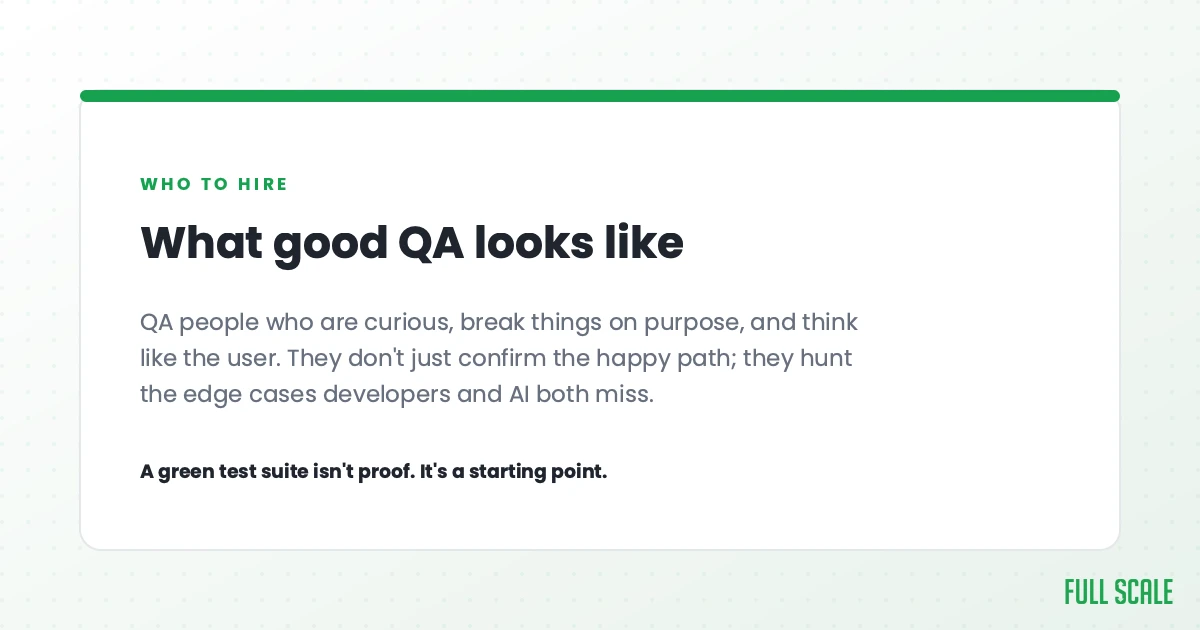
First, a passing test suite is not the same as working software. I’ve shipped products where every test ran green and a customer hit the bug anyway, because the suite only checks what someone thought to check. Automated tests catch regressions. They don’t catch the thing nobody imagined, which is exactly the thing that takes down your release.
Second, don’t let your developers be the only people testing their own code. They wrote it, so they unconsciously test it the way they built it, walking the happy path they already had in mind. Jeff Weiner of RealQuantum made this point on my podcast about the value of QA: you need fresh eyes, because the person who built it is the worst person to find its blind spots. A separate QA function exists to think like a user who has never seen your roadmap.
Don’t: Build automation you won’t maintain, or offshore a process you can’t define
If you write a pile of automated tests and then stop maintaining them, they rot. Tests start failing for reasons nobody bothers to chase, people learn to ignore the red, and within a few months the suite is noise. Automated testing only pays off if you keep maintaining it, so don’t start a suite you won’t commit to.
AI has made this worse, not better. It will happily generate hundreds of tests you never needed while it writes your code, and we see the result on client codebases all the time: huge automated suites full of redundant or not-quite-accurate tests nobody asked for. Researchers keep finding the same pattern in the code itself. A December 2025 CodeRabbit study of 470 pull requests found that AI-written code carried about 1.7 times more issues than human-written code, including 75% more logic and correctness bugs. The tests AI writes alongside that code inherit the same flaws. When one of them fails six months later, no one can tell whether it caught a real bug or was junk from the start. A bloated suite is slow, flaky, and trains your team to ignore failures, which defeats the entire point of having tests. Good automation is lean and intentional: test the behavior that matters, and delete the tests that don’t earn their keep. That takes a QA engineer who knows the product well enough to tell the difference.
And the big one: don’t offshore a QA process you can’t define yourself. If you can’t say what “done” and “quality” mean for your product, no team anywhere on earth can test to it. Offshoring a broken process doesn’t fix it, it just exports the mess and adds a time zone. This is the real lesson from my friend with 16 developers and no QA. His problem was never going to be solved by hiring a 17th developer, cheap or otherwise. He needed someone to own quality, with a clear definition of what quality even meant. More bodies on a broken process just make the fires bigger.
What good QA people look like
If you do offshore your testing, judge the people the way you’d judge any great hire, not by whether they can run a script. The testers worth having share three traits, the same ones I wrote about in Product Driven.
The first is communication. A QA engineer’s output is a bug report a developer can act on without a follow-up call, and that’s a writing and clarity skill as much as a technical one. The second is curiosity. The best testers poke at the thing nobody asked them to poke at, and they stay curious about how AI is changing the work instead of pretending it isn’t. The third is courage. A tester who won’t speak up when a spec is wrong, or who won’t hold a release they know is broken, is worse than no tester at all, because now you have false confidence. Tooling you can teach. These three you hire for.
How to vet an offshore QA partner
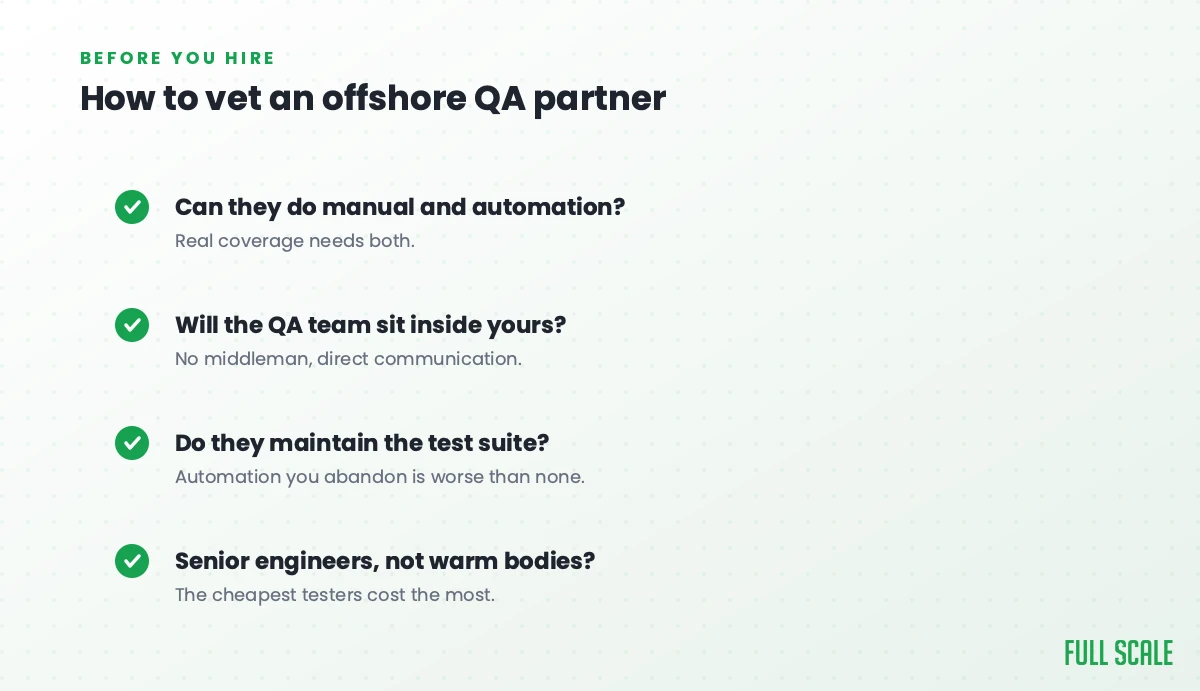
If you’ve decided to do it right, here’s what actually separates a real partner from a body shop. It comes down to three things: how they recruit, how they manage, and how they retain.
Recruiting is most of the job, and it’s the part the cheap option skips entirely. Good QA engineers are hard to find anywhere. A real partner does the sourcing, the screening, and the vetting for you. Our background checks in the Philippines go further than the US norm, to the point where investigators physically interview a candidate’s neighbors. You won’t get that from a freelancer marketplace.
There’s a trust dimension here too. Your testers touch your code and often your data, so it matters who’s accountable if something goes wrong. When you hire through us, your contract is with Full Scale as a US company under US law, not with an individual freelancer in a jurisdiction you’ll never be able to chase.
Managing matters because even great engineers need support. We put a customer success manager on every account whose only job is to make sure the engagement is healthy, which gives you a relief valve that has nothing to do with sales.
Retention is the one people forget until it bites them. We hold developer retention above 93%, and we’re Great Place to Work Certified in the Philippines two years running, with 95% of our people saying it’s a great place to work versus 65% at a typical company. For context, the Philippine outsourcing industry as a whole churns through people, with attrition that has run around 30% a year. A QA engineer who stays learns your product more deeply every month. One who leaves every nine months resets you to zero.
Retention isn’t a feel-good metric, it’s whether your testing gets smarter over time or starts over.
That focus on doing offshore right is a big part of why Full Scale has made the Inc. 5000 five years running. It’s also how we run software testing and QA outsourcing as a service, and how we hire developers in the Philippines across every role, QA included. If you want to go deeper on choosing well, we wrote a whole guide on how to choose an offshore software testing company.
What good QA actually costs
Let’s do the honest math, because the percentage-savings claims you see everywhere don’t tell you much.
A US QA engineer has a median base salary north of $100,000, and once you add benefits, taxes, and overhead, the real number runs closer to $130,000 or more. A skilled, dedicated QA engineer in the Philippines costs a fraction of that, and the savings come straight from the cost-of-living gap. You are not buying less skill.
Run those two numbers and you land somewhere between 50% and 70% less than a comparable US hire. For the same testing budget, that’s the difference between one tester onshore and two or three offshore.
Now hold that against the $2.41 trillion that poor software quality costs US companies, or just against the cost of your own last bad release: the support tickets, the emergency fix, the customer who didn’t renew. Good QA is cheap insurance against expensive failure. Skipping it to save a salary feels like a win right up until a bad release costs you ten times that in lost customers and emergency fixes.
The bottom line
My friend with the 16 developers still thinks his team’s firefighting is a strength. It isn’t. It’s the sound of a missing function, and every fire is a bug that a single good QA engineer would have caught before a customer ever saw it.
QA is the least glamorous part of building software and the easiest to skip, and skipping it has never been riskier than it is now, with AI helping everyone ship more code, faster, than they can carefully check. The Philippines is a great place to build that function, if you do it right: hire a dedicated, integrated team for their communication and judgment, use the time zone to test while you sleep, vet your partner on how they recruit and retain, and never pick on price alone.
Do that, and QA stops being the thing that catches fire and becomes the thing that keeps you from catching fire in the first place.
If you’re ready to build a real testing function, we can help you hire QA engineers in the Philippines who work as part of your team.
Frequently asked questions
How much do software testing services in the Philippines cost?
A dedicated QA engineer in the Philippines costs a fraction of a US hire, generally 50% to 70% less. A US QA engineer runs around $130,000 a year fully loaded, while a skilled Filipino QA engineer costs far less, with the savings coming from the lower cost of living rather than any drop in skill. Through Full Scale, a dedicated automation engineer is roughly $35 an hour all in.
Is the time zone difference a problem for QA?
It’s an advantage if you run it right. Your US developers commit code at the end of their day, your Philippines team tests it overnight, and a triaged bug list is waiting in the morning. You just need a few hours of daily overlap for handoffs, which a half-day schedule covers easily.
Should I use manual or automated testing?
Both. Automation handles repetitive, predictable checks like regression and smoke tests, while manual testing catches the usability problems and edge cases a script never will. A good offshore QA team gives you both, and a passing automated suite is never a substitute for human exploratory testing.
What’s the difference between hiring a dedicated QA team and a project shop?
A dedicated team works inside yours, sitting in the same standups and building the same product knowledge, and they’re on the hook for quality right alongside your developers, with direct access to every tester. A project shop puts a middleman between you and the people doing the work and tends to fit scoped, hand-it-off projects rather than ongoing quality ownership.