Software Testing Trends in 2026: AI Made Testing a Bigger Job, Not a Smaller One

In this article
- A quick map of the 2026 trends
- 1. AI writes your tests now, and that is how you end up with slop tests
- 2. Testing AI-generated code is the baseline job now
- 3. Self-healing and autonomous testing agents: who checks the checker
- 4. Shift-left and continuous testing, including security
- 5. Risk-based testing beats chasing a coverage number
- 6. AI-generated synthetic test data
- 7. Human-in-the-loop is no longer optional
- 8. The QA role is leveling up, and it changes who you hire
- What this means for your team in 2026
- Frequently asked questions
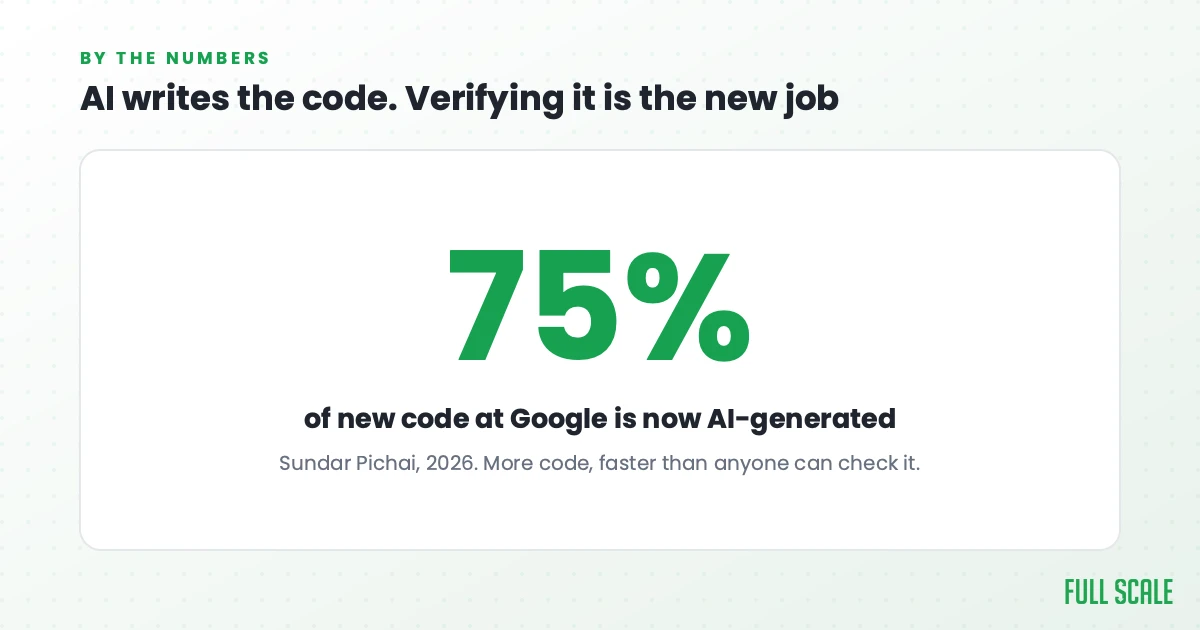
Roughly 75% of the new code at Google is now written by AI, according to CEO Sundar Pichai. Most teams I see are not far behind. Code is getting written faster than at any point in my 20-year career, and a lot of it ships before anyone really looks at it.
So the slop is piling up: half-right features, security holes, and logic that looks fine until it isn’t. And here is the part the trend reports keep getting wrong: the slop is showing up in the test suite too. Teams point AI at their testing the same way they point it at their code, and now they have a second pile to clean up. One of those shifts is how teams now write the QA engineer job description.
I have said before that AI without product thinking is just a slop machine. That is as true for tests as it is for features.
Most of the software testing trends you will read about this year are sold as ways to do less testing work. From where I sit, running QA across more than 80 client teams at Full Scale, it went the other way.
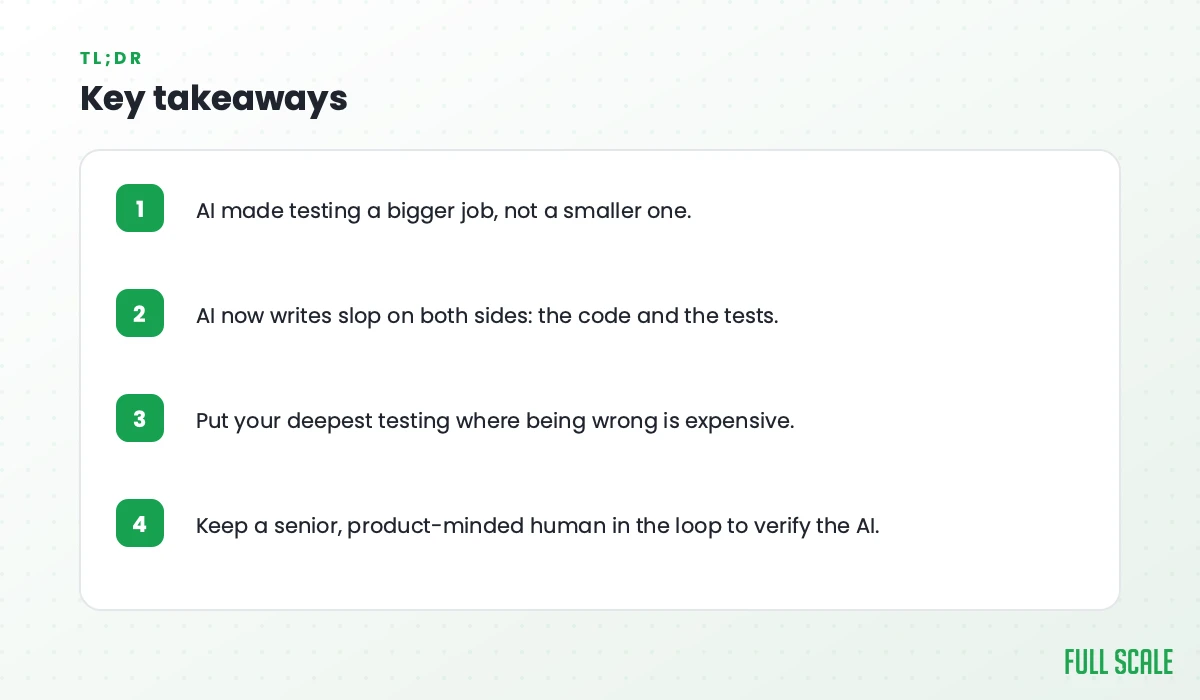
AI made testing a bigger job, not a smaller one.
Below are the trends that actually matter in 2026, and my honest read on each one: real, hype, or double-edged. I have spent money on most of these, and watched clients spend money on the rest.
A quick map of the 2026 trends
Here is the short version before we get into each one.
| Trend | My verdict |
|---|---|
| AI writes and maintains your tests | Double-edged |
| Testing AI-generated code as the baseline job | Real, underrated |
| Self-healing and autonomous testing agents | Hype, handle with care |
| Shift-left, continuous testing, and security validation | Real |
| Risk-based testing over coverage chasing | Real, the right default |
| AI-generated synthetic test data | Real, bounded |
| Human-in-the-loop becomes non-negotiable | Real, the through-line |
| The QA role levels up | Real, and it changes who you hire |
1. AI writes your tests now, and that is how you end up with slop tests
Start with the good news, because it is real. Building automated tests has never been cheaper. Tools like Playwright and Cypress made browser testing far more approachable than the old tooling ever was, and AI assistants like GitHub Copilot, Cursor, and Claude can draft a test script faster than a person can type one.
That handles the typing. It does not handle the thinking.
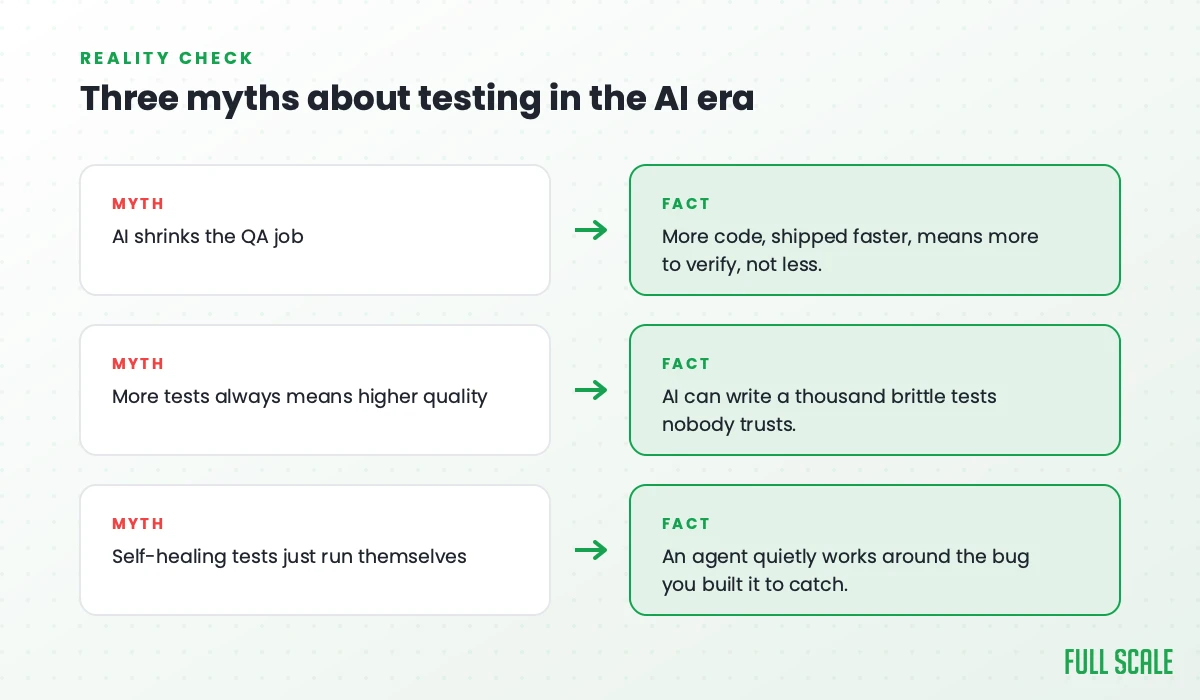
Here is the trap. Tell an AI to raise your test coverage and it will happily write you a thousand tests. What it will not do is tell you which thousand matter, or whether you needed a thousand at all. You end up with a giant, slow, brittle suite full of tests that check things nobody cares about and break every time someone renames a button. Engineers stop trusting it. They start ignoring red builds. The suite becomes noise.
I have watched teams over-test by hand for years. A good testing strategy is a risk decision, not a coverage number, and most teams already get that backwards. AI does not fix that instinct. It pours gas on it.
More tests is not more quality. It never was, and AI does not change the math.
Verdict: double-edged. Let AI write the tests you actually decided to write. Do not let it decide what to test.
2. Testing AI-generated code is the baseline job now
For most of my career, writing software was the slow part. I started as an engineer, became a CTO, and co-founded VinSolutions, which sold for $147 million. I later founded Stackify, where we built application monitoring and logging tools, so I have spent years on software whose entire job was catching the defects in other people’s running code. Across all of it, the thing that took forever was the building. Every tool and process we adopted existed to help engineers ship faster.
AI broke that pattern. The building got fast. The proving did not.
When code volume goes up and human attention per line goes down, the risk does not vanish. It moves downstream to whoever is supposed to catch the problems, and that is QA. What I see across client teams is simple. AI does not have to write buggier code than a careful engineer for this to bite. It just has to write a lot more of it, faster than anyone can read each line, so more code reaches the tester looking correct when it is not.
The numbers back this up. In the 2025 Stack Overflow Developer Survey, 84% of developers said they use or plan to use AI tools, but more of them actively distrust the accuracy of what those tools produce than trust it.
Everybody is shipping AI code, almost nobody fully trusts it, and somebody still has to check it.
Verdict: real, and underrated. This is the trend almost nobody is talking about. AI did not shrink the testing job. It handed QA a bigger pile.
3. Self-healing and autonomous testing agents: who checks the checker
Self-healing tests and autonomous testing agents are the trend the tool vendors love most in 2026. Self-healing tests fix themselves when the UI changes. Autonomous agents explore your app and write their own test cases. It sounds like the dream of testing that runs itself.
Be careful here.
A test has one job: notice when something is wrong. An AI agent has the opposite instinct. It is built to get through the task you gave it. So if a button used to take one click and now takes two because of a bug, a naive agent told to complete the checkout flow will just click twice and move on. The test passes. The bug ships. The exact thing you built the test to catch is the thing the agent quietly worked around.
A suite that “self-heals” around a real defect is worse than no suite, because it tells you everything is fine while it hides the failure.
The judgment about whether a change is a fix or a bug has to stay with a human. A machine optimizing to make the test pass will always find a way to make the test pass.
Verdict: hype, handle with care. Use self-healing to cut maintenance on tests you trust. Never let an agent decide on its own whether a failure was real.
4. Shift-left and continuous testing, including security
Shift-left is the idea that testing should start early, woven into design and development, instead of being a phase you hand off at the end. Paired with continuous testing in your CI/CD pipeline, it means quality gets checked on every change rather than in a panic before release.
This one is real and it is not new, but AI raised the stakes. When code ships this fast, waiting until the end to test means the pile is already too big to dig through. Catching problems as they land is the only thing that keeps pace.
Security is the part of this that deserves its own attention in 2026. AI writes a lot of code, and a fair amount of it carries the kinds of holes a hurried developer would also leave: missing input checks, leaky permissions, secrets in the wrong place. If your security testing still happens once, right before launch, it cannot keep up with code that ships every day. Continuous security validation, run in the pipeline alongside the rest of your tests, is how you catch that slop before it reaches a customer instead of after.
The catch is the same as everywhere else. Shift-left only works if someone with judgment decided what those early tests should check. Run it on autopilot and you just fail faster.
Verdict: real. Do it, on quality and security both. Just remember the pipeline runs the tests, but a person still has to choose them.
5. Risk-based testing beats chasing a coverage number
If there is one trend I would put real money behind in 2026, it is this: teams are finally moving away from “test everything” toward testing by risk.
The question that should set your whole approach is simple. What is the worst thing that happens if this code is wrong? Code that bills customers, fires automatically at scale, or could hurt someone earns the deepest testing you can give it. A low-stakes internal screen earns very little. Most teams get this backwards and spread their effort evenly, which means they over-test the safe stuff and under-test the dangerous stuff.
The cost of getting it wrong is not theoretical. Poor software quality cost US companies an estimated $2.41 trillion in 2022. And in July 2024, a single faulty update from CrowdStrike crashed about 8.5 million Windows machines, grounding airlines and taking down hospitals for the better part of a day. That is what high-blast-radius code looks like when the testing and rollout do not match the risk.
Put your deepest testing where being wrong is expensive, and very little where it isn’t.
Verdict: real, and the right default. This is the discipline that keeps the slop pile from burying you.
6. AI-generated synthetic test data
Good test data has always been a pain. You need data that looks like production without exposing real customer information, and you need enough variety to catch edge cases. In 2026, AI is genuinely good at this. It can study the shape of your production data and generate synthetic data that keeps the statistical patterns without carrying real names, cards, or health records.
This is a clean win for privacy and for coverage. I am not going to talk you out of it.
The bound shows up here the same way it does everywhere else. The AI can generate ten thousand realistic records. It cannot tell you which scenarios actually matter for your product, or which weird combination of inputs is the one that breaks you. A human who understands the product still picks the cases worth caring about.
Verdict: real, bounded. It is great for generating the data, but it still cannot tell you what is worth testing.
7. Human-in-the-loop is no longer optional
Across the whole industry, the human-in-the-loop has gone from nice-to-have to required. More and more teams now build a formal human review step into their AI workflows, catching mistakes before they reach users. Teams are learning the hard way that AI makes confident mistakes, and a review step is how they catch them.
Jay Aigner, who founded the QA firm JDAQA and came on my Startup Hustle podcast, put the stakes of the QA role plainly. QA is “the last line of defense,” he told me. “You could test 99.999%, and that 0.0001 is the thing that their biggest client is going to open up and explode first, and then it’s the end of your relationship.”
A green test suite only proves the things you thought to check are still working. Whether you checked the right things is a different question, and no number of passing tests answers it. I have shipped products where the suite ran green and the customer hit the bug anyway. The human in the loop is what closes that gap.
AI can run the tests. It cannot decide whether the product is actually good.
Verdict: real, and it sits underneath every other trend here.
8. The QA role is leveling up, and it changes who you hire
Put the last seven trends together and you get the biggest shift of all. The QA job is moving up a level. Running scripts is the part AI handles. Deciding what to test, reading whether a failure is real, and judging whether the software actually solves the customer’s problem is the part that needs a person, and a sharp one.
The market sees it. In the latest World Quality Report, generative AI ranked as the number-one skill quality engineers need now, ahead of the core testing skills that used to top the list. The tester who only knows how to follow a written script cannot keep up with the volume, and cannot tell which failures matter. The tester who understands the product, can effectively use AI testing tools to automate repetitive testing tasks, direct AI workflows, and can hold a release when something feels wrong is worth more than ever.
The best way I know to describe the new QA job is that a good tester now has to think like a product owner. They have to understand the problem the customer has and whether the software actually delivers value, not just whether the code does what someone wrote down. AI does none of that.
Verdict: real, and it should change your hiring. The cheap, script-running QA role is the one AI is eating. The senior, product-minded one is the one you now need more of.
What this means for your team in 2026
Here is the mistake I see leaders about to make. AI sped up their developers, so they figure QA is the layer they can cut. That is exactly backwards. The faster your team writes code, and the more of it AI writes, the more verification you need, not less.
Be honest about what is actually changing, because there is a real version of the opposite view. AI genuinely is eating the cheap, script-running part of QA, and that headcount can shrink. What grows is the total job of verifying the software, and it shifts to a more expensive kind of person: someone who can judge whether the AI got it right, on both the code and the tests.
So stop treating QA as the cheapest, most automatable seat on the team. Put senior, product-minded testers in the loop as the people who own quality across both the AI’s code and the AI’s tests. That is the trend under all the trends.
The problem is that those people are hard to find and hard to keep. We saw this coming at Full Scale, so we upskilled our manual QA engineers to automate with Playwright and Cypress, and we train every engineer we place, QA included, on the Product Driven approach plus the modern AI toolkit. The goal was never to turn testers into script-writers. It was people with real product judgment who can also automate the repetitive work, so they spend their attention where a human is actually needed.
That combination is what worked for Testery, where we staffed a dedicated team around their automated testing platform, and for AMC Theatres, which needed to scale quality without scaling headcount carelessly. Our QA engineers are senior, retention runs above 93%, and a dedicated offshore QA engineer costs about $35 an hour all in.
If you are tempted to solve this by hiring the cheapest testers you can find, do not. That is cheapshoring, and it fails for the same reason it always has: the work that matters here is judgment, and judgment is the one thing you cannot buy at a discount. If you want testers who own quality on a real product, that is what hiring dedicated QA engineers through a staff augmentation model should get you. You can also outsource the whole QA function to a dedicated team if you would rather not build it seat by seat.
The future of software testing means more code, more to verify, and a higher bar for the people doing the verifying.
Frequently asked questions
Will AI replace software testers in 2026?
No. AI is replacing the part of testing that was always mechanical, like writing and running repetitive scripts. It is not replacing the judgment about what to test, whether a failure is real, and whether the product actually works for a person. That judgment is now the most valuable part of the job.
Is QA still worth investing in if my developers use AI?
More than ever. AI lets your developers write code faster, which means more code to verify and more that looks right but isn’t. The faster the build side moves, the bigger the verification job gets. Cutting QA right when code volume spikes is the most expensive mistake you can make.
Can AI write all my automated tests for me?
It can write them, but it should not decide them. AI is great at drafting test scripts and maintaining them. Point it at “more coverage” with no human direction and you get a brittle, bloated suite nobody trusts. A person still has to choose which tests are worth having and read whether a failure is a real bug.
What software testing trend matters most in 2026?
The one under all the others: the QA role is leveling up. The cheap, script-running version of the job is being automated, while the senior, product-minded version, the tester who can direct AI tools and judge the result, is in short supply and high demand.
Do I still need human QA if I have a passing test suite?
Yes. A green suite only proves the things you thought to check still work. It says nothing about whether you checked the right things, or whether the product is any good. Human testing is where you catch the edge cases and usability problems no script anticipated. UAT is the specific layer built to answer that question, and someone outside engineering has to own it.