
My Startup Exit Story: How Stackify Got Acquired by Netreo (Then BMC)

In this article
Quick Answer: This is my startup exit story. I founded Stackify, an application performance monitoring (APM) company, in 2012. It was acquired by Netreo on April 20, 2021. Three years later, on April 15, 2024, BMC Software announced it was acquiring Netreo, and the deal closed on May 1, 2024. The startup exit went from Stackify founder, to Netreo CTO, to watching my old product land inside one of the biggest IT software companies in the world. I dug into when an exit actually makes sense, and why I’m not selling my current company, in a separate piece.
I sold my company today
When BMC announced the Netreo deal in April 2024, I wrote a short post on LinkedIn that opened with five words: “I sold my company today!” That wasn’t quite accurate. I had technically sold Stackify three years earlier, in 2021, when Netreo acquired it. But it felt true. Stackify was the product I had spent nine years building, and watching it move from one parent company to another was watching the thing I made take another step out into the world without me. Building and selling Stackify shaped how I think about how to start a SaaS company the capital-efficient way.
Here is the full startup exit lineage in one sentence: I founded Stackify in 2012, sold it to Netreo in April 2021, took the CTO role at Netreo to help integrate the products, and then watched Netreo itself get acquired by BMC in 2024. That’s twelve years across one product and two acquisitions.
This is the long version of that story.
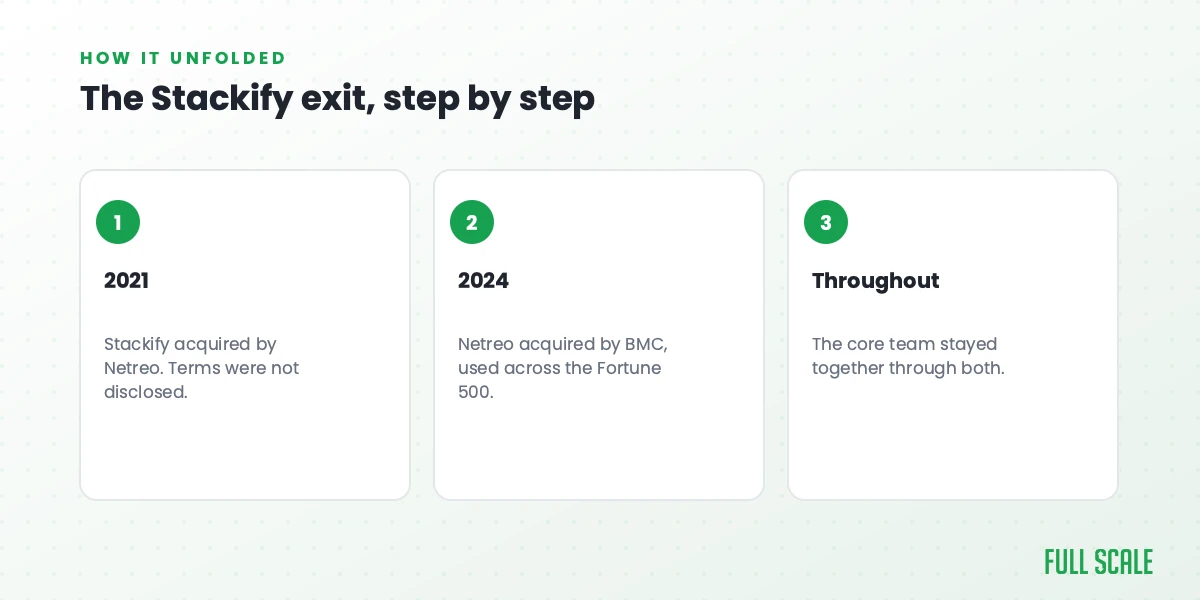
April 20, 2021: Stackify Acquired by Netreo
The Netreo deal closed on April 20, 2021. Terms were not disclosed publicly, and they still aren’t. What was announced is that Stackify, a developer-focused APM company I had built in Kansas City, was now part of Netreo, an IT infrastructure monitoring company headquartered in California. I took the role of Chief Technology Officer at Netreo, where my job was to integrate Stackify’s core capabilities into Netreo’s platform and continue building the developer-facing product line.
The strategic logic was clean. Stackify’s APM solution helped developers troubleshoot application performance. Netreo’s platform helped operations teams monitor IT infrastructure. Combined, the two products covered the full stack from code to network, which is what every observability customer eventually wants.
The deal was announced jointly by both companies. Jasmin Young, then CEO of Netreo, said in the press release: “We are delighted to welcome the Stackify team and community to the Netreo family.” I went on the Startup Hustle Podcast the same week to talk through what the acquisition meant for both products and what was coming next.
What Stackify Actually Was
I founded Stackify in 2012, a couple of years after VinSolutions (the company I had co-founded as CTO in 2003) was acquired by AutoTrader.com for $150 million. I had spent eight years inside a high-growth SaaS company watching engineers struggle with the same set of problems over and over again. Monitoring took too many tools. Developers had no quick access to the data they needed to fix issues. The good APM tools were too expensive for most teams to actually use.
Stackify was my attempt to fix that. The product gave developers a single place to see logs, errors, and application performance metrics, with pricing that small and mid-sized engineering teams could afford. Over nine years we built it into a real platform, hired developers across the US and the Philippines, and made the Inc. 5000 list of fastest-growing private companies. Stackify came in at number 379 on the Inc. 500 in 2019.
We were a known name in the APM space. We were never one of the giants.
Why I Was Ready for the Startup Exit
People assume founders take a startup exit because they get a number they can’t refuse. Sometimes that’s true. With Stackify, it wasn’t the main reason.
The honest version is one I’ve written about since: I sold Stackify because I was ready to do something different, and the business was challenging. Competing with heavily capitalized companies like New Relic, Datadog, AppDynamics, Elastic, and Microsoft Application Insights was brutal. Those companies had raised hundreds of millions of dollars. We had not. Every quarter we were competing for the same buyers with a smaller marketing budget, a smaller sales team, and a smaller product surface area. Capital paths get set early, which is why so many founders start with a startup accelerator before they ever face a fight like that.
The other piece was personal. By 2021, I had been running Stackify for nine years. I had already started Full Scale on the side in 2018 to handle the offshore engineering team I had built for Stackify in the Philippines, and that business was growing fast. I wanted to put my time into Full Scale and let Stackify find a home where it could get the investment it needed to actually compete with the giants.
Netreo was the right fit because the products were complementary. Selling to another APM vendor would have meant Stackify getting absorbed and killed off. Selling to an infrastructure monitoring company meant the product had a real future as the developer-facing layer of a bigger platform.
April 15, 2024: Netreo Acquired by BMC
Three years later, BMC Software announced it was acquiring Netreo. The agreement was signed on April 15, 2024, and the deal closed on May 1, 2024. Financial terms again were not disclosed. Netreo’s previous owner, Saratoga Investment Corp, sold its position as part of the transaction.
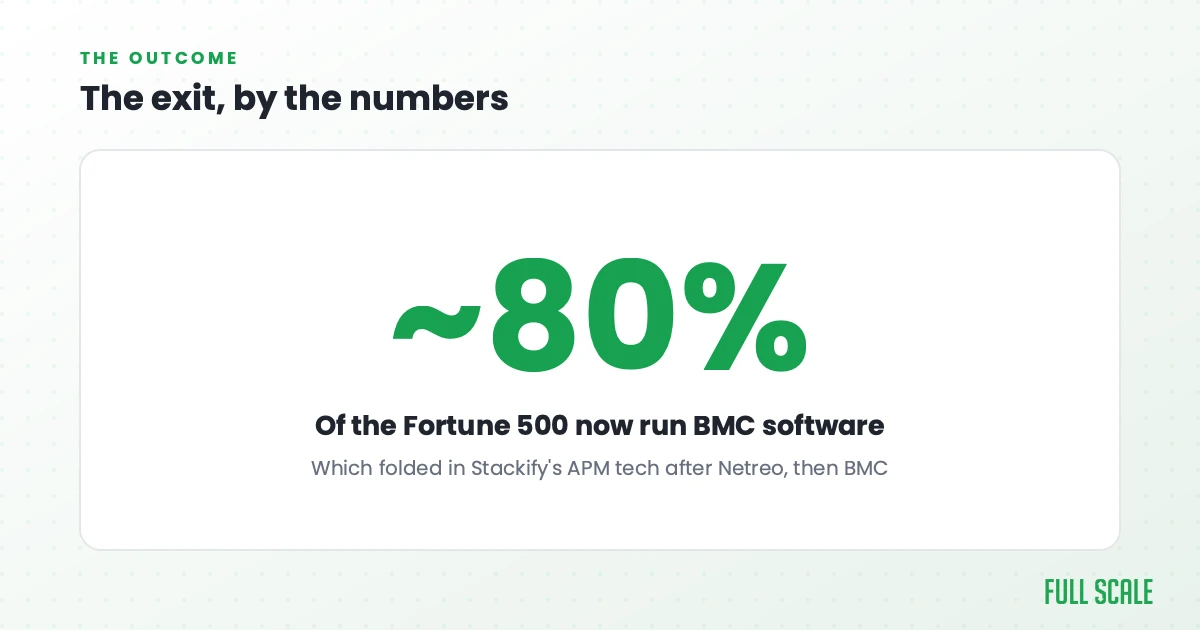
BMC’s stated rationale was that Netreo’s network performance monitoring and APM capabilities would slot into BMC Helix Observability and AIOps and accelerate their OpenTelemetry-based observability roadmap. In plain language: Stackify’s APM technology, which I had built starting in 2012, was now going to live inside one of the largest IT software vendors in the world. BMC ships software that runs in something like 80% of the Fortune 500. The reach Stackify never had on its own was suddenly available.
I wrote a short post on LinkedIn that day. It said:
“I sold my company today! Today, it was announced that BMC Software has acquired Netreo, which previously acquired my company, Stackify. How does it feel? Stackify is an application monitoring solution for developers. It is a really cool product, but we never had the funding to go big and compete with the likes of New Relic, Datadog, etc. I am excited to see what BMC does with it. Hopefully, they will make big investments in it and make it an industry-leading solution! Everyone wants to see their baby grow up and do big things. Go, baby, go!”
That is honestly how I felt then and how I feel now. The “baby” metaphor is the right one. You build a company for years, you sell it, you let it go, and then years later you watch someone bigger pick it up and give it the resources you never had. That’s not a loss. That’s the whole point.
The Team That Stayed Together Through Both Acquisitions
The part of this story I’m proudest of has nothing to do with valuations or press releases. It’s the team in the Philippines.
In 2018, I opened a small office in the Philippines with a friend so I could build a development team for Stackify. We grew that team to more than 20 developers. They were a big part of Stackify’s product velocity and a big part of why the acquisition went smoothly. We set them up as employees of their own company, not as loose contractors, with a clean staffing contract between that entity and Stackify. That structure is the outstaffing model we now use across Full Scale, and it was the entire point of starting Full Scale in the first place.
When Stackify sold to Netreo in 2021, that Philippines team transferred to the new owner without renegotiation. The deal closed, and the team kept working. When Netreo got acquired by BMC three years later, the same thing happened. Same outcome. The team stayed.
If you’re a founder thinking about an exit, this is the part nobody warns you about. The mechanical pieces of an acquisition (the lawyers, the diligence, the announcement) are the easy parts. The hard part is whether the team you built can actually transfer cleanly to a new parent. If you set up your engineering team correctly from the start, the answer is yes. If you didn’t, the deal will either drag for months or fall apart in diligence. The outstaffing services model we now run at Full Scale is what made the difference for me on both Stackify deals.
We’ve turned that lesson into the model we use at Full Scale for every client we work with.
What I’d Tell Another Founder Eyeing a Startup Exit
A few things about the startup exit that didn’t fit anywhere else, in the order I think they matter:
- Selling is not the end of your relationship with the product. Three years after I sold Stackify, I was still emotionally invested enough to write a five-word LinkedIn post when it changed hands again. I genuinely thought I’d be over it by then, and I wasn’t. That part surprised me more than the deal itself did.
- Choose the buyer for the product, not for the check. Selling to a competitor would have killed Stackify. Selling to Netreo gave it three more years of life and set it up for a bigger home at BMC. The number on the wire was less important than what happened to the company afterward.
- Engineering structure decides whether you can sell. If your engineering team is a tangle of contractors, undocumented IP, and informal arrangements, you can’t get to close. That’s exactly why the way we build offshore teams at Full Scale matters so much for the founders we work with.
- Two exits feel different. When VinSolutions sold in 2011, I was 29 and ready to take the money. When Stackify sold in 2021, I was 41 and ready to put my full attention on the next company. Same outcome, very different headspace. Where you are in your life matters as much as where the company is.
- Write down what you learned. I’ve written about Stackify and the acquisitions across my newsletter, on LinkedIn, in the Full Scale blog, and in Product Driven, the book I published in 2025 about engineering leadership. Each version of the story makes me notice something I missed the last time. The value is in the reflection, not in whether anyone reads it.
The Short Version
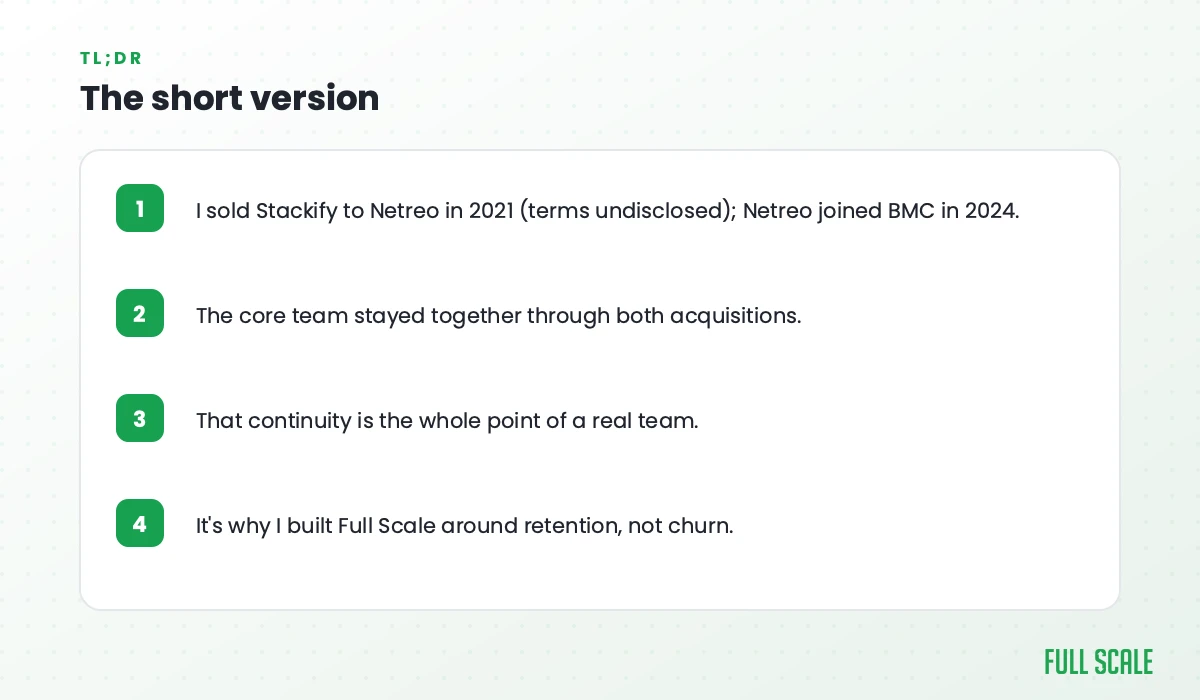
I founded Stackify in 2012 and sold it to Netreo on April 20, 2021, then served as Netreo’s CTO through the integration. Netreo itself got acquired by BMC three years later, announced on April 15, 2024 and closed on May 1, 2024. The same product has now lived under three parent companies, and the Philippines engineering team has been there for the whole twelve-year arc.
If you want the longer story of why building engineering teams the right way is what makes a startup exit like this possible, that’s what we do for our clients at Full Scale today, and it’s what Product Driven is about in book form.
Go, baby, go.