
Read Before You Hire .NET Developers in India


In this article
- The five reasons to slow down (and none of them are about .NET)
- They accept the offer, then they back out
- So why does everyone push “hire .NET developers in India”?
- The fix is not a better vendor. It’s a different model.
- Where I’d hire .NET developers instead
- India vs the Philippines for .NET hiring, side by side
- If you’re set on hiring .NET developers in India
- What AI changes about this
- Frequently asked questions
- Hire .NET developers who think about your product
Search for “.NET developers in India” and you get a wall of nearly identical offers, all promising Microsoft-certified engineers, dedicated teams, a rate too good to pass up, and a 14-day risk-free trial. Every page sells the same story, and the story is mostly true. India does have a deep pool of C# and ASP.NET talent. The rate really is a fraction of what you’d pay onshore.
So I’m not going to tell you that you can’t find good .NET developers in India. You can.
What none of those pages will tell you is the part that actually decides whether the engagement works. The risk in hiring .NET developers in India has almost nothing to do with .NET. It’s structural, it sits underneath every stack, and you only see it after the contract is signed. It starts with being honest about what you are hiring for, which is why writing a sharp .NET developer job description matters more than the rate.
I’ve spent two decades hiring developers offshore. I founded Stackify), a developer-tools company built on .NET, and I run Full Scale, which staffs .NET teams in the Philippines for companies like AMC Theatres and SOTA Cloud. I’ve hired in India, and I’ve watched plenty of other people try. Here’s what I’d want to know before doing it again.
The five reasons to slow down (and none of them are about .NET)
I dug into why outsourcing to India fails so often and kept landing on the same five structural problems. They’re not about talent, and they’re definitely not about which language the talent writes.
- A thin layer of job-ready talent. India graduates over a million engineers a year, but only a small slice are ready to ship production code. The pool is huge; the filter is brutal.
- The best engineers are already taken. The strongest people are on payroll at the in-house India offices Microsoft, Google, and Goldman Sachs run, or at funded startups paying above the local market. A staffing vendor recruits from who’s left.
- The market churns underneath you. Long notice periods, counteroffers, and offers that fall through after you’ve planned around a start date.
- The hand-off vendor model hides problems. Account managers sit between you and the engineers, so you find out about trouble late, when it’s expensive.
- Indirect communication delays bad news. A polite “yes” in a status meeting often means “I heard you,” not “it’s done.” The 2025 EF English Proficiency Index ranks India 74th, in the low-proficiency band.
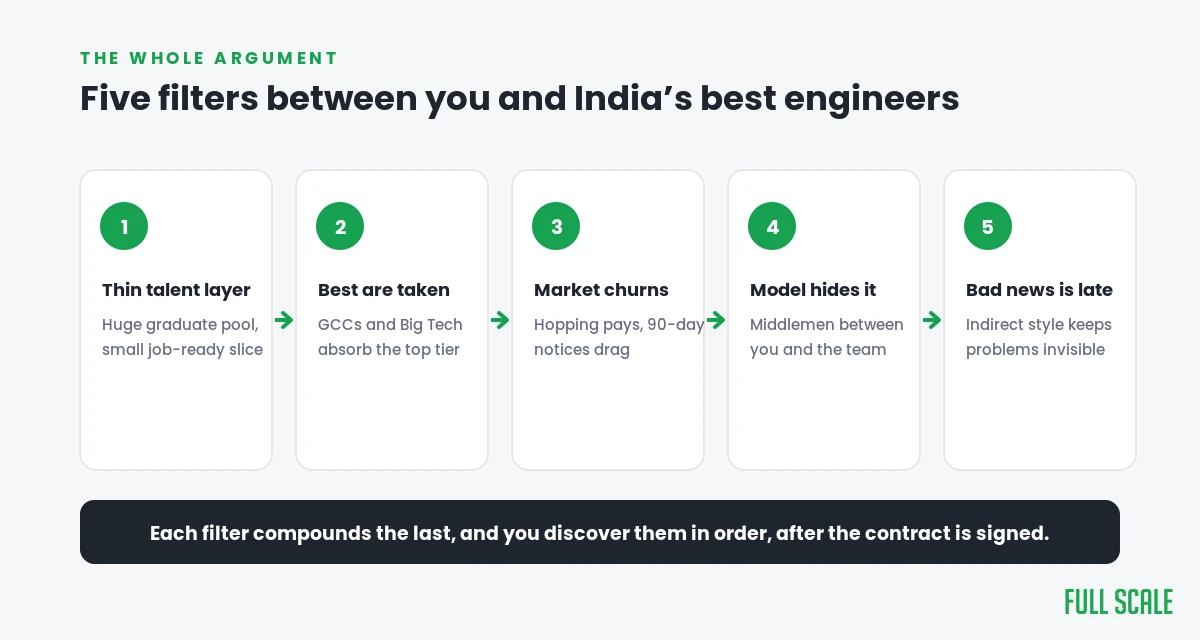
I made the full, evidence-backed case for all five in a separate piece. If you want the data, the sources, and the honest “here’s when India actually works” caveat, read why outsourcing software development to India fails. This post is the short version, aimed at one decision: should your next .NET hire come from India?
These five filters apply to your .NET hire the same way they’d apply to a Java, Python, or React hire. That’s the point. Nobody is going to hand you a worse .NET developer because the work is .NET. They’re going to hand you the same model that buries the things you needed to know. If you’re not tied to one stack, the general guide is here: read before you hire developers in India.
They accept the offer, then they back out
The one that stings most when you’re actually hiring in India is the offer back-outs, and it’s worth slowing down on. You source a strong .NET engineer, run the interviews, make the offer, and they accept. Great. Except the notice period in India often runs 60 to 90 days, and that’s 60 to 90 days for their current employer to counteroffer and for the three other companies that were also mid-process to come back with a number. The person you planned a whole sprint around quietly takes one of those instead. You don’t usually get a “no.” You get a start date that comes and goes, a few unanswered messages, and a hole in your roadmap.
This isn’t just my bad luck. A veteran Indian recruiting executive estimated in Business Today that only one in every two or three accepted offers in Indian IT turns into a person who actually starts, and put the cost to the industry at $5 to 6 billion a year. The long notice period is the engine: when switching jobs pays a 20 to 50% raise against the 9% you’d get for staying, the smart move for the candidate is to keep shopping the offer right up to the start date.
Make an offer that evaporates two or three times and you stop wanting to hire there at all.
That’s not a hypothetical. It’s roughly how I stopped trying to grow a team in India. The individual engineers were never the problem. I lost trust in the process itself, in whether the person who said yes would actually show up.
So why does everyone push “hire .NET developers in India”?
Two reasons, and they’re both about price.
India has a real .NET workforce, so the supply is there. The Azure and Microsoft certifications the vendor pages lead with are real too, and they aren’t the problem. A certification tells you someone knows .NET. It tells you nothing about whether they’ll still be on your team in six months, or whether anyone will warn you when the project starts sliding. And the headline rate is hard to argue with on a spreadsheet. The problem is that the rate is the easy number to see and the structural cost is the one you pay later, in rework, in churn, in the sprint where you learn the thing that was “almost done” three weeks ago was never started.
I call hiring on rate alone cheapshoring, and it’s the most expensive way to save money in software. The cheapest developer who needs to be replaced in four months was never cheap.
The fix is not a better vendor. It’s a different model.
If you take one thing from this, take this: the model you hire under matters more than the country you hire in.
The model that fails is the one those search results are selling: a project handed to a vendor, run behind an account manager, billed by a team you never meet. The model that works is staff augmentation. You hire named engineers who work directly for you. They join your standups, your Slack, your code reviews, and they report to your leads. Someone else handles their payroll and benefits, and that’s the only wall between you and the work.
Run it that way and three of the five filters basically dissolve. Vetting stops being a leap of faith, because you’re the one running the interview instead of a vendor with a seat to fill. Nobody sits between you and the engineer to soften the weekly status. And the problem that would have hidden behind a polite “yes” surfaces while it’s still small, because you’re watching the same board they are. The two this can’t fix, the churn and the capability centers paying more than you will, are about the market itself. That’s the real reason the country you pick still counts. I wrote the longer version of this argument for .NET specifically in why most companies outsource .NET development the wrong way.
Any shop can find someone who writes C#. The real question is whether that person thinks about the product they’re building, or just closes the ticket they were handed. That’s the difference between a software engineer and a software developer, and it’s the thing you actually want on a .NET system you plan to keep for ten years. And before you optimize for rate, see why the cheap coder is the wrong hire now that AI writes the rote code.
Where I’d hire .NET developers instead
I’d hire them in the Philippines, and I do.
Cost is barely a factor here. The Philippines and India sit in the same neighborhood on rate, so the decision comes down to everything the five filters measure. Communication is the big one: the Philippines ranks 28th on that same English Proficiency Index, in the high-proficiency band. Filipino engineers communicate in a way that reads warm and American-familiar, so a US team picks up on the hesitation behind a soft “yes” quickly. The same hesitation from an Indian engineer can stay buried under formal, indirect phrasing until it’s expensive. Retention is the other. We hold 93%+ retention, which means the engineer who learned your codebase is still on it next year.
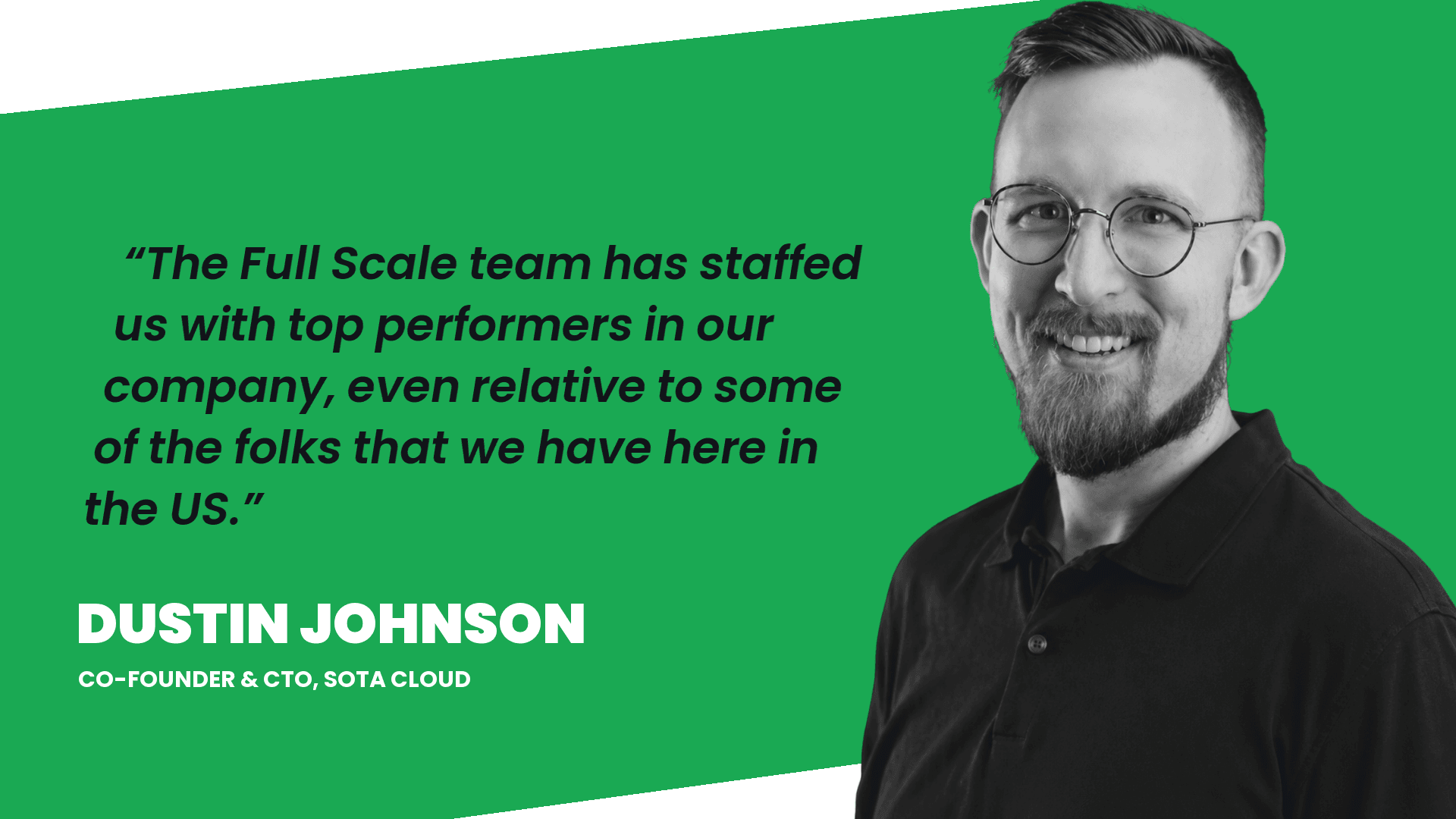
The Microsoft stack has had a home in the Philippines for a long time, and we’ve staffed serious .NET work on the strength of it. SOTA Cloud runs FDA-cleared dental imaging software on C#/.NET, Angular, and Azure across 1,000+ dental locations. Here’s their co-founder and CTO, Dustin Johnson:
AMC Theatres runs the world’s largest movie-theatre ticketing platform on .NET, with Full Scale engineers in the Philippines working as full members of their team, not a contracted block on the other side of a vendor wall. AMC CIO Derrick Leggett puts it plainly: “It’s a fully integrated team. It’s just some of the people happen to be living in the Philippines.” Neither of those worked because the code was cheap. They worked because the model and the place let good engineers do their best work.
If you want to see how we staff it, start with hiring dedicated .NET developers.
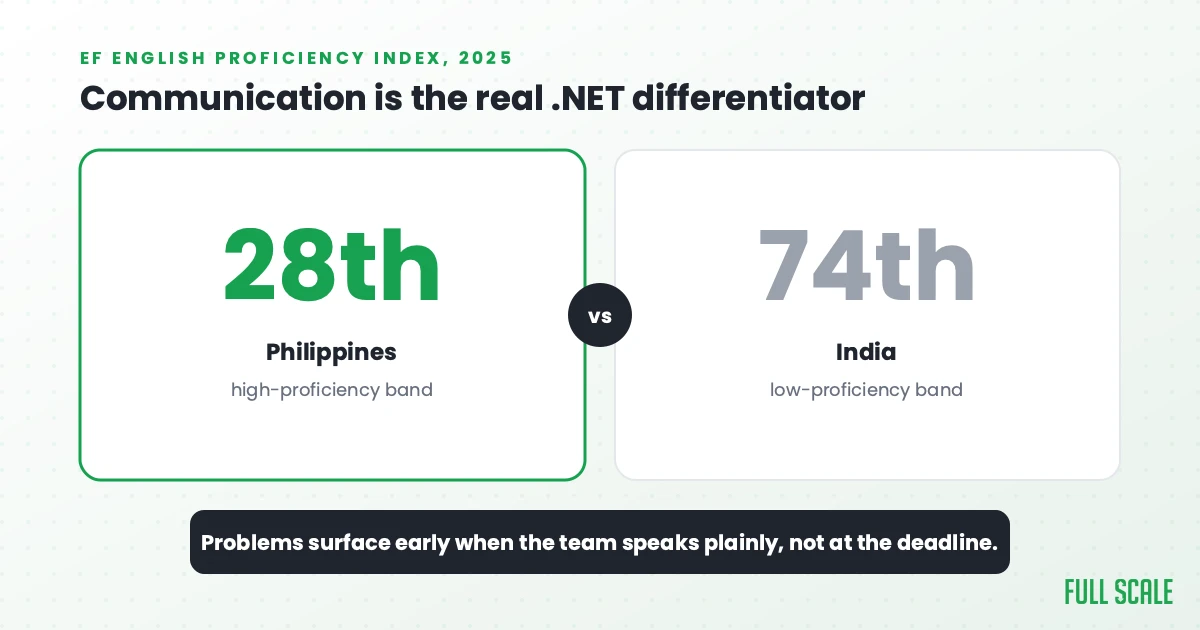
India vs the Philippines for .NET hiring, side by side
Cost is roughly a wash, so the decision comes down to the things the five filters measure. Here’s the honest comparison. I’ve hired in both, so this isn’t a sales chart.
| What you’re weighing | India | Philippines |
|---|---|---|
| Hourly rate | Low, hard to beat on a spreadsheet | About the same as India |
| .NET / Microsoft talent | Real and deep, but the market skews Java, JavaScript, and PHP | A long-standing home for the Microsoft stack |
| English proficiency (EF EPI 2025) | 74th, low-proficiency band | 28th, high-proficiency band |
| Communication style | Formal and indirect to American ears | Warm and American-familiar |
| Offer reliability and retention | 60-to-90-day notice fuels offer-shopping and back-outs | Far less offer churn; 93%+ retention on our teams |
| Best fit | 50-plus engineers fast, 24/7 ops, or building for India | An integrated, long-lived product team |
That last row is the decision in one line. India is the better call when you need raw scale or a vendor to own compliance. The Philippines is the better call when you want a small team of engineers who stay, learn your product, and tell you the truth early.
If you’re set on hiring .NET developers in India
Sometimes India is genuinely the right call: you need a big team fast, you’re building for the Indian market, or you want a vendor to own enterprise compliance. If that’s you, de-risk it with the same model, not a better brochure.
Interview the actual engineers, not a sales rep. Insist on direct access into your standups, your Slack, and your code reviews, and refuse the account-manager hand-off that hides the things you need to see. Keep the team small enough that you’d know within two weeks if someone wasn’t working out. The country can absolutely work. The hand-off model is the part that doesn’t.
What AI changes about this
AI is making the code-writing part of the job faster and cheaper, which cuts against the body-shop pitch, not for it. I tell clients half-jokingly that we’re all basically paying developers to babysit AI now, to review what it generates and steer it toward something useful. If that’s the job, paying for a vendor’s hand-off layer makes even less sense, and paying for an engineer who understands your product makes even more. The Product Driven approach we train on is built around exactly that kind of ownership.
Frequently asked questions
How much does it cost to hire .NET developers in India?
On paper, India is one of the cheapest places in the world to hire a .NET developer, usually a fraction of the US rate. The catch is that the Philippines sits in the same range, so cost isn’t what separates them. The number that actually matters is total cost, not the hourly rate. A cheap developer who backs out before day one, churns in six months, or hides a problem behind a vendor costs far more than the rate ever saved. Weigh the model and the market, not just the sticker price.
Can you hire good .NET developers in India?
Yes. India has a large, real pool of C#, ASP.NET, and Azure talent, and you can absolutely find strong engineers in it. The talent is rarely where engagements go wrong. The risk lives in the hand-off vendor model and the market churn that most India engagements run on. Hire under a staff-augmentation model, the same direct-integration approach behind offshore ASP.NET development in the Philippines, and you remove most of that risk.
Is the Philippines better than India for hiring .NET developers?
For most of our clients, yes, and rate has little to do with it, since the two are similar on cost. The Philippines wins on communication (28th vs. 74th on the English Proficiency Index), on cultural fit with US teams, and on retention. For long-lived .NET systems, continuity and clear communication are worth more than a slightly lower hourly number.
How fast can a .NET developer start?
With Full Scale it can be as little as 7 days, depending on bench availability, though full onboarding into your codebase usually runs closer to two weeks. We work on a two-week money-back guarantee: if it isn’t working out in the first two weeks, you get your money back.
Hire .NET developers who think about your product
If you’re weighing .NET developers in India, weigh the model before the map. The country matters, but the model matters more, and the combination we’d put our name on is staff augmentation in the Philippines. Talk to us about building your .NET team.