
Read Before You Hire Developers in India

In this article
- Five problems the sales pitch leaves out
- The problem that bites hardest: the offer that never shows up
- Which “hire developers in India” decision are you actually making?
- The fix is the model, not a better vendor
- Where I’d hire instead
- What AI changes about the decision
- Frequently asked questions
- Hire developers who own the outcome
Type “hire developers in India” into Google and you get a page of near-identical sales pitches: $9 an hour, save 70%, your team live in 24 hours. The pitch isn’t wrong about the basics. India has an enormous developer workforce, and the rates really are a fraction of US cost. That part is true.
So this isn’t an article about whether India has talent. It has more than almost anywhere on earth.
What decides whether hiring developers in India works has very little to do with the developers themselves. It’s the machinery around the hire: how they’re sourced, how they’re managed, how a problem reaches you. That machinery stays invisible while you’re comparing rates and only shows itself once people are actually working.
I’ve spent two decades hiring engineers offshore. I founded Stackify), a developer-tools company built on .NET, and I run Full Scale, which builds engineering teams in the Philippines. I tried to grow a team in India along the way, and I’ve sat with plenty of founders who did the same. Here’s what I wish every one of them had known going in.
Quick Answer: Hiring developers in India works when you need a large team fast or want a vendor to own compliance at scale, but the real risk isn't the talent, which is genuinely strong, it's the machinery around the hire: sourcing, management structure, and how a problem actually reaches you. Five recurring problems sit underneath the low sticker rate: most graduates aren't ready hires, the top tier is already spoken for, notice periods and counteroffers make the market move under you, layered account/delivery-manager structures filter out the truth, and offers can evaporate before a start date. For a small, long-lived product team, Full Scale usually points founders to the Philippines instead, not on price, since the two are close, but on communication, cultural fit, and retention.
Five problems the sales pitch leaves out
I went deep on why outsourcing to India goes wrong so often, and the same five structural problems kept surfacing. None of them is about whether Indian engineers are smart. They are.
- Graduates are plentiful, ready hires are not. India turns out more than a million engineering graduates a year, which is exactly why a vendor can promise you a team next week. The share who can own production work on day one is a small fraction of that headline number.
- The top tier isn’t on the market. The strongest engineers already work directly for the global companies that built their own offices in India, or for funded startups that outpay the local rate. By the time a staffing vendor sources for you, the best people are spoken for.
- The market moves under you. Two-to-three-month notice periods, aggressive counteroffers, and accepted offers that dissolve before a start date make the hiring process itself unreliable.
- The usual contract structure filters out the truth. A typical India engagement routes everything through account and delivery managers, so the signals you most need, a struggling developer or a wrong spec, reach you last if they reach you at all.
- Indirect communication hides the “no.” In much of India’s business culture a “yes” is courtesy, not commitment, and that gap stays buried until a deadline drags it into the open. India ranking near the bottom of the 2025 EF English Proficiency Index, 74th and in the low band, doesn’t help.
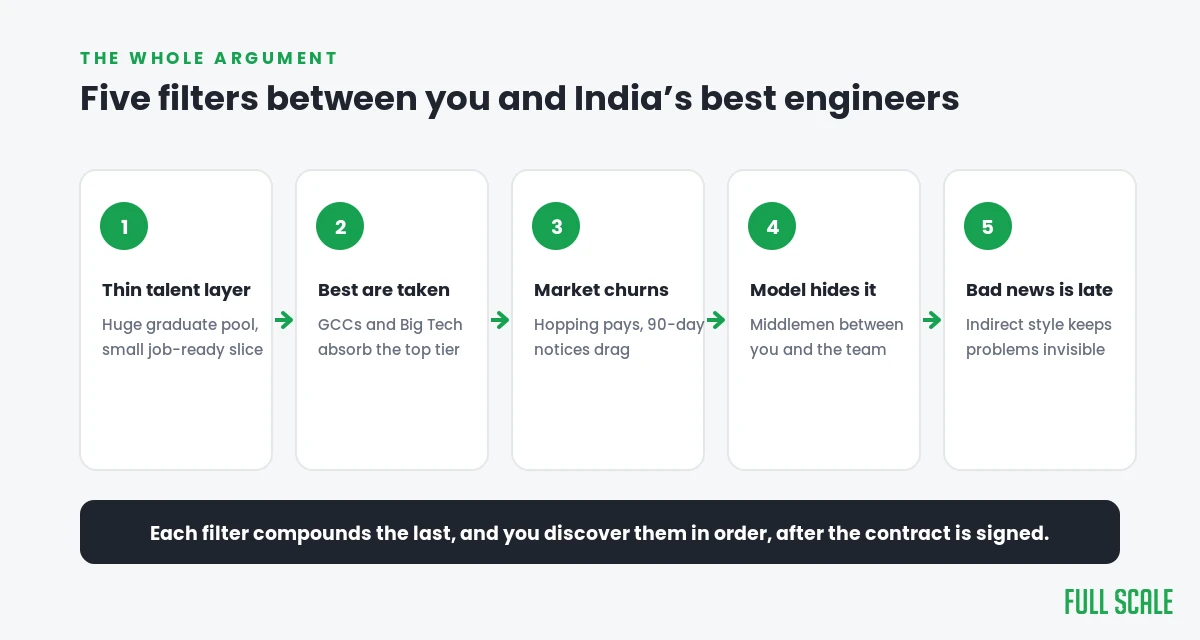
I laid out the data and sources behind all five in the full breakdown of why outsourcing to India fails. This is the shorter version, pointed at one question: how should you hire?
Hand a great engineer to a broken system and you still get a bad result.
The problem that bites hardest: the offer that never shows up
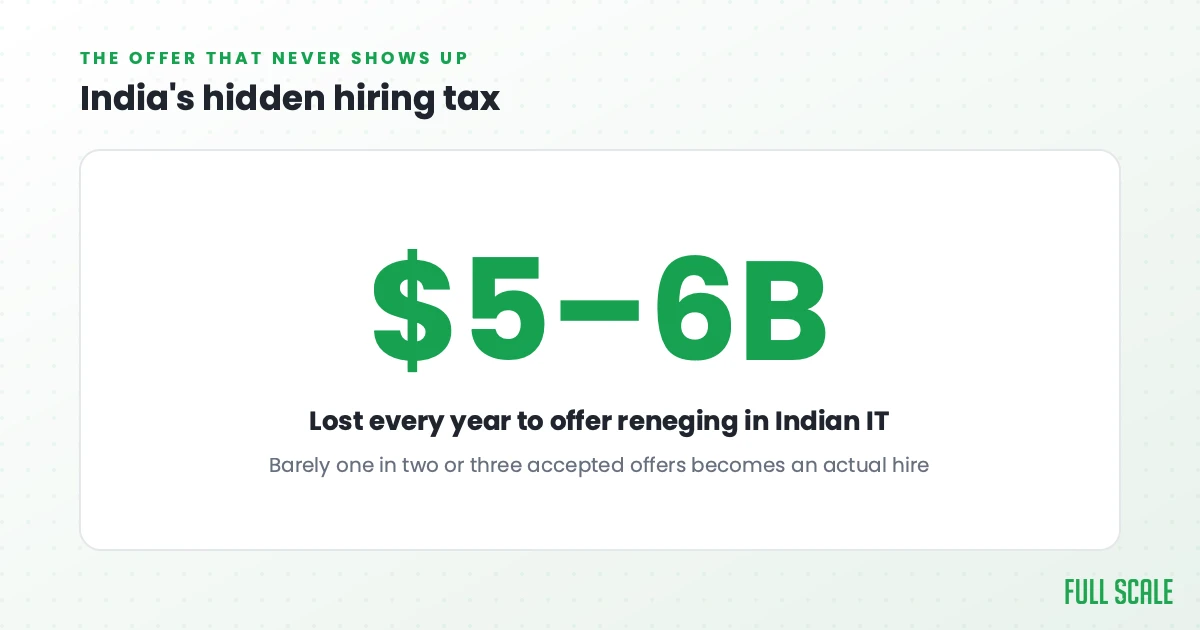
Of those five, the churn is the one that does real damage while you’re mid-hire, and it works in a way most US managers have never had to plan around. Your top candidate accepts. Then they spend the next two or three months of notice quietly weighing a counteroffer from their employer and fresh offers from everyone else who interviewed them. A meaningful share of the time, the person you were building around just doesn’t turn up.
That isn’t me being cynical. Business Today reported an industry estimate that barely one in two or three accepted offers in Indian IT ends in someone actually starting, and pinned the waste at $5 to 6 billion a year. With a job change paying a 20-to-50% jump against the single-digit raise for staying put, holding out to the last second is the smart play for the candidate, not a betrayal.
What ended my own attempts to build a team in India wasn’t the engineers. It was that an acceptance had stopped meaning anything.
Which “hire developers in India” decision are you actually making?
“Hire developers in India” is one search box hiding several very different decisions. The structural problems above apply to all of them, but the right call depends on which one you’re making.
– You need a specific stack. The talent depth and the proof points shift by technology, even when the model risk doesn’t. If it’s .NET, I wrote the stack-specific version here.
– You mostly want cheap coders. This is the most dangerous version of the search, and it earns its own warning: the kind of “coder” you’re picturing is the exact role AI just made obsolete.
– You need a large team fast, or a vendor to carry compliance. This is the one case where the traditional vendor model in India genuinely fits.
Sort out which decision you’re in before you compare any two vendors. It changes the answer more than the vendor does.
The fix is the model, not a better vendor
The lever that actually changes the outcome isn’t a higher-rated vendor. It’s how you engage. Stop buying a project and start hiring people.
With staff augmentation, the people you hire are yours: they sit in your standups, work in your repository, show up in your Slack, and take direction from your leads, while a partner carries the employment paperwork. Run it that way and the model-driven filters stop working against you. You’re the one interviewing, so a forwarded résumé can’t fool you. There’s nobody in the middle massaging the weekly update. A problem you’d otherwise discover at the deadline lands on your desk in days. What this doesn’t touch is the market: the churn and the captive offices that outbid you live in the country itself, which is why where you hire still matters.
The cheapest version of all this has a name. Choosing a partner on rate alone is cheapshoring, and it manages to collect every problem on this list at once.
Where I’d hire instead
When the goal is a small, durable team rather than raw headcount, I hire in the Philippines, and so do our clients. It costs roughly what India does, so this isn’t a price move (if you want my full personal case for hiring offshore developers in the Philippines instead, I’ve laid it out separately). It’s a communication and continuity move. Filipino teams tend to read as direct and culturally in step with US teams, so the hesitation behind a soft answer surfaces fast instead of festering. And with retention past 93%, you aren’t re-teaching your codebase to a new face every spring. We staff teams there for companies like AMC Theatres and SOTA Cloud on that basis. If you want the head-to-head, I compared India and the Philippines from having hired in both, and you can see how we staff developers in the Philippines directly.
What AI changes about the decision
AI is making the raw act of writing code cheaper every month, which quietly raises the bar for what “hire a developer” should mean at all. The work worth paying for is the judgment wrapped around the code: knowing what to build, catching what the AI got wrong, owning the result. That is the difference between a software engineer and a software developer, and it’s the Product Driven idea our engineers train on. It also means hiring for the cheapest available hands is a worse bet with every passing quarter.
Frequently asked questions
How much does it cost to hire developers in India?
The hourly number is the easy part: India is cheap, and the Philippines is close enough that rate alone won’t pick the winner. The expensive part never shows up on the rate card. It’s the offer that evaporates before a start date, the engineer gone by month four, the slipping project nobody flagged because a vendor sat in the middle. Weigh the odds of those, not the sticker rate, and India’s headline number stops looking like the bargain it advertises.
Is it a good idea to hire developers in India?
It can be, in the right situation. India is a strong choice when you need a large team quickly or want a vendor to own compliance at scale. For a small, long-lived product team, the structural churn and the hand-off model work against you, and the model you hire under matters more than the country.
Should you hire developers in India or the Philippines?
For the founders I talk to who want a team that lasts, I usually point to the Philippines, and again it isn’t a price argument since the two are close. The edge is communication, cultural fit, and people who stay. India earns the nod when you need to stand up a large team fast or want around-the-clock coverage.
Hire developers who own the outcome
If you’re weighing how to hire developers in India, weigh the model before the map. The country matters, but how you engage matters more, and the version I would put my name on is named engineers, integrated into your team, in a market built for people who stay. Talk to us about building your team.