
Outsourcing Product Development Still Requires Your Vision and Input

In this article
- What outsourcing product development actually means
- The trap: “that’s just not my thing”
- Innovation phase versus maintenance phase
- What staying involved actually looks like
- AI changed who does the building, not who owns the vision
- What you can hand off, and what you can’t
- The engagement models, and which one keeps you involved
- Onshore, nearshore, or offshore
- What it costs, and why cheapest is a trap
- The risks worth planning for
- When outsourcing is the wrong call
- How to outsource without losing control
- Frequently asked questions
- Build your product without giving up the wheel
I have a good friend who runs a tech company, and he keeps making the same mistake. He thinks that if he hires an engineering leader or brings on an outsourcing company, he can hand the whole thing off and they’ll just figure it out. He wants to step back and not be involved anymore.
I get the instinct. Running a company is exhausting, and outsourcing product development feels like the part you can finally pay someone else to own. But here is the problem with that thinking. For ongoing product work, a project contract almost always produces the wrong outcome, regardless of stack. The teams that get this right are staffed with developers who think like product owners, not order-takers waiting for a spec.
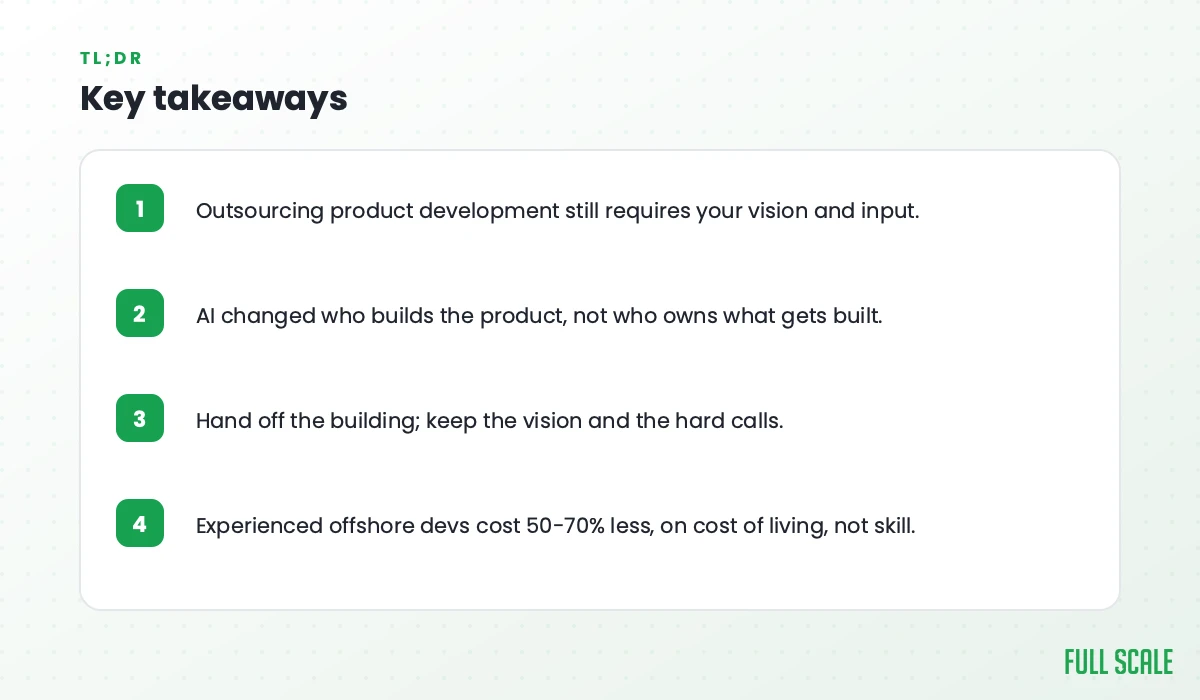
It’s your vision. You raised the money, you took on the debt, and you bet your life savings on this thing working. Nobody you hire is going to care about it the way you do, and nobody can read your mind about where the product needs to go.
You can outsource the work. You can’t outsource the vision. This gap is especially sharp in outsourced .NET developmentrge fastest.
That’s the part most articles about outsourcing product development leave out. They sell you on the talent pool and the cost savings, and all of that is real. But they skip the uncomfortable truth that the team you hire still needs you in the room.
What outsourcing product development actually means
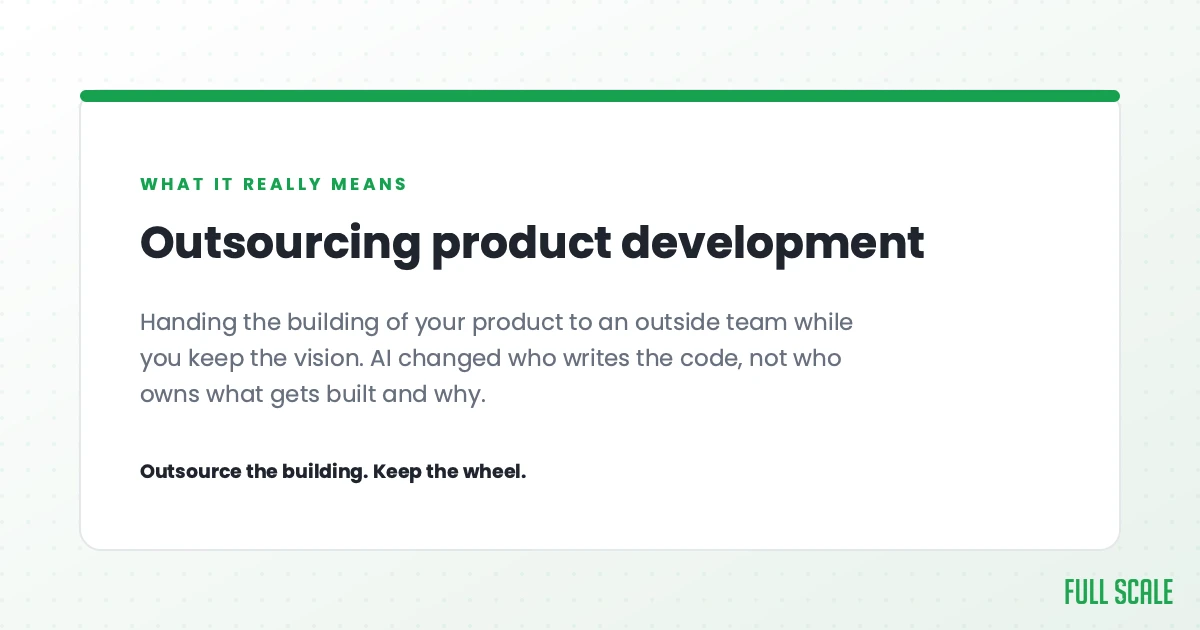
Start with what you’re actually buying. Outsourcing product development means hiring an external team to build some or all of your product instead of doing it with full-time employees in house. Software product development outsourcing can cover engineering, quality assurance (QA) and testing, user experience (UX) and user interface (UI) design, and project management, and you can run it through an offshore software development partner or a local one.
People outsource for a few honest reasons. They don’t have the in-house expertise, they want to move faster than local hiring allows, they’re trying to control cost, or they need to scale a product development team up and down without carrying the payroll and recruiting.
Those are all good reasons. None of them mean you get to disappear.
The trap: “that’s just not my thing”
The founders who get burned all say a version of the same thing. “I don’t know anything about tech. I don’t know anything about development. That’s just not my thing, so I don’t want to be involved in it.”
I understand why they say it. But that mindset is exactly where it comes back to bite them.
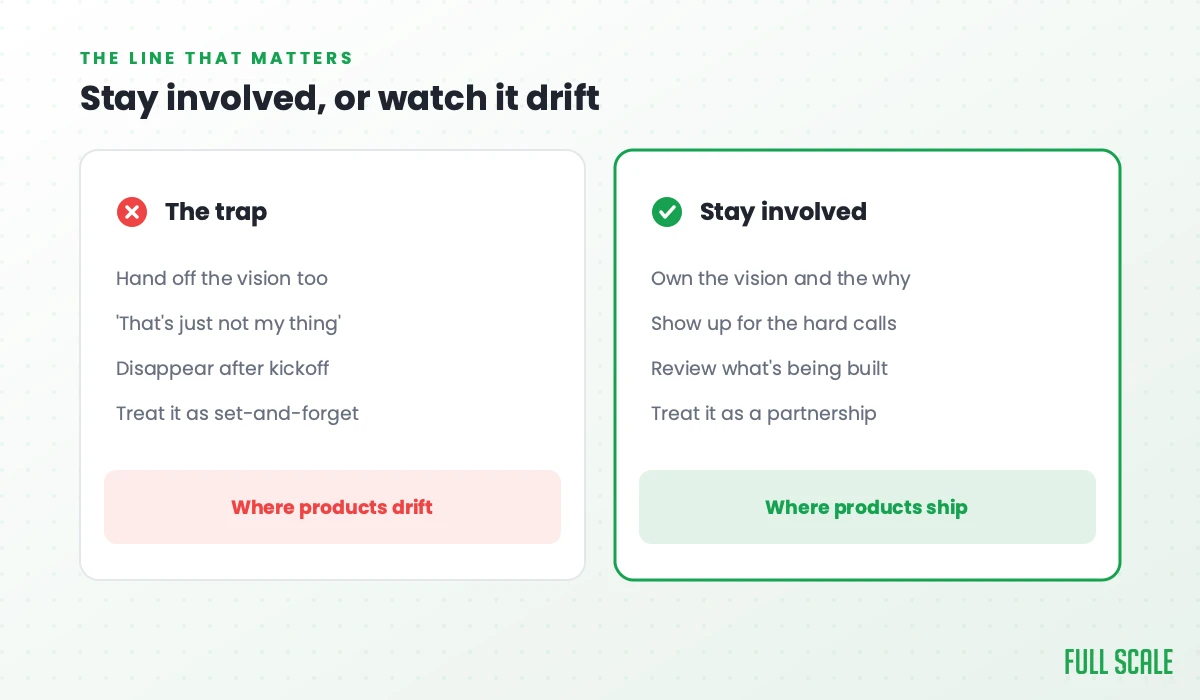
When you check out, the team is left guessing. They build what they think you want. They make a hundred small decisions a week without you, and every one of those decisions gets a little further off from what you actually had in mind. By the time you look up, you have a product that works but isn’t the product you needed.
Knowing how to write code was never the job. Knowing what the product is for and who it’s for, that part has always sat with you, and outsourcing doesn’t change it.
There’s an important caveat here for non-technical founders. Owning the vision doesn’t mean owning the architecture. If you can’t evaluate technical decisions yourself, you need someone who can on your side, a CTO, an engineering lead, or even a fractional one, who turns your vision into technical calls and holds the team to a quality bar. Think of it like building a house. You decide what the house is for and how you want to live in it, and you hire a contractor you trust to make sure it’s built right. Handing off the product with nobody technical in your corner is the version of this that actually burns people.
Innovation phase versus maintenance phase
How involved you need to be depends on where your product is.
When you’re getting a business off the ground, when you’re still figuring out what to build, outsourcing new product development demands that you stay close. This is the phase where vision matters most and where a team flying blind can waste months building the wrong thing. You cannot delegate the discovery of what your product should even be.
Once you reach a maintenance phase, it changes. The product is established, the roadmap is steadier, and the team mostly knows the playbook. You can pull back some. The decisions are smaller and the cost of getting one wrong is lower.
The mistake is treating the innovation phase like it’s already maintenance.
That’s when founders hand off too much, too early, and it’s the single most expensive error I see.
What staying involved actually looks like
Staying involved doesn’t mean micromanaging or sitting in every standup. It means showing up with the vision on a regular cadence.
In practice, that’s meeting with the team at least once a month. On an active build, every couple of weeks, even every week, is better. You use that time to help guide the roadmap, give feedback, and remind the team where you’re trying to go.
The most important thing you bring is information the team can’t get on their own: what’s working and what isn’t, what you’re hearing from customers, and what changed in the market this month. That feedback is how the team knows whether they’re winning or losing.
If you don’t know whether your team is winning or losing, neither do they.
This is the heart of what I wrote about in Product Driven. Teams don’t fail because the engineers are bad. They fail because they’re busy without being pointed at what matters. Your job as the founder is to supply the vision, keep the focus narrow, and give the kind of clarity that lets a team make good decisions when you’re not in the room. Feedback isn’t a nice-to-have. It’s the signal that keeps everyone aimed at the same target.
I learned this the hard way before Full Scale, running offshore teams across Uruguay, Colombia, Russia, and the Philippines at my last company, Stackify, which we sold in 2021, and earlier as a co-founder and CTO of VinSolutions. The teams that shipped the right thing were never the ones I handed off and forgot about.
AI changed who does the building, not who owns the vision
You can’t write about outsourcing product development in 2026 and ignore artificial intelligence (AI). AI coding tools like GitHub Copilot, Cursor, and Claude Code are now standard on any competitive offshore team, and they genuinely speed up the building. That has changed what you’re really paying for when you hire developers. You used to be buying raw code output. Now you’re paying for judgment, for architecture, and for the discipline to review what the tools produce.
That review really matters. In the 2025 Stack Overflow Developer Survey, 84% of developers said they use or plan to use AI tools, yet nearly half don’t trust the accuracy of what those tools produce. Speed without judgment is just faster mistakes.
Here’s what most people miss. When AI handles more of the building, the why becomes even more your job. The machine can write a feature fast. It has no idea whether that feature is the right one for your customers. That call was always yours, and AI just raised the stakes on getting it right.
So the trend that’s supposed to make outsourcing more hands-off actually makes your vision matter more.
What you can hand off, and what you can’t
It helps to be clear about the dividing line.
| You can hand off (the how) | You can’t hand off (the why) |
|---|---|
| Writing the code | What the product is for |
| QA and testing | Which customers you’re serving |
| UX and UI design | What problem you’re solving |
| Sprint and project management | What “good” looks like |
| Shipping and releases | When to change direction |
A good team will do everything in that left column better than you would. The right column is vision, and it stays with you no matter who builds the software. The teams that succeed at outsourcing product development are the ones where the founder still owns that right column.
The engagement models, and which one keeps you involved
Most product development outsourcing companies sell one of three models, and the differences matter.
Project-based or fixed-bid work is when you hand over a spec and get back a finished deliverable for a set price. It’s fine for a scoped, one-off job with a clean handoff. I’ve outsourced WordPress builds and small projects this way myself. It’s the wrong tool for your core product, because your product is never really “done” and the spec always changes.
A dedicated team is a group of engineers who work full-time and long-term on your product under your direction, while the vendor handles employment and HR. Staff augmentation is the same idea, often framed as filling specific roles on a team you already have.
I’ll be upfront that staff augmentation is the model we run at Full Scale, and I’m a fan of it for one reason. The developers become part of your team. You, or whoever leads engineering on your side, direct them the way you’d direct an in-house engineer. They join your standups, they hear your feedback directly, and they work inside your process instead of behind a project manager who filters everything.
The model itself keeps you involved, which is the whole point.
Project shops are built the opposite way, to take the work off your plate, and that’s exactly how founders end up disconnected from their own product. If you want the deeper comparison, we wrote up staff augmentation versus outsourcing separately.
Onshore, nearshore, or offshore
Where the team sits is its own decision. Onshore, a team in your own country, is the most expensive option, with the easiest communication and full time-zone overlap. Nearshore, a country a few time zones away, trades a little of that overlap for a lower rate. Offshore, somewhere like the Philippines, is where the real savings live, and the thing you’re managing in return is time-zone overlap and communication.
I land on offshore with enough overlap to talk in real time. You get the cost-of-living gap without giving up the daily conversation that keeps a team on track. That’s why we hire in the Philippines, where English fluency is high and teams routinely arrange their day to overlap with US working hours. If your product is Python-based, that same decision shapes how you staff it: whether you’re building a Python team offshore or hiring a project vendor, the engineers who take ownership are the ones who keep improving it.
What it costs, and why cheapest is a trap
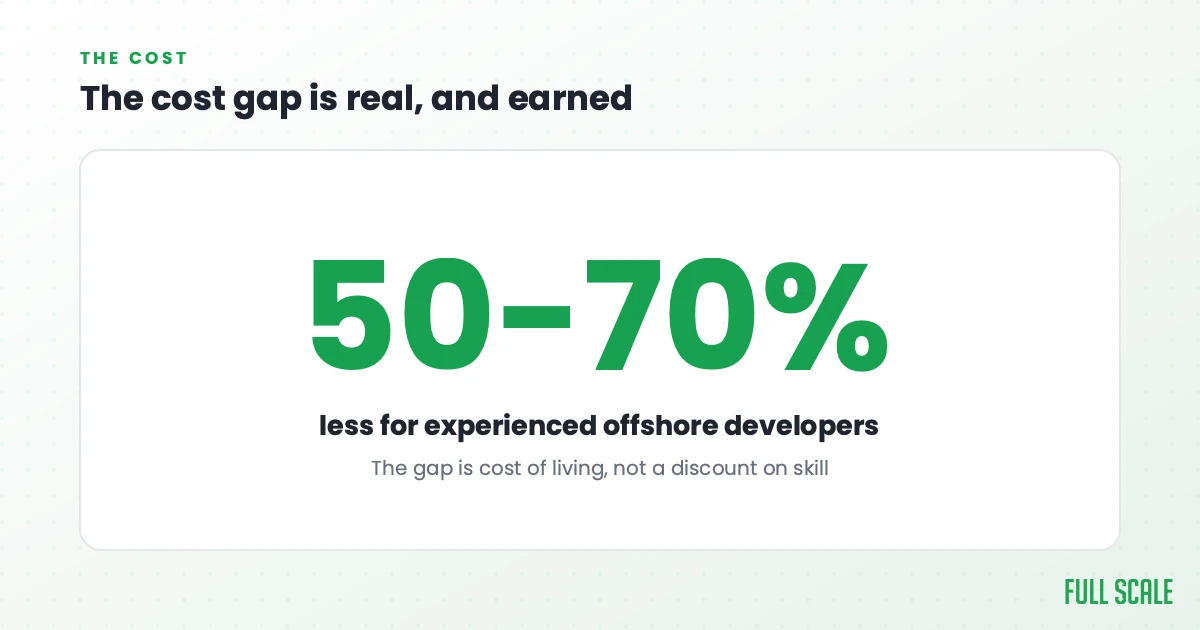
Cost is usually the reason people start looking offshore, and it’s a good one. The Bureau of Labor Statistics puts the median US software developer salary near $133,000, and a senior engineer’s base runs well above that. Once you add benefits, taxes, recruiting, and overhead, the fully loaded cost of an employee runs about 1.25 to 1.4 times base salary, which puts a senior US hire close to $200,000 a year. Experienced developers in the Philippines cost 50% to 70% less, and that gap is cost of living, not skill.
But don’t do what I call cheapshoring. Picking a team purely on the lowest hourly rate is the fastest way to end up with junior developers building something you’ll have to redo.
The cheapest option is rarely the cheapest in the end.
Judge a partner by what they actually deliver, not the number on the invoice. There’s a whole post on cheapshoring if you want the long version.
The risks worth planning for
Outsourcing product development isn’t free of downsides, and the founders who do it well plan for a few things up front.
- Intellectual property and security. Handle ownership of the code and non-disclosure terms in the contract before anyone writes a line, not after.
- Time zones. You want enough overlap with your team for real-time conversation, instead of a 24-hour lag on every question.
- Communication. This is where most offshore work actually fails, so insist on talking to the developers directly rather than through a middleman.
- Lock-in and turnover. A partner with high developer retention keeps the knowledge on your product instead of letting it walk out the door every few months.
None of these are reasons to avoid outsourcing. They’re reasons to choose the model and the partner carefully.
When outsourcing is the wrong call
Outsourcing product development isn’t always the right move, and I’d rather tell you that than sell you on it.
If your product runs on deep proprietary knowledge that lives in your own head or your core team, handing the build to an outside group rarely works until you’ve gotten that knowledge out and written down. If you’re pre-product-market-fit and changing direction every few days, the overhead of onboarding an external team can slow you down more than it speeds you up. And if you’re in a heavily regulated space with strict data or compliance rules, the right partner is out there, but the bar for vetting them is much higher and the wrong one is a real liability.
None of these are permanent. They’re usually a sign to fix something on your side first, or to wait a little longer before you bring a team on.
How to outsource without losing control
Put it together and the playbook isn’t complicated.
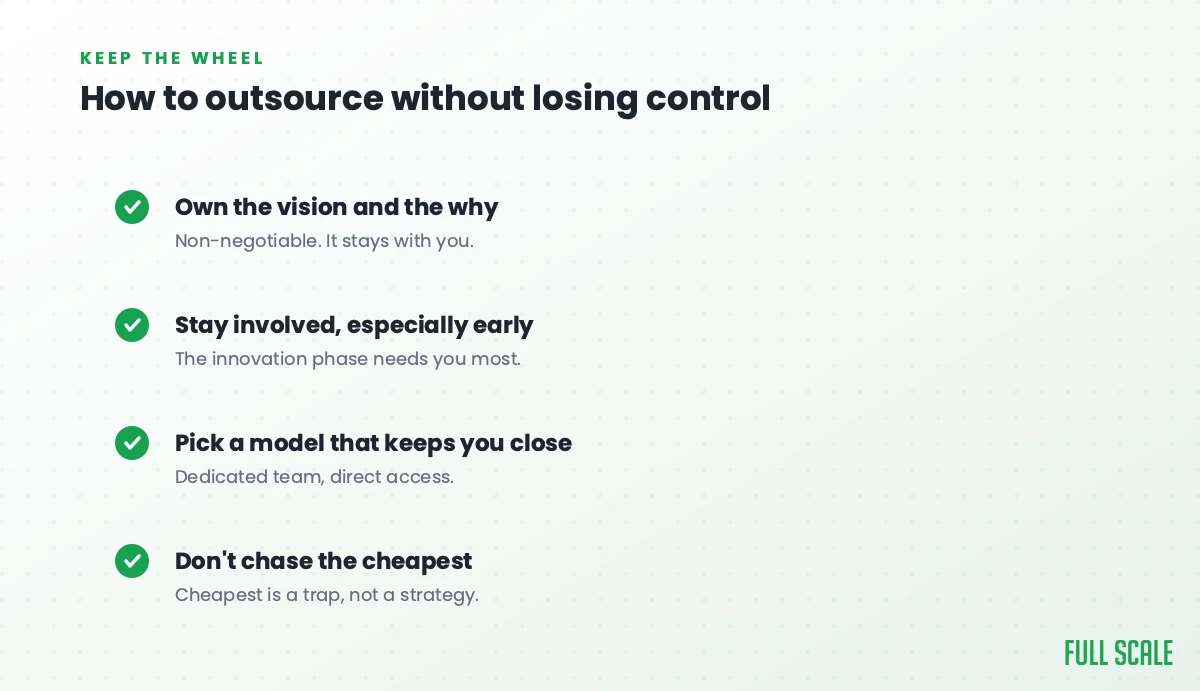
Pick a long-term team over a one-off project for anything that’s actually your product. Get the scope and your first few priorities clear enough that a new team isn’t guessing on day one. Then vet partners on the things that actually predict success: ask how they recruit, how they manage the engagement, and what their developer retention is. A good answer is specific, a hiring process they can walk you through, named people managing the work, and retention numbers they’ll stand behind. A bad answer is a low rate and a promise.
Before you commit to a long engagement, run a small paid trial. A few weeks of real work tells you more about a team than any sales call ever will. Insist on talking to the developers directly instead of through a middleman. And once the team is in place, stay in the loop with a real cadence, especially while you’re still innovating.
That’s how we built Full Scale. I’ve helped more than 200 tech companies grow by augmenting their teams with experienced software developers from the Philippines, and the model is designed so you stay in the vision seat while the team executes. If you want the broader version of this, our guide to outsourcing software development walks through it.
Frequently asked questions
What is outsourced product development?
Outsourced product development is hiring an external team or company to build part or all of your product, instead of staffing the work entirely with full-time in-house employees. It can include engineering, QA, design, and project management.
What can you outsource in product development?
You can outsource software development, quality assurance and testing, UX and UI design, and project management. What you should not outsource is product vision, the decisions about what to build, who it’s for, and what success looks like.
When should you outsource product development?
Outsourcing makes sense when you lack the in-house expertise, need to move faster than local hiring allows, want to control cost, or need to scale a product development team up and down. It works best when you stay involved in guiding the roadmap, especially while you’re still innovating.
Can you fully hand off product development to an outsourcing company?
No. You can hand off the building, but you can’t hand off the vision. The founder still needs to guide the roadmap and give the team regular feedback, particularly in the early innovation phase when getting the direction wrong is most expensive.
What are some tips for outsourcing product development?
Hire a long-term team instead of a one-off project for your core product, insist on talking to the developers directly, vet any partner on how they recruit and retain engineers, plan for IP and communication up front, and stay involved on a regular cadence.
Does AI mean I can be less involved in outsourcing product development?
No, the opposite. AI coding tools speed up the building, which means the value you add shifts toward judgment and vision. Deciding what to build and whether it’s right for your customers is more important than ever, and that’s your job, not the tool’s.
Build your product without giving up the wheel
Outsourcing product development can be one of the best moves you make, as long as you go in understanding what it is and isn’t. It’s a way to get your product built by people who are great at building. It is not a way to stop caring about the product. If your product is built on .NET, .NET development outsourcing offshore follows the same principle: keep product vision and ownership on your side, and staff engineers who work as part of your team rather than behind a project shop.
Stay in the vision seat. Show up for your team, and give them the feedback and clarity they need to win.
If you want a team that’s built to work that way, let’s talk.