
Outsource Laravel Development: How to Pick the Right Model

In this article
- Staff Augmentation or Project Outsourcing?
- When Laravel Project Outsourcing Works
- Three Ways Outsourced Laravel Projects Fail
- What to Look For in a Laravel Outsourcing Partner
- Philippines for Laravel Outsourcing
- What the Cost Comparison Looks Like
- What AI Changes About Outsourcing Laravel Work
- Frequently Asked Questions
- Ready to Build a Laravel Team That Works Like Your Own
Quick Answer: Outsourcing Laravel development usually means one of two models: project outsourcing, where a vendor delivers a fixed scope, or staff augmentation, where Laravel engineers join your team directly. For most Laravel applications that keep evolving, staff augmentation wins because engineers who own the codebase catch Eloquent-relationship and legacy-code risks a spec hand-off misses. Full Scale places senior Laravel engineers in the Philippines under this model, drawing on the country’s twenty-year PHP history.
PHP earned its “spaghetti code” reputation. A decade of shared hosting, procedural scripts with no structure, global state everywhere, business logic mixed directly into HTML templates. Teams inherited PHP codebases and spent months untangling them before they could ship anything new.
Laravel was built to fix that. Taylor Otwell designed it to give PHP developers the structure, conventions, and tooling that professional web applications require. Eloquent makes the data layer readable. Artisan makes the CLI consistent. Service providers, middleware, and the service container give the application a shape that anyone familiar with the framework recognizes immediately.
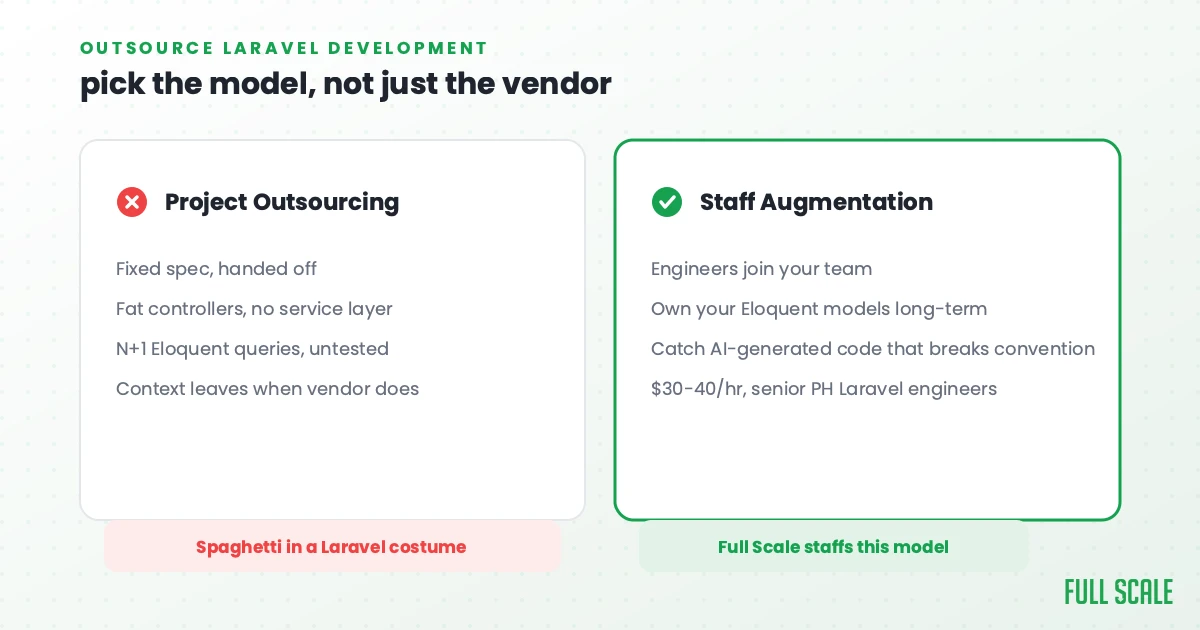
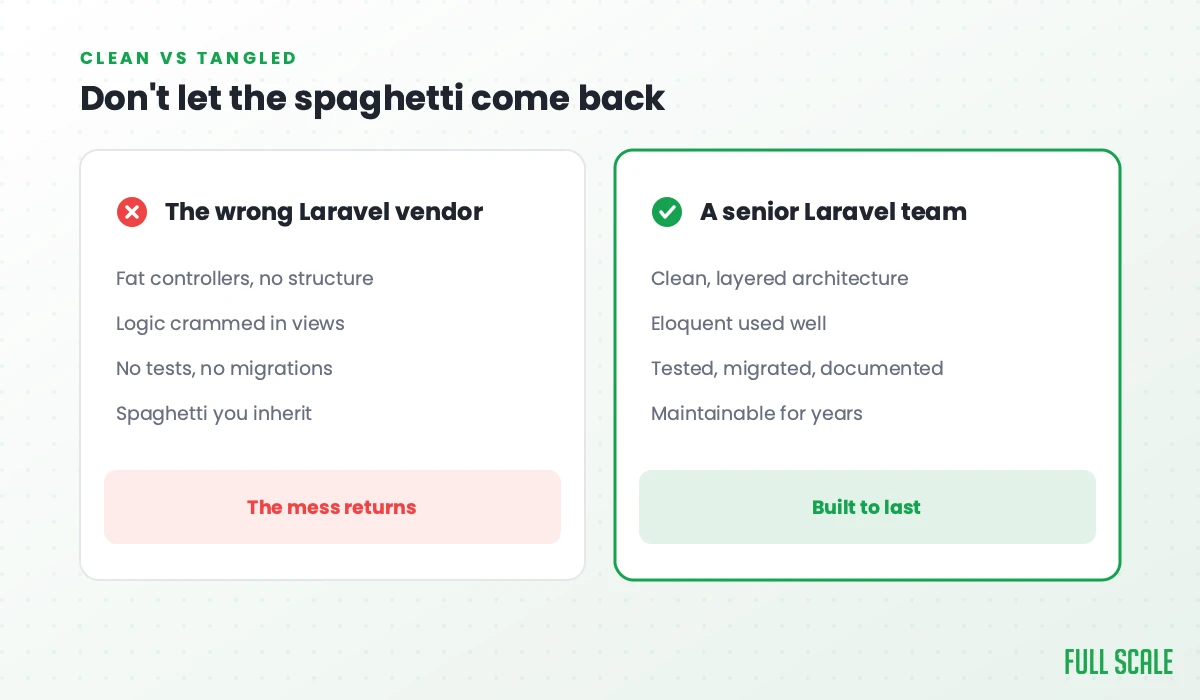
That is why the most common failure mode in outsourced Laravel development is so frustrating: you hire a vendor to build in Laravel, and you get PHP spaghetti wearing a Laravel costume. The file structure looks right. The migrations exist. The controllers have names that match Laravel’s conventions. But the logic is in the controller instead of a service class. The Eloquent queries produce N+1 problems nobody tested for. The tests cover lines to satisfy a checklist rather than catch regressions. The framework is present in name. The conventions are not present in practice.
I run Full Scale, which staffs offshore software development teams in the Philippines. I have also personally outsourced scoped projects when the scope was genuinely locked. Here is what I have learned about the difference between Laravel outsourcing that works and Laravel outsourcing that produces exactly the problem it was supposed to solve.
Staff Augmentation or Project Outsourcing?
This is the fork that determines everything before you evaluate a single vendor.
Staff augmentation means Laravel engineers join your team directly. They are in your standups, they know your Eloquent models, they understand why your service layer is structured the way it is. For any Laravel application that will keep evolving, this is the model that makes the offshore cost argument real. A team model, not a project handoff, optimizes for engineers who accumulate knowledge of your specific application.
Project outsourcing means you hand a scope to a vendor and they deliver it. For genuinely scoped Laravel work with a locked spec, this can work. A third-party API integration with complete documentation. A data migration with a fixed schema. A specific feature whose requirements will not change. I have outsourced exactly this kind of work myself (an Elasticsearch integration at Stackify, a WordPress build) and gotten good results when the scope stayed fixed.
The failure mode: signing a project contract for Laravel work that will keep evolving. The vendor delivers. The code runs. Nobody who wrote it is still on the engagement when you need to extend it. And because the wrong vendor hired from PHP’s enormous cheap end, what they delivered is structured like Laravel but does not behave like Laravel.
If you already know you want offshore Laravel engineers embedded in your team long-term, our offshore Laravel development guide covers that model: the Philippines’ twenty-year PHP history, what to evaluate in offshore Laravel engineers, and why convention knowledge is what separates strong hires from spaghetti vendors.
The honest filter: if your Laravel application will keep evolving, you need engineers who own it. Ask whether you would want the same Laravel developers in your standup in twelve months. If yes, that is staff augmentation. If the work truly ends when the deliverable ships, project outsourcing can work.
When Laravel Project Outsourcing Works
The model is not always wrong. The model is wrong when the work is not genuinely scoped. The same principle applies to outsourcing Angular development: the model works for scoped Angular work with a locked spec, and fails for enterprise applications where the service architecture and component library keep evolving. The broader PHP outsourcing decision, across every framework rather than Laravel alone, is covered in our outsource PHP development guide.
Laravel project outsourcing works when the spec is locked and the deliverable is verifiable:
- A Stripe or payment gateway integration where the API is documented and the scope does not change
- A data migration where the source schema and target schema are both fixed
- A queue worker or scheduled command for a one-time data processing task
- An API endpoint with a complete contract that other systems call but nothing needs to evolve
The pattern: finite, testable, non-evolving. When the Laravel work has a clear end state that both sides can verify, a project vendor can handle it. When the application needs to grow, a project vendor cannot.
Three Ways Outsourced Laravel Projects Fail
PHP spaghetti in Laravel clothing. PHP has a larger global developer pool than any other language. That makes the cheap end enormous. Developers who learned PHP in 2010 for shared hosting scripts and picked up Laravel syntax for a few months are part of that pool. I call this cheapshoring: hiring the cheapest developer in the world’s largest talent pool is the most predictable way to get code that uses the framework’s file structure without the framework’s discipline. Fat controllers. Anemic models. Queries that grow with every feature until the page load time becomes the application’s signature.
Spec hand-off loses Eloquent context. Laravel applications are built around Eloquent relationships, scopes, and model events that encode business logic. A vendor who receives a spec and builds to it has none of the context that explains why a model relationship is structured the way it is, or why a particular scope handles a certain edge case. The spec describes what the feature should do. It does not explain why your Order model has the relationships it has or what a “pending” status actually means to your business logic. That context lives in the engineers who built the application and disappears when the vendor moves on.
Scoping ongoing work as a deliverable. A Laravel application that will keep adding features, integrations, and new models needs engineers who understand the existing shape of the codebase. Structure a series of feature requests as project contracts and you pay a re-orientation tax every time a new vendor touches the code. Laravel’s service container and Eloquent relationships reward engineers who understand the whole application. Project contracts deliver engineers who understand only the feature they were hired to build.
What to Look For in a Laravel Outsourcing Partner
The evaluation is the same whether you are considering staff augmentation or project outsourcing, but the consequences of a wrong call are higher with project outsourcing because you inherit the output.
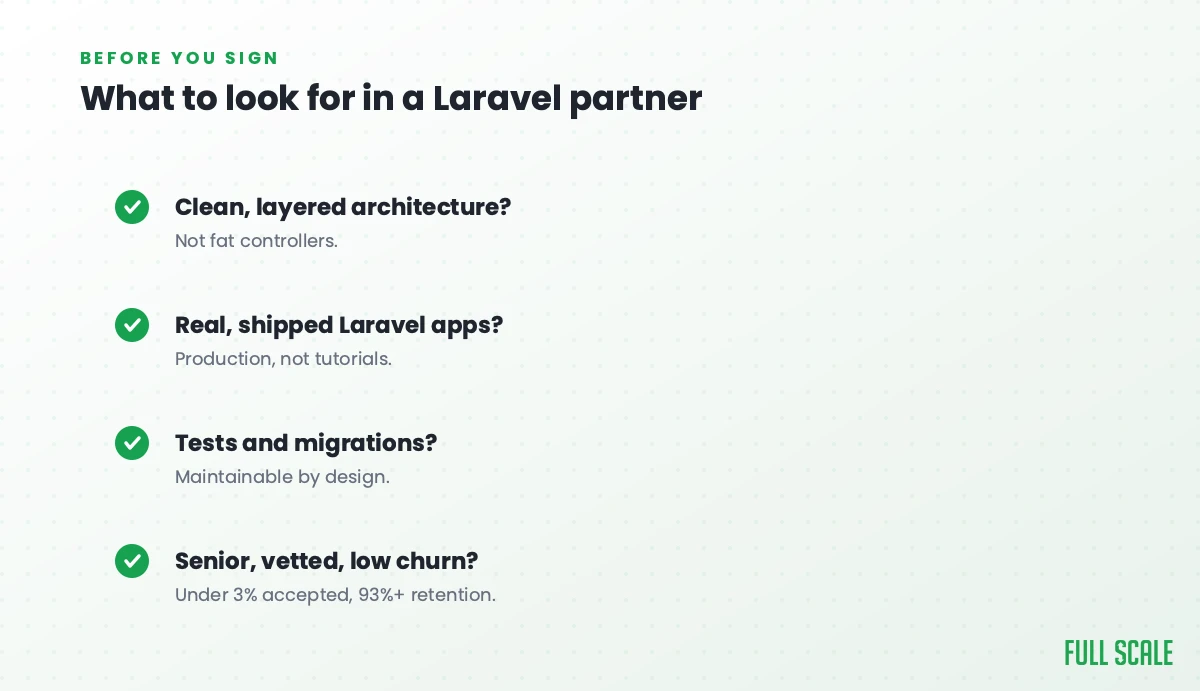
Can you talk to the developers directly? A Laravel vendor who routes all technical conversations through an account manager is signaling something. Laravel’s conventions require engineers who can explain why they made the architectural decisions they made and push back when a feature request conflicts with the existing model structure. Engineers who cannot communicate directly will not do that. They will build what they were told.
Do they know why companies still use PHP, or only the framework commands? Ask technical questions in the sales process. Ask how they handle N+1 queries in Eloquent. Ask their opinion on when to use model events versus service classes. Ask how they test complex queue jobs. Engineers who know Laravel will have opinions. Vendors who know how to win Laravel contracts will have responses. Those are different things.
Is their business model staffing or projects? A vendor whose revenue depends on scoping new work has no incentive to build maintainable code, because maintainable code means you need fewer new projects. A partner whose engineers stay on long-term client teams has every incentive to build code that lasts, because they will be the ones extending it.
Philippines for Laravel Outsourcing
The Philippines built its IT sector on PHP. Twenty years of PHP development history means the senior Laravel engineers there are not developers who adopted the framework recently because it became popular. They are developers who learned PHP when it was the dominant language and moved into Laravel as the modern standard around 2012.
The old outsourcing model of handing a Laravel spec over the wall and getting code back is increasingly replaceable by AI. Artisan’s scaffolding commands and Laravel’s code generation are exactly what AI tools produce well. If your outsourced Laravel engineer’s only job is to execute a spec you hand them, an AI tool does that job cheaper.
What you need in 2026 is a Laravel engineer who helps determine what the spec should be. Who asks whether the Eloquent relationship is modeled correctly before building on top of it. Who catches when an AI-generated service class is technically correct but architecturally wrong for the existing application. The Philippines is the third-largest English-speaking country in the world, and Filipino engineers bring the communication orientation that Laravel’s convention-heavy architecture requires.
What the Cost Comparison Looks Like
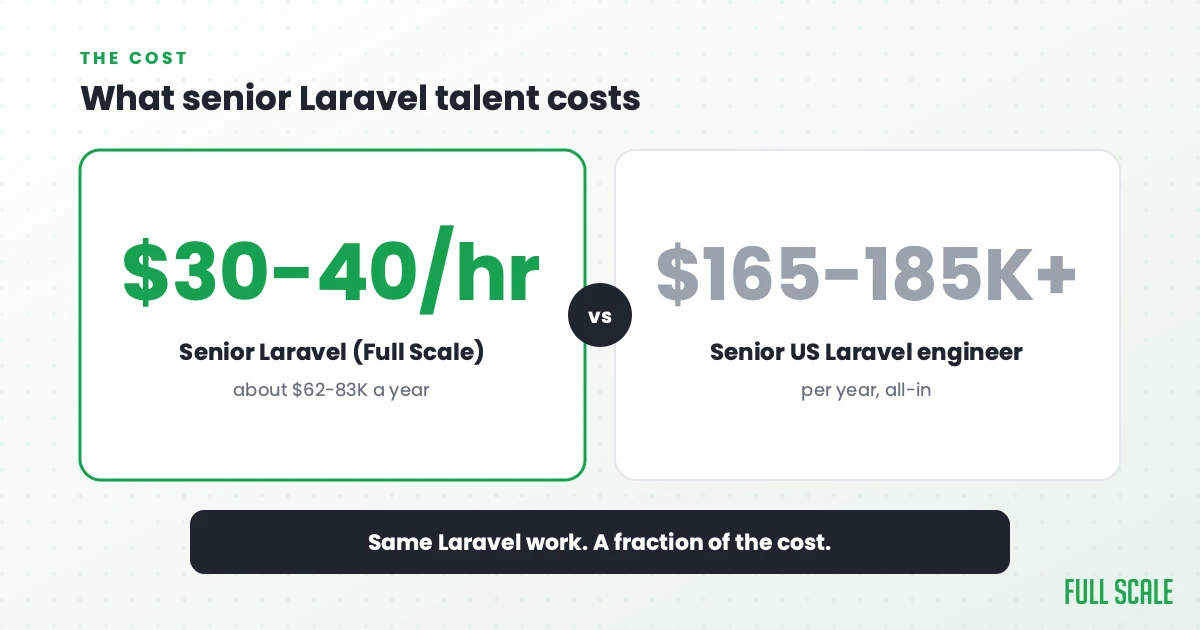
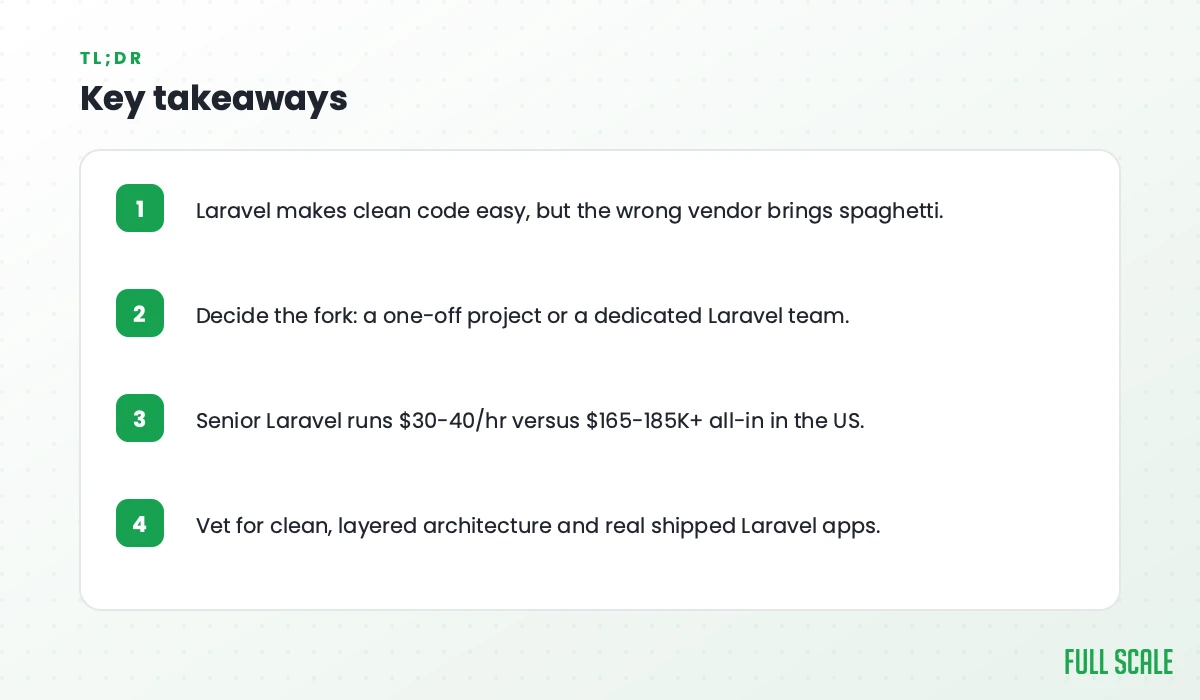
Full Scale clients pay $30 to $40 per hour for senior Laravel engineers in the Philippines. A comparable engineer in the US earns a BLS median of around $133,000 per year in base salary, with an all-in cost of $165,000 to $185,000 or more when you add benefits, payroll taxes, and overhead (what MIT research estimates at 1.25 to 1.4 times base salary).
| Full Scale (Laravel, Philippines) | US Senior Laravel Engineer | |
|---|---|---|
| Hourly / annual cost | $30-$40/hr (~$62K-$83K/yr) | $133K base → ~$165K-$185K all-in |
| Time to staff | ~14 days | 6-12 weeks |
| Recruiting fee | None | 20-25% of first-year salary |
The same caveat as always: the cost gap only materializes as a win when model selection and engineer quality are both right. With PHP’s enormous talent pool, the gap between a $20/hr Laravel developer and a $35/hr one is wider in practice than the numbers suggest.
What AI Changes About Outsourcing Laravel Work
I tell clients half-jokingly that we are all essentially paying developers to babysit AI: to review what it generates, catch what it gets wrong, and steer it toward something useful. For Laravel, this framing is especially literal.
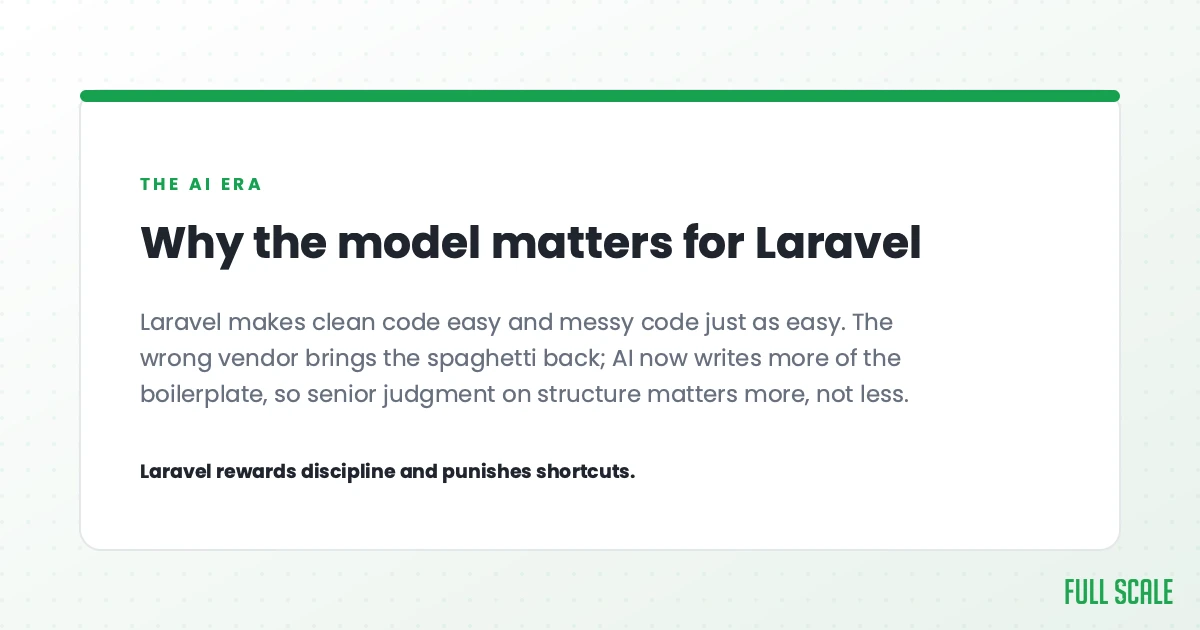
Laravel generators scaffold controllers, models, migrations, and tests. AI tools do the same, with more context and natural language. The question is whether the engineer reviewing that output understands what idiomatic Laravel looks like and catches when the AI has produced code that uses the framework’s syntax without its conventions. A fat controller generated by AI is still a fat controller. A Laravel engineer who knows the framework sees it immediately. An engineer who knows PHP syntax may not.
The difference between an engineer and a developer in a Laravel context: one can tell when the AI-generated code violates the conventions that make Laravel maintainable. Product Driven is about building engineers who own what they build. In a framework as convention-dependent as Laravel, ownership is what prevents the spaghetti from coming back through the AI-generated scaffold.
Frequently Asked Questions
What does it mean to outsource Laravel development?
Outsourcing Laravel development means engaging an external partner to staff or build work on your Laravel application. The model can be project outsourcing (a vendor delivers a defined scope) or staff augmentation (Laravel engineers join your team directly). At Full Scale, we’ve found staff augmentation produces better outcomes than project outsourcing for most Laravel applications that will keep evolving, because the engineers accumulate knowledge of your specific Eloquent models, service layer, and queue architecture.
Why does outsourced Laravel development fail so often?
The most common failure is getting PHP spaghetti in Laravel clothing: a vendor hired from the cheap end of PHP’s enormous talent pool delivers code that uses Laravel’s file structure but ignores its conventions. Fat controllers, anemic models, unbounded Eloquent queries, and tests that exist to satisfy a checklist. The fix is not a better vendor selection process. It is choosing staff augmentation for work that requires long-term ownership.
How much does it cost to outsource Laravel development?
At Full Scale, senior Laravel engineers in the Philippines are staffed at $30 to $40 per hour, with typical onboarding timelines of 14 days. A comparable US engineer costs $133,000 or more in base salary before benefits and overhead. With PHP’s large talent pool, rate comparisons are especially important to contextualize: a cheap PHP developer is cheaper than a cheap developer in most other languages, and the quality difference is proportional.
Why is the Philippines the right place to outsource Laravel development?
The Philippines has been building PHP for twenty years. Senior Filipino Laravel engineers are not developers who adopted the framework recently. They are developers who learned PHP when it was the dominant language and moved into Laravel as the modern standard, which means they understand the conventions well enough to catch when AI-generated code violates them. Combined with English fluency and a communication culture suited to distributed teams, the Philippines produces Laravel engineers who are both cost-efficient and deeply competent.
Ready to Build a Laravel Team That Works Like Your Own
Full Scale has been staffing offshore software development teams since 2018. We have placed 700+ developers with clients across 200+ tech companies. Our Laravel engineers work inside product organizations across North America, maintaining and extending production Laravel applications.
If you want to hire Laravel developers who know the framework’s conventions, work inside your team, and own what they build, that is what we staff.
Schedule a call to talk through your Laravel team needs.