
Software Engineer vs. Software Developer: The Distinction AI Is About to Kill

In this article
- The textbook difference, and the crack running through it
- The split was a scaling tax, not real engineering
- AI is replacing the assembly line, not the developer
- Product thinking is the whole job now
- Who you actually need to hire now
- Frequently asked questions about software developer vs software engineer
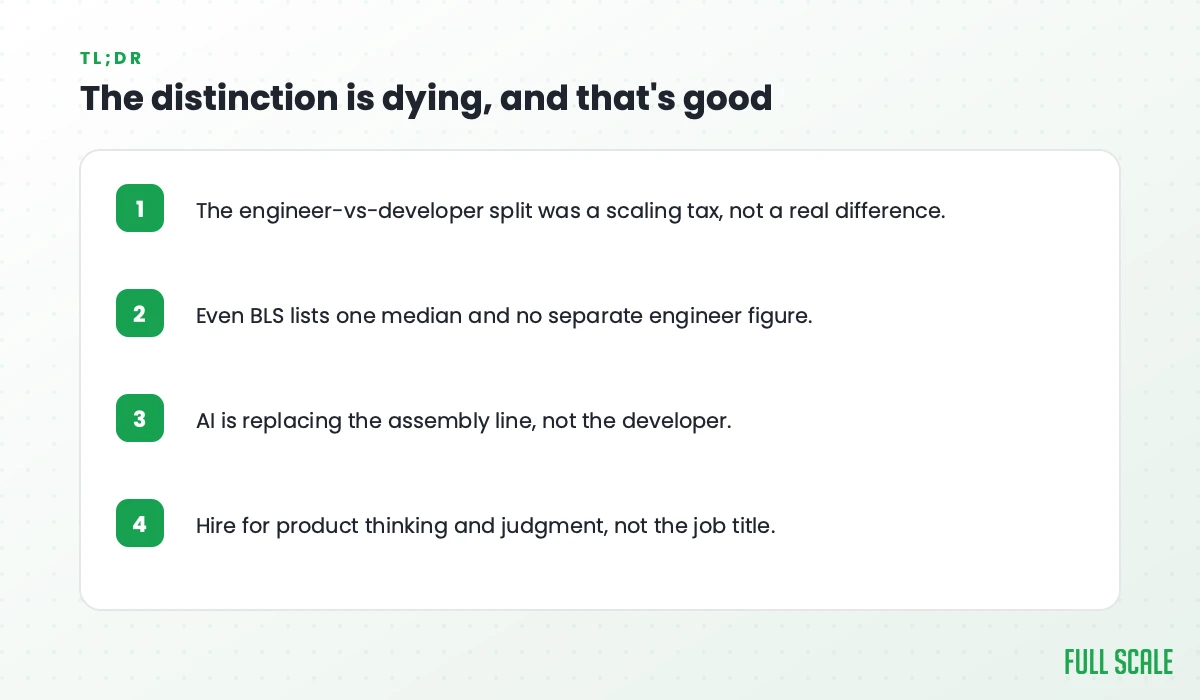
- The distinction is dying, and that’s good news
Quick answer: The software developer vs software engineer question was always thinner than it looked. The textbook split says engineers design systems and developers build features, but in practice the titles are used interchangeably, and the U.S. government files both under one job. Now that AI writes most of the code, the two roles are collapsing back into a single full-lifecycle job: the person who decides what to build, builds it, checks that it works, and owns it in production. Design roles are shifting the same way, and UX strategy in the AI era is moving from making screens to deciding what makes a product different. It’s the whole reason not to hire cheap coders in India when what you need is a developer who owns the product.
When I started my career, my job title was software developer. Not engineer. Developer. New specialties keep splitting off the same way, like the MarTech developer role that owns a marketing team’s software.
For twenty-five years the difference between a software developer and a software engineer confused me, because in practice there wasn’t one. The terms got used interchangeably, the job descriptions overlapped, and nobody could ever give me a clean answer about where one ended and the other began. I am Matt Watson), and I built VinSolutions and Stackify carrying both titles at different times, doing the exact same work either way.
The difference is finally obvious, and AI is the reason.
Here is the short version. The split between a software developer and a software engineer was never a law of nature. It was a side effect of how the industry scaled, and AI is removing the reason it existed in the first place. The job is collapsing back into one role: someone who sits with the customer’s problem, builds the thing, and stays on the hook for it once it ships.
That person used to be called a software developer. They are about to be called that again.
The textbook difference, and the crack running through it
Ask the internet for the difference between a software engineer and a software developer and you get the same answer on every page.
A software developer writes and maintains code, usually focused on specific features or applications. A software engineer applies engineering principles to the whole system, designing architecture and making sure the pieces fit together at scale. Developer builds the feature. Engineer designs the system the feature lives in. The same blurring runs through the broader software engineering vs software development debate, where the discipline names get swapped just as freely as the job titles.
That distinction shows up everywhere, so it is worth laying out plainly before we take it apart.
| Software developer (textbook) | Software engineer (textbook) | |
|---|---|---|
| Main focus | Writing and shipping features | Designing systems and architecture |
| Scope | A component or application | The whole system and how it scales |
| Typical background | Bootcamp, self-taught, or CS degree | CS or engineering degree |
| How it’s framed | Builds the product | Designs how the product gets built |
| Pay (US median) | About the same | About the same |
Read down that last row. Even the salary data refuses to cooperate with the distinction.
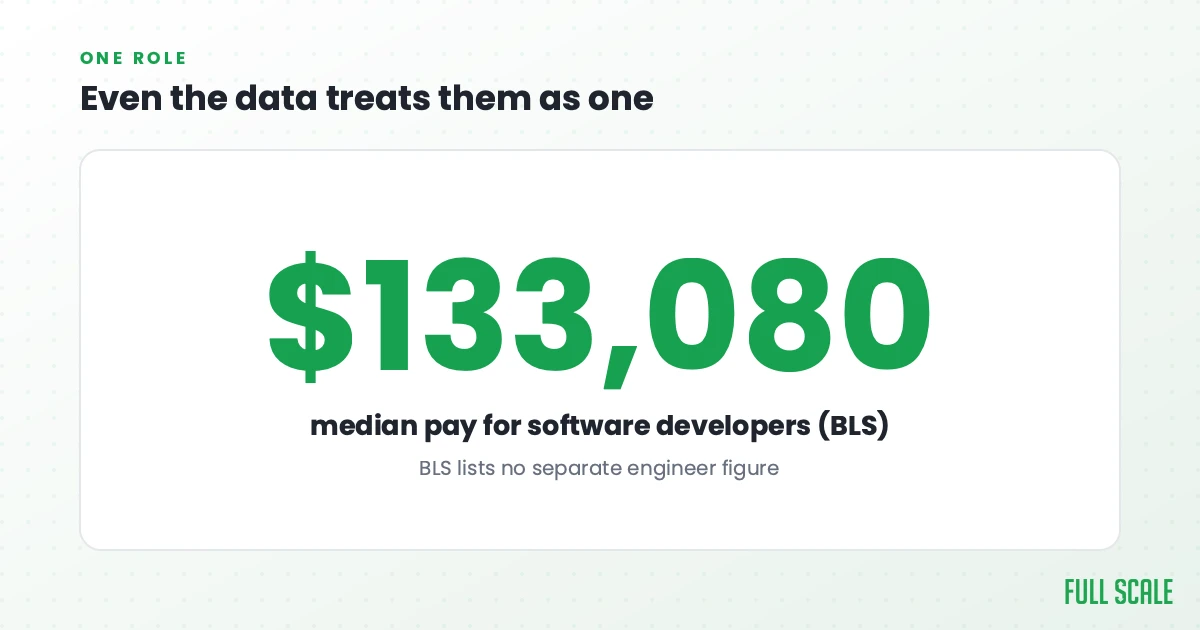
The U.S. Bureau of Labor Statistics reports a median pay of $133,080 for software developers and does not publish a separate number for software engineers, because it does not treat them as separate jobs. The government files developers, engineers, QA analysts, and testers under one occupational category. The agency whose entire job is to classify work looked at developers and engineers and decided they were the same thing.
Every credible page admits this somewhere near the bottom. They run through the definitions, then concede that in real companies the titles depend on the employer, the era, and the recruiter who wrote the posting.
That admission is the crack. Once you accept the titles are interchangeable in practice, the obvious question is why we ever pulled them apart.
The split was a scaling tax, not real engineering
When I wrote software for car dealerships in the early 2000s, development was the whole job.
I would talk to a customer in the morning and ship a solution that afternoon. There was no spec sitting in a queue, and no product manager translating what the customer wanted into a ticket. I sat in a medical lab watching how they checked in specimens, flew around the country meeting ticket brokers, and walked dealership lots learning how cars actually got sold. Then I wrote the code, released it, and fixed it when I got it wrong.
One person owned the entire loop, from the customer’s problem to the running software.
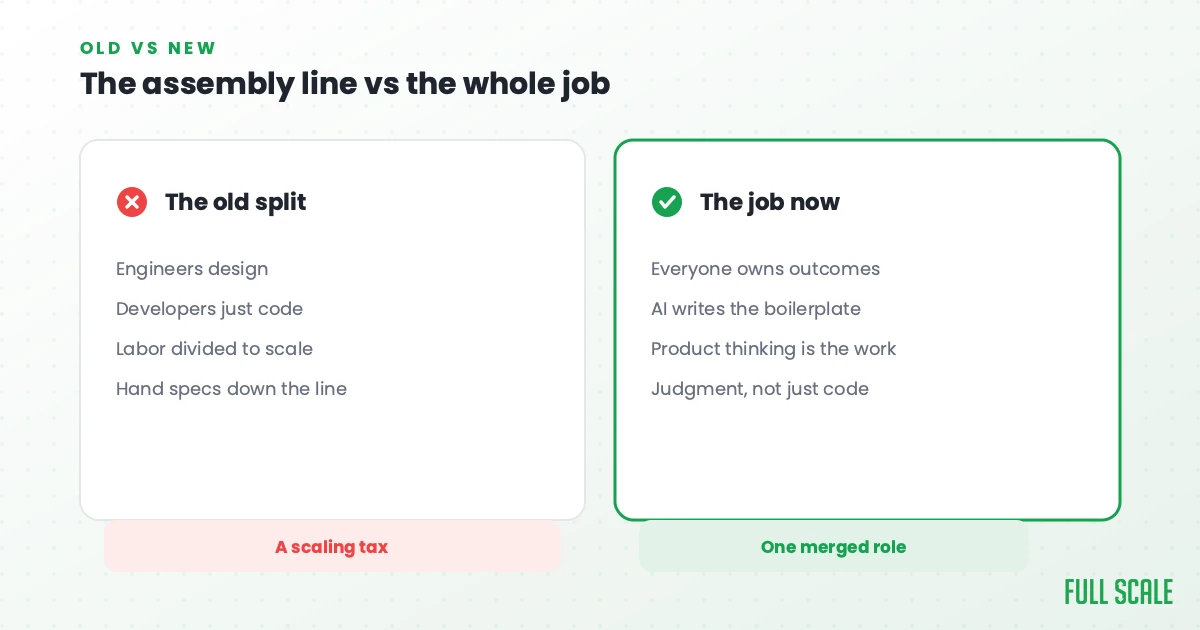
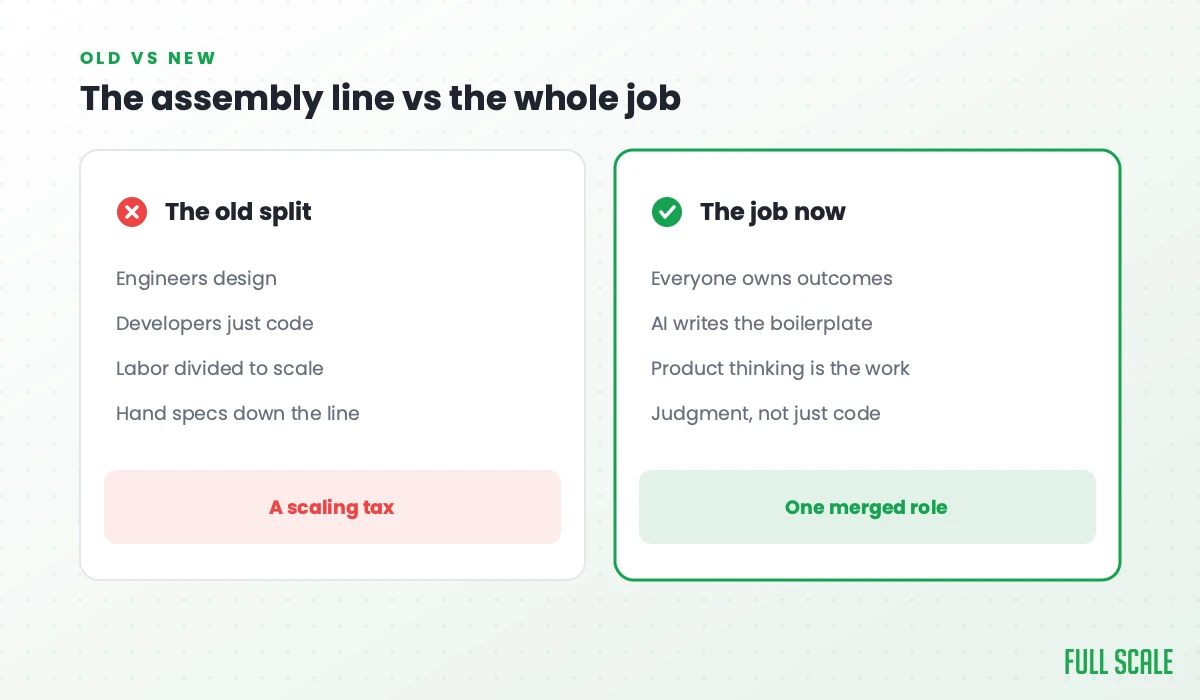
Then the tech boom happened. Companies got bigger. Teams got bigger. Compliance showed up. The way the industry chose to scale was to break the job into pieces and hand each piece to a specialist.
The customer conversation went to product managers. The roadmap went to product owners. Project managers ran the schedule, business analysts wrote the specs, QA tested at the end, DevOps ran the infrastructure, UX designers owned the experience, and architects drew diagrams nobody read.
That is an assembly line, and we renamed it engineering. The debate about whether Agile itself is dead is really a debate about whether that assembly line was ever what Agile intended.
I watched it happen inside my own company. At VinSolutions I started as the lead developer talking straight to dealers. As we grew, their feedback reached me through a support person, then through two layers of support, then through other engineers, until there were four people between me and the customer. The work kept moving. Something still felt off. I only spoke to actual users at trade shows.
To be fair, there is real engineering discipline in the world. Where reliability is the product itself, in avionics, medical devices, or systems that cannot fail, the formal rigor earns its name. But that was never the majority of software jobs. For most teams building ordinary business software, the specialty split was an org-chart decision, not an engineering one.
It grew the headcount without making the software better. “Software engineer” became the respectable name for one worker on a line that turned requirements into code, and the title ladder grew to match. We ended up with a sprawling hierarchy of engineer titles and twenty-one flavors of specialist to describe slices of a job that one person used to do start to finish.
The specialty split was a tax we paid to scale. For two decades it looked permanent.
AI is replacing the assembly line, not the developer
Here is the part everyone gets backwards.
We are not in a moment where developers are getting replaced. We are in a moment where the assembly line is getting replaced. AI is very good at the middle of that line, the part where requirements get converted into working code. That is exactly the part we spent twenty years calling engineering.
Think about how a developer’s time used to split. When I started, maybe twenty percent of my day went to talking with customers, working out requirements, and checking that what I built actually solved their problem. The other eighty percent was the engineering: writing the code, searching for answers, fixing the bugs.
That ratio has flipped.
Today the typing is the cheap part. I describe a problem clearly enough for a coding agent to solve it, then I review what comes back. Most of my time goes to deciding what to build and confirming the result is right. The hands-on-keyboard share has shrunk to a sliver, and a lot of that sliver is reading the AI’s output with enough judgment to catch when it is confidently wrong. That describe-then-review loop is exactly why vibe coding still needs a real engineer in the loop.
Claude Code is the software engineer now. I am the one managing it. What is left for me is a blend of product owner, architect, and QA, three jobs the industry spent twenty years pushing apart and treating as separate. AI has collapsed them back into one role, and that role is software developer.
This is not just my workflow. Google’s CEO Sundar Pichai said in 2026 that roughly 75 percent of the company’s new code is now AI-generated, up from about a quarter in early 2024 and half by late 2025. When the largest engineering organization on earth writes most of its code with AI, the typing is no longer the job.
The productivity research points the same way, though it is messier than the headlines. A 2023 McKinsey study found generative AI can help developers complete tasks up to twice as fast, and GitHub’s research measured developers finishing a task fifty-five percent faster with Copilot. But the gains are uneven. McKinsey found the savings shrink to under ten percent on the genuinely hard problems, and a 2025 randomized trial from METR found experienced developers working in code they knew well were nineteen percent slower with AI, even though they felt faster. The tools help most with the boilerplate and least with the deep, context-heavy work senior engineers are paid for. That is the same point from another direction: the mechanical work is getting compressed, the way compilers and frameworks compressed it before, and the value is moving to everything around it. This is also why the shape of an engineering team is changing, even on a large legacy codebase where the AI does the grunt work and a human owns the decisions.
This is not a new kind of event. Fred Brooks called it back in 1986 in his essay No Silver Bullet. He split software work into two kinds of complexity: accidental, the busywork of making the code run, and essential, the hard thinking about what the software should do.
Every tool we have ever celebrated went after the accidental kind. Compilers, IDEs, frameworks, each one was sold as the thing that would replace engineers, and each one only made the job bigger. AI is the largest swing yet at accidental complexity, and it still does not touch the essential part.
What AI absorbs, and what it leaves on your desk:
| AI is absorbing | AI is not touching |
|---|---|
| Boilerplate and scaffolding | Framing the actual problem |
| First drafts of features | Deciding what is worth building |
| Glue code and CRUD | Trade-offs with real consequences |
| Routine tests | Understanding the customer |
| Tier-one bug triage | Owning the outcome end to end |
The trust data shows why the right column still needs a human. In the 2025 Stack Overflow Developer Survey, eighty-four percent of developers use or plan to use AI tools, but trust in their accuracy fell to thirty-three percent, down from forty-three percent the year before. Two-thirds said their biggest frustration was AI code that is “almost right, but not quite,” and nearly half said debugging that code takes longer than expected.
Almost right is the most dangerous output a machine can produce. Catching it takes someone who understands the problem well enough to know the answer is wrong. As I have said before, vibe coding only works if you have been coding long enough to know when the AI is wrong.
Product thinking is the whole job now
If AI eats the typing, what is the job?
The job is everything we spent twenty years treating as someone else’s department. Figuring out what to build. Understanding the person who will use it. Having the judgment to say this is the wrong thing to build, before a single line gets written.
The hard part of software development isn’t writing code. It’s understanding the problem you’re trying to solve. That was always true. It is just no longer hidden behind the eight hours a day that used to go into making the code work.
When code gets produced far faster than before, you need clear product requirements just as fast, or all that speed only produces the wrong thing more efficiently. The bottleneck moves from writing to knowing what to write and reviewing what comes out. Product thinking and customer empathy stop being soft skills and become the entire job.
I think it comes down to three things, the ones I tell every engineer at Full Scale will keep them safe through this shift. Communication, so you can pull a real problem out of a customer and hand a clear one to the machine. Curiosity, so you keep asking whether you are solving the right thing. Courage, so you are willing to push back when the answer is that the team should not build this at all. None of that is new. It is the same judgment that always separated the strong engineers from the fast typists, finally visible now that the typing is cheap, and it sits right alongside the durable engineering fundamentals that AI does not replace.
I owe you one honest caveat here, because the tidy version of this argument is wrong.
Not every engineer wants to sit in front of a customer, and not every engineer should. Plenty of brilliant builders want nothing to do with discovery calls, and the work of talking to users is its own kind of messy. That is fine. But the customer’s voice has to reach the people building, somehow. If your developers cannot all be on the call, then piping that signal to them becomes your job as a leader. The teams that figure this out will pull away from the ones still organized around tickets.
Most engineers did not lose product thinking. They never got the chance to build it, because we hid them behind a wall of product managers and analysts for twenty years. The wall is coming down. This is the full argument behind Product Driven, the book I wrote about building teams that ship what actually matters.
Who you actually need to hire now
For founders and engineering leaders, this changes the hiring question.
The old question was which specialist to add next, whether a front-end developer, a back-end engineer, a QA tester, or a DevOps person. You staffed the assembly line one seat at a time. That instinct is now a trap, because the line is the thing AI is dismantling.
The better question is who can own a whole outcome.
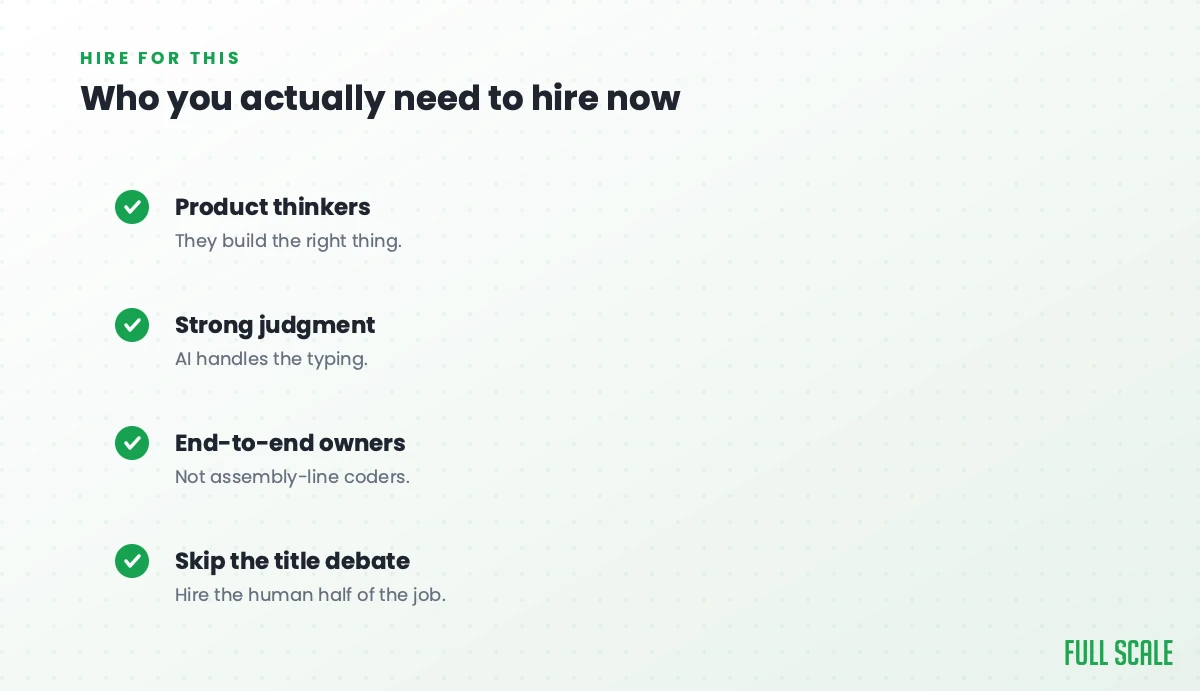
You want people who can sit with a customer’s problem, shape it into something worth building, direct AI to build it, and have the judgment to know whether the result is any good. That is a senior, full-lifecycle developer. Fewer of them, each covering ground that used to take a small team.
This is the profile we staff through our staff augmentation model at Full Scale. Our engineers average more than seven years of experience and we hold a 93 percent developer retention rate, because the people who think like owners are exactly the ones you want to keep when AI is doing the typing. Plenty of companies now add senior developers in the Philippines for this, keeping product and architecture leadership in-house and adding owners who can run with it. I will own the obvious: this is also what my company sells, which is exactly why I have watched the shift happen up close on real teams.
Frequently asked questions about software developer vs software engineer
Is software engineering the same as software development?
In practice, yes. The U.S. Bureau of Labor Statistics files both under a single occupation and does not separate them. The textbook split says engineers design systems while developers build features, but most companies use the titles interchangeably, and AI writing the code is erasing what little distinction remained.
What is the difference between a software engineer and a software developer?
The conventional answer is scope: a software engineer designs the overall system and architecture, while a software developer focuses on writing and shipping specific features. The honest answer is that the two roles overlap so heavily that pay and day-to-day work are nearly identical, and the difference is more about job-title fashion than the actual work.
Do software engineers and software developers earn different salaries?
Barely. The BLS reports a median of $133,080 for software developers and does not publish a separate engineer figure, since it treats them as one occupation, and it projects 15 percent growth for the role through 2034. In my experience the gaps that show up between the two titles are small and depend more on the company than the label, so title alone is a weak predictor of pay.
Which should I hire, a software developer or a software engineer?
Stop hiring for the title and hire for ownership. The most valuable person now is someone who can understand the customer’s problem, direct AI to build the solution, and judge whether the result actually works. That full-lifecycle ability matters far more than whether their badge says developer or engineer.
The distinction is dying, and that’s good news
For twenty years we turned developers into engineers, broke a whole job into specialist roles, and built a title ladder to celebrate the pieces. AI is undoing that in a few short years.
The work that survives is the work that was always the point: understanding the problem and the person who has it. Pure coders will be replaced by AI. Problem solvers will run technology organizations.
The title on the door is about to matter less than it has in a generation. What matters is whether someone can own the outcome from the customer’s problem all the way to running software.
Software development is back. The companies that remember what that ever meant are the ones that will win. If you are rethinking who belongs on your team in this new shape, schedule a call with Full Scale and we will talk through what to keep in-house and what to build with a dedicated team.