
Outsource PHP Development: How to Pick the Right Model

In this article
- The Two Models You’re Actually Choosing Between
- When Project Outsourcing Actually Works for PHP
- The Cheapshoring Trap (Why Most PHP Outsourcing Fails)
- How to Vet a PHP Outsourcing Partner
- Red Flags in a PHP Outsourcing Proposal
- Structuring a PHP Outsourcing Engagement for Success
- When to Use PHP Staff Augmentation vs. Project Outsourcing
- Ready to Outsource PHP Development?
- Frequently asked questions
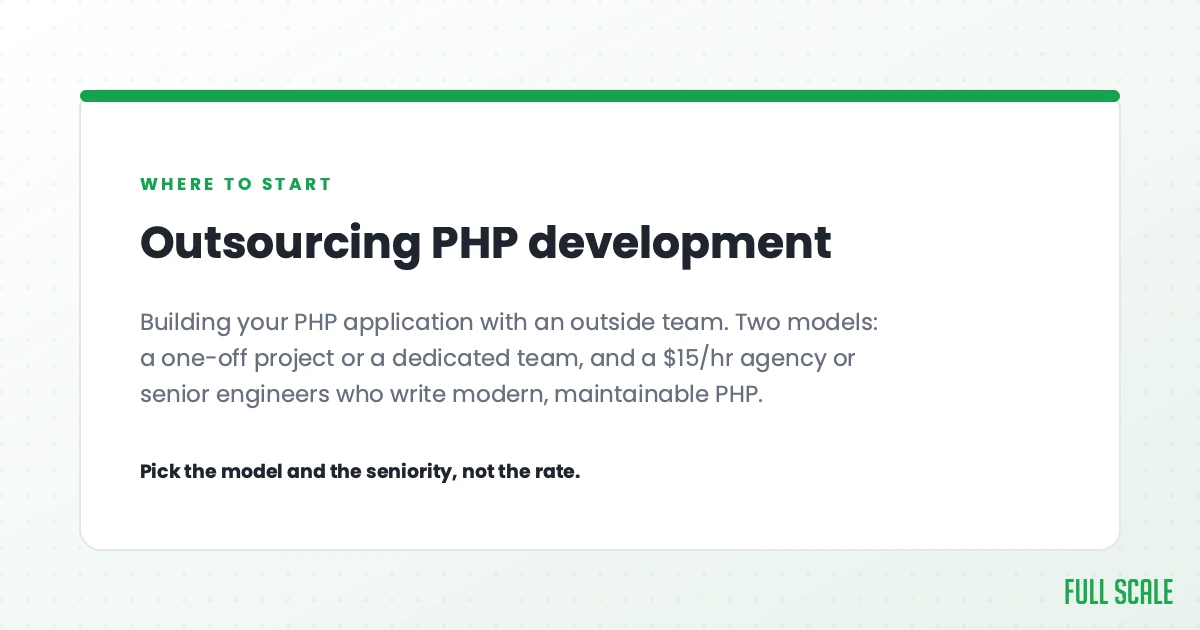
Quick Answer: Outsourcing PHP development usually means one of two models: project outsourcing, where a vendor delivers a fixed scope, or staff augmentation, where PHP engineers join your team directly. For most ongoing PHP work, staff augmentation wins because the product keeps evolving past any fixed deliverable. Full Scale places senior PHP engineers in the Philippines at real rates, the model that avoids the cheapshoring trap of $15/hour agencies that cost more in rework than they save.
I’ve outsourced PHP development myself: not just placed developers for clients, but actually gone out and hired an outside team to build PHP work I needed done.
Here’s what I learned: the most important question isn’t which vendor to hire. It’s which model you actually need.
Most companies walk into a PHP outsourcing engagement asking the wrong question. They search for “outsource PHP development,” find a list of agencies, and start comparing rates. But they haven’t figured out yet whether they need a project outsourced or a team extended. Those are completely different arrangements, with completely different success rates, and treating one like the other is where most outsourcing failures start. So does a fuzzy brief, which is why writing a sharp PHP developer job description is the first thing to fix.
I’ve seen this play out hundreds of times. The company hires a project shop for ongoing product development, the project shop treats it like a fixed-scope delivery, and six months later the client has code that’s technically complete and functionally wrong. Or they hire for an ongoing engagement but frame it like a project (no real onboarding, no direct access to developers, requirements handed off like a spec document) and wonder why communication broke down.
Getting PHP outsourcing right starts with answering two questions before you talk to a single vendor.
The Two Models You’re Actually Choosing Between
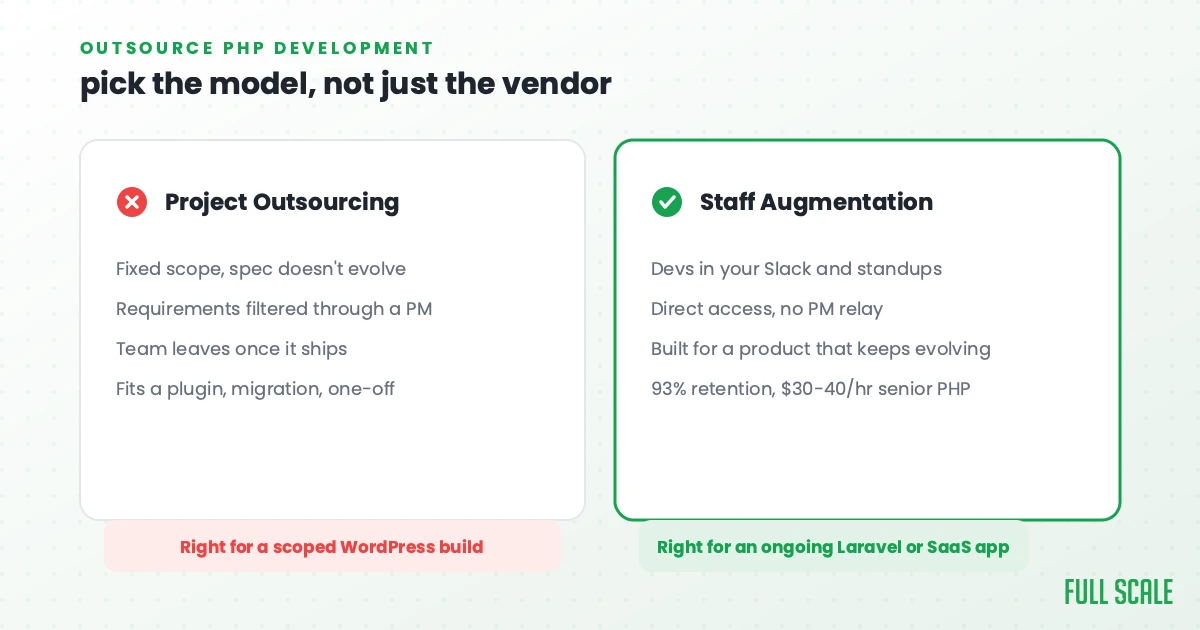
Project outsourcing means handing a fixed scope of work to an outside team and receiving a deliverable. You define what gets built. They build it. You review it. You pay for the output.
This is the right model when your PHP work is genuinely self-contained: a well-scoped WordPress plugin, a data migration, a one-time API integration, a clear specification that doesn’t need to evolve as you build it.
Staff augmentation means adding developers to your team who work as extensions of your organization. They’re in your Slack, on your standups, following your processes. They work on your roadmap, not a spec document. You manage their priorities. They’re measured by the same standards as your local team.
This is the right model when your PHP work is ongoing: a SaaS product in active development, a Laravel application that’s growing and changing, a WooCommerce platform you’re continuously building. For a WooCommerce build that keeps evolving, our custom WordPress development staffs a team that stays with it.
Most “outsource PHP development” searches are actually people who need staff augmentation, not project outsourcing. They want a PHP team that builds their product over time. The word “outsource” is how they describe it, but the engagement they’re describing is team extension.
The distinction matters because the vendor you choose for a scoped project is different from the vendor you choose for ongoing development. Their pricing models are different, their accountability structures are different, and the ways they can let you down are different.
When Project Outsourcing Actually Works for PHP
I’ve outsourced PHP work as project work myself, and it worked, because I scoped it correctly.
The projects that work as true outsourcing:
Bounded, well-documented specifications. If you can write down exactly what you need built and that spec won’t change during development, project outsourcing can deliver it. The failure mode of project outsourcing is the telephone game: requirements filtered through a PM layer, context lost, developers building what they interpreted rather than what you needed. When the spec is concrete enough that interpretation has little room, this failure mode shrinks.
WordPress builds with clear scope. A WordPress plugin with defined functionality. A theme implementation against a design that’s done. A specific set of WooCommerce custom jobs. These work as projects because the deliverable is clear.
One-time integrations and migrations. Moving data between systems. Connecting two APIs with a defined contract. These have a defined done state. You can write an acceptance test before a line of code is written.
Work you’re comfortable owning and maintaining afterward. If the deliverable goes into production and you need to live with it forever, make sure you’re getting code you can actually maintain, not a black box built by developers you’ll never talk to again.
What doesn’t work as a project: any PHP development where you’ll need to ask why decisions were made, any code that will evolve in response to user behavior, any work where “done” is a moving target.
The Cheapshoring Trap (Why Most PHP Outsourcing Fails)
PHP has the highest supply of low-cost developers of any language globally. When 77% of the web runs on PHP, there are a lot of agencies willing to promise you PHP development at $15/hour.
I call this cheapshoring: offshoring done for cost alone, with no real qualification bar. And PHP is where I see it most.
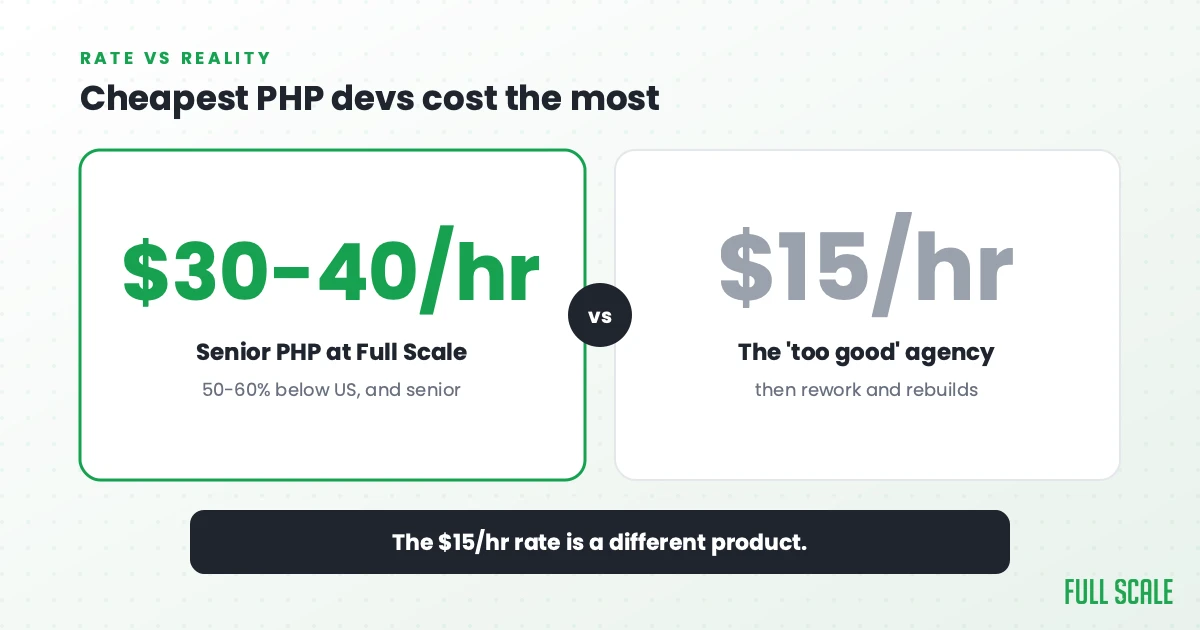
Cheapshoring follows a predictable pattern. Company sees $15/hour. Thinks it sounds amazing compared to $100-150/hour for local development. Hires the agency. Gets developers with inflated resumes, code that needs complete refactoring, no test coverage, and no documentation. Then pays a second team to fix it.
The cheapshoring trap isn’t unique to PHP, but PHP makes it especially common because the cheap end of the market is so large. Any language where there’s enough supply to create a genuine race-to-the-bottom on price has this problem. PHP has it worse than most.
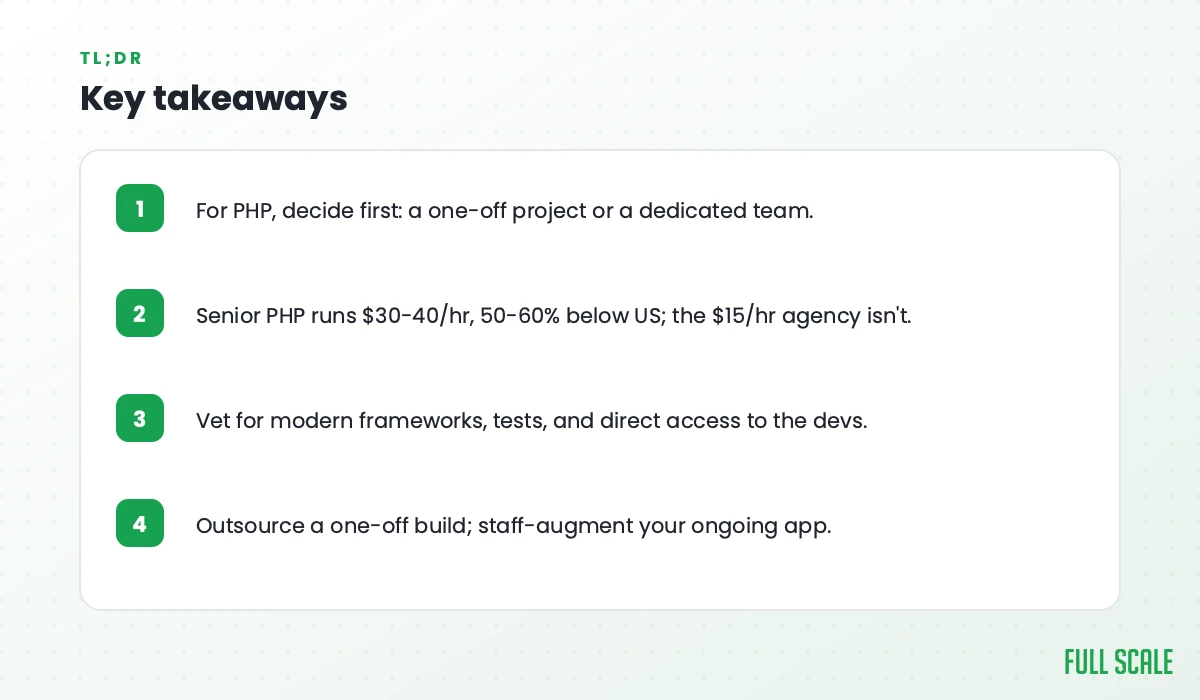
The fix isn’t to avoid offshore PHP development. It’s to avoid the bottom tier of offshore PHP development. Senior offshore PHP developers at real rates ($30-$40/hour at Full Scale’s model) are still 50-60% below US total cost for equivalent talent. You’re not saving money by going to $15/hour. You’re just shifting when the real cost lands.
Deloitte’s 2024 Global Outsourcing Survey found the share of companies citing cost reduction as the top reason to outsource fell from 70% in 2020 to 34% in 2024. Companies that have been at this long enough have figured out that you don’t buy development work the way you buy commodities. The best ones have shifted to evaluating on outcomes, speed, and quality, not the hourly rate.
How to Vet a PHP Outsourcing Partner
Whether you’re outsourcing a scoped PHP project or looking for an ongoing staff augmentation partner, the vetting criteria overlap but aren’t identical. Either way, knowing how to screen a PHP developer for judgment instead of trivia is what keeps you from paying for code AI already writes for free.
For project outsourcing:
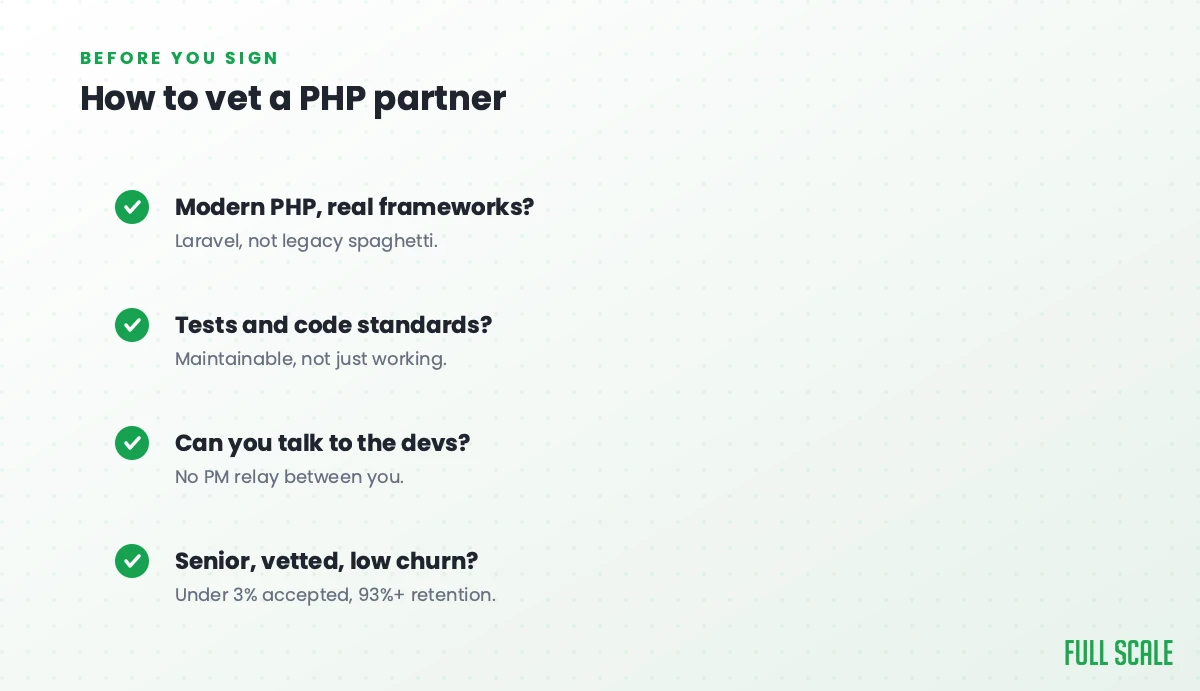
Ask to see their test coverage on past work. PHP projects fail silently when there’s no test coverage. A vendor who can’t show you tests on delivered code is selling you technical debt.
Ask how they handle scope changes. They will happen. A vendor who says scope changes “aren’t a problem” hasn’t thought through how they’ll manage them. A vendor who can articulate a real change management process has been here before.
Ask who you’ll talk to directly. The worst PHP project shops are the ones with a layer of account management between you and developers. If you can’t talk to the developer writing your code, you’re back to the telephone game.
Check their PHP version standards. In 2026, any vendor still building on PHP 7.x or older without a migration path is a red flag. PHP 8.x adoption is the baseline quality signal for active PHP shops.
Get a fixed-price quote with explicit scope boundaries. Understand what’s in and out before signing. “We’ll handle any reasonable requests” isn’t scope, it’s a disagreement waiting to happen.
For staff augmentation / ongoing development:
Ask about their developer vetting process. Vague answers (“we only hire the best”) aren’t vetting processes. Ask for the stages, what each stage tests, and what the rejection rate is. At Full Scale, more than 97% of applicants don’t make it through our five-stage process. A partner who can’t describe the failure rate on their vetting is probably not filtering hard enough.
Ask how communication works. Direct access to developers, or does everything go through a project manager? The answer tells you immediately which model you’re actually buying.
Ask about retention. Any offshore PHP staffing company should be able to tell you their developer retention rate. High retention means stable teams. Low retention means you’re constantly onboarding new developers who don’t know your codebase. Full Scale’s annual retention is 93%.
Ask about the replacement policy. If a developer isn’t working out, what happens? “We’ll handle it” isn’t a policy. Understand the timeline and cost before it becomes relevant.
Check their English proficiency standards. The Philippines is the third-largest English-speaking country in the world, but not every offshore PHP company is Philippines-based or has consistent English standards. Test it yourself in the vetting process: have a real conversation with the developers, not just the sales team.
Red Flags in a PHP Outsourcing Proposal
No transparency on who’s actually building. If the agency won’t tell you which developers are on your project, or shows you profiles only after signing, you have no way to verify the people you’re actually getting.
Rates that don’t support senior talent. A $15/hour blended rate for a “senior PHP team” doesn’t support the compensation levels that attract strong developers. The math doesn’t work. The talent will be whatever the rate can buy.
A “project manager is your single point of contact” model. This is the model that produces the most communication failures. You want to talk to developers.
No mention of your ownership of the code. IP assignment should be explicit in the contract. Any hesitation on this is a red flag.
Timeline estimates with no discovery phase. If they can quote you a project timeline before understanding your requirements, they’re guessing, or they’re going to let the timeline slip and claim scope creep.
Generic capability claims. “We do PHP, Laravel, WordPress, React, Node.js, Python, and mobile” from a small shop usually means they’ll staff whoever they have available. Depth in one or two areas is more credible than a list of every technology that exists. I see the same pattern when companies outsource Vue.js development, where a long capability list usually hides shallow framework depth. The same holds in Python: when you hire dedicated Django developers, real depth in the framework matters far more than a long list of buzzwords.
Structuring a PHP Outsourcing Engagement for Success
The engagement structure is what determines whether it actually works, once you’ve chosen the right model and the right vendor.
For a scoped PHP project:
Write the spec before you find the vendor. The cleaner your requirements going in, the better the output coming out. Include acceptance criteria, not just feature descriptions. Define what “done” means before the first line of code is written.
Negotiate direct developer access into the contract. Even on a project engagement, you should be able to talk to the person building your code.
Build in a code review milestone at the midpoint. Don’t wait until delivery to find out the architecture is wrong.
Plan for the post-delivery relationship. Who maintains this code? If it’s you, build in a knowledge transfer phase. If it’s the vendor, understand what that contract looks like.
For ongoing PHP staff augmentation:
Treat the first 30 days as an onboarding investment. Pair the new offshore developer with someone on your local team. Give them real work, not test projects. Give them access to everything.
Set expectations explicitly in the first week. Coding standards, commit practices, communication norms, how code review works, how to ask for help. The offshore developers who struggle aren’t usually struggling because of skill: they’re struggling because nobody told them how your team works.
Build the relationship over time. The developers who become your best long-term team members are the ones you treated as team members from Day 1. That’s not a soft observation: it’s directly linked to the 93% retention rate we see at Full Scale versus the ~40% industry average.
When to Use PHP Staff Augmentation vs. Project Outsourcing
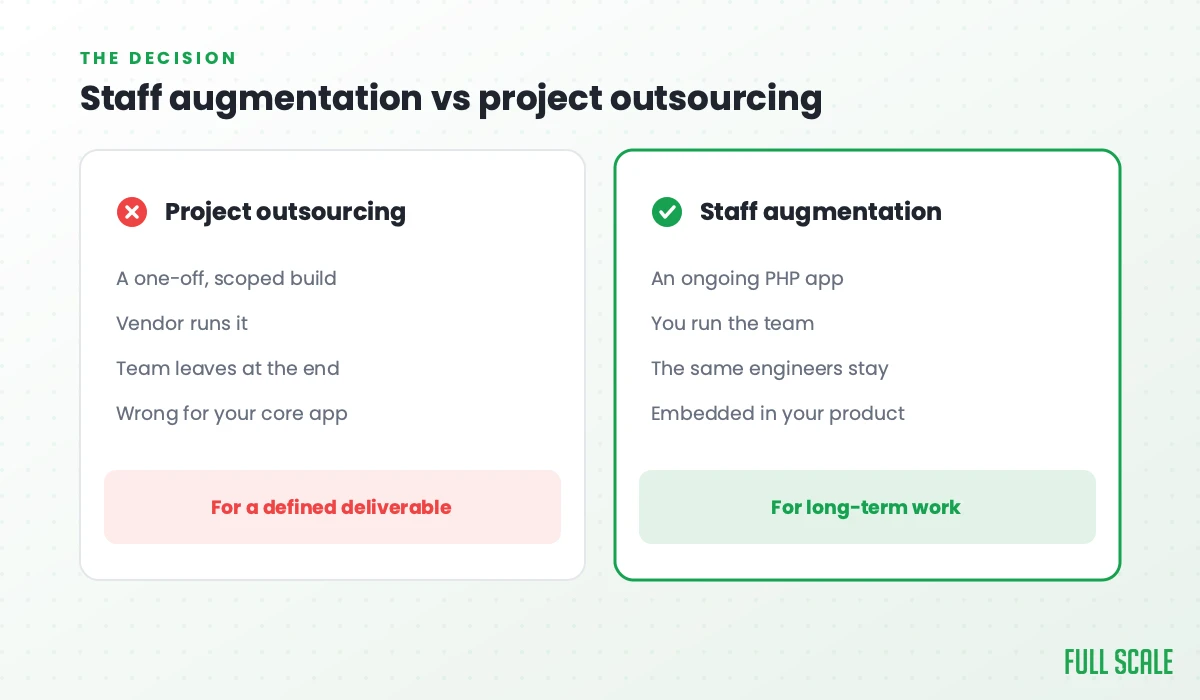
Use project outsourcing when: – The scope is genuinely fixed and you can write it down completely before starting – The work is a one-time build with a clear done state – You don’t need the team to understand your product deeply – You’re comfortable owning the deliverable without ongoing access to the people who built it
Use staff augmentation when: – You have an ongoing PHP product in active development – Your requirements evolve in response to user behavior or market changes – You need developers who understand your architecture, not just your spec – You’re planning to work with this team for a year or more – You want to manage them like any other member of your team
When in doubt, the answer is usually staff augmentation. Most companies looking to “outsource PHP development” are describing a product roadmap, not a one-time project. The vocabulary of outsourcing is familiar; the engagement they actually need is team extension.
Ready to Outsource PHP Development?
If you’re looking for a scoped PHP project, the right starting point is a well-documented spec and a vendor willing to give you direct developer access.
If you’re looking to scale an ongoing PHP team (Laravel SaaS, WordPress at scale, legacy PHP upgrades), Full Scale builds integrated teams in the Philippines. Offshore staff augmentation with 93% annual retention, a 5-stage developer vetting process, and direct access to the developers building your product.
Schedule a consultation to discuss your PHP development needs. Honest assessment included: we’ll tell you if the engagement you’re describing is a better fit for project outsourcing or staff augmentation.
Want to understand the offshore side of the equation first? Read The Complete Guide to Offshore PHP Development for the full breakdown on how the staff augmentation model works for PHP teams.
Frequently asked questions
What does it mean to outsource PHP development?
Outsourcing PHP development means hiring an outside team to handle PHP work for your company. There are two models: project outsourcing (a fixed-scope deliverable built by an external team) and staff augmentation (offshore developers who join your team directly and work on your ongoing PHP product). Most companies searching for PHP outsourcing actually need staff augmentation, which is the ongoing team-extension model Full Scale builds around, not a one-time project.
How much does it cost to outsource PHP development?
Project outsourcing costs vary significantly by scope and vendor quality. For ongoing staff augmentation, senior offshore PHP developers at Full Scale cost $30-$40/hour: about 50-60% less than the fully-loaded cost of a US PHP developer. A US senior PHP developer earns $120K-$145K in base salary, and with the fully-loaded cost multiplier of 1.25-1.4, total annual cost reaches $150K-$200K+. Offshore at $30-$40/hour runs $62K-$83K per year.
What’s the difference between outsourcing PHP development and staff augmentation?
Project outsourcing: you hand a spec to an external team and receive a deliverable. Staff augmentation: offshore developers join your team, work in your Slack, attend your standups, follow your processes, and build your product as direct extensions of your organization. Staff augmentation produces significantly better outcomes for ongoing PHP product development; project outsourcing works for scoped, one-time builds with clear specs.
How do I avoid getting burned when outsourcing PHP?
The biggest risks: choosing the cheapest provider rather than the most qualified; hiring for project outsourcing when you actually need ongoing staff augmentation; and working with vendors who put a project manager between you and the developers actually writing your code. Vet the developer vetting process itself, not just the agency’s claims. Ask about retention rates. Insist on direct developer access. Get IP assignment in writing before signing.
How do I find a good PHP outsourcing partner?
Ask how they vet developers specifically: stages, tests, rejection rate. Test English communication directly with the developers, not just the sales team. Ask about retention rates and what happens when a developer isn’t working out. Look for transparent pricing that supports real senior talent. And check their PHP version standards: any shop still building on PHP 7.x without a migration plan is a signal.
When should I outsource PHP development vs. hire offshore developers directly?
Outsource (project model) when you have a scoped, well-specified project with a clear done state. Use offshore staff augmentation when you have ongoing PHP product development and need developers who understand your codebase deeply over time. If you’re not sure which you need, describe your situation: if you’re talking about a roadmap and user behavior, you need staff augmentation. If you’re describing a spec, you may be able to outsource it.