Is PHP Still Relevant in 2026? Why Companies Still Use It

In this article
- Is PHP Dead? The Narrative vs. The Deployment Data
- Why Companies Still Use PHP: The Business Case Nobody Mentions
- Resume-Driven Development and the Push to Rewrite
- Modern PHP Reality: What Changed Since 2015
- PHP vs. Python, Java, and Ruby on Rails
- The PHP Developer Hiring Reality in 2026
- Why I’m Still Betting on PHP in 2026 (Including for My Own Startups)
- Why Partner with Full Scale for PHP Development
- PHP Is Not Dead, It Is Just Unfashionable (And That Is a Feature)
- Choose Business Outcomes Over Developer Sentiment
- Frequently Asked Questions About PHP in 2026
Is PHP still relevant in 2026? Yes, and the data is not close. PHP runs about 72% of all websites with a known server-side language, powers Etsy, Slack, Wikipedia, and Mailchimp, and remains one of the top backend languages used by professional developers worldwide. The “PHP is dead” line has been recycled for fifteen years while PHP quietly kept shipping production code. Laravel, PHP’s dominant modern framework, is a big part of why, and the Philippines’ deep PHP history makes it the strongest offshore destination for offshore Laravel development teams. If you are weighing it against the obvious alternative, see PHP vs Node.js.
I have heard this question from CTOs, boards, and engineering leaders for a decade. Their team wants to rewrite everything in Node, and they have started pricing what hiring Node.js engineers actually costs. Their board questions why anyone still uses PHP. Meanwhile, Etsy handles billions of requests a day on PHP, and Full Scale is shipping its own new products on Laravel.
The board and the engineers who keep PHP in production cannot both be right about what works.
The “PHP is dead” noise came from developers chasing resume keywords, not from companies trying to ship products. Here is what the data, the SERPs, and our own production experience actually say.
- Why PHP still runs roughly 72% of the web in 2026
- What changed from PHP 5.6 to PHP 8.5
- PHP vs. Node.js, Python, and Java decision tables
- Why Full Scale is building its own startups on Laravel
- How to evaluate if migration off PHP actually makes sense
Is PHP Dead? The Narrative vs. The Deployment Data
PHP has been declared dead more times than a soap opera character. Yet it keeps showing up for work.
The “PHP is dead” narrative started around 2010, when developers discovered Node.js could run JavaScript on servers, Python gained machine learning credibility, and Ruby on Rails looked elegant. PHP just kept powering more websites.
The narrative came from three places. Stack Overflow’s developer survey shows PHP isn’t a “loved” language by developer sentiment, which is accurate. The same survey shows PHP is still used by roughly 18% of professional developers, putting it in the top tier of backend languages by actual usage.
Developers want trendy languages; companies need languages that ship products. Those aren’t the same thing.
Hacker News and Reddit amplified the noise. WordPress security vulnerabilities from 2012 got blamed on PHP itself. Legacy PHP 5 code became proof that the language failed. Modern PHP frameworks got ignored completely.
PHP Market Share and Usage Statistics (2026)
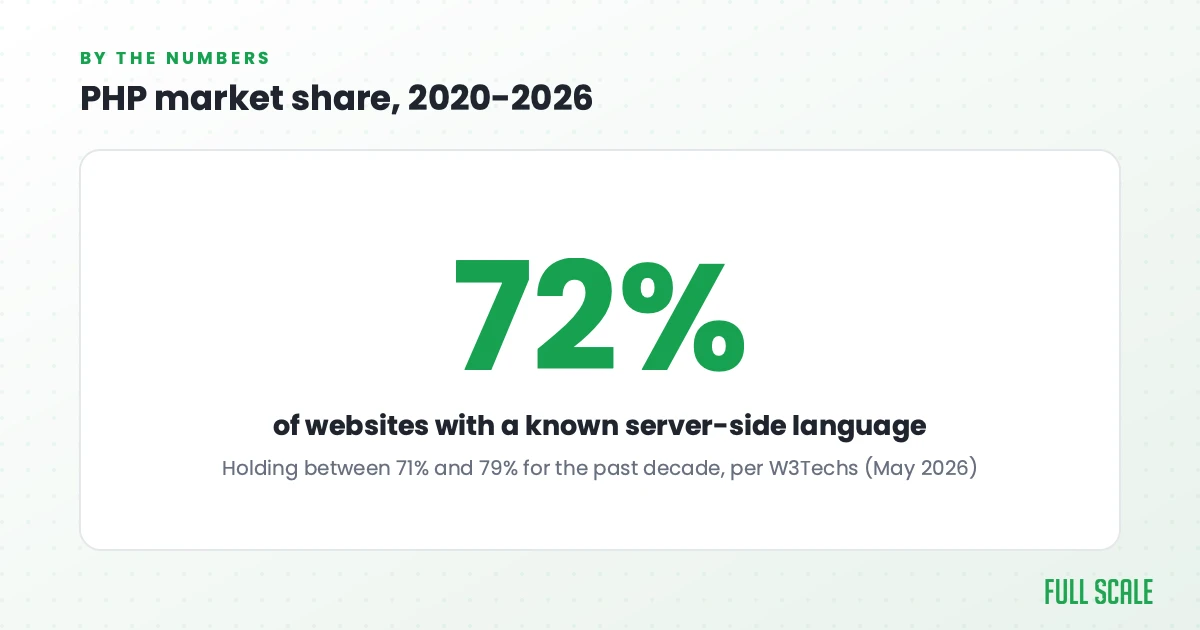
According to W3Techs, PHP powers around 72% of all websites with a known server-side language as of May 2026. That share has hovered between roughly 71% and 79% for the past decade, with no other server-side language anywhere close. ASP.NET sits in the single digits.
PHP also remains one of the most-used backend languages by working developers. The Stack Overflow Developer Survey 2024 shows PHP used by 18.2% of all respondents and 18.7% of professional developers. That’s roughly the same usage band as Java and C#, and well above Ruby and Go.
Laravel, the leading PHP framework, has more than 80,000 GitHub stars, and the framework gets a major release every year.
WordPress alone powers around 43% of all websites globally. That single PHP application drives massive ongoing developer demand all by itself.
Enterprise adoption tells the real story. Etsy handles billions of daily requests on PHP. Slack serves 47 million daily active users on a PHP/Hack backend. Wikipedia, Tumblr, and Mailchimp run production systems on PHP.
These aren’t small hobby projects.
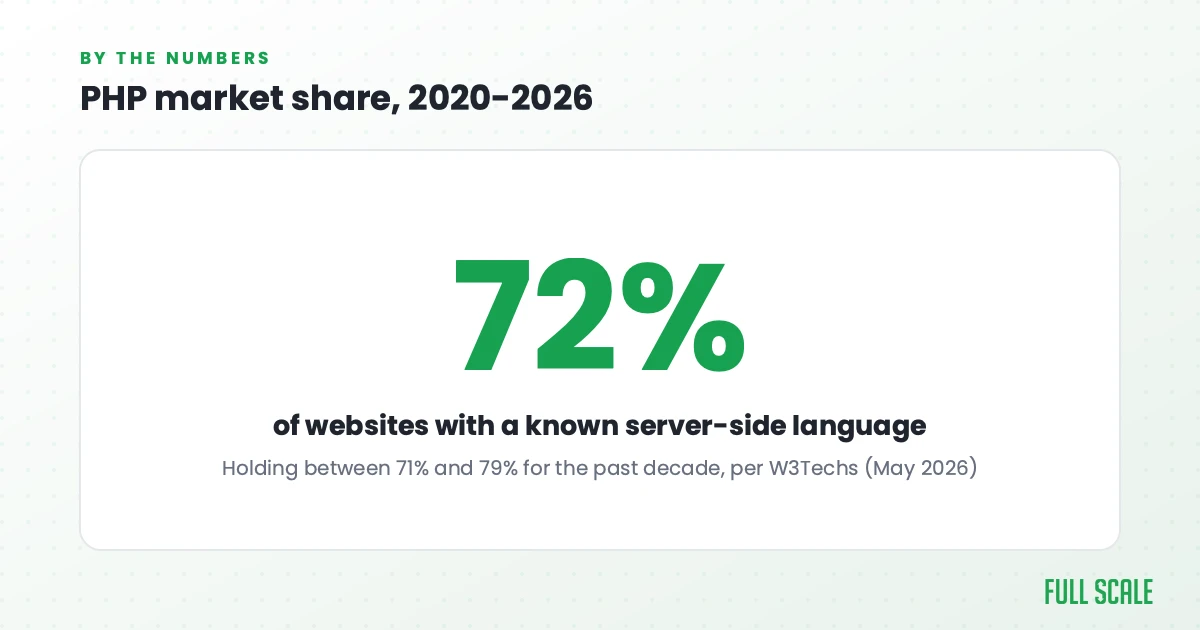
PHP market share has stayed remarkably stable from 2020 through 2026. The narrative of decline doesn’t match the deployment data.
PHP didn’t die. It became boring. Boring means stable, predictable, and proven, which is exactly what you want when you’re hiring developers to ship products instead of chase the framework of the month. Languages that actually die stop evolving. PHP 8.3 has JIT compilation, union types, and performance rivaling Node. That’s not dead, that’s unfashionable on Hacker News.
Matt Watson, CEO, Full Scale
Understanding why the narrative is wrong matters less than understanding why the reality works. So let me lay out the business case that boards actually care about.
Why Companies Still Use PHP: The Business Case Nobody Mentions
Why companies still use PHP in 2026: mature frameworks, abundant talent pools, and proven scalability outweigh language trends. PHP offers faster hiring than most stacks, dramatically lower offshore cost, extensive framework support, and three decades of production-tested libraries. Business pragmatism, shipping products and scaling teams, matters more than developer sentiment.
Most PHP defense focuses on technical features, which misses the point completely. Boards care about business outcomes.
Talent Availability Creates Real Hiring Advantages
PHP is one of the most widely used backend languages on earth. The Stack Overflow Developer Survey shows PHP held by 18%+ of professional developers, and W3Techs puts it on ~72% of the web. The combination of a huge installed codebase and a deep working developer pool is exactly what makes hiring practical.
What this means for hiring:
- PHP developer hiring in US markets: typically 30-45 days
- Node.js developer hiring in US markets: typically 60-90 days (you can skip the cycle entirely and hire dedicated Node.js developers from a pre-vetted bench)
- Senior PHP developers: more available than Node or Python equivalents, because PHP has a longer working history
- Offshore PHP hiring in the Philippines through Full Scale: 14-21 days
A deeper pool produces real competitive advantages. You fill positions faster, you have salary negotiating room, and you find experienced developers who have actually shipped products in production.
Full Scale’s hiring data shows clear patterns. In our Philippines pipeline, PHP candidates pass our technical assessment at noticeably higher rates than Node or Python candidates, somewhere in the high 70s versus low 70s. That isn’t a comment on language difficulty, it’s a function of pool depth: more applicants means better selection.
Companies looking to hire offshore development teams benefit significantly from PHP’s deep talent availability.
Total Cost of Ownership Tells the Real Story
Development costs extend beyond salaries. Total cost of ownership includes hiring time, onboarding complexity, and opportunity costs.
Direct cost comparisons (2026 data):
- US PHP developer salary: $95,000-$140,000 annually
- Offshore PHP developer through Full Scale (Philippines): see our pricing page for current rates
- Cost savings: 50-70% versus equivalent US senior hires, depending on seniority
- Hiring timeline savings: 45-75 days
Opportunity cost matters more than salary differences. Rewriting a working PHP application typically costs $1.5-5M, takes 12-24 months, and during that timeframe you ship zero new features. Every month spent rewriting is lost product development. If each major feature generates $500K in revenue, and you’d normally ship 6-8 features in 18 months, that’s $3-4M in opportunity cost on top of the $2M rewrite budget. Total damage: $5-6M to end up roughly where you started.
Framework maturity creates hidden savings. Laravel provides out-of-the-box authentication, queues, caching, and APIs. Symfony offers enterprise-grade components with four-year LTS releases. Time-to-market advantages compound across the life of the project.
Proven Scalability Beats Theoretical Benchmarks
Let’s look at real production deployments.
Etsy handles billions of requests daily on PHP. Their architecture supports a business that generated about $2.6 billion in 2024 revenue. Etsy’s engineering team tried HHVM and saw substantial performance gains, and those lessons fed directly into the PHP 7 release. PHP scales to billions of requests without a rewrite.
Slack serves 47 million daily active users on a PHP/Hack backend. Their hybrid architecture handles massive concurrency without needing a migration to “solve scale problems.”
WordPress demonstrates internet-scale PHP deployment, serving hundreds of millions of monthly visitors across millions of sites. These companies all show PHP working at any traffic level you’ll realistically hit.
| Factor | PHP | Node.js | Python (Web) |
|---|---|---|---|
| Adoption (Stack Overflow Survey 2024) | ~18% of pro devs | ~40% of pro devs (JavaScript) | ~50% of pro devs |
| Average US hire timeline | 30-45 days | 60-90 days | 45-75 days |
| US salary range | $95K-$140K | $110K-$165K | $105K-$155K |
| Offshore option (Full Scale, Philippines) | 14-21 days to staffed | 14-21 days to staffed | 14-21 days to staffed |
| Enterprise examples | Etsy, Slack, WordPress | Netflix, PayPal, LinkedIn | Instagram, Spotify |
The table makes the practical case: PHP gets you a deep talent pool, faster hiring, lower costs, and proven enterprise deployment. Python is bigger in absolute developer share, but its production share on the web is far smaller and the talent is more concentrated in data and ML roles.
Resume-Driven Development and the Push to Rewrite
Your developers want to rewrite in Node.js. They say PHP is outdated. They claim “nobody good” uses PHP anymore. Here’s what they actually mean: “I want Node.js on my resume for my next job interview.” This is resume-driven development.
Resume-driven development happens when technology choices prioritize career positioning over business needs. It’s not malicious. Developers optimize for their own careers, which is rational behavior, just not aligned with your roadmap.
Common patterns emerge:
- “Nobody uses X anymore” (but usage statistics show otherwise)
- “We can’t hire for X” (but you currently have a team of X developers)
- “X is faster/better” (but you haven’t hit current limits)
- “Everyone is moving to Y” (but that’s selection bias from tech Twitter)
Evaluating Technology Change Requests
When your team requests a technology migration, ask three specific questions.
Question 1: What specific problem does our current stack prevent us from solving? Vague answers (“it’s just better”) signal resume-driven development. Specific answers (“we can’t handle X at scale”) deserve investigation.
Question 2: What’s the opportunity cost? Calculate features not shipped during rewrite time. Estimate revenue impact. Compare against the rewrite benefit. An 18-month rewrite means 18 months without major features. Competitors ship features in that window. You ship nothing.
Question 3: What’s the actual talent landscape? Can you hire for the proposed stack at all? What are realistic timelines? How do costs compare? In most cases, the existing PHP stack has better hiring economics than whatever the team is proposing.
When Migration Actually Makes Sense (Rare)
Four scenarios justify a technology migration:
A specific technical limitation exists. The current stack fundamentally cannot solve a business-critical problem and the new stack definitively solves it. Example: you need real-time WebSocket handling at massive scale, and PHP’s limitations are creating genuine problems your team has tried and failed to work around.
Talent pool genuinely exhausted. You literally cannot hire any qualified developers, not “fewer applicants” but actual zero. This almost never happens with PHP given how many working developers know it.
The framework hit a dead end. Framework abandoned. No security updates. Community collapsed. Laravel and Symfony are nowhere near this state, and the PHP Foundation funds ongoing core development.
Acquisition requirement. A parent company mandates one technology stack. This is a political reality, not a technical decision.
If fewer than two or three of these criteria are met, you’re dealing with resume-driven development.
I’ve been a founder four times. Every single time, developers lobbied to rewrite in the new hot framework. You know what the successful runs did? They said no. They invested in modernizing the existing stack, hired senior developers who’d shipped products, and kept the team focused on customer value. The unsuccessful runs approved the rewrite. Eighteen months later, they’d burned $2M, shipped nothing new, and competitors had eaten their lunch. PHP is far from dead, and the people who keep it running have real PHP developer responsibilities worth spelling out.
Matt Watson
Your team’s objections often cite “outdated PHP” as their reasoning, but their mental model of the language is probably outdated, too.
Modern PHP Reality: What Changed Since 2015
If your last serious PHP experience was a PHP 5.6 codebase, your mental model is more than a decade out of date. PHP 8.5 doesn’t resemble PHP 5.6.
PHP 8.X Performance Revolution
PHP 8.0 introduced JIT (Just-In-Time) compilation. This brought 2-3X performance improvements for CPU-intensive tasks. PHP 8.3 performs within 10-15% of Node.js on most general-purpose benchmarks.
The earlier upgrade story is just as dramatic. Tumblr’s engineering team documented that after upgrading their full web server fleet from PHP 5 to PHP 7, “latency drop by half, and the CPU load on the servers decrease by at least 50%.” That kind of improvement is rarely available from a version upgrade alone, and PHP 8 continued the trend.
Type Safety and Modern Features
PHP evolved from a dynamically typed scripting language to a gradual typing system. Compare:
// PHP 5.6 (old)
function process($value) {
    if (is_int($value) || is_float($value)) {
        return calculate($value);
    }
}

// PHP 8.3 (modern)
function process(int|float $value): float {
    return calculate($value);
}
Union types, intersection types, readonly properties, and the never type all arrived in 8.x. You can add types incrementally to a legacy codebase, which means gradual migration without a from-scratch rewrite.
Async Capabilities Most Don’t Know About
The “PHP can’t do async” myth persists despite multiple working solutions:
- Fibers (PHP 8.1): built-in async primitives
- Swoole extension: async I/O, WebSockets, coroutines
- ReactPHP: event-driven, non-blocking architecture
Modern PHP handles concurrency just fine.
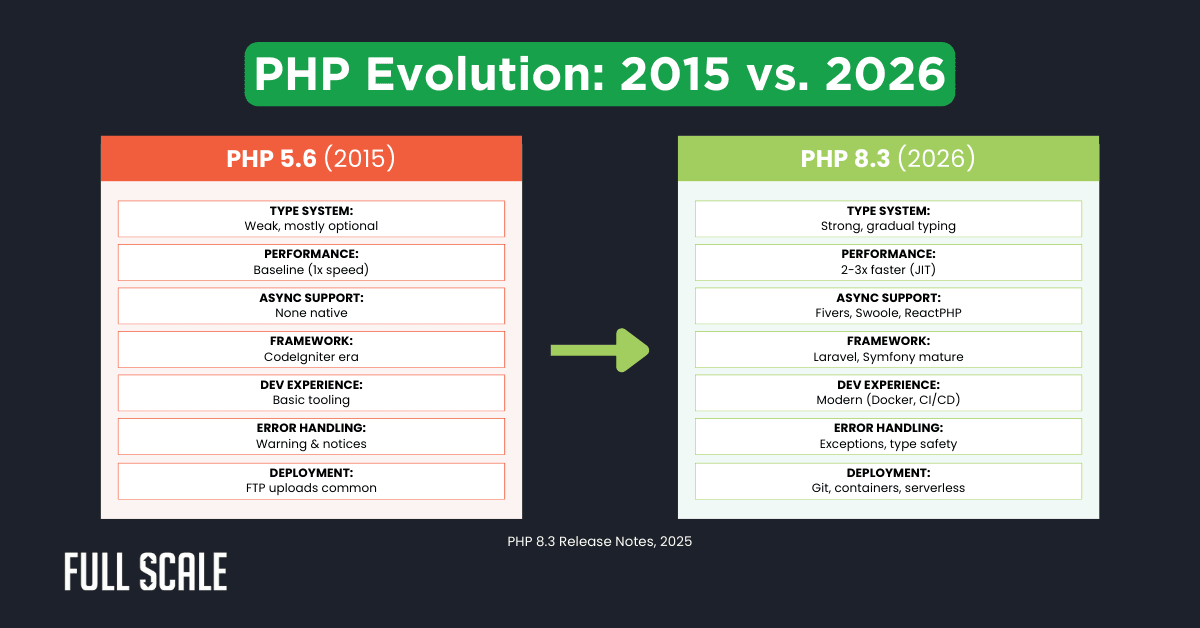
Most PHP criticism references museum exhibits from 2010. Languages evolve, and the surrounding tooling matures along with them.
Laravel and Symfony Framework Maturity
Laravel transformed the PHP development experience. Eloquent ORM is genuinely pleasant to write against, Artisan CLI handles code generation, and Livewire builds dynamic UIs without a separate JavaScript stack. There are 30+ first-party Laravel packages covering common needs out of the box. Laravel pairs naturally with Vue.js on the frontend, which is why teams running Laravel often hire Vue.js developers to complete the full-stack picture. That transformation is exactly why the model matters when you want to outsource Laravel development: the wrong vendor delivers PHP spaghetti wearing a Laravel costume, which is harder to inherit than unstructured PHP because the framework’s conventions make the violations more visible. I ranked Laravel against the rest of the field in our breakdown of PHP MVC frameworks, and it was not a close call.
Symfony serves enterprise requirements. Component-based architecture, four-year LTS releases, and professional support from SensioLabs. Used in production by Spotify, BlaBlaCar, and Trivago.
When developers say “PHP is slow,” ask if they’ve used PHP 8 with Opcache and Laravel. Usually they haven’t. When they say “PHP can’t do async,” ask about Swoole or Fibers, and they usually answer “what are those?” Most PHP criticism in 2026 is operating on outdated information.
PHP vs. Python, Java, and Ruby on Rails
PHP isn’t right for everything. Here’s where each alternative actually wins, and where PHP still beats them.
PHP vs. Python
Python wins anywhere machine learning, data engineering, or scientific computing dominates. The library set (NumPy, Pandas, PyTorch, TensorFlow) is unmatched, and the data community has standardized on it. For web applications, Django and FastAPI are excellent, but Python’s web share is far smaller than its developer share suggests. PHP wins on web specifically: deeper production track record, more shared hosting, more CMS work, more e-commerce. If the application is content-heavy or transactional and doesn’t lean on ML, PHP has a faster path to shipped.
PHP vs. Java
Java wins inside large enterprises that already run on the JVM, especially in financial services and anywhere strict performance contracts and long-lived backend services are the norm. Spring is mature, the talent pool is enormous, and JVM observability tools are unmatched. PHP wins on hiring speed and feature velocity for web-first products. A Laravel team can ship a feature in the time it takes a Spring team to get the configuration right. For a CRUD-heavy web app, PHP is dramatically lower friction.
PHP vs. Ruby on Rails
Rails has lost ground over the past decade as the broader Ruby talent pool has shrunk. The framework itself is still good, and Shopify proves Rails can scale, but hiring Ruby developers is materially harder than hiring PHP or Node developers in 2026. Laravel borrowed many of the design ideas that made Rails great and put them on a deeper talent pool. For a greenfield web project today, Laravel has most of the developer-experience benefits Rails had a decade ago, and the hiring economics are friendlier. That smaller pool is actually one reason offshore Ruby on Rails development works well when structured correctly: the engineers who stayed with the framework through its decline are genuinely senior, and the conventions enforce code quality in ways that make offshore teams more predictable.
The PHP Developer Hiring Reality in 2026
The “PHP developer shortage” narrative contradicts the actual market data.
Global Talent Distribution
PHP is among the most-used backend languages worldwide, with about 18% of professional developers using it according to the Stack Overflow Developer Survey 2024. SlashData puts the global developer population at roughly 47 million as of early 2025, with PHP, Java, and C# all sitting in a similar usage band well above Ruby or Go. The implication for hiring: pool depth is not the bottleneck for PHP teams in 2026.
Where the pool is especially deep is the Philippines, India, Eastern Europe, and Latin America, all of which have long-running PHP and WordPress communities. The US has a smaller share of working PHP devs as a percentage of its developer population, which is why offshore hiring favors PHP so heavily.
Full Scale’s Hiring Data
Based on 700+ developer placements with clients since 2018, here’s what we see for offshore PHP development:
Average time to a staffed developer:
- PHP (Laravel or Symfony): 14-21 days
- Node.js: 35-45 days
- Python (Django or FastAPI): 30-40 days
Quality metrics from our internal assessments:
- PHP developers: ~78% pass rate
- Node developers: ~71% pass rate
- Python developers: ~75% pass rate
Why PHP hiring runs faster: a deeper local pool means better selection, more senior developers are available, the Philippines specializes in WordPress and e-commerce work, and the framework set (especially Laravel) is mature enough that onboarding into a new codebase is fast.
Understanding how to manage offshore development teams effectively is what lets companies actually capture these hiring advantages.
Philippines PHP Advantage
WordPress is a huge tailwind. WordPress runs about 43% of all websites, which created a massive PHP training infrastructure in the countries that built that hosting work. E-commerce work through WooCommerce, Shopify, and Magento adds to it. That same bench is who you want when a WooCommerce store outgrows its template and needs real e-commerce development work.
Cost-quality balance. Senior offshore developers come in at 50-70% lower fully loaded cost than equivalent US hires, with the same technical capabilities and strong English communication. The Philippines is the third-largest English-speaking country in the world, which is why it works so well for synchronous engineering collaboration.
The “PHP developer shortage” is a US tech hub problem, not a global reality. When clients ask why companies still use PHP given hiring concerns, we present 3-5 vetted senior Laravel or Symfony developers within two weeks. The talent exists globally; the bottleneck is usually local recruiting.
PHP’s “uncoolness” actually makes hiring easier. Resume-driven developers chase Node and Python jobs, which leaves an underpriced pool of experienced senior PHP developers who have already scaled production systems. That pool is available at materially lower cost with materially faster time-to-staffed.
Why I’m Still Betting on PHP in 2026 (Including for My Own Startups)
I run Full Scale, and PHP shows up in client work constantly. Laravel projects, WordPress at enterprise scale, Magento builds, existing PHP codebases that need senior developers instead of a rewrite. The demand has not trailed off. It has looked the same shape for years.
One of our clients, Facility Ally, came to us after multiple agencies told them their existing platform needed to be scrapped and rebuilt from scratch. We took the opposite position. We extended what they already had, integrated our developers directly into their team, and turned what other shops had called a “must-rewrite” into a platform that grew with their business. That is the typical PHP story I see in production. The language is rarely the problem, the previous shop’s process was.
The part that surprises people is that we are using PHP for our own new products, too. Full Scale Ventures is the startup studio side of our business, and our newest product, ProductWave, is built entirely on PHP with Laravel. The reason is not nostalgia. We got tired of the JavaScript world’s churn, the dependency hell, the new framework every nine months, the constant re-platforming. Laravel is opinionated in the right places. You get authentication, queues, an ORM, scheduling, and a sensible directory structure on day one, and you stop arguing with the tooling and start shipping features.
The AI part matters too. Modern coding agents work very well with Laravel because the framework’s conventions are so consistent across every Laravel project on earth. The same file lives in the same place every single time. That predictability means AI tools generate far better code in a Laravel app than in a from-scratch Node service where every team has invented its own layout. We have been shipping startup MVPs in weeks instead of months, and PHP is a big part of why.
This is the same lens behind the Product Driven approach: engineering decisions get made against customer outcomes, not framework fashion. So when a client asks me whether PHP is still relevant, I do not just point at Etsy and Slack. I point at our own product roadmap.
Why Partner with Full Scale for PHP Development
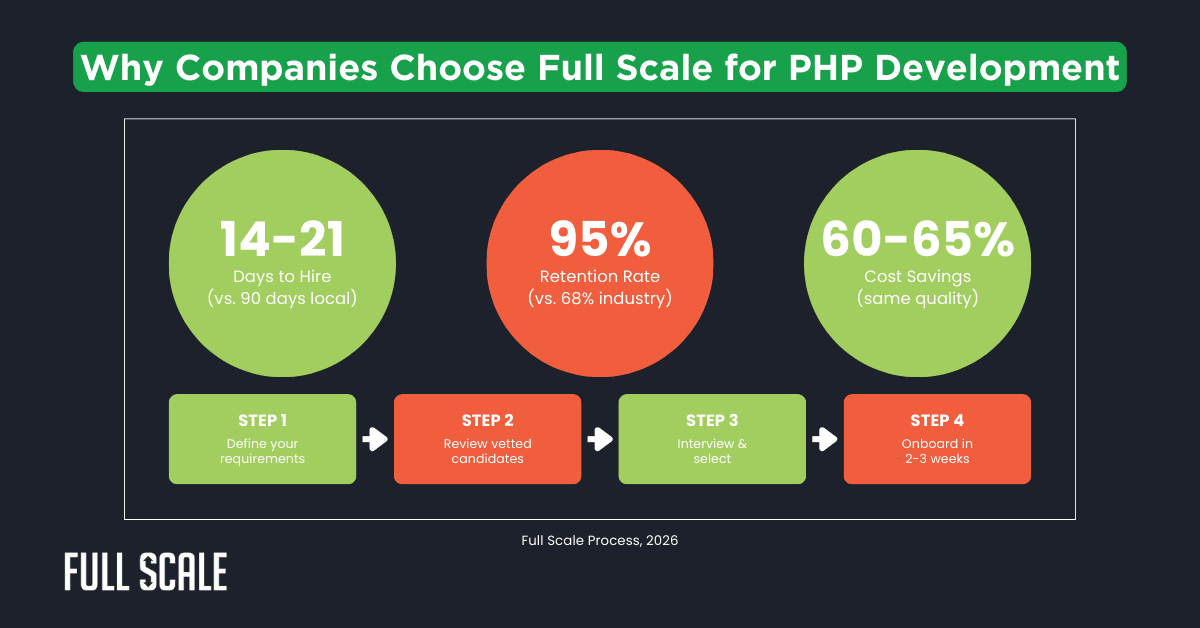
Most companies discover offshore PHP development after local hiring fails. They’ve spent 90+ days searching, lost candidates to salary competition, and come out the other side with no developers and a delayed roadmap. Full Scale solves that specifically.
What makes our approach different:
- Pre-vetted PHP talent pool: access to deep Laravel and Symfony specialist relationships in the Philippines
- 14-21 day hiring timeline: not 90 days, two to three weeks from requirements to onboarded developer
- Direct integration model: your developers work directly with your team, no project-manager middlemen, daily standups, Slack access, full integration
- 93%+ developer retention rate: our developers stay because we treat them as team members, with competitive local salaries and career development paths
- Month-to-month flexibility: no long-term contracts; scale up during launches, scale down between initiatives
- Cost efficiency without quality trade-offs: senior offshore developers at 50-70% lower fully loaded cost than equivalent US hires
- Named to the Inc. 5000 five years in a row, with 350+ engineers and operations staff in the Philippines
We’ve placed 700+ developers with clients since 2018 and served 200+ tech companies. We understand the specific failure modes of offshore PHP staffing, and how to build a team that avoids them.
PHP Is Not Dead, It Is Just Unfashionable (And That Is a Feature)
PHP “died” on Hacker News, not in production. The gap between developer sentiment and business reality is where the opportunity sits.
The core thesis: ~72% of websites with a known server-side language, 18%+ of professional developers using it, enterprise scale across billions of requests. Modern PHP 8.x rivals Node and Python in features and performance. The business case (talent, maturity, cost) beats developer sentiment.
The Real Competitive Advantage
Choosing PHP creates real business advantages: it filters out resume-driven developers, gives you a deeper talent pool with better selection, runs on faster hiring timelines that save whole quarters, costs less without quality compromise, avoids the rewrite trap that has killed countless companies, and lets your team spend time shipping products instead of debating languages.
Developers who dismiss PHP are usually optimizing for their next job interview, while the ones who choose it are optimizing for shipping the product in front of them.
Boring Technology Wins
The best technology decisions are boring. Boring means proven, stable, staffable, and predictable. Boring means you spend time on customer problems, not framework problems.
We’ve worked with 200+ companies through Full Scale. The companies that succeed ship features consistently, scale teams predictably, control costs intelligently, and focus on business outcomes. PHP checks all four boxes, especially when you hire senior PHP developers offshore in 14-21 days at materially lower cost.
Choosing the boring, proven option here is the strategic move, not a compromise.
Choose Business Outcomes Over Developer Sentiment
Great CTOs ship products, scale teams, and hit business objectives. Nobody got fired for choosing PHP when it powered their successful product. They got fired for spending 18 months rewriting working applications while competitors shipped features.
Your decision framework should prioritize five questions:
- Does this help us ship products faster?
- Can we hire and retain quality developers?
- Does it reduce operational risk?
- What’s the total cost of ownership over 3-5 years?
- Will this decision make sense in 3 years?
For most web applications serving real customers, PHP’s proven track record, abundant talent, and mature framework support create competitive advantages that newer alternatives can’t match. Node and Python have their place. PHP has the production web.
The noise about “PHP is dead” will continue. Meanwhile, you’ll be shipping features customers pay for, on technology that works, at costs that make CFOs happy.
Build Your PHP Team the Smart Way
Stop debating technology stacks. Start shipping products with senior PHP developers who integrate directly into your team.
- Vetted senior developers in 14 to 21 days
- 50-70% lower fully loaded cost than equivalent US hires
- Direct team integration, no middlemen
- 93%+ retention rate, proven results
- Month-to-month flexibility, no long-term contracts
Schedule a call with Full Scale
Frequently Asked Questions About PHP in 2026
Is PHP actually dead or dying in 2026?
No. PHP powers about 72% of websites with a known server-side language according to W3Techs, runs platforms handling billions of daily requests, and remains one of the top backend languages by developer usage. PHP 8.x ships JIT compilation, union types, and async capabilities. “PHP is dead” reflects developer sentiment, not usage reality. Companies still use PHP because it works at scale, and the market share has held between roughly 71% and 79% for the past decade.
Should I migrate my PHP application to Node.js or Python?
Only if PHP has specific technical limitations blocking critical business objectives. Most migrations fail (industry studies put 70%+ over budget or timeline), cost $1.5M-5M, take 12-24 months, and deliver zero customer value during the rewrite. Consider modernizing the existing PHP application instead: upgrade to 8.x, adopt Laravel or Symfony, improve architecture incrementally. Costs roughly 80% less, ships features along the way.
Can I still hire good PHP developers in 2026?
Yes. PHP is among the most widely used backend languages globally (about 18% of professional developers per the Stack Overflow Developer Survey 2024). Average US hiring timeline for PHP is 60-90 days. Offshore (Philippines, Eastern Europe): 14-30 days. PHP’s “uncoolness” filters out resume-driven developers, which leaves experienced engineers who ship products. Offshore salary advantage is typically 50-70% lower than equivalent US hires.
How do I defend the choice to keep using PHP to my board?
Frame it in business terms: PHP offers a deep talent pool, faster hiring than most alternatives, lower fully loaded costs, and proven enterprise scalability. Etsy (~$2.6B annual revenue), Slack (47M daily active users), and WordPress (~43% of the web) all run on PHP. Rewriting working code would cost $2M+ and 18 months with zero customer value delivered. Boards care about risk, staffability, and business outcomes; technical elegance doesn’t move that conversation.
What’s the difference between PHP 5 and PHP 8?
PHP 8 is fundamentally different: 2-3X faster (JIT compiler), strong type system (union types, readonly properties), modern syntax (attributes, enums, match expressions), async capabilities (Fibers), and improved error handling. If your mental model is PHP 5.6, you’re operating on more than a decade of stale information. The gap between PHP 5.6 and PHP 8.x is roughly the same shape as jQuery-era JavaScript versus modern React.
Is PHP still used in 2026?
Yes. W3Techs reports PHP powers about 72% of all websites with a known server-side language as of May 2026, with that share holding between roughly 71% and 79% for the past decade. Major platforms running PHP in production include Etsy, Slack, Wikipedia, Mailchimp, Tumblr, and WordPress (which alone runs around 43% of the web). PHP usage is widespread, stable, and embedded in the infrastructure of the web.
Does PHP have a future?
Yes, an actively developed one. The language ships a new major version roughly every year. PHP 8.0 added JIT compilation, 8.1 added Fibers and enums, 8.2 and 8.3 added performance and type improvements, 8.4 added property hooks, and 8.5 added the pipe operator. Laravel and Symfony continue to release major versions. The PHP Foundation, launched in 2021, funds core language development with backing from JetBrains, Automattic, Laravel, and others. A language with a dedicated foundation, annual major releases, and millions of working developers is not running out of future.
What is replacing PHP?
Nothing, at the scale PHP operates. Node.js, Python, Ruby on Rails, and Go are all growing, but none have displaced PHP from the bulk of the web. WordPress alone runs around 43% of all websites, and migrating WordPress, Drupal, Magento, and the hundreds of thousands of custom Laravel and Symfony applications running in production is not happening at any meaningful volume. For greenfield projects, teams choose Node, Python, or Go for specific reasons (real-time, ML, microservices), but PHP remains the default for content sites, e-commerce, CMS work, and standard CRUD applications.
Is PHP outdated or obsolete?
No, but a lot of PHP codebases are. The “PHP is outdated” opinion almost always comes from a developer whose last PHP experience was a PHP 5.6 codebase in 2014. Modern PHP (8.x) is a typed, JIT-compiled, async-capable language with mature frameworks. If you have only seen legacy spaghetti PHP, you are evaluating a 10-year-old version of the language. The “obsolete” perception is real, but it is about what people remember, not what PHP actually is today.
My team is still on PHP 7.4 or 8.0. Is that safe in 2026?
PHP 7.4 and PHP 8.0 are both end-of-life. They no longer receive security patches from the core team. If you are running them in production, you are accepting unpatched vulnerabilities and increasingly broken framework and dependency compatibility. The fix is straightforward: upgrade to a currently supported PHP 8.x release. The work is usually weeks, not months, and far cheaper than a full language migration. Treat EOL PHP the way you’d treat an EOL operating system in production.
Is core PHP (without a framework) still relevant?
For small scripts, microsites, hosting bootstrap, and learning purposes, yes. For production applications, almost everyone uses Laravel or Symfony, and that is the right choice. Modern PHP development is essentially framework PHP. The same is true everywhere else (Python production work happens in Django, FastAPI, or Flask; Ruby production work happens in Rails). “Core” PHP without a framework is fine for tiny tools but not the realistic comparison point against Node or Python.
Is PHP worth learning in 2026?
Yes, especially if you want to be employable quickly. PHP has the largest production web footprint of any backend language because WordPress, Magento, and the millions of Laravel applications all create ongoing demand. Laravel is one of the most loved frameworks in modern web development. Salaries are strong, the learning curve is gentler than JavaScript or Java, and AI coding tools generate Laravel code unusually well, which makes new developers productive faster.
Why does Full Scale use PHP for its own products?
We are tired of the JavaScript world’s churn and constant re-platforming. Laravel is opinionated in the right places, so we stop arguing with the tooling and start shipping. Our newest internal product, ProductWave, is built entirely on PHP and Laravel. AI coding agents also produce notably better code in Laravel than in a from-scratch Node app, because Laravel’s conventions are consistent across every project. That predictability compounds when you are shipping startups quickly.
Is PHP still relevant in 2026?
Yes. It runs about 72% of all websites with a known server-side language, powers production systems at Etsy, Slack, and Wikipedia, and remains one of the most widely used backend languages by working developers. The “PHP is dead” narrative is a developer-sentiment problem, not a deployment-data one.