
Outsource iOS App Development: How to Pick the Right Model

In this article
- Two iOS Engagement Models, and the App Store Changes the Math
- Three Things That Break Outsourced iOS Engagements
- What to Look for in an iOS Outsourcing Partner
- Native vs Cross-Platform, and Why the Engagement Model Matters More Than the Framework
- Why the Philippines for Outsourced iOS Work
- What the Cost Comparison Actually Looks Like
- What AI Changes About Outsourcing iOS Work
- How Offshore iOS Engagements Run Day to Day
- Frequently Asked Questions
- Ready to Build an iOS Team That Works Like Your Own
Quick Answer: Outsourcing iOS app development usually means one of two models: project outsourcing, where a vendor delivers a fixed v1 build to the App Store, or staff augmentation, where iOS engineers join your team directly and keep shipping after launch. For most apps that keep evolving past v1, staff augmentation wins because Apple’s platform never stops needing new work: OS updates, App Store re-reviews, feature releases. Full Scale places senior iOS engineers in the Philippines under this model, the same approach AMC Theatres uses for its iOS team.
I have been building iPhone apps for nearly twenty years. Back at VinSolutions, my team built a mobile app for car dealerships to track their customer interactions on the lot, and iOS was part of the product before most car dealers had ever heard of an iPhone. Every product I have shipped since has had iOS in it somewhere. Stackify, the developer-tools company I founded after VinSolutions, had iOS. Full Scale today staffs iOS engineers at AMC Theatres, where they help build the ticketing platform serving 900+ theatres worldwide, the A-List loyalty app, and the popcorn subscription experience. That history is why I have strong opinions on Objective-C vs. Swift and what to do with an older codebase. A vague brief is usually the root cause, which is why writing a sharp iOS developer job description comes first.
This is the iOS-specific version of the outsourcing decision. For the cross-platform picture (how the project-versus-team call plays out across Android and React Native too), see our outsource mobile app development guide.
I have also shipped cross-platform iOS work along the way in React Native, Ionic, and Xamarin, when one codebase across iOS and Android was the right call. The lesson has been consistent: when the app has to feel like an iPhone app, it needs an engineer who actually understands iPhone: Apple’s Human Interface Guidelines, the App Store review queue, and what users expect out of a native iOS experience.
That experience changes how I read the phrase “outsource iOS app development.”
Most companies typing it into Google are trying to solve one of two distinct problems, and the right model is different between them. Treating them as the same engagement is how iOS outsourcing horror stories happen.
Problem one: “I need an iOS app built and shipped to the App Store. We have a spec. We need a team to take it, ship a v1, and hand it back.” This is a real scoped project. App Store submission of a defined v1 with a locked scope IS a legitimate outsourcing candidate.
Problem two: “I need iOS engineers shipping updates, new features, and bug fixes for years on a live iPhone app, working alongside my product team.” That is not a project. That is a team. Outsourcing it as a project is the most common iOS engagement failure.
If you already know you want offshore iOS engineers embedded in your team for the long haul, the section on how those engagements run day to day, further down, covers that model. This post starts with the earlier decision: is your iOS work a project, a team, or both?
Two iOS Engagement Models, and the App Store Changes the Math
Which model you pick decides more than which vendor you pick.
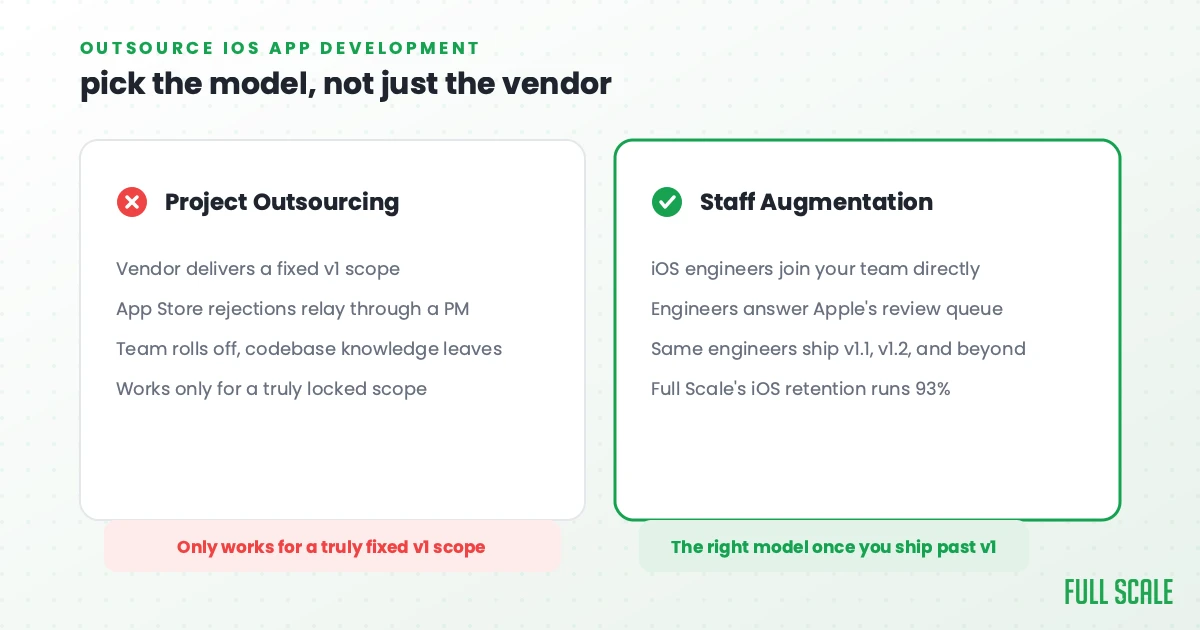
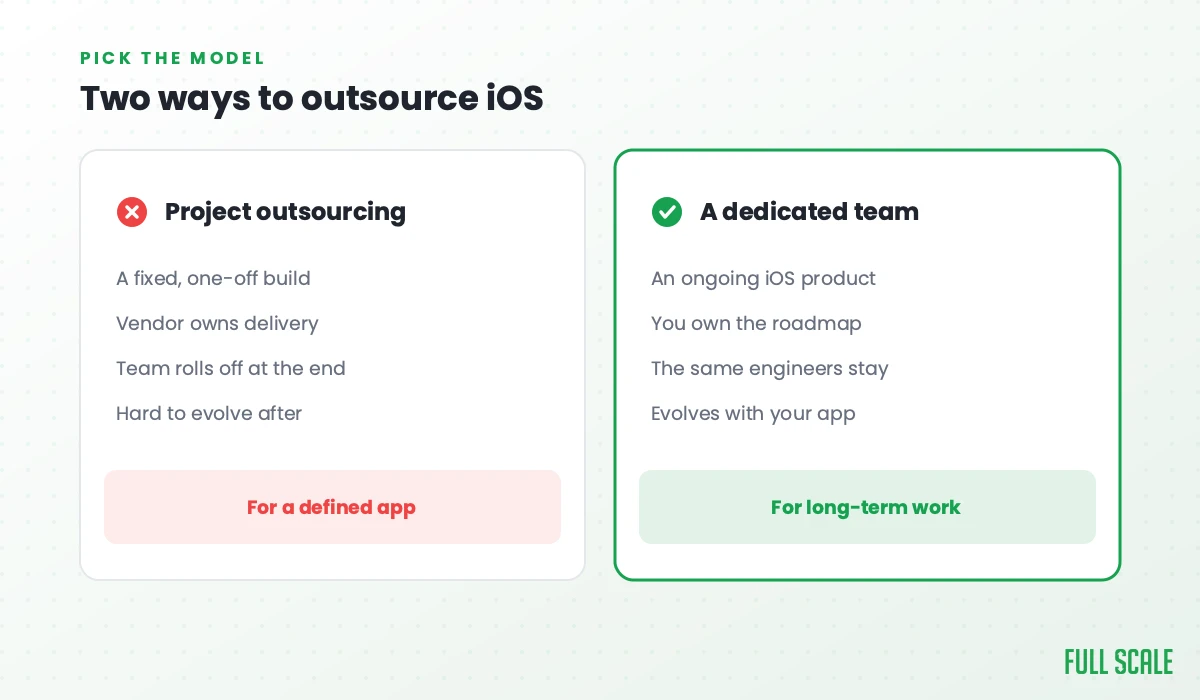
Staff augmentation means you add iOS engineers directly to your team. They report to your engineering lead, they’re in your standups, they ship to your TestFlight pipeline, they read your code review standards. For any iOS engagement past launch, this is the model that works. Every iOS app keeps shipping after launch: bug fixes, App Store rejections to handle, iOS version updates to test against, new Apple frameworks to adopt. The engineers become institutional knowledge holders over time. A team, not a project shop, optimizes for the outcome.
Project outsourcing means you hand a defined scope to a development shop and they deliver it. For iOS specifically, this can work for a narrow case: a finite v1 app with a locked spec, a defined feature set, a known submission target. I have outsourced scoped software projects myself when the scope was genuinely fixed.
The reason iOS has a real project carve-out is the App Store. A v1 submission is, by Apple’s design, a discrete deliverable: the app gets reviewed, approved, and shipped. That makes “ship me a v1” a more honest scoped project than equivalent work on the web, where the boundary is fuzzier.
Here is the catch. Every successful iOS app needs version 1.0.1. Then 1.1. Then 1.2. Then a fix for the App Store rejection. Then support for the new iOS release every September. Then a SwiftUI rewrite of the screen that creaks. Then a Face ID auth flow. Each of those is small. None of them is the same engagement as the v1 build. The moment your iOS work crosses from “ship a defined v1” to “keep shipping for years,” the right model has changed and you should be hiring a team, not extending a project contract. That ongoing stream of fixes is the real work of application maintenance and support, and it never really ends.
The honest filter: if your iOS app will keep shipping past v1.0, you need iOS engineers on your team, not a project vendor. The question is whether you want the same iOS developers in your standups twelve months from now.
For most products that ship to the App Store, the answer is yes. Full Scale staffs iOS engineers on the team side of this table:
| Your iOS situation | Model that fits |
|---|---|
| A finite v1 with a locked spec and a defined App Store submission target | Project outsourcing |
| A live app that needs bug fixes, new features, and iOS version updates | Staff augmentation |
| App Store rejections you want the engineers to answer directly | Staff augmentation |
| Nobody on your side reviewing builds and making product decisions daily | Fix that first, because either model loses direction without a product owner |
| You want the same iOS engineers in your standups twelve months from now | Staff augmentation |
Three Things That Break Outsourced iOS Engagements
Outsourced iOS engagements usually break in three places: who talks to Apple, who makes the product calls, and how the contract is scoped. Swift quality is rarely the problem.
Handing the App Store relationship over the wall. In a project shop model, the engineers shipping your iOS app are usually not the ones answering Apple’s review queue. The PM relays Apple’s rejection notes through three layers, the engineers don’t see the actual binary that got rejected, and the fix takes a week longer than it should. Apple’s own numbers put that in perspective: App Review typically clears 90% of submissions in under 48 hours, and over 40% of unresolved issues trace to guideline 2.1, App Completeness, which covers crashes, placeholder content, and incomplete information. App Store review is a conversation with Apple, not a checklist, and it goes faster when the engineers writing the Swift can read Apple’s response directly. That is cheapshoring in structural form on iOS.
No product judgment on your side of the call. A senior iOS developer can flag a screen that violates Apple’s Human Interface Guidelines, push back on a navigation pattern that won’t pass review, and call out a privacy disclosure that Apple now requires. What they cannot do is decide what your iOS app is supposed to be. If no one on your side is reviewing the build daily and making the product decisions an iOS app demands (the App Store screenshots, the empty-state copy, the onboarding flow), the build loses direction. Onshore, that loss is uncomfortable. Offshore, with a project shop relay in the middle, it happens faster than you can correct it.
Scoping ongoing iOS work as a finite project. If your iOS app is going to keep evolving (and every consumer or SaaS iOS app does) and you’ve written it as a fixed scope with a defined end date, you have built in a cliff. The engineers who learned your codebase are gone when the contract ends. The Apple developer account credentials get re-handed-off. The next contract restarts the re-orientation from zero. The compounding value of senior iOS engineers who actually know your app never accrues to you.
What to Look for in an iOS Outsourcing Partner
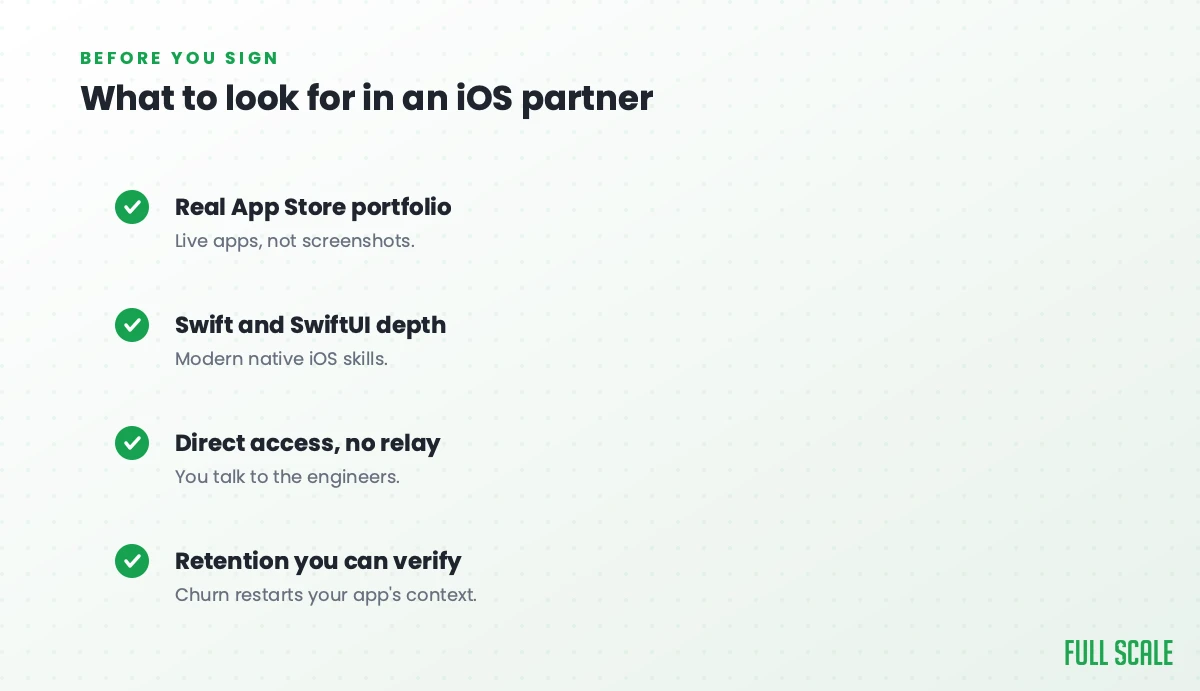
Judge an iOS outsourcing partner on four things: direct access to the engineers, real Apple platform fluency, a staffing model instead of a project model, and retention you can verify. Framework checklists (Swift versions, SwiftUI vs UIKit, Combine vs Swift Concurrency, third-party SDK familiarity) matter, but they are table stakes, because senior iOS developers in the Philippines are building the same production iOS apps as developers anywhere else.
Can you talk directly to the iOS developers writing your Swift? If the vendor will not put their engineers in your Slack, on your video calls, and in your code reviews, walk away. Direct access is the baseline for iOS work specifically because of how often the Apple platform needs an engineer-level conversation, not a PM-level one.
Do they have real Apple platform fluency, or just Swift fluency? Anyone who passed a SwiftUI tutorial can ship a screen. The question is whether the developer can read a Crashlytics trace, profile a slow scroll in Instruments, reason about why your app is being killed in the background, and explain why Apple flagged the privacy nutrition label. Test for Apple’s Human Interface Guidelines in the developer’s bones, not just SwiftUI syntax. Code that ignores platform conventions is the single most common reason an iOS app feels off and gets one-star reviews.
Have they shipped through Apple review, and can they read the rejection? Real iOS work covers App Store Connect, TestFlight pipelines, metadata that survives review, privacy nutrition labels, and the rejection reasons Apple actually flags. The iOS developer you want has been through review enough times to read a rejection email and know right away whether it is a real policy issue or a reviewer interpretation that can be appealed.
Do they run a staffing model or a project model? A vendor whose business depends on closing new project scopes has an incentive to keep your engagement transactional. A vendor whose model is built around long-term staffing has an incentive to retain the iOS engineers who learned your codebase and put them on your team for years. The incentives diverge from day one. For iOS specifically, the staffing model wins because the work doesn’t end at v1. The same incentive test applies when the vendor calls the model outstaffing, and I’ve covered how to vet outstaffing services separately.
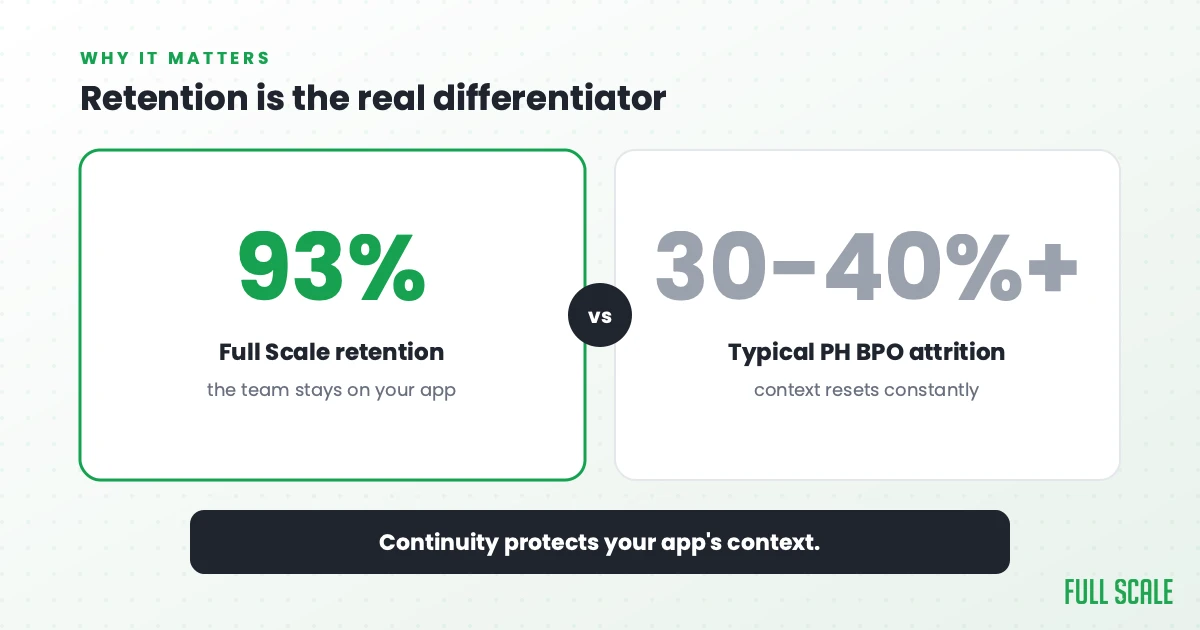
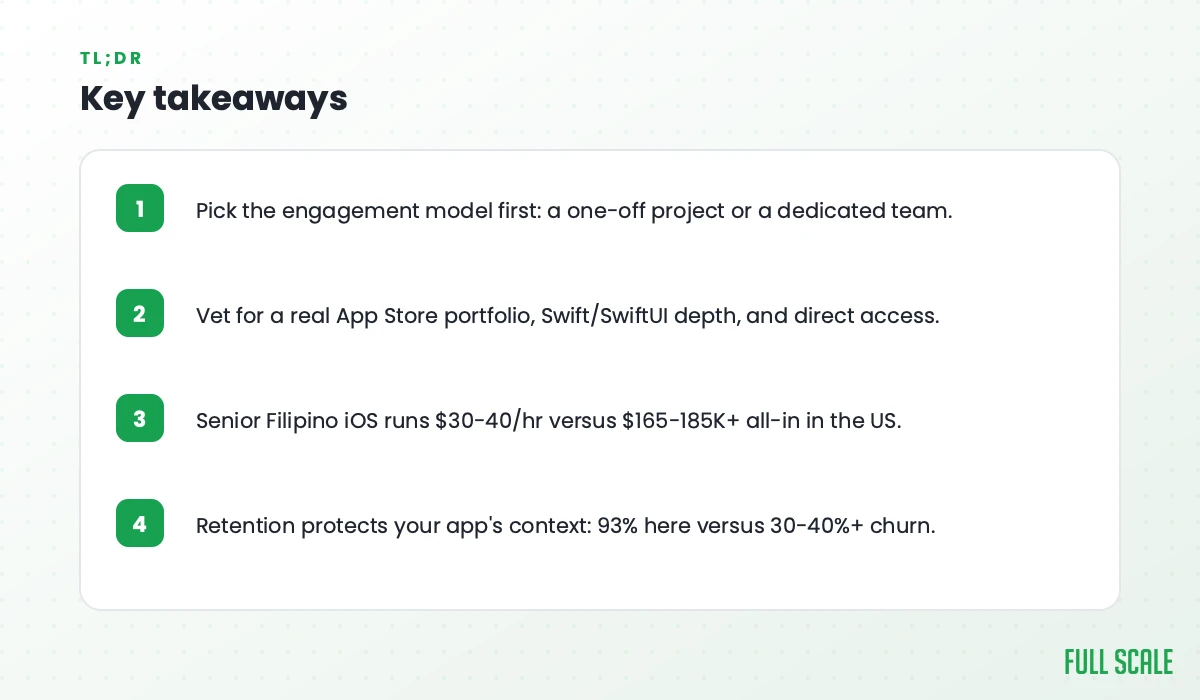
What does developer retention actually look like? Full Scale’s developer retention runs at 93%, against 30-40%+ voluntary attrition typical in Philippine BPO work. Retention is a continuity number. It shows up in how fast the iOS developer who knows your codebase can ship the next iOS version compatibility fix.
When you find an offshore software development partner that clears those four filters, the rest of iOS hiring starts to feel less like outsourcing and more like building a team.
Native vs Cross-Platform, and Why the Engagement Model Matters More Than the Framework
Both native and cross-platform work when you pick the right one for the product. The debate eats more iOS hiring conversations than it should.
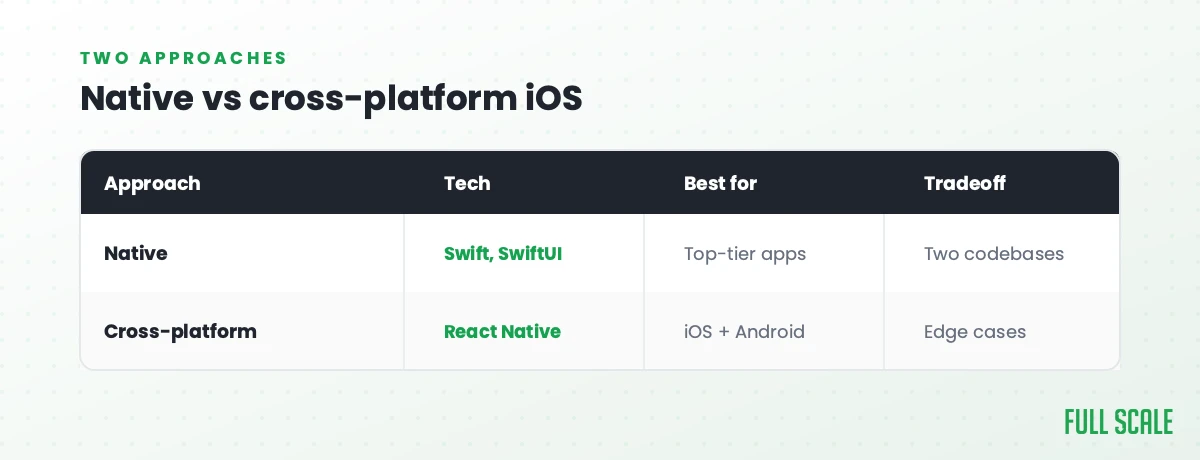
I have shipped React Native and Ionic apps that did exactly what the product needed. I have also shipped native iOS apps where cross-platform would have been the wrong call, anything that needed deep Apple platform integration, complex animations, or App Store-tier polish.
What matters more than the framework choice is who is operating it and how the engagement is structured. A senior iOS engineer working as part of your team for two years, fluent in both native Swift and React Native, will outperform a project shop shipping you “an iOS app” without context. The wrong engagement model with the right framework still produces a bad app. The right engagement model with whichever framework actually fits the product will ship.
Why the Philippines for Outsourced iOS Work
The reason Full Scale operates specifically in the Philippines for iOS is not the hourly rate. It is the combination of attributes that make a remote iOS engineering team actually function. There are talented iOS developers in many countries. I have hired engineers in Russia, Latin America, India, and the Philippines across my career.
The old offshore model looked like this: write requirements, hand off, wait, receive build. AI can now do most of that. If your offshore iOS team’s only value is executing a spec you wrote, you do not need an offshore team. You need a better prompt.
What you need in 2026 is a team that asks the right questions when a screen spec is unclear, challenges a navigation pattern that won’t ship past Apple review, and pushes the app toward the best product solution rather than the requested one. That requires communication skills and a culture of intellectual engagement that not every country brings to iOS work.
The Philippines is the third-largest English-speaking country in the world. Filipino iOS developers grew up consuming American culture, American media, American tech conventions. The communication style suits remote engineering. More than language fluency, the hospitality and service orientation that makes Filipinos exceptional at customer-facing work translates straight into iOS development. Filipino iOS engineers ask whether the screen should ship before they pick up the ticket.
The Philippine IT-BPM industry generates $40 billion in annual export revenue and employs 1.8 million workers. The iOS talent pool is deep and has been deep since the App Store opened in 2008.
What the Cost Comparison Actually Looks Like
Full Scale clients typically pay $30-$40 per hour for a senior Filipino iOS engineer. A comparable engineer in the US earns a BLS median of around $133,000 per year in base salary. Once you add benefits, payroll taxes, and overhead (what MIT research estimates at 1.25 to 1.4 times base salary), the all-in cost of a senior US iOS engineer runs $165,000 to $185,000 or more per year, with senior San Francisco iOS engineers clearing $200,000.
| Full Scale (iOS, Philippines) | US Senior iOS Engineer | |
|---|---|---|
| Hourly / annual cost | $30-$40/hr (~$62K-$83K/yr) | $133K base → ~$165K-$200K all-in |
| Time to staff | ~14 days | 6-12 weeks |
| Recruiting fee | None | 20-25% of first-year salary |
The math is what it is. The caveat: that cost gap does not matter if you pick the wrong model. A $35-an-hour iOS engineer on a project-outsourcing contract delivering an app you can’t update is not a bargain compared to a $200K in-house engineer who understands your product.
What AI Changes About Outsourcing iOS Work
AI is making the code-writing part of iOS development cheaper by the month. I tell clients half-jokingly that we are all paying developers to babysit AI now, to review what Copilot and Claude generate, catch where the generated SwiftUI breaks Apple platform conventions, and steer the output toward something Apple will actually approve.
The Xcode built-in AI tools and the Claude / Copilot / Cursor toolchain are now part of every senior iOS engineer’s workflow. That shift changes the offshore cost argument, but not in the direction most people expect. If supervising and directing AI-generated iOS code is increasingly the core of the job, there is less reason to pay $200,000 a year for someone to do it onshore when a Filipino senior iOS engineer can do the same work for 50 to 70 percent less.
The more important implication runs the other way. The real value in iOS engineering has always been the product thinking, not the typing of Swift. Understanding what users will tap, why the navigation should branch where it does, and whether Apple will approve the experience is the work that matters. That is the difference between a software engineer and a software developer. AI is making the engineering part cheaper. Product thinking is not something AI replaces.
The reason I push it: I do not want to be a year down the road with clients returning iOS developers who never learned AI and are now a generation behind. We refuse to be in that position.
That arc is also what Product Driven is about. It is about building iOS engineers who take ownership of what they ship and why, not engineers who produce Swift when handed a ticket.
How Offshore iOS Engagements Run Day to Day
If you land on staff augmentation for your iOS work, here is what the engagement looks like in practice, because "offshore iOS development" is a phrase that hides a lot of different setups.
Every iOS developer is vetted before they touch a client team. The screen includes a technical assessment against real iOS architecture problems, not Swift syntax quizzes, an English fluency evaluation, and detailed background checks. Once an engineer is on your team, they are in your tools, your standups, your TestFlight, and your App Store Connect access. Full Scale Customer Success Managers stay in regular contact with both the client and the engineers, so the engagement keeps producing what you need and the engineers keep developing. Most clients run a half-day overlap model: the engineers work late afternoon through midnight Manila time, which gives three to four hours of shared working hours with a US team for sprint planning, code reviews, and the conversations that have to happen live.
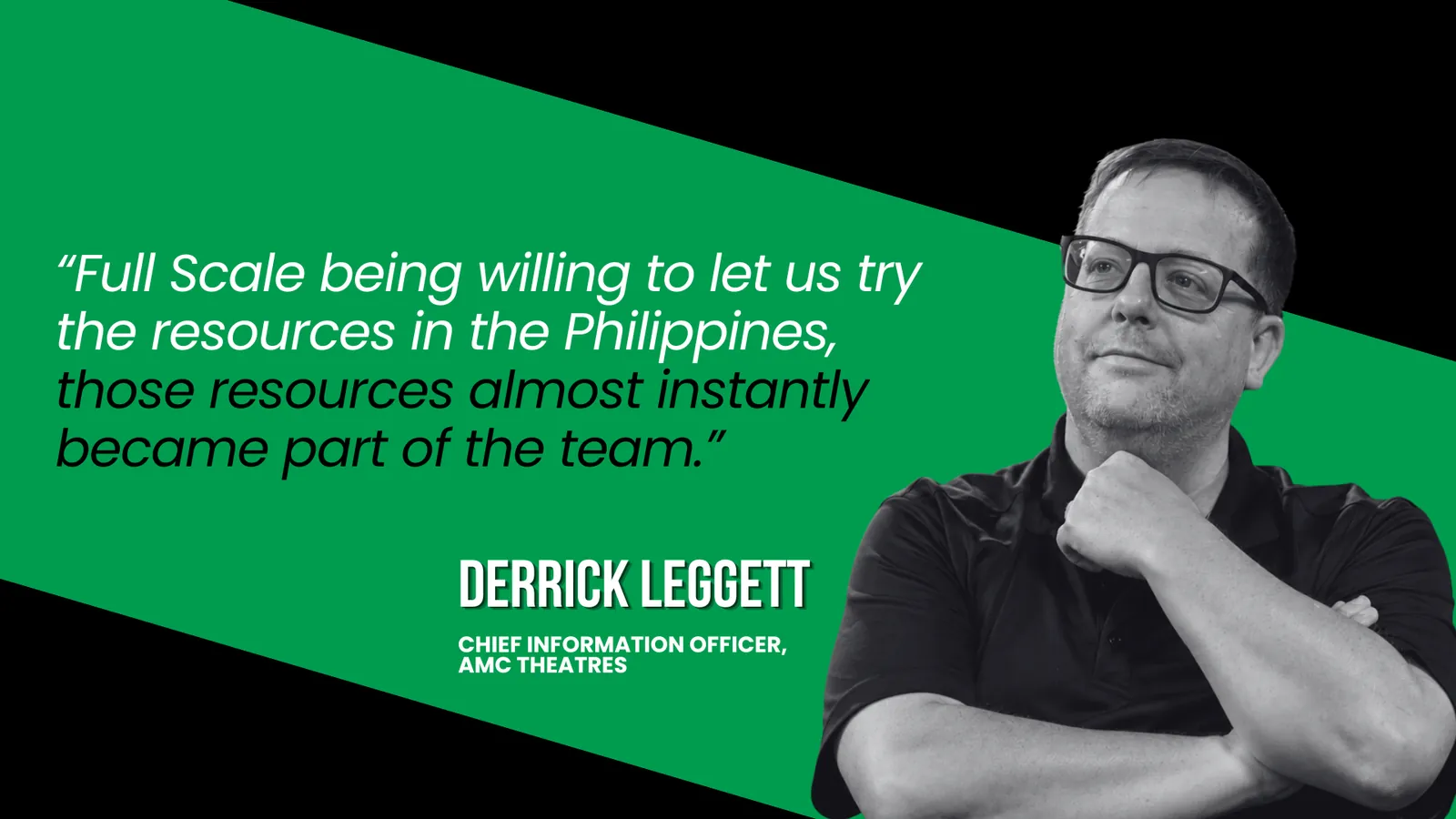
The AMC Theatres engagement is the example I come back to most. The Filipino iOS engineers there have been part of the team for years. They know AMC's ticketing surface and the A-List flows, and they contribute to product roadmap conversations alongside the rest of the engineering org. Derrick Leggett, AMC's CIO, has built a global engineering organization on the conviction that where a developer sits is irrelevant. What matters is whether they are treated as part of the team. That is the standard we hold ourselves to on every iOS engagement.
Frequently Asked Questions
What does it mean to outsource iOS app development?
Outsourcing iOS app development means engaging an outside partner to build or staff work on the Apple platform: Swift, SwiftUI, UIKit, Objective-C migrations, App Store submission and review, TestFlight pipelines, Apple developer account management, and everything around it. The model can be project outsourcing (a fixed v1 scope handed to a shop for delivery) or staff augmentation (engineers who join your team and keep shipping for years). At Full Scale, we’ve found staff augmentation produces materially better outcomes than project outsourcing for most iOS apps that will keep evolving past v1.
What is offshore iOS app development, and how is it different from outsourcing?
Offshore iOS app development means engaging iOS engineers (Swift, SwiftUI, UIKit, App Store Connect, TestFlight, the full Apple platform stack) from a country where engineering costs are significantly lower than in the US. Outsourcing describes who does the work, a project shop or a partner. Offshore describes where the engineers sit. The structure that produces the best results is staff augmentation, where offshore iOS developers join your team directly instead of working through a project shop, with direct access to your product lead, your code review, and your Apple developer account.
When does project outsourcing actually work for iOS?
Project outsourcing works when the work is genuinely scoped. A v1 App Store submission with a locked feature set and a defined launch target can be a real project. Anything past launch (bug fixes, new features, iOS version updates, App Store re-approvals) is a team engagement and should be staffed that way. The most common iOS outsourcing failure is scoping a project contract for what is actually ongoing work.
How much does it cost to outsource iOS development to the Philippines?
At Full Scale, senior iOS developers in the Philippines are staffed at $30-$40 per hour, with typical onboarding inside 14 days. A comparable senior iOS engineer in the US costs $133,000 or more in base salary before benefits, payroll taxes, and recruiting overhead, which puts the all-in cost above $165,000 per year and often above $200,000 in major US tech hubs. The cost gap is real, but the model decision matters more than the rate.
Should I hire iOS-native or cross-platform engineers offshore?
Both can work. Native Swift is the right call for apps that need deep Apple platform integration, complex animations, or App Store-tier polish. React Native, Flutter, or Ionic can be the right call when one codebase across iOS and Android is the business priority and the app does not need native-level Apple platform behavior. What matters more than the framework is who is operating it and whether your engagement is structured as a team relationship or a project handoff. If you land on Flutter, our dedicated Flutter developers integrate into your team instead of taking a handoff.
Ready to Build an iOS Team That Works Like Your Own
Full Scale has been staffing offshore software development teams since 2018. We have placed 700+ developers with clients across 200+ tech companies. Our iOS engineers are working inside consumer-scale brands and SaaS products, including AMC Theatres, where they are full members of the engineering team, not a vendor on the other side of a wall.
If you want to hire iOS developers who can ship to the App Store and keep shipping for years, that is what we staff.
Schedule a call to talk through what the right iOS engagement looks like for your product.