
Outstaffing Services: How They Actually Work

In this article
- Outstaffing is just another word for staff augmentation
- The services an outstaffing company should actually provide
- The roles you can fill through outstaffing
- What outstaffing actually costs
- What outstaffing looks like in practice
- How to choose an outstaffing provider
- Frequently asked questions
- Talk to us about your team
A CTO friend of mine just fired his offshore team.
Productivity was about a quarter of what his local team could do, with no US time zone overlap and communication breakdowns on every standup. He’d been told he was buying outstaffing services. What he actually bought was a roster of underemployed contractors with someone else’s loyalty. The same engagement model works for any frontend stack, including Vue.js: teams that hire Vue.js developers through outstaffing get engineers who join their own standups rather than working behind a vendor wall.
When CTOs and tech founders search for “outstaffing services,” that’s the picture in the back of their head. The horror story. The version where it goes wrong.
That’s not what outstaffing should look like. And honestly, most of the failures I hear about have very little to do with offshore. They have to do with picking the wrong provider, treating the engagement like a project handoff, and not having technical leadership in-house to direct the work. Offshore development sounds great when it’s half the cost. But it should never mean half the performance.
I’ve hired offshore developers in three regions over the past fifteen years, built one of those teams into the engineering org that helped me exit Stackify in 2021, and accidentally turned the model into Full Scale when other founders started asking how we did it. Here’s what an actually-good outstaffing service includes.
Outstaffing is just another word for staff augmentation
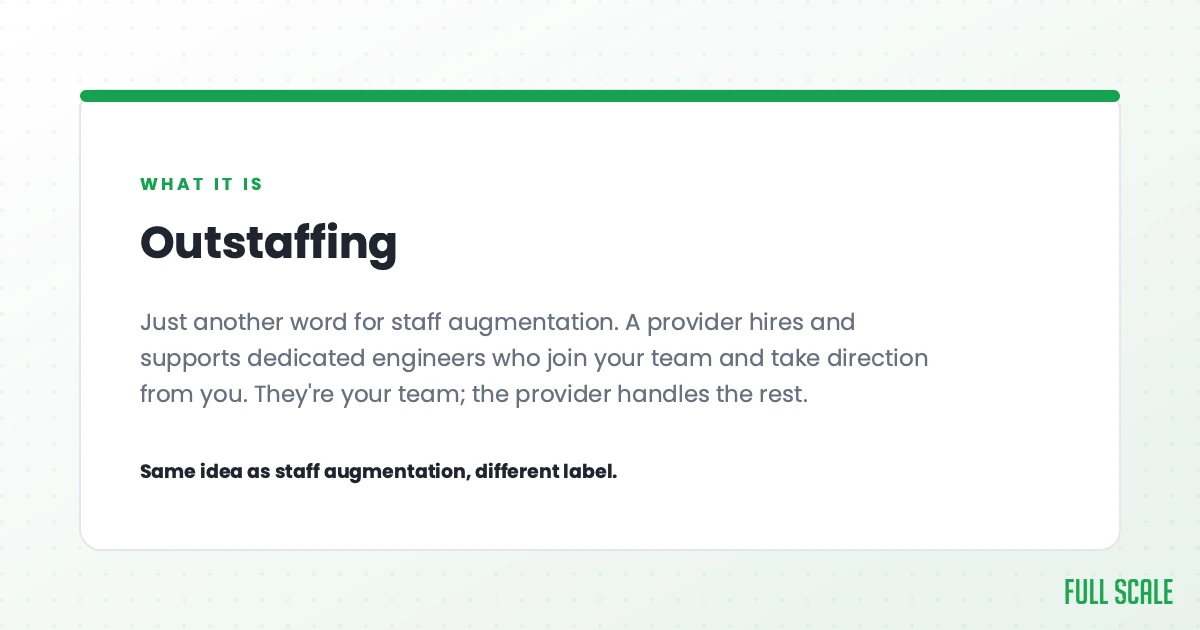
Outstaffing, staff augmentation, team augmentation, dedicated development team, software development as a service. Five names for the same model.
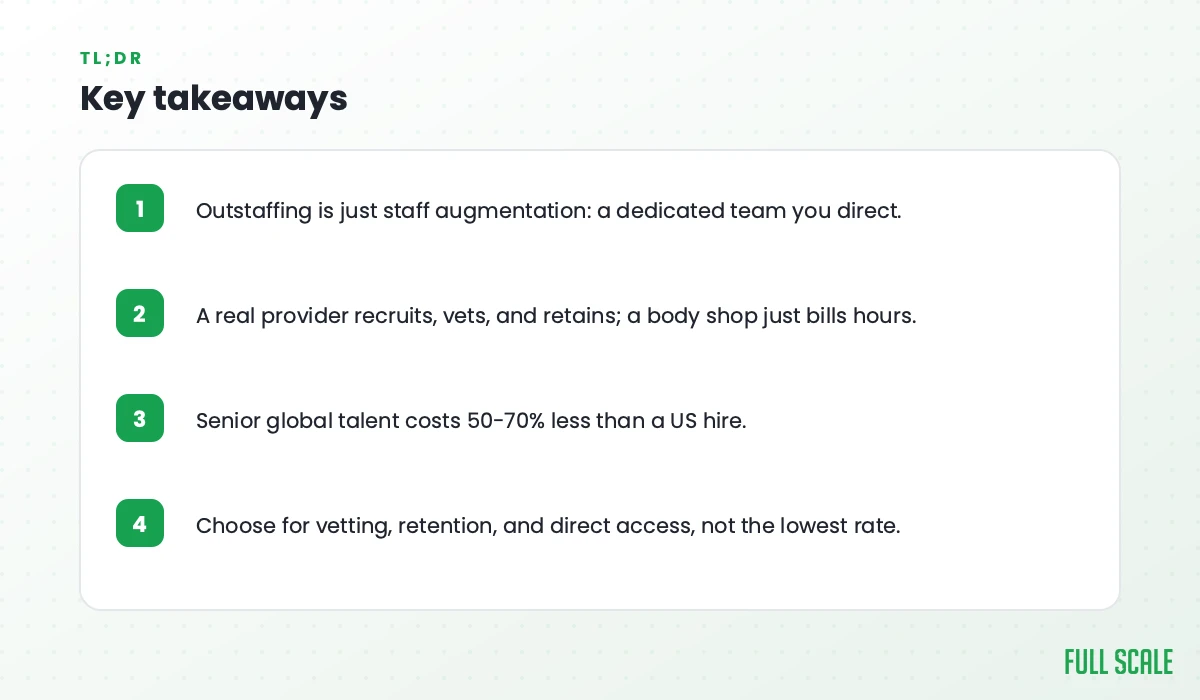
A developer is employed by a third-party provider. They work exclusively for you. They join your standups, code in your repo, report to your tech lead, and follow your priorities. The provider handles their employment, payroll, benefits, taxes, and HR. You handle the work itself.
This is different from outsourcing, where you hand the entire project to a vendor and pay for a delivered outcome. With outstaffing, you own the product and you direct the people building it. With outsourcing, you hand off both.
The reason there are four terms for one model is mostly historical. “Outstaffing” became common vocabulary in Eastern European dev shops in the 2000s, “staff augmentation” is more common in the US, and “team augmentation” or “dedicated team” gets used when more than one developer is involved at a time. Pick the term your team uses internally and move on. The model is what matters, not the label. More on the outstaffing model and the staff augmentation vs. outsourcing decision.
The services an outstaffing company should actually provide
Most ranking pages for this keyword list eight to twelve services in parallel bullets without saying what each one is for. Here’s a tighter version.
| Service | What it is | When you need it |
|---|---|---|
| Dedicated development teams | A full team of developers, designers, QA, and DevOps embedded in your engineering org for the long haul | You’re building and maintaining a product, not shipping a one-off deliverable |
| Specialist augmentation | One or two engineers with specific skills you can’t hire fast enough locally | You have a gap (mobile, AI/ML, niche framework) and your current team can lead the work |
| Recruiting and vetting | The provider sources, screens, and onboards the developer; you interview the finalists | Always. This is the part most providers do badly. |
| Ongoing management and retention | Payroll, benefits, equipment, performance reviews, replacement when something doesn’t fit | Always. The reason you’re hiring through a provider in the first place. |
The four rows above are not separate products. They’re the bundle. An actual outstaffing provider does all of them. The dev shops that try to sell you just the first one and skip the third and fourth are the ones the horror stories come from.
Dedicated development teams
In 2018, my friend and I opened a small office in the Philippines so I could build a team for Stackify, my second startup. We grew that team to over 20 developers. They were a big key to the success of Stackify and our eventual exit in 2021.
What I learned from that experience is that hire-a-team is a completely different animal from hire-some-help. The team became part of Stackify, knew the product, knew the customers, and could push back on bad requirements and propose better ones.
By the time we sold the company in 2021, the Philippines team wasn’t an outside resource. They were Stackify.
That’s the model an outstaffing provider should sell, and it’s the model that turned into Full Scale once friends started asking how we did it. We hired 100 developers in our first year just servicing that demand. Today the company employs over 350 people, almost all of them developers and operations staff in the Philippines.
When you hire a dedicated team through outstaffing, you should be planning for years, not quarters. Hire talent to work directly for you on a long-term basis. Don’t hire them just for a project. Long-term teams handle ongoing development, maintenance, post-launch support, and feature work without breaking continuity at contract end. More on building this kind of team on the Full Scale staff augmentation services page.
Specialist augmentation
Sometimes you don’t need a whole team. You need one or two senior engineers who can fill a gap your current team can’t fill fast enough locally.
I recently hired a developer in Cebu who spent six years at IBM. He might be the smartest developer I’ve ever hired. The hourly rate is dramatically lower than what an equivalent hire in the US would cost, but his skill bar isn’t lower. Your offshore developers make $25 an hour because of where they live, not because of their skills.
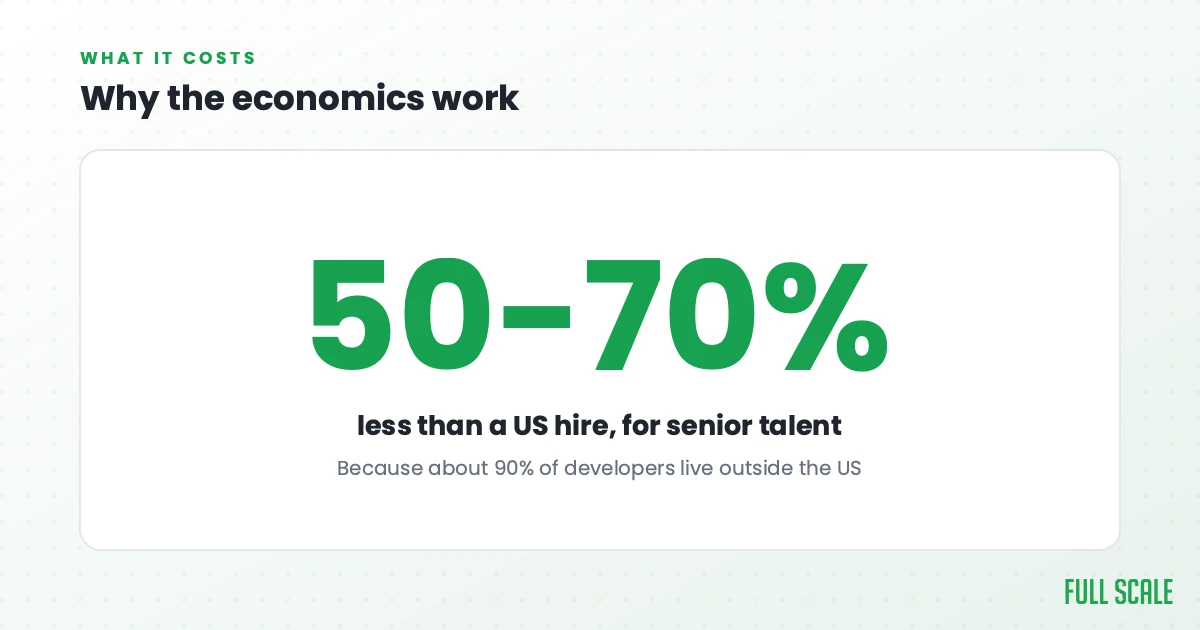
The economics work because 90% of software developers don’t live in the United States, per the Stack Overflow Developer Survey. The talent pool you’d reach by posting a US-only LinkedIn ad is roughly 10% of what’s out there. When the rest of the world is available to you and you can hire from it, the cost-of-living gap becomes a feature.
Specialist augmentation is the right call when you’ve got an engineering org that already knows what it’s doing and just needs one more hand. Maybe a React developer to ship the next product surface, a Python developer for a data pipeline, or a Java developer for a system rewrite. It’s the same employment model as a full team, just at a smaller scope.
Recruiting and vetting
The vetting is where the engagement either works or falls apart.
The first offshore developers I ever worked with were Java engineers in St. Petersburg, Russia, back in 2012. I would not hire from Russia today, but that engagement is what led me to build a bench of dedicated Java engineers in the Philippines. A friend of mine ran a dev agency and placed them on the Stackify team. I didn’t actually know they were in Russia until our first phone call, and to be honest I was kind of annoyed about that. But the developers were great. Their English was strong, their communication was clear, and the code they shipped was excellent.
We worked together for two years. (Side note: this was years before the Ukraine conflict; today I would not hire developers in Russia. The story is about the vetting, not the location.)
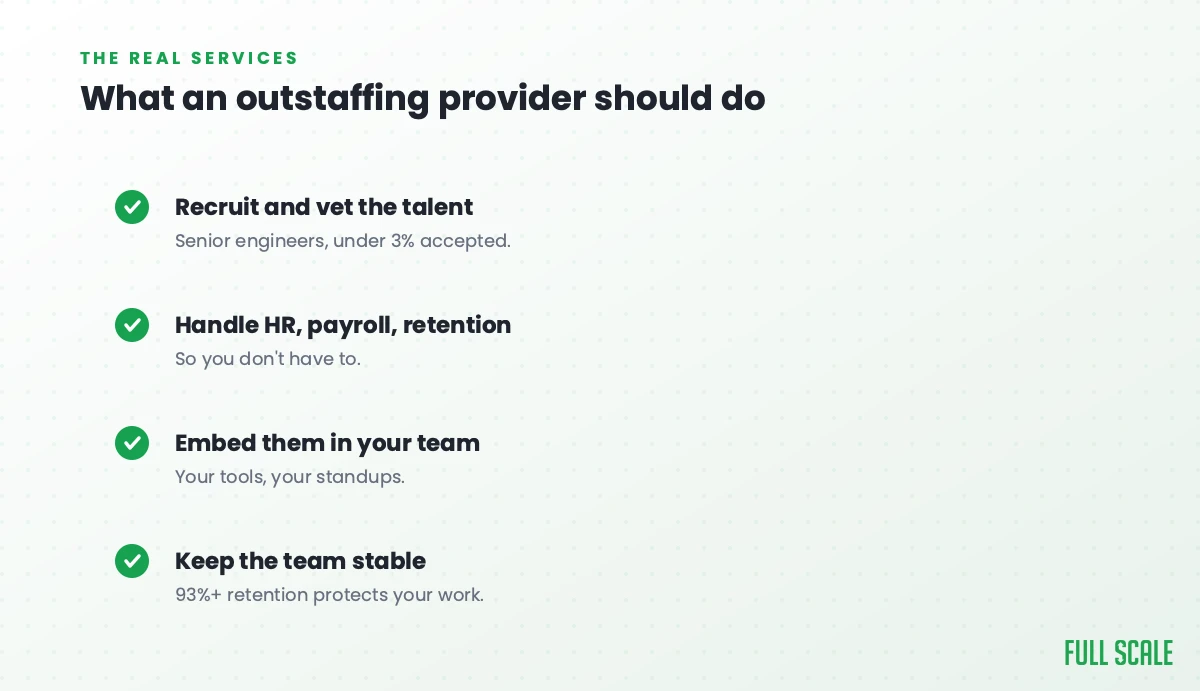
A real outstaffing provider should source the developer, screen for technical depth in actual interviews instead of resume keywords, screen for English fluency in real conversation, and only present you with candidates worth your interview time. The typical hiring timeline at Full Scale runs about two weeks from initial scoping to a vetted developer joining your standups. The reason it can be that fast is that the recruiting and the vetting run in parallel.
Most offshore collaboration fails because people simply hand a bunch of requirements over to an outsourcing firm. Then they expect to get back a successful project. The vetting layer is what prevents that. If the provider can’t tell you exactly how they screen for English, soft skills, and technical depth, that’s the conversation you should be having before you sign anything.
Ongoing management, retention, and replacement
I’ve been running Full Scale for seven years. 350+ team members in the Philippines. Zero offices. One of our engineers codes from a mountain in Bukidnon. Our accountant has closed books watching a sunset outdoors. A full-stack developer takes breaks looking out over a city skyline.
All of them deliver exceptional work. There is no talent shortage. Just a shortage of companies treating developers like adults.
The provider’s job on the back end is to run payroll, manage benefits, handle compliance, supply equipment, conduct retention reviews, and replace anyone who isn’t a fit. Replacement should happen within a week of you raising a concern, not at the next contract renewal. Full Scale’s developer retention runs above 93%, which matters because the institutional knowledge stays in your team instead of churning every six months.
The roles you can fill through outstaffing
Most clients hire developers, but a real outstaffing provider can staff the rest of the engineering org too.
On the engineering side: backend developers, frontend developers, and full-stack developers across Node.js, Python, Java, .NET, PHP, Ruby on Rails, Laravel, and a dedicated Django development team. Frontend specifically across React, Vue.js, and Angular. Mobile across iOS, Android, Flutter, and Swift.
On the supporting side: QA engineers (both manual and automation), DevOps engineers, UI/UX designers, project managers, and business analysts. Mostly you’ll want developers first and the supporting roles second, but a good provider can staff the whole stack.
What outstaffing actually costs
The cost story is the cost-of-living story, not the skill story.
A senior developer hired through an outstaffing provider typically costs 50% to 70% less than the equivalent US hire. The discount comes from where the developer lives, not from a lower skill bar. Four thousand dollars a month buys a great life in Cebu and doesn’t pay rent in San Francisco. Cost is the easiest number to point at, but it is not the only reason teams switch, and the advantages of outstaffing go well beyond the rate.
Most providers price per developer per month, not per project, and they don’t tack on a separate management fee. You’re paying for a person, full-time, with the provider’s HR and payroll baked into the rate. If you’re trying to make the cost case to your CFO, the budget conversation post walks through how to frame it.
What outstaffing looks like in practice
Three Full Scale clients, three different problems, three actual outcomes.
LendingStandard. Kansas City based, processes roughly 30% of affordable multifamily property loans nationwide. The CEO, Andy Kallenbach, tried local hiring for years through vocational programs and college recruiting. Local hiring couldn’t keep up with growth. Once a Full Scale team was embedded, here’s what he wrote on their case study page: “Waking up each morning to collaborate with the Full Scale team has become the highlight of my day. Their work ethic, pride in craftsmanship, and the sheer quality of their output have not only met but exceeded our expectations. The most significant impact has been the seamless integration of their team with ours, making every challenge surmountable and every success sweeter.”
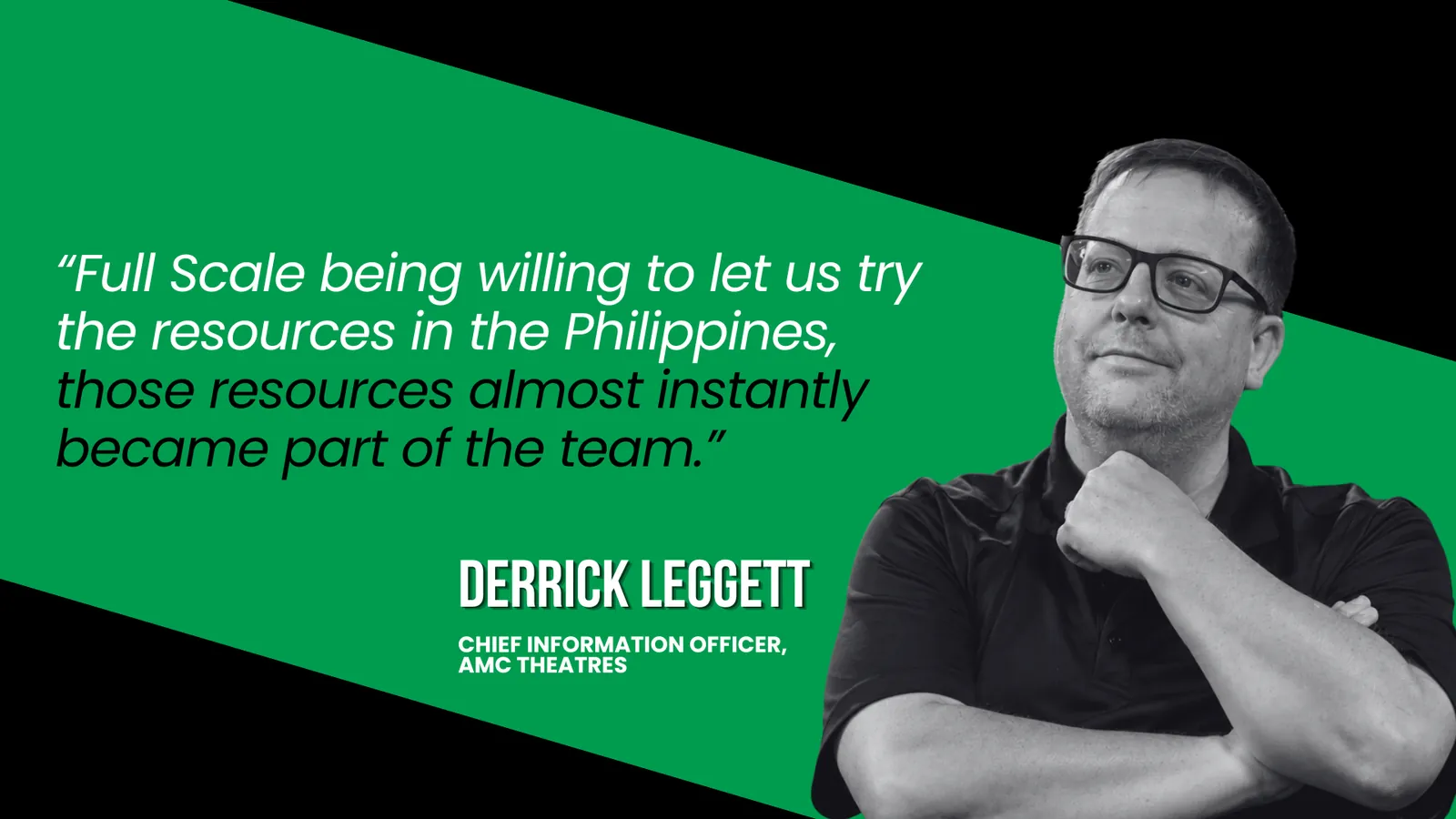
AMC Theatres. National brand, Kansas City based, global engineering organization. Their CIO, Derrick Leggett, has built an engineering org where developers in the Philippines are treated as full AMC engineers, not contractors. Same Slack threads, same code review process, same standards. The team ships production releases weekly. That’s the long-term-team model lived out at the scale of a recognizable national company. (I wrote about how they think about delivery cadence in the Deployment Pullback Ratio newsletter a while back.)
PMI Rate Pro. Mortgage industry, technology that lets lenders offer the most competitive private mortgage insurance rates. Different industry, same playbook. The full case study is on the Full Scale case studies site with a direct quote from their team.
How to choose an outstaffing provider
Most offshore failures come from picking the wrong provider, not the wrong model.
After hiring offshore developers in three regions over fifteen years, I have a simple framework for what makes the engagement work. I wrote about it in detail in Why I Avoided Offshore Development, but the short version is three things:
- Location matters, but English matters more. Strong English fluency and US business-hours overlap are non-negotiable. The Philippines specifically has both, with most developers willing to shift their schedule to overlap a half-day with US working hours. (We avoid India, which is where most of the offshore horror stories I hear originate. Latin America and Eastern Europe both work, though both are typically more expensive than the Philippines.)
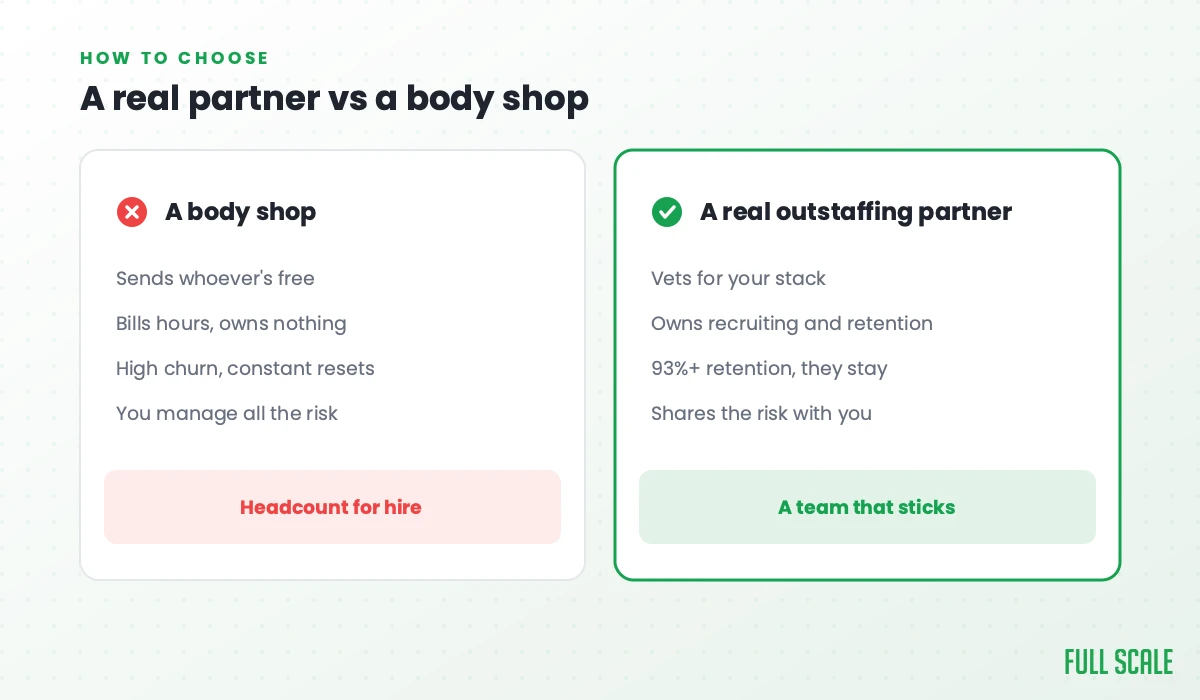
- Hire a team, not a project. If the provider is selling fixed-bid project deliverables as the default, that’s not outstaffing. That’s outsourcing in different packaging. You always need technical leadership in-house to direct the work, and the provider should be selling you that model openly, not hiding the fact that you’ll need to manage it.
- You always need technical leadership in-house. Outstaffing extends your team. It does not replace your CTO. If you don’t have a CTO or a senior technical lead, you have a different problem and a different solution.
On top of the framework, here are the specific criteria worth checking before you sign anything. Look for vetted senior talent (7+ years of average experience is a reasonable bar, less means juniors). Ask about retention rate (above 90% is real; below 80% is not). Confirm the provider offers replacement within a week, not a quarter. Ask for named clients with verifiable case studies, not anonymized “a Fortune 500 client” copy.
For trust signals on Full Scale specifically: we’ve been named to the Inc. 5000 list of America’s fastest-growing private companies for three consecutive years, we’ve served over 200 tech companies, and I’ve written extensively about how to build engineering teams that ship in Product Driven. Make sure you work with a dev agency that cares about your product, not just your project.
Frequently asked questions
What is outstaffing in IT?
Outstaffing is a model where a developer is employed by a third-party provider but works exclusively for your team under your day-to-day management. The provider handles recruiting, HR, payroll, and retention. You handle the work itself. It’s the same model commonly called staff augmentation, team augmentation, or a dedicated development team.
What is the difference between outstaffing and outsourcing?
Outstaffing extends your team with developers you manage directly. Outsourcing hands an entire project to a vendor who manages it for you and delivers a defined scope. With outstaffing, you keep ownership of the product and the people doing the work. With outsourcing, you hand off both.
Is outstaffing the same as staff augmentation?
Yes. The two terms describe the same model. Outstaffing became common in Eastern European dev shops; staff augmentation is more common in the US. The difference is vocabulary, not substance.
How much do outstaffing services cost?
A senior developer hired through an outstaffing provider typically costs 50% to 70% less than the equivalent US hire, depending on role and seniority. The discount comes from cost of living, not from a lower skill bar. Most providers price per developer per month with no separate management fee.
How long does it take to hire an outstaffed developer?
Two to three weeks is typical from initial scoping to a vetted developer joining your standups. The provider runs the recruiting and the vetting in parallel with your interviews, which is what compresses the timeline compared to a typical in-house hire.
Where are most outstaffing developers located?
Outside the US. The annual Stack Overflow Developer Survey consistently shows that roughly 90% of software developers don’t live in the United States. The major outstaffing regions are the Philippines (Full Scale’s base), Latin America, and Eastern Europe.
Talk to us about your team
At Full Scale, our clients are not hiring us for a short-term engagement. They are trusting us with their long-term teams.