
What Is an In-House Recruiter? And Why One Isn’t Enough to Hire Great Engineers


In this article
- What is an in-house recruiter?
- How in-house recruiting actually works
- Where an in-house recruiter genuinely wins
- Where it breaks for engineering hires
- In-house recruiter vs. agency vs. offshore partner
- How we built our own in-house recruiting, and what it taught us
- Frequently asked questions
- Build the engineering team without the open seats
Ask most people to define an in-house recruiter and you’ll get the textbook answer: a recruiter who works for one company instead of an agency. That’s true, and it’s also the least useful way to think about it. An internal recruiter and an outside IT recruiting agency solve different problems, and the agency rarely owns what happens after the hire.
I’ve hired engineers in four countries and built a recruiting team that finds them for a living. So here’s the version I’d give a founder over coffee.
An in-house recruiter is great for most of your hiring, and quietly terrible at the one hire you probably care about most: a great software engineer.
That’s not a knock on in-house recruiters. We run our own at Full Scale, and they’re some of the most valuable people in the company. It’s a knock on the idea that putting one recruiter on payroll solves engineering hiring. It doesn’t, and I’ll explain exactly where it falls apart.
What is an in-house recruiter?
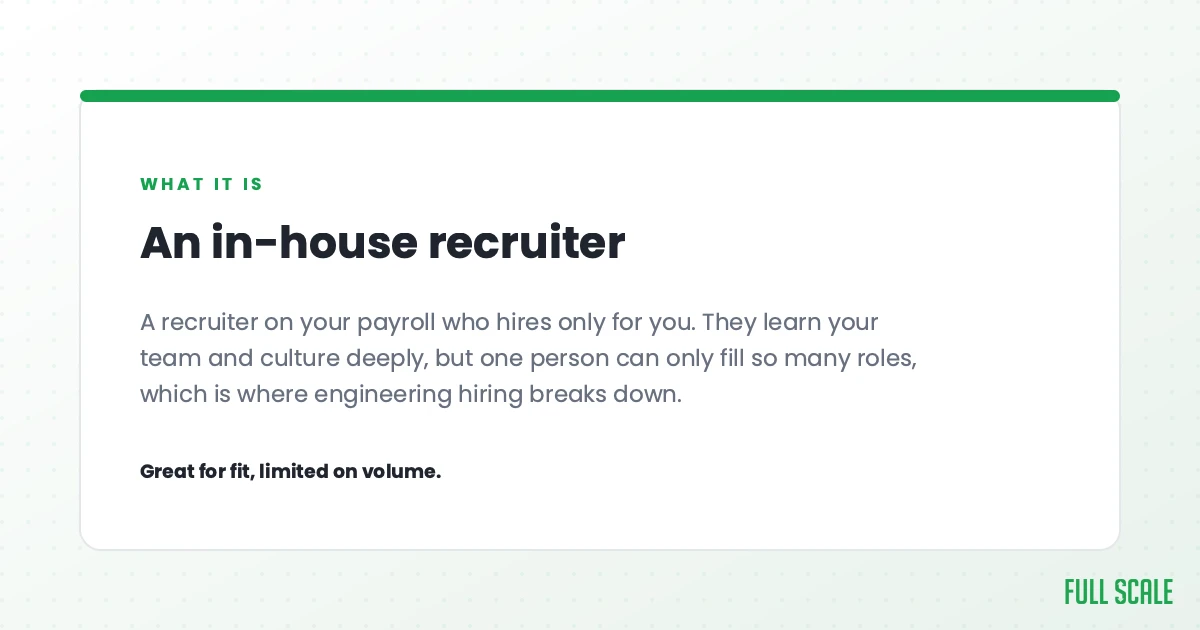
An in-house recruiter is a salaried employee whose job is to fill your company’s open roles using your own resources instead of an outside agency. They own the full hiring lifecycle: writing the job description, sourcing candidates, screening them, running interviews with your hiring managers, and getting an offer signed.
People also call this in-house recruiting, internal recruiting, or in-house talent acquisition. Same idea. The recruiter sits inside your company, knows your team and your culture, and works only on your roles.
Compare that to an external recruiter or staffing agency. Those are third parties who work on commission, usually across many clients at once, and hand you a candidate in exchange for a placement fee. The in-house recruiter is on your team. The agency recruiter is renting you an introduction.
How in-house recruiting actually works
The day-to-day is straightforward. A hiring manager has a seat to fill, so they brief the recruiter on the role, the must-have skills, and the budget. The recruiter turns that into a job post and starts working candidates.
Sourcing is where the real work lives. Good in-house recruiters don’t just wait on applications. They post on the job boards, sure, but they also dig through their own network, post on social media platforms, lean on employee referrals, and reach out to people directly. Then comes screening: resume reviews, phone screens, skills checks, and enough back-and-forth to get the shortlist down to people worth a manager’s time.
From there the recruiter coordinates the interviews, keeps the candidate warm through what is usually a slow process, helps the team compare finalists, and carries the offer across the line. If you want the step-by-step version, we break down the full software developer hiring process separately. When it works, it’s a clean handoff and a new hire who fits.
Where an in-house recruiter genuinely wins
I want to be fair here, because there’s real value in the model and it’s the value we built our own recruiting around.
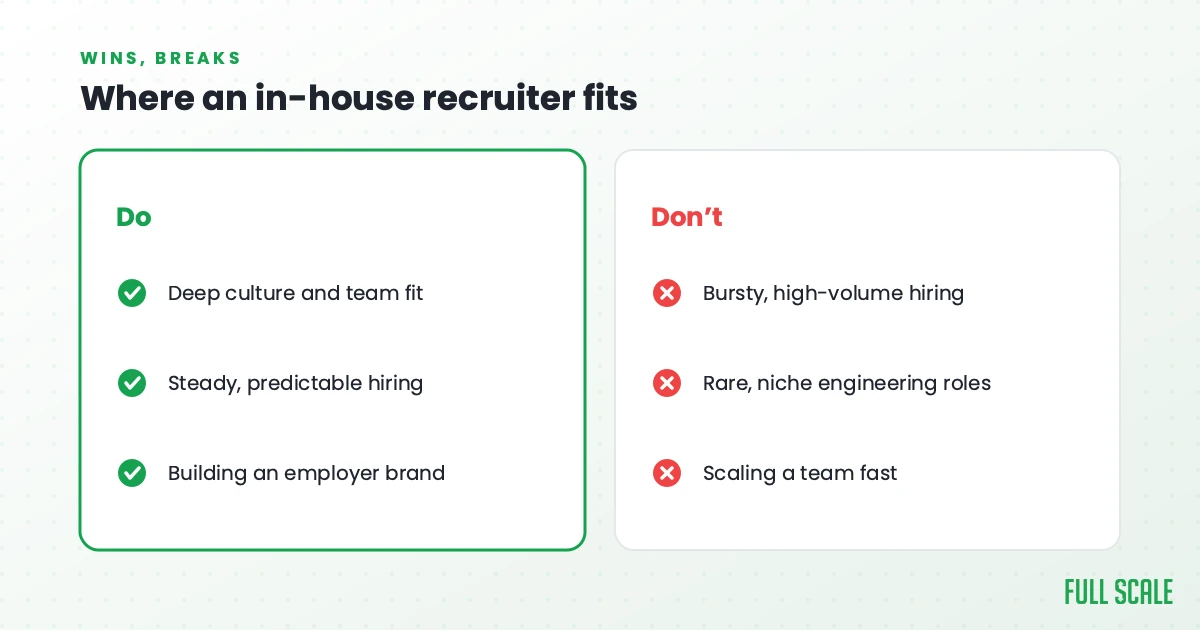
A good in-house recruiter knows your company in a way no agency ever will. They’ve sat in your standups, felt the culture, and watched who thrives and who flames out. That makes them a far better judge of fit, and it makes them a real ambassador for your brand when they talk to candidates. They’re selling a place they actually know.
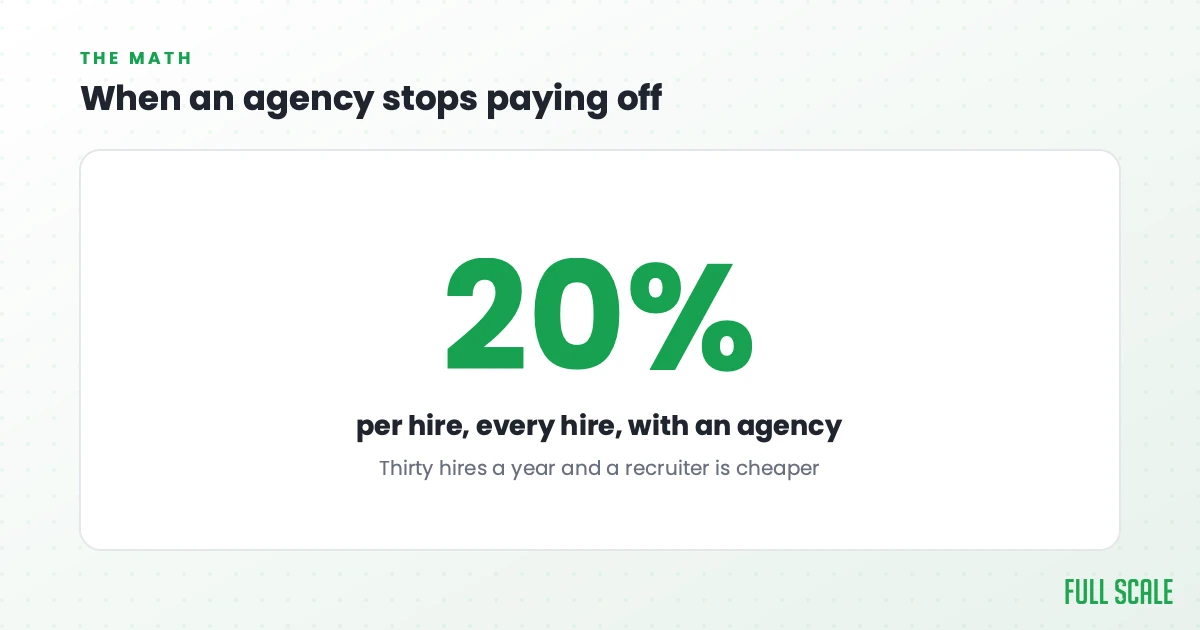
They also build relationships that compound. An in-house recruiter who’s been with you two years has a pipeline of people they’ve talked to across multiple roles, knows who’s open to a move and who isn’t, and can move fast when a seat opens. And once you’re hiring at volume, the math works in your favor. A salaried recruiter is a fixed cost. Pay an agency 20% per hire across thirty hires a year and you’ll wish you’d hired the recruiter.
For most roles, this is the right answer. The trouble starts when the role is a senior software engineer.
Where it breaks for engineering hires
Here’s the hard lesson from 25 years of hiring developers.
The best engineers are not looking for a job, because they already have one and nobody is letting them go.
They’re not browsing your careers page or scanning the job boards. They’ll never see your post, and even if they did, they wouldn’t answer it. The only way to reach them is to go find them and recruit them away from where they work today. That is active, specialized, full-time work, and it looks nothing like screening inbound applications.
Meanwhile, the people who do apply are a different population entirely. Plenty of them are good. But a lot of them have sent that same resume to a hundred companies in six months and gotten nowhere, and now they’re flooding your inbox too. AI has made that worse, since one click now fires off a tailored-looking application to dozens of openings, so the pile is bigger and harder to read than it’s ever been. And no screening tool fixes the real problem, because the engineer you actually want still isn’t in the pile. Your recruiter has to wade through all that noise to find the few worth a real conversation. For a generalist in-house recruiter juggling sales roles, ops roles, and three open engineering seats, that’s a brutal ask. They often don’t have the technical depth to tell a strong backend engineer from a confident talker, or to weigh the soft skills that actually predict success, and they rarely have the time to chase passive candidates who aren’t going to respond to the first message anyway.
So the seat sits open. And an empty engineering seat is not free. The feature you needed slips, the rest of the team picks up the slack, and your competitor ships the thing you decided to wait on. A few months of an unfilled senior role costs far more than the recruiter’s salary, and most companies never put that number on a spreadsheet.
None of this means in-house recruiting is broken. It means engineering hiring needs more than one generalist and a job board.
In-house recruiter vs. agency vs. offshore partner
When you’re working out how to hire tech talent, you’ve got three real options, and each fits a different situation.
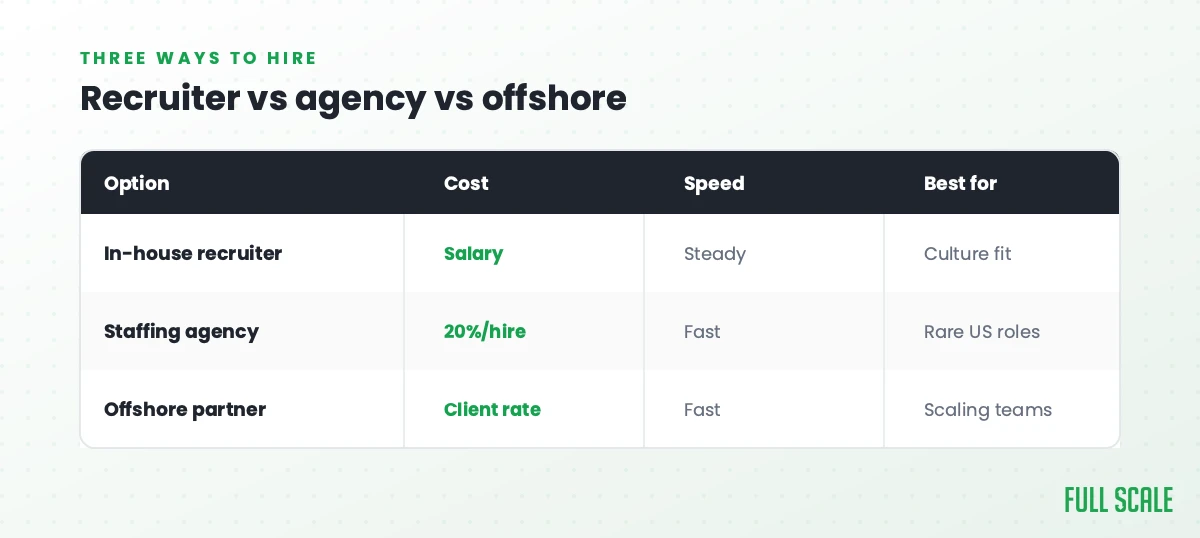
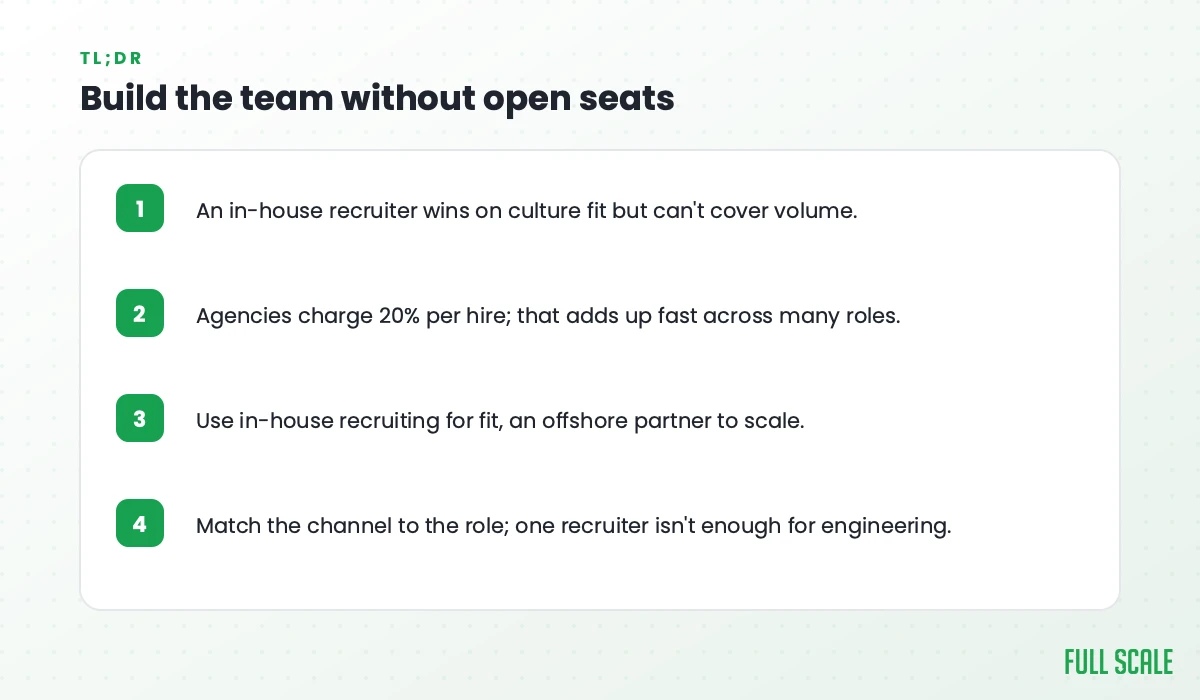
An in-house recruiter is the right backbone for your overall hiring. They’re strong on culture, brand, and the kind of volume hiring that rewards someone who knows your company. On their own, though, they struggle to reach passive senior engineers, especially when that one recruiter is covering every other role too.
An external recruiter or staffing agency charges a placement fee that generally runs 20 to 25 percent of the hire’s first-year salary, and up to about 30 percent for senior or hard-to-fill roles. That fee buys you the introduction and nothing after it. Early on I paid an IT recruiter a 25 percent ransom for a single hire, and it stung, because the fee sits on top of an already expensive US developer salary. The Bureau of Labor Statistics puts the median software developer base around $133,000, and senior engineers run $150,000 to $185,000. The fully loaded cost lands even higher once you add benefits, payroll taxes, and overhead, which push the real number to roughly 1.25 to 1.4 times base. An agency fee on top of that is real money. It’s worth it for the rare hard-to-find local leader where the search itself is the value. For the everyday engineering hire, it usually isn’t. If you want the full breakdown, I wrote about why I stopped paying those placement fees.
An offshore partner is the third option, and it’s the one most people misjudge. The mistake is hiring offshore purely to find the cheapest body you can. I call that cheapshoring, and it fails every time, for the reasons I lay out here. The version that works is a partner that recruits, manages, and retains real engineers for you, so you get a dedicated developer who joins your team and your process without the placement fee and without the open seat dragging on for months. That’s what staff augmentation actually is, done right.
The decision rule I’d give you is simple. Pay the agency fee only for the rare local leader you genuinely can’t find any other way. Build an in-house recruiter for your general hiring. And for the engineering team you need to build and keep, get a partner who does the passive recruiting you don’t have the time or the network to do yourself.
How we built our own in-house recruiting, and what it taught us
We didn’t outsource our recruiting. We built it in-house, on purpose, because recruiting good engineers is too important to treat as a job-board chore.
We run several full-time in-house recruiters whose entire job is to find the best engineers in the country and recruit them away from their current employers, every single day. They’re backed by referrals from our 350-plus team, which turns out to be one of the strongest sources of great people there is. Good engineers know other good engineers. That combination, active outreach plus a deep referral network, is how you reach the talent that never shows up in your applicant pile.
The payoff isn’t just in the hire. It’s in keeping them. Our developer retention sits at 93 percent, and we’re Great Place to Work Certified in the Philippines two years running, with 95 percent of our team saying it’s a great place to work against 65 percent at a typical company. Recruiting gets the right person in the door. Retention is what makes that hire pay off instead of repeating it every nine months.
That’s the whole reason an in-house model works, and it’s the same reason hiring direct from a job post disappoints. Going direct gets you the flood of applicants. Building real recruiting, in-house or through a partner who’s already built it, gets you the people who weren’t looking.
Frequently asked questions
What does an in-house recruiter do?
An in-house recruiter manages hiring for one company, end to end. They write job descriptions, source and screen candidates, coordinate interviews with hiring managers, and close the offer. Unlike an agency recruiter, they’re a salaried employee focused only on your roles, so they understand your culture and hire for long-term fit.
What’s the difference between an in-house recruiter and an agency recruiter?
An in-house recruiter works for your company and earns a salary. An agency recruiter works for a third party, usually across many clients, and earns a commission or placement fee on each hire. In-house recruiters know your business better and think long-term. Agencies have broader networks and get paid only when they place someone, so they move fast on the roles they take.
How much does an in-house recruiter cost?
You pay an in-house recruiter a salary plus benefits, like any employee, which makes them a fixed cost. That’s cheaper than agency fees once you’re hiring at volume, since an agency charges 20 to 25 percent of first-year salary per hire. For a company making only a few hires a year, the math can favor an agency or a partner instead.
Can an in-house recruiter hire software engineers on their own?
They can hire some, but a single generalist recruiter usually struggles with senior engineering roles. The best engineers already have jobs and won’t answer a posting, so reaching them takes active, specialized recruiting and enough technical depth to screen well. Most in-house teams need help from a technical hiring partner for those roles.
When should I hire an in-house recruiter?
Hire one when you have steady, ongoing hiring across multiple roles and you want someone who owns your employer brand and candidate experience. If your main need is building an engineering team fast, pair the in-house recruiter with an offshore development partner who already has the recruiting engine for technical talent.
Build the engineering team without the open seats
An in-house recruiter is a smart investment for most of your hiring. For the engineering roles that decide whether you ship, you need recruiting muscle that reaches the people who aren’t looking.
That’s what we do. We recruit, manage, and retain senior developers so they join your team without the placement fee and without the months-long gap. If that’s the team you’re trying to build, let’s talk about hiring developers.