
How to Estimate Software Development Cost: Build a Range, Then Test the Quote

In this article
- Software development cost is developers times months times a rate
- Why software estimates miss
- The four-step method for estimating software development cost
- A worked example, priced two ways
- What the estimate leaves out
- What AI changes about an estimate, and what it doesn't
- How to test a vendor quote against your range
- How Full Scale handles estimating
- Frequently asked questions
- Turn your estimate into a team
Quick Answer: To estimate software development cost, size the work in team-months (developers times months), price a team-month at a real rate, and build a low, likely, and high case instead of one number. Do the sizing three ways, from past projects, a bottom-up feature list, and a time box, and trust the gap between them. Then hold every vendor quote against your range.
Estimating software cost is multiplying developer-months by some rate and finding a range where there's only a small chance you'll get caught off-guard. All other aspects of estimating are ways to improve the accuracy of the developer-month count. I run a company that sells developer time, so I have a stake in your estimate. I would still rather you do this yourself because having done so means you ask better questions of every vendor.
Software development cost is developers times months times a rate
The estimate has three inputs: how many developers, for how many months, at what monthly rate.
A Full Scale developer begins at $35 per hour, fully loaded. That puts the cost of a month (2,080 working hours per year) at around $6,070. An employee in the US earning the median salary for a software developer ($135,980), grossed up because wages are 70% of what private employers spend, costs around $16,200 per month. You can move either or both numbers around with your choice of seniority. And, of course, the final Full Scale rate depends on skill level, seniority, and team size, all of which are described on our pricing page.
Most people don't stop to think about it like that; they just start listing features. Which is why budgets turn into wishlists with dollar signs. A feature list tells you what you want, a team-month count tells you what you can pay for, and the two must meet somewhere.
Want a single number without the rest? Try our software development cost calculator. If you're more interested in the math and reasoning behind the number, read on! And if you need an estimate for a full project, check out our custom software development cost post. For an MVP, take a look at our MVP development cost article.
Why software estimates miss
But estimates are wrong, because they're done at the point when we know the least. Steve McConnell's cone of uncertainty, in a Construx white paper, says that an estimate at the initial concept phase could be off by a factor of 4 in either direction. That's a 16x range between the low and the high, and McConnell describes that as the best you can hope for. These ranges aren't drawn from a measured data set; they're from experience and judgment. Think of them as guidance on direction rather than as a specific prediction.
The same trend is seen on a larger scale. A study by McKinsey and the University of Oxford of over 5,400 IT projects showed that large ones ran 45% over budget and delivered 56% less value than predicted. In that study, large was defined as an original quote above $15 million, so your $200,000 project is very different. But again, the general trend applies, because there's no way those large projects ended up being 45% under budget.
On top of all that, there's the fact that new things always take longer than you think they will. Technical leaders know this, but they'll tell you it'll take two weeks when they really mean three just to avoid arguing. I once compared asking a developer for an estimate of a new feature to asking a vegetarian chef how long it would take to make homemade German sausage. They could have an idea of what it might look like, they may have even seen someone do it, but until they've done it themselves, it's just a guess.
The estimate that causes the most trouble is the unrealistic one, since a long estimate at least gives you room for a surprise, which is why the method below always results in a range.
The four-step method for estimating software development cost
There are four steps to this process: determine done; size the work three different ways; turn the size estimates into a range; and include costs external to development. Each step will take a few hours.
-
Write down what done means. List testing, deployment, documentation, and hand-off along with writing the code. A definition of done that stops at "it works on my machine" leaves out a third of the work.
-
Size the work three ways using reference estimation, bottom-up estimation, and time-boxing. All estimates should be expressed in terms of developer-months.
-
Turn the estimates into low, likely, and high. The difference between the three estimates provides the basis for a range.
-
Add the costs outside of development. Costs such as design, project management, infrastructure, and post-launch maintenance are typically not included in developer-month counts.
| Sizing method | How to run it | What it catches | What it misses |
|---|---|---|---|
| Reference (compare to past projects) | Identify two or three comparable projects, then use the actual resources used in those projects, not the quotes | Optimism bias, because the only accurate data comes from actual usage | Any novel aspects of your project |
| Bottom-up (estimate every component individually) | Break the project into individual tasks, assign each task a size (small, medium, large) based on the number of weeks required to complete, then sum all the sizes together | Missing components and system integrations | Any coordination time, which increases with the size of the team |
| Time box (decide the limit first) | Select the number of team members and months available for the project, then determine the maximum scope that fits within that budget | The amount of work that cannot be funded | Whether the chosen scope fits the resources available at all |
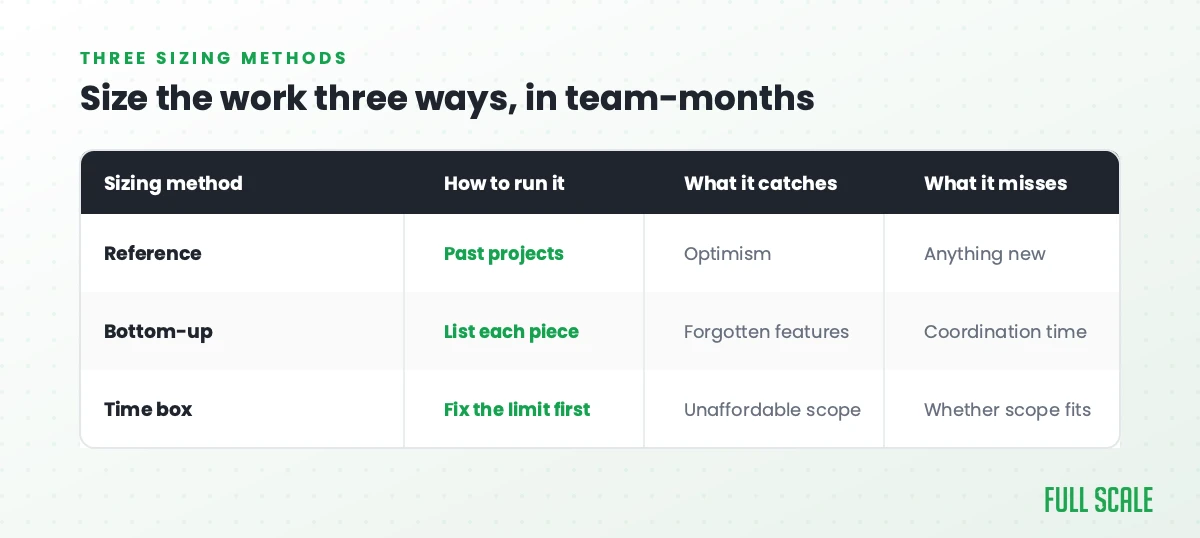
When the three estimates converge within 25%, there's a reliable baseline. When they diverge, the divergence is the signal: the divergence reveals which input is the weakest link, and that's the place a vendor will do their best work or deflect with a number.
My software development project timeline article explores three-point (PERT) scheduling, so I'll skip the math and focus on cost.
A worked example, priced two ways
Let's say four developers is the most likely estimate at 5 months, with 4 on the low end and 8 on the high end. These numbers are illustrative arithmetic based on the rates above; no actual client engagement is being discussed here.
| Case | Months | Developer-months | Full Scale dedicated team at $35/hr | US employees, fully loaded at the BLS median |
|---|---|---|---|---|
| Low | 4 | 16 | About $97,100 | About $259,000 |
| Likely | 5 | 20 | About $121,300 | About $323,800 |
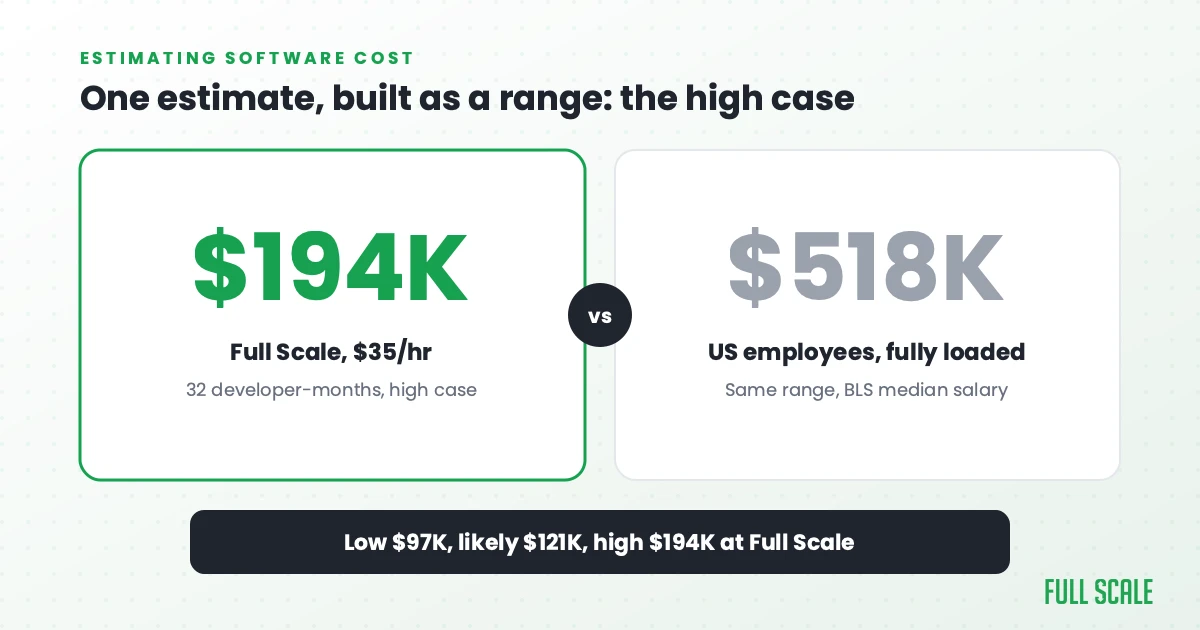
| High | 8 | 32 | About $194,100 | About $518,000 |
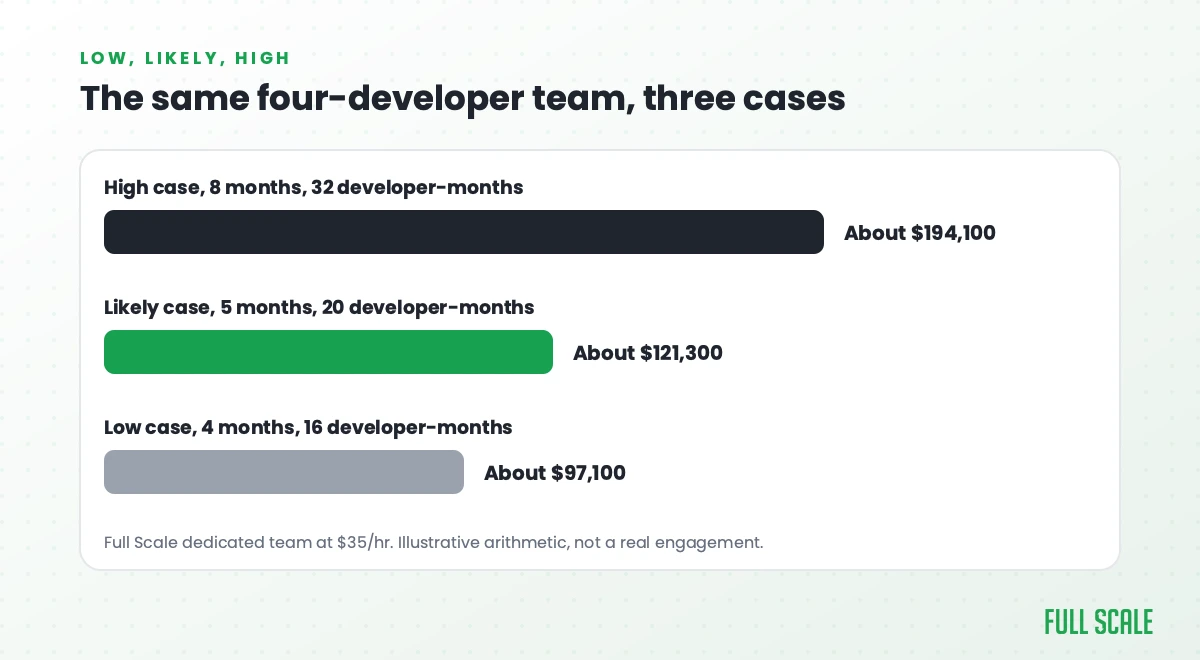
You should budget for the high case, or at least have a plan for what you will cut or defer if that ends up happening. The most likely case is what your roadmap should be based on. And the low case is what you tell the board if you like surprises followed by disappointment.
This table also illustrates why the hourly rate isn't as important as the total range. Going from low to high cost estimates amounts to about $97,000 at Full Scale rates, which is a larger variance than many of the debates around the hourly rate. At $35 an hour, that is where our pricing starts, not what every developer costs. A senior-heavy team will bill more than that. And Full Scale clients typically save between 50 and 70% vs. hiring equivalent staff in the US. This example comes in slightly above that range because we compared a median US salary to our starting rate.
What the estimate leaves out
A developer-month count prices the people who write code. Add four more lines to your budgeting spreadsheet and then you can call it an estimate.
| Cost line | How to size it | Where to read more |
|---|---|---|
| Design and product ownership | A designer and one internal person who will define requirements, often not full-time | Our guide to how to manage a dedicated development team |
| Testing and QA | Estimate it like a full-time seat, or at least a defined % of each sprint. Never leave it open-ended | QA and software testing services |
| Infrastructure and third-party services | Depends on user count and amount of data, so ask for a monthly figure | Our guide to cutting cloud spend |
| Maintenance after launch | Plan for ongoing developer time, and ask your vendor for a firm number | Software maintenance |
Leaving out those lines is how the project you expect to cost X ends up costing you more than X. Two similar-looking line items on a PowerPoint slide could translate to wildly differing amounts on an invoice.
What AI changes about an estimate, and what it doesn't
AI coding tools alter what lines on the estimate are big. They don't eliminate lines. My cost calculator explains how AI-assisted engineering changes hours per feature, so I'll direct you there for the math.
The piece you should keep in your estimate is the DORA finding. The 2025 DORA report describes AI as an amplifier, increasing the organization's existing strengths and weaknesses, and discovered that AI adoption increases both software delivery throughput and instability. If the code comes in faster, but breaks more, then the savings go toward review, testing, and rework. Don't reduce the QA line just because the typing was faster.
My advice is to take any promised AI savings from a vendor, ask where the hours went, and require they show you the results in the sprint reports a month later.
How to test a vendor quote against your range
A quote is simply a claim about team-months. So take it, convert it to team-months, and check it against your range. The bulk of the work can be done with four questions.
-
How many people, full-time, and for how many months? If a vendor can't answer in a single sentence, they've priced a guess.
-
What's excluded? The standard omissions are design, QA, infrastructure, and the launch phase.
-
What happens if scope changes? Ask for the change-order rate and how changes get priced before you commit.
-
Who pays when it runs long? In a fixed-bid contract, the vendor builds the cost of delays into the price from the beginning. I explain why that almost never works for actual software projects in my article Why Fixed-Cost Software Development Doesn't Work.
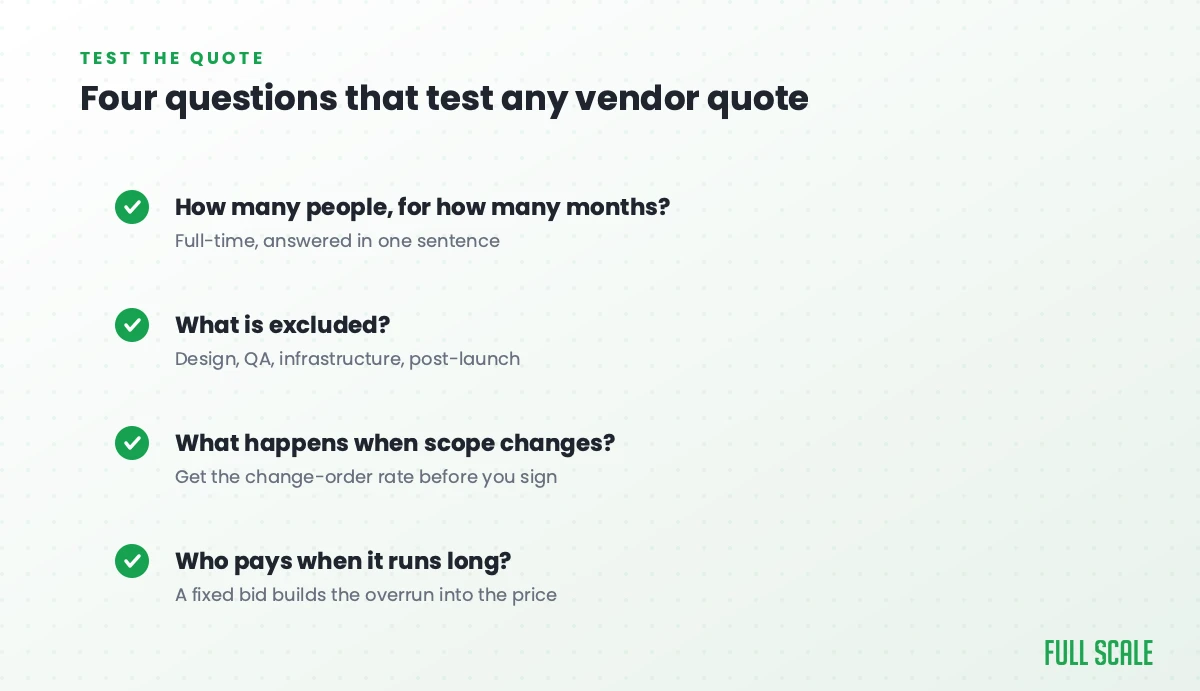
A quote significantly lower than the bottom end of your range should make you uneasy rather than thrilled. I call the habit of hiring on price alone cheapshoring.
A quote significantly higher than the top end of your range indicates either you've forgotten something or they've added extra items. The four questions above will help you figure out which.
How Full Scale handles estimating
Full Scale sells staff augmentation, meaning you purchase the team on a monthly basis and control the work, so it becomes a plan you can iterate on, rather than an offer you have to justify.
Work can start in as little as 7 days, and developers come from across the Philippines onto a team that works only for you.
If it isn't working out in the first two weeks, you get your money back. After that, you can drop a developer with 30 days' notice, and there is no long-term contract. The conditions are spelled out in when it isn't working out.
Engineers have been educated on the principles outlined in my book, Product Driven, which includes speaking up if the requirements appear incorrect, something I believe adds value to an estimate beyond anything a template could provide.
Frequently asked questions
How do you estimate the cost of a software project?
Estimate the number of developers, multiply by the number of months, and multiply by a monthly rate. Do it three ways, from past projects, from a bottom-up list of features, and from a time box, then compare the answers. The gap between them is your risk, and the honest output is a low, likely, and high number instead of a single figure.
Why are software cost estimates so often wrong?
Early estimates are made before the scope is settled, and uncertainty is highest then. Steve McConnell's cone of uncertainty puts the best-case error at 4x too high or 4x too low at the initial concept stage. McKinsey and Oxford also found that large IT projects ran 45% over budget on average, though that study covered projects over $15 million.
How accurate should a software estimate be?
Accuracy depends on how much of the scope is decided. At the idea stage a range of 4x either way is normal, and by the time requirements and design are done the range narrows to roughly 1.25x either way, according to the Construx cone of uncertainty. If a vendor gives you a single precise number before the scope is written down, the precision is cosmetic.
How much contingency should I add to a software estimate?
Use a range instead of a flat percentage. Build a low case, a likely case, and a high case from the uncertain parts of the scope, and fund the likely case with a plan for the high case. A flat buffer hides which parts of the project are risky, and the risky parts are what you need to find.
Does AI make software development cheaper to estimate?
It shifts the lines more than it shrinks the total. DORA's 2025 research found AI raises delivery throughput and instability together, so review and testing time should not be cut just because code is faster to write. Treat any AI savings as something to confirm against your own team's results after the first sprints.
Turn your estimate into a team
Divide your probable scenario by $6,070 and you know how many Full Scale developer-months can be allocated to it. If the range holds up, tell us what you're building and we'll walk through the scope with you.