
Engineering Organization Structure: When to Add Managers, Directors, and a VP

In this article
Engineering organization structure comes down to one rule: add a layer of leadership when a leadership job has no owner, not when the org chart looks thin. The title comes second.
That rule answers what founders and CTOs actually ask: when to hire the first manager, whether the next hire is a director or a VP, and what to do when you're the one covering every job. It comes from a chapter of my book, Product Driven, and from building engineering teams at VinSolutions, Stackify, and Full Scale.
Quick Answer: Engineering organization structure should follow four leadership jobs: strategic, operational, product, and technical. Add a manager, director, or VP when one of those jobs has no owner, not at a fixed headcount. Past about 10 to 15 engineers you usually need your first dedicated leader, and offshore developers report into your own leads, so the four jobs still need owners on your side.
Engineering organization structure starts with four leadership jobs
A title like director, VP, tech lead, or manager doesn't tell you what the person is responsible for. A healthy team has all four of these leadership jobs covered:
- Strategic: connects engineering to the business and decides which bets are worth making.
- Operational: keeps planning, delivery, and the people side running smoothly.
- Product: stays close to the customer so the team solves the right problem.
- Technical: makes the architecture calls that decide how fast the team can move.
I wrote about these in chapter 14 of Product Driven, and the chapter is online. Kathy Keating of CTO Levels sorts engineering leadership into the same four lanes, so this isn't just a quirk of my book.
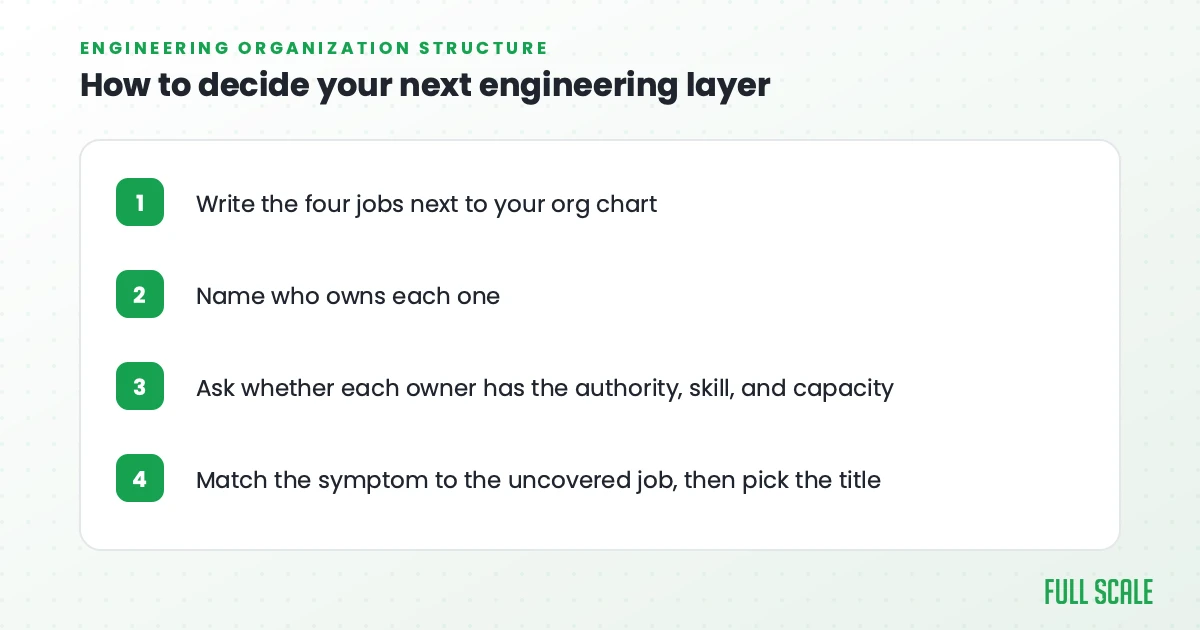
The structure question gets simple once you have the four jobs. Draw your org chart, write the four jobs next to it, and name who owns each one. Then ask whether that person has the authority, the skill, and the capacity to lead it.
A gap in your org chart is usually a missing owner.
If your answer to all four jobs is "me," you don't have an org chart. You have a very busy person.
Each uncovered job shows up differently, so the symptom tells you which layer to add:
| The job nobody owns | What it looks like |
|---|---|
| Strategic | The team ships quickly toward the wrong target |
| Operational | Strong people stall, dates slip, and communication frays |
| Product | The team delivers the ticket and misses the problem |
| Technical | The architecture, not the team, sets the speed limit |
Match your symptom to the job, and you know what the next hire has to do before you pick the title.
Find who on your team is good at operations
The best owner of operations is usually whoever on your team already keeps plans calm without being asked. For me, that wasn't the CTO, and I learned it the hard way.
At VinSolutions I was the CTO. The product direction was clear to me, but plans slipped and the team was stretched thin. The company needed an operator, someone who would happily live in sprint plans and one-on-ones, and that isn't me. So naturally I appointed myself to the job anyway, and it wore me down. I tell the longer version in the director vs. VP guide.
Most leaders have one of the four jobs they'd do for free and one they'd pay to skip. Yours may be different from mine. The question is whether the jobs you dread have an owner who doesn't dread them.
Know which of the four jobs you dread, and make sure someone else owns it.
Before you go shopping for a title, look inside your own team. Ask who people go to when a plan slips, and who already keeps planning calm without being asked. Being the best engineer on the team doesn't make someone good at this work, and a CTO forced into operations doesn't do much for anyone's morale, least of all the CTO's.
Engineering department structure by stage
The layers change as the department grows, and so does what breaks first. Treat these as rules of thumb rather than data:
| Engineers | Who leads | What breaks first |
|---|---|---|
| Fewer than about 10 | A hands-on CTO, sometimes with one strong lead | Delivery and planning, because the CTO is carrying everything |
| Roughly 10 to 15 | Your first dedicated leader, often an engineering manager | Planning and communication, once one person can't follow everyone's work |
| Teams of teams | Directors run groups of managers, and a VP or the CTO answers for the whole department | Strategy and product, because operations takes over and the reason for the work gets lost |
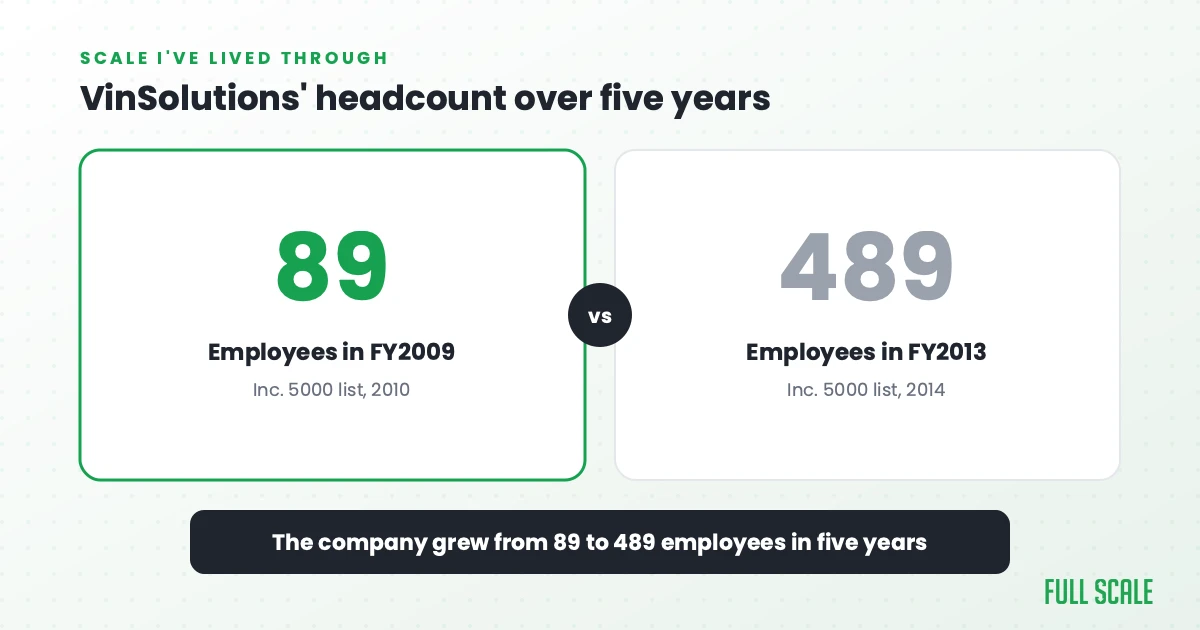
VinSolutions went from 89 employees to 489 over the five years it was on the Inc. 5000 list, so these layers are something I've lived through.
The numbers matter less than the question behind them: which of the four jobs is failing right now? Say your CTO is buried in planning and people problems. That's a hole in the operational job, so the next hire runs delivery and owns the people side, and at a small company that person is often called a VP of engineering. If direction is fine but teams keep missing dates, you want someone running the managers below them, which is the director's seat.
I wrote a longer guide to director of engineering vs. VP of engineering, and another on what a VP of engineering does. For the top of the chart, head of engineering vs. CTO covers that split.
Every layer also has a cost. Each one moves the people making decisions a little farther from the people using the product, which is why a new layer should earn its place.
Whichever model you pick, whether you organize by function, by product area, or around platform and enabling teams as in Team Topologies, the four jobs still need owners. For the team-level version of this question, see our guide to software development team structure, and for the signs you've outgrown your setup, read our post on scaling engineering teams.
Where offshore and staff augmentation teams fit in the org chart
Offshore developers should report into your own team leads. At Stackify, we had three team leads, and each of them managed an offshore team. That structure worked great, and the leads were my own employees, so no vendor sat between a lead and their team. I wrote about how that hybrid worked in the onsite and offshore model.
The same logic applies if you add developers through staff augmentation. The engineers report into your leads and join your standups like anyone else on your team. Adding engineers raises the same leadership question as any other growth, though, so staff the leads first. Full Scale sells this model, so weigh that accordingly, and our developers work remotely from across the Philippines. The part that stays on your side is leadership: someone at your company still has to own the four jobs.
Frequently asked questions
What is an engineering organization structure?
An engineering organization structure is how engineers, managers, and leaders are arranged into teams and reporting lines. The useful version also names who owns each of the four leadership jobs: strategic, operational, product, and technical.
How many engineers do you need before hiring an engineering manager?
There's no fixed number, but somewhere past about 10 to 15 engineers one person can't keep up with what everyone is working on, and that is usually when you need your first dedicated leader, often an engineering manager.
What is the difference between an engineering manager, a director, and a VP of engineering?
An engineering manager runs a team, a director owns a group of managers, and a VP of engineering or CTO owns the whole engineering function. The right hire depends on which leadership job is going uncovered, not on the title.
Should a startup hire a VP of engineering or a director first?
Start with the job that's failing, not the title. A CTO buried in operations needs an operational leader, while teams that keep missing dates under working managers need a director, as the stage section above explains.
How do offshore developers fit into an engineering org chart?
They report into your own team leads and work as part of your teams. At Stackify, three team leads each managed an offshore team, and the leads were our own employees. Adding developers still raises the leadership question, so staff the leads first.
What is the best engineering org structure for a startup?
Keep it simple while the team is small, and write down who owns each of the four leadership jobs. When one goes uncovered, add the layer that covers it, and don't add one just because the chart looks thin.
Need engineers to put under your own leads?
Full Scale developers join your team and report to your leads, with a two-week money-back guarantee and no long-term contract. Schedule a call and we'll show you who's available.