
How to Attract Top Tech Talent: We Turn Away 97% of Applicants and They Keep Applying

In this article
- What top tech talent wants depends on the job market
- Why developers pick Full Scale: we're not going anywhere
- A recruiter's message beats a job post
- The applicant flood is the real attraction problem now
- Employer branding only works when your own people back it up
- How to attract top tech talent when you're hiring yourself
- Frequently asked questions
- Want developers who chose stability?
How to attract top tech talent in 2026 comes down to offering the one thing the job market stopped offering: security.
We get more than 800 applications a month at Full Scale, and some months top 1,000. Most of the developers we actually want aren't in that pile. They already have jobs, and the reason they take our call is that we can promise them something their current employer probably can't.
Quick answer: How to attract top tech talent right now: offer job security and go recruit people who aren't looking. Full Scale wins developers in the Philippines because it has been around since 2018 and usually keeps engineers employed on its bench when a client engagement ends. Most of Full Scale's hires come from recruiters reaching out to passive candidates, not from job posts.
What top tech talent wants depends on the job market
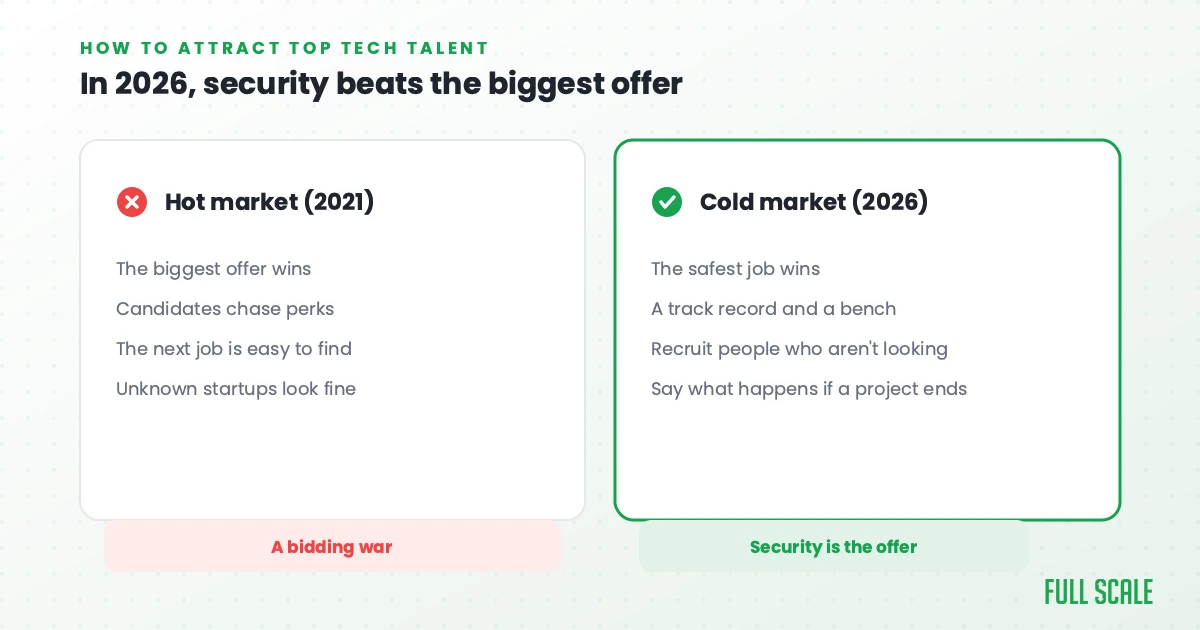
What top tech talent wants swings with the job market. In 2021 developers chased the biggest offer, and in 2026 they chase whoever looks least likely to lay them off.
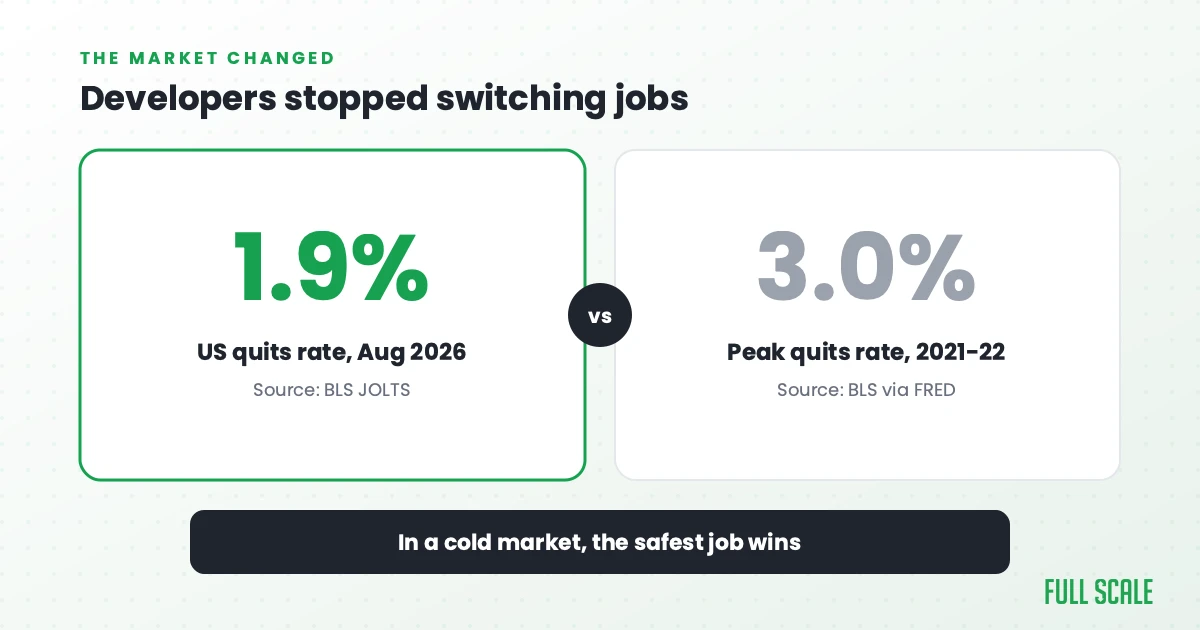
Think back to 2021. A developer with a pulse and a GitHub account had three recruiters in their inbox before lunch. The US quits rate hit 3.0 percent in November 2021, and again in April 2022. People switched jobs because switching was easy.
In a market like that, attracting talent was almost a bidding war. Developers took bigger offers from companies nobody had heard of, because if it fell apart, they'd have another job in a month. The risk felt like zero. That was the golden age of the signing bonus.
Right now, top developers pick the job that looks safest, not the one that pays the most.
The quits rate was 1.9 percent in August 2026, per the Bureau of Labor Statistics. Software development job postings on Indeed are still around 27.5 percent below pre-pandemic levels, even after climbing back some this year. A Stanford study found that employment for workers aged 22 to 25 in AI-exposed jobs sits 19 percent below where it would have been, mostly because companies stopped hiring them.
The Philippines isn't immune either. At a Senate hearing in February, a Cebu outsourcing company said its staff fell from more than 300 to fewer than 100 after it lost clients to AI automation. That was back-office work, the kind AI hits first, but developers in the Philippines read that news too.
The internet has a cute name for all this. It's called job hugging, which is a polite way of saying nobody is letting go of the job they've got.
That changes the first thing a good developer wants to know before your call, from "how much more will you pay me?" to "will this job still be here next year?"
| What the candidate is thinking | Hot market (2021-2022) | Cold market (2026) |
|---|---|---|
| If this job fails | "I'll find another one in a month" | "I might be out of work for six months" |
| What wins them | The biggest offer and the newest stack | A company with a track record and a plan for when projects end |
| Who has the edge | Whoever pays the most | Whoever looks the most stable |
| What a top developer does | Takes risks on unknown startups | Stays put unless the new job is clearly safer |
Why developers pick Full Scale: we're not going anywhere
We've been around since 2018, we have 350+ people, and Inc. has put us on its 5000 fastest-growing list five straight years while we've worked with more than 200 companies. To a developer weighing an offer, that reads as "these people aren't going anywhere."
At Full Scale, losing a client usually doesn't mean losing your job. If a client ends an engagement, the engineer usually stays on our bench, still employed and still paid, while we look for their next team. It varies by role type and a few other things, which is why I say usually.
Compare that to the other options a Filipino developer has. A freelance gig ends the day the client stops paying, and a remote job at a US startup lasts exactly as long as the startup's bank account. Usually the developer finds out on a Zoom call at 2 a.m. their time.
We take on most of that risk so the developer doesn't have to.
That costs us real money. Paying people between engagements is one of the reasons Full Scale isn't the cheapest option out there, and I'm fine with that. Buyers who pick the vendor that stripped out every cost end up with developers who leave the first chance they get. I call that cheapshoring, and it doesn't attract anybody good.
If you're hiring direct, the lesson still holds. Tell candidates what happens to them when a project gets cut, because that's the question they're actually asking.
A recruiter's message beats a job post
None of that matters if the right people never hear about you.
I've hired developers for over 20 years, from VinSolutions to Stackify to Full Scale, and the best ones were always busy doing good work for somebody else. They're usually pretty happy where they are.
The most important part of attracting top talent is going out and recruiting it.
Full Scale has a team of full-time recruiters, and LinkedIn is where they spend their day. Our recruiting team says most of this year's hires started as a LinkedIn message to someone who wasn't job hunting. Plenty of others started with one of our engineers telling a friend to apply, and the rest trickle in from everywhere else.
Our recruiters ask every candidate about their career goals, including whether they're after stability or just a bigger salary. Then they talk about what it's actually like to work here, down to the calendar of company events for the year. A lot of candidates already know who we are before that call. One of our recruiters even found a Reddit thread where developers were asking each other what Full Scale is and what our hiring process is like.
If you're hiring for your own team, the same rule applies. I wrote more about recruiting passive candidates in our guide to hiring tech talent.
The applicant flood is the real attraction problem now
In a cold market the applicants show up on their own, and almost none of them are the ones you want.
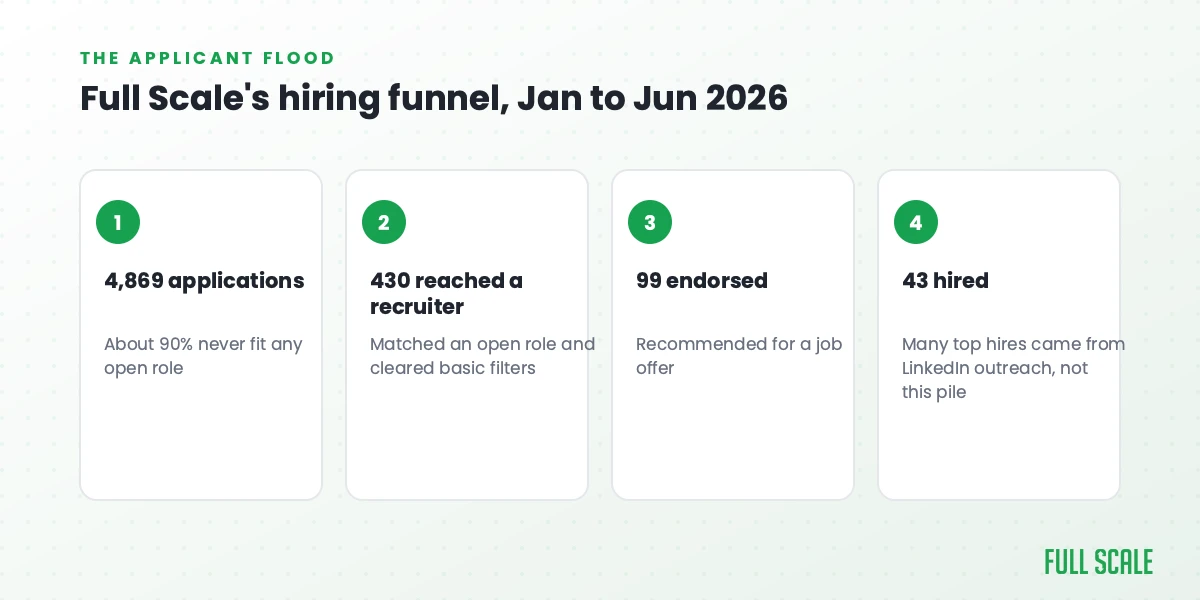
These are Full Scale's real recruiting numbers from the first six months of 2026:
| Recruiting stage, Full Scale (Jan to Jun 2026) | People | Share of applicants |
|---|---|---|
| Applications received | 4,869 | 100% |
| Matched an open role and cleared basic filters | 430 | 8.8% |
| Endorsed for a job offer | 99 | 2.0% |
| Hired | 43 | 0.9% |
That 0.9 percent looks crazy selective. Our standards explain some of it, and the mismatches explain a lot more. Roughly 90 percent of those applications were never real candidates. People applied from countries we don't hire in, sent the same resume to every job on the internet, or had no overlap with any role we had open. A few people we liked got parked for a future opening, and a couple of clients pulled the role halfway through. You can see the rest of our hiring process here.
That's how we end up turning away more than 97 percent of applicants, and most of them were never candidates for anything we had open.
A bigger pile of applicants mostly just means more sorting.
Somebody has to read all 4,869. If you're a 40-person company with no recruiter, that somebody is you, or your best engineer, and neither of you has time for it. It's one of the reasons recruiting in another country is harder than it looks, which we covered in the real challenges in offshore recruitment.
Employer branding only works when your own people back it up
Recruiting gets someone on the phone. What closes the deal is when everything they hear from people already inside the company matches what the recruiter said.
A few things back up Full Scale's pitch:
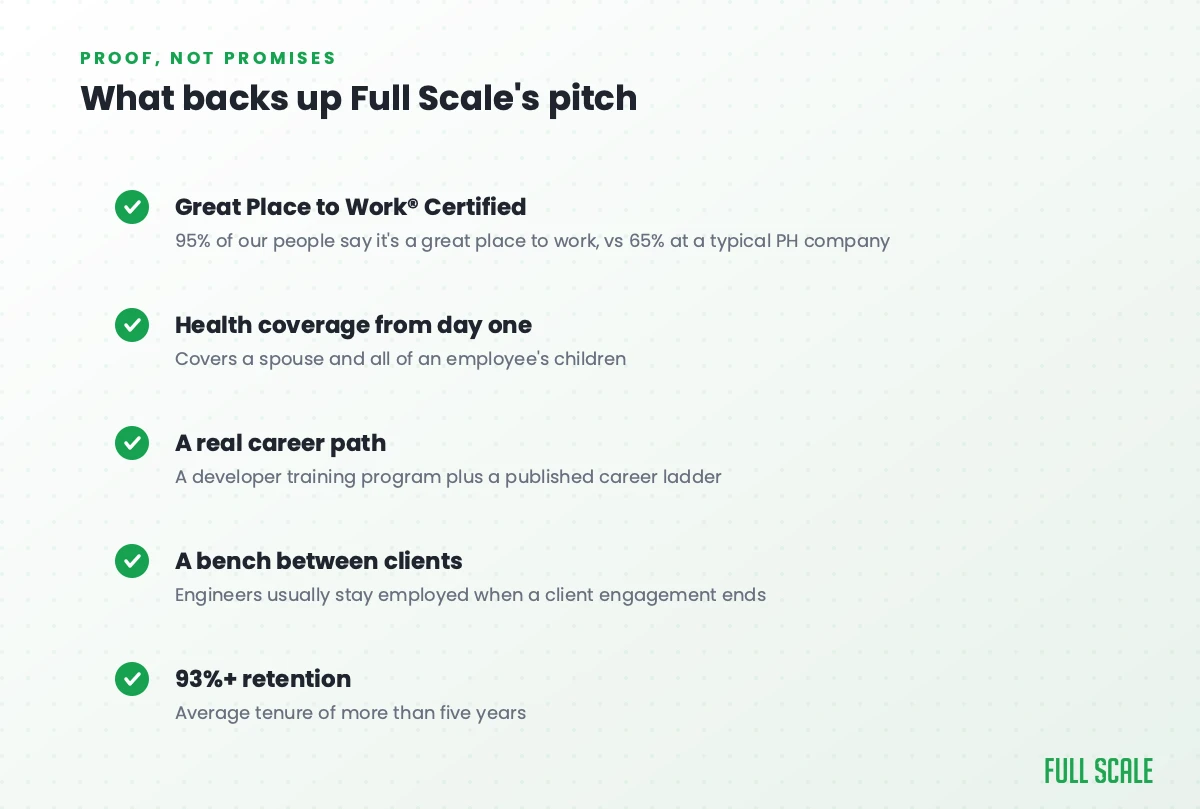
- Survey results from our own people. When our people filled out the Great Place to Work® survey, 95 percent said Full Scale is a great place to work. A typical Philippine company scores 65, and we've been certified two years in a row. We also ranked #15 on the Southeast Asia Best Workplaces™ in Technology list for 2026.
- Benefits that cover the family. Health insurance starts on day one and covers a spouse and all of an employee's children. Everyone gets a company laptop and a work-from-home allowance, and our engineers work remotely from across the Philippines.
- A way to keep growing. Our developer training program runs AI courses for the whole engineering team, and our career ladder spells out what it takes to move from mid-level to senior.
- Actual fun. We run 5 big company events a year and have 9 employee clubs. Our recruiters bring up the sports fest on calls, which is how a developer applying for a backend job ends up being asked whether they'd run a marathon.
- Fair pay. We pay at the top of the local market. You can see what that looks like in our breakdown of software engineer salaries in the Philippines.
The real proof comes later. Full Scale's developer retention runs 93%+, and average tenure is more than five years. People who were sold something fake don't stay five years. The model behind that number is in our post on developer retention.
How to attract top tech talent when you're hiring yourself
Most of what works for us works for any company. The hard part is that some of it takes years to build, so how I'd approach it depends on where you are:
| Your situation | What actually attracts top tech talent for you |
|---|---|
| You're competing locally against big tech salaries | Sell stability and interesting work, and recruit passive people directly. Show candidates your runway and your layoff history, because they'll ask. You won't win a pure bidding war. |
| You're a startup with no recruiter | Lean on referrals and personal outreach, and be honest about the risk. Candidates will figure it out anyway. |
| You want to build your own offshore team | Plan on months to earn a local reputation and find a recruiter who knows the market. Decide up front what happens to people when a project ends. |
| You'd rather skip the recruiting machine | Work with a partner whose stability is already the pitch, so you get developers who chose a safe employer and are still yours to manage day to day. |
The last row is the business I run. Through staff augmentation, our engineers sit in your standups and your Slack like anyone else on your team, and we worry about finding them and keeping them. You get developers who picked us because we're stable, and you skip reading 4,869 applications. We publish developer profiles for the developers on our bench, and you can hire developers in the Philippines through us in as little as 7 days.
Frequently asked questions
How do you attract top tech talent when you can't match big tech salaries?
Compete on what big tech can't promise right now, which is stability. Developers have watched layoff after layoff, so a company with a long track record and a plan for what happens when a project ends can win people who would have chased a bigger number a few years ago. Pay still has to be fair for the local market, but it doesn't have to be the highest offer on the table.
How do you attract software engineers to a small company or startup?
Reach out first. At a small company, strong engineers almost always come through a direct message or a referral, not an application, because the best ones usually already have a job. Be honest about the risk, because candidates are weighing job security heavily right now, and show them why the company will still be around next year.
Where should you post a job to attract top talent?
Posting a job attracts volume, not the best people. At Full Scale, most of our hires come from recruiters reaching out on LinkedIn to developers who weren't looking, and referrals from our own team are another big source. A job post is still useful, but expect to sort through a pile where most applicants don't match the role at all.
Does employer branding actually help attract developers?
Only when the people inside the company back it up. Developers read reviews and ask each other about employers on Reddit before they ever take a call. A brand helps when it's a promise current employees confirm, like Full Scale's Great Place to Work survey results, and it hurts when it's a careers page full of claims nobody inside would repeat.
What do software developers care about most right now?
Job security moved to the top of the list. The US quits rate was 1.9 percent in August 2026, down from a 3.0 percent peak in 2021 and 2022, so people are holding on to the jobs they have instead of taking risks on new ones. Pay and good teammates still matter, but a candidate now wants to know the job will still exist in a year.
How does Full Scale attract developers in the Philippines?
Mostly by being a safe place to land. Full Scale has been around since 2018, and when a client engagement ends, the engineer usually stays on our bench instead of losing their job. Our recruiters also go after developers who aren't looking, and benefits like day-one health coverage for a spouse and all children back up what they say on the call.
Want developers who chose stability?
Full Scale already did the recruiting, so you don't have to. Schedule a call and we'll show you who's available.