
Hidden Costs of Offshore Software Development: Who Pays for Each One

In this article
- Every hidden cost of offshore software development lands on one of two ledgers
- What a good all-in rate already absorbs
- The costs that stay on your side
- A year-one budget with the forgotten lines added
- The big leaks dwarf every line in the ledger
- When the hidden costs do eat the savings
- Questions that surface the lines before you sign
- Frequently asked questions
Quick Answer: The hidden costs of offshore software development are the lines your vendor's rate card never shows and your budget has no row for: your lead's time, ramp-up, tool access, time zone overlap, annual rate increases, and the notice period on exit. A good provider's all-in rate absorbs recruiting, payroll, benefits, and the employing entity. At Full Scale, which bills from $35 an hour, the rest stays on your side of the ledger.
Some of these costs are more "unbudgeted" than "hidden": the vendor quoted an hourly rate, the spreadsheet got one row for it, and everything else became a surprise.
Think of an offshore quote like a plane fare. The number is real, but you'll still spend more on the trip. I've covered the three big ones in my offshore development cost analysis: Rework, management overhead, and employee churn. These are what you get when you choose cheapshoring (buying on price). This blog is about the rest of the spreadsheet: The items no one thought to include in their budget, and the question to ask about each: Who is actually paying for it?
Every hidden cost of offshore software development lands on one of two ledgers
A hidden cost is a cost that is genuine, ongoing, and not included in the rate quote. The question that helps is whose budget the cost hits.
There are some costs that belong to the provider and that a quality, all-in rate would cover. There are other costs that are yours, and there is nothing a provider can do to cover them.
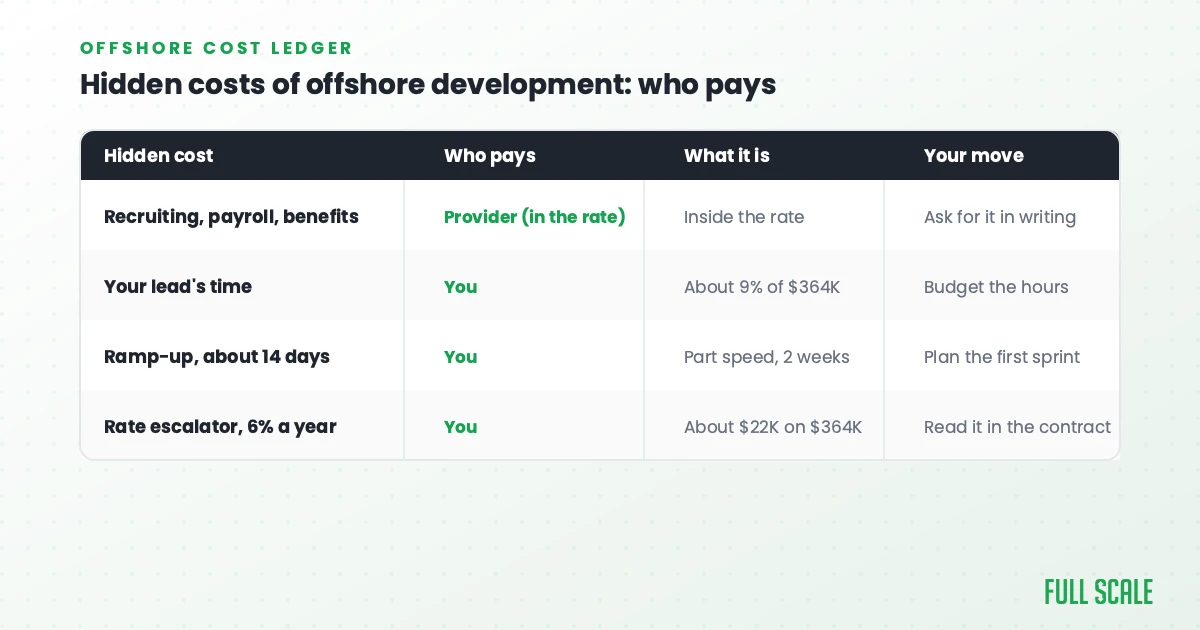
Here is how Full Scale breaks down the ledger: Full Scale bills from $35 an hour, and the table shows what that rate covers and what it doesn't.
| Cost line | Who pays in a Full Scale engagement | How to size it |
|---|---|---|
| Recruiting and vetting | Full Scale, inside the rate | Compare to your own time to fill a role |
| Payroll, 13th-month pay, statutory benefits | Full Scale, inside the rate | Ask if the quote is fully loaded or base plus fees |
| Employing entity, HR, and each engineer's equipment | Full Scale, inside the rate | The pricing page lists benefits, HR, and equipment as included |
| Account management (Customer Success Manager) | Full Scale, inside the rate | Ask how often the CSM meets your team |
| Your engineering lead's time | You | Weekly hours times your loaded hourly cost |
| Ramp-up in your codebase (about 14 days) | You | Treat the first two weeks as part productivity |
| Time zone overlap (3-4 hours a day as standard) | You | Whose calendar moves, and how often |
| Tool seats, system access, and security review | You | Seats times headcount, plus your IT queue |
| Review time for AI-generated code | You | Added hours per pull request on your lead |
| Annual rate escalator (6 percent, two 3 percent steps) | You | Compound it over the length of the engagement |
| Payment timing (paid up front by ACH, net 10) | You | One month of working capital |
| Notice to drop a developer (30 days) | You | One month of rate after you decide to leave |
The top four are your provider's problem; a competent vendor will have accounted for these. The bottom eight are yours, and this is why a rate card can't become a budget.
What a good all-in rate already absorbs
An all-in rate from a quality provider must include recruiting, payroll, benefits, employing entity, and account management. They shouldn't appear as a separate line item. If they do, the rate isn't an all-in rate, and comparing it to a US salary becomes meaningless.
Consider recruiting. Workable's tech hiring data puts the global average time to fill a tech role at about 62 days, though its own table shows 68 days for IT and engineering roles. This is two months before they write their first line of code. Full Scale runs its own full-time recruiters. A client can start in as little as 7 days when the right engineer is on the bench, and we absorb the search time instead of billing it to you.
Payroll is another cost. Every Filipino worker receives a mandatory 13th month in December. That's an additional month's pay, or roughly 8.3% on top of the monthly figure. Our developers are paid at the top end of the local market; read what engineers earn in the Philippines for more details on what software engineers make in the Philippines. These costs are included in the rate. You won't find an extra line item for 13th month. The same goes for the legal entity that employs the engineer, HR-related activities, and laptop/home office equipment. Full Scale is the employer, which means these are our costs.
Why the line items matter more than the total
One common technique vendors use is to quote a low hourly rate and then add one piece at a time: an additional layer for a project manager, a setup fee, a cost adder on benefits. In AMC Theatres' case study, it describes the traditional outsourcing model as engineers being isolated behind their vendor's account manager. The overhead is calculated at about 30-40%, paid for by the layers of management that the client wouldn't be able to identify. You can see how they run things differently in the AMC case study.
When there's a line item in the quote you can't explain, ask yourself what you're paying for. Our article on the staff augmentation pricing model explains the four types of charges that vendors use, so you can tell which one you're seeing.
The costs that stay on your side
Those are lines no one else can cover for you, as they take place within your own organization. You don't want to skip them on account of using offshore vendors; and you also shouldn't omit them from the estimate.
Your lead's time is the one cost you can't offshore
An offshore team still needs someone on your side to define the product, manage the architecture, and drive decisions. Someone whose time isn't included in the savings.
Let's do the math, based on my assumptions, and substitute your numbers if you like. Assume your internal lead spends 6 hours per week for a five-person team at a cost of $100 per hour, fully loaded. To put that in perspective, the Bureau of Labor Statistics puts the median US software developer wage at $135,980 as of May 2025, and your lead will cost more than the median. This translates to 312 hours per year, or roughly $31,200. According to the pricing page, a five-person team from Full Scale costs $364,000 in year one, making your lead's time approximately 9% of the total.
An offshore team without an internal lead will cost you more in rework than it saves on hourly rates.
If you don't have someone on your team who can lead an offshore group, you need to fix that first. It's the ownership pillar from my book, Product Driven: there must be someone in your organization who owns the project, and it can't be a vendor.
Ramp-up means the first two weeks aren't full speed
A new engineer requires about 14 days to integrate into your standups, your code, and your practices. In that time, your team fields questions that an experienced peer would have no need to ask.
This is a cost and it is a cost that a US-based hire incurs as well, except that a US hire doesn't have to go through a 62-day search beforehand. To understand what a good plan would look like, check out our developer onboarding checklist, which outlines the first 90 days.
The delay is usually on the client's side. If a client's contract process takes a while, that's not a vendor cost; it starts the clock late. We've found this with our own process. As I've stated before: "It usually takes our clients a lot longer than it takes us." I know some clients taking weeks to complete an MSA.
Time zone overlap costs somebody's calendar
The Philippines is 14 hours away from Kansas City, which means any time we have a shared meeting, it's going to be either someone's very early morning or very late night. We typically aim for 3–4 hours of overlap per day. Some teams go to US hours on a rotating night schedule, while others remain async-first and have just one stand-up per day.
Overlap isn't a law of physics, it's a scheduling decision, but every decision has a cost. If you ask an engineer to work night hours, they should be paid well for it and have extra support. If you stretch your US-based engineering manager too far, their productivity will suffer.
The time zone management guide covers how teams handle it day to day. Somebody is always going to have an early meeting. Make sure it isn't always the same somebody.
Tool seats, system access, and your own IT queue
For every engineer you onboard, you need to provision a license for your repository, ticketing system, cloud accounts, and collaboration tools. This cost scales with headcount. If you plan to provide any AI coding assistants to your team, those will also be a per-engineer cost.
The hidden cost here is time. If it takes a week for access to be granted in your IT system, then the engineer is being paid but unable to work. As I discussed in the offshore software development offshore challenges post this is the most common delay, and it has nothing to do with the offshore team.
Security audits, vendor questionnaires, data privacy policies, etc., all require your resources. My IP protection framework checklist shows which items you should agree on up front.
Reviewing AI-generated code is the newest line
AI made code cheaper to write, but reading code is now the expensive part. I like to joke that we pay developers to be supervisors for AI: read its output, find its mistakes, and point it somewhere useful.
The joke has a budget line inside: someone has to sign off on what AI and the team are producing, and typically that's your lead. Typing was never the hard part of software; knowing what to build was, and AI didn't make that any cheaper.
The annual rate escalator
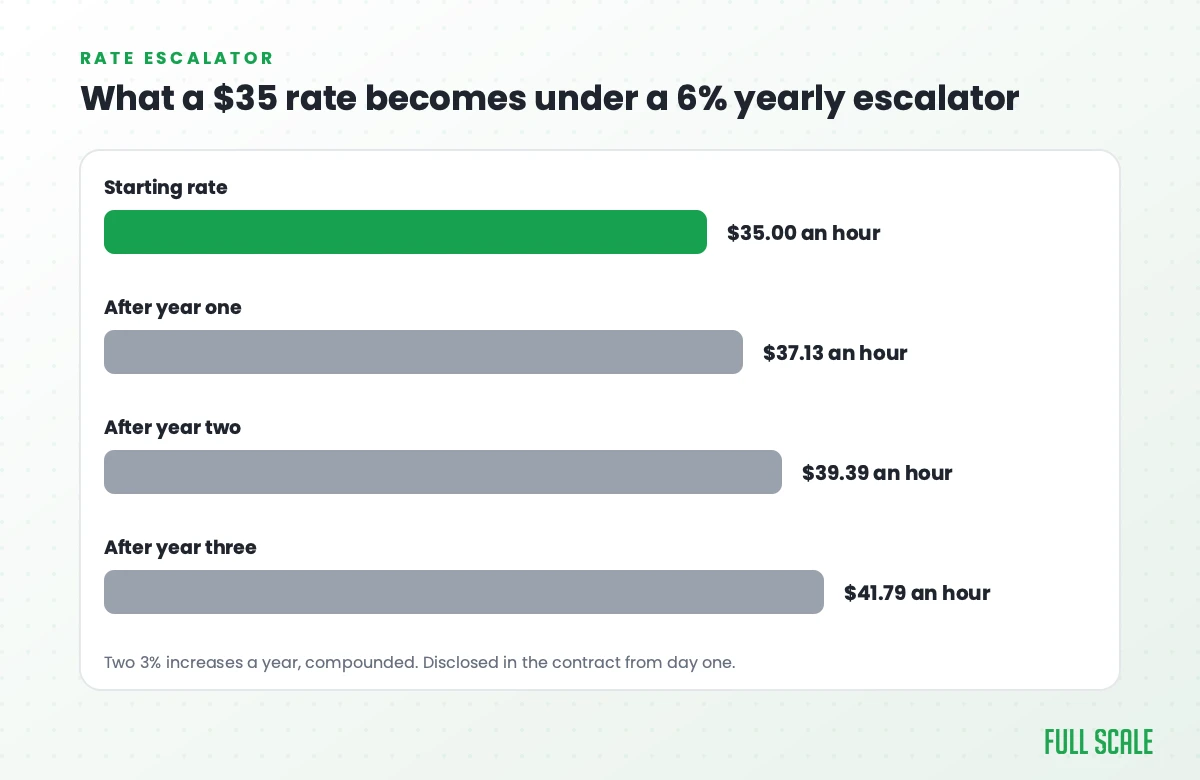
The rate escalator is built into Full Scale's contract (6 percent a year, applied as two 3 percent increases), and we disclose it on day one. Two 3 percent increases compound to roughly 6.1 percent, which means a $35 hourly rate would be around $37 after a year, $39 after two years, and $42 after three.
On a $364,000 team, that's about $22,000 over the course of one year. Real money. I prefer you see that information in the contract on day one, not in month seven. The increase doesn't just apply to the engineer; it's also where the budget for our Customer Success Managers comes from, along with the people who support our 93%+ retention. That budget has to grow with inflation, much like salaries do. The staff augmentation contract terms post goes into more detail about why this is necessary. When you get a quote for a staff augmentation contract that locks in a rate for three years, ask how the engineer's compensation will look in year three.
Payment timing and the cost of leaving
Billing is done via autopay ACH up-front with a 10 day net term. Full Scale pays the engineers each month. Our billing cycle mirrors a monthly payroll rather than a typical AP cycle. For your cash flow, that is roughly one month of working capital you do not get to hold.
Leaving is cheaper than most buyers think. There are no long-term contracts. If it isn't working in the first two weeks, you get your money back. After that, you drop a developer with 30 days' notice. So, the true exit cost is about a month of rates after you've made the decision to leave. The post on when it isn't working out covers how that conversation goes.
The developers also have a notice period. Every developer is under contract for a 90-day notice period. If they leave, there's no two week scramble to replace them.
A year-one budget with the forgotten lines added
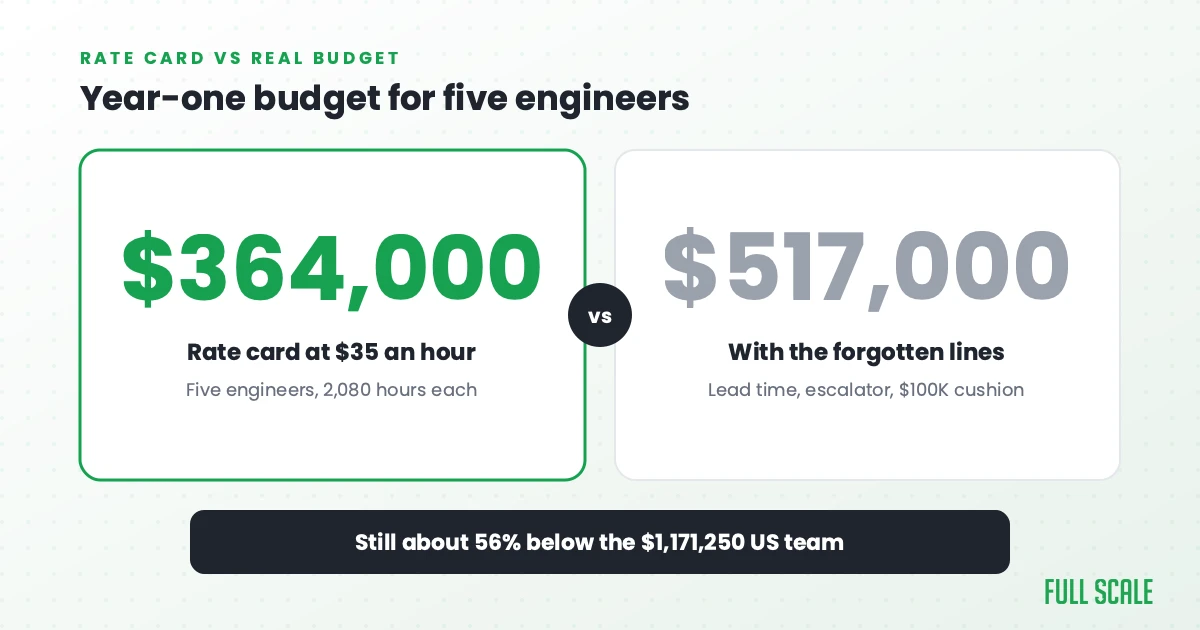
The forgotten lines take ten minutes to size, and they're smaller than the fear. The table below is based on the 5-person comparison on Full Scale's pricing page, plus the assumptions in this article. Change every assumption to your number before believing it.
| Year-one budget line, five-person team | Assumption | Amount |
|---|---|---|
| Full Scale team at the all-in rate | Five engineers at $35 an hour, 2,080 hours each | $364,000 |
| Your lead's time | 6 hours a week at $100 an hour | $31,200 |
| One full year of the 6 percent escalator | 6.1 percent of $364,000 | about $22,000 |
| Cushion for tool seats, ramp-up, and security review | A round number, not a measurement | $100,000 |
| Total with the forgotten lines | about $517,000 | |
| Equivalent US team, year one | Salaries, benefits, recruiting, office, and turnover | $1,171,250 |
Both numbers are from Full Scale's pricing page. The US team includes salaries, benefits, recruiting fees, office costs, and turnover; benefits, HR, and equipment are bundled into the Full Scale rate. According to my math, the forgotten lines represent 15% to 40% of the rate card. The team still costs about 56% less than the US team, within our 50–70% range. The pricing page says 69% less, before any forgotten lines are added.
The cushion is deliberately generous. If your numbers come out bigger than mine, the model is telling you something real, and the next section is where to look.
The big leaks dwarf every line in the ledger
All these lines are a rounding error when compared with the three costs I discussed in my cost analysis: rework from a low-priced developer building the wrong thing, management costs of the project-shop model, and turnover. The $31,000 for the lead time line is nothing. But the cost to rebuild all of a quarter's work is enormous.
The line items determine whether you have accurate budgets. The model determines whether you actually save the money.
This is why I advise buyers to choose staff augmentation rather than a fixed-bid project shop, and why the ROI math is more important than any individual line item. My article on the risks of outsourcing lists hidden costs as risk #8. The common offshore mistakes demonstrates how most of those risks are self-inflicted.
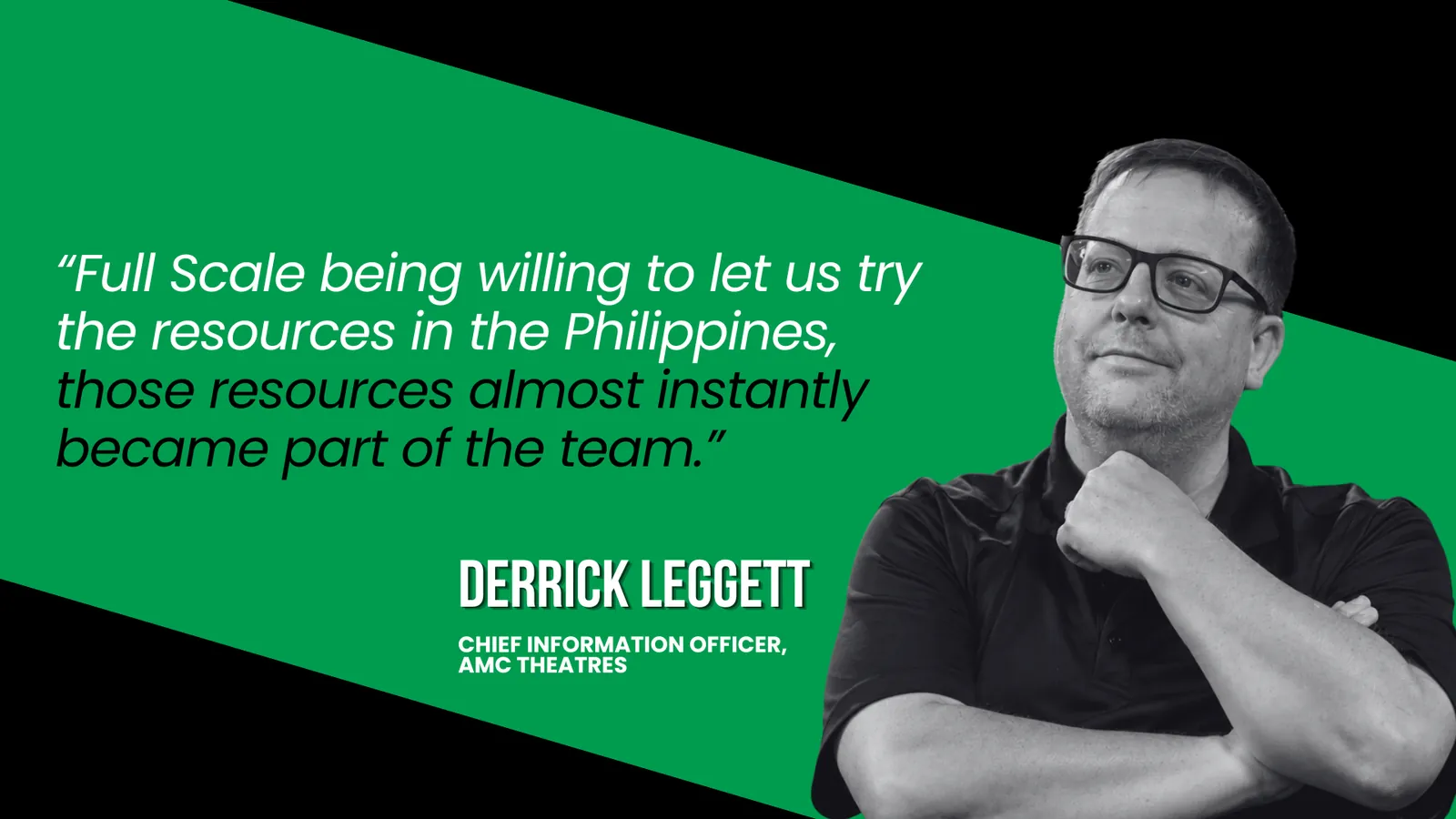
AMC Theatres CIO Derrick Leggett described the integrated team like this: "It's a fully integrated team. It's just that some of the people happen to be living in the Philippines." On such a team, most of the translation and rework costs never start.
When the hidden costs do eat the savings
There are a few circumstances where hidden costs will drain your potential savings. I would rather call these out than imply that offshore can always save you money. In this table, we have listed your situation, the hidden cost, and the solution to address it.
| Your situation | The hidden cost that bites | What to do |
|---|---|---|
| No engineering lead on your side | Rework and unclear direction | Appoint or hire a lead before the first engineer starts |
| A one-off project under three months | Ramp-up and 30-day notice take a big share of the work | Use a fixed-scope contractor instead |
| You need full US hours every day, forever | Shifted schedules cost more in pay and attention | Compare against a nearshore region, then price both honestly |
| Regulated data or strict IP rules | Security review and legal time | Settle terms before day one using the IP framework |
| The quote is the lowest of five | Rework, turnover, and a project-shop model | Read the due diligence checklist before signing |
Questions that surface the lines before you sign
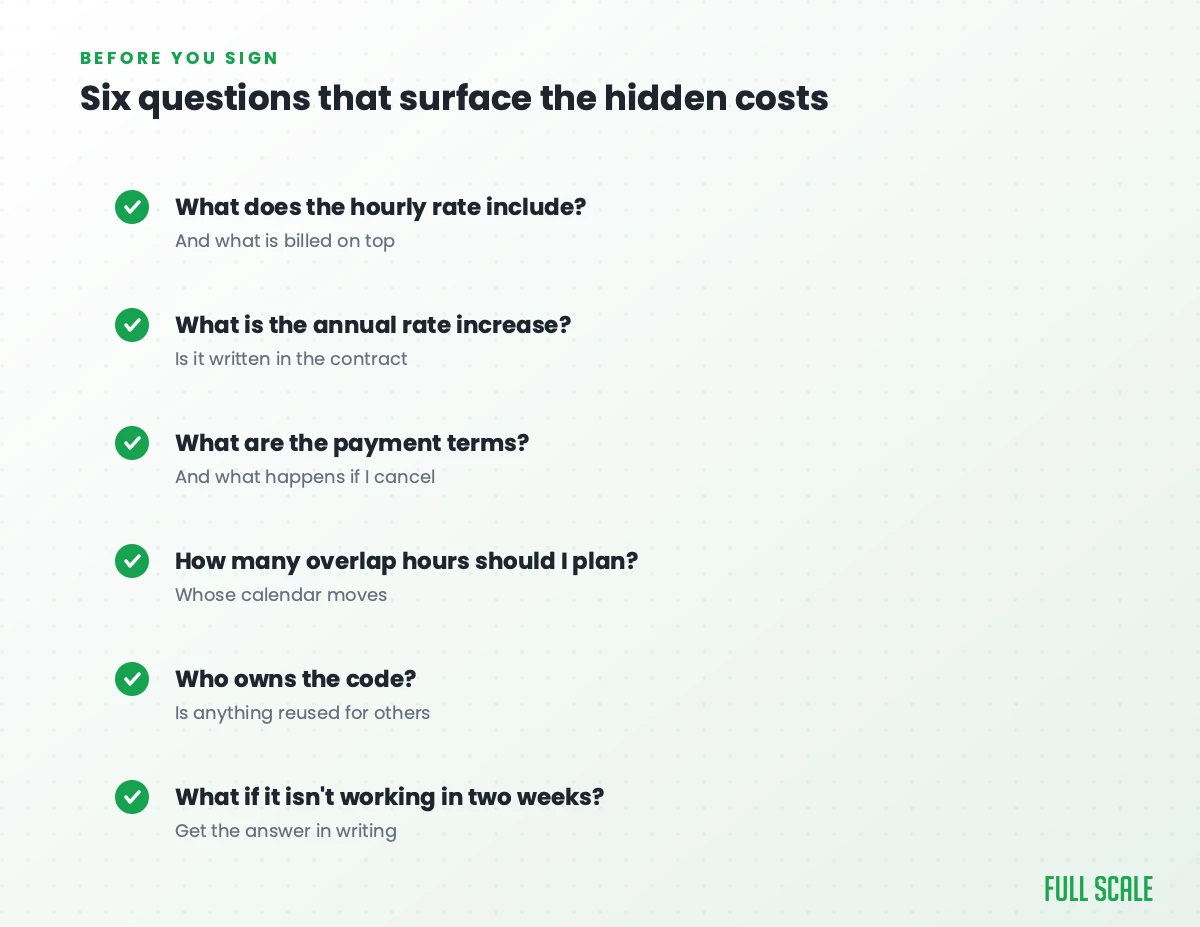
The following six questions will bring out the majority of hidden costs during a single call. Use these questions to interview any offshore partner, including Full Scale.
- What is included in the hourly rate, and what is billed separately?
- What is the annual rate increase, and is it mentioned in the contract?
- What are the payment terms, and what happens in case I cancel?
- How many hours a day of overlap do I need to plan for?
- Who owns the code? Is the vendor using anything they've built for me?
- What happens in the first two weeks if it's not working?
You can find a longer version of these questions in the due diligence checklist with eight categories and examples of what a good answer looks like.
To learn more about rates for different countries, check out the offshore rates by country guide.
For information on where the savings come from, read reducing software development costs.
If you're putting your rate card and the forgotten lines side by side in a spreadsheet, then you're already much closer to realizing the potential savings.
Book a call with Full Scale and ask for the complete list of line items.
Frequently asked questions
What are the hidden costs of offshore software development?
The hidden costs of offshore software development are the real expenses that never appear on a rate quote: your own lead's time, the ramp-up weeks before an engineer is productive, time zone overlap, tool seats and system access, review time for AI-generated code, annual rate increases, and the notice period when you leave. A good provider's all-in rate already absorbs recruiting, payroll, benefits, and the employing entity, so the rest is what your budget has to carry.
What does an offshore provider's all-in rate usually include?
A good all-in rate bundles recruiting, payroll, statutory benefits, the legal entity that employs the developer, and account management into one hourly number. At Full Scale, that rate starts at $35 an hour. Ask any vendor to list those lines in writing, because a quote that shows a base rate plus separate fees for each of them is a different product.
How much should I budget on top of the hourly rate for an offshore team?
On Full Scale's numbers, budget roughly 15 to 40 percent above the rate card for the lines the rate does not cover: your lead's time, a built-in 6 percent annual rate escalator, tool seats, and a cushion for ramp-up. That range comes from the worked example in this article, so replace the assumptions with your own. Even at the high end, a five-person team stays far below the cost of the equivalent US team.
Are offshore developers still cheaper once hidden costs are counted?
Offshore developers are still cheaper when the hidden costs are sized honestly and the provider is chosen on structure instead of price. Full Scale's five-person example runs $364,000 in year one against about $1,171,250 for a US team, and adding $100,000 of cushion for unsized costs still leaves the savings near 56 percent. The savings disappear when a team buys the cheapest rate, has no engineering lead, or uses a project shop.
How do I avoid hidden costs when hiring an offshore development company?
Avoid hidden costs by getting every cost line in writing before you sign: what the rate includes, the annual rate increase, the payment terms, the notice period to drop a developer, and the guarantee window. Then budget your own lead's time and ramp-up separately. Full Scale discloses a 6 percent annual escalator, 30 days' notice, and a two-week money-back guarantee in the contract from day one.