
Software Development Cost Estimation: A 2026 Calculator + AI Guide

In this article
- Software Development Cost Calculator
- How AI-Powered Engineering Changes Software Development Cost Estimation
- Typical Software Project Costs by Size
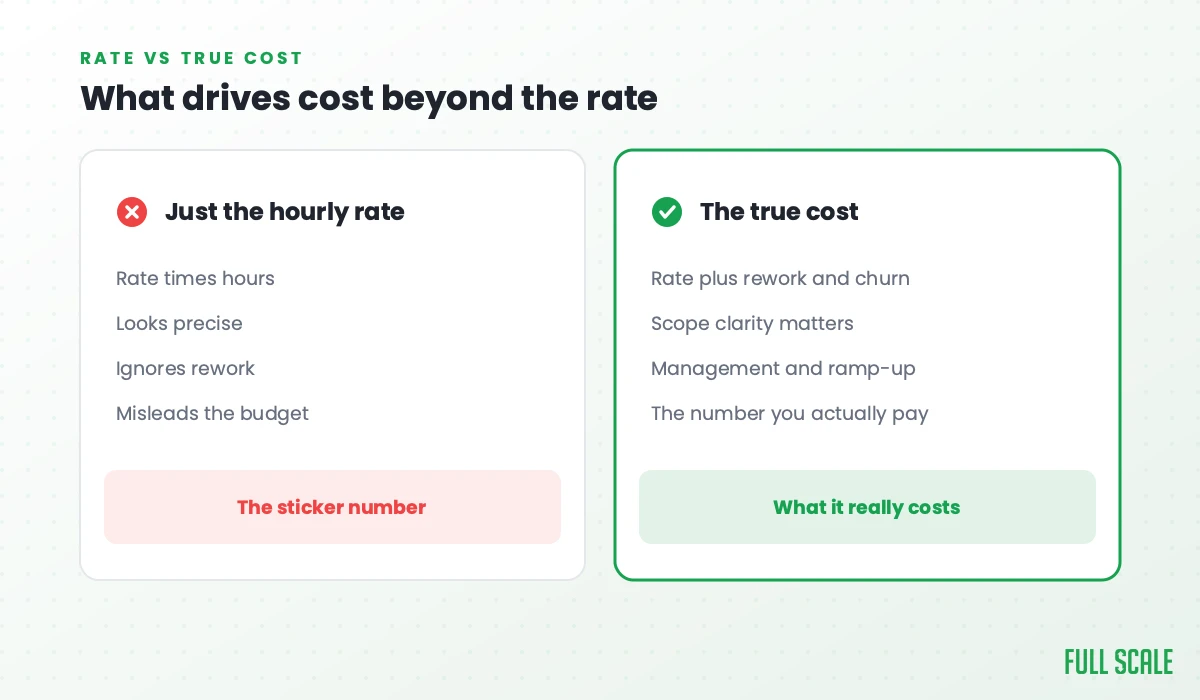
- What Drives the Numbers Beyond the Rate
- Running the Offshore Math
- When the Calculator Math Holds (And When It Doesn’t)
- Frequently Asked Questions About Software Cost Estimation
- The Bottom Line
Quick Answer: Software development cost estimation starts with four inputs: team size, project duration, hours per month, and a blended hourly rate. A five-person Full Scale team in the Philippines at $35 an hour for six months comes to about $168,000, or roughly $134,000 with a 20% AI productivity boost. Treat that number as a floor, then add 20-30% for scope creep and rework before it becomes your budget.
Software Development Cost Calculator
Estimate your project budget across team sizes, regional rates, and the AI productivity boost.
Your Project
Number of developers 5 5
Project duration 6 months 6
Team type and region Philippines Team (Full Scale) — $35/hr blended (35) Custom $/hr (e.g. 45)
AI productivity boost 20% 20 How much does AI tooling (Copilot, Claude, Cursor) lift your team’s output? 40% is the cap, not the average. Senior-heavy teams average 25-35%. Mixed teams average 15-25%. Junior-heavy without senior oversight: 0% or negative.
Your Estimate
Project cost without AI boost $168,000
Project cost with AI boost $134,400
Cost per developer-month $4,480
Estimated cost per feature $7,467
Assumptions: 160 working hours per developer per month, ~0.6 features per developer-month at small team size. Outputs are illustrative ranges. The AI boost slider models net productivity gain after accounting for the senior review tax and AI hallucination cleanup time. For a more precise estimate on your specific project, schedule a call.
Software development cost estimation usually misses because it fixates on the hourly rate, the one variable that matters least. Move the sliders above to model your own project, then read on for what actually drives the number. The defaults reflect a typical mid-sized engagement with a Full Scale Philippines team plus a 20% AI productivity boost. Location is one of the largest inputs in any estimate, because developer pay varies several-fold by city and country.
The hourly rate is the easiest input to negotiate and the smallest variable in your final invoice. Scope creep, rework, integration complexity, and the seniority match between the team and the work matter more. Add AI-powered engineering, which compresses some of the work and creates new hidden costs in others, and the old estimation math stops holding. The same forces decide whether you can estimate a realistic project timeline, not just a realistic budget. Below: the five ways AI changes the math, the project-size cost bands, and the assumptions that decide whether the number you get is the number you actually pay. If you’re sizing a server-side build, see what really drives backend development cost.
The calculator above assumes 160 working hours per developer per month and that the AI productivity boost is net of overhead (senior review time, AI cleanup, hallucination debug). The cost-per-feature line treats a “feature” as a mid-sized unit of work, so read it as illustrative, not a price list. The boost slider’s 40% cap is the maximum a senior-heavy team should plug in, and most teams should sit in the 15-25% range. The regional rates in the dropdown are typical blended ranges you can edit; the only Full Scale-specific number is the $35/hour Philippines rate.
One thing to do with every number this tool returns: add 20-30% for scope creep and rework before you treat it as a budget. That gap is the whole point of this page. Rate is the part the calculator can see, and it’s rarely the part that blows the budget. Most of that gap is scope creep you did not plan for, one small change at a time.
How AI-Powered Engineering Changes Software Development Cost Estimation
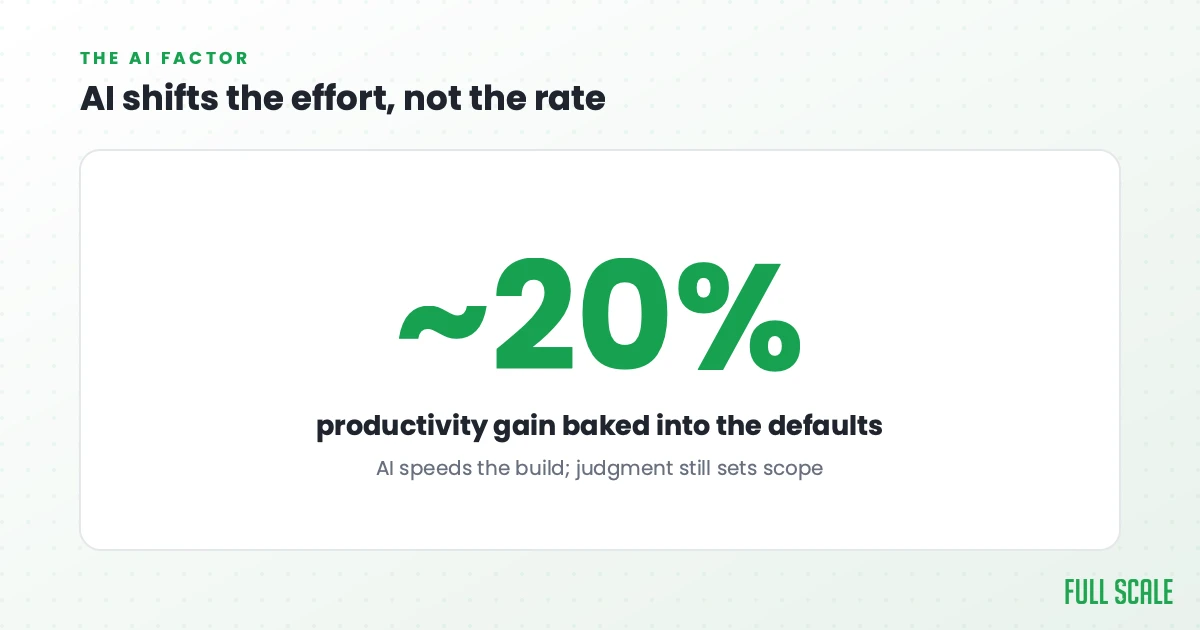
The biggest shift in 2026 software development cost estimation is what AI tooling does to the math, both when it’s used well and when it’s used badly. Location used to be the headline variable; now the bigger swing is how the team uses AI. Here are the five concrete ways AI changes the calculator.
1. Hours per feature drop 20-40% for experienced teams
AI-assisted coding compresses the time spent on boilerplate, glue code, and test scaffolding. For senior teams who can judge AI output, that drop is real and shows up directly in the cost-per-feature number in the calculator. The 20-40% range is the upper bound, not the average. Most working teams land at 15-25% net once you account for the time spent reviewing what got generated.
Be skeptical of the headline numbers. In a 2025 randomized study from METR, experienced developers expected AI to make them about 24% faster and were actually 19% slower on code they knew well, even though they still felt faster. The boost is real, but only for teams set up to capture it. That’s why the calculator treats AI as a slider you set honestly, not a discount it applies for you.
2. Junior-to-senior cost ratio shifts
A junior developer with Claude or Copilot or Cursor can produce mid-level output. But only if a senior reviews the code. The estimate now needs a “senior review tax” line, typically 10-15 percent of the junior’s hours added to a senior’s plate. A team that was 40 percent juniors and 60 percent seniors used to balance on rate. With AI, the seniors are doing more reviewing and less shipping, and the team cost moves with that.
3. Boilerplate is approaching free
The estimate used to include 30-40 percent of dev time on glue code, scaffolding, and routine integrations. Now those hours are closer to 5-10 percent, which means more of the estimate concentrates on the genuinely hard work: architecture decisions, complex integrations, judgment-heavy product calls. That pushes the total down even as the per-hour value of the work that’s left goes up, so the cost-per-feature math gets harder to get right, not easier.
4. Hidden cost: AI code nobody understands
Code that’s “good enough to ship” but nobody on the team can debug becomes tomorrow’s tech debt at today’s prices. Add 5-10 percent to the estimate for AI code review and explanation overhead, which is the time a senior spends understanding what got generated and whether it’s safe to deploy.
AI is a powerful tool that can boost productivity, but relying on it to generate unexplainable code creates tomorrow’s technical debt today. GitClear’s analysis of 211 million changed lines of code found duplicated code blocks climbed sharply as AI assistants spread, while refactoring fell, which is exactly the pattern that turns a cheap build into an expensive maintenance bill. The hard part of software development was never writing the code. It’s understanding the problem you’re trying to solve.
5. Small teams ship faster, but the single-senior risk is real
AI lets small teams cover ground that used to require 8 to 10 engineers. The cost-per-feature drops aggressively. But the single senior who can judge AI output becomes a single point of failure. A team of 3 with 1 strong senior using AI ships at the velocity of a team of 6 without it. The estimate has to include what happens if that senior gets sick for two weeks, leaves the company, or pushes back on a bad spec and gets ignored.
Pure coders will be replaced by AI, and problem solvers will run technology organizations.
Net effect on the calculator
The calculator’s number is more accurate when the AI productivity slider matches the team’s actual ability to judge AI output:
- Senior-heavy teams (60%+ senior): 25-35% net boost, the slider’s high end
- Mixed-seniority teams: 15-25% net boost, the slider’s middle
- Junior-heavy without senior oversight: 0% net or NEGATIVE, more rework than boost
Wrong slider position equals wrong estimate. For most product teams in 2026, 20% is the safe default. For a deeper take on AI’s actual impact on software development costs, see our writeup on reducing software development costs structurally.
Typical Software Project Costs by Size
Most projects fall into one of four bands. The calculator above lets you model any specific project; the bands below give you a quick reality check on whether your estimate is in the right neighborhood.
| Project Size | Typical Cost Range (2026) | What Fits Here |
|---|---|---|
| Small | $10,000 – $50,000 | Simple landing page, single integration, validated prototype, marketing website with light dynamic functionality |
| Medium | $50,000 – $250,000 | MVP for a SaaS product, mobile app v1, mid-complexity internal tool, e-commerce build on an existing platform |
| Large | $250,000 – $1,000,000 | Full-featured SaaS product, multi-platform application, custom B2B platform, regulated industry product with compliance work |
| Enterprise | $1,000,000+ | Large-scale platform rebuild, multi-year custom enterprise software, regulated industries with deep integration requirements, AI/ML systems with proprietary models |
Where your project lands within a band depends on the structural drivers in the next section, and on how aggressively you manage them. The bands are illustrative ranges based on patterns across the 200+ tech companies Full Scale has served, not Full Scale-specific rate cards.
What Drives the Numbers Beyond the Rate
The hourly rate in the calculator is one input. I’ve watched this math play out across the 200+ companies Full Scale has worked with. The bigger drivers of where your project lands sit on the structural side:
- Scope and complexity. The single biggest factor. Larger and more complex projects require more time, more people, and more skilled people. Most cost overruns are scope-creep problems dressed up as estimation problems.
- Integration complexity. Every external API, every legacy system handoff, every third-party authentication flow adds engineering time and testing surface area. Two clean integrations cost roughly 2x one integration; two messy integrations cost 5x.
- Security and compliance requirements. SOC 2 adds modest cost. HIPAA, PCI DSS, or defense compliance can add 30-50% to a build. Bake compliance in from week one; bolting it on at the end is the most expensive thing you can do in software.
- Seniority match between the team and the work. Don’t pay senior rates for mid-level work, and don’t put juniors on architectural decisions. Misallocating seniority is one of the largest hidden cost drivers in software.
For the structural levers that move these numbers most, see our guide to reducing software development costs.
Two things this calculator deliberately leaves out, and you should add both before treating any estimate as your real budget. First, the rest of the team: QA, design, and product management usually add 20-40 percent on top of pure developer cost. Second, maintenance: keeping software alive and current typically runs 15-20 percent of the original build cost every year. The build is the down payment, not the total.
Running the Offshore Math
Offshore staff augmentation from Full Scale cuts fully-loaded developer cost by 50-70 percent versus US in-house, but only when the team is run well. The calculator above shows what your project costs at any single team’s blended rate. The bigger question for many teams is whether to pick a US team or an offshore team in the first place. For server-side teams, that maps onto when to outsource backend development.
US software developers earn a median around $133,000 a year per the Bureau of Labor Statistics, and once you load in benefits, overhead, equipment, and management, senior talent runs roughly $80-$150 per hour fully loaded. Senior developers at Full Scale in the Philippines run $30-$40 per hour. The cost reduction is real: 50-70 percent on fully-loaded developer cost when structured as a long-term team.
That saving only holds if offshore doesn’t quietly add rework. Hire the cheapest developers you can find, hand them a spec, and give them no engineering leadership, the mistake I call cheapshoring, and the coordination and rework overhead can erase the rate advantage entirely. The rate is only an advantage when the team is run well enough to keep it. That’s the whole point of staff augmentation done right: a senior team you direct, not a vendor you hand a spec to.
If you’re seriously considering offshore for your project, the math gets more specific than this general-purpose calculator can model. We’ve built a dedicated offshore development cost analysis post with an offshore-specific ROI calculator that handles regional rate variations, productivity adjustments, and overlap-hour modeling. That’s the next step if the general calculator above has you curious about the offshore side.
For the rate context by country, see our offshore software development rates by country guide. For the local-side math (what a US senior developer actually costs all-in versus the headline salary), see our in house development vs outsourcing breakdown. For the model-comparison decision (nearshore vs offshore vs onshore), see our nearshore vs offshore writeup.
When the Calculator Math Holds (And When It Doesn’t)
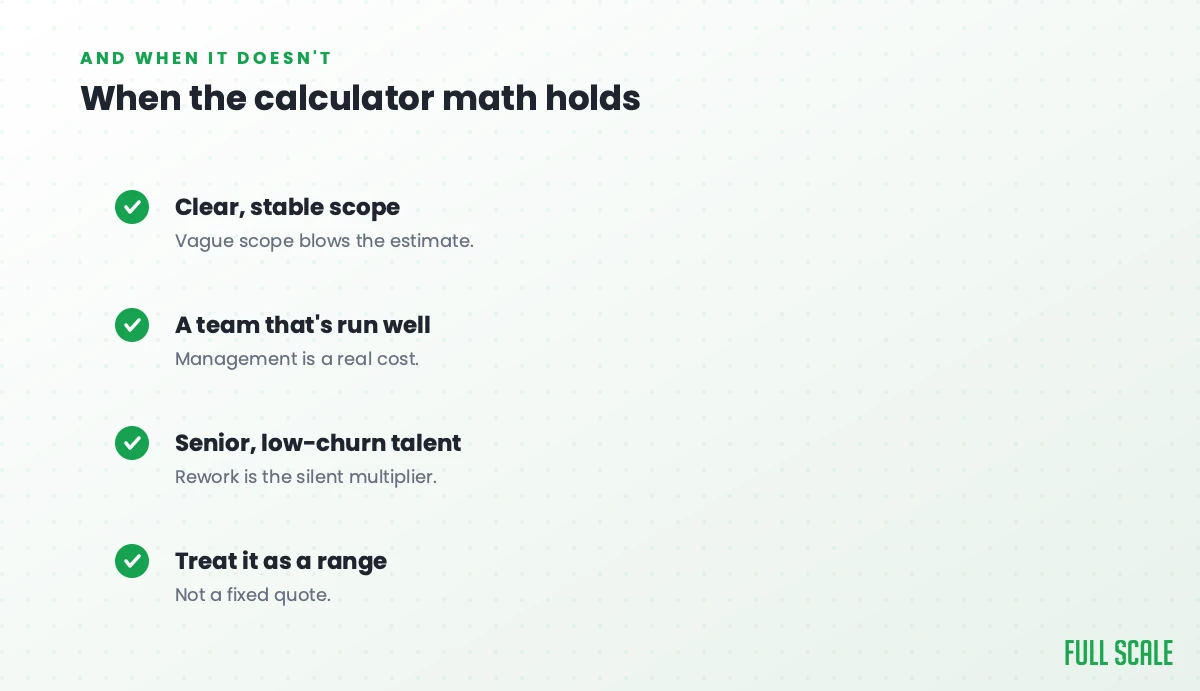
The calculator gives you a number, and the assumptions behind the inputs decide whether that number is right.
Three things break most software development cost estimates:
Scope creep. Across the 200+ companies we’ve worked with, the most consistent variance is scope. The team starts with one feature set, the founder sees something on a competitor’s site three weeks in, and the spec grows by 30 percent without the timeline or budget moving. Build a 20-30 percent contingency into the original estimate. Most teams don’t, and they discover the gap when timelines slip. Even big, well-funded programs miss: a McKinsey and University of Oxford study of more than 5,400 IT projects found that those with budgets over $15 million ran 45 percent over budget on average.
Wrong-build risk. The most expensive code is the code that gets shipped and then thrown away because the assumption it was based on was wrong. The calculator can’t model this because it depends on product judgment that lives outside the dev team. But it’s the largest single category of waste in software, and it doesn’t show up on any rate card.
Productivity assumptions, especially AI productivity claims. The AI boost slider in the calculator is a real lever, but it’s also where most estimates fail. If your team can’t judge AI output, the 20-40 percent boost reverses and becomes a tax. Test the assumption before you bake it into the budget.
Rate is not the cost. Rework is the cost.
Frequently Asked Questions About Software Cost Estimation
How do you calculate software development cost?
Multiply your team size by project duration by hours per month by blended hourly rate. The calculator on this page runs that math. Two variables move the number most. The rate depends on where your team works, and the AI productivity boost depends on whether your team can judge AI output. A 5-person Philippines team for 6 months at $35/hour with a 20% AI boost runs roughly $134K. The same team in the US at $150/hour runs $720K before AI adjustment. Just remember the calculator only prices the work you can see: scope creep and rework, not the hourly rate, are what blow most real budgets.
How much does AI reduce software development cost?
For experienced teams that can review AI-generated code, AI reduces development hours by 20-40 percent on boilerplate-heavy work, with a typical net of 15-25 percent across a project. For teams that can’t supervise AI output, the boost reverses and adds 10-20 percent to the cost as rework. The compound condition: AI saves money when the engineers using it can judge what to build, when the AI is wrong, and how to integrate the output safely.
What’s a typical software development project cost in 2026?
Small projects ($10K-$50K) are landing pages and scoped integrations. Step up to $50K-$250K and you’re funding an MVP or a mid-complexity SaaS build. Full-featured products run $250K-$1M, and anything past $1M is enterprise territory. Where your specific project lands depends on team size, duration, hourly rate, and structural drivers like integration complexity, compliance requirements, and the seniority match between the team and the work.
How do you estimate a software project budget?
The calculator covers developer cost only, so add what it leaves out. QA, design, and product management usually add 20-40 percent on top of pure developer cost. Scope creep and rework call for another 20-30 percent of contingency, and keeping the software alive typically runs 15-20 percent of the original build cost every year. Treat the calculator number as the down payment, then price those three lines before anyone approves the budget.
How accurate are software development cost calculators?
Cost calculators are accurate within 15-30 percent when the inputs match the work. They miss when scope creeps mid-project, when productivity assumptions are wrong (including AI assumptions), or when integration complexity gets discovered late. Treat the calculator’s number as a planning floor, then add 20-30 percent for scope contingency. The final cost lands in the range, but specific projects vary based on how cleanly the team executes.
What tool can I use to estimate software project cost?
The calculator on this page is a quick planning tool. It multiplies team size, project duration, hours per month, and a blended rate, then adjusts for the AI productivity boost you choose. It prices only the work you can see, so treat its output as a planning floor that lands within 15-30 percent of real cost when the inputs match the work. For a project with a written scope and several integrations, Full Scale can walk through the estimate with you on a call.
Why do software projects go over budget?
Three things break most estimates. Across the 200+ companies Full Scale has served, the most consistent variance is scope creep, where the spec grows by 30 percent without the timeline or budget moving. Wrong-build risk is next, because code that ships and then gets thrown away is the largest single category of waste in software. The third is productivity assumptions, especially AI, where a team that can’t judge AI output turns the promised boost into rework. Build a 20-30 percent contingency into the original estimate.
Should I use offshore developers to lower my software development cost?
If you have engineering leadership in-house and the project runs 6+ months, yes. Offshore staff augmentation through a long-term team partner cuts fully-loaded cost by 50-70 percent versus US in-house. If you don’t have engineering leadership yet, or the project is scoped short-term work, the answer is different. Our offshore development cost analysis walks the math; the in house vs outsourcing breakdown shows the local-side hidden costs.
The Bottom Line
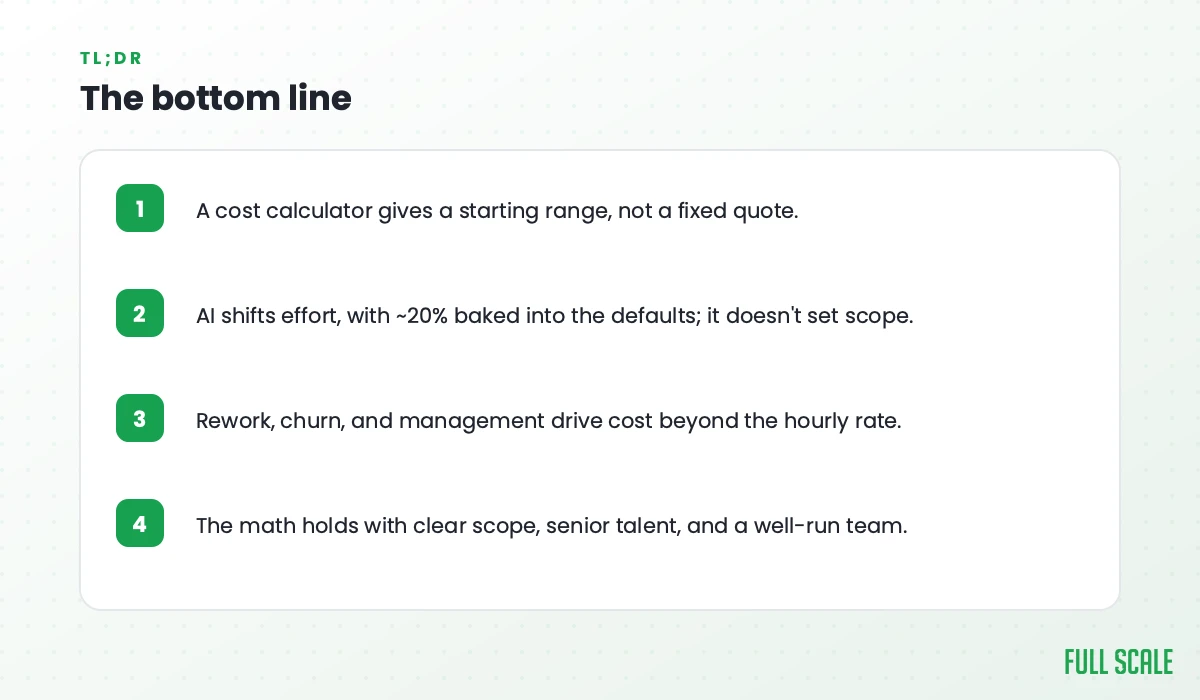
Software development cost estimation comes down to one thing: the calculator gives you the number, but the assumptions decide whether that number is right.
Want help running the math on your specific project? Schedule a call and we’ll walk through it.