PHP vs Node.js in 2026: An Honest Build-and-Hire Guide

In this article
- The 30-second answer
- Killing the “PHP is dead” myth first
- What each one is in 2026
- The real decision: product shape
- Cost and hosting: PHP’s quiet advantage
- Hiring: Node leads, but PHP’s pool is deep and stable
- The AI-era wrinkle
- Who builds on each
- Frequently asked questions
- Build for the product, not the trend
Pick a PHP versus Node.js comparison at random and you’ll get the same two myths: PHP is old and dying, and Node is the modern default for everything. Both are wrong. PHP quietly runs most of the web and got roughly three times faster over the last decade. Node is excellent, but it isn’t automatically the right call for a content site or a standard SaaS app. The real decision in 2026 is about what you’re building, what your team already knows, and who you can hire, not about which language is fashionable.
I run Full Scale, and we staff both PHP and Node teams for US companies. I also built monitoring at Stackify that ran across both in production, so I’ve seen where each one earns its keep. Here’s the honest comparison from a buyer’s seat.
The 30-second answer
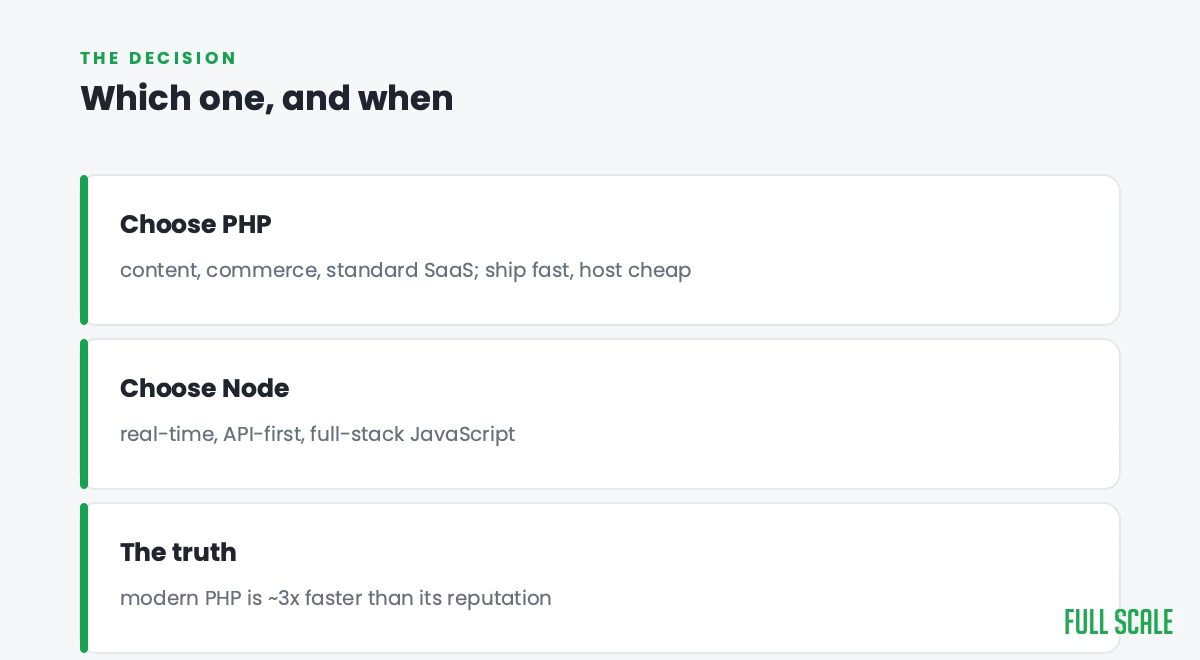
- PHP (almost always Laravel today) wins for content sites, CMS-driven products, ecommerce, and classic CRUD SaaS. It has cheap, ubiquitous hosting and the fastest path to a shipped server-rendered app.
- Node.js wins for real-time features, API-first and microservice architectures, full-stack JavaScript teams, and anything serverless or edge.
- Both are mature and fast. Modern PHP is roughly three times faster than the PHP people remember, and its old “can’t do real-time” limit is largely solved now.
- Hiring favors Node slightly on pool size and momentum, but PHP’s pool is large and stable, and the two pay within a modest range of each other.
Killing the “PHP is dead” myth first
You can’t make an honest comparison while one side is buried under a decade-old reputation, so let’s clear it. We’ve made the full case for why PHP is still relevant elsewhere; here’s the short version for this comparison.
PHP ships a major version every year. The current line, PHP 8.4, added property hooks, a rewritten just-in-time compiler, and real type-safety improvements. On raw speed, modern PHP is dramatically faster than the PHP 5 era that shaped its reputation, by most measures roughly three times faster per request. Laravel, the framework most new PHP work uses, ships annually with near-zero breaking changes.
And the footprint is staggering. By W3Techs’ measurement, PHP runs about 70% of all websites whose server-side language is known, largely because WordPress alone powers around 41% of all websites, and WordPress is PHP. So when someone calls PHP dead, what they mean is that fewer developers choose it for greenfield projects, which is true. The language itself is current, fast, and everywhere.
The mirror-image myth is that Node is automatically modern and therefore the default. Node is genuinely excellent, but “newer” isn’t a reason to put a real-time runtime under a content site that would ship faster and host cheaper on Laravel.
What each one is in 2026
Node.js is JavaScript on the server, currently on the Node 24 long-term-support line. Its frameworks are Express 5 (the ubiquitous default), NestJS (opinionated, enterprise, TypeScript-first), and Fastify (the high-throughput option). Its defining trait is the single-threaded event loop, which holds huge numbers of concurrent connections cheaply, the thing that makes it so good at real-time.
PHP is the web’s most-deployed server language, and in 2026 that mostly means Laravel: a batteries-included framework with the database layer, auth, queues, scheduling, and mail built in, which is why it ships server-rendered apps so fast. The classic deployment model is a script per request, which is what makes PHP so cheap and simple to host.
The real decision: product shape
The cleanest way to choose is to look at what you’re actually building.
PHP, with Laravel, is the faster and cheaper path when your product is content- or CMS-driven, an ecommerce store, or a standard CRUD SaaS application: dashboards, admin panels, billing, scheduled jobs. The framework hands you most of what you need, the hosting is inexpensive, and the per-request model is simple to reason about and hard to crash, since one request can’t corrupt another.
Node is the stronger choice when real-time is the point, chat, collaboration, live dashboards, presence, multiplayer, because its event loop holds thousands of live connections cheaply. It’s also the natural fit for an API-first or microservice architecture, for a full-stack JavaScript team that wants one language and shared types across the front and back end, and for serverless or edge deployment, where Node is a first-class runtime and PHP is a second-class citizen.
Here’s the honest nuance on the most-cited dividing line. PHP’s old inability to do real-time is largely solved: tools like Swoole, FrankenPHP, and Laravel Octane keep the application in memory and hold persistent connections, which is exactly what classic PHP couldn’t do. So PHP can do real-time now. But Node does it more idiomatically and with a deeper pool of developers who’ve done it before. If real-time is the core of your product, Node is the lower-risk pick. If it’s one feature on an otherwise PHP app, a Node sidecar or a managed service beats rewriting everything.
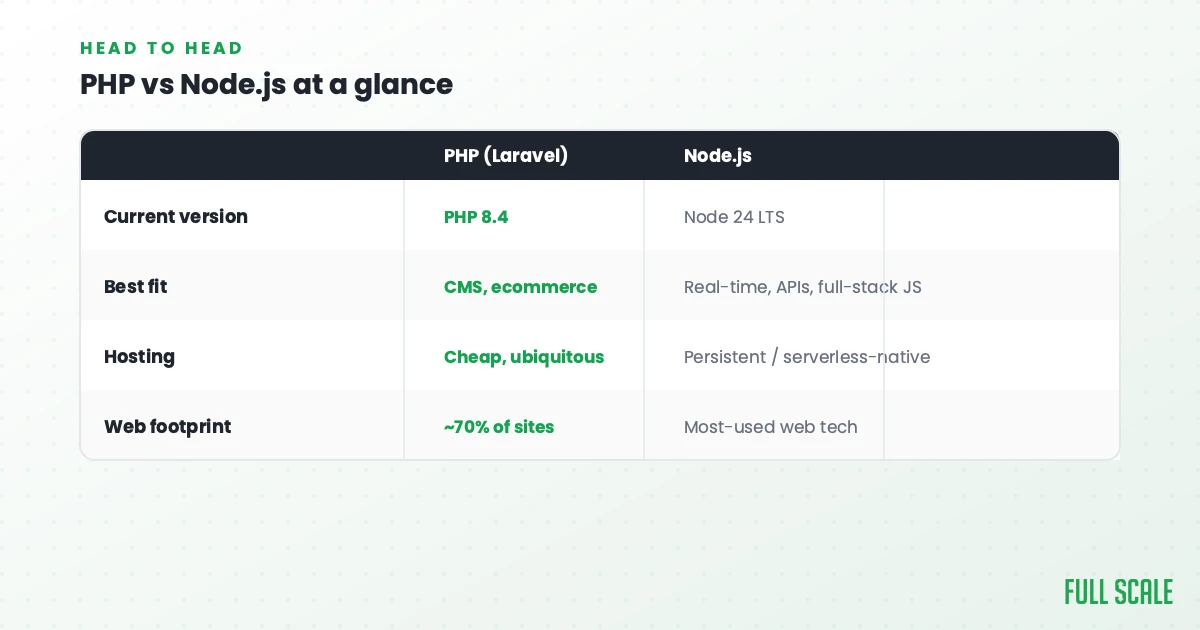
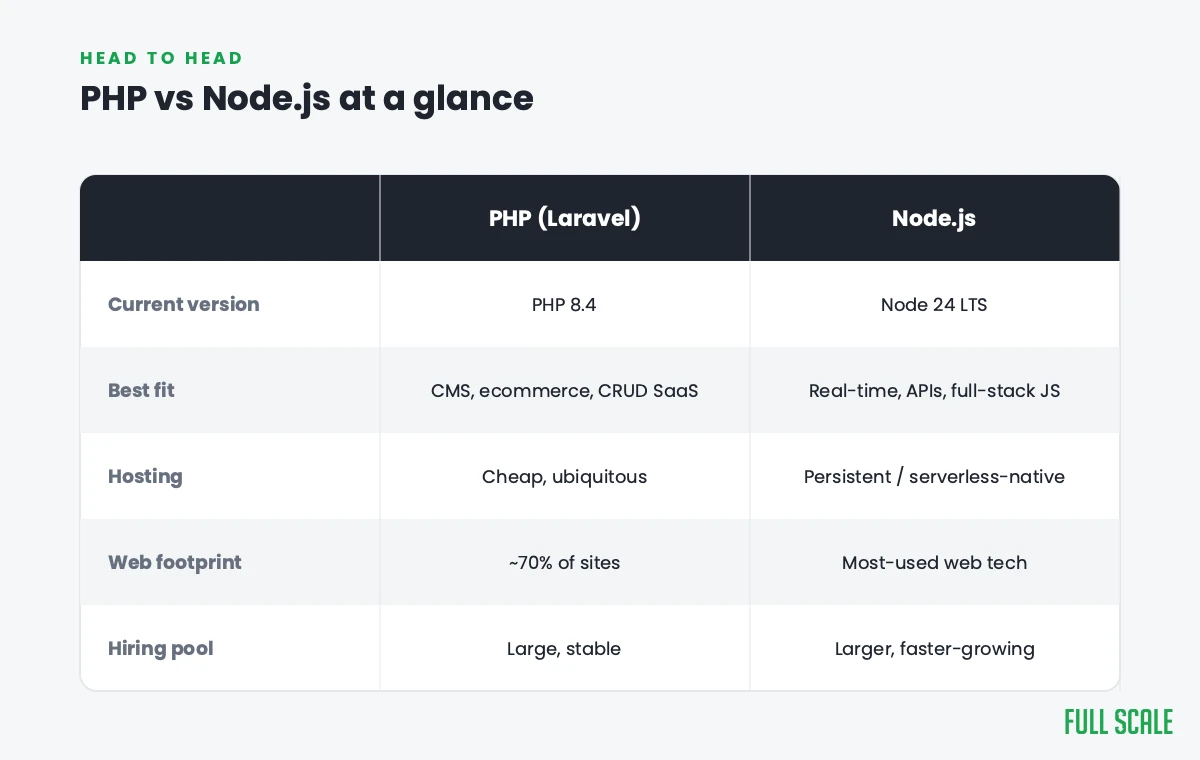
| PHP (Laravel) | Node.js | |
|---|---|---|
| Current version | PHP 8.4 | Node 24 LTS |
| Best fit | CMS, ecommerce, CRUD SaaS | Real-time, APIs, full-stack JS |
| Hosting | Cheap, ubiquitous, simple | Needs a persistent process; serverless-native |
| Concurrency | Per-request (Swoole/Octane add async) | Event loop, built for concurrency |
| Web footprint | ~70% of sites (WordPress is PHP) | The most-used web tech in surveys |
| Hiring pool | Large, stable | Larger, faster-growing |
Cost and hosting: PHP’s quiet advantage
PHP has a real structural cost edge at the low end. Because a PHP app is a script that runs per request, you can host it on commodity shared hosting for a few dollars a month, with no long-running process to manage. Node needs a persistent process to keep the event loop alive, so it skips classic shared hosting and wants a VPS or a platform-as-a-service, which starts higher and needs more operational care.
The picture flips on serverless. Node is a first-class serverless and edge runtime, native to the major function platforms, so for spiky or scale-to-zero workloads it can be cheaper. PHP runs serverless only through workarounds and swims against the current there. So PHP has the cheaper floor for traditional always-on hosting, and Node maps more cleanly onto pay-per-use scale. Neither wins in the abstract; it depends on your traffic shape.
Hiring: Node leads, but PHP’s pool is deep and stable
In the 2025 Stack Overflow survey, Node is used by about 49% of developers, roughly two and a half times PHP’s 19%. Node also has the momentum, drawing from the enormous JavaScript pool. So on raw availability and trajectory, Node leads.
But two things keep PHP firmly viable as a hire. First, that 19% is stable, not collapsing; PHP has held roughly flat in developer surveys for years, and the deployed-web footprint means there’s an enormous installed base of work and talent. Second, salaries are close. Both sit around the general developer median, with Node carrying a modest premium because it skews toward newer full-stack and cloud roles. Both staff well offshore, where PHP and Laravel talent is especially deep and cost-effective. For a buyer, this isn’t a pick-Node-or-you-can’t-hire situation. It’s a modest tilt, not a cliff.
The AI-era wrinkle
AI coding tools are strong on both, with a slight edge to JavaScript and TypeScript because there’s more public JavaScript for the models to train on. That’s a marginal point in Node’s favor if your team leans hard on AI assistants, not a decision-flipper. The bigger truth is the same one that applies to every stack now: AI makes producing the code cheap, so the value moves to the developer who decides what to build and catches what the AI got wrong. That judgment is language-agnostic, which is exactly why we tell clients the framework matters less than the engineer you put on it.
Who builds on each
A caution first, because the company lists in most comparisons are sloppy: Facebook and Slack are usually cited as PHP, but both actually run Hack, a PHP-derived language, on their own runtime, so they’re not clean vanilla-PHP examples. The clean current PHP examples are Wikipedia, which runs on PHP, Tumblr, Etsy’s core, and the entire WordPress and Automattic world. For Node, the honestly current examples are Netflix’s web tier, Walmart’s mobile traffic, and Trello’s real-time board; several famous “runs on Node” claims (LinkedIn, PayPal, Uber) are a decade old and describe a single tier those companies have since moved on from.
Frequently asked questions
Is PHP still worth using in 2026?
Yes. PHP ships a major version yearly, the current PHP 8.4 is roughly three times faster than the PHP 5 era, and PHP runs about 70% of all websites, largely through WordPress. It remains the fastest, cheapest path for content sites, ecommerce, and standard CRUD SaaS, especially with Laravel.
Is Node.js better than PHP?
Not universally. Node is better for real-time features, API-first architectures, full-stack JavaScript teams, and serverless. PHP is better for content and CMS-driven sites, ecommerce, and classic CRUD apps, with cheaper hosting and a faster path to a shipped server-rendered product. Match the tool to what you’re building.
Which is faster, PHP or Node.js?
Node is faster for high-concurrency real-time and I/O work because of its event loop. Modern PHP is far faster than its old reputation and, with Swoole or Laravel Octane, competitive for persistent and async workloads too. For most applications the framework and architecture matter more than the language.
Can PHP do real-time like Node?
Yes, now. Tools like Swoole, FrankenPHP, and Laravel Octane keep a PHP app in memory and hold persistent connections, which classic PHP couldn’t do. Node still does real-time more idiomatically and has a deeper pool of developers experienced in it, so for a real-time-first product Node is lower-risk; for one real-time feature on a PHP app, an add-on beats a rewrite.
Which is easier to hire for?
Node has the larger and faster-growing pool, used by about 49% of developers versus PHP’s 19%. But PHP’s share is stable, its installed base is enormous, and salaries are close. Both staff well offshore, where Laravel talent is especially deep. Node leads on availability, but PHP is far from hard to hire for.
Which should a startup choose?
If you’re building a content site, store, or standard SaaS and want to ship fast and host cheap, start with PHP and Laravel. If real-time is core, you’re API-first, or you want one JavaScript stack across the front and back end, start with Node. Your team’s existing skills should break the tie.
Build for the product, not the trend
PHP and Node are both modern, both fast, and both very hireable. The “PHP is dead” and “Node is always better” takes are marketing, not engineering. The benchmark gap won’t decide your product’s fate, and for most apps neither language is the constraint.
What should decide it is product shape and team fit. Content, commerce, and standard SaaS lean PHP and Laravel, with cheaper hosting and a faster start. Real-time, API-first, and full-stack JavaScript lean Node. Then hire for the choice, which on either side is very doable.
If you’d rather not sort the hiring out alone, that’s what we do, and we staff both. Talk to us about building your team, and we’ll put pre-vetted PHP or Node developers in front of you who already work the way the AI era demands.