Why Offshore Software Development Makes Sense (and When It Doesn’t)


In this article
- What offshore software development actually means here
- Why offshore software development makes sense: 6 signs you’re there
- The one sign you’re not ready: no engineering leadership in-house
- Staff augmentation vs traditional outsourcing
- How to start offshore the right way
- Frequently asked questions
- Ready to figure out if offshore fits your roadmap?
Most people come to Full Scale trying to do one of two things: save money, or grow their engineering team without the budget falling apart. Sometimes the cost story means moving existing work offshore and reducing local headcount. More often it’s the opposite. They have a roadmap they can’t staff fast enough on US salaries, and they need net-new developers they couldn’t otherwise afford.
That second situation is the one I lived myself, and it’s where the real question of why offshore software development makes sense starts. For a Python team, that question usually ends with a decision to hire Django developers offshore.
When I was building Stackify, the application performance monitoring company I founded in 2012, I already had several strong local developers in Kansas City. The problem wasn’t the people I had. It was the roadmap in front of us. I needed to hire something like ten more engineers to build everything we’d planned, and there was no version of the math where I could pay ten more US salaries and keep the company healthy.
So I figured out how to scale the team offshore in a way I could actually afford. I built a development team in the Philippines, grew it past 20 engineers, and that team became the reason the company was worth buying. When Stackify sold to Netreo in 2021, and Netreo sold to BMC in 2024, every one of those developers transferred to the new owner, both times, without a single person leaving. I don’t think I hit that outcome without going offshore.
So when people ask me why offshore software development makes sense, I’m not reading from a list of warning signs. Offshore makes sense when your roadmap is bigger than your budget can hire for, which is also where the real offshore vs. local engineering team decision starts locally, and you have someone in-house who can point a development team in the right direction. This post is about both halves of that sentence, including the half most articles skip.
If you want the broader case for the model itself, I wrote the 10 real benefits of offshoring separately. This one is about timing.
What offshore software development actually means here
Before the signs, one distinction that decides almost everything.
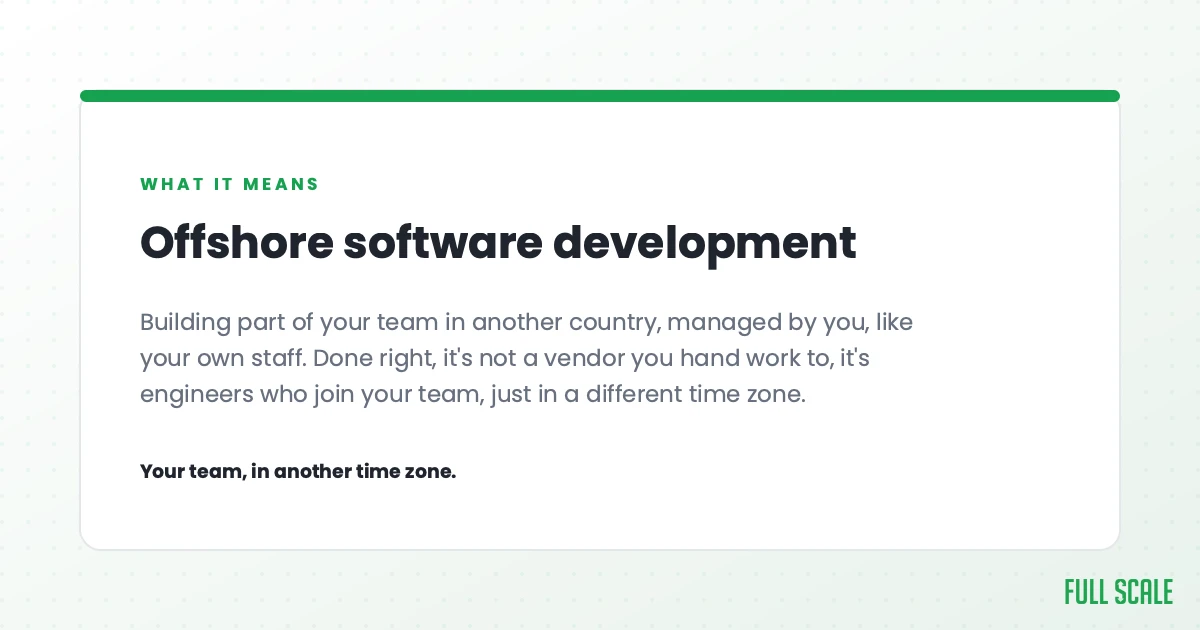
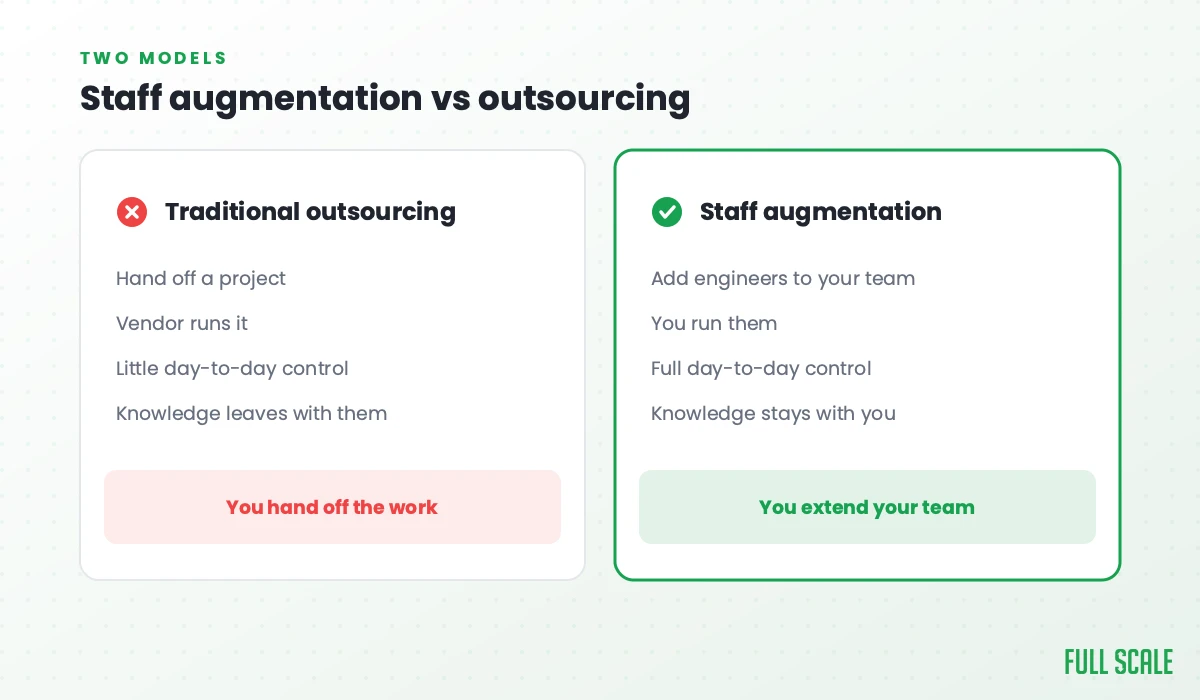
There are two very different ways to use developers in another country. The first is project outsourcing, where you hand a spec to a vendor and they go away and come back months later with finished software. The second is staff augmentation, where the developers are dedicated to you, take direction from your engineering leads, work in your codebase, and show up in your standups. The only real difference between them and a local hire is where they sit. That distinction is the same one that determines whether outsourcing Python development works: a project contract delivers a result, while staff augmentation builds the team that keeps improving it.
Everything below assumes the second model. When people say offshore development burned them, they’re almost always describing the first one. If you want the longer version of that argument, it’s in the outstaffing breakdown. For now, just know that “when to outsource software development” and “when staff augmentation makes sense” are the same question for most growing companies, and the signs are the same too.
Why offshore software development makes sense: 6 signs you’re there
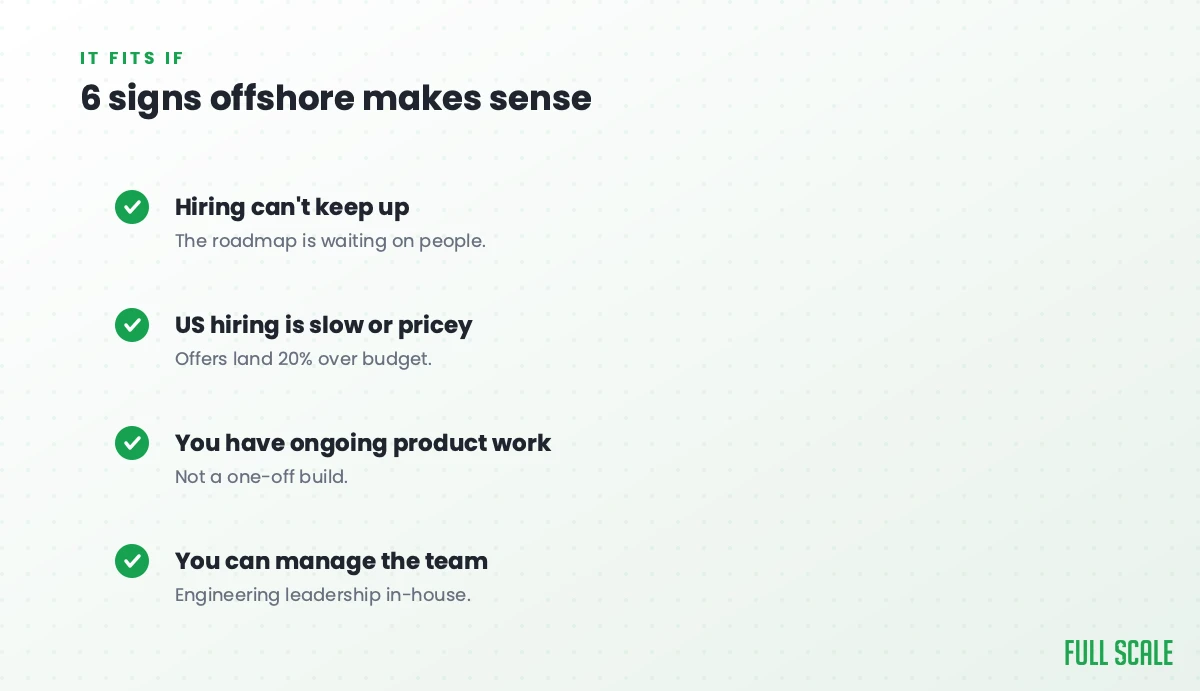
1. Your roadmap is bigger than your budget can hire for
This is the Stackify sign, and it’s the most common one I see at Full Scale.
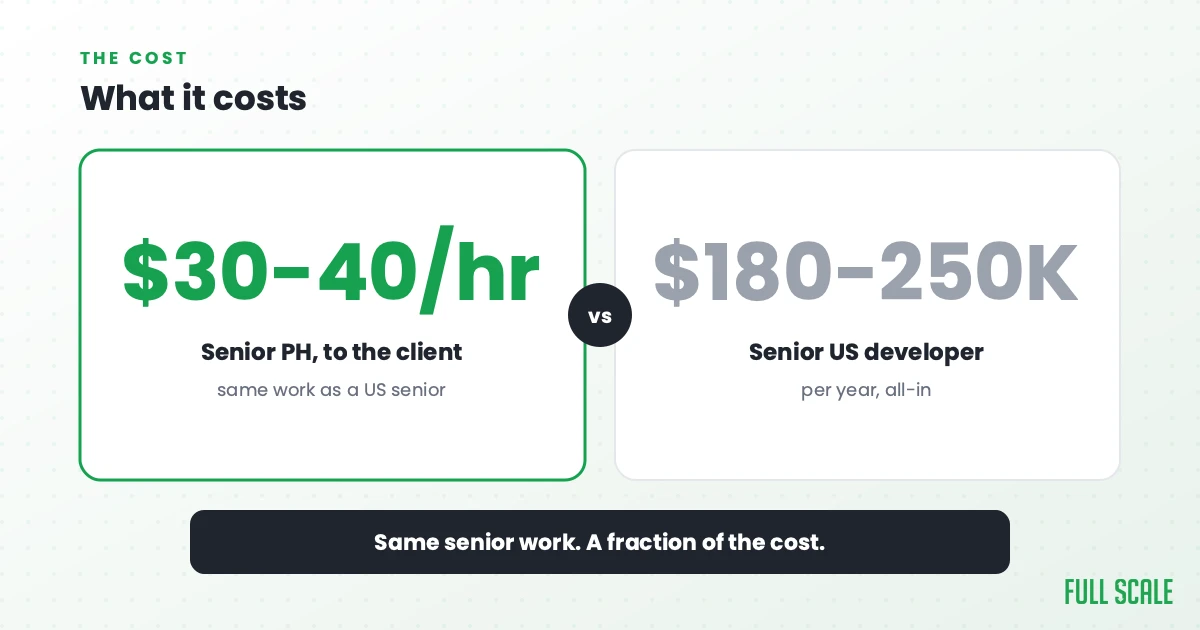
You know what you need to build. You have the demand, the funding, and the plan. What you don’t have is a way to pay for the headcount the plan requires at US engineering rates. A senior US developer runs $180,000 to $250,000 all-in once you add benefits, payroll taxes, equipment, and recruiting. A senior developer in the Philippines doing the same work costs a client $30 to $40 an hour.
When the roadmap is real but the local salary math doesn’t close, that gap is the entire reason offshore exists. It’s not about doing the work cheaply. It’s about being able to do the work at all.
2. You’re trying to grow the team, not shrink it
People assume offshore is a cost-cutting move where someone loses a job. Occasionally it is. Far more often, the companies we talk to are adding capacity, not subtracting it.
The typical situation looks like this: an engineering leader and a developer or two, a backlog that keeps growing, and a founder who wants to expand the team in a way that doesn’t blow up the burn rate. Offshore lets you add three or five engineers for what one or two would cost locally. You’re not replacing anyone. You’re finally building the team the roadmap always needed. For startups specifically, I broke down why this works here.
3. Local hiring has become the bottleneck
Sometimes the budget isn’t even the problem. The clock is.
Hiring a senior engineer in the US takes about two to three months from posting the job to the person actually starting. The offer often lands 20% above what you budgeted, and there’s a real chance your finalist takes a counter from their current employer and you start over. Meanwhile the work waits.
You’re also fishing in a small pond by choice. Around 90% of the world’s software developers live outside the United States, so a US-only search means competing with every other local company for the same short list. When hiring speed is what’s capping your growth, offshore turns a three-month search into a two-week one, because a good provider already has vetted engineers ready to interview. There’s a reason I keep saying the talent is everywhere else.
4. You need a specific skill for a finite stretch of work
Not every gap justifies a permanent hire. You might need a senior React developer for a four-month frontend rebuild, then a backend engineer next quarter, then someone who knows a stack nobody on your team has touched.
Hiring and unhiring full-time US employees on that cadence doesn’t work. The math is bad and it’s rough on the people involved. Offshore staff augmentation lets you bring in the skill for the window you actually need it, then release the seat or repoint it at the next priority. The rates vary a lot by country and stack, so it’s worth knowing the landscape before you commit.
5. Your senior people are managing instead of building
Here’s a quieter sign that shows up in growing teams.
You hired your best engineers to architect systems and write the hard code. Now they spend most of their week coordinating junior developers, reviewing tickets, and sitting in meetings. You’re paying senior salaries for project management, and the actual engineering you hired them for isn’t happening.
A well-run offshore team handles implementation so your senior people can get back to the work only they can do. Your architects design and review; the offshore team builds. Everybody works at the level you’re paying them for.
6. A few resignations would put you in real trouble
If three of your eight developers left next quarter, would your roadmap survive it?
For a lot of companies the honest answer is no. The whole team sits in one city, on one pay scale, exposed to the same local market. When a big employer opens an office nearby and starts hiring, your people are the target. US tech turnover already runs 13% to 15% a year, and it never arrives evenly.
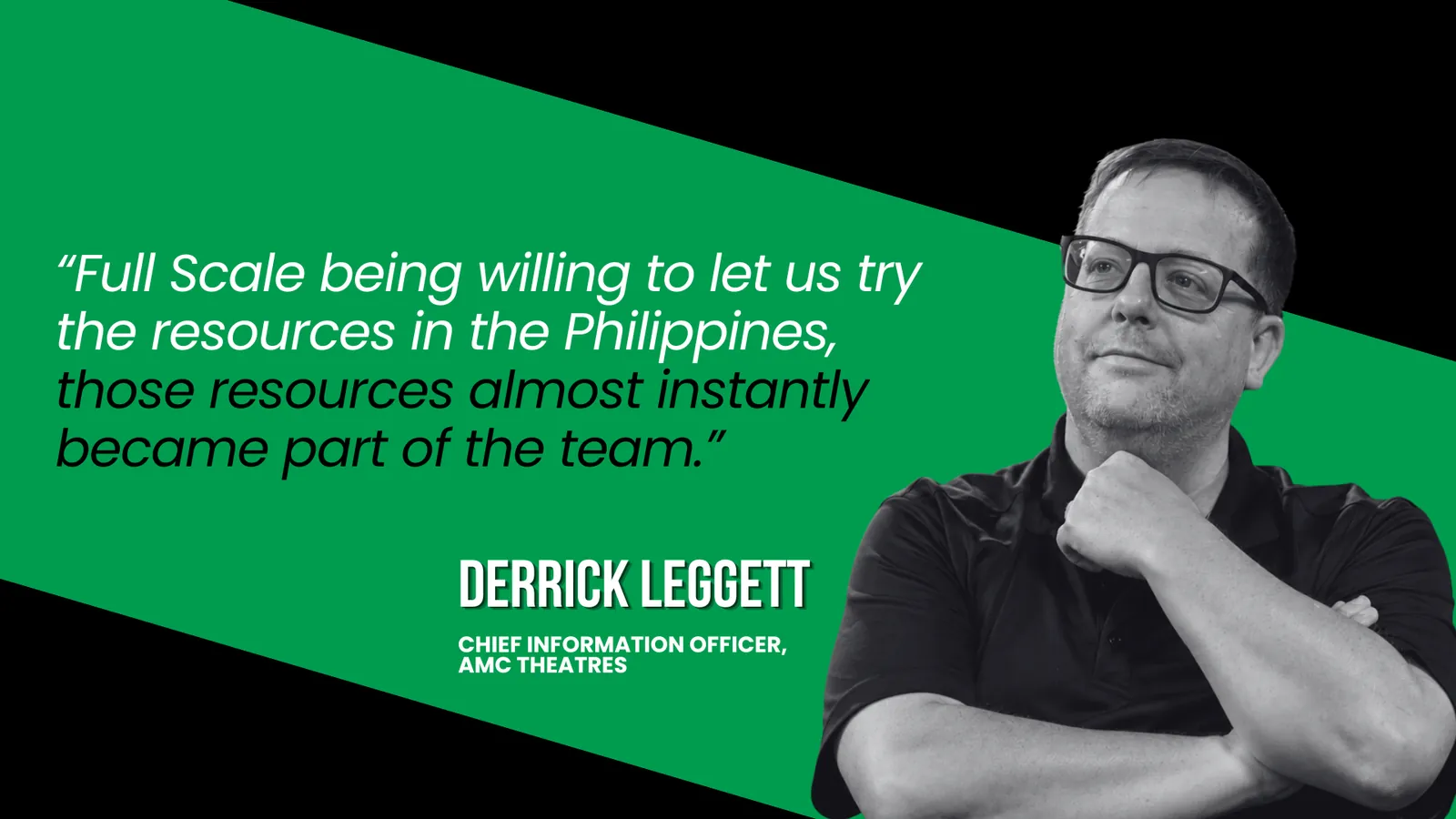
Spreading your team across more than one location is insurance against that. It’s also where the continuity argument gets real: at Full Scale our developer retention runs north of 93%, and clients like AMC Theatres have kept the same offshore .NET engineers on their core team for years. A team that stays is a team that keeps the knowledge.
The one sign you’re not ready: no engineering leadership in-house
Every article about this topic is written by a company that wants you to say yes. Here’s the part they leave out.
You can always hire an outside team to write software. But offshore staff augmentation works dramatically better when you already have engineering leadership in-house to drive it. That can be a seasoned CTO. It can also just be one strong engineer who doesn’t mind overseeing a couple of extra developers and owning the technical direction. Either way, someone on your side needs to decide what gets built, how it gets built, and whether what came back is any good.
If you’re a non-technical founder hoping to hand the whole thing off and walk away, offshore development is the wrong tool. And I’d rather tell you that now than take your money and watch it go sideways. What you actually want in that case is a traditional outsourcing or consulting firm that provides the engineering leadership as part of the deal. They charge a lot more for it, and that premium is real, because that consultative direction is the expensive part. Offshore staff augmentation gives you excellent engineers at a great rate. It does not hand you a CTO.
This is really a question of clarity. In my book Product Driven, I talk about three kinds you need before any team can move fast: product clarity (what you’re building and why), scope clarity (what’s in and what’s out), and technical clarity (how it should be built). If you can supply those, offshore developers will fly. If you can’t, no amount of talent on the other side of the world fixes it, and most of the offshore horror stories trace back to exactly this gap.
Staff augmentation vs traditional outsourcing
It’s worth saying plainly because the whole “offshore is risky” reputation lives here.
Traditional outsourcing puts a wall between you and the people writing your code. You talk to a project manager, the team is a black box, and the incentives are the vendor’s, not yours. Staff augmentation tears that wall down. You interview every developer, they join your standups, they push to your repo, and they answer to your leads. Once you’ve settled on that model, the next decision is how to choose an outstaffing company you can actually trust.
The geography is identical in both models. The outcomes are not. Pick the integrated model and the country barely matters. Pick the black box and the country can’t save you. The due diligence checklist for picking a partner is mostly about telling the two apart.
How to start offshore the right way
If the signs above describe you and you’ve got the leadership half covered, the rest is choosing a partner that runs the integrated model. The short list:
- Dedicated developers assigned to you, not a rotating pool of whoever’s free.
- Real time-zone overlap, three to four hours minimum, for standups and live problem-solving.
- You interview every candidate before they join. A provider that won’t allow that is hiding something.
- Direct integration into your tools, your repo, and your process, not theirs.
- A flat hourly rate per developer, with no opaque project pricing or change-order games.
That’s the model I built at Stackify and the one we run at Full Scale today. We’ve placed more than 700 developers with over 200 companies, we’ve made the Inc. 5000 five years running, and the reason the model works is that it’s the one I needed to exist when I was the founder doing the hiring.
Frequently asked questions
When should a company outsource software development?
When your roadmap needs more engineers than you can hire affordably or quickly enough locally, and you have someone in-house who can direct the technical work. Cost pressure and hiring speed are the two most common triggers, and growth, not crisis, is the usual backdrop.
Is my company too small for offshore software development?
Probably not, but team size matters less than structure. You want at least one technical person who can set direction and review work. A solo non-technical founder with no engineering leadership should build that foundation first, or hire a consulting firm that supplies it.
What do I need in place before going offshore?
Engineering leadership and clarity. Someone has to own the technical direction, and you have to be able to describe what you want clearly enough to write a spec. If writing that spec is hard, the gap is internal, and offshore won’t paper over it.
What’s the difference between staff augmentation and traditional outsourcing?
Staff augmentation means dedicated developers who join your team, take your direction, and work in your codebase. Traditional outsourcing means handing a whole project to a vendor who manages it separately. The first keeps you in control; the second puts a wall between you and the work. For .NET-specific builds, the tradeoffs between these models are covered in detail in our outsource .NET development
What if we tried offshore before and it failed?
Most failures come from the project-outsourcing model, not from offshore itself. Which offshore development model you pick is usually what decides it. If you handed off a spec and hoped, that’s usually the real culprit. The integrated, dedicated-team model is a different experience, and it’s worth separating the model from the geography before you write the whole idea off.
How long until offshore developers are productive?
With a good provider you can interview candidates within about a week and have someone starting within two. Experienced offshore engineers who already work in US workflows tend to contribute within their first couple of weeks, since they’re not learning your tools and your way of working from scratch. That speed is only possible because we already keep a bench ready, which is the whole point of building a process to hire proven offshore developers before you need them, not after.
Ready to figure out if offshore fits your roadmap?
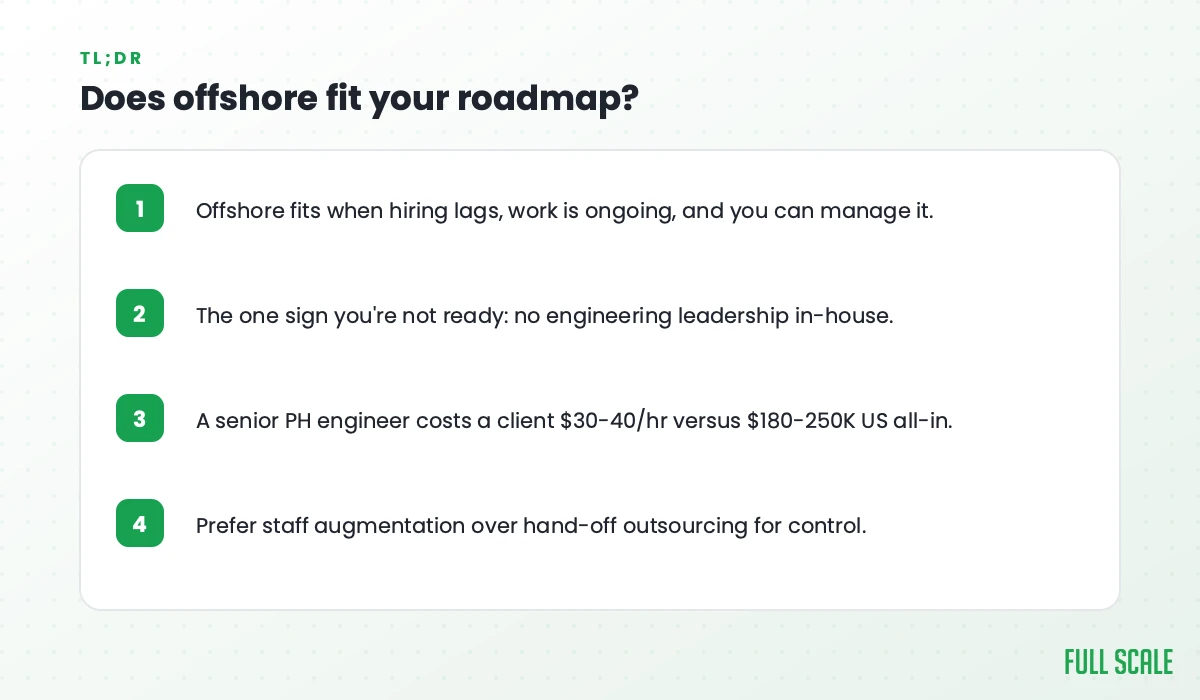
If your plan is bigger than your local hiring budget and you’ve got someone who can steer the technical work, offshore is probably worth a real look. The fastest way to know is to talk it through with people who do this every day. Schedule a call with our team and we’ll walk through your roadmap, your team, and whether offshore actually makes sense for where you are. If your product runs on .NET, offshore .NET development in the Philippines is one of the clearest examples of this model working: strong English fluency, direct team integration, and engineers who ship production .NET systems.