Offshore Vue.js Development – Hire Trusted, Affordable Talent from the Philippines

In this article
- The Model That Determines Everything
- The 7 Reasons Offshore Vue.js Projects Fail
- The Full Scale Direct Integration Model for Vue.js
- The 5-Stage Vetting Process: Finding Senior Vue.js Engineers
- The 7-Day Integration Framework for Vue.js Teams
- The Real Cost of Offshore Vue.js Development
- The Vue.js Codebases That Offshore Best
- When Offshore Vue.js Makes Sense
- When It Doesn’t Make Sense
- Common Objections
- Why Full Scale for Offshore Vue.js Development
- Frequently asked questions
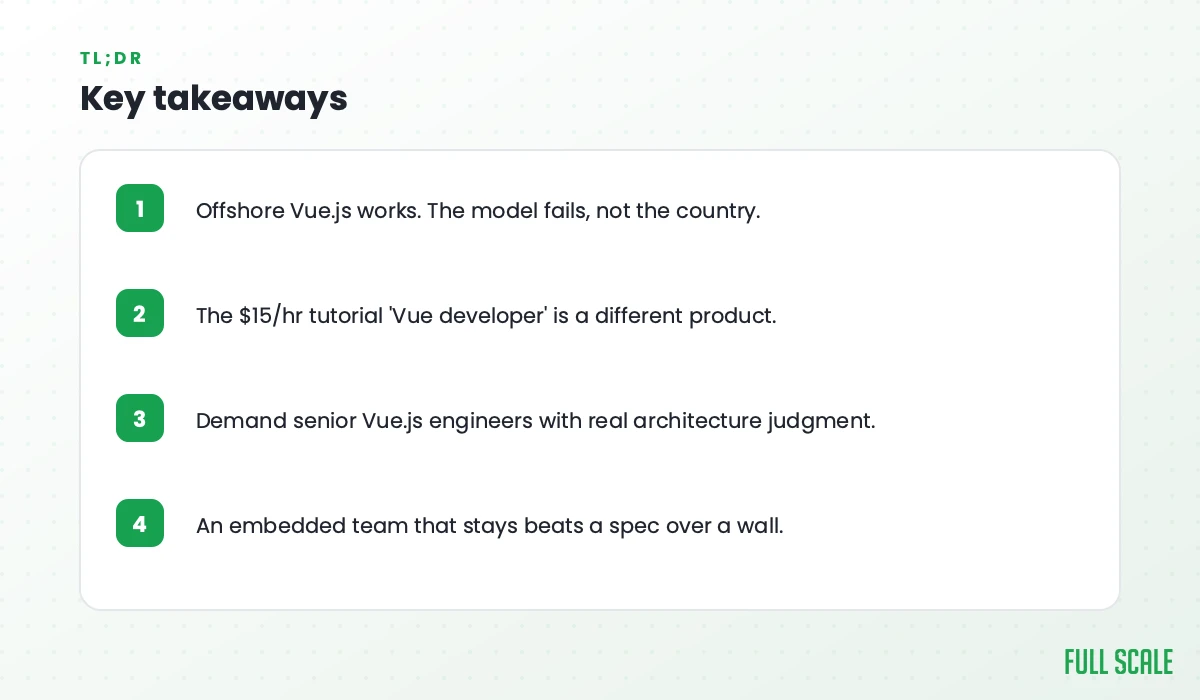
Quick Answer: Offshore Vue.js development works when you hire developers who actually know the Composition API, not just legacy Options API syntax, and when you skip the traditional outsourcing model where a project manager relays requirements to developers you never talk to. Full Scale uses Vue.js internally and places senior Vue.js engineers in the Philippines who join your team directly, at $30-40/hr fully loaded, with 93%+ retention. Most offshore Vue.js projects fail on the engagement model, not the framework.
Don’t tell the React fans, but Vue.js is my favorite frontend framework.
I’ve been shipping software for twenty-plus years, through the jQuery era and the Backbone era and the Angular 1 era and the React era. I’ve co-founded two companies. I understand why React won the market it won. And I still prefer Vue. For the role itself, see what a Vue developer actually does now.
The template syntax is HTML-first. Designers who know HTML can read it. Single File Components (<template>, <script setup>, <style> all in one .vue file) are self-contained and legible in a way that JSX files often aren’t. The reactivity system in Vue 3 is more predictable for developers coming from backgrounds outside JavaScript. And we use Vue at Full Scale on multiple internal apps, so I’m speaking from daily experience, not just staffing opinions. On the React side of that same market, teams hire offshore Next.js developers for the same reasons.
Here’s the other thing: Vue has an urgent problem right now that most offshore guides don’t acknowledge.
Vue 2 reached end-of-life on December 31, 2023. It’s no longer receiving security patches. Millions of production applications are still running on it. The migration from Vue 2’s Options API to Vue 3’s Composition API is real work, not a find-and-replace. And the offshore market is full of developers who learned Vue on Vue 2 and haven’t made the transition.
At Full Scale, we’ve placed dozens of Vue, Nuxt, and TypeScript engineers in the Philippines. We know what a senior Vue 3 developer looks like and what a Vue 2 developer with a freshly updated resume looks like. That distinction drives every stage of our vetting.
Here’s what most companies get wrong about offshore Vue.js development.
What you’ll learn:
- The structural mistake that causes most offshore Vue.js projects to fail
- The Composition API gap, Vue’s version of the React TypeScript divide
- The Vue 2 EOL urgency and how offshore project shops handle it wrong
- Our 5-stage vetting process for Vue.js engineers
- Real cost comparisons
- Which Vue.js codebases offshore well
- When offshore Vue.js doesn’t make sense
The Model That Determines Everything
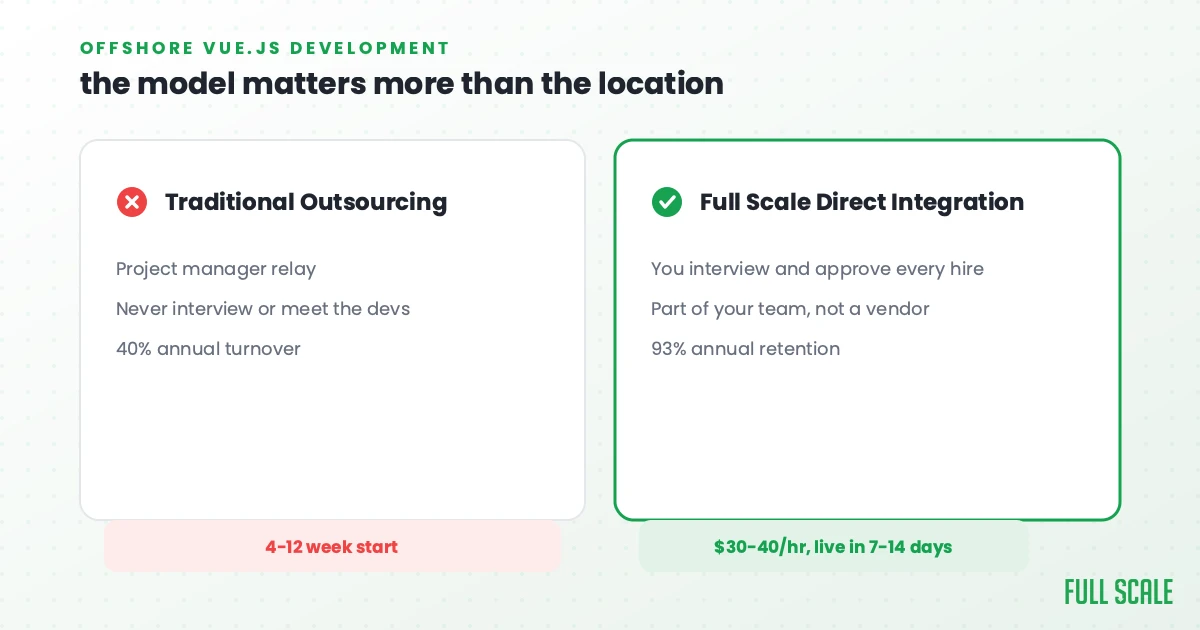
The same structural mistake that kills offshore React projects kills offshore Vue.js projects. The model matters more than the country.
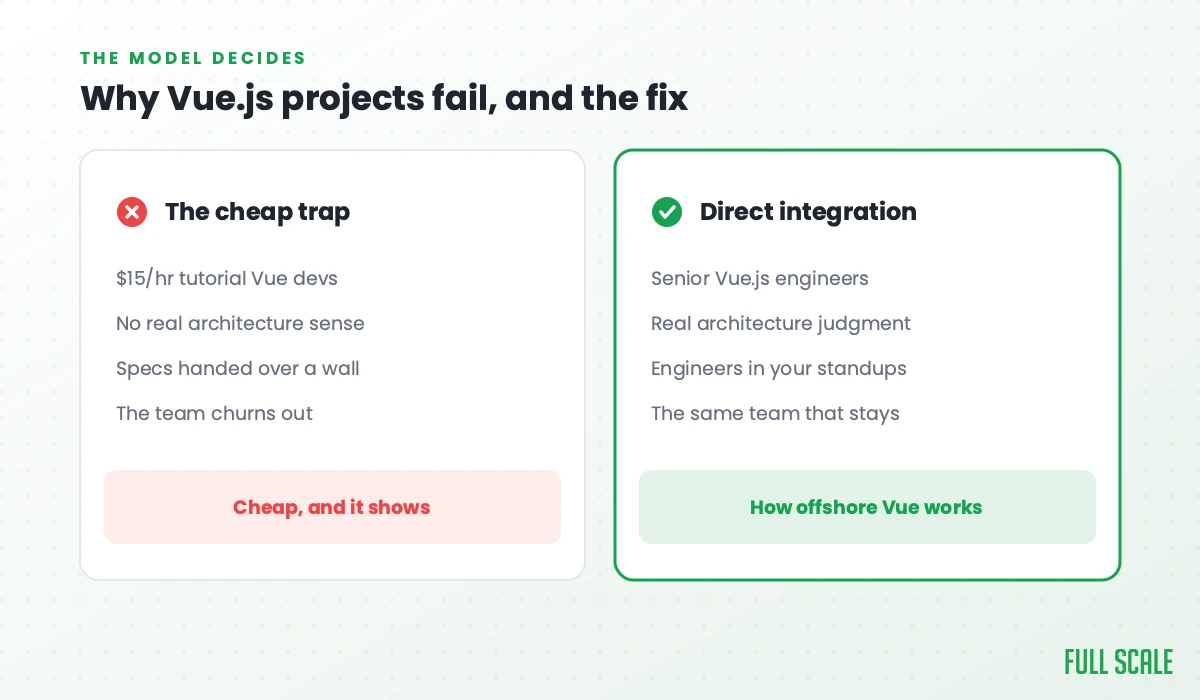
Project outsourcing means your Vue.js requirements flow through account managers and project managers before reaching the developer writing your components. Each layer strips context. Your component architecture decisions, your Pinia store design, your Nuxt routing conventions all require real understanding to implement well. The telephone game produces Vue that runs and doesn’t fit.
Direct integration / staff augmentation means your offshore Vue.js developers are in your Slack, in your codebase, in your code review queue. They work with your Vite config, your TypeScript strictness, your Pinia patterns, your composable conventions. Full Scale handles payroll, HR, and workspace in the Philippines. You handle technical direction.
| Factor | Project Outsourcing | Direct Integration (Full Scale) |
|---|---|---|
| Component conventions | Shop’s patterns | Your patterns |
| Composition API fluency | Varies, untested | Tested explicitly in vetting |
| Vue 2 vs Vue 3 alignment | Often unclear | Specified upfront |
| Annual developer turnover | ~40% | ~7% (93% retention) |
| Start time | 4-12 weeks | 7-14 days |
The staff augmentation vs. outsourcing decision is the actual choice that determines whether offshore Vue.js works for you.
The 7 Reasons Offshore Vue.js Projects Fail
Reason 1: The Composition API gap
The Composition API gap is the split between developers who write Vue 3 the modern way and those who still write Vue 2’s Options API, and most companies never test for it.
Vue 3 introduced the Composition API as the modern way to write Vue: <script setup>, composables replacing mixins, ref and reactive for reactivity, Pinia replacing Vuex. The Options API still works but it’s the legacy path. Developers who’ve kept current with Vue are fluent in the Composition API. Many offshore developers who claim senior Vue experience learned Vue 2’s Options API and have either not transitioned or have only touched the Composition API in tutorials.
The gap shows up in code that works but reads wrong: Options API patterns where Composition API belongs, Vuex code in a project that’s supposed to be on Pinia, mixins where composables should live, missing TypeScript generics in components that need them.
Our vetting specifically tests Composition API production patterns. We reject Vue developers who know data() and methods: but can’t write a real <script setup> component from scratch.
Reason 2: Vue 2 EOL mishandled
Vue 2 is dead. End-of-life December 31, 2023. No security patches. If you’re running a Vue 2 app in production, that’s a real risk that compounds over time.
The migration path (Options API to Composition API, Vuex to Pinia, Vue CLI to Vite) is substantial work, and Vue’s official migration guide is where you see how many breaking changes a Vue 2 app has to get through. Project shops handed this migration frequently approach it wrong: wholesale rewrite instead of incremental migration, breaking existing behavior in ways that don’t surface until production, no test coverage on the migrated code to catch regressions.
The right approach for Vue 2 → Vue 3 migration is incremental and embedded: offshore developers working alongside your local team, understanding the existing behavior before modifying it. That’s a staff augmentation model, not a project shop model.
Reason 3: Cheapshoring the Vue stack
I call this cheapshoring: offshoring for cost alone. The offshore Vue.js market at $15-25/hour is large, well-advertised, and heavily weighted toward developers who learned Vue 2’s Options API, haven’t adopted TypeScript, and have never built a Nuxt 3 SSR app.
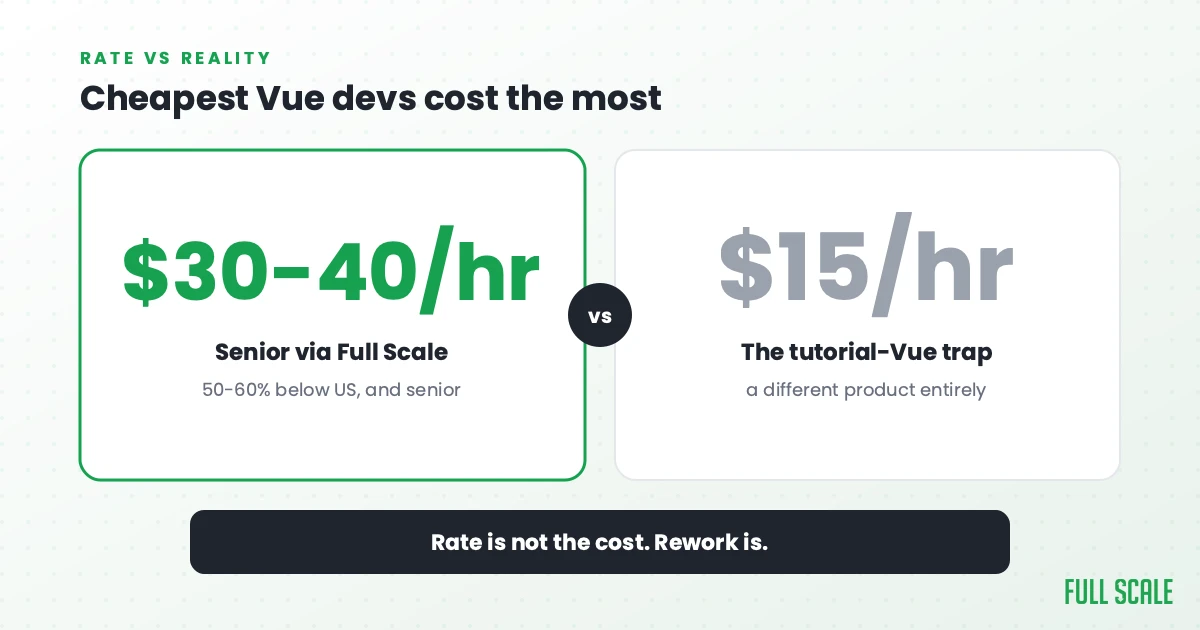
Senior offshore Vue.js developers at Full Scale cost $30-$40/hour, still 50-60% below the all-in US equivalent. The $15/hour tier buys a fundamentally different product. The cost of technical debt from cheapshored Vue development routinely exceeds the rate savings.
Deloitte’s 2024 Global Outsourcing Survey says skilled talent and agility now join cost reduction as key drivers for outsourcing. The companies learning this lesson the hard way are the ones who cheapshored a Vue.js project.
Reason 4: No TypeScript fluency in Vue 3
Vue 3 with TypeScript is the production standard. The Composition API with <script setup lang="ts"> gives you typed props, typed emits, typed composables. Developers who work in Vue without TypeScript in 2026 are cutting corners that show up as runtime errors and unclear component APIs.
This is the same dynamic as React/TypeScript. Vetting for it explicitly is the only way to catch it before the first PR.
Reason 5: Nuxt 3 claimed, Options API delivered
Nuxt 3 is the standard for Vue.js SSR and full-stack Vue development. It’s a significant framework with its own routing, data-fetching patterns, auto-imports, composables, and server routes. Developers who’ve built Nuxt 3 apps in production understand things that Nuxt 2 (or raw Vue) developers don’t: Nitro server behavior, the useAsyncData vs useFetch distinction, Nuxt modules, the app config system.
Claiming Nuxt experience without Nuxt 3 production work is a common misrepresentation in offshore developer resumes. Our vetting distinguishes between the two.
Reason 6: Component architecture made in isolation
Vue’s flexibility, like React’s, means a project shop delivers components structured their way, not yours. Your composable conventions, your store design patterns, your component naming system, your slot architecture: these are decisions made by developers who never saw your existing codebase.
The result is code that runs and requires refactoring before it can be extended. That refactoring time costs more than the rate savings.
Reason 7: Treating Vue developers as interchangeable with React developers
They’re not. The mental models are different. Vue’s reactivity system, its slot API, its component lifecycle, and its provide/inject pattern are distinct from React concepts. Developers who primarily know React and “also do Vue” produce React patterns written in Vue syntax, which reads as React wearing a Vue costume.
Our vetting specifically tests Vue-idiomatic patterns, not generic JavaScript knowledge.
The Full Scale Direct Integration Model for Vue.js
Your offshore Vue.js developers are in your Slack, in your Vue files, in your code review queue. They use your Vite config, your ESLint rules, your Pinia store patterns, your composable naming conventions.
Full Scale handles Philippines-side payroll, benefits, HR, background checks, and workspace. You handle all technical direction.
What this means specifically for Vue.js teams
No separate component library diverging from your design system. No Vuex vs Pinia confusion mid-project because the offshore team didn’t know which you were using. No Options API showing up in a Vue 3 codebase because the developer was more comfortable with it.
One codebase. One set of conventions. The frontend is where the product lives, and integrated Vue developers build it correctly because they’re part of the team making the product decisions.
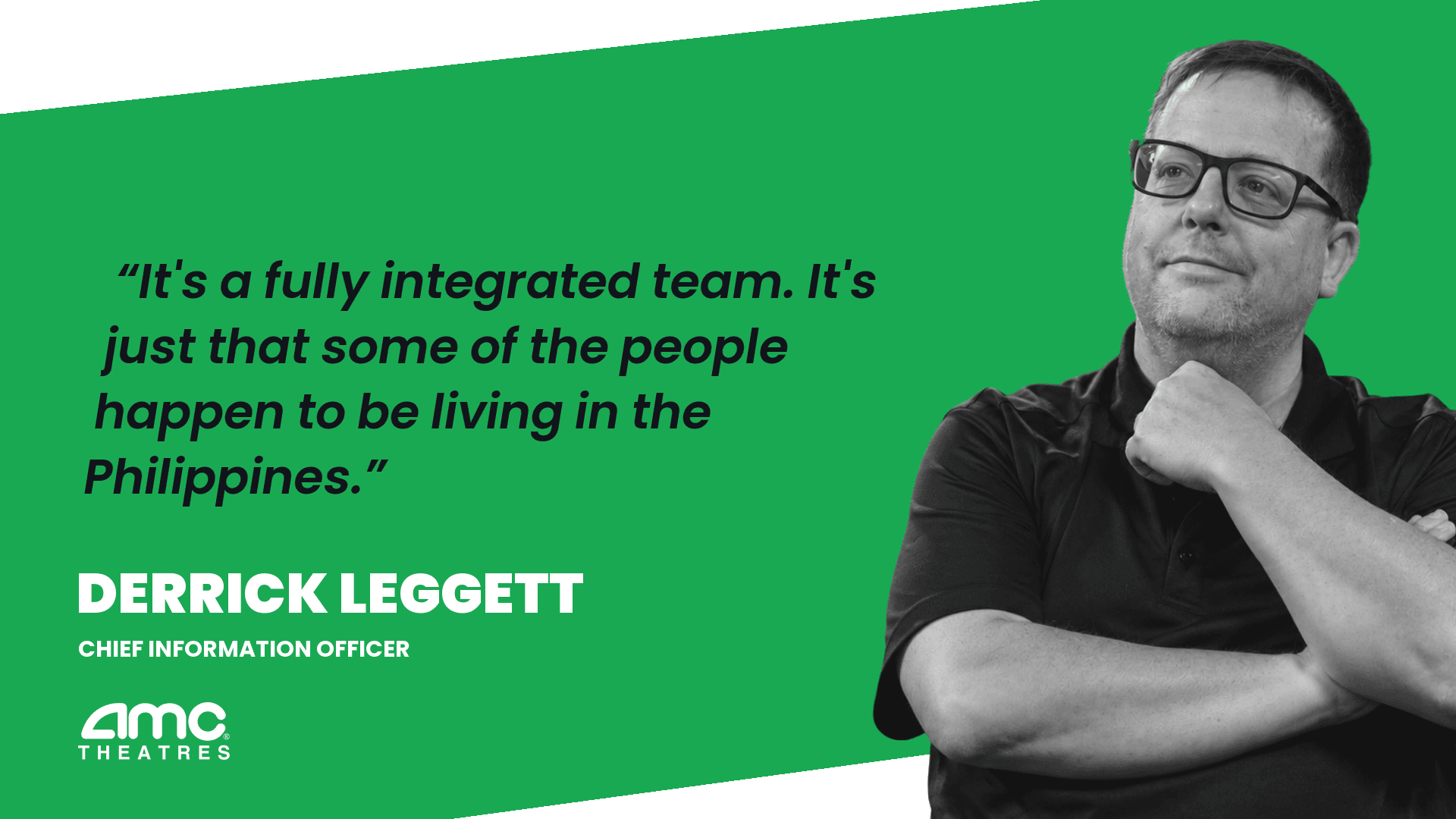
Derrick Leggett, CIO of AMC Theatres: “It’s a fully integrated team. It’s just some of the people happen to be living in the Philippines.” That’s the AMC Theatres case study proof at consumer product scale.
Why 93% annual retention compounds in Vue.js teams
Vue developers who’ve been in your codebase for 18 months know things that a new hire, onshore or offshore, doesn’t: why the composable architecture evolved the way it did, which Pinia stores have known quirks, where the legacy Options API code still lives and why it hasn’t been migrated. That knowledge takes time to build and walks out the door with every turnover event.
Full Scale’s developer retention strategies and 93% annual retention mean your Vue team retains that institutional knowledge.
The 5-Stage Vetting Process: Finding Senior Vue.js Engineers
Fewer than 3% of applicants make it through. Here’s what we test.
Stage 1: Resume and portfolio screening (55% rejected)
What we look for: 4+ years Vue experience with evidence of Vue 3 Composition API in production (not just tutorials), TypeScript in recent work, Nuxt 3 experience for SSR positions, GitHub with real Vue code (not demo repos), English proficiency.
Red flags: Vue 2 only in recent projects, no TypeScript, “Vue/React/Angular” interchangeably listed.
Our Vue.js developer hiring process follows this standard across all engagements.
Pass rate: 45%
Stage 2: Technical assessment (40% rejected)
90 minutes. Vue 3 Composition API patterns, TypeScript + Vue integration, Pinia state design, Nuxt 3 data fetching, composable architecture, reactivity system understanding.
Sample questions:
- “Explain the difference between
refandreactivein Vue 3, and when do you use each?” - “Walk me through how you’d design a Pinia store for an e-commerce cart with offline support.”
- “What’s the difference between
useAsyncDataanduseFetchin Nuxt 3?” - “How do you share stateful logic between components in Vue 3 without a state management library?”
- “Walk me through a Vue 2 → Vue 3 migration you’ve done, and what was the hardest part?”
The last question surfaces developers who’ve actually done Vue 2 migrations versus those who’ve only read about them.
Cumulative pass rate: 27%
Stage 3: Live coding exercise (30% rejected)
Build a small Vue 3 feature with TypeScript and Composition API under real conditions. We observe: is their component structure idiomatic Vue 3 or retrofitted Options API thinking? How do they handle composable extraction? Do they write tests? How do they communicate while building?
Cumulative pass rate: 19%
Stage 4: Code review and architecture discussion (20% rejected)
Review their real Vue code. “Why did you structure this composable this way?” “How would you migrate this Options API component to Composition API?” “What’s the performance implication of this watcher?”
Cumulative pass rate: 15%
Stage 5: Cultural fit and English proficiency (about 20% rejected)
The Philippines is the third-largest English-speaking country in the world. We still verify communication fluency directly. A Vue developer who can’t clearly explain a reactivity bug in a code review comment is a problem regardless of technical skill. Our skills assessment framework covers the methodology.
Final pass rate: under 3%
The 7-Day Integration Framework for Vue.js Teams
Day 1: Environment and component system orientation
Repository access, Vite setup, design system walkthrough (your component library, your Pinia store structure, your composable conventions), local dev environment. Goal: developer can run the app and understand the component tree by end of Day 1.
Days 2-3: Codebase walkthrough and pairing
Walk through the Pinia store architecture. Explain the key composables. Pair on a small bug fix or UI addition. First PR submitted.
Days 4-5: First real feature
A scoped component or feature from the actual backlog. Active code review with explicit feedback on Vue 3 patterns and TypeScript usage.
Days 6-7: Process integration
Sprint planning participation. Feedback session. Set 30-day expectations.
Weeks 2-4: Ramp to full productivity
Vue.js developers who understand the composable architecture and Pinia store design from Day 1 reach full productivity faster than developers who learn it by trial and error in PRs.
The Real Cost of Offshore Vue.js Development
Senior offshore Vue.js developer at Full Scale: $30-$40/hour fully loaded. Annually: $62K-$83K. See Full Scale’s pricing page.
US equivalent: senior frontend developers earn $120K-$150K in base salary. With the 1.25-1.4× loaded-cost multiplier: $150K-$210K+ annually. Recruiting adds 20-25% of first-year salary, or $30K-$37K per hire.
| Cost Factor | US Senior Vue Dev (3 years) | Full Scale Offshore (3 years) | Savings |
|---|---|---|---|
| Compensation | $450K-$600K | $186K-$249K | $264K-$351K |
| Recruiting | $30K-$37K | $0 | $30K-$37K |
| Onboarding | $12K | $6K | $6K |
| Turnover | $80K-$120K | $0 | $80K-$120K |
| Total | $572K-$769K | $192K-$255K | $380K-$514K |
Our offshore development cost analysis covers the full ROI model if you want the detailed breakdown.
The Vue.js Codebases That Offshore Best
Vue 3 + Composition API + TypeScript SPAs
The strongest offshore fit. Single File Components with <script setup lang="ts"> are self-contained and readable. Pinia stores are simple and well-typed. A new senior offshore Vue developer can understand a component’s props, state, and side effects by reading the file, with no navigation required.
Nuxt 3 SaaS and content sites
Nuxt’s conventions (file-based routing, auto-imports, Nitro server) enforce patterns that make the codebase navigable. Similar to Next.js for React, the framework structure accelerates offshore ramp-up significantly.
Vue 2 → Vue 3 migrations
High demand. Vue 2 is EOL. The migration requires deep Vue platform knowledge at both ends. This works as an offshore project when the offshore developers are embedded with your local team, not handed a migration spec. The incremental migration path (introduce Composition API alongside Options API, migrate store by store from Vuex to Pinia) is the approach that preserves existing behavior.
What doesn’t offshore as cleanly
Highly experimental Vue apps where the component structure is being invented. Greenfield apps without established composable conventions. Once patterns are defined, offshore works.
When Offshore Vue.js Makes Sense
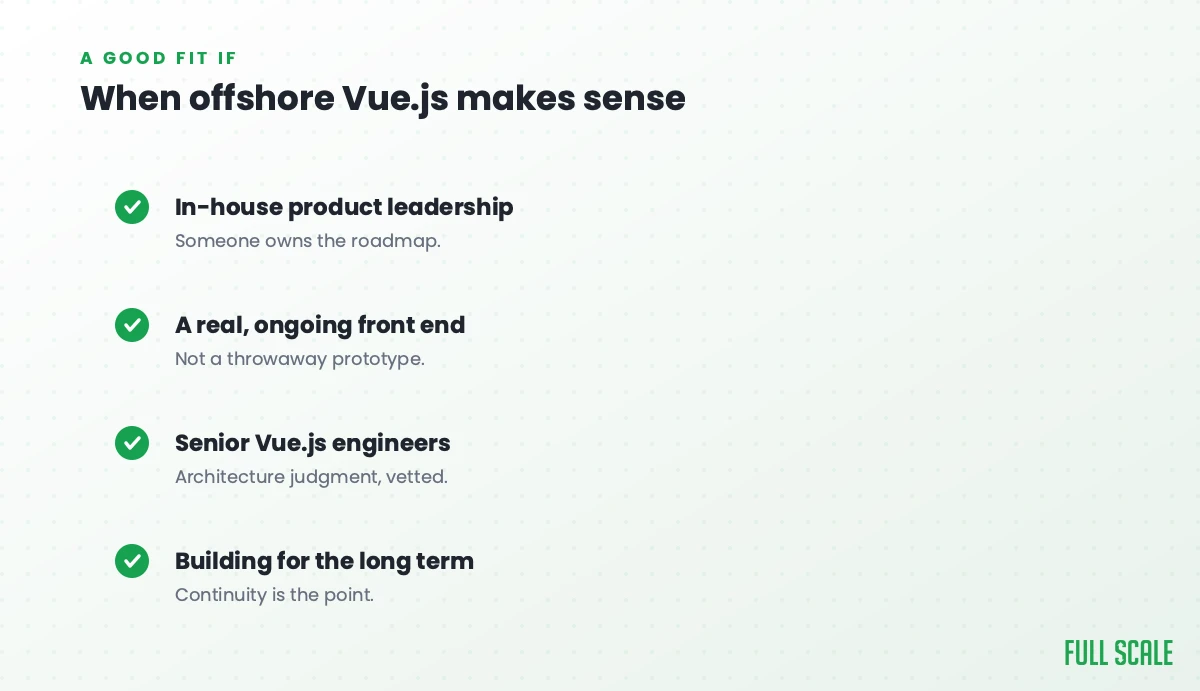
You have a Vue 3 codebase with established patterns. Composition API, TypeScript, Pinia: the conventions are in place. Offshore Vue developers extend what exists.
You need Vue 2 migration help. Your Vue 2 app is on unsupported software. Offshore Vue developers with migration experience can do the incremental work alongside your local team.
You’re scaling an ongoing product. Feature backlog, component library work, Nuxt performance. Offshore staff augmentation was built for ongoing product development.
You need speed. Senior Vue.js hiring in the US takes 60-90 days. Our timeline is 7-14 days. The common offshore software development challenges guide covers what to watch for as you scale.
When It Doesn’t Make Sense
Your Vue architecture isn’t defined. Work out the composable patterns and Pinia store structure with your core team before adding offshore capacity.
You want project outsourcing for ongoing product. The project outsourcing model for Vue.js consistently produces component patterns that don’t fit your codebase. If you’re unsure which model fits, offshore development best practices covers the decision framework. Integrated teams build with your conventions; project shops build with their own.
Common Objections
“How do I know the Vue 3 Composition API experience is real?”
Stage 2 assessment explicitly tests <script setup>, composable design, Pinia patterns, and Vue 3 reactivity. Developers who’ve only used the Options API fail these questions. Stage 3 is a live Vue 3 coding exercise. We don’t place Vue 2 developers as Vue 3 developers.
“What about our Vue 2 codebase?”
This is exactly the scenario where offshore Vue developers with Vue 2 experience and Vue 3 fluency add the most value. We test for both. The migration is incremental, with your offshore developers working alongside your local team rather than being handed a rewrite spec.
“Time zones?”
The Philippines has 8+ hours of overlap with US morning hours. Your Vue developers are in your standups and responding in Slack during your workday.
“IP protection?”
Full Scale is a US company, with US contracts, IP assignment, and enforceable NDAs. See our offshore development due diligence checklist.
Why Full Scale for Offshore Vue.js Development
Vue.js is my favorite frontend framework. We actively use it at Full Scale on internal apps, so this is daily experience, not marketing positioning. The Product Driven framework I wrote about applies to Vue development the same way it applies to any stack: build what serves the user, own the outcome, use AI as a thinking tool rather than a replacement for judgment. I prefer its HTML-first templates, its single-file component model, and its Vue 3 reactivity system. That genuine preference is what shaped how we vet Vue developers, what we test for, and why we can tell a production Vue 3 developer from a Vue 2 developer with an updated resume.
Full Scale has placed dozens of Vue, Nuxt, and TypeScript engineers in the Philippines. 93% annual retention. Inc. 5000 for five consecutive years. Great Place to Work Certified in the Philippines. See our client case studies for real-world proof, including the AMC Theatres case study at Fortune 500 consumer scale.
You get month-to-month contracts with no lock-in and direct access to the developers.
Schedule a consultation when you’re ready to build a Vue.js team that works like part of yours.
Not sure whether to outsource a Vue project or staff-augment? Read How to Outsource Vue.js Development Without Getting Burned.
Frequently asked questions
What is offshore Vue.js development?
For context on the broader offshore model, read what offshore development actually means before diving into the Vue-specific details below.
Offshore Vue.js development is hiring Vue.js engineers in another country to work on your frontend. The model determines success more than the location: staff augmentation (developers integrated directly into your team, using your Pinia patterns and Composition API conventions) produces 93% annual retention at Full Scale versus 40% typical of project outsourcing.
How much does offshore Vue.js development cost?
Senior offshore Vue.js developers at Full Scale cost $30-$40/hour fully loaded, or $62K-$83K annually. US senior Vue/frontend developers cost $120K-$150K base, $150K-$210K+ fully loaded. That’s 50-65% in annual savings, compounding further when you factor in near-zero recruiting costs and 93% retention.
How do you verify Vue 3 Composition API experience?
Full Scale’s stage 2 assessment tests <script setup> patterns, composable design, ref vs reactive usage, Pinia store architecture, and Vue 3 reactivity. Stage 3 is a live Composition API coding exercise. Developers who’ve only used the Options API in Vue 2 fail both assessments.
Can offshore Vue.js developers handle Vue 2 → Vue 3 migrations?
Yes. We test for Vue 2 history and Vue 3 fluency. The migration questions in our stage 2 assessment surface developers who’ve actually done Vue 2 migrations in production. The right approach is incremental: Composition API alongside Options API, Vuex → Pinia store by store, with offshore developers embedded with your local team rather than handed a migration spec.
How long does it take to hire offshore Vue.js developers?
With Full Scale, it takes 7-14 days from consultation to a developer working in your Vue codebase, depending on bench availability. US Vue.js hiring at the senior level typically takes 60-90 days.
What Vue.js frameworks do your developers specialize in?
Vue 3 with Composition API and TypeScript, Nuxt 3 (SSR and static sites), Pinia (state management), Vitest (testing), and Vite (build tooling). For legacy engagements, we also vet for Vue 2 Options API knowledge and migration experience.