
Lemon.io vs Full Scale: Which One Gets You a Developer, and Which One Gets You a Team

In this article
- Lemon.io is a marketplace of contractors, and Full Scale is staff augmentation
- Lemon.io vs Full Scale, side by side
- Lemon.io developers are independent contractors you sign with directly
- Lemon.io costs $60 to $90 an hour, and Full Scale starts at $35
- Lemon.io's 1.2% vetting claim and ours both leave the real question open
- Lemon.io swaps a developer faster, and Full Scale diagnoses first
- When Lemon.io is the better call
- When Full Scale is the better call
- Lemon.io alternatives
- Frequently asked questions
- Choosing between Lemon.io and Full Scale
Quick Answer: In the Lemon.io vs Full Scale comparison, Lemon.io is a vetted marketplace of independent contractors billed by the hour, at rates its own docs put between $60 and $90. Full Scale is a staff augmentation partner that places dedicated engineers from the Philippines on your team, starting at $35 an hour fully loaded, under a contract with Full Scale. Pick Lemon.io for a scoped job. Pick Full Scale for a team you plan to keep.
Lemon.io's own terms of use say it is not a party to the contract between you and the developer you hire. Full Scale is the opposite arrangement, with one contract that runs through one company, and that single difference drives most of what follows.
Full Scale is my company, so weigh what I say about us accordingly. As of November 2, 2026, Lemon.io's docs, homepage, and terms of use say what I describe below, and I name the page each time so you can check me. Marketplace terms change, so treat anything here as a starting list of questions for Lemon.io's sales team.
Lemon.io is a marketplace of contractors, and Full Scale is staff augmentation
Lemon.io calls itself a curated tech talent marketplace. It says it has more than 1,500 senior developers across more than 100 tech stacks, drawn from Europe, Latin America, the US, and Canada, and that matching takes about 24 hours. Its billing docs say all work is billed by the hour and fixed-price projects are not offered. A short-term engagement starts at 160 hours for one position, and you prepay one billing cycle at a time.
That is a clean marketplace model. You describe the work, they show you a few vetted people, and you pay by the hour.
Full Scale is staff augmentation. We place dedicated engineers across the Philippines who join your standups and code reviews and keep working your roadmap until you decide otherwise. We have 300+ engineers on staff and accept fewer than 3% of applicants. You can start in as little as 7 days, depending on who is on the bench, and every engagement has a dedicated Customer Success Manager.
Lemon.io vs Full Scale, side by side
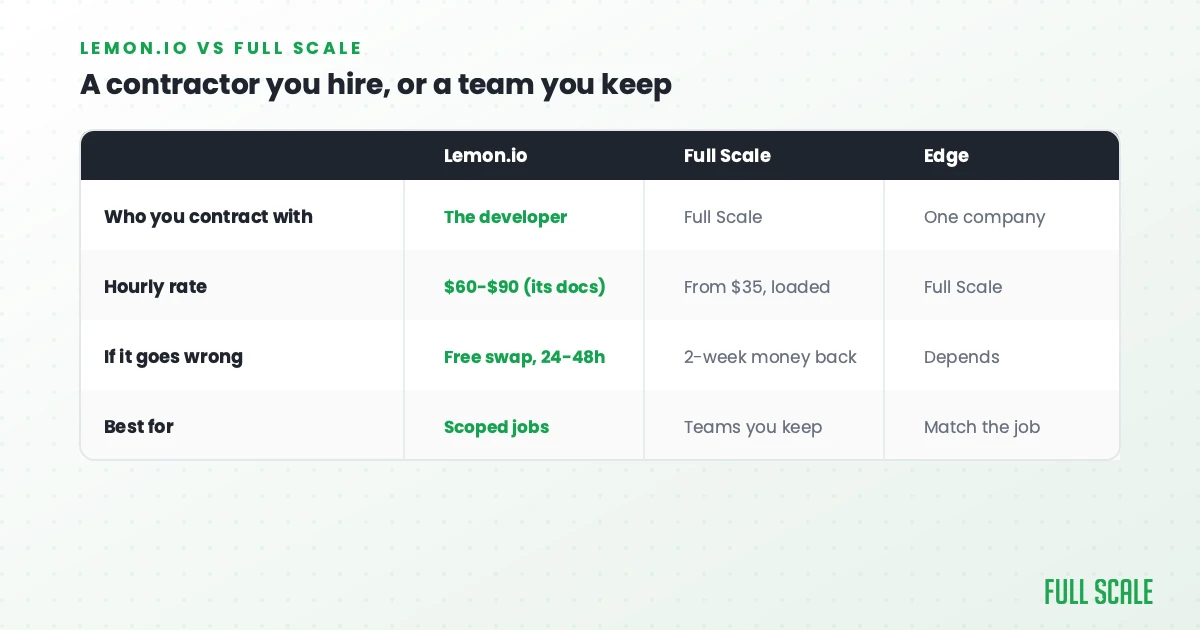
Full Scale and Lemon.io sell different things under different contracts. The Lemon.io column comes from the pages named in the text, and the Full Scale column is our published terms.
| Factor | Lemon.io | Full Scale |
|---|---|---|
| What you get | A vetted independent contractor, one to three profiles per match | A dedicated engineer or team placed on yours |
| Who the developer works for | Themselves. Lemon.io's terms call developers independent contractors | Full Scale. Nearly all of our engineers are regular employees |
| Who you contract with | The developer directly. Lemon.io says it is not a party to that contract | Full Scale, a US company |
| Where the talent sits | Europe, Latin America, US, Canada | Across the Philippines, with 3-4 hours of daily overlap as the standard |
| Rate | $60-$90 an hour per Lemon.io's billing docs, other pages say $30-$95 | Starting at $35 an hour fully loaded, depending on seniority and stack |
| Minimum | 160 hours for a short-term engagement, hourly billing only | No long-term contract, 30 days' notice to cancel |
| Time to start | Matching in about 24 hours and an average time to hire of 1-2 weeks, per its docs | As little as 7 days, depending on the bench |
| Hiring the person later | $20,000 placement fee under its terms of use | Set in your agreement |
| If it isn't working | Free replacement in 24-48 hours per its docs | Two-week money-back guarantee |
| Best fit | A scoped job or one specialist | A team you build over years |
Lemon.io developers are independent contractors you sign with directly
Lemon.io's terms of use say developers are independent contractors and not employees, agents, or representatives of Lemon.io. They also say clients and developers contract directly with each other, and that Lemon.io is not a party to those contracts. Its developer payment docs add that Lemon.io does not cover taxes, equipment, paid leave, or a retainer between projects, and that developers should factor those into the hourly rate they set.
When you hire through Lemon.io, you are signing with an individual, and Lemon.io's docs tell that individual to price in their own taxes, equipment, and leave. Its terms do say the work product is yours once you've paid, with an assignment fallback, which is the right thing to have. Enforcing that clause would mean dealing with an individual and not with a company.
At Full Scale, nearly all of our engineers are regular Full Scale employees. Some choose independent-contractor status for their own tax reasons, and either way the engineers work for Full Scale and not for you. Your client contract covers confidentiality and IP assignment, and we hold the engineers' agreements and a legal presence in the Philippines. That is a structural difference and not a defect in the marketplace model: your contract runs to one US company instead of to each individual. Every engineer also goes through eight background checks run by an independent Philippine firm.
A Lemon.io developer can stay for years, since you pay by the hour for as long as you want them. The difference is who carries the risk when they leave: with a marketplace it lands on you and one individual, and with us it lands on a company that has other engineers to staff around the gap. I wrote about the general version of this choice in staff augmentation vs independent contractors. A contractor is a good fit for a job with an end date. For the people who hold your whole codebase in their heads, I'd want more than a contract with one person.
Lemon.io costs $60 to $90 an hour, and Full Scale starts at $35
Lemon.io's billing docs say typical hourly rates run from $60 to $90 depending on stack, seniority, and scope. Full Scale starts at $35 an hour fully loaded, and engagements land between $30 and $40 depending on seniority, specialty, and team size.
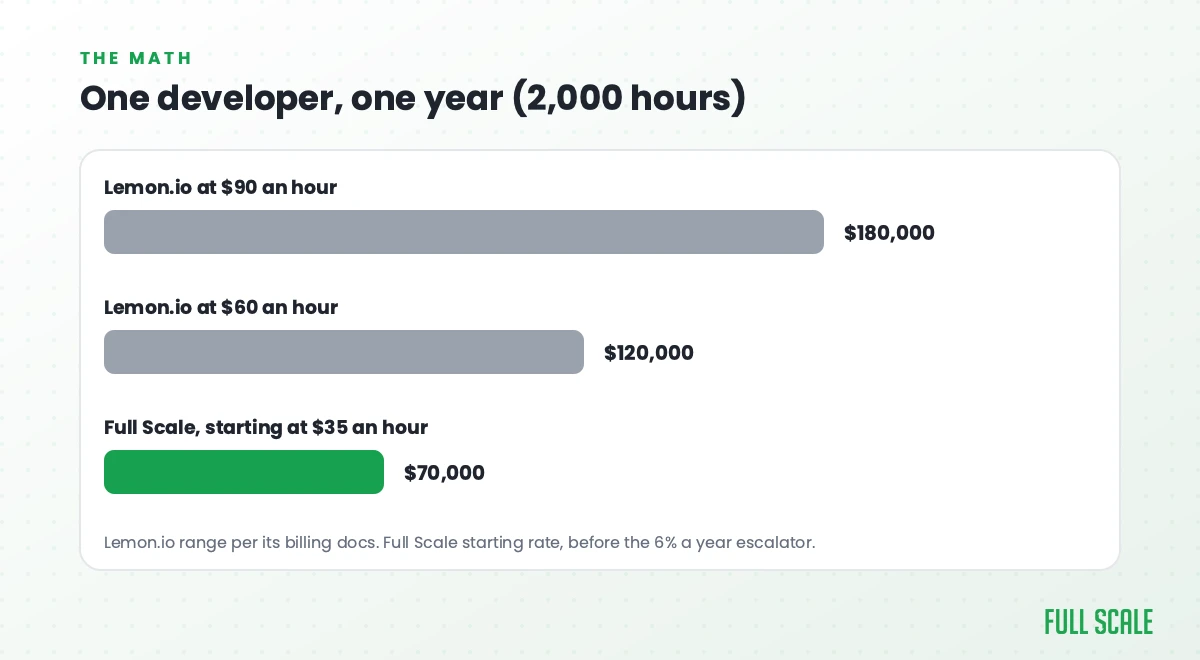
Here is what that looks like over a year at 2,000 hours per developer, for one developer and for a three-person team:
| Option | Hourly rate | One developer, one year | Three developers, one year |
|---|---|---|---|
| Lemon.io, low end of its docs range | $60 | $120,000 | $360,000 |
| Lemon.io, high end of its docs range | $90 | $180,000 | $540,000 |
| Full Scale, starting rate | $35 | $70,000 | $210,000 |
At its starting rate, Full Scale runs $150,000 to $330,000 a year below Lemon.io's documented range for a three-person team. Those numbers matter most when you keep the team for a full year, because that is when an hourly rate becomes your biggest line item.
I'm not pitching cheap. Hiring the cheapest developer you can find is a mistake I call cheapshoring, and the table is a gap in price, not in the quality of the people. Two things make it less even than it looks. Lemon.io's developers sit in Europe and Latin America, and part of that rate is where they live. Our contracts also carry a built-in rate escalator of 6% a year, applied as two 3% increases and disclosed from day one, so later years cost more than the starting rate.
Lemon.io's own pages disagree on its range. The billing docs say $60-$90. The startups page says $55 to $95, and the SaaS developers page says $30 to $95. A comparison page in its docs prints $55-$120 in a table and $55-$90 in the sentence beside it. I used the billing docs because they give the narrowest range, which is also the one most favorable to us. If you get a quote, the quote is the number. A marketplace also has to earn its margin somewhere, and I can't see how Lemon.io builds it into the rate, so ask.
Lemon.io's 1.2% vetting claim and ours both leave the real question open
Lemon.io says it accepts 1.2% of applicants. Its docs describe a four-stage process that includes a soft skills check, a hard skills check, and background checks. Its homepage lists the steps as source, reach out, test, a one-to-one interview with a senior engineer, and match, and its startups page says 90% of startups are happy with the first developer it delivers.
Those are Lemon.io's claims, and the screen sounds real. Ours is selective too, since Full Scale accepts fewer than 3% of applicants. An acceptance rate tells you who gets in, not how long they stay.
The vetting process ends when the match is made, whoever runs it. What happens afterward is the part I'd ask about. Full Scale publishes 93%+ annual company-wide employee retention, and that is the number I trust more than any acceptance percentage, mine or anyone else's. It measures engineers staying employed with us, which is a different thing from how long any one client keeps a given engineer.
Lemon.io swaps a developer faster, and Full Scale diagnoses first
Lemon.io's replacement terms are a real strength. Its docs on free developer replacement say you get a free replacement when the developer goes silent, misses deadlines consistently or underperforms, turns out to have a skills mismatch, doesn't fit the team's culture or communication, or leaves the project. The docs put the swap at 24 to 48 hours, and each case is resolved individually.
The trial is harder to pin down, and these may be different programs. The SaaS developers page describes a no-risk trial of up to 20 hours of real project work. A comparison page in Lemon.io's docs describes a "paid 30-day / 160-hour trial." The replacement doc doesn't mention a trial. Ask which one applies to your engagement, in writing.
Full Scale doesn't sell a replacement guarantee. We offer a two-week money-back guarantee: if it isn't working out in the first two weeks, you get your money back. After that, you can drop a developer with 30 days' notice and no long-term contract, and you pay through that notice period.
When something is off, we first work out whether it's a skill gap or a poor fit, then use a written development plan or a move to a better-matched account. Part of the reason is Philippine labor law. It requires documented due process before an employee can be dismissed for cause, so a quick swap is harder for us than for a marketplace. Our engineers also sign a contract requiring 90 days' notice if they leave, which gives you a long runway. The full terms live in When it isn't working out.
A fast swap is useful when the match was wrong. It also fills a seat without necessarily solving the problem that emptied it, so it's worth asking any vendor what happens before the swap. A 24-hour swap fixes a bad match. It doesn't tell you why people leave, so ask about retention.
When Lemon.io is the better call
I'd send you to Lemon.io when the work has a finish line, like a single specialist for a one-off fix, a senior engineer to unblock a launch for a quarter, or a fix you need staffed this week and not in a few weeks.
It also fits when you want no commitment beyond the hours you use, and when your own engineering leaders can direct day-to-day work themselves. Time zones can matter here as well, because a single developer in Europe or Latin America may start closer to your day without any schedule planning. For those jobs the marketplace is the right tool and our model is the wrong one.
Renting a developer is like renting a car. It's great for the trip, and by year three you've paid for the car and still can't change the radio presets.
When Full Scale is the better call
Full Scale fits when you're building something you plan to keep building, and you want engineers who keep learning your codebase year after year under a contract that runs through one company.
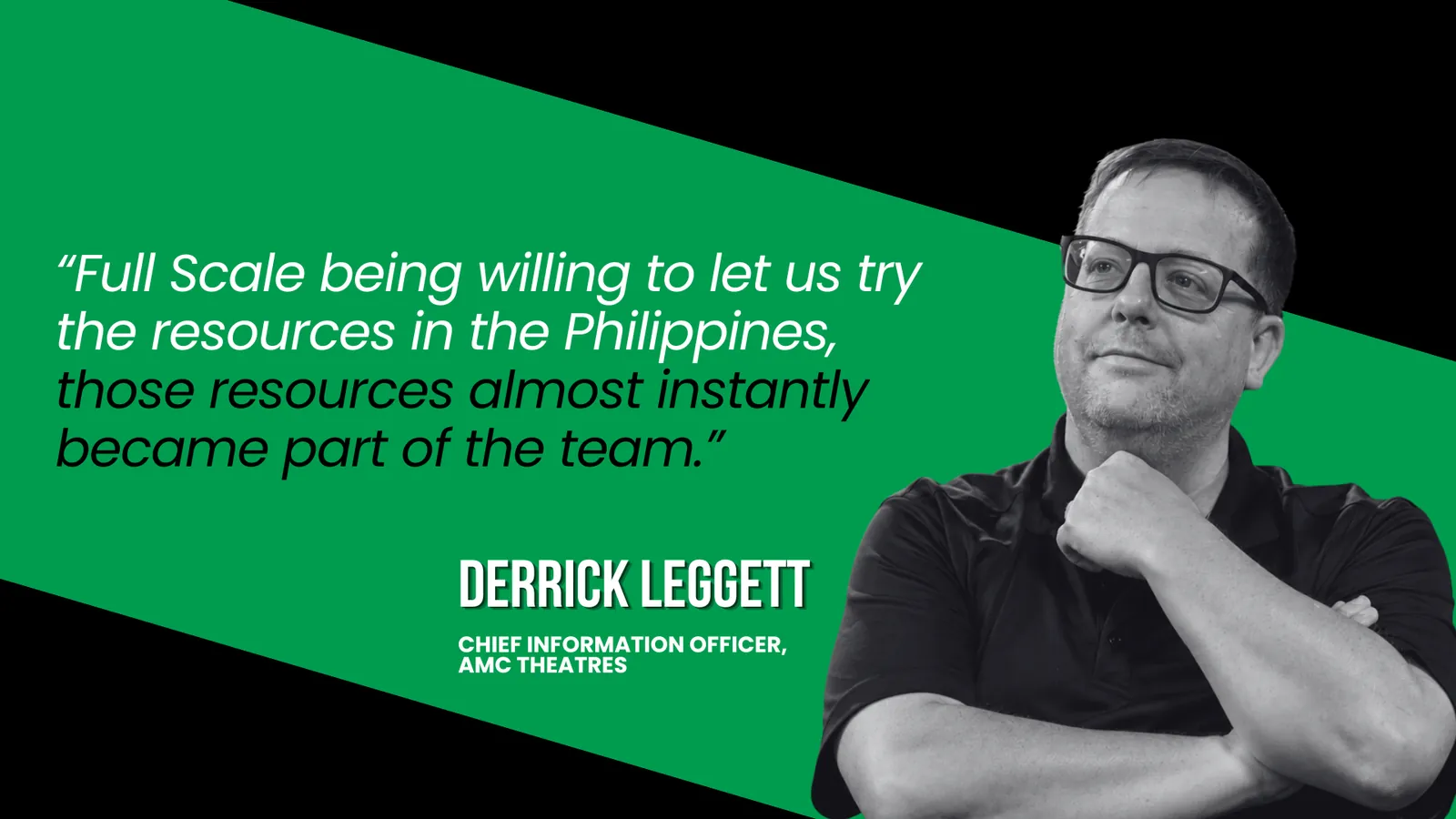
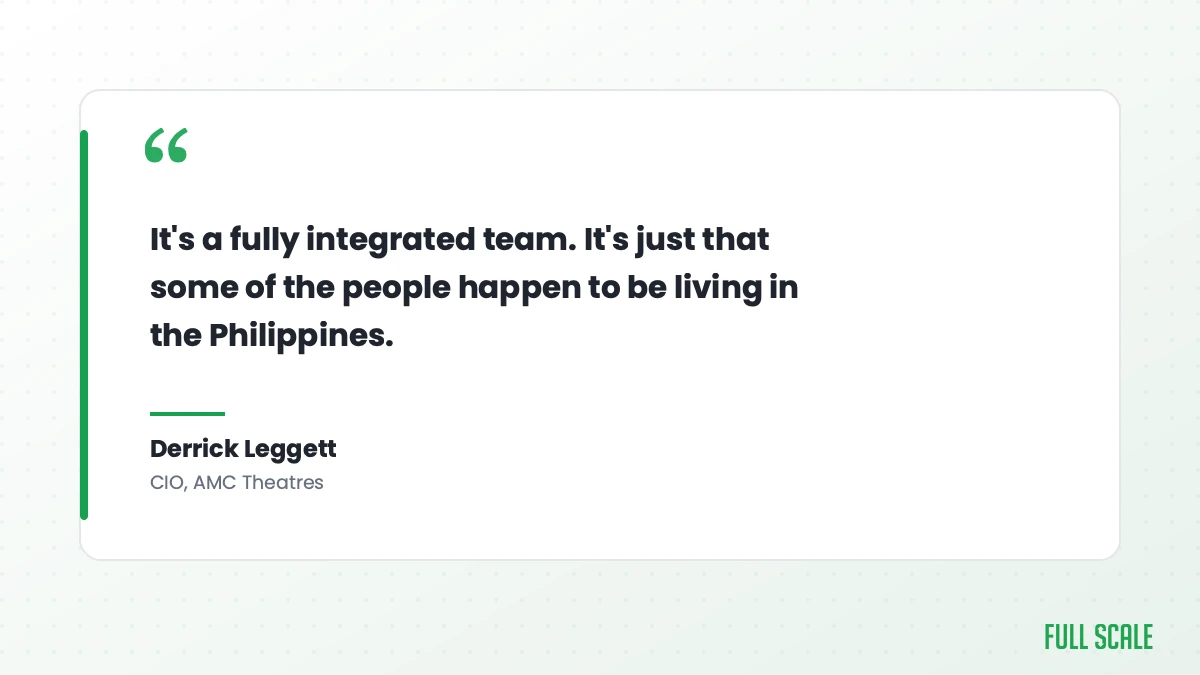
AMC Theatres is the clearest example I have. Derrick Leggett, AMC's CIO, put it this way: "It's a fully integrated team. It's just that some of the people happen to be living in the Philippines." That is the model working: the engineer sits in your meetings and owns a piece of the roadmap.
SOTA Cloud is a cloud dental imaging company, and continuity matters to them. Dustin Johnson, SOTA Cloud's co-founder and CTO, said: "We really highly value retention and so Full Scale has been a great partner on the retention front to ensure that we have continuity with the folks that we really value on our team."
Both quotes come down to people who stay on the work. That is the thesis of Product Driven, my book on building engineering teams that own the outcome. I've always said to hire talent to work directly for you on a long-term basis, not just for a project, and Full Scale does that by placing engineers on your team through a company they work for.
The honest cost is the clock. The Philippines is 13 to 14 hours ahead of Kansas City, so the standard is 3-4 hours of shared time each day. Our engineers can shift their hours to stretch that to 4-8 hours or to cover full US hours, and your side needs someone who owns the roadmap and the day-to-day direction. I covered how it works in time zone differences on a remote software team.
Lemon.io alternatives
Most Lemon.io alternatives are other vetted marketplaces with a different logo. The alternative that changes the model is a partner that employs its engineers and places them on your team. If you want the full map of options on the marketplace side, I wrote it up in Toptal alternatives, and I compared the freelance-marketplace model with staff augmentation in Toptal vs Full Scale staff augmentation.
Frequently asked questions
Is Lemon.io cheaper than Full Scale?
Usually, at the rates in Lemon.io's billing docs, which put typical rates at $60 to $90 an hour. Full Scale starts at $35 an hour fully loaded, with the final rate depending on seniority and specialty and a disclosed escalator of 6% a year. Over 2,000 hours that is $120,000 to $180,000 per Lemon.io developer against $70,000 at our starting rate. One Lemon.io page lists $30 to $95, so get a quote.
Does Lemon.io offer free replacement of a developer?
Lemon.io offers free replacement of a developer. Its docs say it provides one when a developer goes silent, misses deadlines, underperforms, has a skills mismatch, is a poor communication fit, or leaves, typically within 24 to 48 hours. Full Scale does not sell a replacement guarantee. It offers a two-week money-back guarantee, then 30 days' notice to cancel with no long-term contracts.
Are Lemon.io developers employees or contractors?
Lemon.io developers are independent contractors. Lemon.io's terms of use state that they are not employees or agents of Lemon.io, and that clients and developers contract directly with each other. Nearly all of Full Scale's engineers are regular Full Scale employees, and the client's contract is with Full Scale, a US company.
Is Lemon.io's 1.2% acceptance rate real?
Lemon.io's 1.2% acceptance rate is its own claim, published on its homepage and docs, and I can't verify it independently. Full Scale's comparable figure is fewer than 3% of applicants accepted. An acceptance rate shows how selective a screen is and nothing about how long engineers stay. Full Scale publishes 93%+ annual company-wide employee retention for that reason.
How does Lemon.io compare to Toptal?
Lemon.io and Toptal are both vetted marketplaces, so compare each one's contract terms, rates, and replacement policy directly and not by reputation. Staff augmentation is a different model, where the engineers work for one company that you contract with. For the fuller comparison of the marketplace and staff augmentation models, see Toptal vs Full Scale staff augmentation.
Can I hire a Lemon.io developer full time?
A Lemon.io developer can be hired full time, but Lemon.io's terms of use set a $20,000 placement fee if a client hires a developer directly or pays them off the platform. Its LemonHire program credits the $2,000 management fee paid during a trial against that fee. Check the current terms before you plan around converting a contractor.
Choosing between Lemon.io and Full Scale
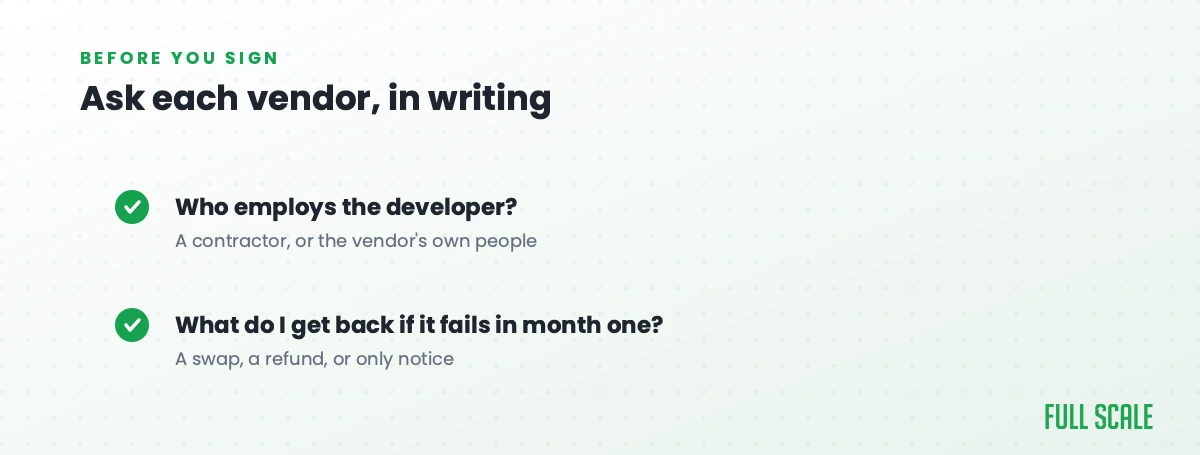
Lemon.io gets you a vetted person fast for work with an end date. Full Scale is for a team that stays long enough to learn your product. If you're still unsure, ask each vendor two things in writing: who employs the developer, and what you get back if it fails in the first month. Nobody has ever cheered at explaining the same codebase to a new person for the fourth time.
If you're building a team to keep, book a time and we'll show you how that would work for you.