
Toptal vs Full Scale Staff Augmentation: A Model Comparison

In this article
- What Toptal actually is
- What staff augmentation actually is
- The real difference: a badge you check once vs. a number you have to keep earning
- What Toptal actually costs vs. staff augmentation, when you’re building a team
- Who’s actually accountable if something goes wrong
- When Toptal is the right call
- When staff augmentation is the right call
- Can you use both?
- Frequently asked questions
- The model matters more than the brand
I run Full Scale, a staff augmentation company, so I have a horse in this race. I’ll tell you where mine wins and where it doesn’t, and I won’t pretend otherwise.
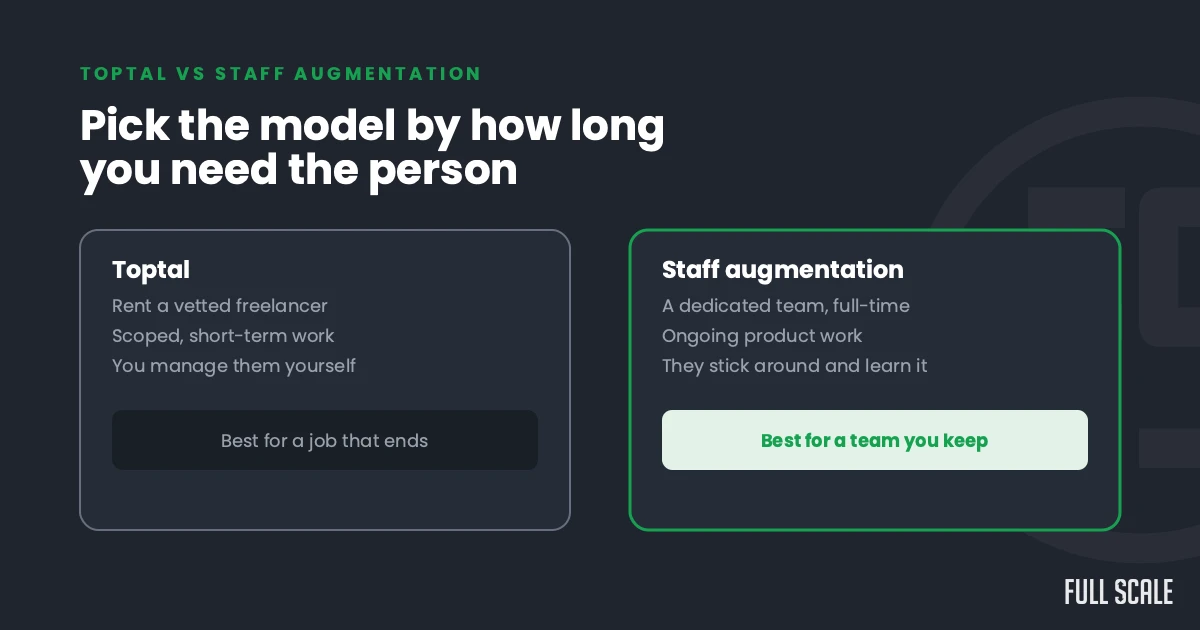
Here’s the question underneath every “Toptal vs staff augmentation” search, whether the searcher knows it or not: how long do you need this person, and do you want to manage them or keep them? Not which brand has the better logo. Not which one has a shinier vetting process. Toptal and a staff augmentation partner aren’t really competing for the same job most of the time. They’re built for two different shapes of work, and picking the wrong shape is the expensive part, not the hourly rate.
If your actual question is whether Toptal itself can be trusted, I already answered that one directly. This post assumes you’ve settled the trust question and you’re trying to decide between the two models.
What Toptal actually is
Toptal is a freelance marketplace. You describe the role, they match you with a vetted, senior freelancer, and from there you run the relationship like any contractor: you assign the work and sit them in your standups, and you’re the one who decides when it’s done. The freelancer works for themselves, not Toptal. They’re an independent contractor who found you through Toptal’s network, usually juggling other clients at the same time.
It’s an honest model, and a fine one. You’re renting access to a vetted person for however long you need them.
What staff augmentation actually is
Staff augmentation is the other model: you get dedicated engineers who are full-time employees of the staffing partner, working exclusively inside your team on your roadmap, for as long as you keep them. They join your standups, your code reviews, your Slack. There’s no project handed over a wall and no freelancer juggling three other clients on the side. You direct the work the same way you’d direct anyone on payroll, minus the payroll.
The tradeoff is the mirror image of Toptal’s. You’re not paying for one-time access to a stranger with a strong résumé. You’re paying for a person who sticks around long enough to stop being a stranger, because they’re a full-time employee with nowhere else to be.
Both models will tell you they vet well. The difference is what happens after the vetting.
The real difference: a badge you check once vs. a number you have to keep earning
Toptal’s whole pitch rests on one claim: it only accepts the “top 3%” of applicants. That’s a real screening process (a language check, a skills review, a live technical interview, a test project), and most applicants wash out. Whether the survivors are literally the top 3% of software engineers on Earth or just the top 3% of people who filled out that particular application that week is a question nobody at Toptal is in a hurry to answer, but the screening itself is genuinely rigorous. Toptal also offers a short trial period so you can swap a bad match early, a fair, honest safety net for a first impression gone wrong.
But that trial only catches a bad match in the first few weeks. It doesn’t tell you whether the freelancer is still good six months in, still around, or still cares once the honeymoon’s over. You check the vetting badge once, at the door, and then it’s done. It was a test, and the test ended.
I’ve said this before and I’ll keep saying it, because it’s the point every marketplace would rather you skip past: a vetting badge is marketing. Retention and integration are what actually decide whether a hire works out. Everybody in this business advertises an elite screen, us included. The percentile on the door predicts nothing. Longevity does: whether the person is still on your codebase a year from now, still learning your product, still accountable to someone.
That’s the whole argument behind Product Driven, the book I wrote on building engineering teams that actually own the outcome instead of renting attention to it. Ownership doesn’t show up on a résumé. It shows up in whether someone’s still there when it matters.
That’s why staff augmentation firms lead with a different number: retention. Full Scale runs 93%+ annual retention, and that number only holds up because the engineers are full-time employees, not because we said so in a paragraph. A firm can’t fake that for long. Quietly benching an underperformer on a year-long engagement shows up in churn within months, the client leaves, and the number drops. Toptal’s top-3% claim gets made once about the applicant pool. Our retention number gets remade every year, out of actual behavior, not a screening test.
If you’re hiring one specialist for six weeks, the one-time badge plus a trial period is exactly the right amount of proof. If you’re building the team that carries your product for the next three years, you want the number that has to be earned continuously, not the one that was earned in an afternoon.
What Toptal actually costs vs. staff augmentation, when you’re building a team
The real story here is what you’re structurally paying for, not who’s cheaper on paper, and it only shows its teeth once the job stops being one seat and starts being a team.
Toptal doesn’t publish a rate card, but client-reported rates commonly land between $60 and $150 an hour for most roles, with specialists running past $200, plus a refundable deposit and a monthly account fee on top. None of that is unreasonable for one senior freelancer on a defined, six-week engagement. That rate is a specialist-finder’s premium, and for a single scoped hire, it’s a fair trade for skipping the search yourself.
The math changes when the job is “build me a team,” not “fill me a seat.” Say you need five mid-to-senior engineers working together for a year. At $100 an hour (the low end of Toptal’s range) across five engineers for roughly 2,000 working hours a year each, that’s about $1 million a year before anyone’s shipped a second feature. Staff augmentation at a fully-loaded rate starting around $35 an hour puts the same five-person team at roughly $350,000 a year, a gap of about $650,000 for identical headcount. Nobody’s cheating anyone on either side of that number. Toptal’s rate bundles in a specialist-finder’s margin that makes sense for a one-time search; a staff augmentation partner doesn’t carry that markup because finding and keeping the team is the entire business, not a one-time service fee.
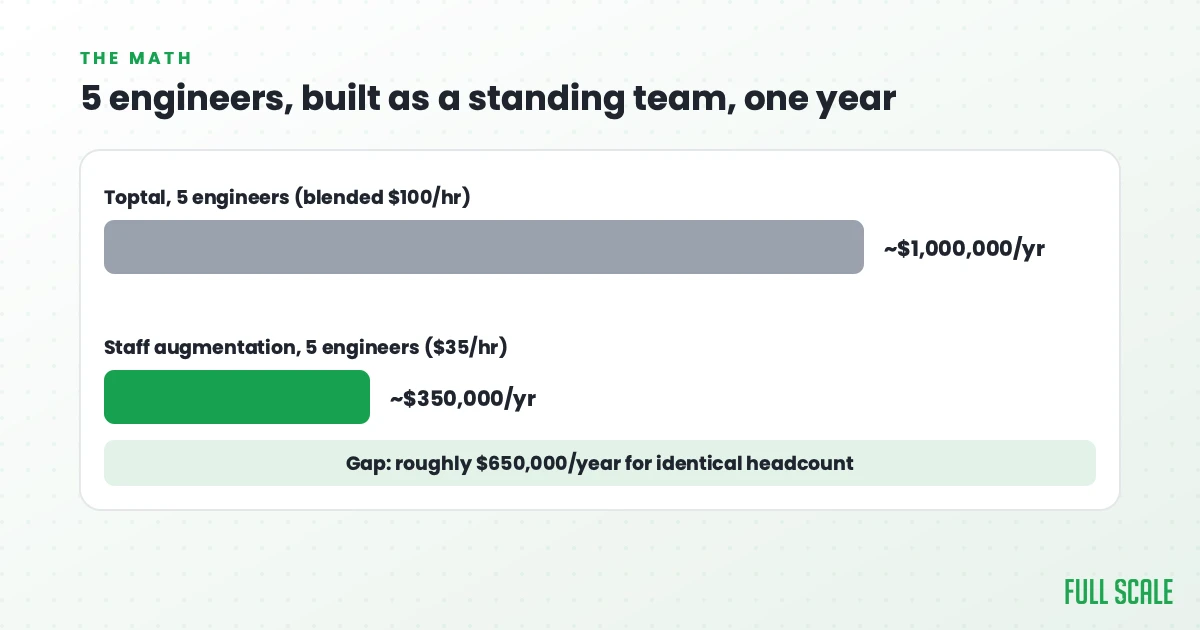
That gap doesn’t show up on a one-person, one-quarter engagement. It shows up hard the moment the engagement turns into a standing team, which is what most companies searching this comparison are actually trying to build.
Toptal vs staff augmentation, side by side
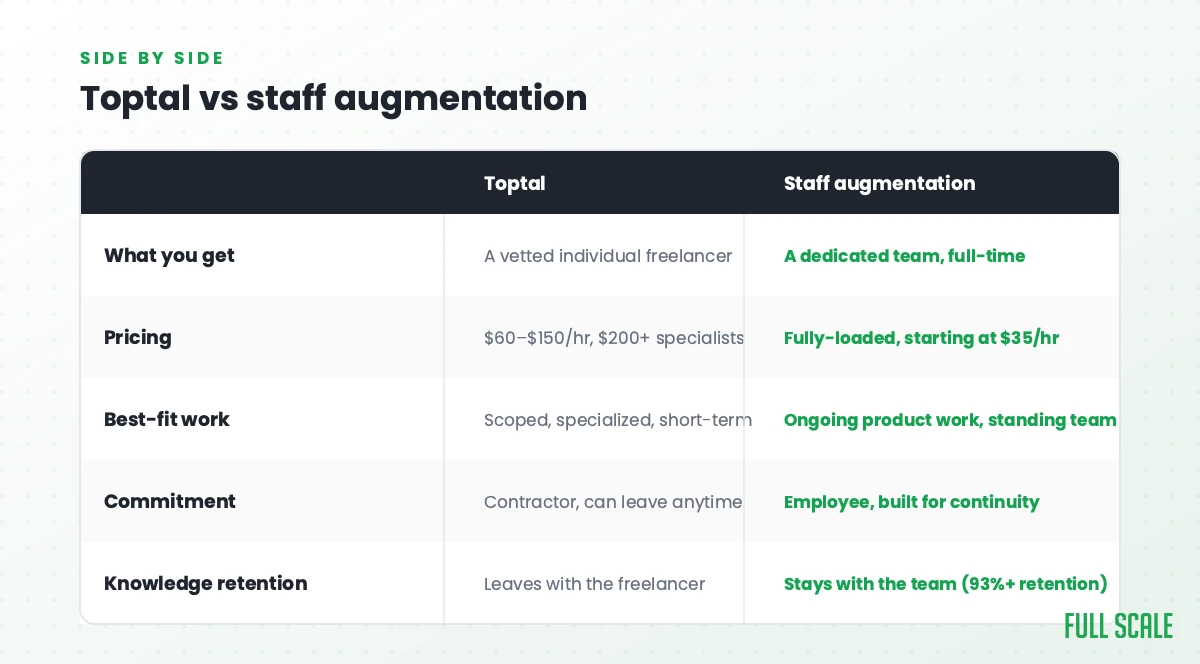
| Toptal | Staff augmentation | |
|---|---|---|
| What you get | A vetted individual freelancer | A dedicated team of full-time employees |
| Who manages the work | You do | You do, day to day, minus the HR overhead |
| Pricing | ~$60-$150/hr, $200+ for specialists, plus deposit and monthly fee | Fully-loaded rate starting at $35/hr, no per-seat markup |
| Best-fit work | Scoped, specialized, short-term | Ongoing product work, standing team |
| Commitment | Contractor, can leave anytime | Employee of the partner, built for continuity |
| Time to start | Often within days | As little as 7 days, depending on bench |
| Knowledge retention | Leaves with the freelancer | Stays with the team (93%+ annual retention) |
Who’s actually accountable if something goes wrong
Cost changes when the engagement gets longer, and so does risk. Nobody asks who’s on the hook for it until something’s already broken.
When you hire a freelancer through a marketplace, your contract is with an independent contractor, often in a country whose legal system you’ve never had reason to learn. If there’s an IP dispute or a confidentiality problem, you’re the one figuring out whose law applies and how to enforce it.
A staff augmentation partner should look different, and it’s worth checking that it does. At Full Scale, the developer’s employment contract is with us, a US company, and the client MSA covers confidentiality and IP assignment directly. If something goes wrong, you’re dealing with a US company under US law, not chasing a contractor across a jurisdiction you’ve never worked in. We also run background checks that go further than what’s typical in the US, including having investigators physically talk to a candidate’s neighbors. That sounds excessive until you consider what you’re trusting this person with, which is usually your entire codebase and a chunk of your customer data.
Toptal’s vetting is real, and it doesn’t answer this question. Vetting tells you the person is skilled. A contract chain tells you who’s actually on the hook when skill isn’t the problem.
When Toptal is the right call
I’ll say this plainly, because it’s true and because pretending otherwise would make the rest of this post worthless: for the right job, Toptal is a strong choice.
You need a senior specialist for a defined, short engagement: a security review, one machine-learning model shipped to production, a niche framework migration that ends the day it’s done. You have the technical leadership in-house to direct someone without a partner’s structure around them, and you don’t want to run a hiring process yourself for a role you’ll only need for a few months. That’s the exact job a vetted freelance marketplace was built for, and it does it well.
When staff augmentation is the right call
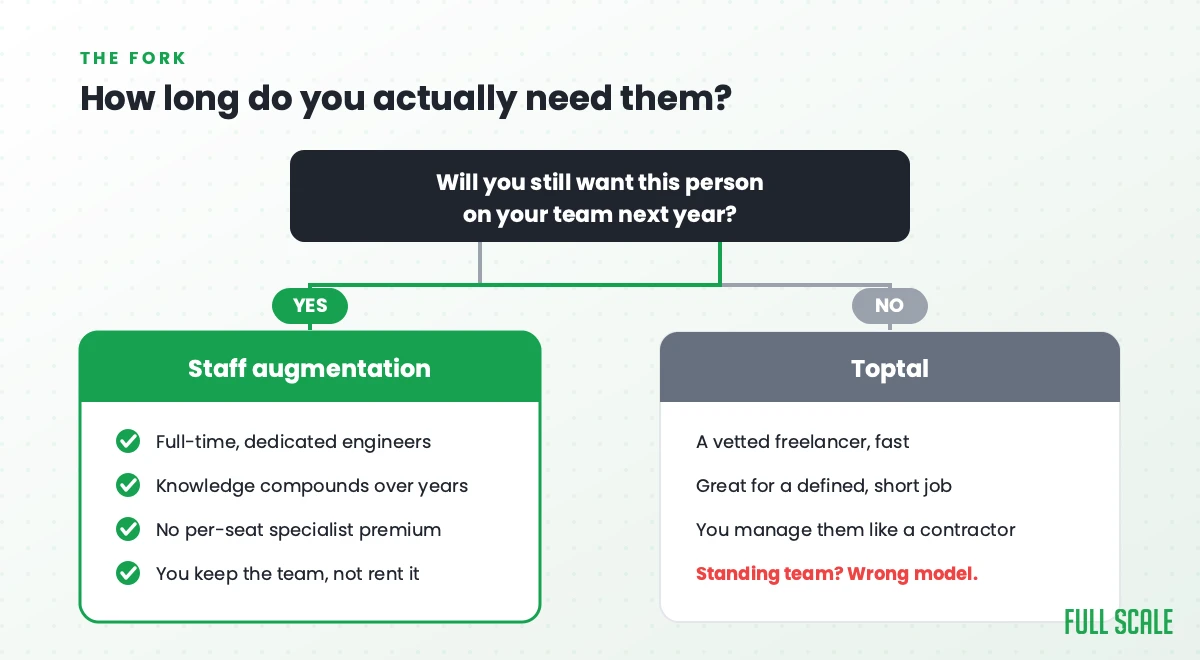
Staff augmentation is the right call when you’re building a product you intend to keep building, not a task you intend to finish. You want engineers who learn your codebase and stay long enough for that knowledge to compound instead of walking out the door with the next contractor to sign them. You have a roadmap that shifts quarter to quarter, which a per-seat marketplace rate handles fine but a fixed-scope contractor arrangement doesn’t. You want the people building your product to still be there when the thing they built breaks at 2 a.m., because they’re the ones who’ll actually remember why it was built that way.
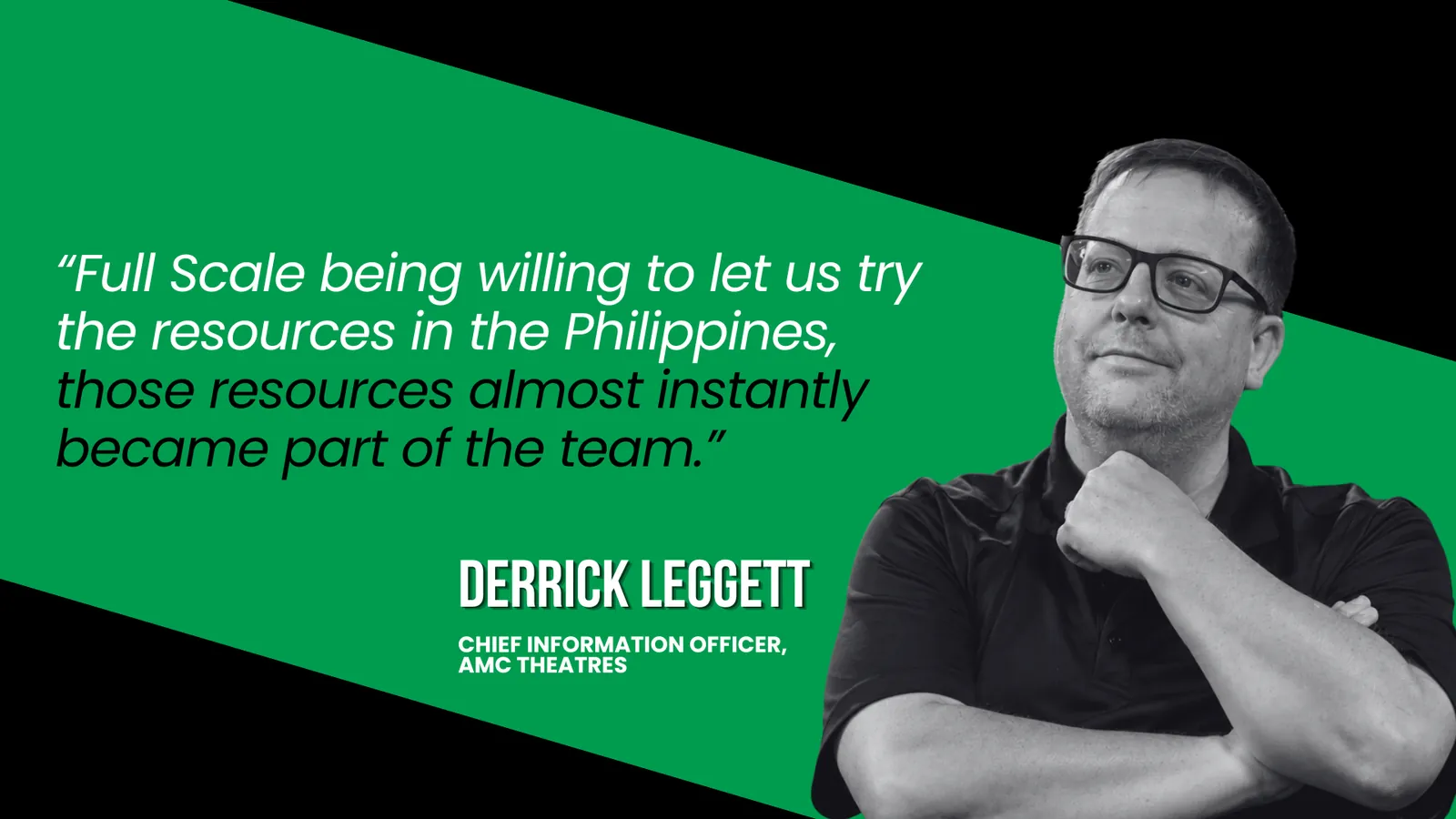
AMC Theatres runs its Philippines-based engineers as full members of its Kansas City team, sitting in the same meetings and owning pieces of the same roadmap rather than getting handed a spec and left alone. A rotating cast of freelancers doesn’t get you there. Staff augmentation does.
Can you use both?
Yes, and honestly, you probably should. This isn’t a marketing answer. It’s how I actually run things.
Use a dedicated team for the core product, the roadmap you’ll be building for years, the codebase where institutional knowledge compounds. Then reach for a freelance marketplace like Toptal for the genuinely scoped, one-off work outside that core: a specialist migration, a niche integration, the kind of task that has a clear finish line and doesn’t need anyone sitting in your standups next year. A website rebuild. A search-infrastructure upgrade nobody in-house wanted to own. I’ve farmed out exactly that kind of narrow, short-lived work myself, and it worked fine every time, because the job had a clear edge and a clear end. My actual to-do list still doesn’t have one, but that’s a me problem, not a hiring-model problem. Clear edge, clear end, that’s the sweet spot for a marketplace hire. The two models are just tools for different-shaped jobs, and most growing companies eventually need both.
What doesn’t work is using a specialist marketplace’s premium rate to staff five ordinary long-term roles, or using a dedicated team to knock out a two-week task nobody will touch again. Neither mistake is about picking the cheap option or the expensive one. Matching the model to the shape of the work is the whole decision, and getting that wrong in either direction is what sends people looking for a comparison article in the first place.
Frequently asked questions
Does Toptal’s trial period protect me the same way a staff augmentation partner’s retention record does?
No, and the difference matters. Toptal’s trial period catches a bad match in the first few weeks, which is a fair safety net for a first impression gone wrong. A staff augmentation partner’s retention number is a different kind of proof: it’s measured over years, across every client, and it drops the moment a partner stops delivering. One protects you from a bad first pick. The other is ongoing evidence the model still works after year one.
What does a team actually cost on Toptal versus staff augmentation?
At Toptal’s lower-middle range (around $100/hr), five engineers working full time for a year runs close to $1 million before fees. A staff augmentation partner at a fully-loaded rate starting around $35/hr puts the same five-person team at roughly $350,000 a year. The gap isn’t about anyone being dishonest. Toptal’s rate bundles in a specialist-finder’s premium that makes sense for a one-time search; that markup doesn’t disappear just because you keep the person on for a year.
Do staff augmentation developers know my product as well as a Toptal freelancer?
Usually better, given time, because they’re there to stay. A Toptal freelancer is vetted for general skill and dropped into your project; a staff augmentation engineer is a full-time employee who joins your team and keeps working your codebase for years, so their product knowledge compounds instead of resetting with every new engagement.
What happens to institutional knowledge when a Toptal engagement ends?
It leaves with the freelancer. They were never your employee, so nothing obligates them to document everything they learned or stick around to answer questions after the contract closes. A staff augmentation team is built around the opposite outcome: the people who understand your product are still on it next quarter.
Is it safe to hand my codebase to a Toptal freelancer instead of a staff augmentation partner?
Toptal’s screening is real, but your legal protection is only as strong as your contract with an individual, often in a jurisdiction you’ve never dealt with. A staff augmentation partner’s developers are typically its own employees under a US-based contract, so IP assignment and confidentiality run through a company you can actually hold accountable, not a contractor who can simply stop answering emails.
The model matters more than the brand
Toptal is good at what it’s built for: fast access to a vetted specialist for work that ends. Staff augmentation is good at what it’s built for: a team that sticks around long enough to actually own your product. Neither one is the wrong choice in the abstract. The wrong choice is picking based on which name you’ve heard of instead of how long you actually need the person. If neither model fits what you’re actually trying to build, I laid out the fuller set of options in Toptal alternatives.
If what you’re building is a team you intend to keep, let’s talk about what that looks like.