
Will AI Replace Software Developers?

In this article
- AI didn’t replace your engineers, it changed what the job is
- The four generations of AI in software development
- What AI actually does across the software development lifecycle
- AI multiplies speed, not clarity
- What AI changes about who you hire
- What AI-first actually looks like: AMC Theatres
- How to adopt AI without just shipping faster garbage
- Frequently asked questions
- The teams that win with AI aren’t the fastest typists
Quick Answer: No, AI will not replace software developers. It replaced the typing, not the thinking. At Full Scale, the engineers who thrive now are the ones who write clear requirements, direct AI agents, and catch a confidently wrong answer. The ticket-taker who only converts specs into code is the role actually at risk.
Everyone’s racing to add AI to their developer workflow. But here’s the thing nobody wants to say out loud.
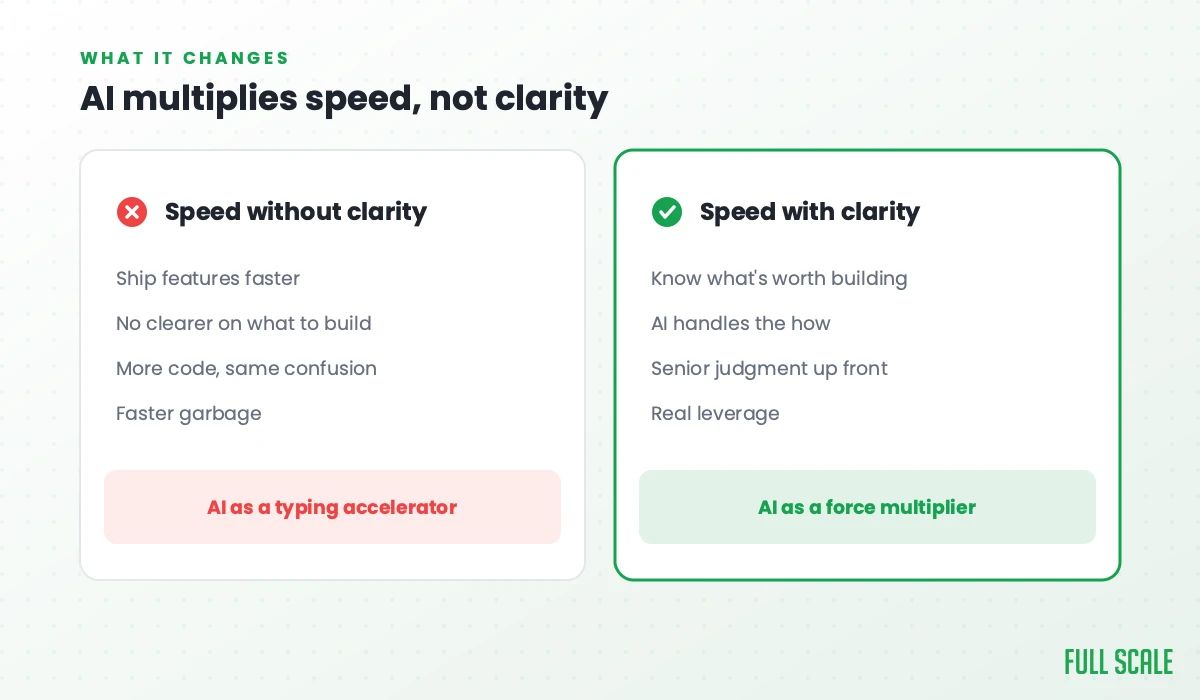
AI multiplies speed, not clarity.
The real impact of AI on software development isn’t that it replaces your engineers. It’s that it has dramatically shaken up what their job even is. The narrow specialist who sat in one lane and turned tickets into code is the role that’s actually in trouble. The people pulling ahead are doing the opposite. They’re going back to being software developers and builders who own the whole process end to end, from the requirement to the shipped result. Owning that whole arc is why the hard part shifts to the communication problems in software development that decide whether the right thing gets built at all. How teams should adjust their process as AI takes over more of the code is the core of the live debate on whether Agile is still relevant.
I’ve spent more than twenty years as a CTO and four-time founder. I built and sold VinSolutions and Stackify, and today I run Full Scale, where we staff engineering teams that work this way every day. So this isn’t a prediction about where things are going. It’s what I’m watching happen on real teams right now, including ours.
Here’s what AI in software development really changes about how your team builds, who you should hire, and where it quietly backfires.
AI didn’t replace your engineers, it changed what the job is
The fear is that AI writes the code, so you don’t need the people. That’s backwards. What actually happened is messier and more interesting. AI took over the typing and left everything around it for a human to own. Knowing where each tool fits starts with the difference between AI and machine learning. You can see the same shift in specialized corners of the field, where in virtual reality development AI now generates much of the 3D content while engineers still own the judgment about what is actually good.
For years, a lot of engineering jobs got narrower and narrower. You were handed a ticket, you wrote the code for your piece, and you threw it over the wall. AI is very good at that narrow slice. It is very bad at deciding what should be built, why it matters, and whether the result actually solves the problem.
So the role is widening back out. The engineers pulling ahead are the ones going back to being software developers and builders, involved in the whole process end to end, from shaping the requirement to shipping the result and owning what happens after it goes live.
Pure coders will be replaced by AI. Problem solvers will run technology organizations.
That’s the shift in one sentence. The engineer who only translates a ticket into syntax is exposed. The one who understands the user, shapes the requirement, makes the design calls, and knows when the output is wrong is more valuable than ever. The effect on design is just as large, where user experience strategy has moved up the stack toward differentiation and design systems.
The hard part of software development was never writing the code. It was understanding the problem you’re trying to solve.
It’s the same idea I wrote a whole book about, Product Driven, and AI just made it impossible to ignore.
The four generations of AI in software development
Software engineering has changed more in the last two years than in the previous ten, and most people are still catching up. The clearest way I’ve found to explain where we are is to walk through how we got here. AI moved through four distinct generations, and each one changed the job a little more.
Generation one: AI as a smarter Stack Overflow
The first wave was simple. ChatGPT showed up and engineers had a faster, smarter version of a search engine.
You’d paste in a function you were stuck on, ask how to write a tricky bit of logic, get a snippet back, and drop it into your editor. The workflow didn’t really change. AI was a research tool you consulted and then left. The engineer was still doing all of the thinking and all of the writing.
Generation two: AI inside the editor
Then AI moved into the editor itself. GitHub Copilot started finishing your thoughts as you typed. Cursor went further and gave the AI access to your whole codebase rather than the single snippet you pasted in, so its suggestions understood what was already around them.
This felt like a real unlock. The suggestions were whole functions and whole files now. But the model was the same as before. Your hands were on the wheel, and you made every call. AI helped you go faster, but you were still the one thinking.
Generation three: agents that own the implementation
Then coding agents like Claude Code arrived, and something more fundamental moved.
In the first two generations, the question was always some version of “how do I build this?” You knew what you wanted and used AI to help write it. Agents made that question almost irrelevant. You stopped asking how. You described the goal, handed it to the agent, and let it figure out the implementation. That shift is exactly why building an MVP is now about proving demand, not proving you can write the code.
That sounds like a small change. It isn’t.
It pulls the engineer out of the implementation loop and puts them in a direction-and-review role instead. You’re not writing the code. You’re describing the problem clearly enough that the agent can solve it, then reviewing what comes back with enough judgment to catch when it’s technically correct but wrong for the actual use case.
Generation four: managing a team of agents
This is where we are now. You’re not in the code at all. You’re managing several agents working in parallel, which looks a lot more like product management than programming.
Picture a real sprint. One agent is building an API endpoint while another refactors a module you flagged last week, and a third writes the tests for a feature that shipped yesterday. You’re not blocked waiting for one task to finish before the next starts. You’re reviewing, redirecting, and feeding in the next requirement. Tools like Vibe Kanban wrap this in a board that lets you run agent tasks the way a manager runs a sprint, and tools like Devin push toward agents that run longer stretches on their own. The same shift is rewriting QA, which I covered in the 2026 software testing trends.
McKinsey calls the end state a “two-shift digital factory”: humans work the day shift setting direction and enforcing quality, and agents work the night shift doing the execution.
The throughput stops looking like one developer. It looks like a small team.
And the bottleneck moves entirely to the front of the process, to the clarity of the requirements going in and the judgment of the person checking what comes out.
What AI actually does across the software development lifecycle
Strip away the hype and AI touches every phase of the software development lifecycle (SDLC). It just does something different in each one, and a human is still on the hook for the part that matters.
| SDLC phase | What AI does well | What still needs a human |
|---|---|---|
| Planning and requirements | Drafts user stories, surfaces edge cases, estimates from past data | Deciding what to build and why; writing requirements clear enough to act on |
| Writing code | Generates functions, whole files, and boilerplate from a description | Architecture, system design, and the calls AI can’t see the context for |
| Testing and quality assurance | Generates test cases and flags likely failure points | Deciding what’s worth testing and what “good enough” means |
| Code review | Spots bugs, security issues, and bad patterns in real time | Judging whether confident-looking code actually solves the problem |
| Deployment and maintenance | Monitors, flags anomalies, and runs routine fixes | Owning the incident and the tradeoff when something breaks |
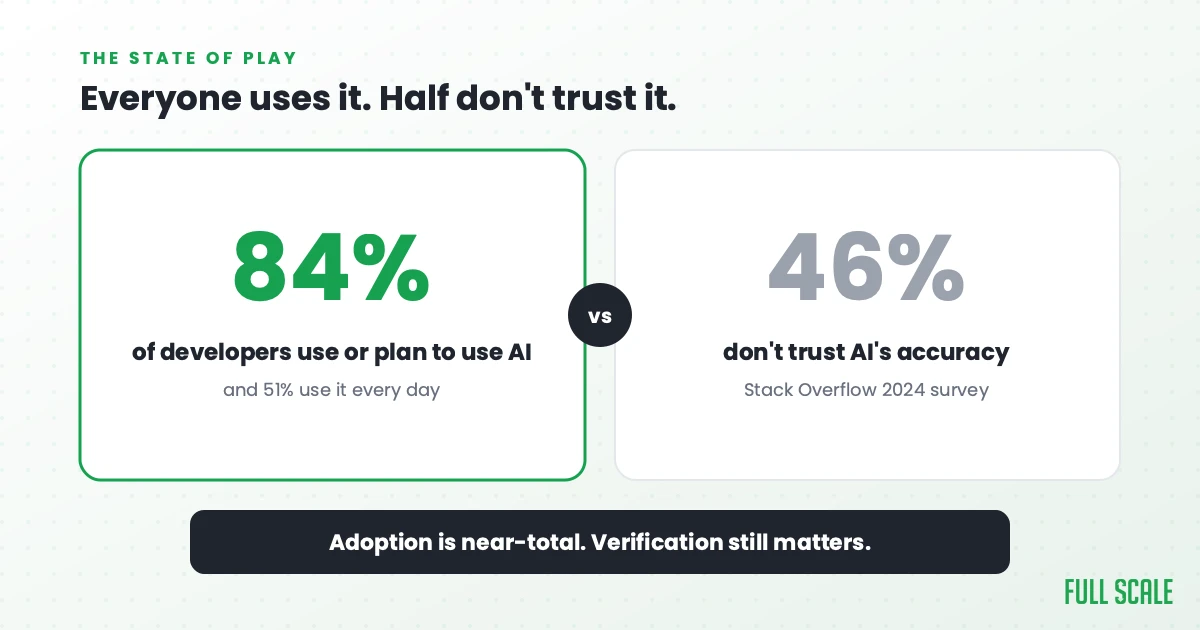
On the coding side, tools like Amazon Q Developer generate and explain code, and analysis tools like SonarQube scan for bugs and vulnerabilities before they reach production. None of this is experimental anymore. In the 2025 Stack Overflow Developer Survey, 84% of developers said they use or plan to use AI tools, and 51% use them every day.
The testing phase is where I see the most confusion.
AI can write a thousand tests, but it can’t tell you which thousand matter, and it won’t decide what’s worth testing in the first place. That’s the real story behind manual versus automated testing now.
That judgment is exactly why AI-heavy teams need a strong quality assurance (QA) engineer even more than slower teams ever did. The same goes for the stack you build on. The questions worth asking now include how well your tools work with AI, which is why AI changes the framework conversation and even how you estimate cost.
AI multiplies speed, not clarity
Here’s the part the vendors skip. AI helps teams that already have their fundamentals together, and it actively hurts the ones that don’t, which is the real story of how AI is reshaping software engineering principles instead of retiring them.
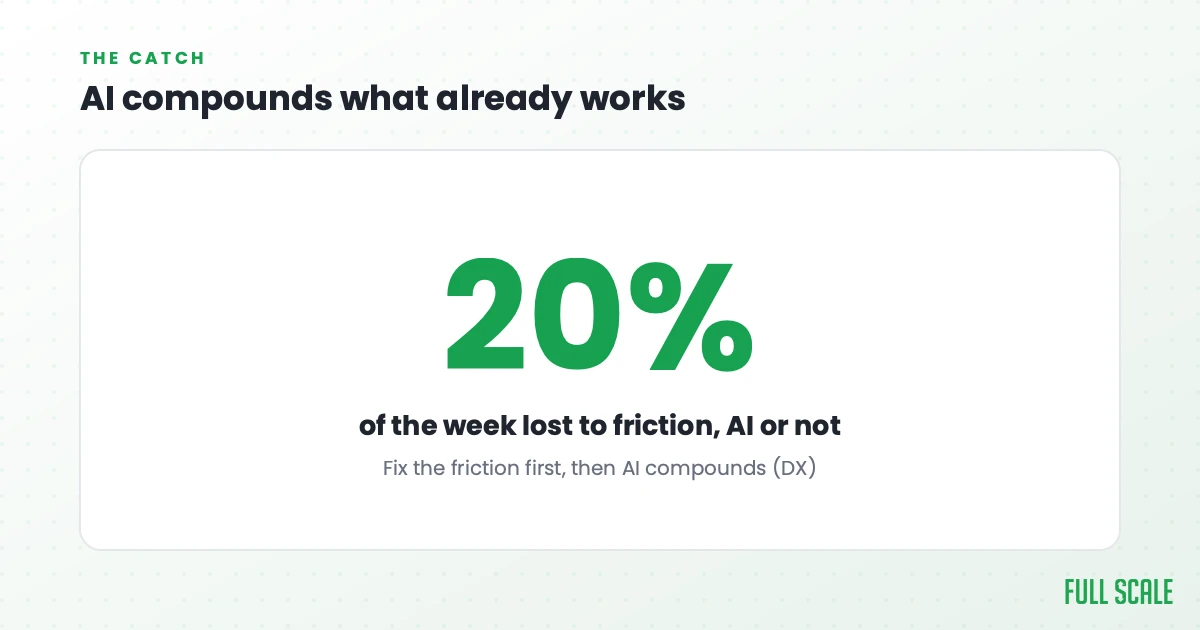
Laura Tacho, CTO of DX, shared research that developers waste about 20% of their time every week on friction. They lose it to unclear requirements, slow build pipelines, broken tests, and documentation nobody can find. That’s a full day every week, gone before anyone writes a useful line of code.
Now layer AI on top of that. If your team is already drowning in wasted time, AI doesn’t save you. It just helps you paddle faster in the wrong direction.
The companies seeing real gains from AI software development are the ones that already fixed the basics: fast pipelines, clear requirements, lightweight process, and leadership that protects focus time. They don’t lose that 20%, so when they add AI, the benefits compound. The teams still fighting friction just produce faster garbage.
The data backs this up in an uncomfortable way. In that same Stack Overflow survey, 46% of developers said they don’t trust the accuracy of AI output, up from 31% the year before. The tools got more capable and trust went down, because people are watching AI produce confident, plausible, wrong answers.
Here’s the truth about vibe coding: it only works if you’ve been coding long enough to know when the AI is wrong.
That’s also why this isn’t free. Relying on AI to generate code nobody on the team understands creates tomorrow’s technical debt today, which is exactly what you have to avoid in the age of AI-generated code.
Speed without comprehension is a loan, and the bill always comes.
The build versus buy decision runs into the same wall: AI made building cheaper, but it didn’t make figuring out what to build any easier.
What AI changes about who you hire
If pure coding is the thing AI does best, then hiring for pure coding is hiring for the part you need least. This is the decision most engineering leaders are getting wrong right now.
Great requirements are more important than great developers. They always were, but you used to be able to paper over fuzzy thinking with a team that ground out enough code. You can’t anymore, because the code is no longer the bottleneck.
The clarity going in is.
I’m not the only one seeing it this way. Seth Rosenbauer, founder of Joggr, put it well on my podcast: “The limitation of how fast a company can innovate has never been how fast they can type code.” It’s focus, product decisions, and committing to a direction without getting pulled off it a hundred times. AI makes the typing faster. It does nothing for the part that was always hard.
So screen for different things. You still want senior engineers who recognize bad patterns and understand what’s happening under the hood, because someone has to catch the AI when it’s wrong. But weight your hiring toward judgment, the ability to write a clear requirement, and a real understanding of the system, over raw typing speed. The type of engineer that thrives now is the one who thinks about outcomes instead of just output. You also still want to bring along junior engineers, both to build long-term talent and because they often adopt the new tools fastest. It’s a different kind of skills assessment for software developers, one built around judgment instead of typing speed.
This is the whole reason we train every engineer at Full Scale on the Product Driven approach plus the modern AI toolkit, Copilot, Claude, and Cursor included. A developer who can take a vague idea, turn it into a clear requirement, direct an agent, and judge the result is worth far more than one who just writes code fast. If you’re trying to build that kind of team, it’s exactly what offshore software development done well looks like, whether you need staff augmentation or a dedicated team of senior engineers from the Philippines.
What AI-first actually looks like: AMC Theatres
This isn’t theory for us. AMC Theatres went AI-first with a global engineering team that includes Full Scale developers in the Philippines who work as full AMC engineers rather than walled-off contractors.
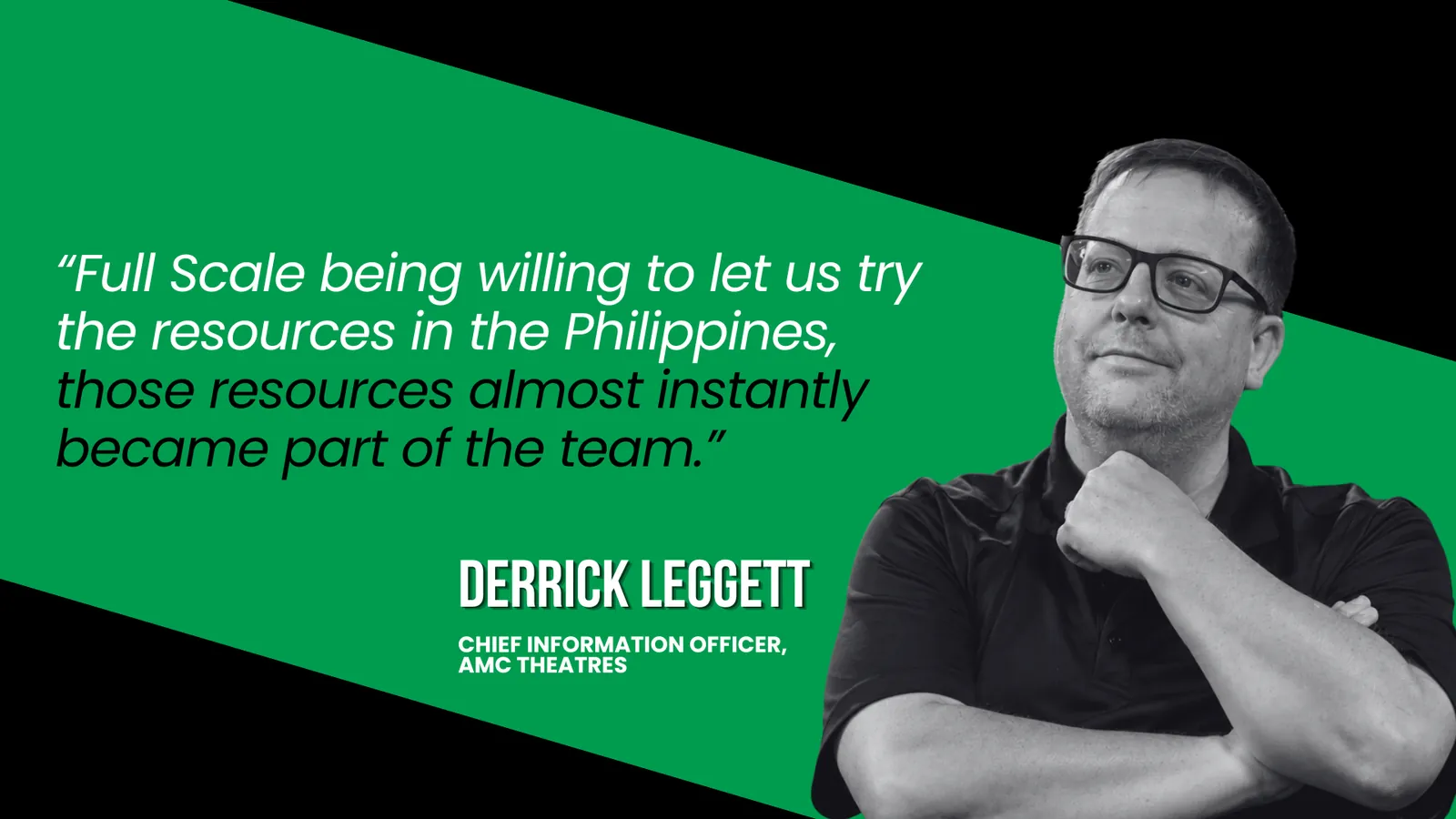
Derrick Leggett, AMC’s CIO, puts the stakes bluntly: “People who don’t adopt AI and learn how to use it are going to be working at 30%, 50%, 80% of what the person sitting next to them is.”
What makes it work isn’t the tools. It’s that AMC treats its engineers as owners who understand the business, sit in the same standups, and share the same standards. That’s the team AI actually accelerates, because the people directing the agents understand what they’re building and why.
The leaders treating engineers as ticket-takers are the ones who’ll get faster garbage.
How to adopt AI without just shipping faster garbage
You don’t get the upside by handing everyone a license and hoping. The teams that win with AI software development do a few specific things first.
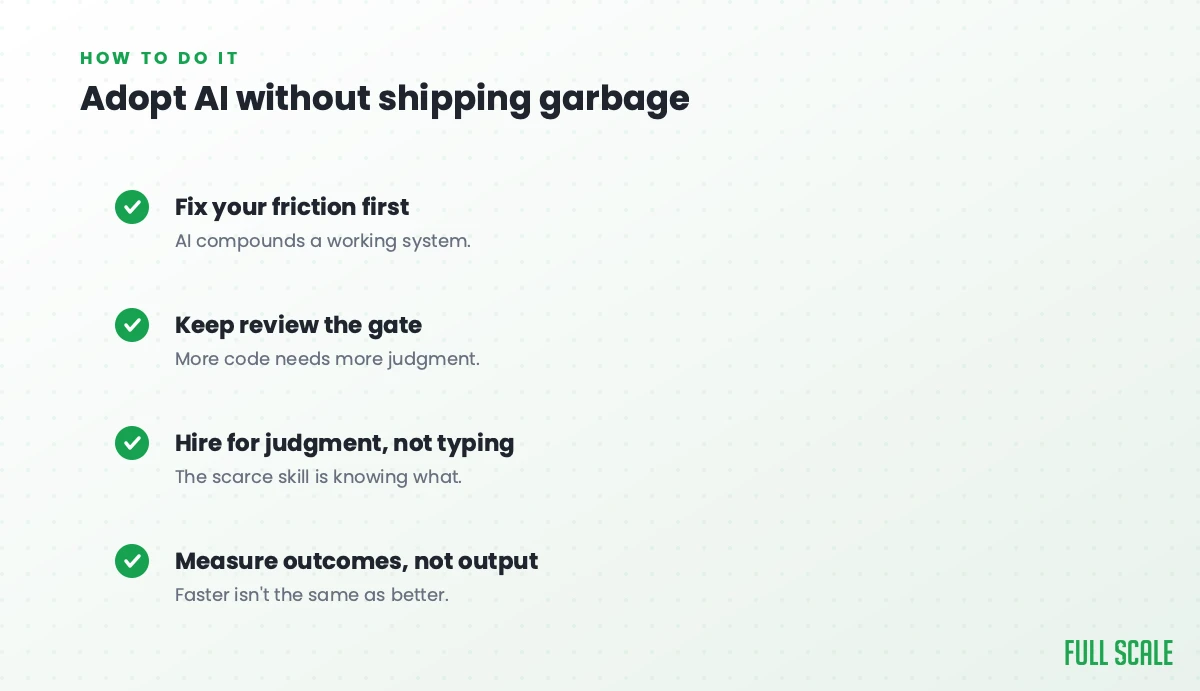
- Fix the fundamentals before you add AI. That means clear requirements, fast builds, and documentation people can actually find. AI amplifies whatever you already have, good or bad.
- Protect focus time. A developer pulled into five meetings a day can’t direct agents any better than they could write code. Clarity and uninterrupted time are the inputs.
- Keep a senior on the output. Someone with enough judgment to catch the confident, wrong answer needs to review what the agents produce. This is not optional.
- Hold the line on architecture and judgment calls. These are the decisions that stay human: build versus buy, where the security surface sits, and how the components connect.
- Measure whether it actually helped. Track cycle time and quality before and after. If nothing improved, you added noise instead of speed.
If you want to go deeper on the developer-experience side of this, I broke it down with Laura Tacho on the Product Driven newsletter and podcast.
Frequently asked questions
Will AI replace software developers?
No. AI takes over the typing, but the thinking is still the job. Developers who only convert tickets into syntax are exposed, but engineers who understand the problem, write clear requirements, and catch the AI when it’s confidently wrong are more valuable than ever, which is exactly the kind of engineer Full Scale places on client teams. The role moved from writing code to directing and reviewing it.
What is the impact of AI on software development?
The biggest impact of AI on software development is on the engineer’s role rather than the headcount. Tools like large language models (LLMs) and coding agents such as GitHub Copilot, Cursor, and Claude Code now handle much of the actual code, so engineers spend less time typing and more time shaping requirements, making design calls, and judging the output. The narrow coding specialist is fading, and the end-to-end builder who owns the whole process is back in demand.
What are the best AI tools for software development?
It depends on your stack and how your team works, but the main categories are code generation (GitHub Copilot, Cursor, Amazon Q Developer), coding agents that handle larger tasks (Claude Code, Devin), automated testing, and code analysis (SonarQube). Most teams combine a few rather than relying on one.
Does AI actually make software development cheaper?
Sometimes. AI cuts the time spent on routine work, but only for teams whose fundamentals are solid. If requirements are vague and pipelines are slow, AI just speeds up the waste, so the savings depend far more on how you work than on which tool you buy.
How is generative AI different from older AI tools in development?
Generative AI writes new code, tests, and documentation from plain-language descriptions, instead of just autocompleting a line or flagging an issue after the fact. That generative ability is what moved engineers from writing code themselves to directing agents that write it for them.
How should an engineering team start using AI?
Fix the fundamentals first: clear requirements, fast builds, and protected focus time. Then introduce AI tools on real work, keep a senior engineer reviewing the output the way you’d run pairing with AI, and measure whether cycle time and quality actually improve before you scale it across the team.
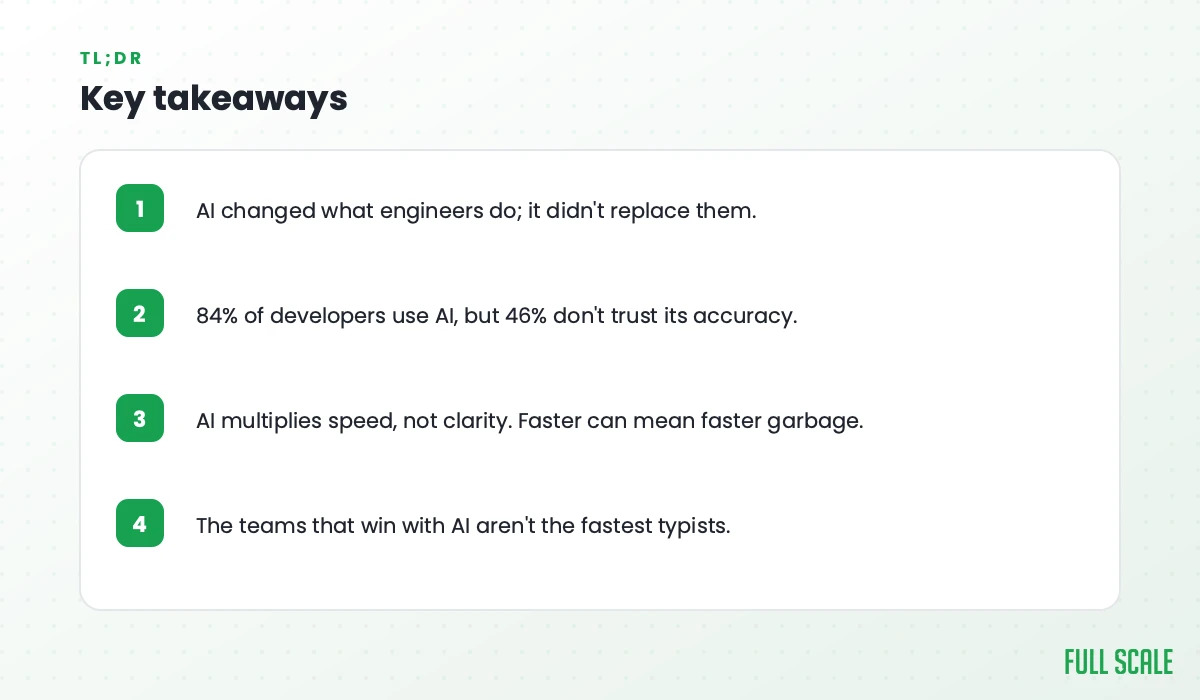
The teams that win with AI aren’t the fastest typists
Software development is back, and the companies that remember what that ever meant are going to win. The real impact of AI on software development isn’t fewer engineers. It’s that the narrow, heads-down coding role is fading, and the end-to-end builder, the person who owns the problem from requirement to shipped result, is valuable again.
The teams that pull ahead won’t be the ones who adopted AI the fastest.
They’ll be the ones who already knew how to think like owners, and now have agents to do the heavy lifting.
If you want to build an engineering team that works this way, let’s talk about what that looks like for you.