
The Best JavaScript Frameworks Right Now (And Why AI Changes the Answer)

In this article
- Does Framework Choice Still Matter If AI Writes the Code?
- The Frameworks That Still Run Most of the Internet
- The Backend: Node.js, Express, and a Runtime Worth Knowing About
- Next.js Is the Default Full-Stack Framework for React
- The New Wave: Svelte, Astro, and the Lightweight Frameworks
- Why AI Actually Changes the Framework Decision
- How to Choose the Right JavaScript Framework for Your Project
- Frequently Asked Questions
There’s a question I’ve been sitting with for a while now: does it even matter what JavaScript framework you use if AI writes all the code? For a focused three-way decision, see React vs Angular vs Vue.
I ask because we just rebuilt the entire Full Scale website in Next.js. I’m a backend developer. I didn’t write a single line of code for it. Not one. The AI handled the scaffolding, the components, the deployment configuration, all of it. And honestly? That made me pretty happy.
When a CTO asks me which of the best JavaScript frameworks to pick, my first instinct now is to flip it back: how much of the code is your team going to write versus generate? Because the answer to that question has started to change the answer to the framework question.
Here’s my take on the best JavaScript frameworks right now, including the part that nobody was talking about in 2020.
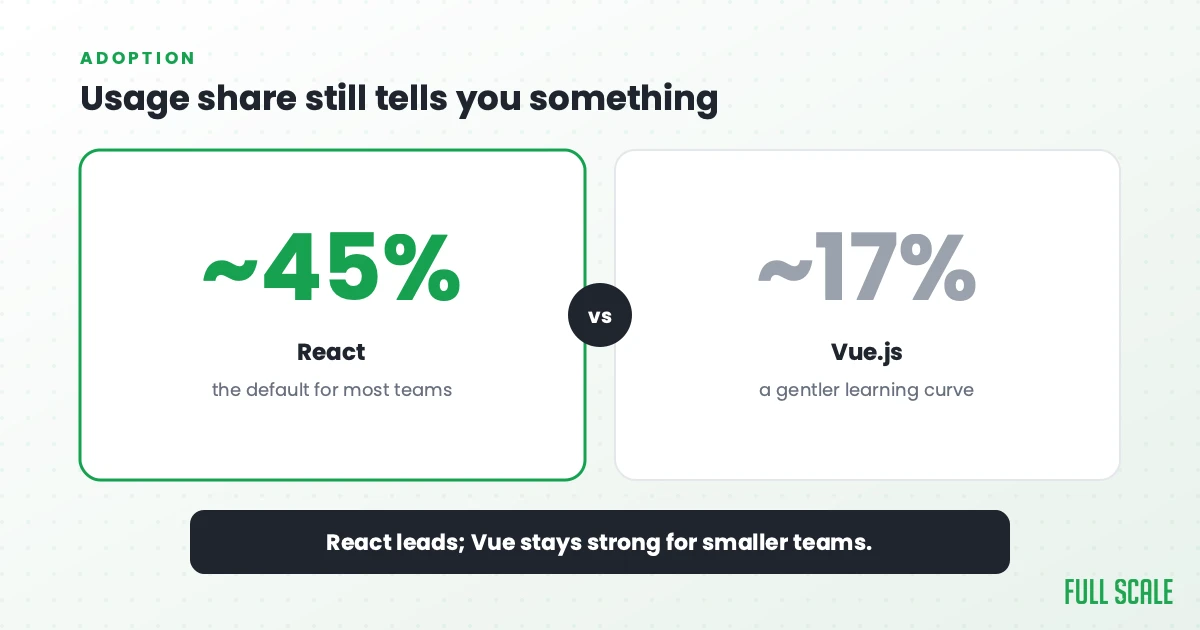
Quick Answer: React is still the best JavaScript framework for most new products in 2026, with roughly 45% usage share, the deepest talent pool, and the strongest AI coding tool support. Vue.js is the gentler-learning-curve option at around 17% usage, Angular remains the right call for large enterprise teams that need enforced structure, Next.js is the default full-stack choice for React-based products, and Astro or Svelte fit content-heavy or performance-critical sites. In 2026, picking a framework AI tooling works well with matters as much as the framework's own features, which is why Full Scale weighs AI-tooling fit alongside talent pool and maintainability when advising clients.
Does Framework Choice Still Matter If AI Writes the Code?
Yes, but for different reasons than before.
The old reasons to care about framework choice: performance benchmarks, community size, job market, how long it takes a new developer to get productive. Those still matter. But there’s a new reason in 2026 that outweighs a few of them: which frameworks produce the best output when AI tools are doing the scaffolding.
This distinction matters. AI coding assistants like GitHub Copilot, Cursor, and Claude Code have been trained on more React and TypeScript code than anything else in the JavaScript world. When you’re working in React with TypeScript, the suggestions are sharper, the generated components are cleaner, and the auto-refactoring works better. When you move into a smaller or newer framework, the quality of AI assistance drops noticeably. The models just haven’t seen as much of it.
That’s the new filter. It’s not that newer frameworks are worse (some are technically impressive), it’s that your AI tools are much better at helping you build in React than in Svelte or SolidJS, and in 2026 that’s a real productivity difference.
AI is a genuinely useful tool that can boost productivity, but relying on it to generate unexplainable code creates tomorrow’s technical debt today. The hard part of software development isn’t writing code. It’s understanding the problem you’re trying to solve.
It’s a principle I dig into in my book Product Driven. Framework choice is downstream of understanding what you’re actually trying to build. Which means picking a framework where AI output is readable, maintainable, and something your team can actually reason about matters more than it did three years ago.
The Frameworks That Still Run Most of the Internet
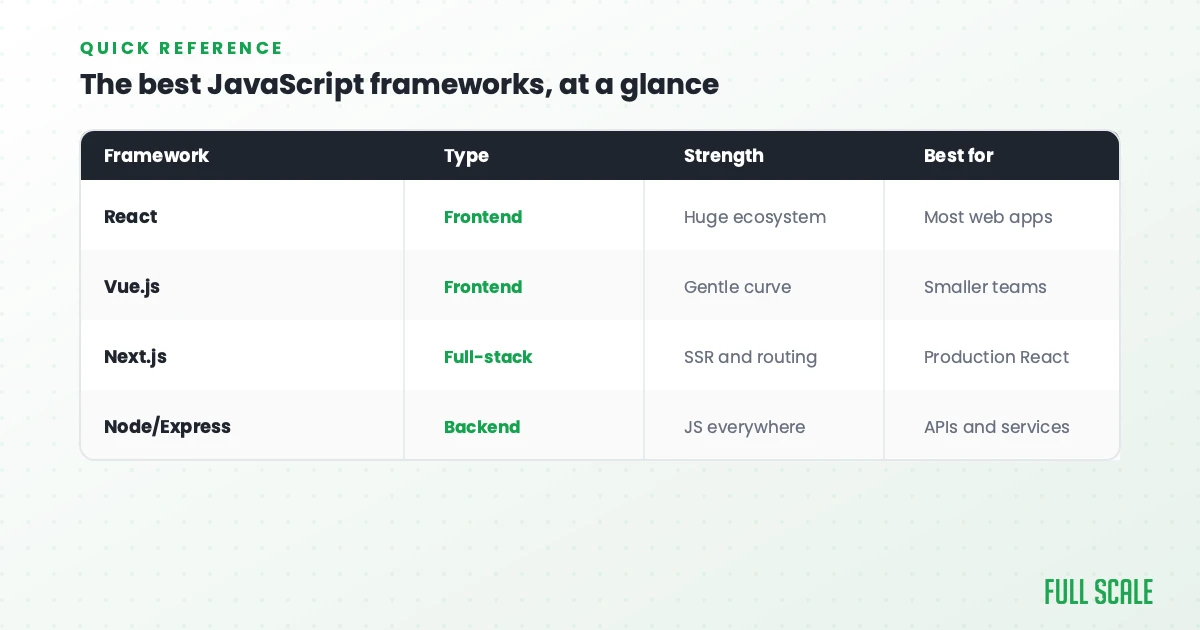
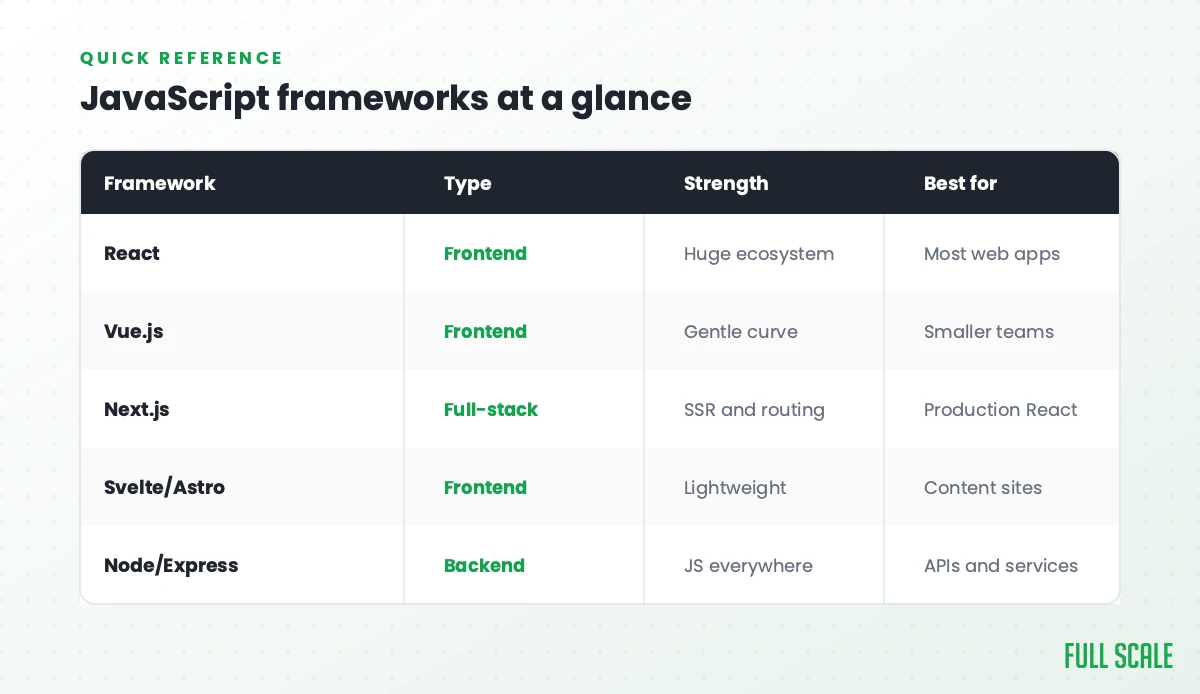
The quick-reference breakdown of where the main JavaScript frameworks stand today:
| Framework | Type | Primary use case | TypeScript support | AI tooling fit | Best for |
|---|---|---|---|---|---|
| React | Frontend library | SPAs, component UIs | Excellent | Best in class | Most new products |
| Next.js | Full-stack | React-based web apps | Excellent | Best in class | Full-stack SaaS, AI-backend products |
| Vue.js | Frontend framework | SPAs, progressive apps | Good | Strong | Mid-size teams, gentler onboarding |
| Angular | Frontend framework | Enterprise apps | Built-in | Good | Large orgs, enforced structure |
| Express / Node.js | Backend | APIs, servers | Good | Good | Backend APIs, existing Node teams |
| Svelte | Frontend | Performance-critical apps | Good | Moderate | When bundle size is the constraint |
| Astro | Frontend / full-stack | Content-heavy sites | Good | Moderate | Marketing sites, docs, blogs |
The top of that list hasn’t changed much since 2020, and it lines up with what you’d expect from any list of the best JavaScript frameworks. React is still the most widely used JavaScript framework by a wide margin, Vue.js holds steady in second place, and Angular remains the default for enterprise shops that need enforced structure. What’s changed is the middle: Next.js has grown from a handy React add-on into the dominant full-stack framework, and a new tier of performance-focused frameworks has gotten serious.
React Is Still the Safe Bet
React hit around 45% usage share among developers according to the 2025 Stack Overflow Developer Survey, and that number has been stable for years. The React Compiler reached version 1.0 in October 2025, which means it now handles memoization automatically without developers having to manage it manually. Meta has been running it in production and reported measurable performance improvements.
For most new products, React is still my first recommendation. The talent pool is deep, the tooling is mature, and AI coding assistants produce better React output than anything else in the JavaScript world. If you need to hire React developers, the bench is larger and the screening is more straightforward than with any other frontend framework.
The one honest knock on React: it’s a library, not a full framework, which means you’re assembling a stack rather than getting one out of the box. That’s fine if your team knows what they’re doing. It’s more overhead than it sounds if they don’t.
Vue.js: High Developer Satisfaction for a Reason
Vue.js sits at roughly 17.6% usage and consistently ranks near the top of developer satisfaction surveys. It’s not just popular: developers who use it tend to like it. The Vue 3 Composition API brought it much closer to React’s mental model while keeping the gentler learning curve that made Vue appealing in the first place.
Nuxt.js (the Vue equivalent of Next.js) drives a lot of Vue’s production adoption and has matured a lot. If your team has Vue experience and you’re starting a new project, there’s no reason to jump ship to React. Teams that want React-like architecture without the React learning overhead often land on Vue and stay there.
If you’re hiring Vue.js developers, the community is smaller than React’s but the quality bar tends to be high. Vue developers usually chose it deliberately, not by default.
Angular: Right for the Right Context
Angular is Google’s full-featured framework and still the default choice for large enterprise organizations, financial services, government work, and anywhere that benefits from an enforced, opinionated structure. Angular is now on version 22, released in June 2026, and TypeScript is baked in from the start.
My honest take: Angular is the right call if you’re building for a large org that needs the structure to be non-negotiable. It’s probably not the right call for a five-person startup. The learning curve is real, the overhead is real, and the thing that makes Angular great at scale (it tells your developers how to do things) is the thing that makes it frustrating at early stage (it tells your developers how to do things).
If you’re already running Angular, keep running Angular. If you’re starting from scratch with a small team, I’d start somewhere simpler.
The Backend: Node.js, Express, and a Runtime Worth Knowing About
For backend JavaScript, Express.js on Node.js is still the workhorse. It was founded in 2010, it’s one of the most-downloaded packages in the npm registry, and it’s running a substantial fraction of the JavaScript APIs in production today. The API at PayPal runs on Express. Accenture’s platform and Pluralsight’s learning environment count too. The server side is its own decision, separate from the frontend, and frontend vs backend development is a real divide in the JavaScript world.
For teams building with Node.js, Express is the boring choice. The boring choice is usually the right choice. Full Scale staffs this side too, so you can hire Node.js developers for APIs and services.
Worth knowing: Bun.js is a newer JavaScript runtime (think of it as a faster alternative to Node.js, not a framework) with built-in TypeScript support and significantly better benchmark performance. It’s not production-proven at scale the way Node is, but it’s gaining real adoption for new projects. If you’re starting a fresh backend service in 2026, it’s worth benchmarking Bun alongside Node before defaulting to Node just because that’s what you’ve always used.
Next.js Is the Default Full-Stack Framework for React
Next.js is now the default full-stack JavaScript framework for React-based products. The original version of this post (written in 2020) called it “a small JavaScript framework” with limited coverage, and that framing is years out of date.
It runs React Server Components and Server Actions natively, handles server-side rendering, edge functions, and static generation in a single coherent architecture, and it’s the go-to choice for products that have AI backends: streaming LLM responses, server-side data fetching for AI features, and the kind of hybrid rendering that modern AI-powered products need.
I built the Full Scale website in Next.js. My team built it, I should say. I didn’t write a line, which as a backend developer I consider a success. The point is that Next.js plus AI tooling has lowered the entry point enough that a backend-focused team can ship a production-quality frontend without a dedicated frontend specialist doing all the heavy lifting.
If you’re building a new SaaS product in 2026 and you want a single framework that handles both the frontend and backend without requiring separate stacks, Next.js is the right starting point. The Vercel platform makes deployment trivial. If you need to hire Next.js developers, Full Scale staffs them too.
The New Wave: Svelte, Astro, and the Lightweight Frameworks
Beyond the best JavaScript frameworks everyone already knows, there’s a tier of newer options that have gotten genuinely good and deserve a real mention.
| Framework | Bundle size | Best for | Maturity |
|---|---|---|---|
| Svelte 5 | ~15KB | Performance-critical, small teams | Production-ready |
| Astro 5 | Near-zero JS by default | Content sites, marketing, docs | Production-ready |
| SolidJS | ~7KB | High-performance UIs | Growing |
| Qwik | Near-zero initial JS | Instant TTI, mobile-first | Early production |
Svelte 5
Svelte compiles components down to vanilla JavaScript at build time rather than shipping a runtime, which means production bundles run around 15KB compared to React’s ~45KB. That’s a real difference on mobile networks and for anything where Core Web Vitals scores are load-bearing for the business.
The catch: Svelte has a much smaller talent pool than React, and AI coding assistants produce noticeably less reliable Svelte output. For a small team that knows the framework well and is building something where performance is the primary constraint, Svelte earns a serious look. For a team that needs to hire developers quickly and iterate fast, the smaller community is a real friction point.
Astro
Astro is purpose-built for content-heavy sites. It ships HTML with zero JavaScript by default, and JavaScript is only added when a component explicitly needs it. That makes it the right call for marketing sites, documentation sites, landing pages, and blogs.
Most Full Scale clients building SaaS products don’t need Astro for the core application. But their marketing site probably should be. If SEO and page speed are critical for a content surface and the content is relatively static, Astro outperforms Next.js on those specific metrics.
Why AI Actually Changes the Framework Decision
Here’s what nobody was writing about in 2020 and most framework comparison posts still aren’t saying clearly: the emergence of AI coding tools has created a real, practical reason to favor some frameworks over others.
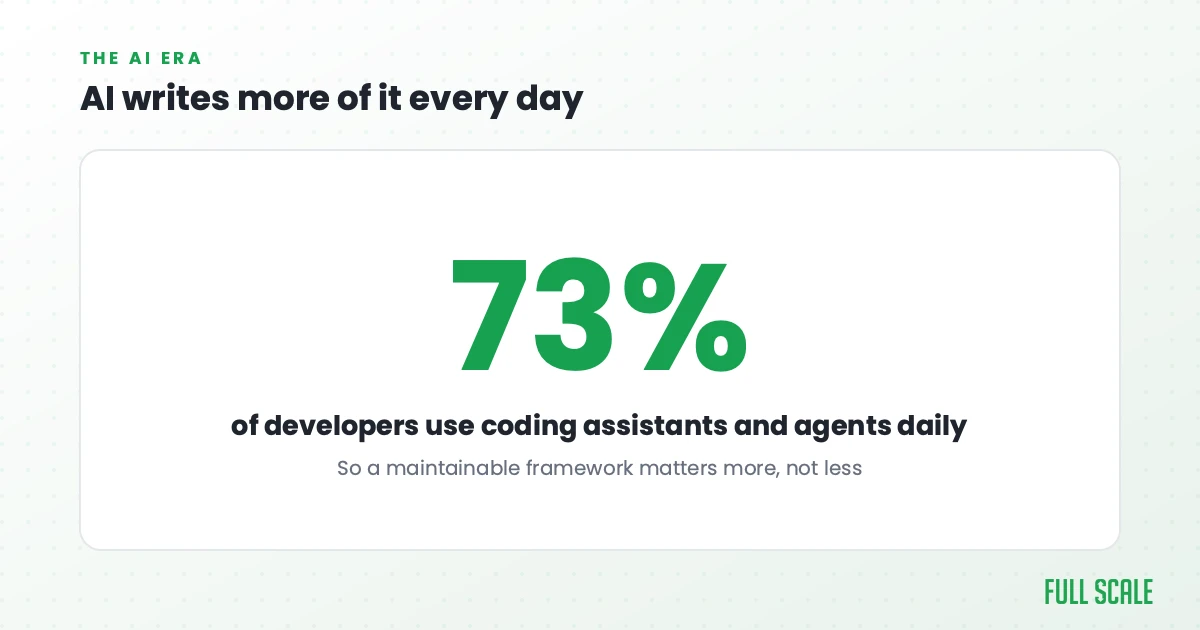
The Stack Overflow Developer Survey 2026 found that 73% of respondents now use coding assistants and agents daily. That means framework choice is now also a decision about how well your tooling will work when AI is generating or refactoring a significant portion of your code.
Three things that matter:
TypeScript is no longer optional. Every framework on this list supports TypeScript, but React and Angular have the deepest TypeScript training data in the models. AI-generated code with strong type annotations is safer and more readable than AI-generated JavaScript. If you’re not using TypeScript in 2026, you’re working against your AI tools rather than with them.
React has the largest training corpus. The models have seen more React code than anything else in the JavaScript world. Suggestions are sharper, generated components are more idiomatic, and the refactoring tools work better. This doesn’t mean you must use React, but it does mean you get a real productivity edge from it when AI is part of your workflow.
Framework flexibility cuts both ways with AI. React’s flexibility (there are many valid ways to do the same thing) is a design choice that experienced developers appreciate. It’s also the thing that lets AI generate technically working code that no human on your team fully understands.
The frameworks that enforce more structure (Angular, Next.js with server components) produce more predictable AI output than the ones that give developers complete freedom. That’s worth factoring in if AI-assisted development is a big part of your workflow.
More on how AI is reshaping frontend development from Sencha’s breakdown of JS frameworks and AI tooling.
How to Choose the Right JavaScript Framework for Your Project
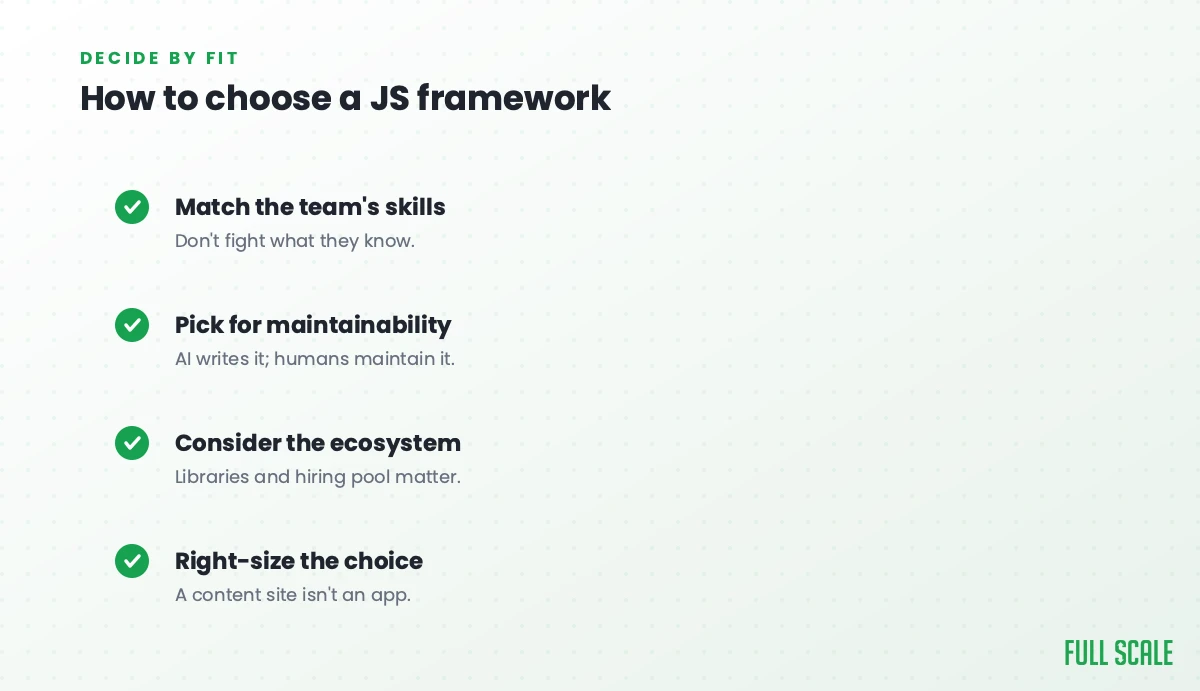
Keep it simple and boring until you can’t.
That’s the principle I give people who ask me to help them choose a tech stack, and it applies here. The best JavaScript framework is the one your team won’t abandon in 18 months, can hire for, and can get real AI assistance with. How that plays out in practice:
Building a new SaaS product: React + TypeScript + Next.js. Full-stack, AI-friendly, deep talent pool, and the tooling for everything from authentication to payments is mature. That is the boring choice, and it is usually the right one.
Building a content-heavy marketing site or documentation: Astro. Ships near-zero JavaScript by default, handles SEO out of the box, and produces significantly better Core Web Vitals scores than a React-based stack for static or mostly-static content.
Building enterprise internal tooling with a large team: Angular. The enforced structure isn’t overhead at scale, it’s the feature. When 50 developers touch the same codebase, opinionated frameworks save more time than they cost.
Small team, performance-critical, team already knows JS well: Svelte. The performance case is real, the developer experience is excellent, and the smaller community isn’t a blocker if you’re not planning to hire externally. (If you do need to hire, think carefully before betting on a smaller community.)
If you need senior JavaScript developers who’ve shipped production code across all of these frameworks and can help you make this decision with real data, that’s exactly what Full Scale does. Our web app developers specialize in React and Next.js, the two frameworks that dominate new product builds in 2026.
Frequently Asked Questions
What is the most popular JavaScript framework in 2026?
When developers search for the best JavaScript frameworks by usage share, React consistently leads at roughly 45% according to the Stack Overflow Developer Survey. Next.js has become the default full-stack choice for React-based products. Vue.js holds around 17% and remains strong for teams that want a gentler learning curve than React.
Is React still worth learning in 2026?
Yes. React has the largest community, the deepest talent pool, and the strongest AI coding tool support of any frontend framework. The React Compiler (v1.0, released October 2025) also handles a lot of the manual tuning work that used to be a common complaint. If you’re learning frontend development and want to maximize your job market options, React is still the answer.
Which JavaScript framework is best for beginners?
Vue.js is generally the easiest starting point: the documentation is excellent, the component model is simpler than React’s, and the cognitive overhead is lower. That said, if you’re planning to join a team or hire developers, learning React makes more practical sense given where the job market is. For enterprise teams that choose Angular, the framework’s TypeScript strictness and dependency injection make offshore Angular projects more predictable than offshoring React or Vue. The conventions enforce a shared code language that travels across time zones.
How does AI change which JavaScript framework I should use?
AI coding tools produce significantly better output in frameworks with strong TypeScript support and large training datasets. React + TypeScript gets the best AI assistance of any combination right now. Smaller or newer frameworks like Svelte or Qwik can produce excellent code, but the AI tooling for them is less reliable and the suggestions are less idiomatic. If AI-assisted development is a major part of your workflow, that’s a real reason to weight React more heavily than a pure benchmark comparison would suggest.
Is Angular still relevant in 2026?
For enterprise teams, yes. Angular enforces structure in a way React doesn’t, which matters when you have 50 developers working on the same codebase. Angular is also current, with version 22 released in June 2026. For a startup or small team, the learning curve and overhead rarely justify the tradeoff. But if you’re already running Angular at an enterprise, the framework is actively maintained and there’s no compelling reason to migrate.
What is the best full-stack JavaScript framework?
For most new products, Next.js with React and TypeScript is the best full-stack JavaScript framework. It handles frontend rendering and server-side data fetching in one architecture, and AI coding tools work best with it. If the backend is its own service, pair React with Express on Node.js. Angular fits large enterprise teams that need enforced structure.
What are the newest JavaScript frameworks?
The newest JavaScript frameworks worth a serious look are Svelte 5, Astro 5, SolidJS, and Qwik. Svelte 5 and Astro 5 are production-ready, SolidJS is still growing, and Qwik is in early production. AI coding tools are less reliable on all of them than on React, and their talent pools are smaller, so weigh both before you commit.
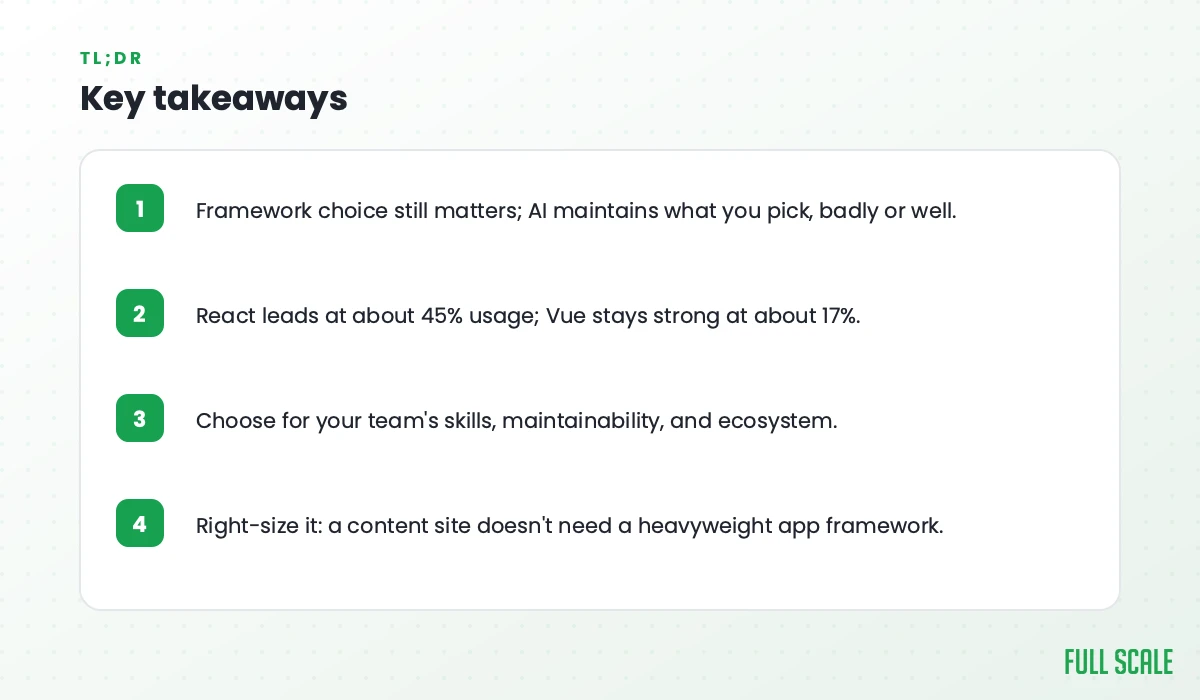
The best JavaScript frameworks list barely changes year over year. The framework matters less than the team behind it. But in 2026, picking one that works with your AI tooling instead of against it is the first filter, not the last.
If you need senior JavaScript engineers who’ve shipped production code across all of these frameworks, talk to us.