
Soft Skills for Developers: Why Communication, Curiosity, and Courage Beat Raw Coding Talent

In this article
- Coding used to be the hard part. AI made it the easy part.
- What soft skills for developers actually means now
- The Three C’s: communication, curiosity, and courage
- Empathy for the user is the soft skill everyone forgets
- The soft skills hiring leaders should actually look for
- How we screen for soft skills at Full Scale
- Hire developers who can do the human half of the job
- Frequently asked questions
Quick Answer: The soft skills for developers that matter most in 2026 are communication, curiosity, and courage, plus empathy for the people who use what you build. AI now writes a lot of the code, so the human half of the job is what separates a developer who succeeds from one who stalls. When you hire, screen for those skills in a real conversation, not a coding test. These traits rarely show up in a whiteboard round, which is why I rethought interviewing software engineers around real work. For a stack-specific version, our questions to ask an iOS developer turn those traits into interview prompts.
For a long time, hiring a developer meant one question above all others: can this person write good code? Everything else was a tiebreaker. You looked for communication and teamwork the way you looked for someone who showed up on time, nice to have, not the thing you were really buying. On a cross-cultural team, that often shows up as high-context versus low-context communication differences. Communication now carries the heaviest weight of anything we measure, which is what scoring communication in an interview looks like in practice.
That order is now backwards. AI writes the code. What it can’t do is understand the problem, decide what’s worth building, or sit in a room full of people who disagree and find the way forward. That part is still all human, and it’s the part that decides whether your team ships something customers actually want. It’s also what separates a developer from an engineer now that AI handles the typing. Those human skills are a big part of what to look for when hiring software engineers today.
So if you’re hiring or evaluating engineers, the soft skills for developers you screen for are no longer a tiebreaker. On most teams I see, they’re the whole game. I’ve hired more than 350 engineers at Full Scale, and the ones who work out are almost never the ones who aced a coding quiz. They’re the ones who ask good questions and care about the answer.
This is the case for weighting software engineer soft skills the way the job now demands, and the specific ones worth looking for. For a front-end hire in particular, here are the front-end developer skills worth screening for. Then turn those traits into front-end interview questions that test judgment.
Coding used to be the hard part. AI made it the easy part.
Start with what changed, because it’s the reason any of this matters.
Most developers now use AI every day. The 2025 Stack Overflow Developer Survey found that 84% of developers use or plan to use AI tools, and 51% of professionals use them daily. On a lot of teams, including ours, nobody sits and writes boilerplate by hand the way they did five years ago. The machine does the typing.
That doesn’t mean the job got easier. It means the hard part moved. The same survey found that 46% of developers don’t trust the accuracy of AI output, and the most common complaint is code that’s almost right but not quite. Catching “almost right” takes judgment. Judgment takes a person who understands the problem deeply enough to know when the answer is wrong.
The skill you’re hiring for now is knowing what to build and spotting when the machine got it wrong.
I’ve said for a while that pure coders will be replaced by AI, and problem solvers will run technology organizations. That’s playing out faster than I expected. The mechanical part of the job, the part a coding test measured, is the part that got automated first. What’s left is the part the test never measured. We wrote a whole piece on why the old coding-test approach to assessment fell apart for exactly this reason.
What soft skills for developers actually means now
Soft skills are the non-technical abilities that decide how well someone works with other people and with hard problems. For a software developer, that’s communication, problem-solving, adaptability, collaboration, accountability, and the curiosity to keep learning when the ground keeps moving.
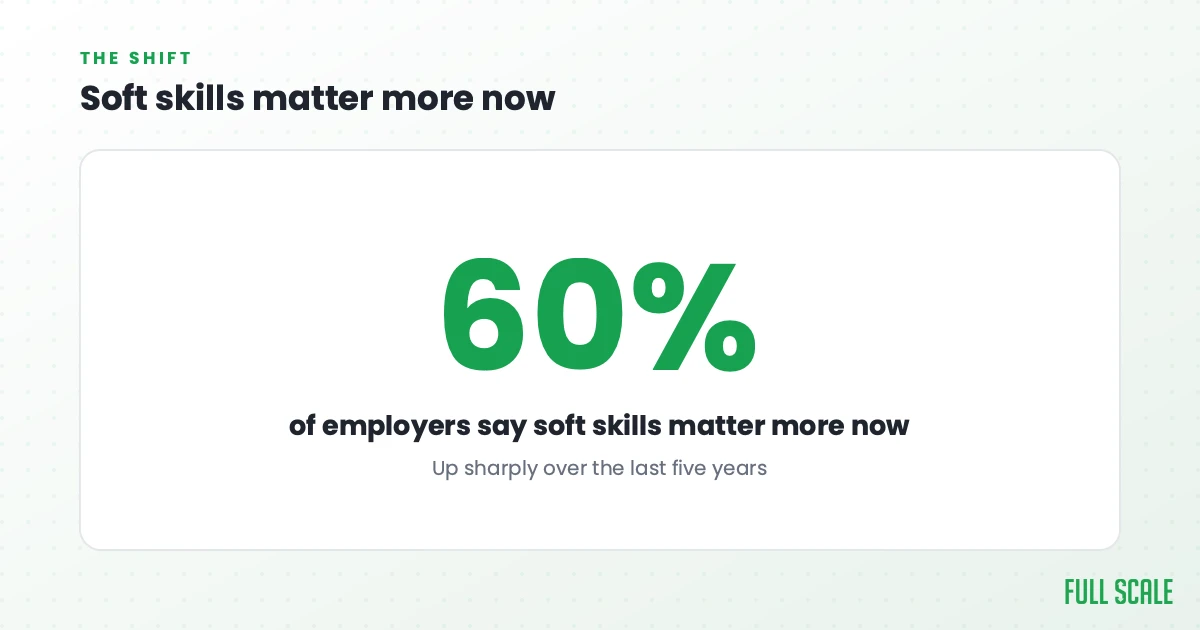
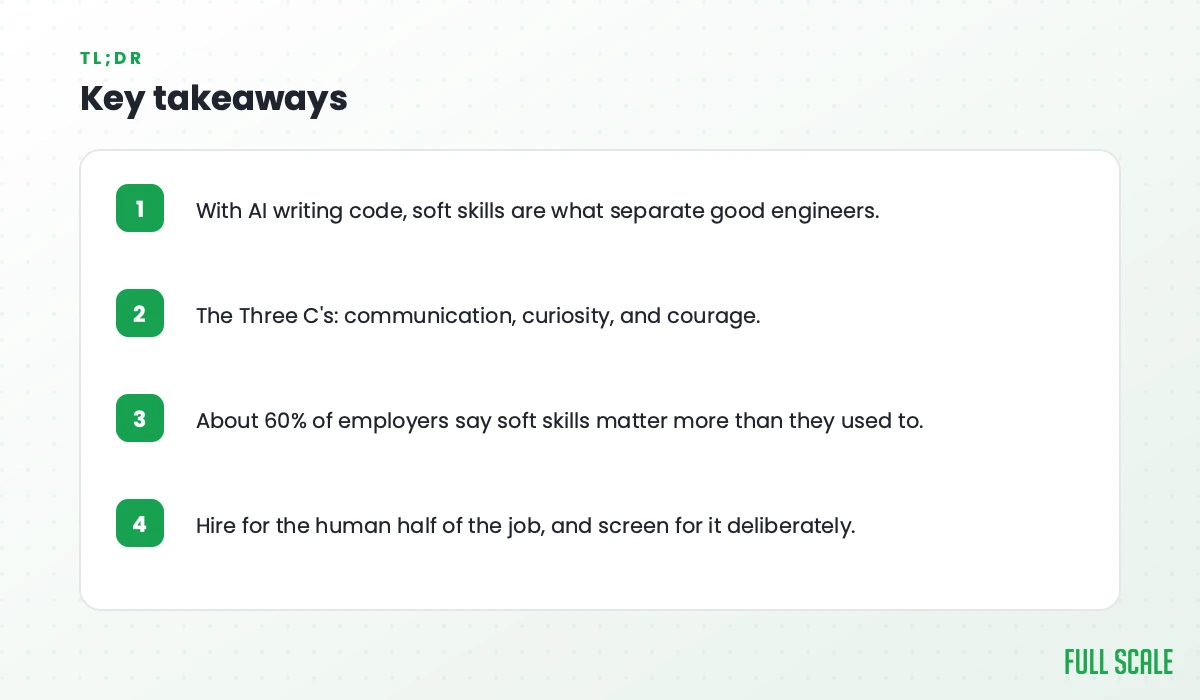
The market caught up to this. About 60% of employers now say soft skills matter more than they did five years ago, according to recent research covered by Harvard Business Review, and communication is the single most requested skill across millions of job postings. Hiring managers heading into 2026 again put communication and problem-solving near the top of the list, ahead of any one technical tool. For developers the shift is sharper than for most roles, because the technical half of their job is the half AI absorbed.
Here’s the reframe that matters for hiring. Software developer soft skills used to be how you broke a tie between two strong coders. Now they’re how you find the strong developer in the first place, because raw coding output tells you less than it ever has.
The Three C’s: communication, curiosity, and courage
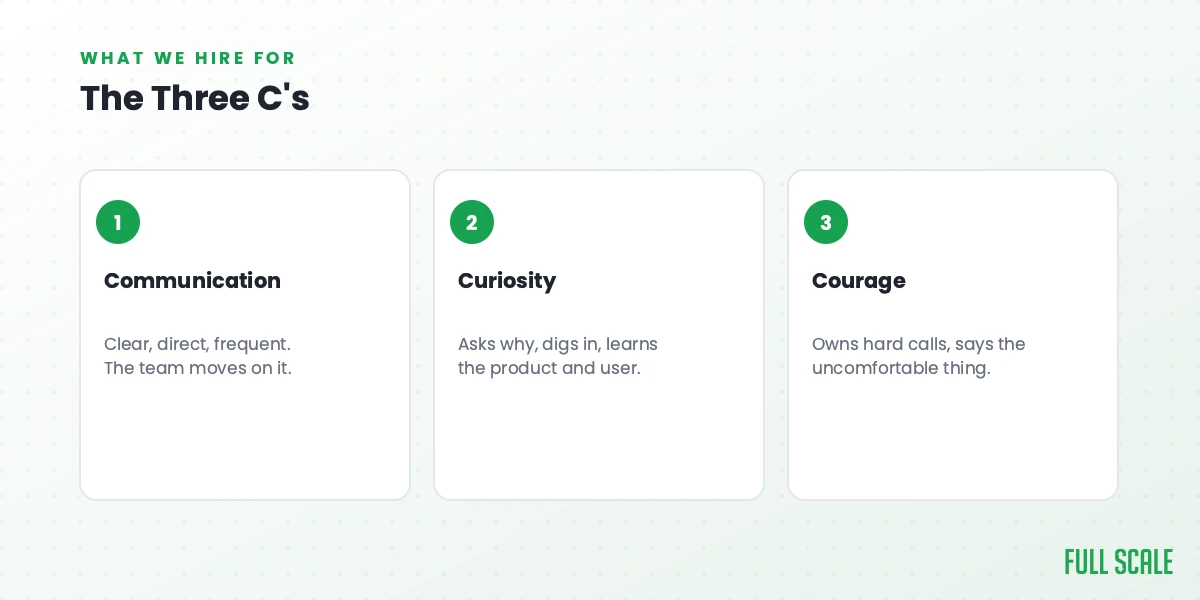
When people ask me what actually decides whether a developer succeeds now, I give them three words. Communication, curiosity, and courage. It’s the same argument I make at length in my book, Product Driven: the hard part was never the code. These are the human skills that hold up once the machine handles the typing.
Communication is the one we screen for hardest
Software development is about communication more than anything else. I mean that almost literally. A developer now has to understand a fuzzy problem, ask the questions that make it less fuzzy, explain a tradeoff to someone non-technical, and write things down so the next person can follow them.
We screen for this harder than anything else when we place a developer. It’s the first thing we look for and the thing we’re least willing to compromise on. A developer who writes beautiful code but can’t tell you why they made a choice, or won’t say so when a spec doesn’t make sense, will cost you more than they save. That’s true for in-house teams and it’s doubly true on a distributed one, where you can’t lean over a desk to clear up a misunderstanding. The same clarity is what separates a forgettable performance write-up from a self review that actually influences a promotion.
A developer who won’t speak up when the requirement is wrong will quietly build the wrong thing.
Curiosity is how a developer survives the next five years
This is the one I push hardest with our own engineers. My message to them is simple: as long as you stay curious, you’ll be fine. Be curious about how AI is changing your job, and curious about how to use it well. If you stay curious, you’ll adapt. If you’re not curious, this career is going to be hard, because it never stops changing.
When I’m evaluating someone, curiosity is the easiest of the three to test and the hardest to fake. Ask how they’re using AI in their own work right now. Ask what they changed their mind about recently. A curious developer lights up. An incurious one gives you a flat answer and moves on. That gap tells you who’s going to grow with the role and who’s going to be doing the same thing, the same way, two years from now.
Courage is what makes the other two useful
Courage is one of the five pillars in Product Driven, and it’s the one that makes communication and curiosity actually pay off. A developer can know the requirement is wrong and stay quiet. A developer can be curious and never push the idea into a room where it might get shot down. Courage is the psychological safety to speak up, push back, and ask why, even when it’s uncomfortable.
You can’t fully interview for courage, but you can build for it. The teams that get the most out of their engineers are the ones where it’s safe to disagree. If you want developers who tell you the hard truth early, when it’s cheap to fix, you have to make it safe to do that. The reward is a team that catches mistakes before they ship instead of after.
Empathy for the user is the soft skill everyone forgets
There’s one more that almost never makes these lists, and I think it’s one of the most undervalued: empathy for the person who uses what you build.
A developer with empathy cares whether the thing actually works for someone. They care when it doesn’t, and they care when it does. They’re not just closing tickets, they’re asking whether the feature solves the real problem the customer had. That instinct is what turns a competent coder into someone who builds products people want.
This connects to something I believe about engineering generally. Great products come from engineers connected to users and outcomes, not from engineers who treat the spec as the finish line. The job is done when the customer sees value, not when the code ships. A developer who feels that in their gut is rare, and worth a lot.
The soft skills hiring leaders should actually look for
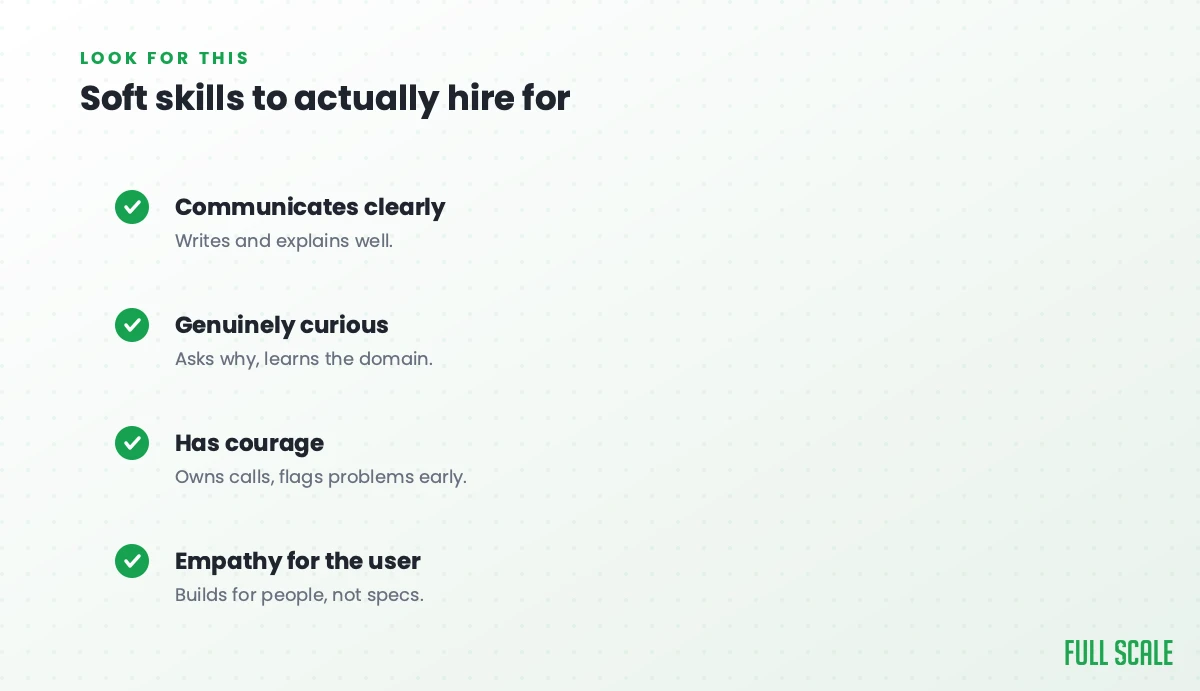
Pulling it together, here’s what to weight when you evaluate a developer, why each one matters more now than it did, and how it shows up in an interview. Employers across every field now name problem-solving, teamwork, and communication as the skills they most want, which maps almost exactly onto the non-technical half of a developer’s job.
| Soft skill | Why it matters more in the AI era | How to spot it |
|---|---|---|
| Communication | The job is now understanding and explaining problems, not just coding | Ask them to explain a past technical decision to you as if you weren’t technical |
| Curiosity | The role changes constantly; AI tooling changes monthly | Ask how they’re using AI today and what they changed their mind about recently |
| Courage | Someone has to say the requirement is wrong before it ships | Ask about a time they pushed back on a boss or a spec, and what happened |
| Empathy for users | AI builds features; humans decide if they’re worth building | Ask what problem their last project solved and whether it actually solved it |
| Problem-solving | Catching “almost right” AI output takes real reasoning | Walk through a messy, ambiguous problem and watch how they think, not what they recall |
| Adaptability | Tools, stacks, and expectations keep shifting | Ask how they handled a project where the requirements changed midstream |
| Collaboration | Delivery is cross-functional; AI doesn’t sit in a standup or settle a disagreement | Ask how they worked through a conflict with a teammate or another team |
| Time management | More of the process lands on each person, so there’s more to juggle | Ask how they decide what to work on first when everything feels urgent |
The last two are table stakes. Every list of developer soft skills mentions teamwork and time management, and they still matter, a developer who can’t prioritize or work with the people around them will struggle no matter how the job changes. I put them lower because they’re the cost of entry, not the deciding signal. The Three C’s and empathy are where the real difference between a good hire and a great one shows up now.
Notice what’s not on the list: how many algorithms they’ve memorized, or how fast they type. Those mattered when code was the bottleneck. The bottleneck moved. If you want a deeper read on how seniority actually shows up, we broke down the difference between junior, mid-level, and senior developers along these same lines, and how to map skills formally with an engineering competency matrix.
One honest objection before we go further. Soft skills sound unmeasurable next to a coding score you can rank on a leaderboard. That’s exactly backwards now. The coding score is precise and nearly useless, because AI can ace it and so can a candidate with a second browser tab. Communication, judgment, and curiosity feel fuzzy only because most hiring processes never actually test for them. Run a real conversation about a real problem and they’re not fuzzy at all. You can hear them in minutes.
How we screen for soft skills at Full Scale
We put our money where this argument is. When we assess a developer before placing them on a client team, we don’t lead with a coding gauntlet. We review the resume like humans, then we have real conversations focused on problem-solving and communication. The whole point is to find good developers, and a process built around a timed coding test scares off the good senior ones while rewarding whoever is best at gaming the test.
The result of reading people this way shows up in the number that matters to us most. Our developer retention sits at 93%. You only get a number like that when you screen for the things that actually predict whether someone will thrive on a team, instead of the things that are easy to auto-grade. Every developer we put on a client team has already cleared this process. That’s the core of our staff augmentation model: you get a pre-vetted team instead of hiring blind, and you can read the full approach in how we run our developer hiring process.
If you’re building the team yourself, the takeaway is the same. Spend your interview time on a real conversation, not a test a machine can ace. The soft skills are what you’re hiring for now, so make the interview the place you actually find them.
Hire developers who can do the human half of the job
The job changed. The way most companies hire hasn’t caught up. They’re still screening for the part AI does best and treating the part that actually decides success as a nice-to-have.
Get the soft skills right and the rest of the team gets easier. Communication, curiosity, courage, and empathy for the user are the difference between a developer who builds what you meant and one who builds what you literally said. That’s the whole game now.
If you’d rather start with developers who’ve already been screened for exactly these skills, let’s talk.
Frequently asked questions
What are the most important soft skills for developers?
Communication, curiosity, and courage are the three that matter most, along with empathy for the people who use what you build. These decide how well a developer understands a problem, adapts to constant change, speaks up when something is wrong, and cares whether the result actually works. As AI handles more of the coding, these human skills carry most of the weight in whether a developer succeeds.
Why are soft skills for developers more important than they used to be?
Because AI now writes much of the code. Around 84% of developers use AI tools, so raw coding speed is no longer the scarce skill. What’s scarce is the ability to understand a problem, judge whether AI output is correct, and work with other people to decide what to build. Those are all soft skills, which is why roughly 60% of employers now say they matter more than they did five years ago.
Are soft skills more important than technical skills for software engineers?
Not more important, but no longer secondary either. Technical depth still matters, but it now shows up as judgment, the choices a developer makes on a messy problem, rather than as how fast they can write code. The strongest software engineers pair real technical understanding with communication, curiosity, and courage. You hire for both, but you can no longer treat the soft skills as a tiebreaker.
How do you assess soft skills for software developers when hiring?
Through real conversation rather than a coding test. Ask a developer to explain a past technical decision in plain language, describe how they’re using AI today, and talk through a messy problem out loud. Watch how they reason and how they handle being pushed. A timed coding test measures the one thing AI already does well and tells you almost nothing about the skills that now matter most.
Can soft skills be learned, or do developers either have them or not?
They can be learned, but they’re built through practice and environment more than training. Curiosity grows when a developer is encouraged to explore. Courage grows on a team where it’s safe to disagree. Communication improves with feedback and reps. The leader’s job is to build the conditions where these skills develop, then hire people who already show the instinct for them.
Pure coders will be replaced by AI. Problem solvers will run technology organizations. Hire for the second kind.