
Fintech App Development Cost in 2026: The Build, the Compliance, and the Gap Between Them

In this article
- Fintech app development cost is two budgets
- What the build costs in developer-months
- What compliance adds, line by line
- Most of the compliance bill is developer time
- The architecture choice that moves the number most
- What recurs after launch
- Why a cheap quote is the riskiest one
- Pick the budget by your product
- How Full Scale prices a fintech build
- Frequently asked questions
- Split your fintech budget in two
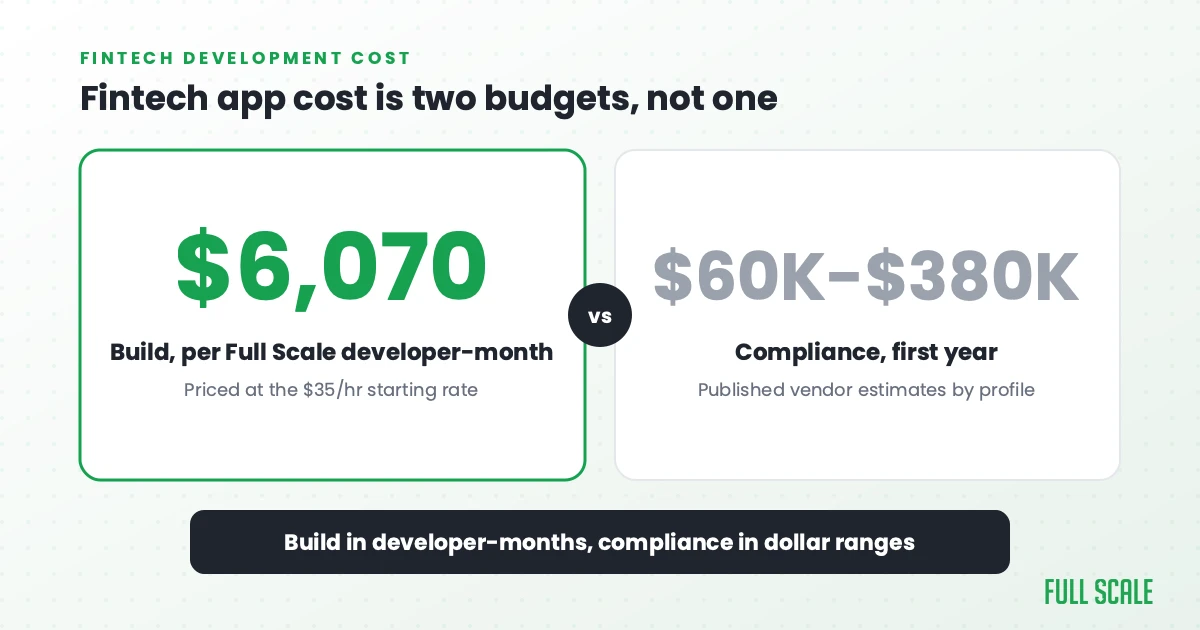
Quick Answer: Fintech app development cost is two budgets, not one. The build is a team times a number of months, and a Full Scale developer-month starts at about $6,070. Compliance is a second line stacked on top, and published 2026 vendor estimates put it at roughly $60,000 to $130,000 in year one for a payment app and $180,000 to $380,000 for a neobank. Budget them separately.
Many articles about fintech costs list a single range with a disclaimer stating the final cost varies depending on many factors. The final cost definitely varies based on several factors, but there are two primary ones that aren't necessarily related: the size of the product and the amount of compliance.
I'm not a lawyer, nor an auditor, so consider anything I write here as cost planning rather than legal or compliance advice. It's up to your auditor, your acquirer, and your legal counsel to determine what applies to you. However, I can provide guidance on pricing the portion involving development work.
Fintech app development cost is two budgets
Build budget is what it costs to build the thing, measured in developer-months. Compliance budget is what it costs to prove it's safe to hold other people's money, measured in audit fees, software, and additional engineering. Blending them in a fintech cost guide obscures the most important number for any given project.
| Budget | What it covers | Price unit | Where the number comes from |
|---|---|---|---|
| Build | Product features, integrations, ledgering, the app itself | Developer-months | About $6,070 per Full Scale developer-month at the $35-an-hour starting rate |
| Compliance, year one | SOC 2, PCI DSS, KYC and AML controls, audits | Dollar ranges by profile | Published 2026 vendor estimates, quoted below |
| Compliance, recurring | Annual audits, monitoring, re-certification | A share of year one | One vendor puts it at 40 to 60% of the first-year cost |
The build row converts easily since developers are paid by the month. But the compliance rows aren't since they include a mix of audit bills and engineering effort. That mixed bag is where the more interesting question lies, so let's separate it out.
What the build costs in developer-months
A fintech build costs a team times a number of months. Four developers for six months cost about $145,600 with Full Scale's $35-an-hour starting rate, compared with about $388,500 for the same US-based team using Bureau of Labor Statistics (BLS) median salaries, fully loaded.
Using the BLS median software developer salary of $135,980, grossed up because wages are 70% of what private employers spend, lands near $16,200/month per developer, vs. $6,070/month at Full Scale. One developer-month is about 173 hours.
| Team shape (illustrative) | Developer-months | Full Scale dedicated team at $35/hr | US employees, fully loaded at the BLS median |
|---|---|---|---|
| 3 developers for 4 months | 12 | About $72,800 | About $194,300 |
| 4 developers for 6 months | 24 | About $145,600 | About $388,500 |
| 6 developers for 9 months | 54 | About $327,600 | About $874,200 |
| 6 developers for 12 months | 72 | About $436,800 | About $1,165,500 |
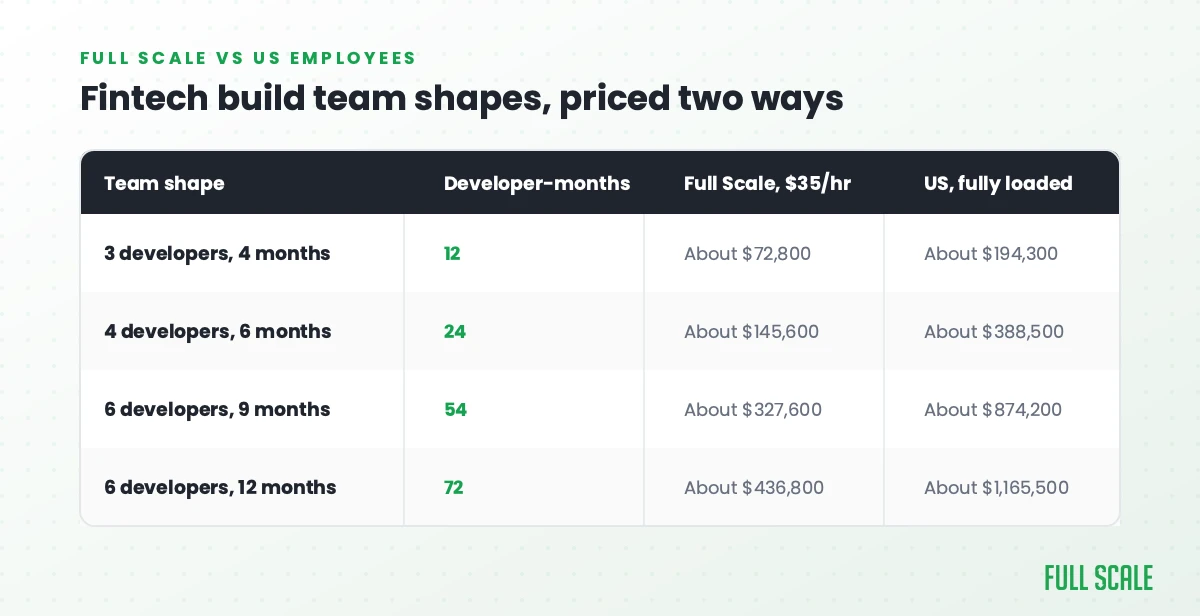
These shapes price developers only, and your scope sets your actual team. You will pay more than the starting rate if you want a senior-heavy team. And even then, the savings Full Scale clients see against a US-based team will usually fall between 50 to 70%. To learn more about custom development cost estimates, read our guide on custom software development cost. To explore mobile application development cost, check out our article on mobile app development cost.
What compliance adds, line by line
Compliance costs for a fintech product in year one vary from tens of thousands to several hundred thousand, depending on your product's scope. One May 2026 vendor estimate of compliance costs is below, for a selection of common combinations. It's a vendor estimate, and its own tables don't match its introduction. Read the table below as ranges for budgeting.
| Product profile | Compliance scope | First-year estimate (vendor) |
|---|---|---|
| Payment app on a hosted payment page | PCI SAQ A plus KYC and AML | $60,000 to $130,000 |
| Payment platform that handles card data | PCI SAQ D plus SOC 2 Type II plus KYC and AML | $150,000 to $320,000 |
| Neobank | PCI SAQ D plus SOC 2 Type II plus KYC and AML | $180,000 to $380,000 |
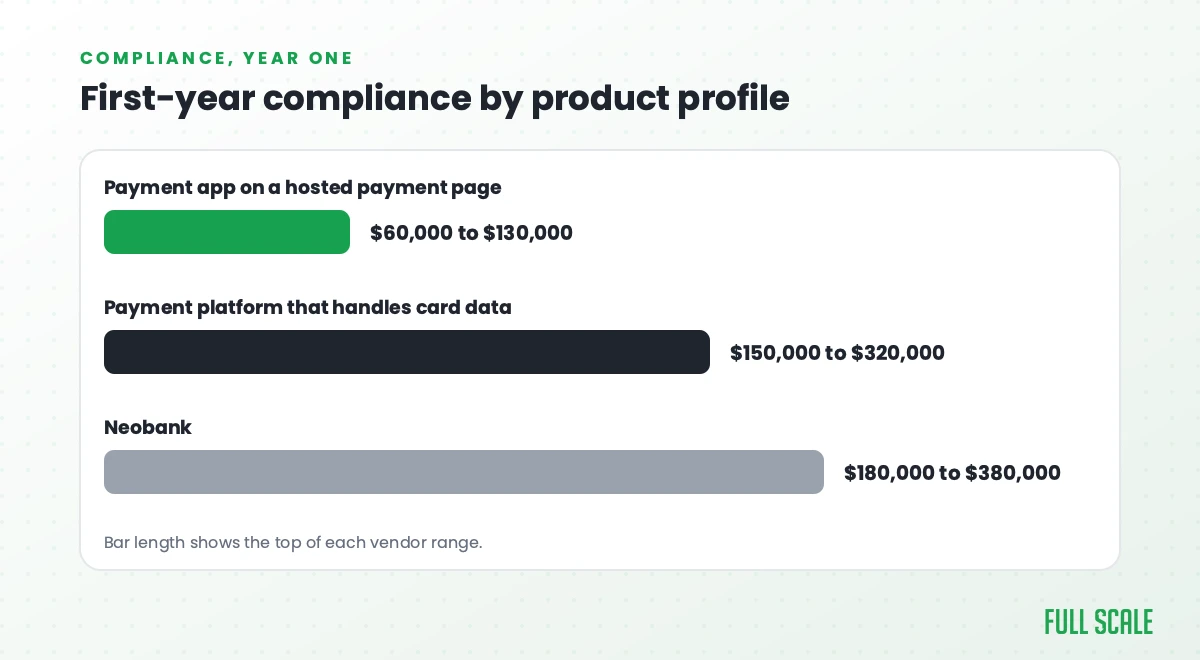
Layered over a build, a project's full first-year picture looks very different. Take a payment app built by four Full Scale developers over six months. That's about $145,600 plus $60,000 to $130,000 of compliance, so roughly $205,600 to $275,600. A neobank team of six for twelve months is about $436,800 plus $180,000 to $380,000, or roughly $616,800 to $816,800. Both of these are illustrative uses of the numbers above, but you can see how compliance makes up 29 to 47% of the first-year total, which is a chunk that a build-only cost guide will never include.
Most of the compliance bill is developer time
Most of the compliance expense is engineering hours, not auditor bills, and engineering hours are where you have control. The same vendor's breakdown of the cost of a first-year SOC 2 Type II for a small company looks like this:
| SOC 2 Type II line (vendor estimate) | Range | In developer-months at $6,070 |
|---|---|---|
| Readiness assessment | $10,000 to $25,000 | Not engineering |
| Control implementation engineering | $15,000 to $40,000 | About 2.5 to 6.6 |
| Audit fee | $15,000 to $50,000 | Not engineering |
| Internal engineering opportunity cost | $20,000 to $60,000 | About 3.3 to 9.9 |
A SOC 2 examination is a CPA's assessment of a service organization's controls, according to the AICPA, so the audit fee is the CPA's bill. The two engineering-related lines together amount to $35,000 to $100,000. By our calculation using the vendor's figures, that's about 5.8 to 16.5 developer-months at Full Scale's starting rate.
The auditor will charge the same if your engineers work in Kansas City or the Philippines. The engineering lines don't.
It's better to be honest than to disguise how much offshore really affects your compliance costs. Offshore reduces the cost of the people who create the controls; it doesn't change the cost of the audit itself. And even then, the potential savings aren't as large as they might appear.
The architecture choice that moves the number most
The primary factor influencing compliance cost is whether your systems will ever have access to card data. There are multiple self-assessment questionnaires within PCI DSS, and which questionnaire you fall under is primarily an architectural decision.
According to a legal summary of PCI Security Standards Council guidance from Davis Wright Tremaine, SAQ A is designed for ecommerce merchants that fully outsource their card processing to a PCI DSS-compliant third party and do not store, process, or transmit card data on their own systems. If a merchant partially outsources, they may not be eligible for SAQ A. Additionally, card network rules apply, so the availability of SAQ A depends on your acquirer. The current standard is on the PCI Security Standards Council site.
Based on the vendor estimate, SAQ A costs between $8,000 and $20,000 in year one, while SAQ D costs between $40,000 and $80,000. You choose between those two ranges during your initial design review, long before any compliance spreadsheet is opened.
Our fintech software development page features engineers with experience building within SOC 2, PCI DSS, and GLBA-regulated environments. The key is adopting compliance as an architectural consideration. A team that does can keep a design in the cheaper column.
Full Scale does not hold its own SOC 2 report, but our dedicated engineers adhere to the SOC 2 requirements of the clients they work with. In other words, you control the relevant compliance rules. For more information on how to assess a vendor's SOC 2 policies, see our blog post on offshore development and SOC 2.
What recurs after launch
But audits are just a milestone, and development isn't finished. One vendor guide says annual compliance costs after year one typically run 40 to 60% of the first-year investment. Using that figure as an estimate, our neobank example would require ongoing annual expenses ranging from $72,000–$228,000 plus developer time to implement necessary changes when standards update or auditors spot a gap. Again, we've used the vendor's guideline to calculate this figure, so please use it as an approximation and not a binding estimate.
This is the strongest argument for a team that stays. When an auditor asks why a particular control functions in a specific way, it takes a team member one minute to explain it; with a rotating crew, it takes a week, and they bill for the week.
Why a cheap quote is the riskiest one
A small fintech quote often reflects a small team or a compliance requirement no one valued. A developer who doesn't ask what happens to the card number isn't saving you money. I refer to single-price hiring as cheapshoring, and fintech is where it's most dangerous, since a rounding mistake can trigger a refund and a missing record can trigger an audit.
To make a fintech quote comparable, ask four questions:
- How many FTEs on my product, and for how long?
- Which compliance framework does this quote include, and who will pay for the auditor?
- Does card data touch my systems in this design?
- What is excluded from this quote?
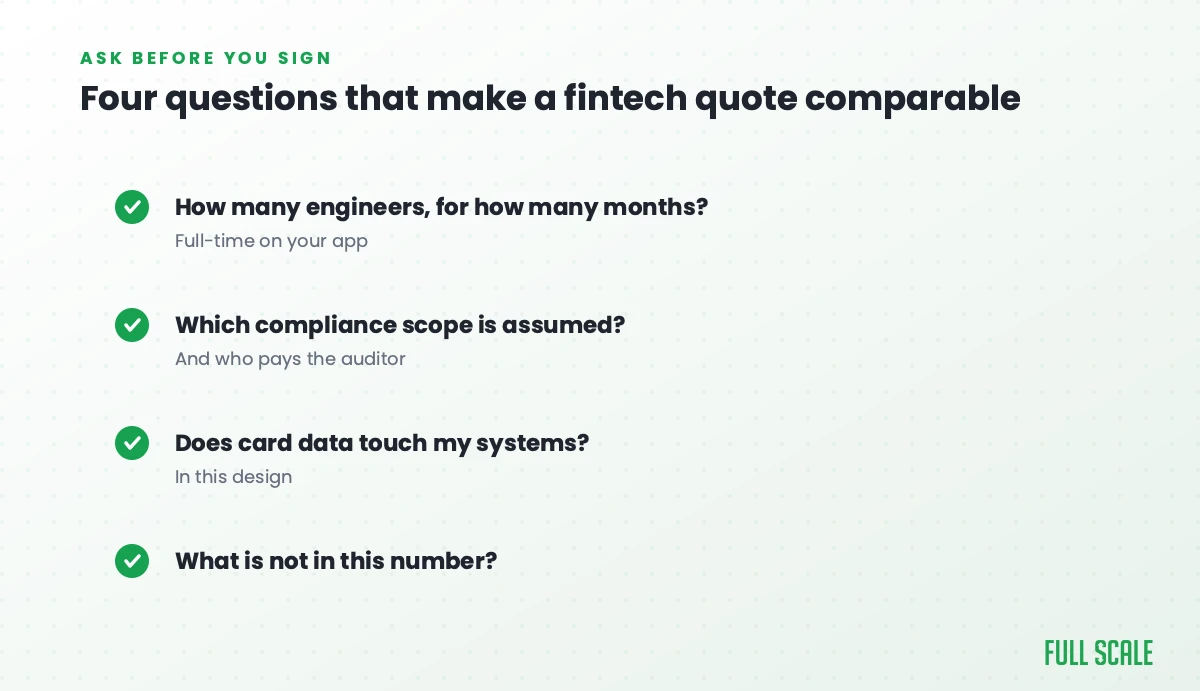
If they can't give you clear answers to the first two in one breath, they're quoting a guess.
Pick the budget by your product
The budget will depend on your product profile. My reading of the figures above is as follows:
| Your product | Budget that dominates | What to do first |
|---|---|---|
| Payment feature inside an existing app | Build, with light compliance | Use hosted payment fields and price a small team |
| Standalone payment or lending product | Build and compliance about equally | Scope compliance before the team, then size the team |
| Neobank or anything holding balances | Compliance and recurring costs | Plan the recurring 40 to 60% from day one |
| Experiment with no real money yet | Neither | Prototype first, see MVP development cost |
How Full Scale prices a fintech build
Full Scale places dedicated engineers from across the Philippines onto your team via staff augmentation, starting at $35 an hour fully loaded. Your final hourly cost varies by seniority, competency, and team size, but you can see exactly how we calculate it on our pricing page. Each engineer works for one client, and work can start in as little as 7 days.
If it isn't working out in the first two weeks, you get your money back. Afterwards, you can drop a developer on 30 days' notice, no long-term commitment involved, as I explain in when it isn't working out. Our engineers are trained on the ideas in my book, Product Driven.
Frequently asked questions
How much does it cost to build a fintech app?
Treat it as two budgets. The build is a team times a number of months, and at Full Scale's $35-an-hour starting rate one developer-month is about $6,070, so four developers for six months is about $145,600. Compliance sits on top of that: published 2026 vendor estimates put first-year compliance at roughly $60,000 to $130,000 for a payment app and $180,000 to $380,000 for a neobank.
How much does SOC 2 compliance cost for a fintech startup?
One 2026 vendor guide estimates $60,000 to $150,000 in the first year for a startup, covering a readiness assessment, control implementation, the audit fee, and internal engineering time, then $25,000 to $60,000 a year after that. The audit fee is only part of the number, and engineering time is a large share. Your auditor, not a blog post, decides what applies to you.
Does PCI DSS compliance add to fintech app development cost?
Yes, and the architecture decides how much. If a PCI-validated provider hosts the payment page and card data never touches your systems, you may qualify for the lightest questionnaire, SAQ A. If card data touches your environment you are in SAQ D territory. One vendor estimate puts first-year cost at $8,000 to $20,000 for the first and $40,000 to $80,000 for the second.
Is it cheaper to build a fintech app with an offshore team?
It is cheaper for the engineering share of the bill, which is most of it. A dedicated Full Scale developer starts at $35 an hour, about 62% below a US employee at the BLS median salary, and clients typically save 50 to 70%. Audit fees and compliance software cost the same wherever your engineers sit, so the savings apply to the build and the engineering hours inside compliance.
How much does it cost to maintain a fintech app?
Plan for recurring compliance costs plus ordinary maintenance. One 2026 vendor guide says annual compliance costs after year one typically run 40 to 60 percent of the first-year investment. Developer time for fixes, regulatory changes, and integrations comes on top, and a common but unsourced rule of thumb for that is 15 to 20 percent of the build per year.
Split your fintech budget in two
Figure out how many developer months the build number will buy you by dividing it by $6,070. Then ask whoever's quoting for compliance about how much that's going to cost.
If you're going to be staffing the build, tell us what you're building, and we'll give you a price for the engineering based on your specific scope. The advice from compliance is going to come from your auditor and counsel.