
The Software Engineer Mentor Playbook That Keeps Engineers From Quitting


In this article
- Mentorship is a retention lever, not a nice-to-have
- The part most leaders overlook: the mentor grows too
- How we run mentorship at Full Scale
- Mentoring a distributed or offshore team
- What good mentorship looks like week to week
- The leader’s checklist for standing this up
- Why this matters more every year
- Frequently asked questions
You can’t out-pay the market for senior engineers. Somebody bigger will always offer more money, more equity, or a shinier logo. So if comp is the only thing keeping your best people in their seats, you’re going to lose some of them, and you’ll lose the ones you can least afford to lose.
Here’s what actually keeps a good engineer around.
They’re still getting better at their job.
The day an engineer stops growing is the day they start reading recruiter messages. I’ve watched this happen at every company I’ve run, going back to when I was a CTO and didn’t understand it yet. A foosball table or another raise won’t fix it. What does is a software engineer mentor who makes the work feel like it’s going somewhere.
Most articles on this topic treat mentorship as a personal skill, a list of ten nice things you should do for a junior dev. Fair enough as far as it goes, but it misses the part that matters if you run a team. Mentorship is one of the cheapest retention tools you have, and most leaders never set it up on purpose. This is the version of the topic I wish someone had handed me earlier: how to build mentorship into how your team works, not how to be a slightly warmer person in a one-on-one.
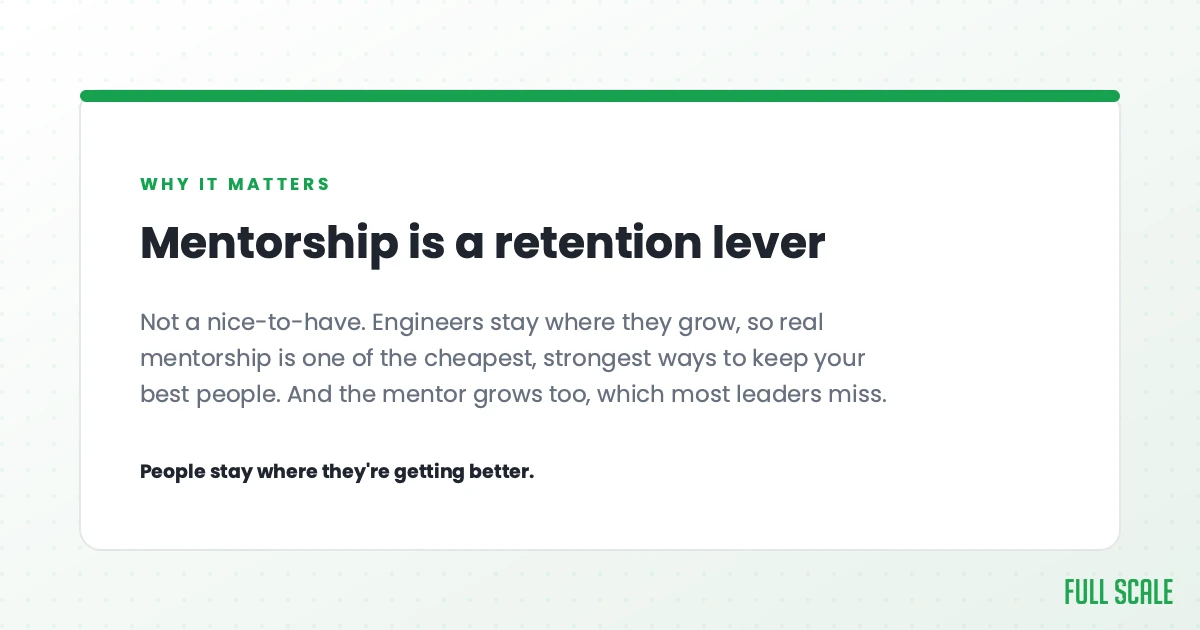
Mentorship is a retention lever, not a nice-to-have
Start with the math, because the math is brutal. Gallup puts the cost of replacing an employee at one-half to twice their annual salary. For a senior engineer that’s a six-figure hole every time one walks, and that’s before you count the half-finished work, the context that leaves with them, and the months the replacement needs to get useful.
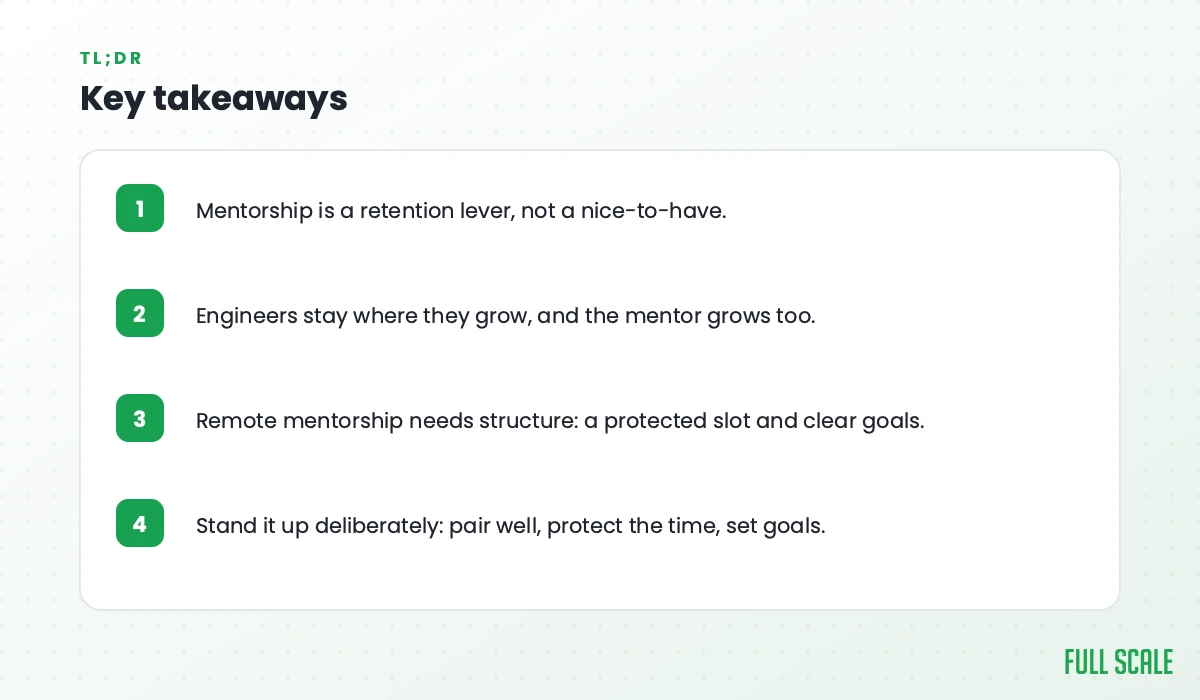
Now look at the other side. Corporate mentoring studies keep finding the same thing: people with a mentor stay far longer than people without one. The logic is simple. People who keep learning stay engaged, and engaged engineers rarely go looking for a new job. A mentor is the most direct way to make sure an engineer is still learning six months from now. The same is true at the top: there’s a strong case for a mentor for founders, not just for junior engineers.
We see this inside Full Scale. Our developer retention runs over 93 percent a year, in a part of the world where the contact-center industry next door loses a third or more of its people annually. When people ask how we hold onto engineers, the honest answer is a few boring things done consistently, and mentoring is one of the biggest. It’s also why our team is certified as a great place to work two years running, with 95 percent of employees saying so versus 65 percent at a typical company.
The flip side is just as real. An engineer who feels stuck doesn’t usually announce it. They quietly disengage, do the minimum, and start interviewing, and by the time you notice, you’re already managing burnout you could have caught earlier. A good mentor is an early-warning system you don’t have to staff. They notice the slump before you do, because they’re the one person talking to that engineer about the work every week.
If you only take one idea from this, take that one.
A mentorship habit is a retention strategy that costs you almost nothing and pays you back in people who stay.
The part most leaders overlook: the mentor grows too
When companies think about mentorship, they picture the junior dev getting better. True, but it’s only half the story, and the half everyone skips is the one that should sell you on the idea.
Everyone needs a mentor to learn from. What we forget is how much the mentor learns by doing the mentoring.
Teaching forces you to actually understand the thing. A senior engineer who can write the code but can’t explain why finds the gaps in their own thinking the first time a mentee asks “but why do we do it that way?” Explaining a decision out loud is how you find out whether you understood it or just memorized it. Your strongest engineers get sharper at communication, at judgment, at seeing the system instead of the ticket, and those are exactly the skills that move someone from senior toward staff and lead.
So mentorship pays you twice. The junior dev levels up, and so does the senior who’s climbing toward the next title. Gergely Orosz, who writes The Pragmatic Engineer, makes the same point from his years at Uber: the engineers who mentor are usually the ones who keep growing the fastest. Here’s the part that should matter to you as a leader. Software engineer mentorship is the rare retention lever that works on two people at once, because the junior grows and so does the senior you’d most hate to lose. No raise buys you both.
How we run mentorship at Full Scale
I’ll be straight about how this works for us, because it’s less of a program than people expect.
We don’t assign mentors with a spreadsheet and a mandate. People raise their hand and offer to mentor, and then we work to get other engineers into a rotation with them. It stays mostly informal. The point is to make mentoring a normal thing that happens instead of a box someone checks for a performance review. When the review does come around, that mentoring is exactly what an engineer should put in their self review.
Here’s a concrete one. Years ago at VinSolutions, I hired Brian Kellogg onto our support team. He turned out to be one of the best I have ever seen at diagnosing the weird, hard-to-reproduce issues in our software. Instead of leaving him in that seat, we gave him room to grow. He climbed from support to level-two support, then to junior developer, and then to senior developer, and he later went on to co-found VinCue, an automotive software company I backed early. None of that happens if you treat a support hire as a fixed cost. It happens because someone hands a person the next rung and backs them while they climb, and that is the whole point of mentoring engineers instead of just managing them.
That looseness is on purpose. The heavy, formal programs I’ve seen usually collapse under their own process. The forms pile up, the monthly check-ins turn into a chore, and the goals get set once and never looked at again. What survives is the lightweight version: a willing mentor, a mentee who wants to grow, and the room to let it happen. We back it with the structure that actually helps, like a clear sense of what each level looks like so both people know what “getting better” means in concrete terms. Beyond that, we get out of the way.
The willing-mentor part is everything. A mentor who got volunteered by their boss goes through the motions. Someone who raised their own hand actually cares whether the other person gets better. You can’t fake that, and you can’t mandate it either.
Mentoring a distributed or offshore team
Here’s where it gets harder, and where most of the generic advice falls apart.
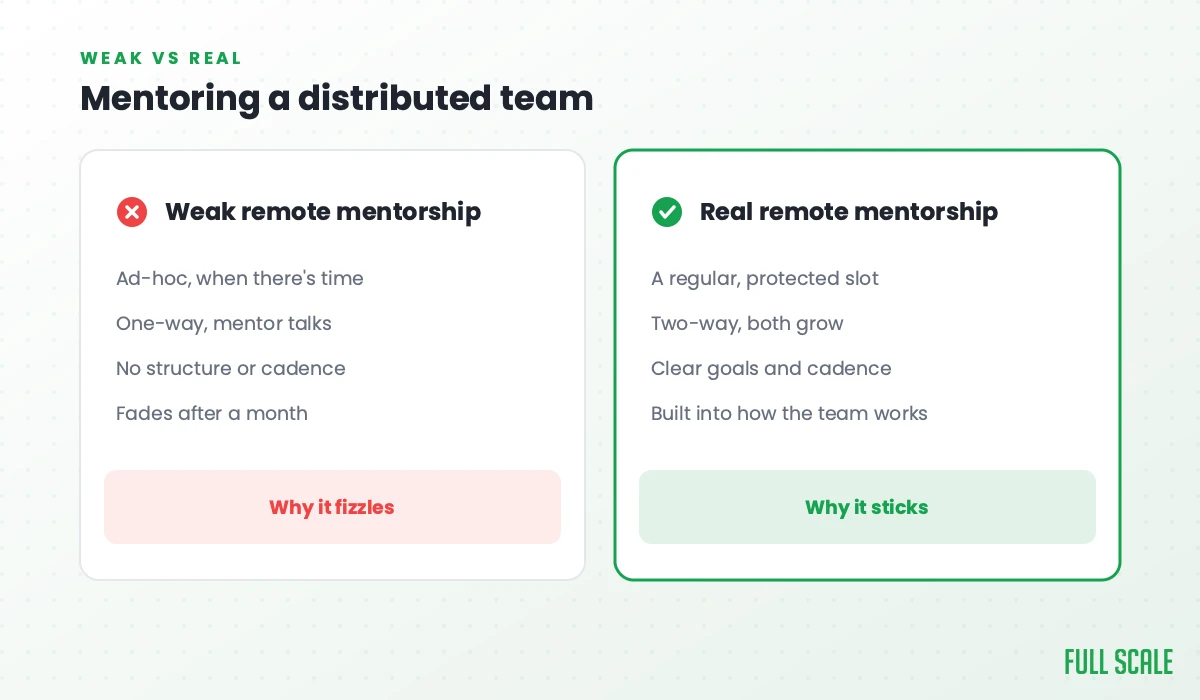
When everyone sits in the same room, a lot of mentoring happens by accident. A junior dev overhears a senior debugging out loud. Someone leans over for a quick question that turns into a twenty-minute lesson. None of that is planned, and none of it survives the move to a remote or offshore team.
So you have to be more purposeful about it. You have to schedule the time, and you have to actually do it.
That sounds obvious, but it’s the thing teams skip. They go distributed, the hallway moments vanish, and nobody replaces them, so the junior engineers just stop getting better and start eyeing the door. The fix is to put mentoring on the calendar like any other commitment: a standing weekly call, code reviews treated as teaching and not just gatekeeping, a shared doc where a mentee brings real problems. The tool barely matters. What matters is deciding the time is worth protecting, then protecting it. There’s more on running a remote team well, but the mentoring piece comes down to deciding it matters and guarding the slot.
This is also where companies who went offshore for the wrong reason get burned. If you hired the cheapest developers you could find and gave them no support, no mentoring, and no path to grow, they’ll churn, and you’ll blame offshore. I call that cheapshoring, and I’ve watched it sink more engagements than bad code ever has. I make the full case in this piece on cheapshoring, so I won’t repeat it here. The short version: an offshore engineer needs the same investment a local one does, and mentoring is a big part of that investment. It’s the difference between staff augmentation that works and a body shop you’ll regret.
What good mentorship looks like week to week
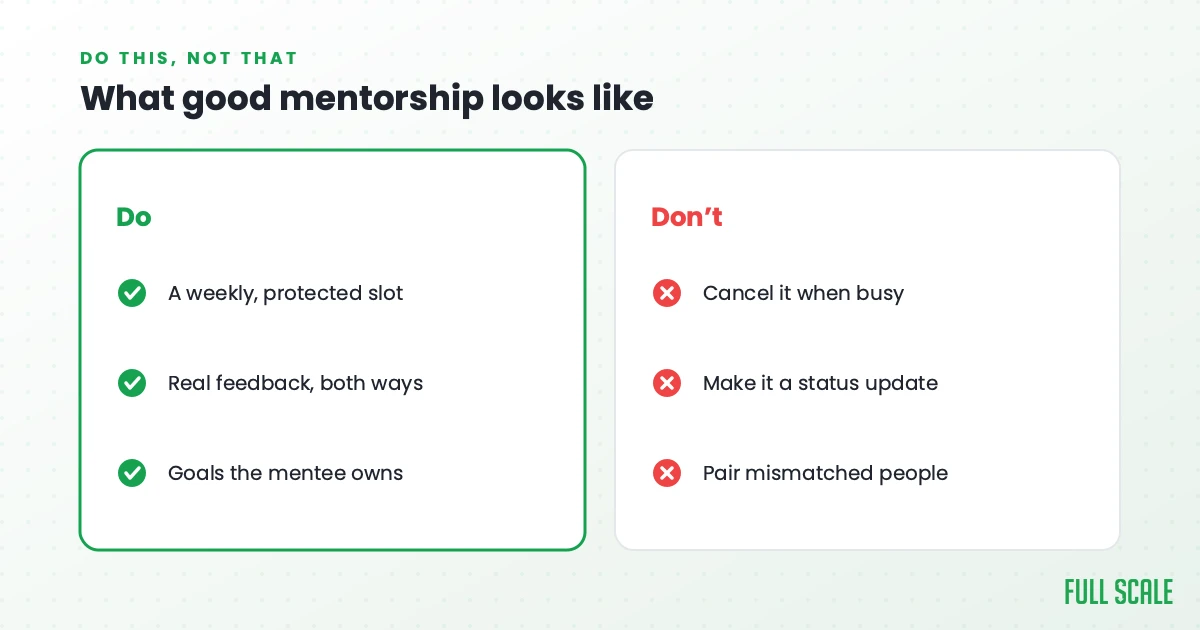
If you’re setting this up, the day-to-day shouldn’t be a mystery. A few things separate mentoring software engineers well from a friendly chat that goes nowhere.
The first is specific feedback. “Write cleaner code” helps no one, but showing what clean code looks like in the pull request in front of you does. The second is the discipline to coach instead of answer. The instinct is to hand over the solution, because it’s faster and you already know it, but the job is to get the engineer to solve it themselves. Ask what they’ve tried and point them at the next question, because they learn nothing watching you type.
Most of this happens in code review, which is the main event whether you plan it that way or not. It’s the most frequent mentoring most engineers ever get, and it costs no extra time because you’re reviewing the code anyway. A review that explains the why behind a suggestion teaches. One that just says “change this” is gatekeeping.
The last piece is curiosity. As AI takes over more of the mechanical parts of writing software, the engineers who thrive will be the ones who stay curious about how the work is changing and where they fit in it. Curiosity is one of the three things I tell our engineers will keep them valuable, alongside communication and courage. A mentor is how that curiosity spreads through a team, one relationship at a time. I wrote a whole book, Product Driven, about building teams that think this way.
The leader’s checklist for standing this up
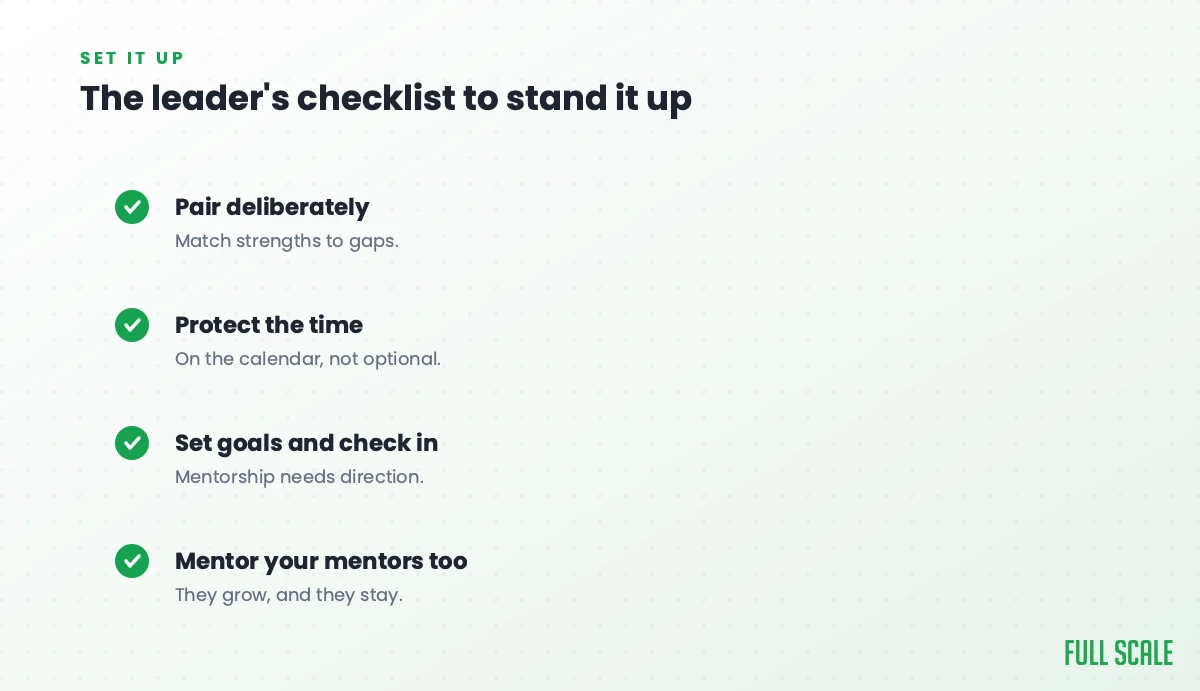
You don’t need a budget or a platform to start. You need to make a few decisions and then defend them.
- Make it opt-in. Ask who wants to mentor and start with the people who say yes.
- Match deliberately. You know your team’s strengths and gaps better than anyone, so pair people where the learning will actually happen, and make the introduction yourself so it carries weight.
- Protect the time. Mentoring takes real hours from your most valuable people, and it returns nothing this sprint. If you treat it as something they’ll fit in around “real work,” it won’t happen.
- Recognize it. Make mentoring part of what it takes to reach senior and beyond. When growing other people is something that gets someone promoted, your best engineers start doing more of it.
- Measure it loosely. You don’t need a dashboard. Are people growing, are they staying, are the mentors energized or drained? That tells you most of what you need to know.
None of this is complicated. It’s just easy to skip, because nothing breaks the day you skip it. The bill comes later, in resignations.
Why this matters more every year
It would be easy to read all this as a soft, people-are-nice argument. It isn’t. As AI changes what the job of an engineer even is, the gap between teams that grow their people and teams that don’t is going to get wider, fast. The mechanical skills are becoming a commodity. Judgment, taste, and the ability to figure out what to build are not, and those are exactly the things you can’t download. They get passed from one engineer to another.
A software engineer mentor is the cheapest, oldest, and most reliable way to make that transfer happen. Set it up on purpose, and you keep your people, you grow them into the seniors you’d otherwise have to go hire, and you build the kind of team nobody wants to leave.
Frequently asked questions
What makes a good software engineer mentor?
A good mentor gives specific feedback tied to real work, coaches instead of handing over answers, and treats code reviews as teaching. More than any technique, they genuinely want the other person to get better. The willingness matters more than the seniority, which is why the best mentors are usually the ones who volunteered rather than the ones who were assigned.
Is mentorship worth a senior engineer’s time?
Yes, and the senior engineer is often the one who gains the most. Teaching forces you to understand your own decisions, sharpens how you communicate, and builds the judgment that moves someone toward staff and lead roles. Mentoring is one of the better ways to keep a strong senior engineer challenged and interested, which is its own retention win.
How do you mentor remote or offshore engineers?
You schedule it. In person, a lot of mentoring happens by accident through overheard conversations and quick desk-side questions, and none of that survives going remote. On a distributed team you have to replace those moments on purpose: a standing weekly call, code reviews used as teaching, and a shared space where the mentee brings real problems. The intention matters more than the tool.
Does mentorship actually improve retention?
It does. Engineers stay when they’re still growing, and a mentor is the most direct way to keep them growing. Research on corporate mentoring consistently shows higher retention among people with a mentor, and it lines up with what we see at Full Scale, where mentoring is one of the reasons developer retention stays above 93 percent. Mentoring sits inside a wider program we call the Spartan Training Academy.
Ready to add senior engineers who stick around? Talk to Full Scale about building a dedicated team you won’t have to keep rebuilding.