
Full Scale Staff Augmentation vs. a Traditional BPO

In this article
- We genuinely don’t compete with traditional BPOs
- Staff Augmentation vs. BPO: Why the Hiring Engines Differ
- A recruiting engine built for one thing
- We’re honestly not great at hiring everything else either
- The training and career system built around software engineers
- Why we don’t chase the BPO business ourselves
- A call center and a software team are two different purchases
- Frequently Asked Questions
Quick Answer: Full Scale isn’t a BPO. Staff augmentation adds engineers who join your team and work under your direction; a BPO takes over a whole business function and runs it for you, priced by process instead of by person. We’ve never actually competed against a traditional BPO like Concentrix or Teleperformance for a client, because hiring software engineers and staffing a call center are different disciplines. If you need dedicated developers who stick around, that’s staff augmentation; if you need an entire function run for you, that’s BPO.
If you called me up and asked me to hire ten people to sell mortgages out of a call center, I’d tell you the truth: I have no idea where you’d even find those people, let alone how to train them to close a deal over the phone. I’ve spent about twenty years hiring software engineers. Mortgage sales is a different planet.
The reverse is just as true, and that’s the part people miss. Hand a traditional call center a mandate to go find ten senior software engineers, and most of them are exactly as lost as I’d be hiring mortgage closers. Specialty cuts both ways.
We genuinely don’t compete with traditional BPOs
I run Full Scale, and since we started the company in 2018, I can’t think of a single deal where we’ve actually competed against a big business process outsourcing (BPO) company for a client. Concentrix and Full Scale have never, as far as I’ve seen, been in the same room pitching the same contract.
When I say BPO here, I mean the classic call-center-first shops: Concentrix, Teleperformance, Foundever, Sutherland. These are companies built around answering phones and running support queues at massive scale. A few of the big outsourcing names, like Accenture or IBM, also run large enterprise IT-consulting arms. That’s a different animal. They compete for big-budget transformation programs, not the kind of dedicated engineering team Full Scale builds. I’m not in that conversation either, just for a different reason than the call-center point above.
I’ve written before about how the Philippine BPO industry got here, and I’ll give it real credit: the Philippine BPO sector overall pulled in about $40 billion in export revenue and employed 1.9 million people in 2025. That’s a hard operational problem, done at a scale most companies never touch. I’ve also laid out which outsourcing companies actually do what, because the famous names on every “top outsourcing companies” list are almost all call centers, whatever the homepage claims.
Full Scale builds dedicated software development teams, not call-center seats or consulting engagements.
Staff Augmentation vs. BPO: Why the Hiring Engines Differ
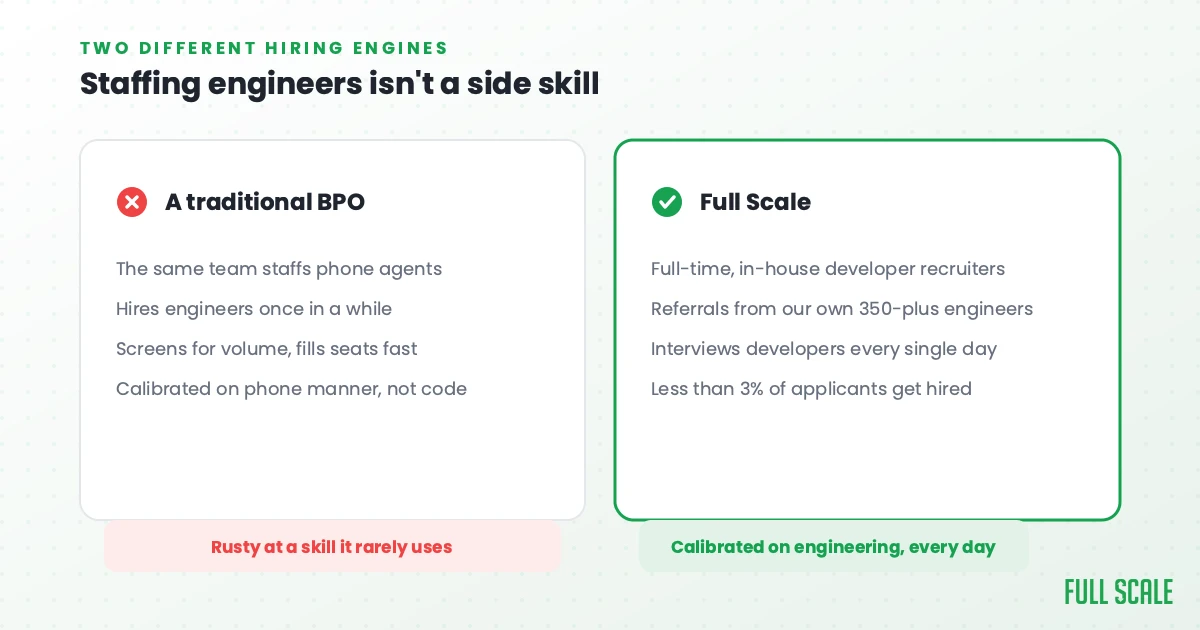
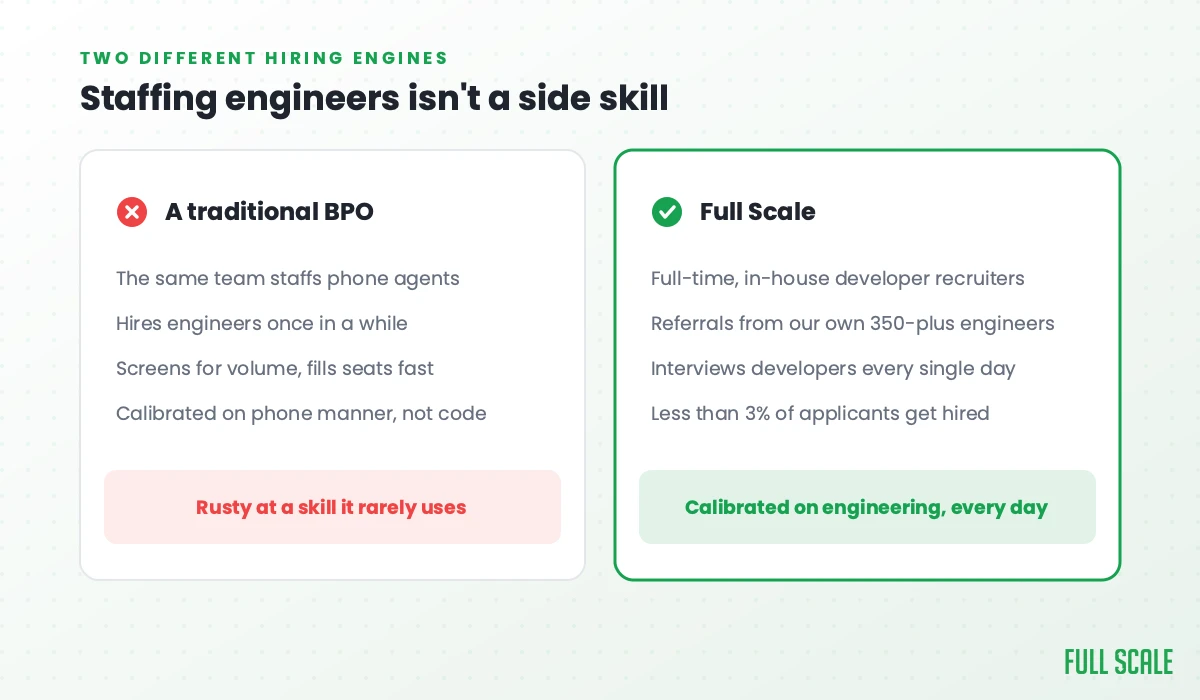
The hiring engines differ because a BPO trains for volume and staff augmentation trains for depth. A BPO that runs call centers hires customer service agents constantly, thousands a month, and they’ve built an entire machine around doing that well. What most of them don’t do every week is interview senior software engineers. Skip a skill for months at a stretch and you get rusty at it, no matter how sharp the rest of the operation runs.
My team talks to developers all day, every day. That’s not a brag, it’s just the job. We know what a good developer looks like because we see hundreds of them, compared side by side, constantly. A BPO’s hiring team, however sharp, is calibrated on customer service skills and phone manner, not on whether someone actually understands database indexing or can explain a tradeoff in a code review. Ask them to suddenly staff software engineers and you’re asking their expertise to do a job it was never built for.
This is the whole case for staff augmentation done right: you need a partner whose daily rep is evaluating engineers, not one who’s great at something adjacent and hoping it transfers.
A recruiting engine built for one thing
Finding developers is basically all we do, and that’s the reason we can even claim to know what good looks like. We run several full-time, in-house recruiters whose entire job is finding software engineers in the Philippines, most of whom already have jobs and aren’t answering a posting. The best developers rarely apply anywhere. You have to go get them, which is exactly why referrals from our own 350-plus engineers matter as much as anything a recruiter does.
Less than 3% of the developers who apply to Full Scale actually get hired.
That number only means anything because of the volume behind it: referrals from our own team and a local reputation that makes people want to work here in the first place keep the applicant pool stacked with people who already have jobs, so we’re picking from the strongest candidates instead of whoever happened to see the listing. A low acceptance rate by itself doesn’t prove anything, though. What actually proves it is whether someone thrives on a team long after they’re hired, which is where our retention number comes in.
A BPO hiring engine is optimized for something completely different: fill a lot of seats, fast, for a role most people can learn in a couple of weeks. Ours is optimized to be picky about a role that took someone years to get good at. Same country, same labor market, completely different machine.
We’re honestly not great at hiring everything else either
Full Scale’s specialty ends outside software engineering. Every once in a while a client asks us to help staff a marketing role, or product support, something adjacent to engineering. We can do it, and we do a decent job. It is not our specialty, and I won’t pretend otherwise. If you need us for that once in a while, we’ll help. If you need a company that hires that kind of role as its main business, go find one that actually specializes in it.
That’s the same honesty I’d want from anyone selling me something.
We’re excellent at one very specific thing. We’re just okay at the stuff next door to it.
The training and career system built around software engineers
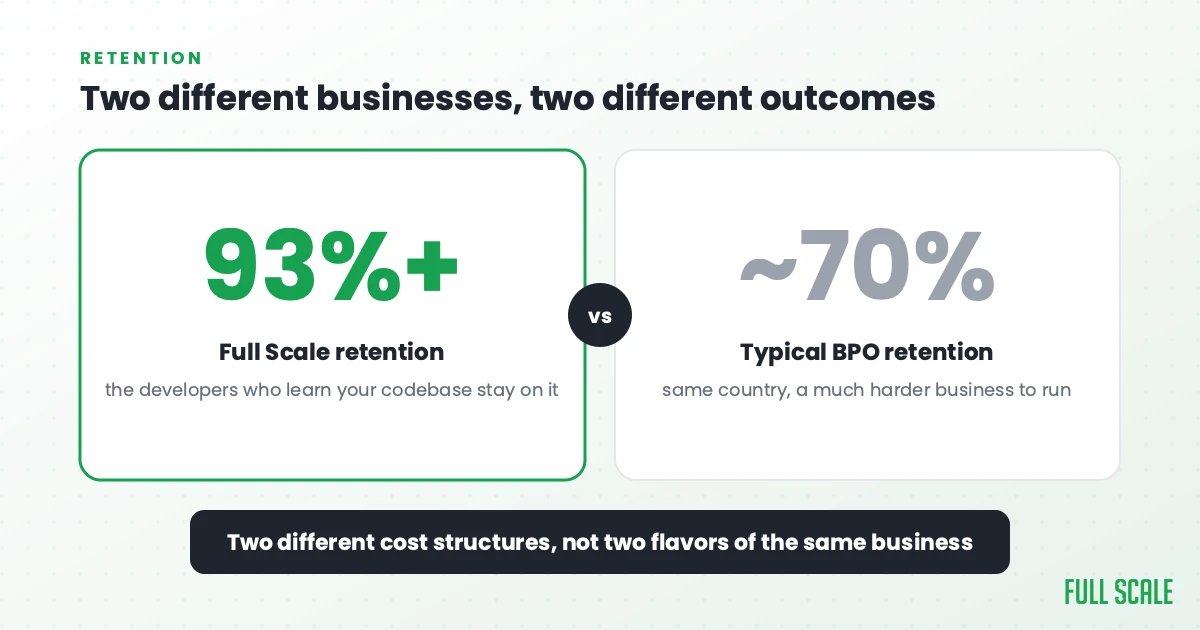
The training and career system is where the bigger difference actually shows up, right after someone’s hired. Every client gets a real, calendared meeting with their Customer Success Manager (CSM) every month, not a quarterly email nobody reads. The CSM also meets with the actual developers every week, not just the client stakeholder. Other shops let one person own 200 accounts. We cap ours at 70, on purpose, because you can’t really know that many people well enough to catch a problem before it becomes one. Every account also gets a quarterly review that goes up to our own senior leadership. When a developer is struggling, the CSM builds a real plan to fix it, not a note in a file. That structure is a real part of how we hold retention above 93% instead of just watching good people walk.
That whole system exists to grow a software engineer’s career. I would have no idea how to help someone build a career selling mortgages out of a call center. What does “senior” even mean in that job? I couldn’t tell you. For a developer, though, I know that path cold. It’s the only one I’ve spent my career building. None of that is cheap to build twice.
Why we don’t chase the BPO business ourselves
We wouldn’t expand into general BPO work even if we could. The reverse capability gap is just as real as the one I described above, and people sometimes assume otherwise. Building a real call-center operation means workforce scheduling, real-time floor management, and hiring for phone manner at volume. That’s not what my team knows how to do either. Even if we built it, the economics wouldn’t reward it. Price points on call center and back-office work run well below software engineering rates. Margins are thinner. Turnover is brutal, too: Philippine contact centers hold retention closer to 70 percent (their own industry data puts voluntary attrition at about 30% in 2023), while ours sits above 93%. It’s two different businesses with two different cost structures, and the BPO version is genuinely a harder, thinner-margin business to run well.
I’ve written before about cheapshoring, the mistake of picking an offshore partner on price alone. Staying out of the BPO business is sort of the mirror image of that, on our side of the table. We didn’t build Full Scale to be the cheapest, highest-volume operation we could run. We built it around keeping good developers long enough to matter, which is the whole idea behind Product Driven, the model I run every engagement on.
A call center and a software team are two different purchases
Traditional BPOs aren’t the villain here. They’re very good at what they do, and what they do isn’t software development. If your company needs a large customer support operation, the big names are the right shortlist, and I’m not going to pretend otherwise.
If you need senior developers who join your team, ship real product, and stick around, that’s a specialist’s job, and it’s the only job we build our business around. Schedule a call with Full Scale and we’ll tell you plainly whether we’re the right fit or not.
Frequently Asked Questions
What’s the difference between staff augmentation and BPO?
Staff augmentation adds engineers who join your team and work under your direction, while a partner handles hiring, payroll, and retention. BPO hands over an entire business function for a third party to run end-to-end, priced by process instead of by person. At Full Scale, we’re the first one: a staff augmentation partner, not a BPO.
Is Full Scale a BPO company?
No. Full Scale builds dedicated software engineering teams that work directly for our clients, not call-center seats or back-office processes. We’ve never actually competed against a traditional BPO like Concentrix or Teleperformance for a client.