
Build vs Buy Software: What AI Changes and What It Doesn’t

In this article
For a long time, the build vs buy software decision came down to one tradeoff. Building meant months of work and a team you had to pay for. Buying meant you wrote a check and had something running next week. Unless the software was the actual product you sold, buying usually won. The same build-or-buy call now plays out inside marketing, which is a big reason teams are hiring a MarTech developer instead of adding another subscription. The same logic applies to people, not just software, and there are times when you do not need a technical co-founder and a dedicated team will do.
AI moved that line.
Writing code is cheaper and faster than it used to be. A developer with the right tools can ship in a day what used to take most of a week. The build side of the ledger got a lot less scary, and I see more founders deciding to build things they would have bought before. Some of that is the right call. A lot of it is a trap.
Here is the part people miss. AI made the typing cheap, but it did nothing to make the planning cheap. Deciding what to build, and getting the requirements right, is still slow and still hard, and it is still mostly on you. I have built and sold software companies for more than two decades, and the planning was always the expensive part. AI did not change that. If anything, it made that part the whole game.
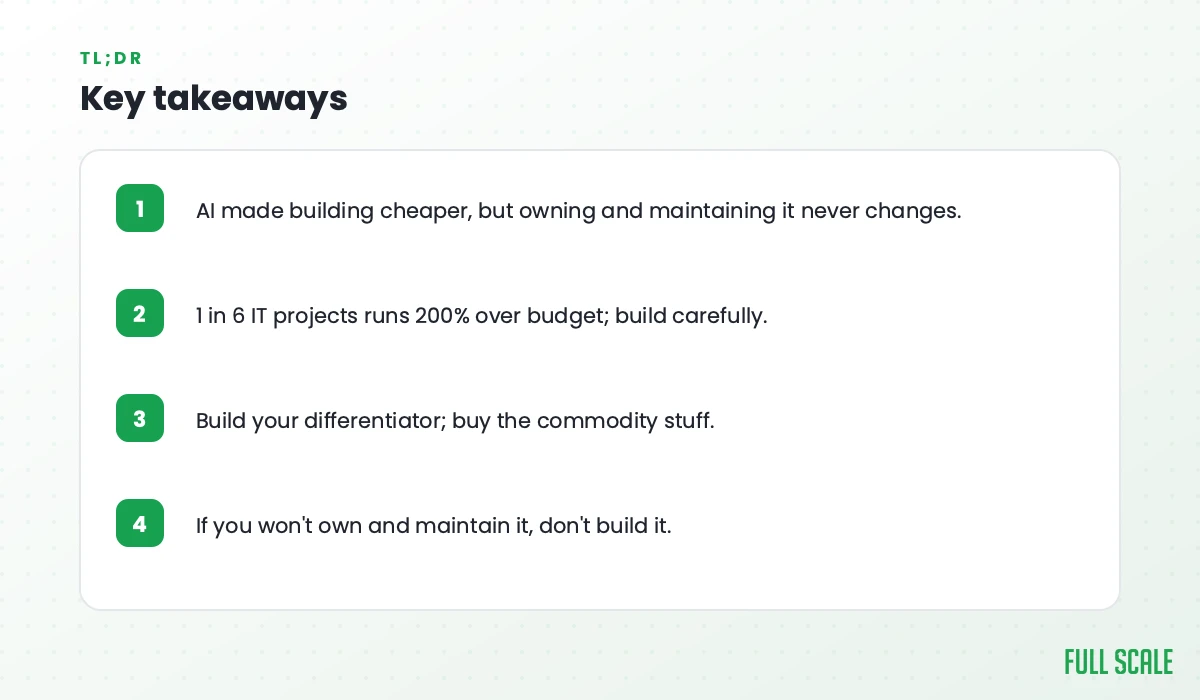
Quick answer: Buy software when it is not your competitive advantage, and build it when it is. AI lowers the cost of building, so more features now clear that bar, but the rule itself has not changed. The expensive part of building was never the code. It is deciding what the software should do and getting the requirements right.
What AI actually changed about build vs buy
The case for buying always rested on speed and cost. Building was slow and expensive, so you only did it when you had no choice. AI knocked a big chunk off both.
Most professional developers now use AI tools as part of their daily work, according to the Stack Overflow Developer Survey. With GitHub Copilot, Cursor, and Claude in the loop, a good engineer moves much faster on the parts that used to eat time: boilerplate, plumbing, and the first rough version of a feature. A prototype that was a two-week job is now an afternoon.
That changes the math. A custom internal tool you would have paid a monthly fee for, year after year, might be a few days of work now. Things that were not worth building because the effort outweighed the payoff suddenly clear the bar. So the honest answer is yes, AI does push the decision toward build, and for plenty of small tools that is fine.
The mistake is assuming the whole job got cheaper. Only one part did.
What AI didn’t change, and most people underestimate
The hard part of building software has always been figuring out what the code should do, not writing it.
This is the whole idea behind Product Driven, the approach I wrote a book about. Engineering value comes from building the right thing, not from typing faster. Someone still has to sit with the people who will use the software, understand the problem, map the edge cases, and decide what happens when a user does something weird. AI does not do that for you. It waits for you to tell it what to build, then it builds whatever you said, fast.
That speed is exactly why this matters more now, not less. A half-specced feature used to cost you a sprint of wasted developer time before anyone noticed it was wrong. Now you can generate the wrong thing in an afternoon and still ship it. The waste just moved upstream, into the planning you skipped.
Requirements are still the bottleneck. They are just a more obvious one now that the code is no longer the slow part.
The part of building that never goes away
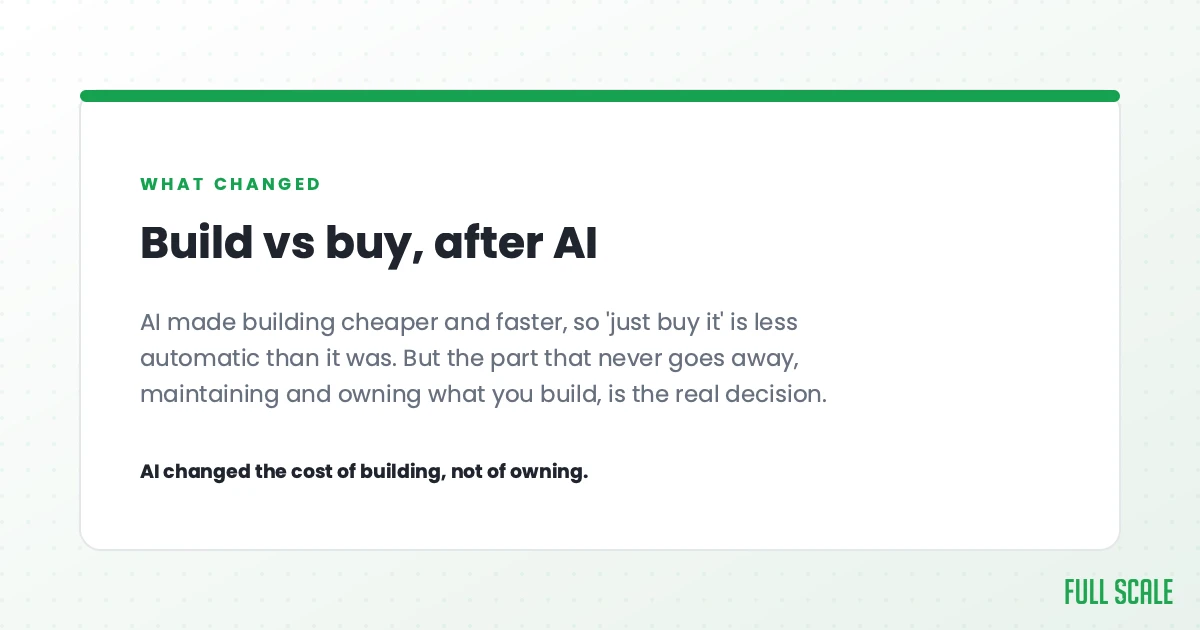
When you build software, you own it for as long as it runs, which is why backend development cost keeps adding up long after the build.
That is the cost nobody puts in the spreadsheet. The first version is the cheap part. After it launches you have bugs to fix, security holes to patch, libraries to keep current, and features to add as the business changes. Most of what you spend on a piece of software happens after launch, not before. At Stackify I ran a system with around two thousand sharded databases behind it, and I can tell you the build was the easy chapter. Keeping it healthy was the long one.
AI helps here too, a little. It can explain old code, write tests, and speed up the boring maintenance work. But it does not own the system. You do. The person who has to understand why the thing broke at 2 a.m. is still a person. Technical debt still piles up, and AI is happy to help you pile it up faster if you are not careful.
When you buy instead, the vendor carries all of that. They patch it, keep it running, and handle the edge cases for thousands of customers at once. You give up some control and you take on a little lock-in, but you also hand off the part of software maintenance that quietly eats engineering teams alive.
When to buy
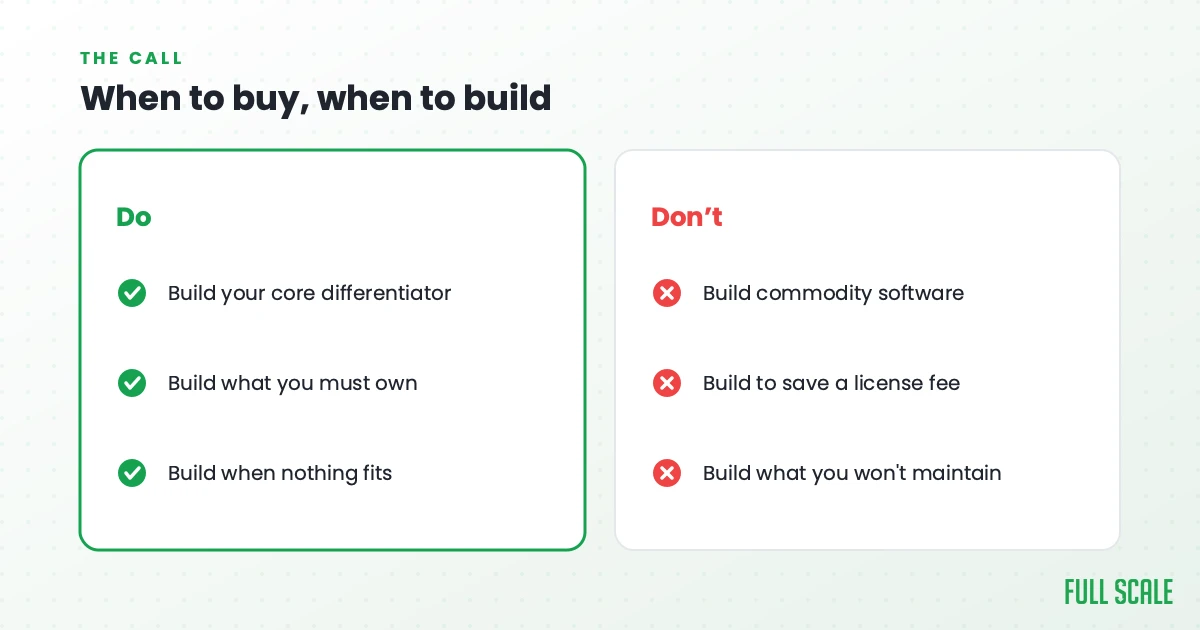
Buy when the software is not what makes you different.
Payments, accounting, email, CRM, analytics: these are solved problems with great products behind them. Do not rebuild Stripe, QuickBooks, or Salesforce. Companies far larger than yours have spent years and fortunes on those tools, and you will not catch up by building a worse version on the side.
At VinSolutions and later at Stackify, I bought everything that was not the product. Payments, infrastructure, email delivery, the CRM we ran the business on. Building any of that would have been lighting money on fire and pulling my best engineers off the work that actually mattered. A fully loaded senior developer in the US runs $180,000 to $250,000 a year. Every hour they spend rebuilding a solved problem is an hour stolen from your real advantage.
Buy when you need it now, when the problem is standard, and when you have no desire to own the upkeep. Speed and zero maintenance are the whole point of buying, so use them.
When to build
Build when the software is your edge.
If the thing you are considering is the reason customers pick you, no vendor is going to hand it to you. At VinSolutions the software was the product. It was the entire reason auto dealers paid us instead of someone else, and there was no off-the-shelf version of that advantage. There never is for anything that is truly your differentiator. That is the test. Is this the thing that makes us different, or is it plumbing?
Build when an off-the-shelf tool forces you to run your business in a way that hurts, when you need real control over your data and integrations, or when the available products almost fit but the gap is exactly where your value lives. AI widens this category. Because building is cheaper now, borderline cases that used to fail the cost test can make sense. Just be honest about why you are building. Do it because the software is your advantage, not because AI made it feel easy.
Whatever you build, treat the planning as the real project. Before you point AI at it, get clear on what the software has to do and who it is for. If you want help scoping that down to the smallest version that proves the idea, our guide to MVP development strategy walks through it. A tight spec is worth more now than it ever was, because it is the one input AI cannot generate for you.
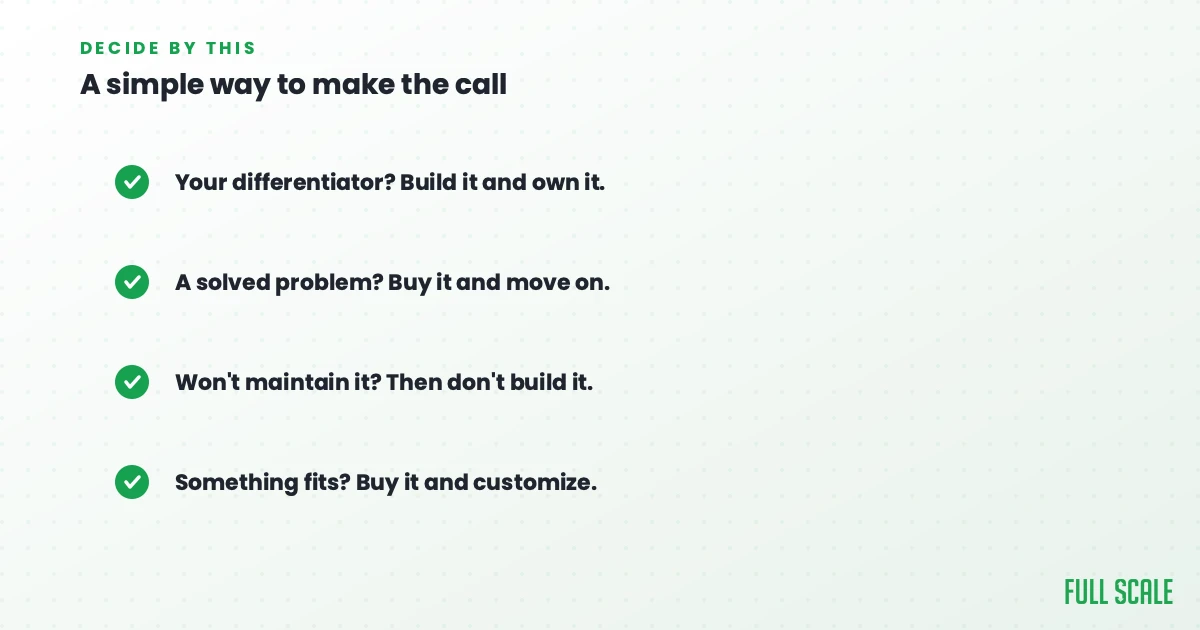
A simple way to make the call
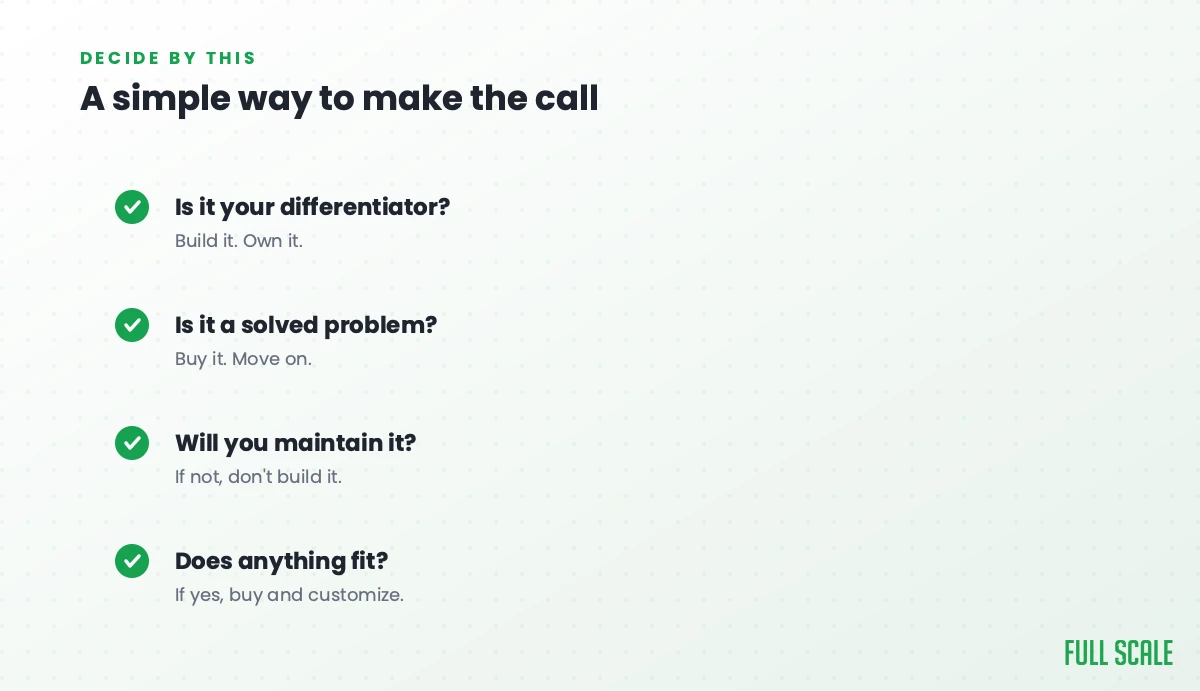
Start every build vs buy software decision with one question: is this software our competitive advantage, or is it plumbing? We apply that same test to build vs. buy for the backend.
If it is plumbing, buy it and move on. Spend the time you saved on the work only you can do.
If it is your advantage, build it, and put your real effort into the requirements, not just the code. Then apply the AI adjustment. If a case is borderline and you can realistically own the upkeep, the lower cost of building now tilts it toward build. If you cannot own it, or it is genuinely a solved problem, buy it no matter how easy AI makes the first version look.
You can sanity-check the money side with our software development cost calculator, which has a slider for the productivity boost AI gives your team. And before any of it, set your business goals so you know which software is actually worth owning.
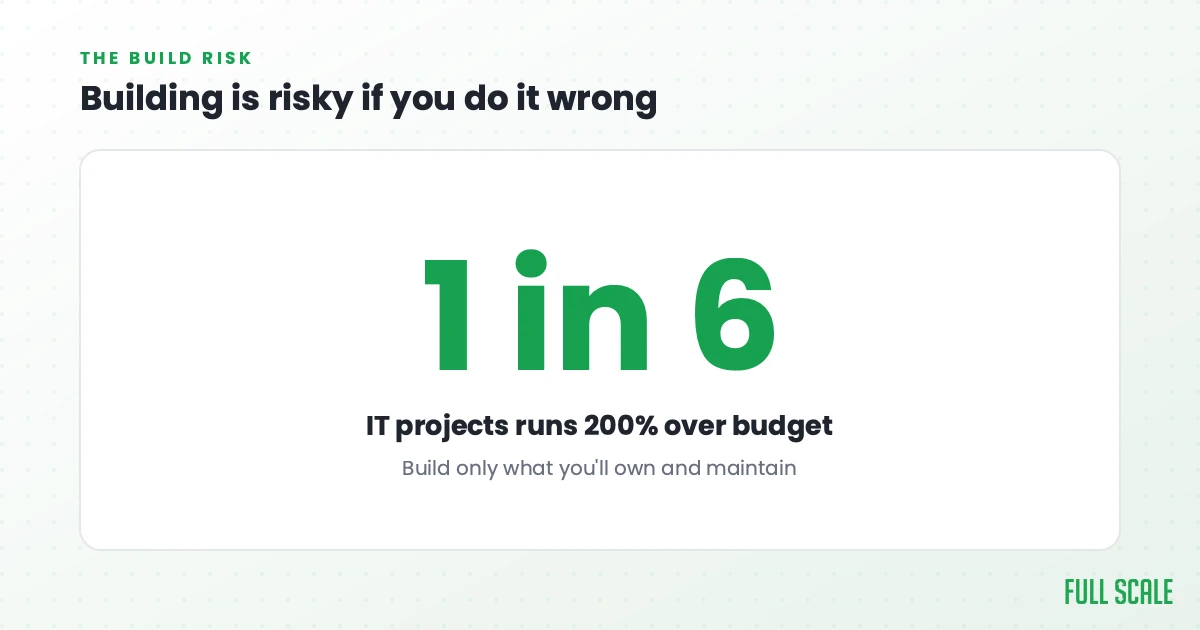
One warning that AI made louder: speed on the wrong thing is just faster waste. Research on large IT projects found that one in six runs an average of 200 percent over budget, and the ones that blow up usually trace back to fuzzy requirements, not slow typing. AI makes the typing faster. It does nothing for fuzzy requirements except help you produce more of the wrong thing sooner.
How we approach this at Full Scale
At Full Scale, we build custom software for companies that have decided the work is worth owning. Our developers are trained on the Product Driven approach and use the full AI toolkit, so they move fast on the code without skipping the planning that makes the code worth writing. The teams that win with AI are not the ones that type the fastest. They are the ones that know what to build before they start. For teams building web applications specifically, that same approach runs through our custom web application development practice.
We have made this call on ourselves, too. When we built out the Spartan Training Academy, our internal AI upskilling program, we had to decide whether to build or buy LMS software like everyone else weighing that same decision. We ended up building our own, the Growth Portal, mostly because we had developers to spare and wanted training tied to the same system as performance reviews and career goals, not living somewhere separate. That math works because of the extra capacity we happen to have. For most companies, it does not, and buying an LMS off the shelf is still the right call.
If you are weighing a build, schedule a call and we will talk through whether it is worth building and what it really takes to own it. You will get a straight answer either way.
Frequently asked questions
Does AI mean I should build more software instead of buying it?
Sometimes. AI lowers the cost of building, so small tools and borderline cases that used to be too expensive can now make sense to build. But the core rule holds: buy anything that is not your competitive advantage, because the planning, requirements, and long-term maintenance are still expensive even when the code is cheap.
Is it cheaper to build or buy software now?
Building is cheaper to start than it used to be, because AI speeds up writing code. Over the full life of the software, buying is usually still cheaper for anything standard, since the vendor spreads maintenance and security across thousands of customers. Build when the value of owning it outweighs that ongoing cost.
What kind of software should I never build?
Solved problems that are not your differentiator: payments, accounting, email, CRM, and analytics. Tools like Stripe, QuickBooks, and Salesforce have years of work behind them. Rebuilding a worse version pulls your best engineers off the work that actually sets you apart. CRM is the one item on that list I’d flag as an exception: the math changes completely once building a custom CRM is your actual product, not just your own sales tooling. When the system in question is your own aging product rather than a commodity, reengineering what you already have usually beats starting over.
What is the biggest hidden cost of building software?
Ownership. Most of what you spend on custom software happens after launch: bug fixes, security patches, updates, and new features as the business changes. AI helps with some of that maintenance, but you still own the system and the responsibility for keeping it running.
How does AI change the build vs buy decision?
It lowers the cost and time of the build side, which moves more decisions toward building. It does not change the hard part, which is deciding what to build and getting the requirements right. Use the speed to build your real advantage faster, not to skip the planning.