How to Become a Product Manager: There’s No School for It, and AI Just Made the Shortage Worse

In this article
- The most wanted job in tech is the one nobody trains for
- What a product manager actually does
- There’s no school that makes a product manager
- Where product managers actually come from
- AI just made product judgment the scarcest skill on the team
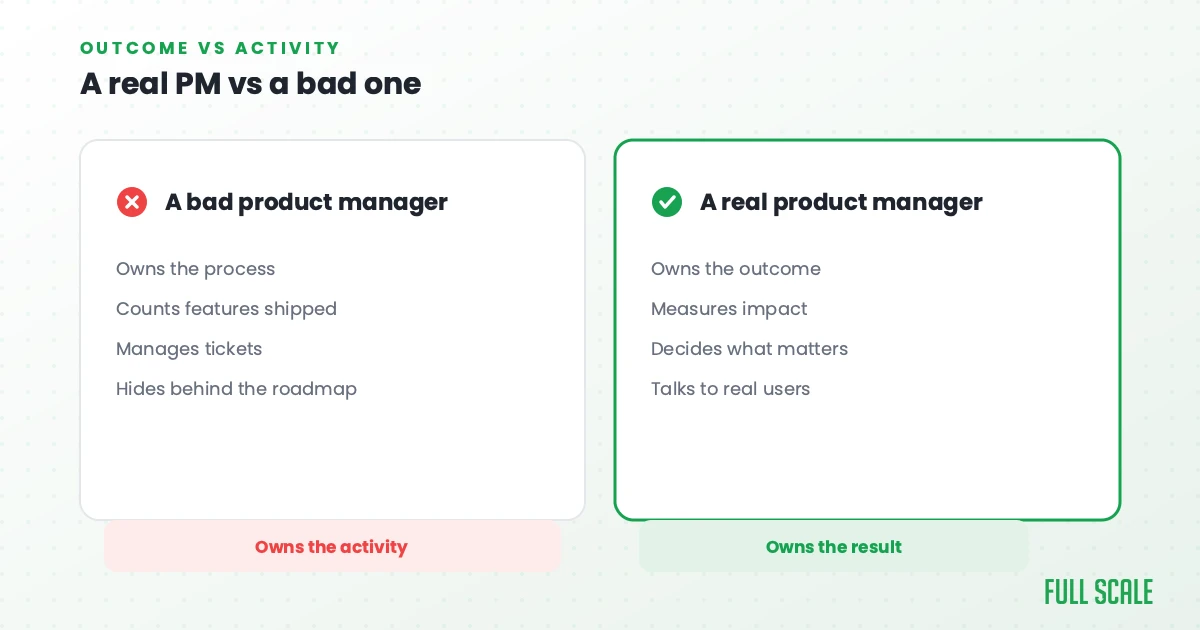
- A real product manager owns the outcome, a bad one owns the backlog
- So how do you actually become a product manager
- If you’re trying to hire one, not become one
- Frequently asked questions
Product manager is one of the most wanted jobs in tech right now. Openings are at their highest level in over three years, and demand for product managers has been climbing while designer demand flattened, with the PM-to-designer ratio now at 1.27x (State of the Product Job Market, 2026).
So here’s the strange part.
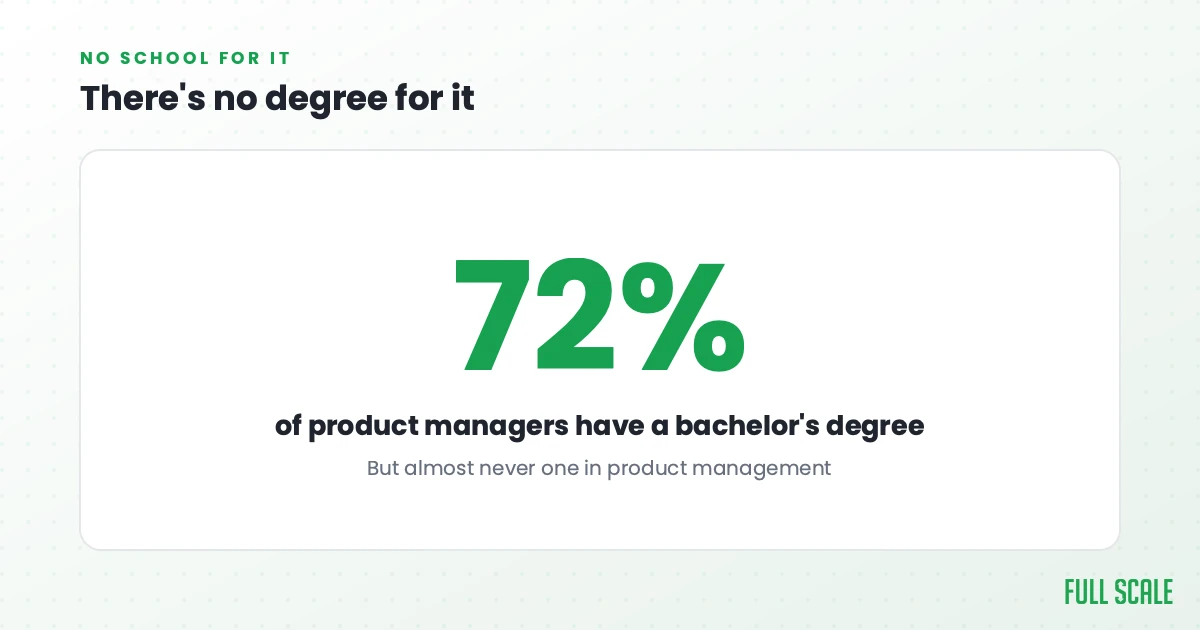
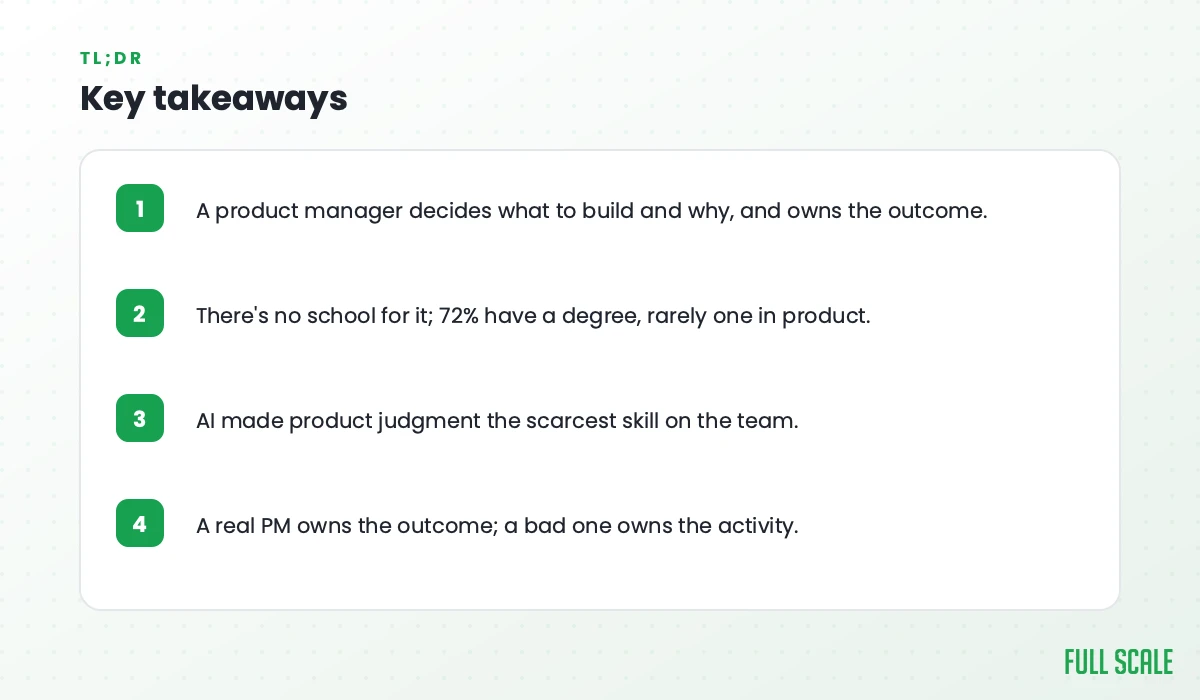
There is no degree that makes you a product manager. No major, no certificate, no bootcamp that reliably produces one. About 72% of product managers have a bachelor’s degree, but almost none of those degrees are in product management, because that degree barely exists.
You can’t go to school for this job. You back into it.
I’ve never had “product manager” on a business card. But I’ve been the product person at every company I’ve built, from VinSolutions to Stackify to Full Scale, and I’ve hired, promoted, and worked next to a lot of them. The ones who were great almost never came in through a front door marked “product.” They came in sideways. That sideways path is the real answer to how you become a product manager, and AI is about to push a lot more people down it.
Quick Answer: There’s no degree or bootcamp that reliably produces a product manager. Most good ones back into the role sideways, after getting deeply expert in something real, whether that’s a domain, a support queue, or a product they built themselves, and getting pulled into owning it because they understood it best. The skills (frameworks, roadmaps, sprints) can be taught in a weekend. The judgment about what’s worth building can’t, and that judgment is the whole job. Full Scale looks for that same instinct when we staff product-minded engineers, not just people who can run a process.
The most wanted job in tech is the one nobody trains for
Most career guides answer “how to become a product manager” with the same checklist. Get a degree. Learn the frameworks. Build a portfolio. Network your way into a junior role.
None of that is wrong, exactly. It’s just not how it actually happens.
The frameworks are easy to learn and easy to fake. The hard part of the job, deciding what to build and why, doesn’t show up in any of that. It shows up only after you’ve lived inside a real problem long enough to have an opinion about it. That instinct is what lets a product manager help a team reach product-market fit instead of just running the process.
That’s why the job resists training. You can teach the tools of product management in a weekend, but you can’t teach the judgment, and the judgment is the whole job.
What a product manager actually does
Here’s the short version, since this is well covered elsewhere and I won’t rewrite it here.
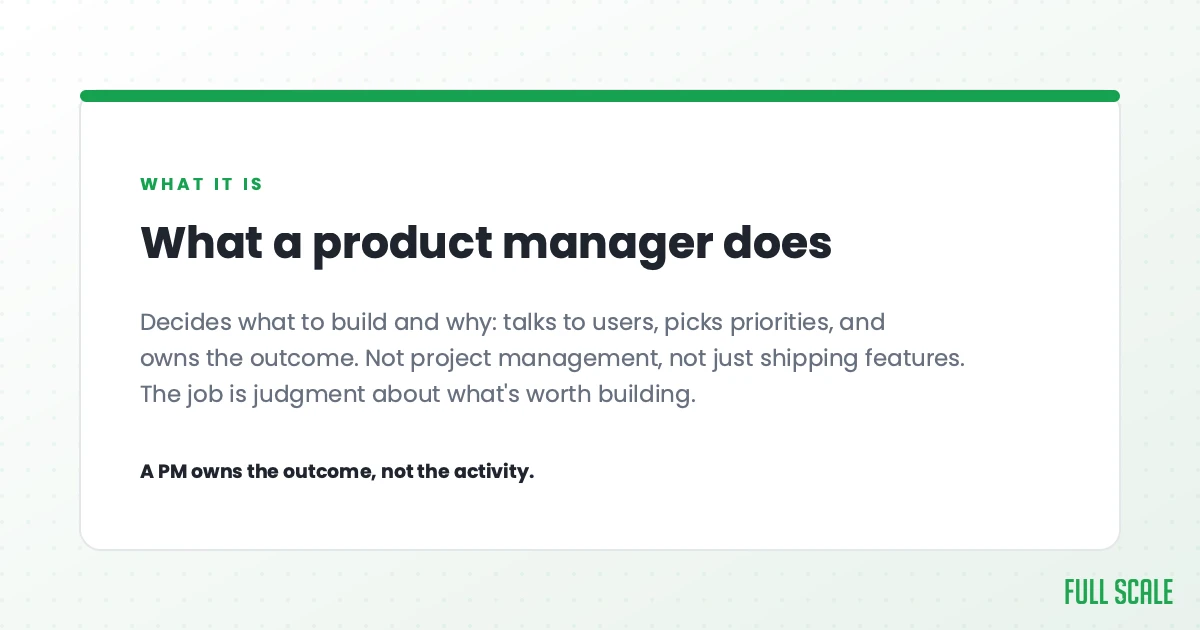
A product manager owns the answer to two questions: what should we build, and why does it matter to the user? They sit between the business, the customer, and the engineers, and they make the calls about priority and trade-offs that keep a team pointed at something worth shipping. If you want the full breakdown of the role and how it differs from a product owner or a project manager, we’ve written those up separately.
For this post, hold onto one thing. The deliverable isn’t tickets or roadmaps. The deliverable is good decisions about the product.
There’s no school that makes a product manager
Think about how you’d actually teach this in a classroom.
You can teach someone to write a user story. You can teach them to run a sprint, build a roadmap, read an analytics dashboard. Those are skills, and they’re useful. But the moment the real work starts, the spec gets fuzzy, two customers want opposite things, the deadline is real and the budget isn’t, and there’s no textbook answer waiting at the back of the book.
I wrote about this for engineers, but it’s even more true for product people. When any tool can hand you the obvious answer in five seconds, the value moves to the people who know which questions are worth asking. Knowing is cheap. Choosing is expensive.
A classroom can’t simulate that. You only build that muscle by owning a real decision, watching it play out, and living with the consequences. To become a product manager, you first have to become an expert at something real. The product instinct grows out of the expertise. It doesn’t come before it.
Where product managers actually come from
If you map the good product managers I’ve known back to where they started, almost none of them started in product. They started somewhere they got deeply expert, and then they got pulled into owning the product because they were the person who understood it best.
Here are the three paths I’ve seen work over and over.
| Path in | Where they start | Why it works |
|---|---|---|
| The domain expert | Runs the actual business process the software supports | Already knows what “right” looks like better than any spec |
| The founder | Has a problem they’re obsessed with solving | Owns the vision by default; can’t not be the product person |
| The support expert | Years of handling real customer problems | Knows the product and the user’s pain cold |
The domain expert who ends up owning the product
Years ago I helped build software to run a medical laboratory. The most important person on that project wasn’t an engineer or a designer or anyone with “product” in their title. It was the woman who ran the lab.
She had zero formal product experience. What she had was a decade of knowing exactly how the lab actually worked, where the process broke, and what a good result looked like. So she became the person who decided how the software should behave. She was the product manager for that application, whether anyone called her that or not.
Her expertise was the product judgment. The title would have just been a label on top of it.
The founder who can’t not be the product manager
Most startup founders are product managers and don’t know it.
You have a crazy idea, a problem you can’t stop thinking about, and a stubborn opinion about how to solve it. That obsession is product vision. When I started EngagePath, my first hire was a product manager, but I was still the one carrying the vision for what we were building, a tool to follow up with the people I’d talked to on LinkedIn. A PM can sharpen a vision. They can’t invent one from nothing.
That’s why in a startup, the whole leadership team has to think like product managers to some degree. Product thinking isn’t a role. It’s a standard. The best product managers I’ve worked with don’t take over the product. They pull the why back into the room and help the team build something worth believing in.
The support rep who already knows the product cold
If you actually want to grow a product manager instead of hiring one off the street, this is my favorite move.
Look at your support team. Find the person who’s spent two or three years fielding real customer problems, who knows every rough edge in the product and every reason customers get frustrated. They already have the two things you can’t teach: deep product knowledge and real empathy for the user.
Promote them into a junior product role and let them learn the rest on the job. They’ll be a better product manager in a year than most outside hires are on day one, because they’re not starting from a framework. They’re starting from the customer.
AI just made product judgment the scarcest skill on the team
Here’s why all of this matters more now than it did two years ago.
AI writes a huge share of the code on most teams now. Once you’ve told it clearly what to build and how you want it built, it can produce most of the implementation. The typing was never the hard part anyway, and now it’s barely a part at all.
So the bottleneck moved. It used to be “can we build this?” Now it’s “what should we build, and why does anyone care?” Once AI writes the code, the only scarce thing left is knowing what to build and why, and that is exactly what product management is.
This is the same shift I’ve watched hit engineering. The developers who are thriving are the ones who think like product people, who ask why we’re doing this, who’ll get value out of it, what the priority should be. The ones who only wanted a ticket and a spec are the ones feeling the developer shortage from the wrong side. The whole shape of a software team is changing toward fewer pure coders and more product thinkers.
Which means the path into product management is wider than it’s ever been. If you’re an engineer learning to think about outcomes instead of output, you’re already halfway there.
A real product manager owns the outcome, a bad one owns the backlog
This is the tell I watch for, and it’s the difference between a product manager worth hiring and one who just adds process.
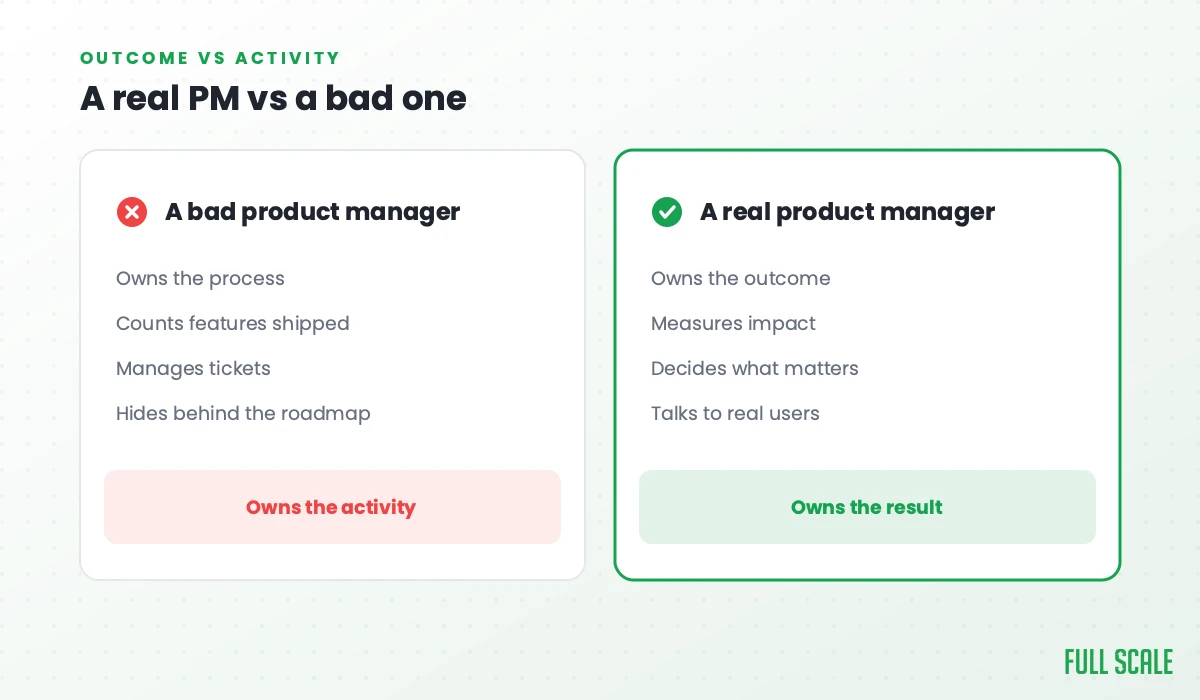
A weak product manager manages the backlog. They write the tickets, run the standup, keep the board tidy, and wait for someone above them to decide what actually matters. The work looks busy. The roadmap moves. And somehow the product still ends up in the wrong place.
A strong one owns the outcome. They’ll tell you what they won’t build this quarter and why. They say “I’d own that” instead of “I’m waiting on a decision.” They drag the messy why back into every conversation until the team can’t lose sight of it.
The signal is ownership, not activity. When someone interviews for a product role, I don’t care how many frameworks they can name. I care whether they take responsibility for the bet or hide behind the process.
So how do you actually become a product manager
Pulling it together, here’s the honest path, the one that doesn’t fit on a certificate.
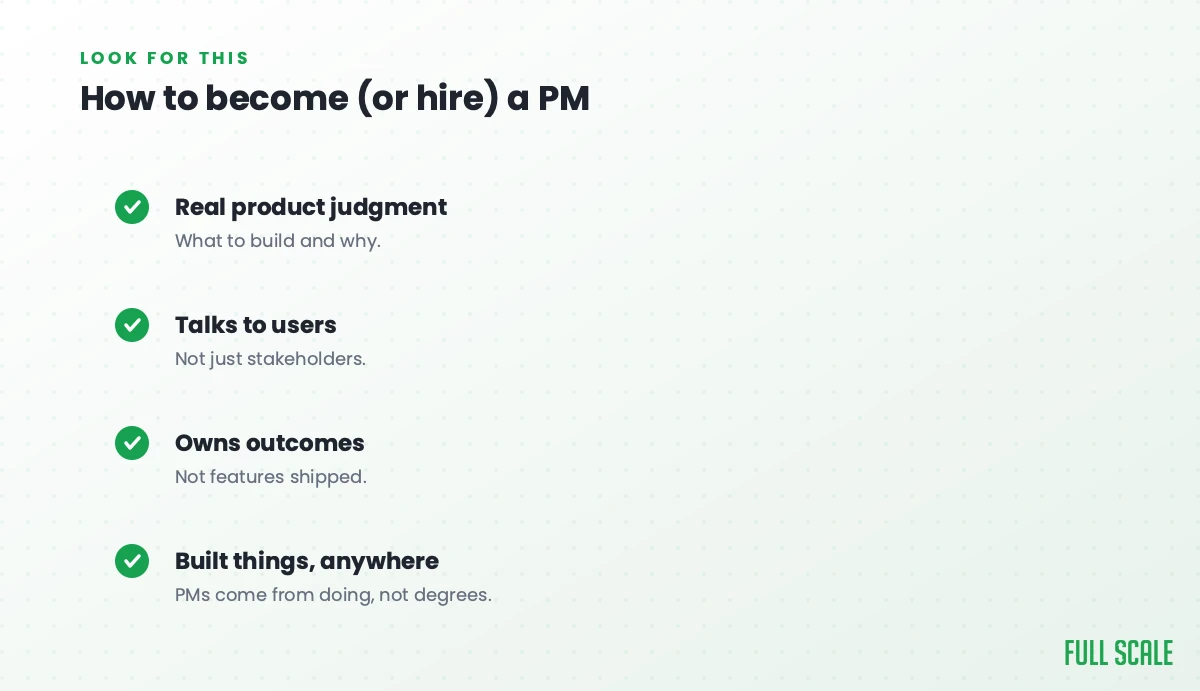
- Get genuinely expert at something. A domain, a product, a type of customer. The expertise is the foundation everything else stands on.
- Start owning outcomes where you already are. Don’t wait for the title. Take responsibility for a result, make the call when the answer isn’t obvious, and own how it turns out.
- Build product judgment by making real decisions. Frame fuzzy problems. Decide what not to do. Learn to be wrong fast and adjust. This is the muscle no course builds for you.
- Find the internal step-up. The easiest way into a first product role is inside a company that already trusts you, where someone will champion the move. Internal transfers beat cold applications almost every time.
Notice what’s not on that list: a specific degree. The credential follows the judgment, never the other way around.
If you’re trying to hire one, not become one
A lot of people reading this aren’t aspiring product managers. They’re founders and engineering leaders who need product talent and can’t find it. The shortage is real, and it’s about to get worse as AI pushes more of the work toward product thinking.
My advice is the same advice that runs through Product Driven: don’t go hunting for a unicorn with the perfect resume. Grow product thinking across the team you have, and get help with the execution. You can pair a strong internal product owner with a dedicated team that ships, instead of waiting six months to hire one person who checks every box.
The companies that win the next few years won’t be the ones who hired the most product managers. They’ll be the ones who built product thinking into everyone.
If you’re trying to staff a team that can actually ship while you grow that thinking, let’s talk.
Frequently asked questions
Do you need a degree to become a product manager?
No. Most product managers have a bachelor’s degree, but rarely one in product management, because that degree barely exists. The job is built on domain expertise and judgment you develop by owning real decisions, not on a specific credential.
How do you become a product manager with no experience?
Start by getting expert at something adjacent, like support, engineering, design, or the business itself, then take ownership of product outcomes where you already work. The most reliable path is an internal move at a company that already trusts you, not a cold application to an outside PM role.
Is product management a good career in the age of AI?
Yes, and arguably more than before. As AI writes more of the code, the scarce skill becomes deciding what to build and why, which is the core of product management. Demand for product managers is at a multi-year high.
What’s the difference between a product manager and a product owner?
A product manager focuses on strategy and the why behind what gets built, while a product owner tends to focus on execution and the backlog. The line between them shifts by company. We break the distinction down in detail in our product owner vs. product manager guide.
What skills make a good product manager?
The skills that matter most are judgment under ambiguity, customer empathy, clear communication, and the willingness to own outcomes instead of just managing tasks. The tools and frameworks are easy to learn; the judgment is what takes years to build.