
How Much Does It Cost to Hire an App Developer? 2026 Rates and the Team You Actually Pay For

In this article
- How much it costs to hire an app developer, by hiring model
- One app developer rarely builds a whole app
- The cost to hire a mobile app developer team for version one
- What the app costs after launch
- When the cheapest app developer is nobody
- Pick the hiring model by whether your app is a project or a product
- Frequently asked questions
- Price the team your app needs
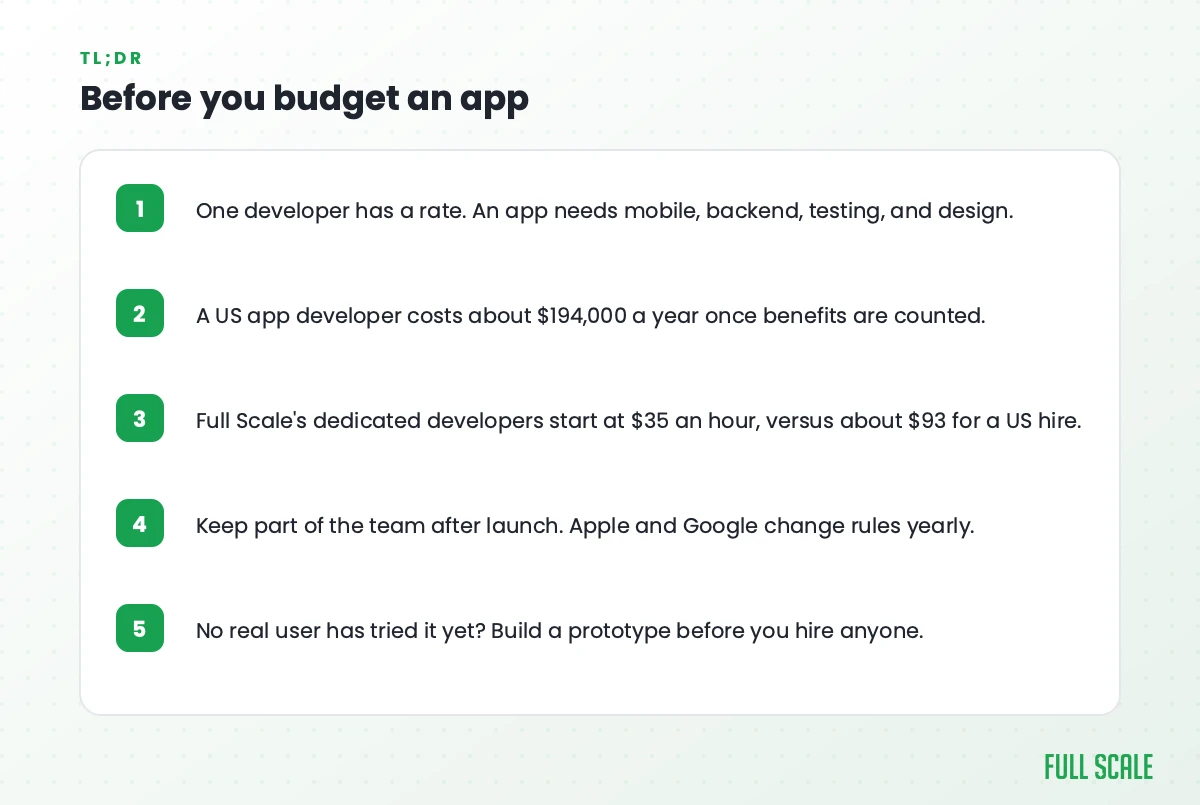
Quick Answer: Hiring an app developer in 2026 costs about $194,000 a year fully loaded for a US employee at the median salary. App agencies listed on Clutch typically charge $25 to $49 an hour, and Full Scale's dedicated developers in the Philippines start at $35 an hour. That's the price of one person, and a shippable app needs a small team working for months, so budget for the whole team.
How much does it cost to hire an app developer? The numbers for one person are easy to find, and they're all below. What you actually need is the cost of the app, and that's a much bigger number, because an app needs a team for months and then for years after launch.
I run a company that sells developers by the hour, so you'd expect me to want you staring at the hourly rate.
Of every number on this page, the hourly rate will matter least to what your app ends up costing.
How much it costs to hire an app developer, by hiring model
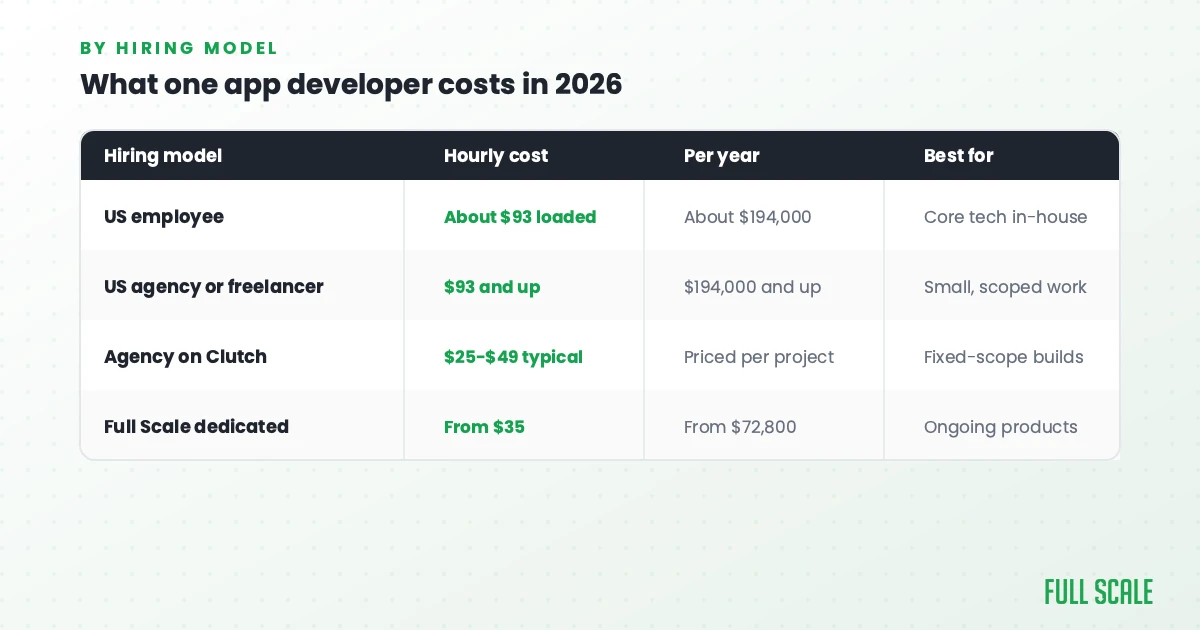
The cost to hire one app developer runs from about $25 an hour at the cheap end of Clutch's agency listings to roughly $93 an hour, fully loaded, for a US employee at the median salary. Full Scale's dedicated developers start at $35 an hour, and US freelancers and US-based agencies bill at or above that $93.
The US figure comes from two Bureau of Labor Statistics (BLS) data sets. The median software developer earned $135,980 in May 2025. But averaged across private employers, wages are only 70% of what they spend per hour worked, once you count health insurance, retirement, paid leave, and payroll taxes. So the real cost is about $194,000 a year. Across 2,080 working hours, that's about $93 an hour, and recruiting fees aren't even in it yet.
That number swings hard by city, and I break down why in our post on the cost to hire a software developer.
I put the four common ways to hire one app developer side by side, using public data for the other three and Full Scale's own published pricing for ours:
| Hiring model | How you pay | Cost of one full-time app developer | What you get |
|---|---|---|---|
| US employee | Salary plus benefits | About $194,000 a year fully loaded at the BLS median (about $93/hr) | Full control, with recruiting, payroll, and management on you |
| US freelancer | Hourly or per project | Usually $93/hr or more to match what a US employee costs, since they cover their own benefits | Flexible hours from one person, often split across several clients |
| App development agency | Per project or hourly | Typically $25-$49/hr listed on Clutch (mostly offshore shops); US-based agencies bill above the $93/hr their own staff cost | A scoped build delivered by the agency's team and process |
| Offshore staff augmentation (Full Scale) | Monthly, per developer | Starting at $35/hr, about $72,800 a year full-time | A dedicated developer on your team, with payroll, benefits, HR, and equipment handled |
What the Clutch numbers leave out
The Clutch numbers need a footnote. A lot of the agencies listed there are offshore shops, which is why the typical rate looks so low next to a US salary. A US-based agency staffs your app with US employees. Its rate has to clear that same $93-an-hour loaded cost before it makes any margin. Clutch's own mobile app pricing guide puts the average project at $90,780 and the average timeline at about 11 months, with most projects landing between $10,000 and $49,999.
Hang on to that 11-month timeline. It's the first hint that you're buying a stretch of time, and a person is only part of it.
The freelancer row is the hardest to pin down. The BLS median salary works out to about $65 an hour in wages alone, and a US freelancer has to bill well above that. They pay their own taxes and health insurance, and nobody pays them for the weeks between clients. You skip the benefits, but you pay for every hour, including the ones they spend learning your code.
At Full Scale, $35 an hour is where pricing starts, not what every developer costs: senior engineers and specialized skills bill higher. You can see how that works on our pricing page.
One app developer rarely builds a whole app
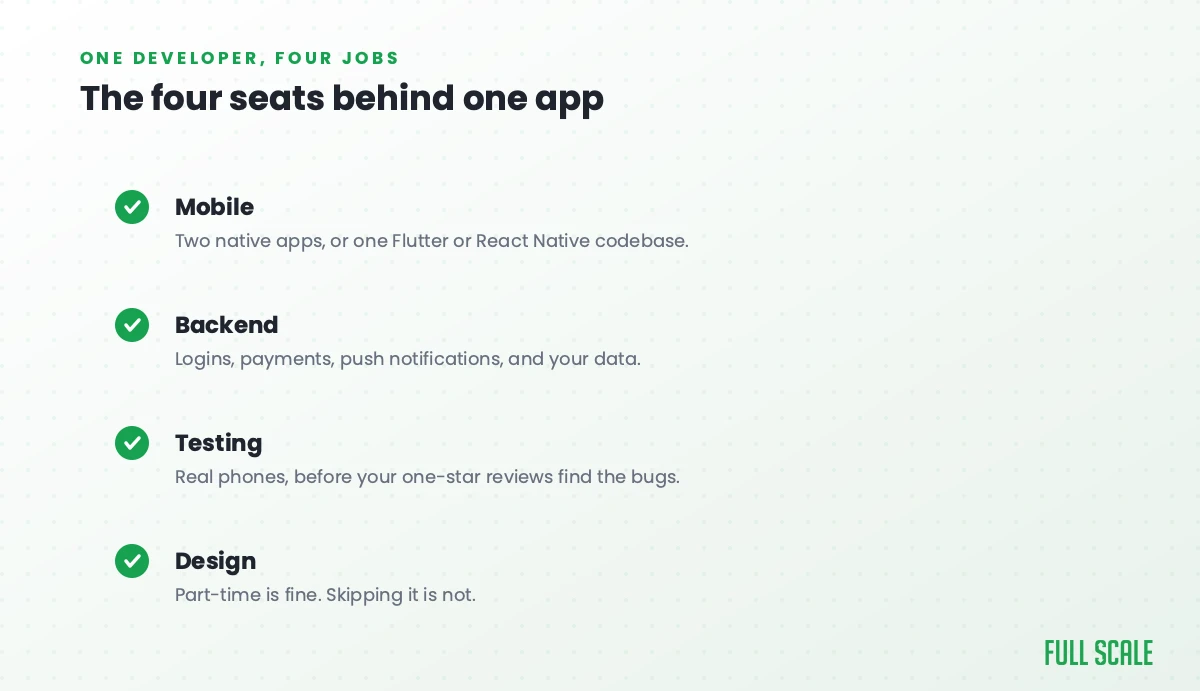
A real app needs several kinds of work happening at once, and one developer can't cover all of it. Each kind of work is a seat somebody has to fill:
- The mobile app. Native apps mean a separate iOS app in Swift and Android app in Kotlin, which usually means two developers. Cross-platform frameworks like Flutter and React Native ship one codebase to both stores. Clutch's guide says building separate native apps roughly doubles the total project cost, and I cover when the single codebase is worth its trade-offs in what cross-platform app development really means.
- The backend. Logins, payments, push notifications, and all your data live on a server the app calls. The screens get all the attention, but the backend is what falls over at 2 a.m., and our mobile app backend development guide covers who should build it.
- Testing. Your Android users are on everything from a new Pixel to a five-year-old Samsung with a cracked screen. Somebody has to try your app on real phones before your one-star reviews do it for you.
- Design. Don't let a developer wing this. I designed the interface myself at VinSolutions, which later sold for about $150 million, and looking back, it was a monstrosity. The exit happened in spite of my design work.
Your first version doesn't need four full-time hires on day one, since a designer can work part-time and one tester can cover the early builds. Somebody still has to own each of those jobs, though.
If you budget for one app developer, you're quietly asking one person to do four jobs.
Why the stack changes the bill
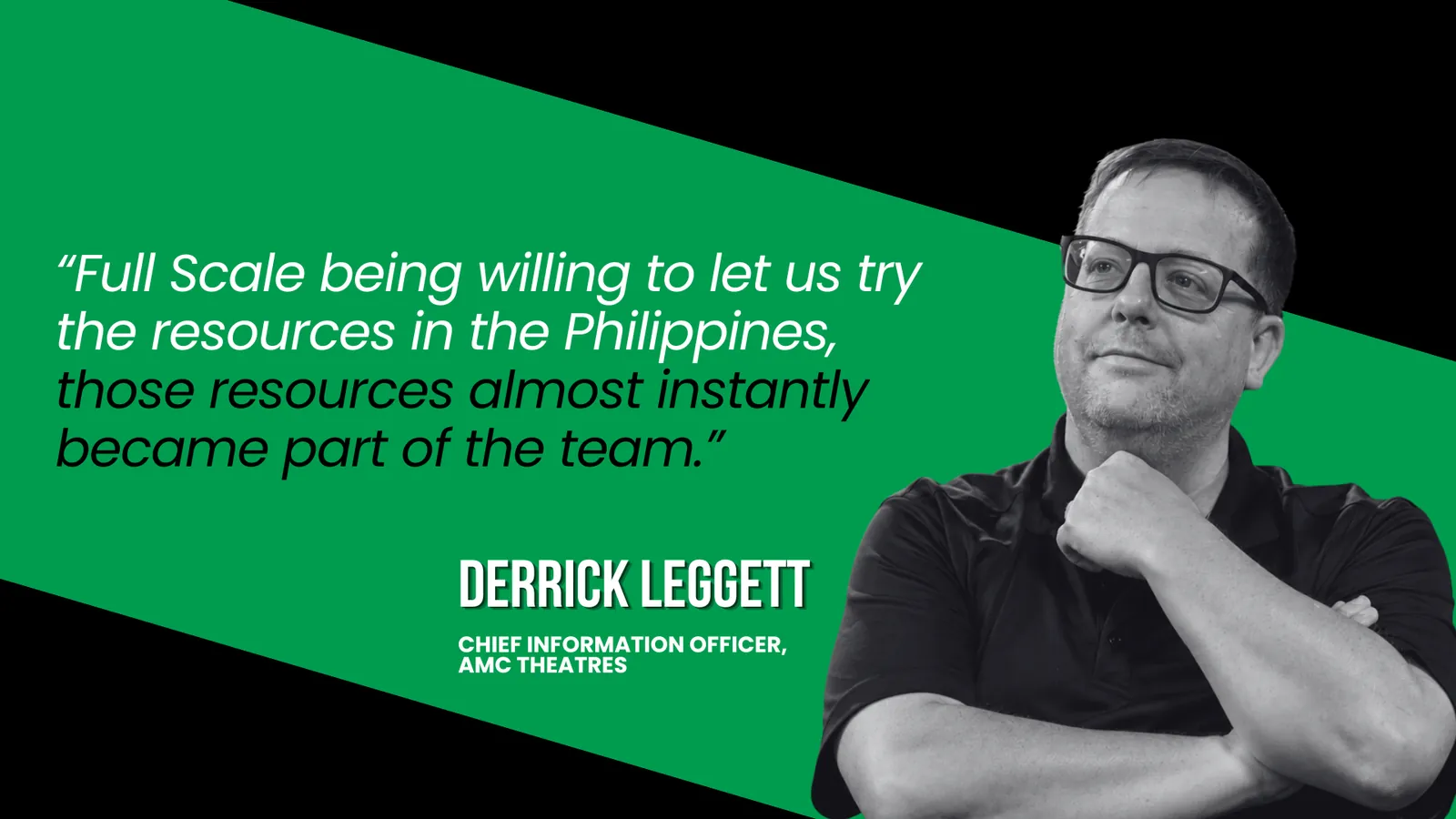
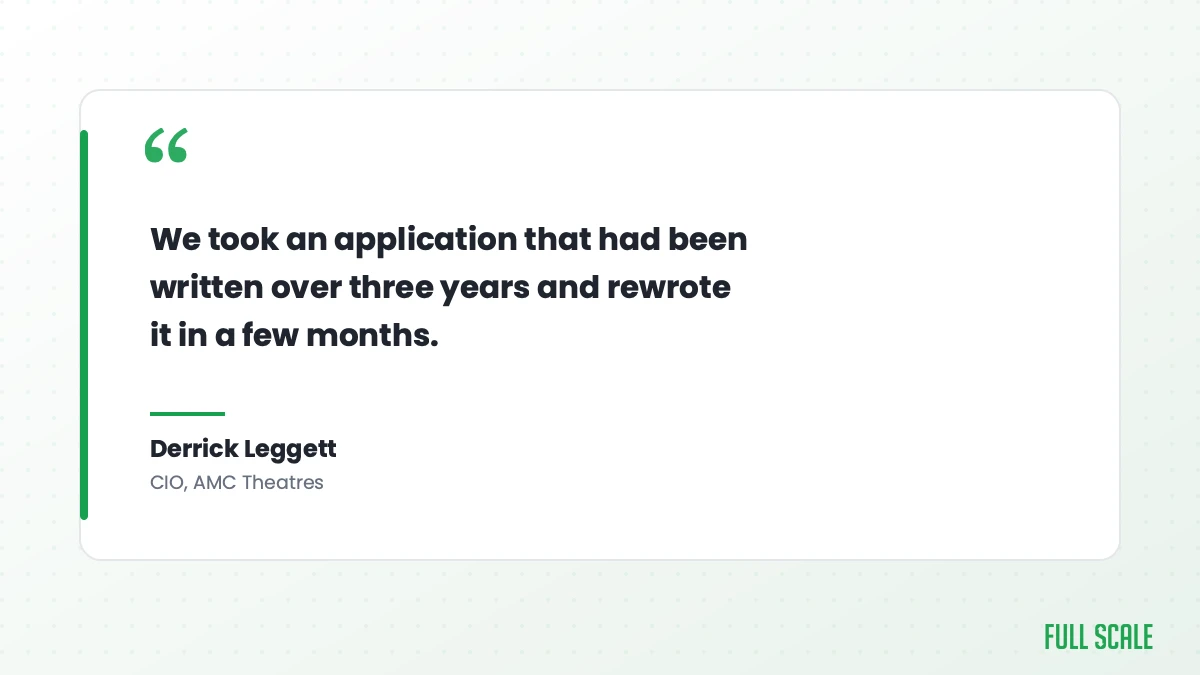
A framework you've outgrown costs you every month you stay on it. AMC Theatres, a Full Scale client whose engineering team includes developers across the Philippines, had a mobile app built on Xamarin that the company had outgrown. A group of AMC's engineers rebuilt it in Flutter on their own, mostly on nights and weekends with Dungeons & Dragons mixed in. Then they brought it to CIO Derrick Leggett asking for forgiveness, and permission to take it live. Leggett recalled their pitch: "We took an application that had been written over three years and rewrote it in a few months."
To be fair to the original team, a rewrite always goes faster than a first build. Three years of figuring out what the app should do was already done. Still, no rate negotiation buys back months like that. If you're hiring for Flutter work, test candidates on Flutter itself.
The cost to hire a mobile app developer team for version one
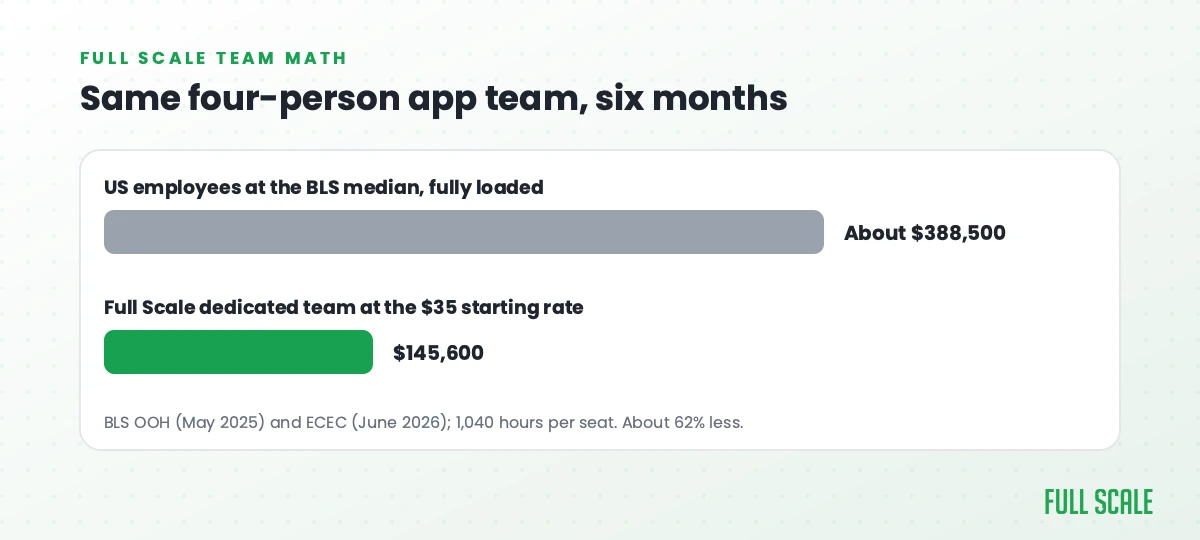
A lean four-person team building an app for six months costs about $388,500 with US employees at the median salary, fully loaded, and about $145,600 with a Full Scale team at our $35 starting rate. The same four-person team costs about 62% less through Full Scale.
The team in this example has two cross-platform mobile developers, one backend developer, and one QA engineer, each working 1,040 hours over six months. A part-time designer isn't counted on either side. Neither is the person on your side who owns the product, whether that's a technical co-founder, a VP of Engineering, or a fractional CTO. Somebody has to run this team, and it can't be the team. A full-time QA seat also assumes real users have already shown they want the app; before that, keep testing light.
Full Scale priced the same four-person app team both ways for six months:
| Line item | US employees (BLS median, fully loaded) | Full Scale dedicated team (starting rate) |
|---|---|---|
| Hourly cost per person | About $93 | $35 |
| One person for six months | About $97,100 | $36,400 |
| Four-person team for six months | About $388,500 | $145,600 |
| Recruiting fees | On top, per hire (see recruitment agency fees) | None |
| Time until work starts | However long four US hires take | As little as 7 days |
This math is harsh on the US side in one spot and kind to it in another. A QA analyst or tester earns a median of $104,300, well under the software developer median, while a senior iOS engineer in San Francisco earns a lot more. Our side moves too, since a senior-heavy team bills above $35 an hour. Run it with your own seniority mix, and the gap usually lands in the 50% to 70% range that Full Scale clients save against a comparable US hire.
Six months is also optimistic for a first version, since the average Clutch project runs closer to a year. Clutch's average project cost looks cheap next to this table because most of those projects are smaller scopes built by offshore agencies splitting people across clients, not four dedicated full-time seats. Software estimates have a way of being six months long in month one and still six months long in month five.
What the app costs after launch
An app keeps costing money after it ships, because Apple and Google change their requirements every year and your users find the bugs your testers missed. Keep at least part of the build team around after launch.
The store fees are the cheap part. Apple charges $99 a year for its developer program, and Google Play charges a one-time $25 registration fee. Nobody's budget breaks on those. The store's cut of your revenue is bigger: Apple takes 15% of in-app purchases for small developers, and Google's service fees run 10% to 30% depending on the market and what you're selling. Add the third-party services most apps lean on, like maps or text messages, before you call the budget done.
The expensive part is keeping up. Since August 31, 2026, Google Play requires new apps and updates to target Android 16 (API level 36), and that bar moves up every year. Fall behind and your app stops being available to new users on newer Android versions. Apple does the same thing on its side: since April 28, 2026, every app uploaded to the App Store has to be built with Xcode 26 and the iOS 26 SDK. Something in your app will notice. Add hosting, monitoring, crash fixes, and the features your first real users ask for, and most of the year-two bill is developer time.
The hiring model you pick matters most after launch. An agency on a scoped project hands over the app and moves on, taking the people who understood your code with it. That hurts most in September, when the new iOS breaks your login screen and the only team that would know why is on someone else's app. That's the case for keeping a dedicated team through staff augmentation.
An app never really gets finished, so price the years after launch, too.
When the cheapest app developer is nobody
If nobody outside your company has used your app idea yet, the cheapest move is not hiring an app developer at all. Build a clickable prototype first and put it in front of real users, and hire once they've told you what's worth building.
On a Startup Hustle episode about validating app ideas, John Rake, the founder of GorillaBot Labs, put the prototype case bluntly: "you can fake most of this in a weekend or two and not pay a developer $30,000, $50,000, whatever." That was back in 2022, and the prices have only gone up.
That's a strange thing for a staffing company to put on its own podcast, but Full Scale has said it for years. On that same episode, my co-founder Matt DeCoursey described telling very early founders who want a team, "you're not ready for what we do yet."
In 2026, that weekend is cheaper than ever. In Stack Overflow's 2026 Developer Survey, 73% of respondents said they use coding assistants and agents daily, and those same tools will get a non-engineer to a believable clickable demo.
Don't mistake the demo for the product, though. In that same survey, only 16% of respondents said they'd trust AI with most tasks that aren't important work decisions, and those are the professionals.
A prototype that impresses your friends still has to survive App Store review and a real user's bad Wi-Fi before it's an app. When real users show they want the thing, by paying in advance or bugging you about when it ships, our minimum viable product guide covers what to build first, and that's the point where hiring developers starts paying for itself.
Pick the hiring model by whether your app is a project or a product
The right way to hire an app developer depends on whether the app is a one-time project or an ongoing product.
Decide that first, then compare rates inside the model that fits. Here's the call I'd make at Full Scale for each situation:
| Your situation | Best fit | Why |
|---|---|---|
| A small fix or one feature on an app that already works | A freelancer | Short, scoped work doesn't justify a team |
| A fixed-scope app you won't keep building, like a one-time event app | An agency on a scoped statement of work (SOW) project | You pay for an outcome and walk away |
| An app that is the product, with a roadmap after launch | A dedicated team through staff augmentation | The people who built it stay to maintain and extend it |
| Core technology you want fully in-house, with the budget and time to recruit | US employees | Most control, but the highest cost and the slowest start |
| An idea no real user has tried yet | Nobody yet, build a prototype | Test the idea with real users before you spend six figures |
Whatever model you pick, don't pick it on rate alone. A developer who'll tell you the spec is wrong in week one is worth more than five dollars an hour off the invoice. Offshore mobile developers advertised at $15 an hour are easy to find, and I call hiring on price alone cheapshoring. I go deeper on that trap in how to outsource mobile app development.
Where Full Scale fits
If your app is an ongoing product, this is what we do. Full Scale places dedicated mobile app developers from across the Philippines onto your team, starting at $35 an hour, and each one works for only one client. Work can start in as little as 7 days. The first two weeks come with a money-back guarantee. Past that, you can drop any developer on 30 days' notice, and nothing locks you into a long-term contract. We spell out how that works in when it isn't working out.
We also train our engineers on the mindset from my book, Product Driven, which means asking why a feature matters before building it.
Frequently asked questions
How much do app developers charge per hour?
App developers charge anywhere from $15 to $25 an hour at the cheapest offshore shops to well over $93 an hour at US-based agencies, which is roughly what a US employee at the median salary costs fully loaded. Clutch lists $25 to $49 an hour as the typical agency rate, and Full Scale's dedicated developers in the Philippines start at $35 an hour. US freelancers usually bill $93 an hour or more, since they cover their own taxes and benefits.
Do I need separate iOS and Android developers?
Separate iOS and Android developers make sense when an app leans hard on device hardware or platform-specific features, like background location tracking or a connected medical device. For most business apps, a cross-platform framework such as Flutter or React Native lets one codebase ship to both app stores, which can shrink the mobile side of the team. Clutch estimates that building two separate native apps roughly doubles total project cost.
Is it cheaper to hire a freelancer or an agency to build an app?
A freelancer is cheaper per hour, and an agency is cheaper per finished app, because one freelancer can't cover mobile, backend, testing, and design at the same time. For a scoped app you won't keep building, an agency working from a fixed statement of work is the better deal. For an app with a roadmap after launch, a dedicated team tends to cost less over time than either, since the people who built the app stay to maintain it.
How much does it cost to maintain an app after launch?
App maintenance costs are mostly developer time, not fees. Apple charges $99 a year for its developer program and Google Play charges a one-time $25, but the real cost is the developer time it takes to keep up with each year's iOS release and Android API requirements and to fix what users break. Keeping part of the original build team is the cheapest way to cover it, since they already know the code.
How much does it cost to hire app developers for an MVP?
A minimum viable product (MVP) built by a small app team usually means three or four people for several months. At Full Scale's $35-an-hour starting rate, a four-person team for six months comes to about $145,600, versus roughly $388,500 for the same team as US employees at the BLS median salary. Before spending either amount, a clickable prototype tested on real users can tell you whether the MVP is worth building.
Price the team your app needs
Add up the seats your app needs and the years after launch, and the right hiring model gets obvious fast. If that's a dedicated team, tell us what your app needs and we'll run this math on your actual app.