
Most Offshore Development Team Mistakes Are Self-Inflicted (Here Are the 9 That Matter)

In this article
- 1. Hiring on price alone
- 2. Offshoring with no engineering leadership in-house
- 3. Handing over vague requirements
- 4. Routing every decision through one project manager
- 5. Outsourcing a project when you should be augmenting your team
- 6. Starving the team of good tools
- 7. Building your team one freelancer at a time
- 8. Ignoring communication and cultural fit
- 9. Treating time zone overlap as an afterthought
- Doing offshore the right way
- Frequently Asked Questions
Quick answer: Most offshore development team mistakes aren’t the developers’ fault. They come from how the company sets up the engagement: hiring on price alone, skipping in-house technical leadership, handing off a whole project instead of building a team, and routing every decision through one project manager. The root cause underneath almost all of them is treating offshore as cheap labor you hand off and walk away from, instead of an extension of a team you still lead, the standard Full Scale holds every offshore team to. Fix that, and offshore works. Underinvesting in quality is another avoidable mistake, and senior-level testing is what closes that gap.
I’ve hired developers in Russia, Belarus, Latin America, India, Pakistan, and the Philippines over the last 20 years. Some of those teams shipped great work. A few were a mess.
The difference was almost never the developers.
It was the setup. Mine, the client’s, or whoever stood the thing up. That’s the part nobody wants to hear. When an offshore project falls apart, the easy story is “offshore doesn’t work” or “the developers weren’t good enough.” Usually that’s wrong. The team failed because of decisions the company made before anyone wrote a line of code.
I’m Matt Watson). I run Full Scale, where we help companies build software teams in the Philippines. Before that I was the CTO of VinSolutions and the founder of Stackify, and I’ve made most of the mistakes on this list myself.
Here are the nine that matter, why each one backfires, and how to avoid it.
Almost every offshore failure traces back to one mindset: treating offshore as cheap labor you hand off and forget, instead of a team you still lead.
Hold onto that. Almost every mistake below is a version of it.
1. Hiring on price alone
Cost is a fine reason to hire offshore. It’s the honest reason most companies start looking, and there’s nothing wrong with that.
An experienced developer in the US starts around a $150,000 to $185,000 base (BLS data), and once you stack benefits, payroll taxes, equipment, and recruiting on top of that (the standard 1.25 to 1.4 loaded-cost multiplier), the real cost runs well past $200,000 a year. A senior engineer in the Philippines earns a fraction of that. The math is real, and it’s why the global talent market exists.
The mistake is making price the *only* filter.
I call this cheapshoring: chasing the lowest rate you can find and ignoring everything else. You hire the cheapest freelancer or the cheapest project shop, and you pay for it later in rework, blown deadlines, and a product you end up rebuilding.
The cheapest developer is almost never the cheapest outcome.
You don’t want to be the company shopping for someone to do QA at $5 an hour. The good vendors don’t want that client either, so you’re left picking from the bottom of the market. Everybody in that race loses.
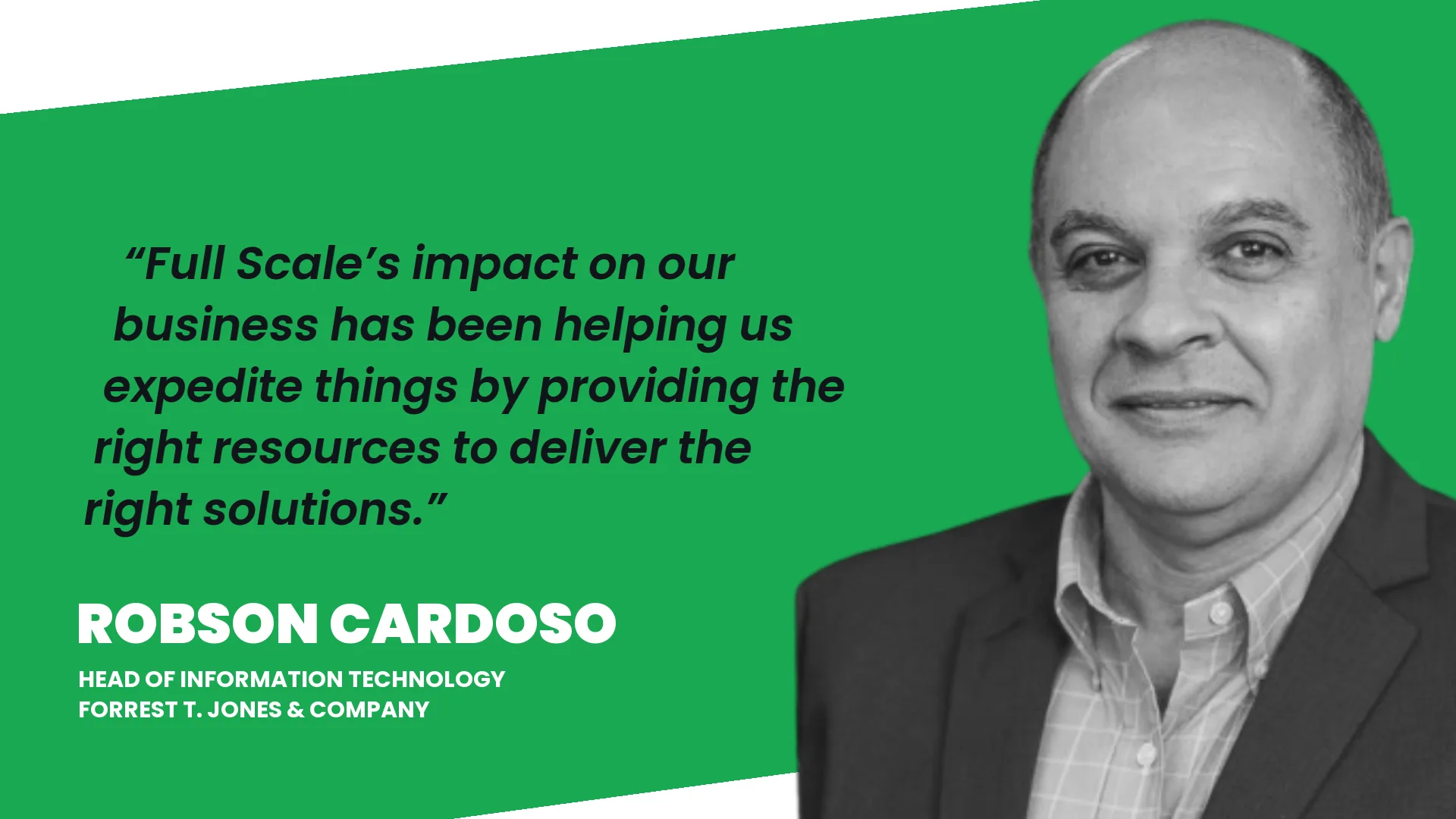
The fix is an order of operations. Figure out who can actually do the work and communicate with your team first. Then look at cost. Let price be a filter, not the goal.
2. Offshoring with no engineering leadership in-house
You cannot offshore software development well without a strong technical leader on your side of the table. A CTO, a VP of Engineering, someone in-house who owns the technical direction and can tell good work from bad.
This is the big one, and the one I’ll defend hardest.
Without that person, nobody is steering. The offshore team makes architecture calls in a vacuum. They build what they think you meant, you don’t catch the problems until they’re expensive, and you have no real way to judge whether the team is any good in the first place.
A non-technical founder hiring an offshore team with no engineering leadership is the most common way these projects die. I’ve watched founders lose six figures this way, convinced the developers were the problem when the actual problem was that no one was leading them.
Offshore developers execute. They don’t replace your need to lead the engineering.
If you don’t have technical leadership in-house, solve that before you hire a single offshore developer.
3. Handing over vague requirements
If you want rockstar developers, you first need rockstar requirements.
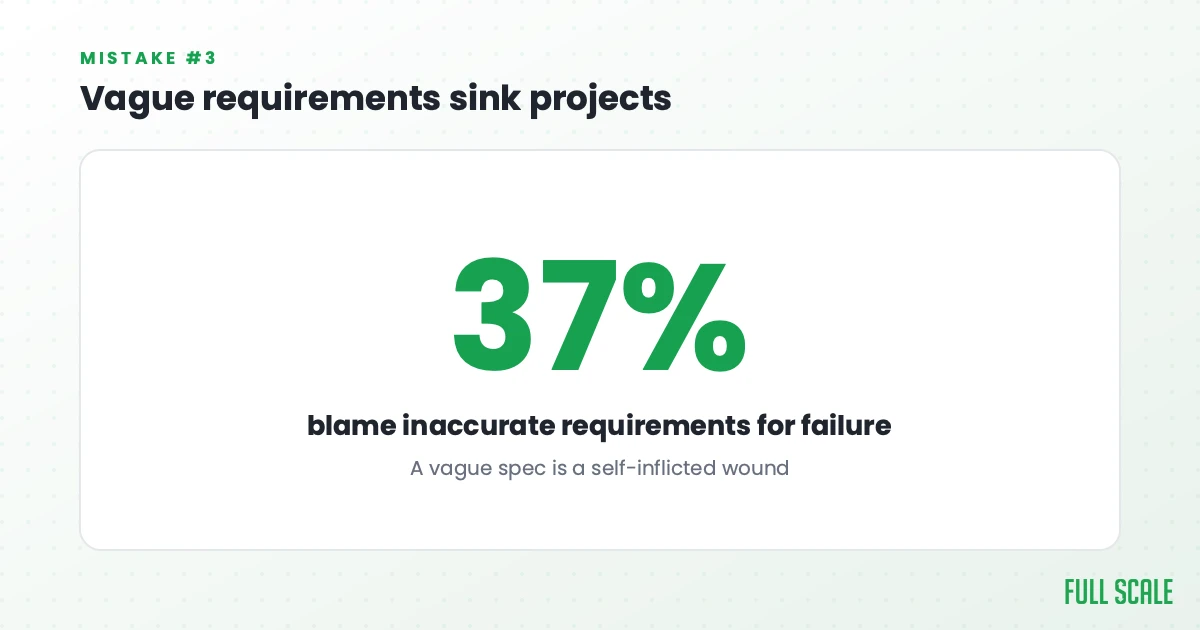
A lot of teams skip this. They hire the developers, then expect a clear product to fall out of unclear instructions. It doesn’t. About 37% of organizations name inaccurate requirements as a primary reason projects fail, and that gets worse when the team is offshore, because you can’t lean over a desk and clear up confusion in thirty seconds.
This is also the real answer to why offshore projects miss deadlines. It usually isn’t slow developers. It’s a team building the wrong thing, finding out three weeks later, and rebuilding it.
The fix isn’t a 60-page spec. It’s a clear product vision, written requirements that say what “done” looks like, and someone available to answer questions as they come up. Garbage in, garbage out applies to software more than almost anything.
4. Routing every decision through one project manager
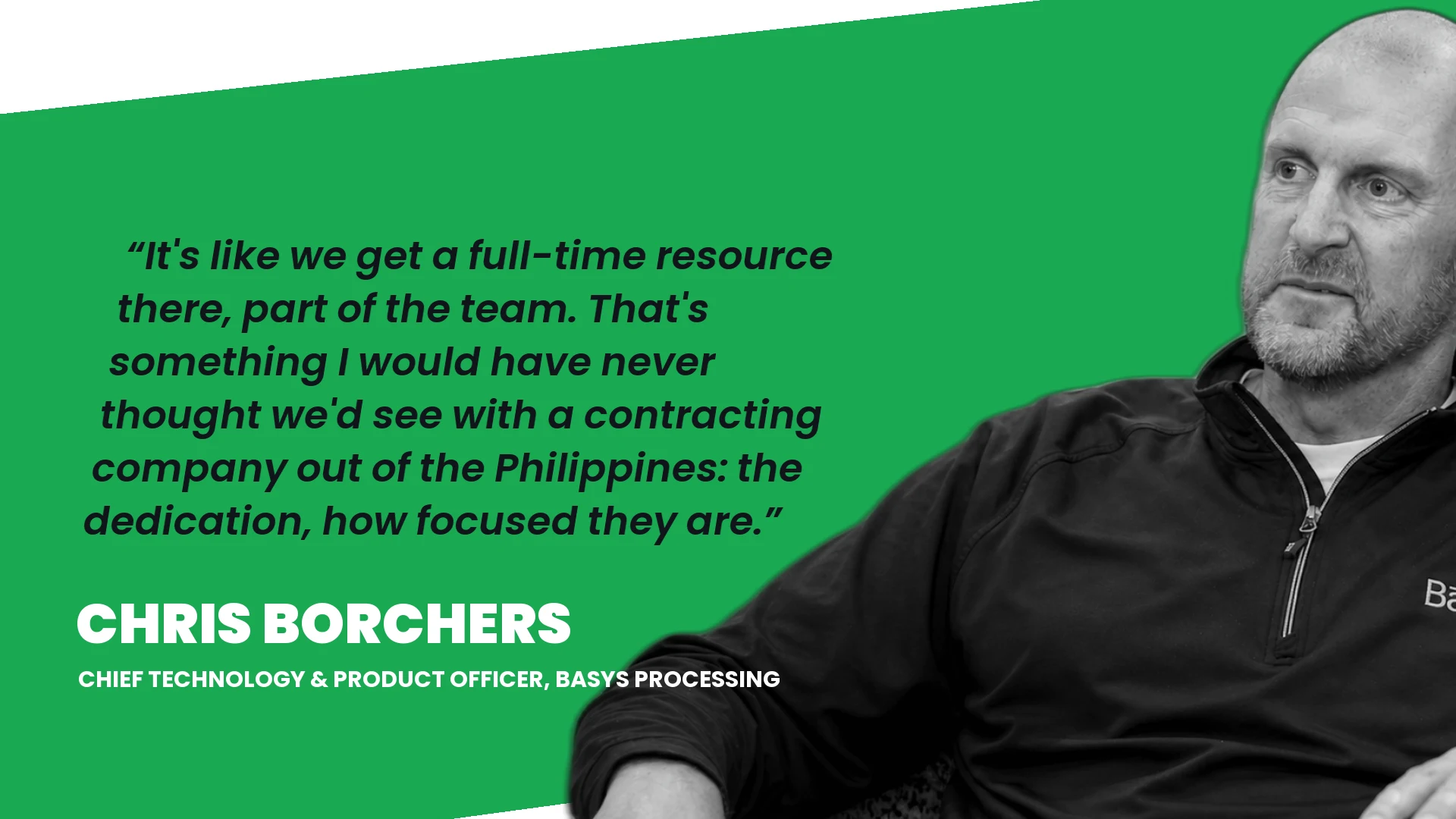
The client only ever talks to one person: a technical project manager. Every other developer hides behind that person. Sometimes it’s a language gap, sometimes it’s a cultural rule about who’s allowed to talk to the client. Either way, you end up managing a team you can’t actually talk to, with a middleman standing in front of every decision.
Here’s a failure mode I’ve seen kill more offshore engagements than bad code ever has.
Feedback gets diluted. Small questions take a day. You never build a relationship with the people actually writing your software.
Most offshore firms run this exact model on purpose, because it lets them swap developers in and out behind the curtain.
Your developers should talk to your team directly, the same way an in-house engineer would.
So talk to them directly. Put your in-house people and the offshore developers in the same channels, the same standups, the same calls. If a vendor won’t let you talk to the engineers, that tells you what kind of engagement it really is. (More on how this breaks down in communication problems on software teams.)
5. Outsourcing a project when you should be augmenting your team
There’s a real difference between handing off a project and adding people to your team, and picking the wrong one sinks a lot of engagements.
Traditional project outsourcing means you write a spec, a vendor disappears for a few months, and you hope what comes back resembles what you wanted. You give up control and the team gives up ownership. For your core product, that’s a bad trade, and it’s why so many offshore engagements fail on the model, not the developers.
Offshore staff augmentation is the opposite. You add vetted offshore engineers to your existing team and keep managing the work yourself. They sit in your roadmap, your sprints, your codebase. They own outcomes alongside your in-house people instead of shipping a deliverable and leaving.
The model matters more than the country. I’ve seen good developers fail inside a project-outsourcing setup and average developers thrive inside an augmented team, because the second model keeps everyone pointed at the same goal. (Offshore staff augmentation goes deeper on where each model fits.)
6. Starving the team of good tools
You’ve decided these developers are part of your team. Then you hand them a slow laptop and tell them to get by without the software licenses and AI tools the rest of your engineers use every day. That’s the cheap-labor mindset showing up again, this time in the equipment budget.
A developer is only as fast as what you put in front of them. If your in-house engineers get top-end machines, paid IDEs, and the current AI coding assistants, your offshore developers need the same. Skip it and you’ve hired good people, then capped how good they’re allowed to be, and you’ll wonder why the offshore team always feels a step behind. In an AI era that gap widens fast, because the work is moving toward developers who can drive these tools well.
This one genuinely surprises me about some of our competitors. At Full Scale we give every developer a high-quality laptop plus the licenses and AI tools the job needs, because they’re real engineers doing real work. Some offshore shops won’t even buy a decent machine. You can’t ask someone to build serious software on hardware you’d be embarrassed to use yourself.
Equip them like the team members they are.
7. Building your team one freelancer at a time
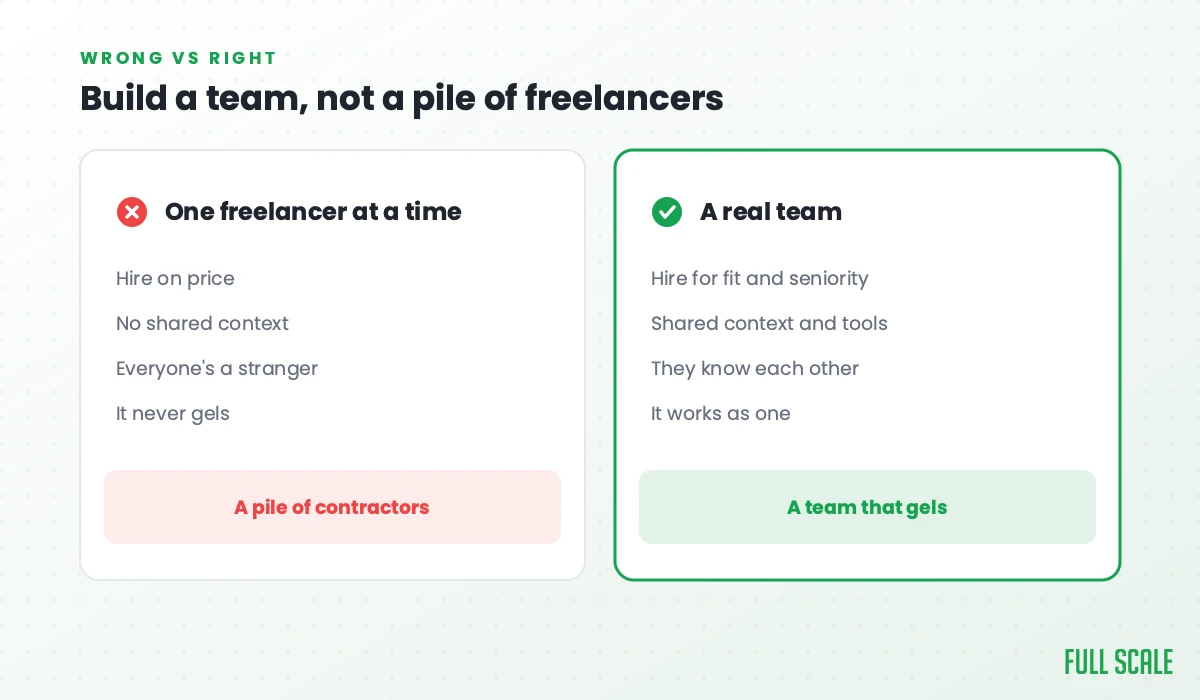
Trying to assemble an offshore team yourself, one Upwork hire at a time, looks cheap and ends up expensive.
You have to vet every candidate with no local context. You handle the contracts, the compliance, the payments, and the legal exposure in another country. You’re also handing your source code and data to someone you’ve never met, with whatever NDA and IP-assignment terms you can get a freelancer to sign. And freelancers leave. The good ones get a better offer and vanish mid-sprint, and you’re back to square one with no bench. These are some of the real challenges in offshore recruitment that don’t show up until you’re in them. The fix is structural, not a matter of trusting the right person, and it is the whole case for protecting software intellectual property through a U.S. contract.
There’s also a hiring truth underneath this. The best developers aren’t browsing job boards. They already have jobs and they aren’t applying anywhere. The people who flood a job post are often the ones who’ve applied to a hundred roles and landed none.
This is the actual value of a real partner. We keep full-time recruiters who pull passive candidates away from their current jobs, plus referrals from a team of 350-plus engineers. You get a vetted team and someone else handling HR, payroll, compliance, IP assignment, and security, instead of a pile of one-off contracts you manage alone.
8. Ignoring communication and cultural fit
Software development depends on communication more than anything else, more than the hourly rate, the framework expertise, or the time zone. Whether your team can actually talk to the people writing the code is what decides if this works.
So when companies pick a country first and worry about communication later, they’ve got it backward. The right question isn’t “where is it cheapest.” It’s “who can my team actually work with.”
This is why we chose software outsourcing to the Philippines. It’s the third-largest English-speaking country in the world, and Filipino engineers grow up on American culture, so they catch the references and the working style without a translation layer in between. They’ll speak up when a spec is wrong instead of quietly building the wrong thing. That willingness to talk is worth more than a slightly lower rate.
Pick for communication first, then look at cost, and let the country fall out of those two.
9. Treating time zone overlap as an afterthought
Time zones are the most overhyped offshore problem and still a real one if you ignore it completely.
You don’t need your team awake at the same hours all day. You do need a few hours of real overlap for standups, quick decisions, and the back-and-forth that email can’t handle. A team with zero shared working hours and no async discipline will stall.
Treating the gap as an afterthought is the same hand-off reflex in another form. So plan for it: set a couple of hours of guaranteed overlap, run the rest of the work asynchronously with clear written updates, and stop pretending the gap isn’t there. Done right, the time difference can even work for you, with progress landing overnight.
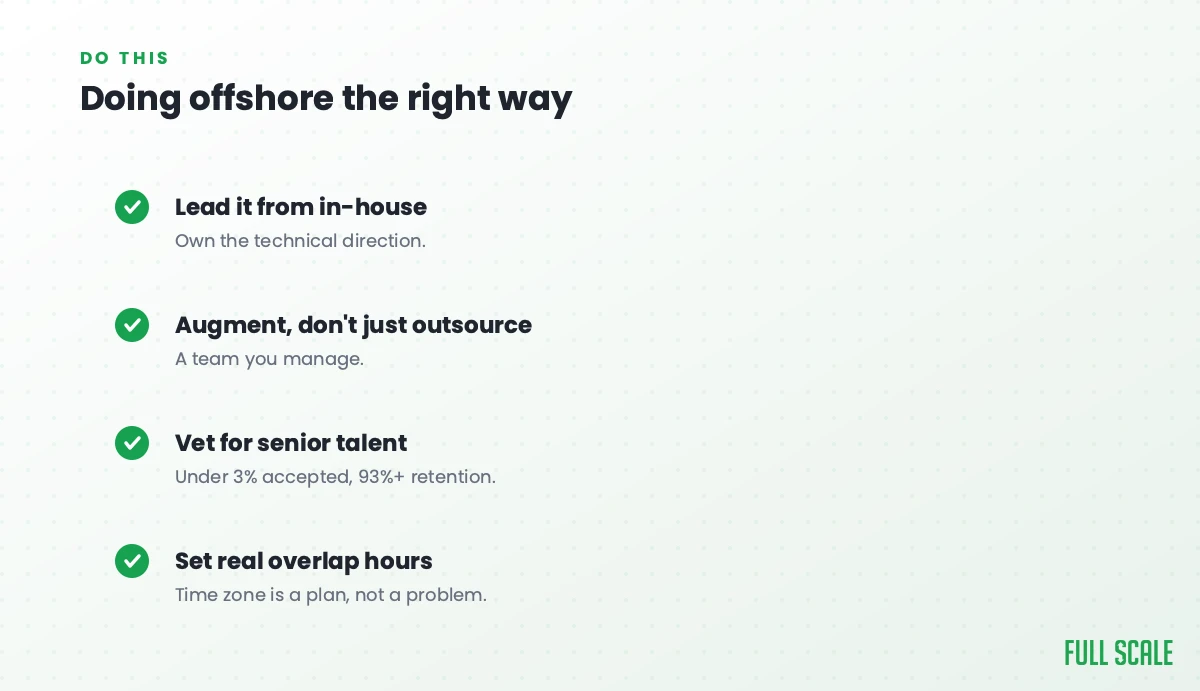
Doing offshore the right way
None of these mistakes are really about the developers. They’re about how the company set up the engagement, and they all come back to that same hand-off mindset, the root cause behind why outsourcing fails more broadly than just offshore. Notice that: every one of them has that in common. Get the setup right and the rest follows, including what actually motivates an offshore team to do its best work.
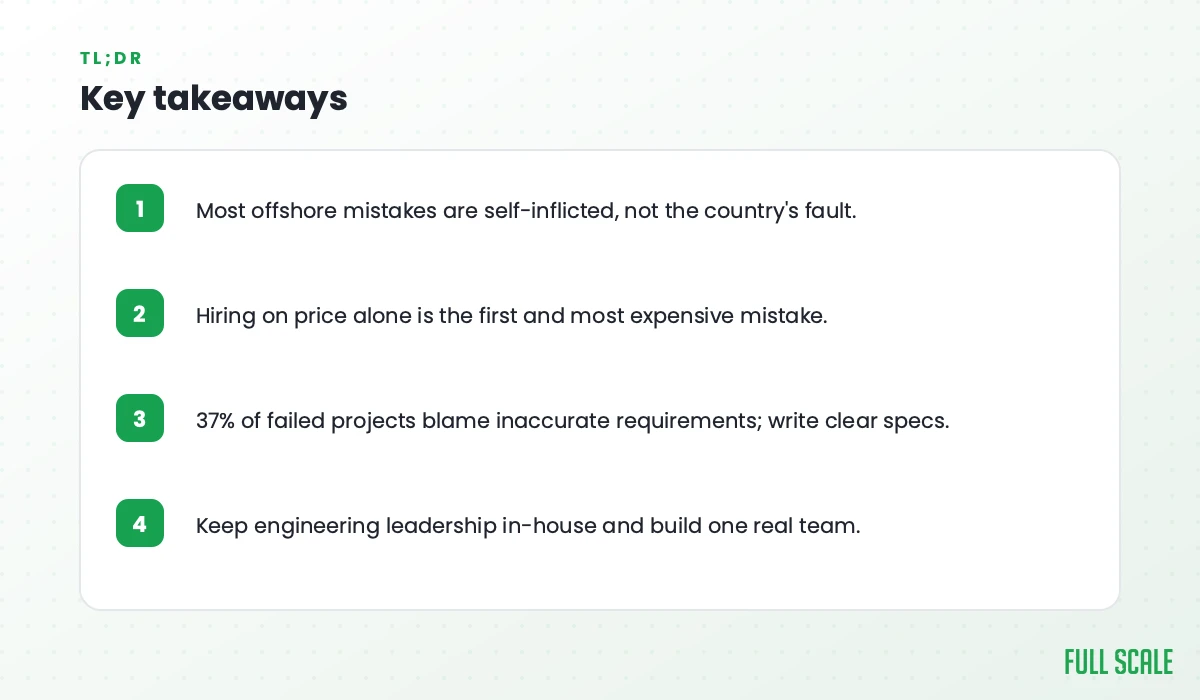
Flip the mindset and the whole thing changes. Keep engineering leadership in-house and write requirements that say what “done” looks like. Put your developers in the same channels as your team instead of behind a project manager. Augment your team rather than outsourcing the product, and let a partner carry the recruiting and retention so you’re not stitching it together one freelancer at a time.
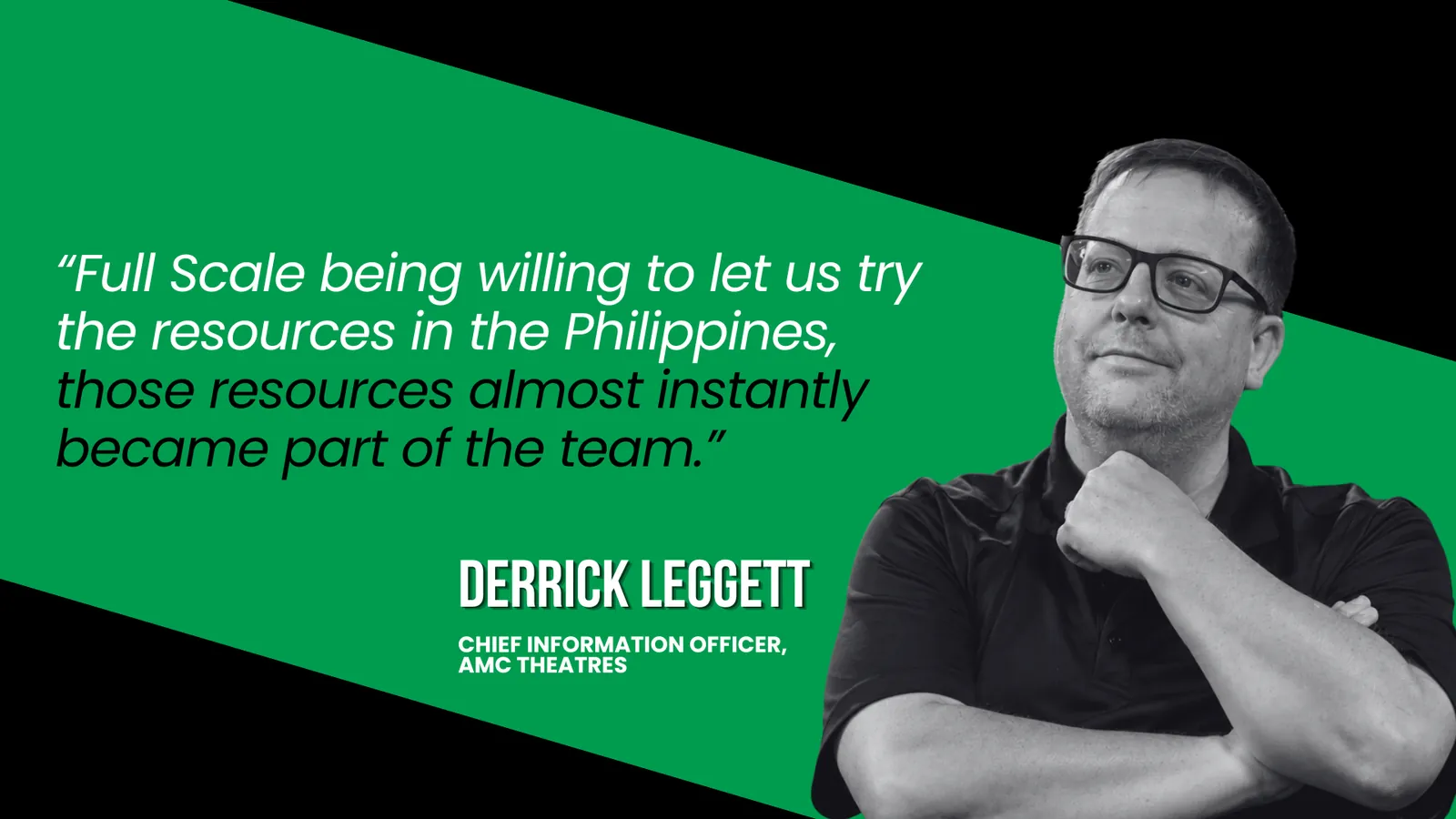
AMC Theatres is the best example I can point to. The developers we placed in the Philippines are treated as full AMC engineers, not as contractors. There’s no middleman in between, and they care about the product the same way the in-house team does. That’s what offshore looks like when none of these mistakes are in the way.
And yes, those engineers cost less than a US hire. That gap is cost of living, not a measure of worth. What stays identical is the standard you hold them to and the ownership you expect from them.
It also takes a stable team, which is why retention matters. Our developer retention runs 93%, and 95% of our Philippines employees say it’s a great place to work, against 65% at a typical company there. A team that stays is a team your product can actually rely on.
Offshore development isn’t risky because it’s offshore. It’s risky when you treat it like a shortcut. Treat it like building a real team, because that’s what it is, and most of these mistakes never get the chance to happen.
If you want the longer version of how I think about building software teams, it’s the core of my book, Product Driven. And if you’d rather just talk through your own situation, let’s talk about your offshore team.
Frequently Asked Questions
What is the most common offshore development mistake?
Hiring on price alone, what I call cheapshoring. Picking the cheapest developer or vendor and ignoring quality, communication, and fit almost always costs more in rework and delays than you saved on the rate. The cheapest developer is rarely the cheapest outcome.
Why do offshore development projects fail?
Most failures come from how the engagement is set up, not from the developers. The usual causes are no in-house technical leadership, vague requirements, a project manager who’s the only point of contact, and outsourcing a whole project instead of augmenting your team. They all trace back to treating offshore as cheap labor you hand off rather than a team you lead.
Why do offshore development projects miss deadlines?
It’s rarely slow developers. Most delays trace back to vague requirements: the team builds the wrong thing, finds out weeks later, and has to rebuild it. Routing every decision through one project manager makes it worse, since even small clarifications take a day to get answered.
Do I need a CTO or technical lead to hire an offshore team?
Yes. You need someone in-house who owns the technical direction and can judge the quality of the work. Without that, the offshore team makes important decisions in a vacuum and you can’t tell good output from bad until it’s expensive to fix.
Is staff augmentation better than project outsourcing for offshore work?
For your core product, usually yes. Staff augmentation adds vetted engineers to your existing team while you keep control of the roadmap and the work. Project outsourcing hands the whole thing to a vendor and gives up both control and ownership, which is where a lot of offshore engagements go wrong. The other mistake is waiting too long to say something, since how quickly performance problems get handled decides whether a small issue stays small.
How do I avoid hiring bad offshore developers on platforms like Upwork?
Hiring one freelancer at a time means you carry all the vetting, compliance, and turnover risk yourself, and the best developers usually aren’t on job boards at all. Working with a partner that recruits passive candidates and handles HR, payroll, and retention gives you a vetted team instead of a stack of one-off contracts. That’s the difference a good partner makes, and it’s why so many CTOs come to us specifically to bring on offshore developers instead of managing freelancers one at a time.