
Staff Augmentation Markup: What Vendors Charge and Where the Money Goes

In this article
- Staff augmentation markup and margin are two different numbers
- Where the bill rate goes
- Why the margin shrinks as pay rises
- Why a 30 to 50 percent margin becomes 15 to 20 percent profit
- Fees that sit outside the rate
- Source code security and the Data Privacy Act
- Questions to ask before you sign
- Frequently asked questions
- What to do next
Quick Answer: Staff augmentation vendors earn a margin, which is the share of the bill left after paying everything it directly costs to employ the developer. At Full Scale that margin runs 30 to 50 percent of the bill rate, and it is lower on developers who earn more. Quoted as a markup on cost, the same dollars sound like a bigger number.
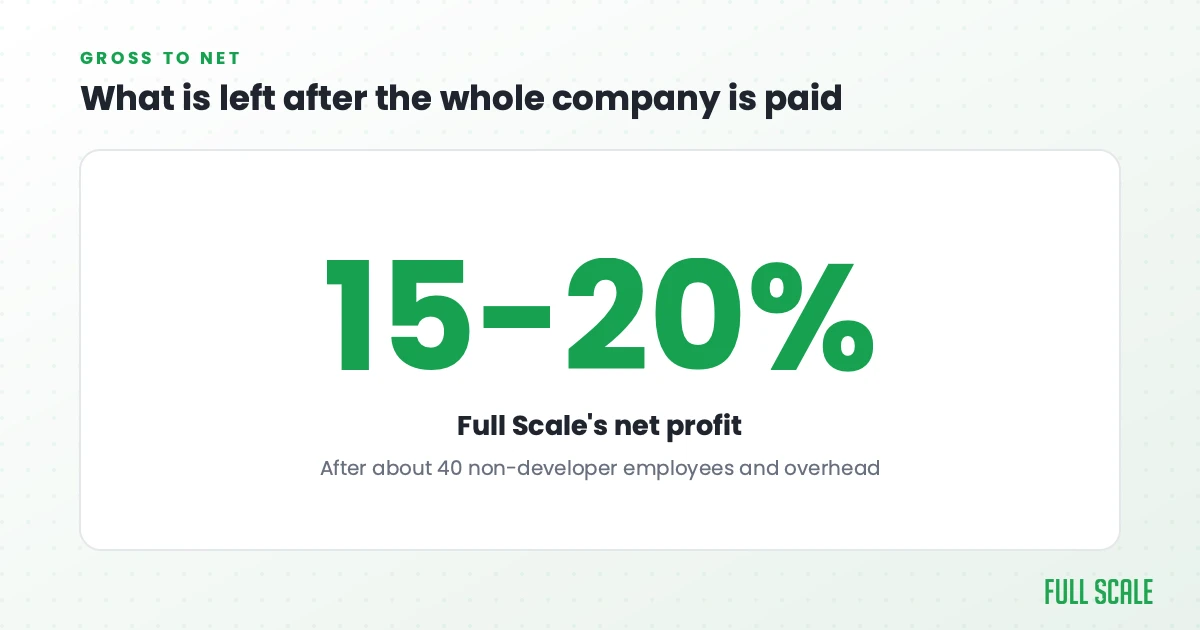
I run one of these companies, so I'll show you the real numbers. Yes, the vendor CEO is about to explain why his own margin is fine, so check my math. Full Scale ends up with a 15 to 20 percent profit on what clients pay us. The distance between that and the margin above is the sales, operations and admin people who run the company, and the rest of this post walks through where the money goes.
The first thing to pin down is what a quoted percentage is a percentage of.
Staff augmentation markup and margin are two different numbers
Markup is a percentage of what the vendor pays. Margin is a percentage of what the client pays. The two only look alike at small numbers. Oracle's staffing documentation gives the formula: margin equals markup divided by one plus the markup.
Say a developer costs a vendor $50 an hour and the vendor bills $75. The profit is $25. Against the $50 cost, that's a 50 percent markup. Against the $75 bill, it's a 33 percent margin. Same invoice, two numbers.
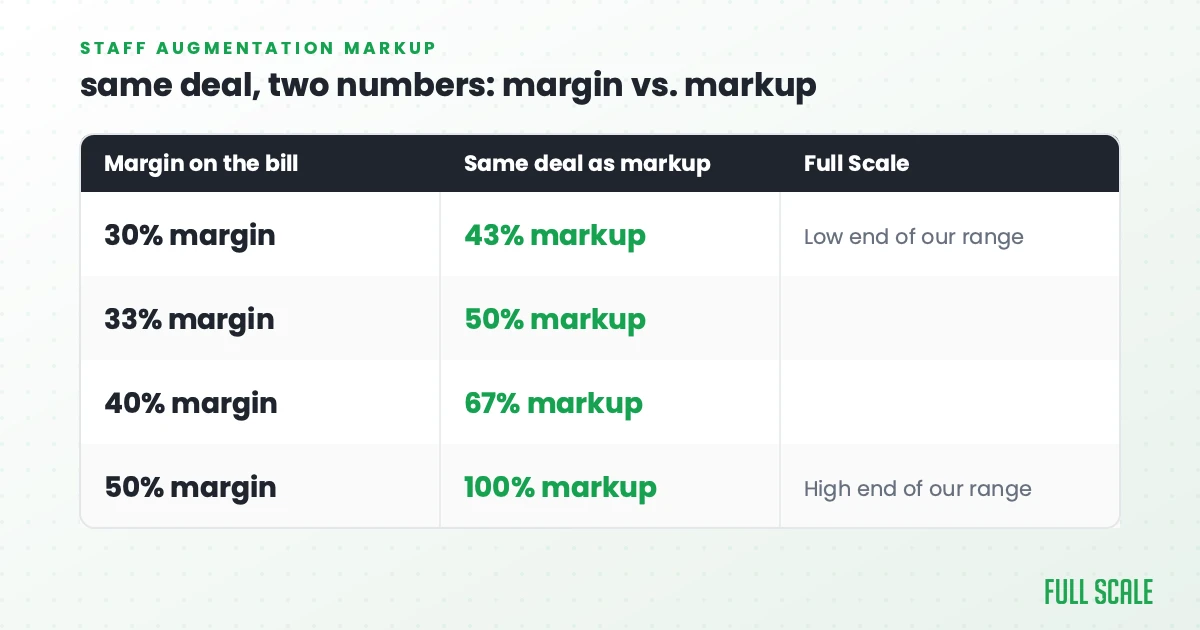
A vendor that keeps a 50 percent margin, as Full Scale does on some roles, is charging a 100 percent markup on its own costs. Here is the conversion for the margins you're likely to see quoted:
| Margin on the bill | The same deal as a markup on cost |
|---|---|
| 30% | 43% |
| 33% | 50% |
| 40% | 67% |
| 50% | 100% |
Every sales rep alive has noticed that "a 50 percent margin" sounds friendlier than "a 100 percent markup." Guess which one shows up in the pitch.
The Resource Company puts IT staffing markup at 30 to 50 percent over the worker's pay, and I walk through how vendors build that number in the staff augmentation pricing model breakdown. Converted, that is roughly a 23 to 33 percent margin, though I can't tell which base those sources measure from. Ours starts around the same place and runs higher on roles where the developer earns less.
One more catch. "Cost" can mean the developer's base pay alone, or everything the vendor spends to employ them. A markup on base pay looks bigger than a markup on full cost, because the full cost is the larger number. Ask which one before you compare quotes.
Where the bill rate goes
When a client pays Full Scale for a developer, the money goes to five places before any of it becomes margin. Our margin is measured after all five.
What goes into the cost
- The developer's pay. The salary itself.
- 13th month pay. Philippine law requires one extra month of pay, one twelfth of annual basic salary and due by December 24, under the 13th month pay rules. That adds about 8.3 percent to annual pay.
- Government contributions and other employer taxes. The employer pays into three programs. SSS, the social security system, takes the larger share from the employer, 10 of the 15 points at the current rate. PhilHealth charges 5 percent of basic salary, split between employer and employee, on pay up to a ceiling of ₱100,000 a month. Pag-IBIG, the housing fund, takes 2 percent of a salary capped at ₱10,000, so the employer's share tops out at ₱200 a month. Add the other taxes an employer has to pay, and I put the total at about 5 percent of pay.
- Benefits above the legal floor. Health coverage that includes dependents, paid leave, and the other things our employee benefits cover. The legal minimum won't keep a good engineer.
- Equipment. The laptop and the gear that goes with it, already inside the rate, so you won't see a separate hardware line.
What it looks like at two pay levels
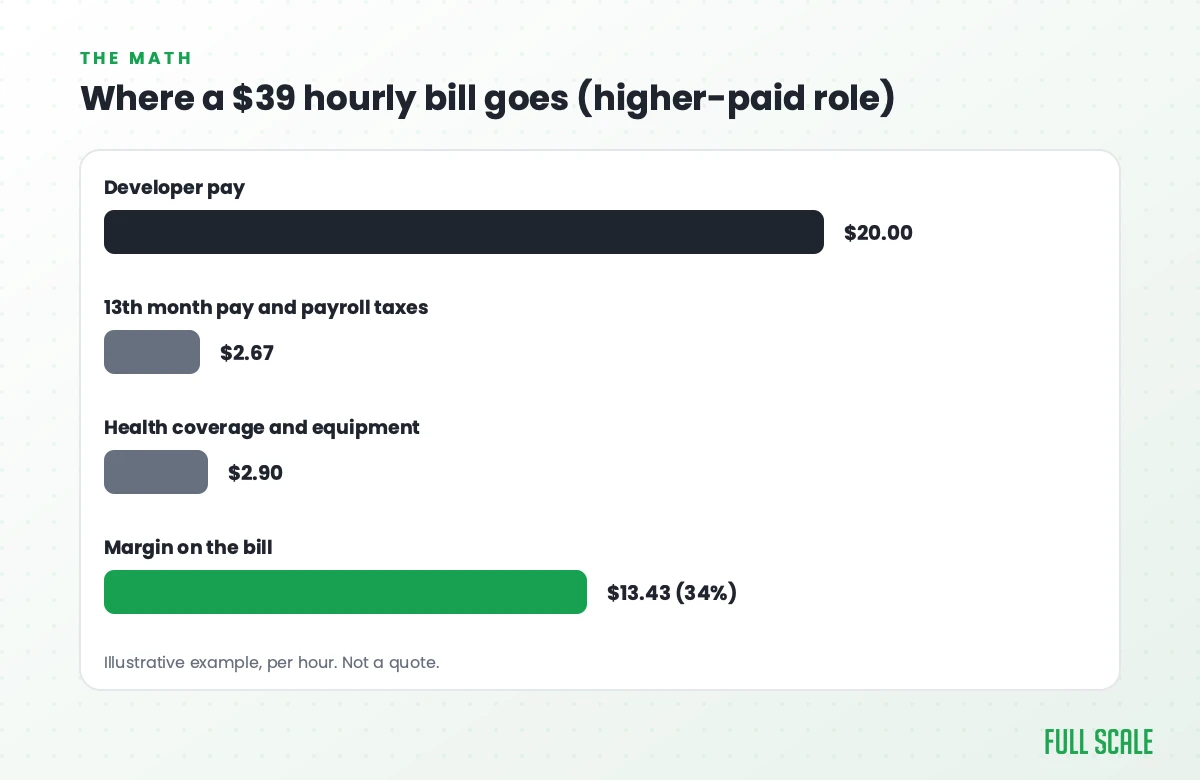
Here is what that looks like at two pay levels, using Philippine developer pay as the starting point. Treat these as simplified examples of a generic vendor rather than a quote or our price list.
| Illustrative cost per hour | Lower-paid role | Higher-paid role |
|---|---|---|
| Billed to the client | $28.00 | $39.00 |
| Developer pay | $11.00 | $20.00 |
| 13th month pay | $0.92 | $1.67 |
| Health coverage and other benefits | $2.40 | $2.40 |
| SSS, PhilHealth, Pag-IBIG and other employer taxes (5% of pay) | $0.55 | $1.00 |
| Equipment | $0.50 | $0.50 |
| Total direct cost | $15.37 | $25.57 |
| Margin in dollars | $12.63 | $13.43 |
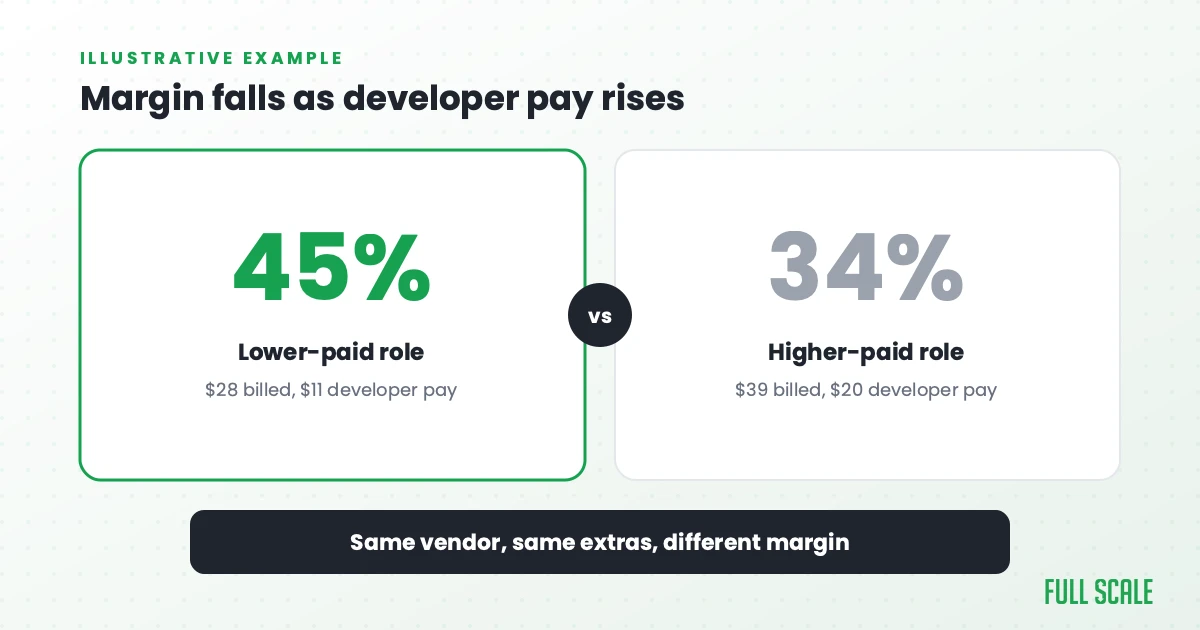
| Margin on the bill | 45% | 34% |
| Same deal as a markup on cost | 82% | 53% |
Both margins land inside our 30 to 50 percent range. The higher-paid developer earns $9 an hour more and the rate rises $11, so the vendor's dollars barely move while its share of the bill falls from 45 percent to 34.
Why the margin shrinks as pay rises
The vendor's costs per developer are mostly fixed, and pay is the part that moves. Health coverage and equipment cost about the same for an $11-an-hour engineer as a $20-an-hour one. Only the pay itself, the 13th month and the payroll taxes rise with every peso.
Meanwhile we work to keep our rates down on the higher-end developer roles. A role that's cheaper to employ leaves more room in the rate, and a developer whose pay is already high leaves less.
A vendor's margin is usually a bigger share of the bill on a lower-paid placement than on a higher-paid one. I'd want to know who is proposing my team and why, and I'd tell you the same about any vendor, ours included. The best engineers cost more to employ, and our margin on them is thinner.
A thin margin isn't automatically a bargain for you either. A vendor that wins your business at a 10 percent margin has to find the savings somewhere, and the usual place is developer pay and everything that keeps developers around. I call this cheapshoring, and it shows up on your side of the contract as turnover.
Why a 30 to 50 percent margin becomes 15 to 20 percent profit
I'd love to tell you the gap between a 30 to 50 percent gross margin and a 15 to 20 percent net profit is a yacht. It's payroll.
About 40 people at Full Scale never write a line of code for a client. They work in admin, sales, marketing, operations, and the other jobs a company this size can't skip. They have salaries, benefits, and managers of their own. On top of that sits the overhead of running a real company in two countries, including what we pay developers while they're between clients. That bench time isn't in the gross margin either.
That is where the gross margin goes. The 30 to 50 percent covers the developers, and the 15 to 20 percent that's left is what remains after the people who find them, support them, and keep them are paid for. My guess is that other vendors' numbers look similar, but I haven't seen anyone else's books, so I won't claim it as a fact.
Going direct is the other option. If you hire through an employer of record or recruit the developers yourself, you skip the vendor's margin and take on the work it pays for: finding engineers, replacing the ones who leave, and running payroll in a country you may not know. That's a fair trade if your team already recruits well there. If it doesn't, the margin is what you pay for that work.
The takeaway for a buyer is practical. A vendor's gross margin tells you how much of your invoice reaches the developer's side of the business. Its net margin tells you whether the company can afford to keep its promises. Replacing people who leave and holding 93 percent retention both cost money that only a healthy margin pays for.
Fees that sit outside the rate
Some vendors charge setup, facility, deposit, or cancellation fees on top of the rate, and the table below lists what to ask about each.
| If the quote includes... | Ask this | What it tells you |
|---|---|---|
| A per-developer setup or onboarding fee | What does it cover, and is it refundable? | Some vendors charge a setup fee per developer. A fee that isn't refundable on a bad fit is cost you carry alone. |
| A separate facility or services fee | Is the laptop, office, and IT support inside it? | Emapta lists salary, a services fee, and facility costs as separate lines. Sourcefit says its price is all-inclusive with no setup fee. Neither is wrong, but you can't compare them without adding the lines up. |
| A deposit or recruitment retainer | When is it due, and what do I get if the search fails? | I couldn't find a public statement on either from the vendors I checked, so ask before you assume. |
| A cancellation clause | How many days' notice, and is there a minimum term? | Long minimums mean you're paying for developers you've already decided to drop. |
Full Scale has no setup fee and no retainer, just a monthly fee. The first two weeks come with a money-back guarantee, and after that you can drop a developer with 30 days' notice. Developers can start in as little as 7 days. We quote one all-in rate and don't itemize it for clients, which is why this article shows the math.
Source code security and the Data Privacy Act
The Philippines' Data Privacy Act, Republic Act 10173, protects personal data, meaning information about identifiable people, and doesn't protect your source code itself. People often assume it does. Any personal data inside a repository is covered, and this isn't legal advice, so confirm the details with Philippine counsel.
Your code is protected the way it is anywhere else: a contract that assigns the intellectual property to you, access controls on the repository, and an employer who actually enforces them. The legal requirements post covers the contract side in detail. For this article, the point is narrower. Ask a vendor how it controls repository access and who owns the work, and treat the privacy law as a separate question about customer data.
Questions to ask before you sign
In 2012 I paid Kansas City rates for two developers in St. Petersburg and had no idea what was inside the number, which is the story behind the pricing model post. These are the questions I'd have wanted to ask.
| Your situation | What to ask | A good answer sounds like |
|---|---|---|
| You've been quoted a percentage | Is that markup or margin, and on pay or on full cost? | A vendor that answers without hesitation and can show the math. |
| You're comparing two quotes | What's inside each rate, line by line? | The same five lines (pay, 13th month, government contributions and taxes, benefits, equipment) in both. |
| You plan to keep the team for years | What's your retention rate, and what does the margin pay for? | A published number, and a list that includes replacing people who leave. |
| The price is far below everyone else's | What are you cutting to hit it? | Specifics. Vagueness here usually means developer pay or benefits. |
| A vendor won't state its markup at all | What is the developer actually paid? | If they won't say, the answer is probably less than you'd want. |
If you want the broader context on how vendors structure their invoices, the staff augmentation guide covers the model itself. The ideas behind how we run Full Scale are in my book, Product Driven.
Frequently asked questions
What is the typical markup on staff augmentation?
IT staffing roles are usually quoted at 30 to 50 percent over the worker's pay. Check whether the vendor means markup on cost or margin on the bill, because a 50 percent markup is only a 33 percent margin. At Full Scale, gross margin on the bill rate runs 30 to 50 percent after every direct employee cost, including equipment.
What is the difference between markup and margin?
Markup is profit as a percentage of what the vendor pays. Margin is profit as a percentage of what the client pays. They describe the same dollars, so margin is always the smaller number: margin equals markup divided by one plus the markup. A 100 percent markup is a 50 percent margin.
What profit margin does a staff augmentation company make?
Full Scale's gross margin on the bill rate is typically 30 to 50 percent after all direct employee costs, including equipment, and it gets smaller as the developer's pay rises. Its actual net margin is 15 to 20 percent after about 40 non-developer employees in admin, sales, marketing, and operations, plus overhead, are paid for.
Why is the margin lower on higher-paid developers?
At Full Scale and most vendors, the other costs per developer, such as health coverage and equipment, stay roughly the same at any seniority, while a senior developer's pay is higher. Because Full Scale keeps its rates down on higher-end roles, more of the bill goes to pay and less is left as margin.
Are there setup fees or deposits for staff augmentation in the Philippines?
Setup fees and deposits vary by staff augmentation vendor. Some charge per-developer setup fees, some itemize facility costs separately, and some bundle everything into one rate. Ask for a written list of every fee outside the rate. Full Scale charges no setup fee and no retainer, just a monthly fee, with a two-week money-back guarantee and 30 days' notice after that.
Does the Philippine Data Privacy Act protect my source code?
The Philippine Data Privacy Act does not protect your source code itself. Republic Act 10173 covers personal data about identifiable people, including any inside a repository, but not the code. Source code is protected by an intellectual property assignment in your contract, access controls on the repository, and an employer that enforces them. Ask any vendor how it handles both.
What to do next
If you're holding a quote and can't tell what's in it, schedule a call and send it over. Full Scale's rate starts at $35 an hour fully loaded, and we'll talk through how it compares.