
Software Development Pricing Models: Which One Fits Your Project

In this article
- The six software development pricing models in one table
- Fixed price: you buy a scope, and the vendor prices the unknowns
- Time and materials: you buy hours, and you need a ceiling
- Retainer and dedicated developers: you buy capacity
- Outcome and milestone pricing: you buy a result, if anyone can define it
- Hybrids: fixed for the part you know, time-based for the rest
- Software development pricing models by situation
- What Full Scale sells, and what it costs
- Frequently asked questions
- Match the model to what you already know
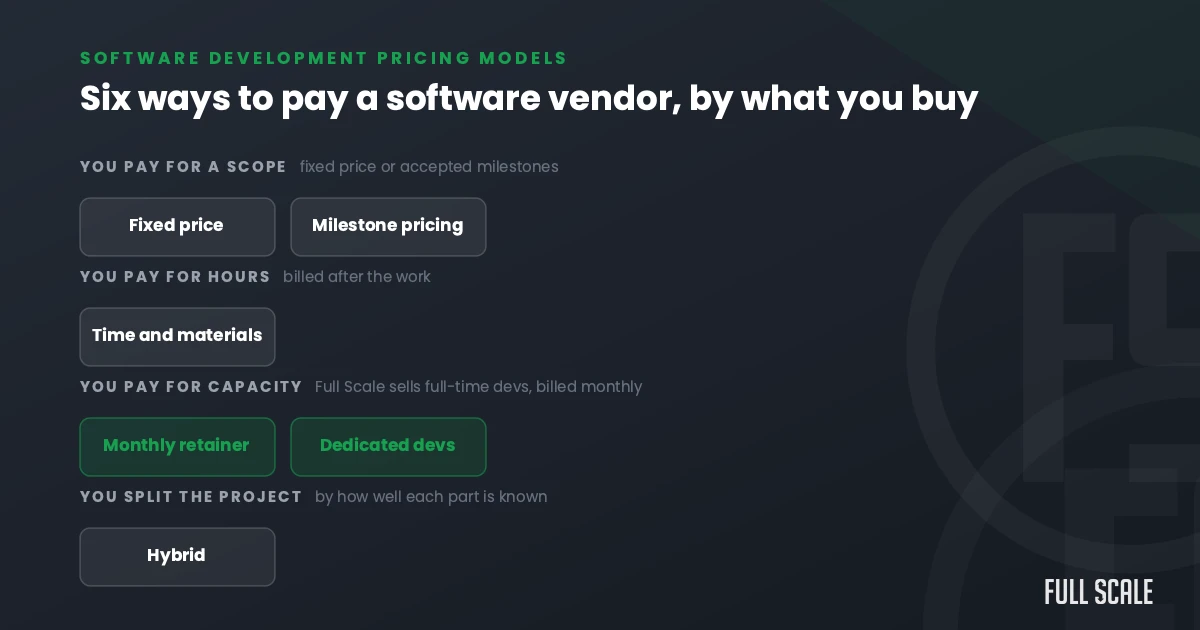
Quick Answer: Software development pricing models differ in what you pay for: a scope (fixed price, milestones), hours (time and materials), or capacity (a monthly retainer, dedicated developers). Use fixed price for small, written scopes, time and materials with a ceiling when you will learn as you build, and dedicated developers for a product that runs for years. Full Scale sells that last one: full-time developers billed monthly, with no hourly billing and no project work.
There are six different pricing models for hiring a software developer, and Full Scale offers one of them. I'll flag which model it is, so you can adjust your enthusiasm accordingly.
They are: fixed price, time and materials, monthly retainer, per person / per month, outcome or milestone-based pricing, and hybrids. Each model places risk differently, and the relevant question is where does the risk land once things change? This page has a summary of all six, including when to use which, and what happens when you don't. The rest is in the individual pages.
The six software development pricing models in one table
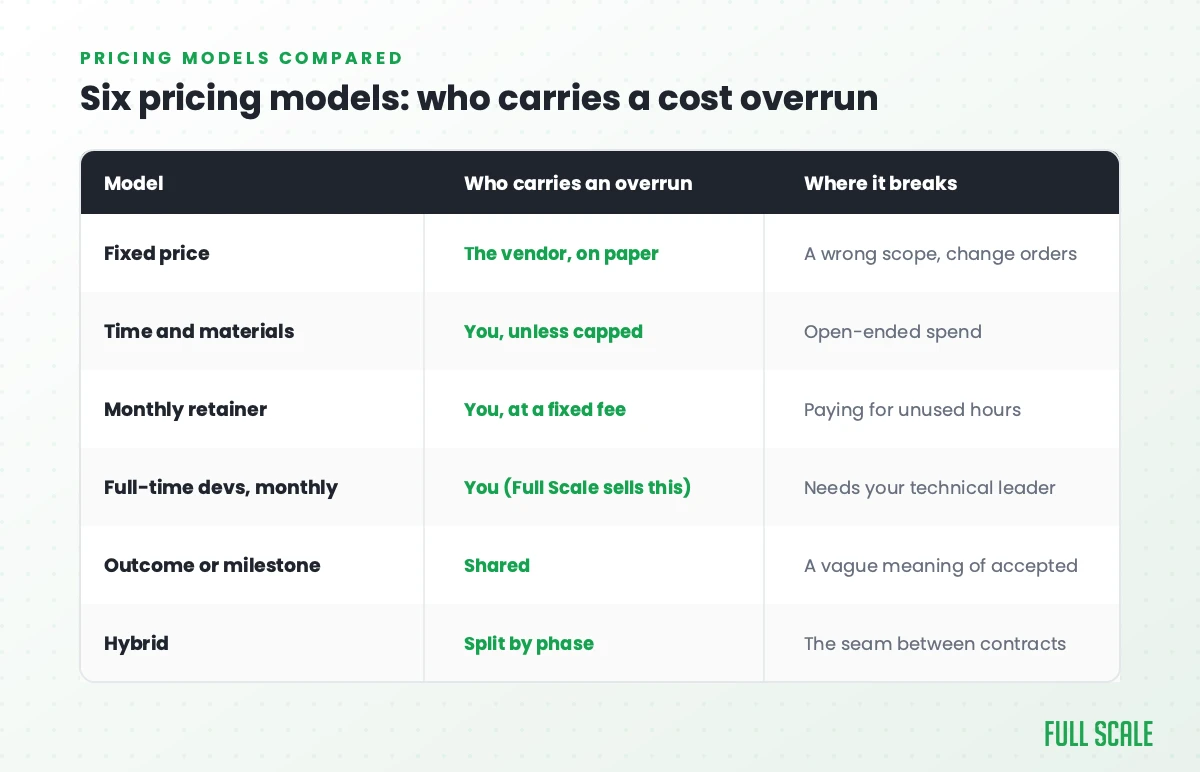
All software development models boil down to one simple thing: what do you get for your money? That determines where you take the hit if things go off budget. Below, the model Full Scale sells is marked. The other five are there for comparison:
| Model | You pay for | Who carries a cost overrun | Where it breaks |
|---|---|---|---|
| Fixed price | A defined scope at one price | The vendor, on paper | A wrong scope, a padded quote, change orders |
| Time and materials | Hours worked, billed afterward | You, unless there is a ceiling | Open-ended spend |
| Monthly retainer | A reserved block of a team's time each month | You, at a fixed monthly fee | Paying for hours nobody uses |
| Full-time dedicated developers, per person (Full Scale sells this) | A named full-time developer, billed monthly | You | It needs a technical leader on your side |
| Outcome or milestone | Accepted deliverables or results | Shared | A vague definition of "accepted" |
| Hybrid | Fixed for the known part, time-based for the rest | Split by phase | Two contracts and a seam between them |
Retainers and dedicated developers look similar on paper, but there's a crucial difference: who steers. A retainer usually gets you a vendor-run team that just takes requests, whereas a dedicated developer takes direction straight from you.
Fixed price: you buy a scope, and the vendor prices the unknowns
In a fixed price contract, there's one number, for one scope. The US government's procurement regulations state that this type places on the contractor "maximum risk and full responsibility for all costs and resulting profit or loss", and that is exactly why it's attractive.
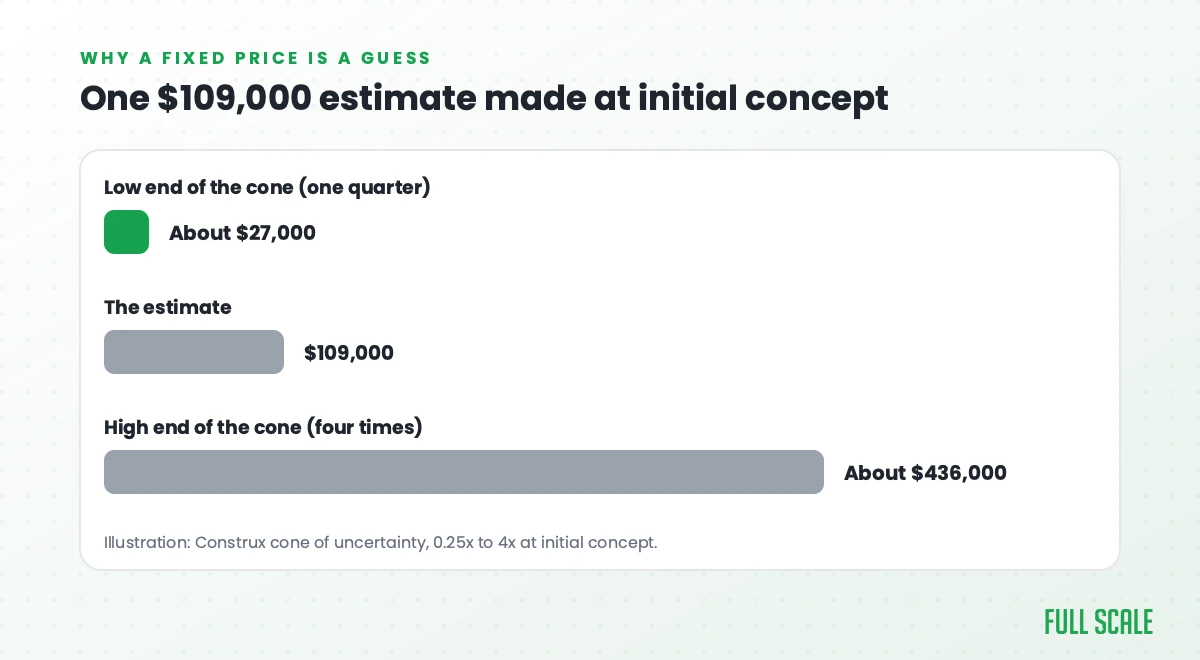
The trouble is when that number gets set. Steve McConnell's cone of uncertainty at Construx says that an estimate at initial concept could be wrong by 4 times in either direction, and a commitment made then or at product definition carries an error rate of 2x to 4x. So if your estimate was $109,000 at initial concept, that number could realistically become anything from $27,000 to $436,000. It's an example only, but a vendor that sees this will give you a quote at the top of the range.
Fixed price works best when the scope is small, clearly stated, and has been done before. We don't offer it, and I went into detail about why a bid doesn't usually make sense for product development in why a statement of work rarely fits product development. A more detailed argument against fixed bids can be found in fixed cost software development. The negotiating terms for both fixed price and time and materials are in fixed price vs time and materials.
Time and materials: you buy hours, and you need a ceiling
Time and materials bills you by the hour worked, leaving the risk of unknown costs on your shoulders and letting you change direction. The federal rulebook allows it only when it is not possible to accurately estimate the extent or duration of the work, and it warns the model gives the contractor "no positive profit incentive" for cost control. Its fix is a ceiling price that "the contractor exceeds at its own risk." That is the rule to borrow.
18F, the federal agency's internal software development group, recommends a time and materials contract with a ceiling on total spending and notes they offer "much easier escape clauses" in case things don't work out. Both require that you can review the product weekly and decide whether it meets your expectations.
Time and materials without a ceiling is a taxi ride with the meter running and no destination. Include the ceiling, rate card, and brief notice period, and it is the right contract type for work that you cannot fully define up front.
Retainer and dedicated developers: you buy capacity
Both sell capacity, which is reserved time for you, but neither sells a result. Where they diverge is in who executes. A monthly retainer reserves a block of the vendor's team for a month at a flat rate. It makes sense if you've got a steady stream of small jobs and you lack a technical leader in-house. Like a gym membership, the monthly fee is the same whether or not anyone actually uses their allotted hours. Make sure you know how any unused time is treated and who gets to decide what the vendor's team works on.
Full-time dedicated developers billed per person are named software engineers who work exclusively for you, take direction from your technical lead, and are billed a flat monthly rate for each individual. That's the model Full Scale offers, so my bias here is obvious: we don't bill by the hour, and we don't do projects. You can read about how we build a team in our dedicated team model guide, and you can see how other companies charge for this model in our staff augmentation pricing model article. The trade-off is direction, meaning a dedicated developer won't tell you what to build, which is your responsibility. If you don't have someone internally to prioritize and manage the work, you have a bigger problem than pricing, and you should probably start with a project agency instead.
Outcome and milestone pricing: you buy a result, if anyone can define it
Outcome-based pricing pays the vendor when a defined result is accepted, and milestone-based pricing pays in installments as each milestone passes review. This one wins the prize for the best marketing brochure because the vendor doesn't get paid if things don't work. The sticking point is the word "accepted."
If you write this up as something that can be tested, say, "an order placed on a phone completes in under three seconds," then the model works. If you write this up as "a modern, intuitive checkout," then you've just purchased a fixed price with a new name, plus an argument at every payment.
My advice, as an individual perspective rather than an evidence-based study:
- Each payment should correspond to a verifiable thing (working feature or passing test).
- Decide on a reasonable time to approve milestones; no delaying payments for a month at a time.
- Anticipate vendors rushing to each milestone and do your own quality assurance.
This is great for projects with checkable milestones and a deadline, e.g. compliance. Not great when you don't actually know what "done" looks like until users use it.
Hybrids: fixed for the part you know, time-based for the rest
The hybrids divide the work according to how well-understood it is, and nearly every actual project turns out to be one. The federal TechFAR Hub says exactly this: fixed price for work with well-understood requirements, and time and materials or labor hour for the parts with "considerable uncertainty."
A typical pattern for a new product would involve a discovery phase under a fixed-price contract that results in a written scope, then a build phase that's either capped T&M or dedicated developers.
The risk point is the interface. Discovery results can become stale very quickly, so minimize the time between the two stages and ask the build team to read through the discovery results.
Software development pricing models by situation
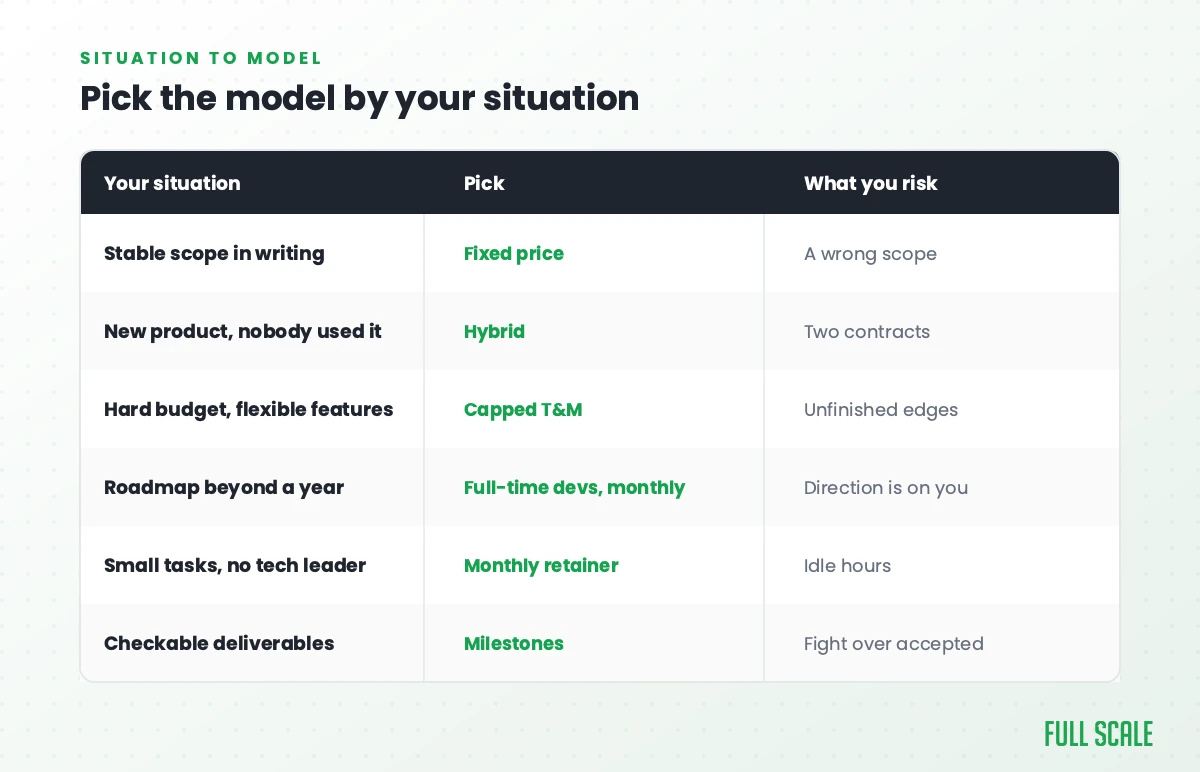
The right model depends on how much you know and who will manage the work. Here is Full Scale's recommendation for each scenario, along with the downside.
| Your situation | Pick | What you risk |
|---|---|---|
| Stable scope in writing, such as an integration against a documented API | Fixed price | A wrong scope, and every change becoming a change order |
| New product nobody has used yet | Hybrid: paid discovery, then capped time and materials or full-time dedicated developers | Two contracts, and discovery notes that age fast |
| Hard budget, flexible features | Time and materials with a ceiling and a ranked backlog | Reaching the ceiling with the edges unfinished |
| A product with a roadmap beyond a year and your own technical leader | Full-time dedicated developers billed monthly | Directing the work is on you, and billing continues until you give notice |
| A steady stream of small tasks and no technical leader | Monthly retainer with a vendor-run team | Paying for idle hours |
| Phased work with checkable deliverables and a fixed date | Milestone pricing | A fight over what "accepted" means |
If you see yourself in more than one of these, it's most likely the second row. And if the lowest price in any of them feels too good to be true, remember what I call cheapshoring, which is buying on price alone. There's no pricing model that can prevent that mistake.
Before you commit, ask the vendor what they would charge for the next change request they anticipate. A vendor that has been there will give you an answer straightaway. A vendor that hasn't will go on about flexibility.
If you're gathering proposals, our software development RFP guide explains how to include asking for the pricing model as a question, and how to estimate software development cost outlines how to get an estimate before any of this gets started.
What Full Scale sells, and what it costs
Full Scale sells full-time dedicated developers, billed monthly per developer, and does not do hourly billing or fixed-bid work. The rate starts at $35/hour fully loaded (that's how we express it, so that you can compare it to other quotes), which works out to roughly $6,070/developer-month ($35 × 2,080 hours ÷ 12). The exact rate depends on the seniority, skill, and size of the team. On average, Full Scale clients save 50 to 70% compared to a similar US-based hire. For perspective, the median software developer in the US makes $135,980 a year, per the Bureau of Labor Statistics (before benefits and overhead).
So for example, two developers for nine months at the entry rate would be approximately $109,000. This is math, not a quote, because the rate depends on the developers.
Here are the terms: work can start in as little as 7 days; if it isn't working out in the first two weeks, you get your money back; after that you can drop a developer with 30 days' notice; and there's no long-term contract. The contract has a disclosed annual rate step-up. The contract terms worth negotiating are detailed in our blog, as is what happens when it isn't working out. And you can see the numbers per role on the pricing page.
I recommend this option if you have a technical leader and a product that will continue to evolve, which is what our staff augmentation services are designed for, and where our engineers have been trained, as detailed in my book, Product Driven. Otherwise, choose one of the other rows in the table. A fixed-bid from another company may be just the right fit for the right project.
Frequently asked questions
What are the main software development pricing models?
The main software development pricing models are fixed price, time and materials, a monthly retainer, dedicated developers billed per person, outcome or milestone pricing, and hybrids of these. They differ in what you pay for: a defined scope, hours worked, reserved monthly capacity, or accepted deliverables. The model decides who carries the cost risk and who carries the scope risk.
Which software development pricing model is best?
No single model is best. Fixed price fits small, written, well-understood work. Time and materials with a spending ceiling fits work you will learn about as you build. Dedicated full-time developers billed monthly fit a product that will run for years under your technical leader. A hybrid fits a new product that needs a paid discovery phase before a build.
What is the cheapest software development pricing model?
The cheapest model on paper is usually fixed price, because the quote is one number, but the vendor prices its risk into that number and charges for changes later. The cheapest in practice is the one that matches how well you know the scope. Location moves cost more than any model. Full Scale's full-time developers start at about $6,070 a month, which is $35 an hour fully loaded, and clients typically save 50 to 70 percent against a comparable US hire.
What pricing model does Full Scale use?
Full Scale places full-time dedicated developers who work only for one client under that client's direction, and bills a flat monthly amount per developer, with rates starting at $35 an hour fully loaded. It does not bill hourly and does not take on fixed-bid or project work. Clients get a two-week money-back guarantee, then can end the arrangement with 30 days' notice, and there are no long-term contracts.
Is outcome-based pricing better than time-based pricing for software?
Outcome-based pricing is better only when the outcome can be written as a test someone can run. Without that, the dispute moves from the hours to the definition of done, and the model turns into a fixed price with a nicer name. Time-based pricing, billed by the hour or by the month, is more honest for work whose result you will only discover by building it.
Match the model to what you already know
If your spec is written down and boring, buy it fixed.
If you'll learn while building, pay by time with a cap.
If your product is going to live on after the project, hire a full-time team.
If you're not sure which bucket you're in, tell us what you're building and we'll tell you honestly, even if it's "get a fixed bid elsewhere."