
AI Proof Interview Questions for PHP Developers

In this article
Most PHP developer interview questions stopped working the day your candidate started using AI.
Think about what those questions usually test. Explain the difference between == and ===. Compare an abstract class and an interface. Walk me through what happens between a request and a response. Reverse a string without the built-in function. For two decades those were the standard screen, and they made sense when the only place to get the answer was the developer’s own head. If the language itself is still open, see PHP vs Node.js.
That assumption is gone. Any candidate with ChatGPT open in another tab can answer every one of those in seconds, and answer them well. The knowledge still matters. You cannot debug a type-juggling bug or judge whether a Laravel app is structured well without it. But you can no longer use those questions to screen, because a clean answer no longer tells you whether the person memorized it, looked it up, or has actually shipped enough PHP to know it cold. AI broke the link between fluent recall and real experience.
There is a second shift, and it is the bigger one. The job itself changed. AI writes most of the boilerplate now, which means the part of the work that is actually scarce moved up the stack. The value of a senior PHP developer is no longer how fast they type. It is their judgment: knowing which structure earns its complexity, where a query will fall over at scale, when user input becomes an attack, and what to build in the first place. Pure coders will be replaced by AI. Problem solvers will run technology organizations. That shift is why the PHP developer job description has to lead with judgment, not syntax.
So the questions have to change too. I have been shipping software for more than twenty years, and PHP has been in the mix the whole way, from the early LAMP days through the Laravel and WordPress work my teams run now. At Full Scale we vet every PHP developer on real architecture and production problems, not syntax quizzes, before they ever touch a client team. This is the question set we actually use to find the developers who think.
Why the old PHP questions stopped screening
The trivia question rested on one assumption: that recall was a proxy for skill. If you knew when to use a prepared statement or how autoloading worked, you had probably built enough to internalize it. The recall was a shortcut to the real thing.
AI broke that shortcut. A developer who has never run a production PHP app can now explain the service container as fluently as one who has shipped a dozen. You are no longer measuring what you think you are measuring. The trivia is still worth knowing. It just stopped being worth asking, because everyone passes now and a pass tells you nothing.
The work that remains is the work AI cannot do for you. A coding tool will happily generate an Eloquent query. It cannot tell you that the query fires once per row and will melt your database the day a customer has fifty thousand records, or that the form it just wired up trusts user input it should never trust. Those are judgment calls, and judgment is what you are hiring a senior person to bring.
Here is the trap to avoid. When syntax is free, it is tempting to hire the cheapest developer who can pass the puzzle. That is a mistake I named cheapshoring: hiring for cost alone, treating engineers as interchangeable bodies that type PHP. It was always a bad bet. In the AI era it is a worse one, because the thing you saved money on is the thing AI already does for free. The judgment you actually need still costs what it always did.
A quick translation of the shift, in PHP terms:
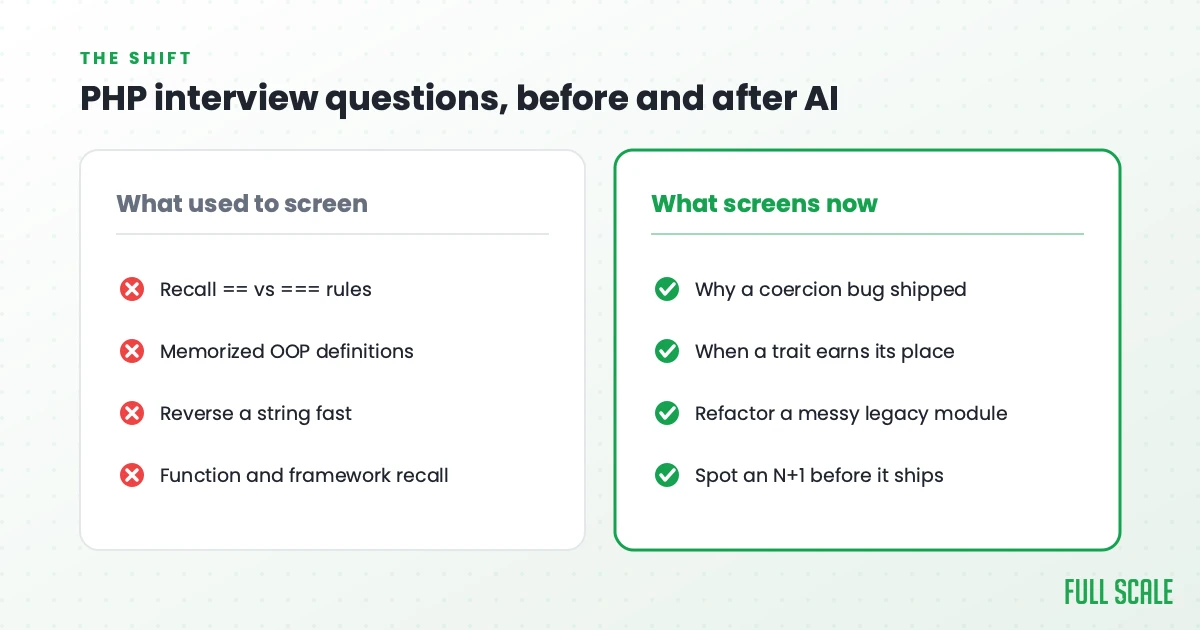
| What the old questions tested | Why it no longer screens | What to test instead |
|---|---|---|
Recall of == versus === and type juggling | AI answers it instantly; everyone passes | Reasoning about a type-coercion bug that reached production |
| Memorized OOP definitions (traits, interfaces) | Free to look up; can’t tell who has shipped | When a trait or a repository layer earns its complexity |
| Reverse a string or sort an array fast | AI writes it; the job is rarely this | How they decompose a messy legacy module |
| Function and framework recall | AI fills the gap in seconds | Whether they spot an N+1 query before it ships |
What to interview for instead
If recall no longer screens, what replaces it? Five things, and they line up with the five groups of questions below.
Design and architecture judgment. Whether they can defend a structural choice and name its trade-offs. The pattern they happened to memorize is the least interesting thing about them. Writing PHP is not the same as building something that survives real traffic. Anyone who finished a Laravel tutorial can ship a CRUD screen. Building a PHP app that holds up is a different job. It means reasoning about the service container, knowing when to lean on the framework and when it is overkill, and moving a legacy PHP 7 codebase toward modern typed PHP 8 without betting the company on a rewrite that never ships.
Problem-solving on open-ended messes. Real PHP work rarely arrives as a clean spec. It arrives as “checkout is slow sometimes” or “the import job keeps dying and we don’t know why.” You want to see how they break an ambiguous problem into parts, and whether they push back to ask what you are really trying to build.
Scaling, performance, and production reality. A PHP page can return in 40 milliseconds with test data and crawl once a real customer fills the database. Senior judgment is anticipating that gap, knowing where the query, the cache, and the queue belong, and designing for load before users find the cliff.
Security and standards sense. PHP runs a huge share of the web, which makes it a huge share of the attack surface. The strongest PHP developers treat every piece of user input as hostile until proven otherwise, lean on the PSR standards and Composer instead of reinventing them, and can tell the difference between code that works and code that is safe to ship. That instinct is not in the language reference. It comes from having cleaned up after a breach.
Curiosity and working with AI. When anyone can generate a controller, the developer who asks “should we build this, and what problem does it solve” is worth more than the one who silently builds the ticket. The same goes for AI output: you want someone who treats it as a draft to review and steer, the way a lead reviews a junior’s pull request.
Underneath all five sit the three traits we screen for hardest across every stack: communication, curiosity, and courage. Communication is whether they can explain why they chose a queue over a synchronous call. Curiosity is whether they are genuinely adapting to how AI changed their craft. Courage is whether they will flag an insecure pattern in code review instead of waving it through. We wrote the long version of this in our book on engineering leadership, and it holds up especially well for PHP, where a careless line can become a security incident.
The AI-proof PHP interview questions
These are open-ended on purpose, and they work in a way trivia no longer does. AI can produce a plausible answer to every one of them, and that is fine. The questions earn their keep in the live interview, where the follow-ups do the real work. Drill into the reasoning, ask them to walk through a real decision they made, push back with a curveball, and a piped answer falls apart on the second question while a real one gets sharper. So ask these, then chase the reasoning.
Design and architecture judgment
1. Tell me about a PHP codebase you have worked on and one architecture decision you would make differently if you started it today. This is hard to fake live and impossible to look up. It reveals whether they reflect on their own work and whether their opinions are backed by experience or by blog posts.
2. You inherit a legacy PHP app: fat controllers, business logic in the templates, no real structure. How do you decide what to refactor first and what to leave alone? Strong answers weigh risk against value and resist the urge to rewrite everything. The weaker instinct is to burn it down and start over.
3. When would you not reach for a full framework or an extra layer like a repository pattern on a PHP project? This catches developers who add structure reflexively. Knowing when Laravel is overkill for a small service, and when raw PHP plus a few good libraries is the right call, is a senior signal.
Problem-solving on open-ended problems
4. A page loads fine in testing, but a customer says the app “feels slow” and your server metrics look healthy. How do you figure out what is actually happening? This separates the developers who think about the whole request, including the database, the front end, and the network, from the ones who only read a CPU graph.
5. You are handed a bug that only shows up in production, intermittently, and you cannot reproduce it locally. Walk me through your approach. Listen for logging, real tools, and a hypothesis instead of random guessing. This is where Xdebug, the slow query log, and APM come up naturally, and where you learn whether they have actually lived in a production system.
6. A feature request comes in as one vague sentence from the CEO. What do you do before you write any code? The answer you want involves questions, not assumptions. The developer who clarifies the problem builds the right thing; the one who guesses builds the wrong thing fast.
Scaling, performance, and production reality
7. Your page is quick with test data but crawls once a customer has fifty thousand records. How do you find the cause and fix it? This is the N+1 query in disguise. Listen for query profiling, eager loading, indexes, and an understanding that the ORM that makes development fast can also hide the thing that makes production slow.
8. The app needs to send a hundred thousand emails, or process a giant CSV import. How do you do that without timing out the request? Sync-versus-async is where naive PHP apps fall apart. You want queues, background jobs, batching, and a real concern for what happens when the job fails halfway through.
9. Traffic spikes ten times normal during a sale and the site falls over. Walk me through what you check and what you would cache. Look for opcache, a real caching layer like Redis, database connection limits, and the judgment to know what is safe to cache and what must stay fresh.
Security and standards judgment
10. A junior opens a pull request that builds a SQL query by gluing user input into a string. Walk me through your code review. This is the PHP question. You want prepared statements, an explanation of why concatenation is dangerous, and a developer who reviews for safety as a habit rather than waiting for a scanner to catch it.
11. An e-commerce checkout works perfectly in every test, but a third of carts get abandoned at the payment step. The code is fine. What is going on, and what do you do? This is the whole thesis in one question. It reveals whether they understand that passing tests and serving users are different things, and whether they will go looking past the code.
Curiosity and working with AI
12. How has AI changed the way you write PHP day to day, and where do you not trust it? This is the easiest of the traits to test and the hardest to fake. A genuinely curious developer lights up and gets specific. The “where do you not trust it” half matters most for PHP: Veracode’s 2025 GenAI Code Security Report found that 45% of AI-generated code samples introduced a known security flaw, so a developer who reviews and hardens the AI’s output is worth far more than one who pastes it and hopes.
How to read the answers
These PHP interview questions only work if you know what you are listening for.
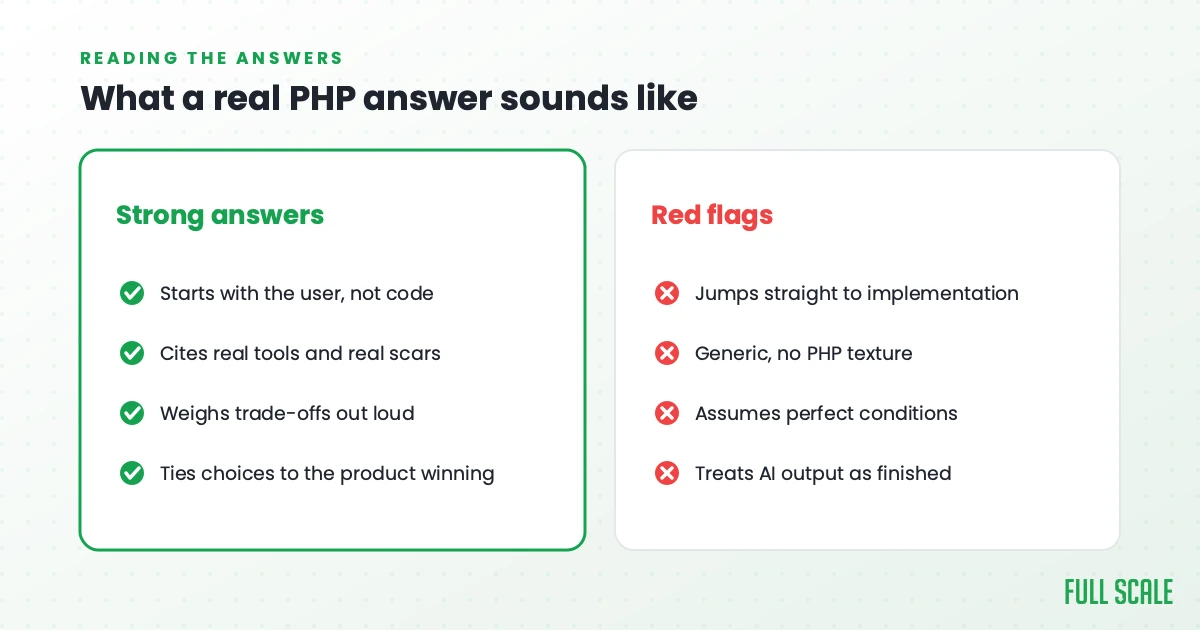
Strong answers start with the user or the problem before the code. They reference real tools and real scars: a query they had to profile, an import job that died at 2am, a security hole they found in review. They weigh trade-offs out loud rather than declaring one right answer. And they connect technical choices back to whether the product actually worked for the people using it.
Red flags tend to cluster. The candidate jumps straight to implementation and never mentions the user or the data. They give generic answers with no PHP-specific texture. They assume perfect conditions that never survive production. They cannot name the tools they would reach for when something breaks. And they treat AI output as finished work rather than a draft to review. None of those failures are about syntax, which is the point.
How we vet PHP developers at Full Scale
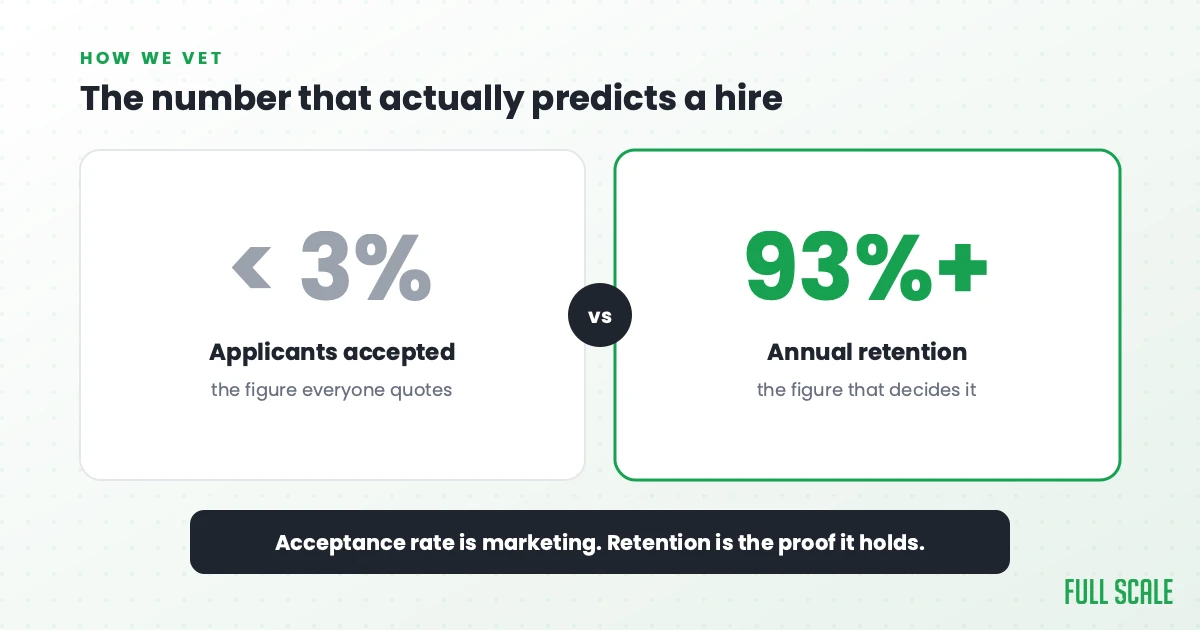
We built our screening around exactly this principle, because we have to stand behind every developer we place. The technical assessment uses real architecture and production problems, not syntax quizzes. We also check communication, English fluency, work ethic, and how well someone works on a distributed team, with background checks thorough enough to include interviews with a candidate’s neighbors. Fewer than 3% of applicants make it through. (The longer version of how we run that process is in our guide to interviewing a software engineer.)
I want to be honest about what that number means, though, because acceptance rates are easy to wave around as marketing. A low percentage is not the thing that makes a hire succeed. What decides it is whether the developer stays long enough to learn your product and integrate with your team. That is why the number I trust is retention: ours runs over 93%, and we have been doing this since 2018. Screening only earns its keep if the people who clear it stick around and do good work, and that is the part we measure.
It is also why we work as part of integrated product teams instead of as a body shop. Our engineers sit in the roadmap conversations for the products they build, including consumer-facing work at the scale of the AMC Theatres platform. That only happens when you hire for judgment and keep people long enough for it to compound. It is the staff augmentation model done the way it is supposed to work.
If you want the longer version of how we think about PHP specifically, our guide to offshore PHP development covers the engagement model, the cost math, and what separates a senior PHP bench from a tutorial graduate. And if you would rather skip the interviewing and start with developers who have already cleared this bar, you can hire PHP developers through us directly.
The takeaway is simple. Stop testing for facts that AI gives away for free. Start testing for the judgment that decides whether your app survives real traffic and keeps user data safe. The questions above are how you tell the difference.
We cover other stacks too: backend, full-stack, Python, Ruby on Rails, and React developer interview questions.
Frequently asked questions
Are technical PHP questions like == versus === and OOP definitions useless now?
The knowledge is not useless. A developer still needs to understand type juggling, traits, and the request lifecycle to debug real problems. What changed is that those topics no longer work as screening questions, because any candidate can look up a clean answer in seconds. Use them as a way into a real debugging story instead of as a recall test.
What should I ask a PHP developer instead of coding trivia?
Ask open-ended questions that reveal judgment: how they would refactor a messy legacy app, when they would not reach for a heavy framework, how they would diagnose a page that slows down at scale, and how they would review a pull request that trusts user input. Then drill into the reasoning with follow-ups.
How do I stop candidates from using AI to answer PHP interview questions?
You do not block AI, you make it useless in the moment. Open-ended judgment questions hold up in a live setting because the follow-ups expose a piped answer fast. Ask them to walk through a real decision they made, push back with a curveball, and chase the reasoning rather than the conclusion.
What is the difference between a senior and a junior PHP developer in the AI era?
Both can generate working PHP with AI. The senior knows which generated code to trust, when a structure earns its complexity, where a query will fall over at scale, and when user input becomes a security risk. The value moved from writing code to judging it.
Want a team that has already passed these questions? Book a call and we will walk you through who we would put on your PHP work.