
Eastern Europe vs Philippines Dev Outsourcing: How to Choose

In this article
- Software Development Outsourcing in Eastern Europe Runs on a 2015 Pitch
- Eastern Europe's Technical Reputation Is Real, and I'm Not Going to Pretend Otherwise
- Who Eastern Europe's Outsourcing Industry Was Actually Built to Serve
- What Eastern Europe Actually Costs in 2026
- The Communication Gap Isn't About English Scores
- Where Eastern Europe Genuinely Has the Edge
- What Nobody Selling You Eastern Europe Will Say About Risk
- Retention Comes Down to the Model
- The Verdict
- Frequently asked questions
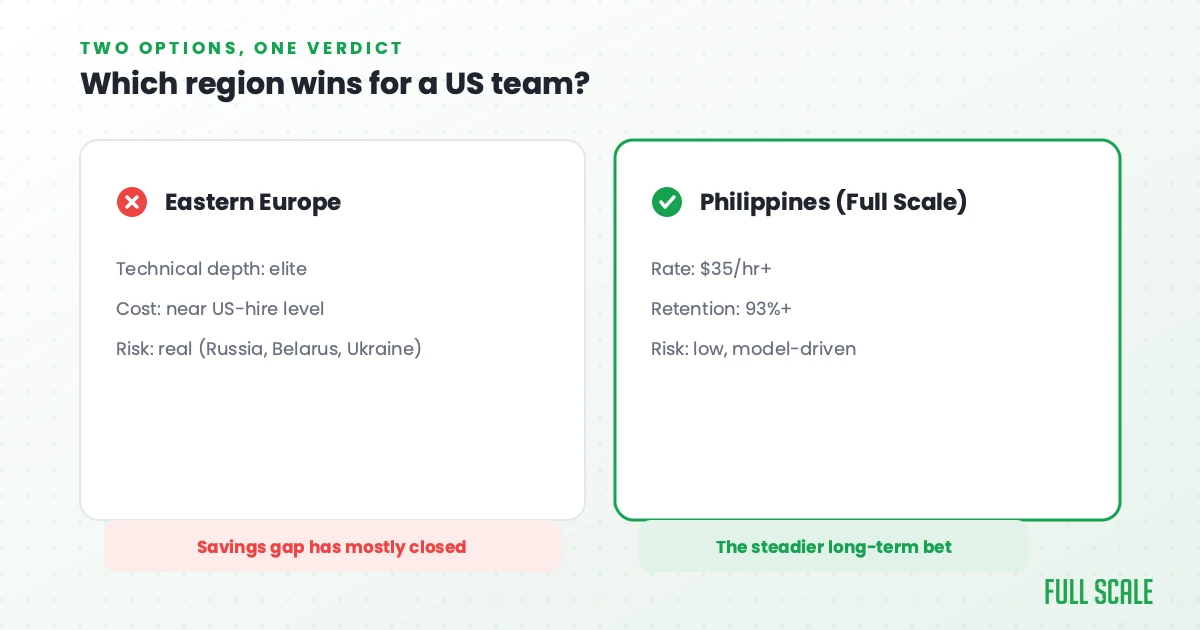
Quick Answer: Eastern Europe vs Philippines outsourcing comes down to risk and cost convergence, not skill. Poland now bills $55-90 an hour for senior engineers, annualizing to roughly $185,000, closing in on a fully-loaded US senior's $190,000-$260,000 (base salary times the standard 1.25-1.4 loaded-cost multiplier). Add real geopolitical risk in Russia, Belarus, and Ukraine, and the Philippines' $35/hr+ rate and 93%+ retention make it the steadier bet for most US teams, even though Eastern Europe genuinely wins on raw technical depth.
My first Java hire ever was a team in St. Petersburg. This was 2012, I was running Stackify, a friend in Kansas City vouched for a dev shop he used, and it turned out that dev shop was Russian. I never interviewed anyone on that team. The engagement ran two years and the work was genuinely good.
I wouldn't do that today, and the developers have nothing to do with it. The whole premise, a country you can casually route work into through a friend of a friend, is gone for Russia. It's shakier than it looks for a couple of its neighbors too.
I've since hired developers in Belarus, Uruguay, and India, on top of building Full Scale in the Philippines. Different levels of success in all of them. So when a founder tells me they've got a team in Poland or Serbia and asks why they should even look at the Philippines, I'm not guessing at the comparison. I lived through the version that went bad enough to change how I hire.
The short version, before I show you the math: the savings that once made Eastern Europe the obvious call have mostly evaporated at the top of the market. The risk that used to sound like something that happens to other people stopped being hypothetical in 2022. None of that makes Eastern Europe a bad place to build software. It just makes it a worse bet than it used to be, and the developers aren't the reason.
Software Development Outsourcing in Eastern Europe Runs on a 2015 Pitch
The pitch for Eastern Europe outsourcing hasn't changed much in a decade: strong computer-science education, developers who can handle hard architecture problems, rates well under US pay. All of that was true in 2015. Most of it is still true today. What's changed is the price and the risk, and neither shows up on the front page of a vendor's sales deck, because every vendor selling Poland, Ukraine, or Romania has a reason to leave both out.
That's also why nobody's written the comparison this article makes. Plenty of pages will sell you on Eastern Europe generally. None of them put it up against a specific alternative and tell you which one to actually pick.
Eastern Europe's Technical Reputation Is Real, and I'm Not Going to Pretend Otherwise
Eastern Europe has a genuine, earned reputation for hard computer-science work, and I'm not going to pretend otherwise just because I sell the Philippines. Poland, Romania, and Ukraine turn out engineers who are strong on complex backends, security, and algorithm-heavy problems. It's the kind of work where a shaky CS foundation gets exposed fast. That reputation came from decades of state-funded technical education and a generation of engineers who went looking for interesting problems instead of settling for whatever showed up first.
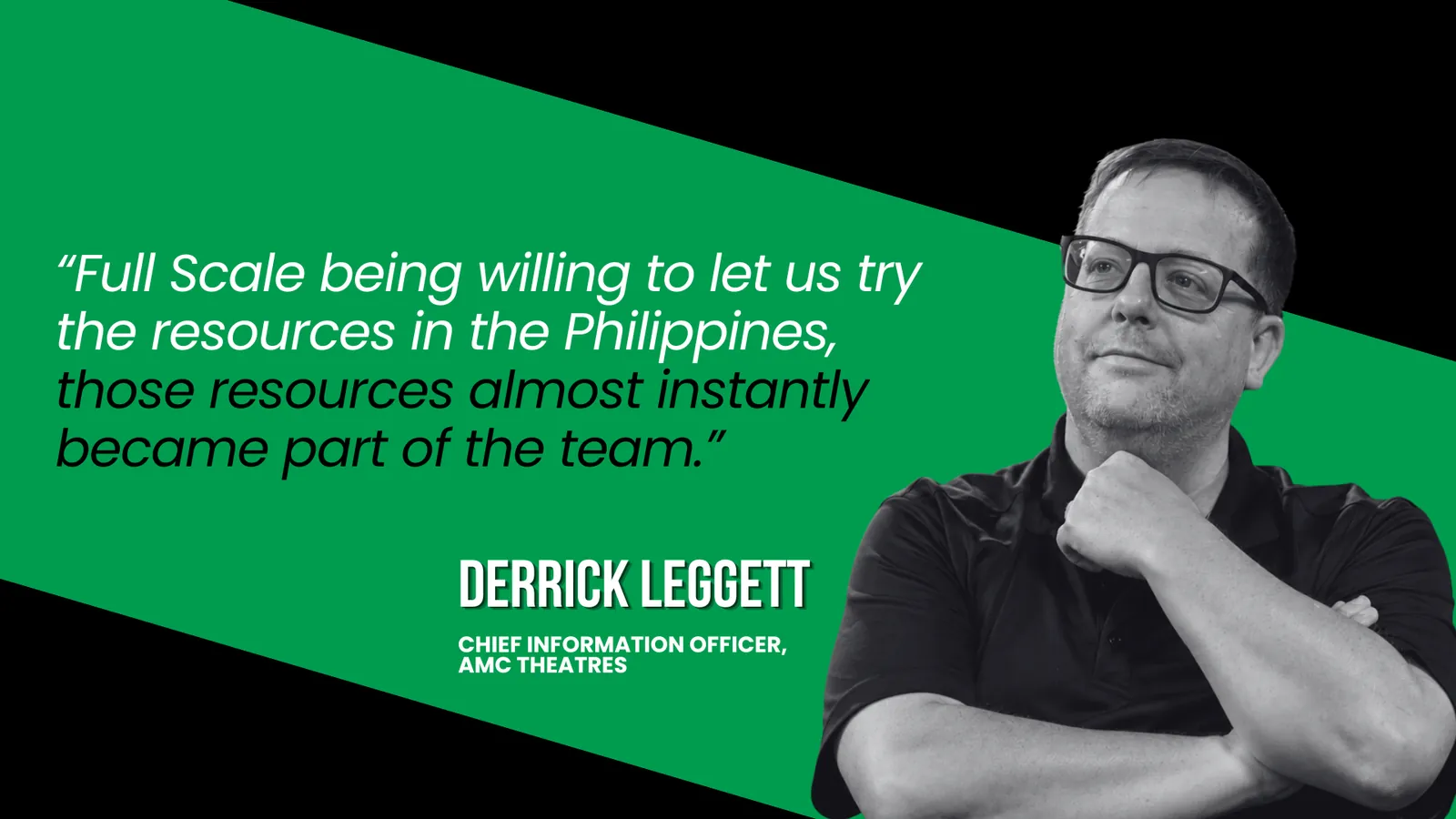
But "good at the job" only answers one part of the decision. It's also not proof that Full Scale can't place the same caliber of engineer. AMC Theatres has run a full .NET architecture team through Full Scale for years. SOTA Cloud built a cloud-native imaging platform their own customers measure as 30x faster than what came before it. Senior, architecture-capable engineering is a hiring bar, and the Philippines clears it too.
If your project is genuinely architecture-heavy and security-critical, and you've already got someone in-house who can run a technical team remotely, Eastern Europe deserves a real look. I'm not writing this to talk you out of a region that's good at its job. Treating "good at the job" as the whole answer is how companies end up with a great engineer and a broken engagement, and the engagement usually breaks somewhere neither side put on the scorecard: who the industry was actually built to talk to.
Who Eastern Europe's Outsourcing Industry Was Actually Built to Serve
The Philippines built its tech workforce inside a business process outsourcing industry that's been serving American companies since the 1990s. That industry now runs roughly $42 billion in annual export revenue and employs close to 2 million people, built almost entirely around US clients from day one. The whole workday grew up around American clients specifically, down to how developers talk to the people paying them.
Eastern Europe's outsourcing industry grew up facing a different direction. Poland and Romania's software talent developed largely to serve nearby EU markets and the UK, with US clients showing up well after that relationship was already built. That's not a knock on the work. It's a fact about which client the workforce learned to talk to first, and it shows up in small ways, like which time zone the workday defaults to or how a developer phrases pushback on an ambiguous spec.
For a European company, none of this is a downside. Poland in particular offers real EU regulatory alignment, useful if you're already running GDPR-native infrastructure. For a US company, you're asking a workforce built for someone else's client relationship to adapt to yours, and you're the one who finds out how much that adjustment costs, usually a few months in. Full Scale handles the equivalent concern, IP protection and data security, through a single US contract and real employment agreements with every engineer.
What Eastern Europe Actually Costs in 2026
Here's where the sales pitch and the math stop agreeing with each other.
| Country | Senior developer earns (/hr) | You pay (/hr) | Annualized billed cost |
|---|---|---|---|
| Philippines (Full Scale) | $20-30 | $35+ | ~$70,000 |
| Romania | $30-45 | $40-60 | ~$85,000-$125,000 |
| Ukraine | $30-50 | $40-65 | ~$85,000-$135,000 |
| Poland | $35-55 | $55-90 | ~$115,000-$185,000 |
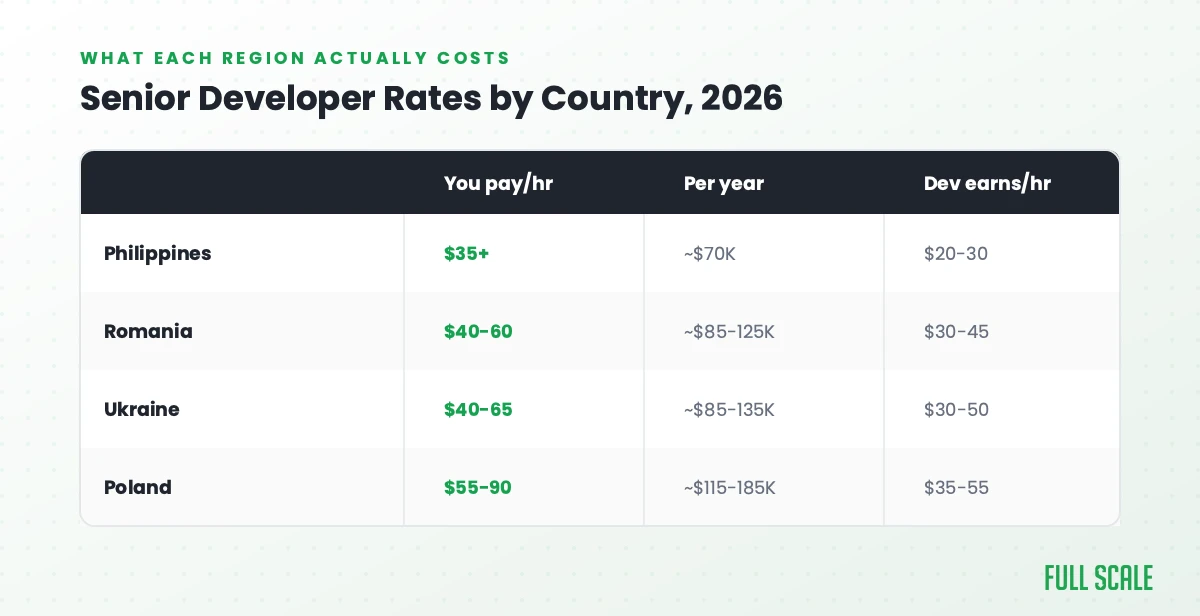
Run Poland's own numbers out to a full year at normal billable hours, and the top of that range lands at roughly $185,000. A fully-loaded US senior engineer costs more than the $150,000-$185,000 base salary the BLS reports. Add the standard 1.25 to 1.4x loaded-cost multiplier for benefits, payroll taxes, and overhead, and the real all-in cost lands around $190,000 to $260,000. Poland's top rate hasn't crossed that line yet, but it's within about 5 percent of the floor. That's a gap that used to be 2-3x. Full Scale's own rates start at $35 an hour, and that floor hasn't needed to move the way Eastern Europe's has.
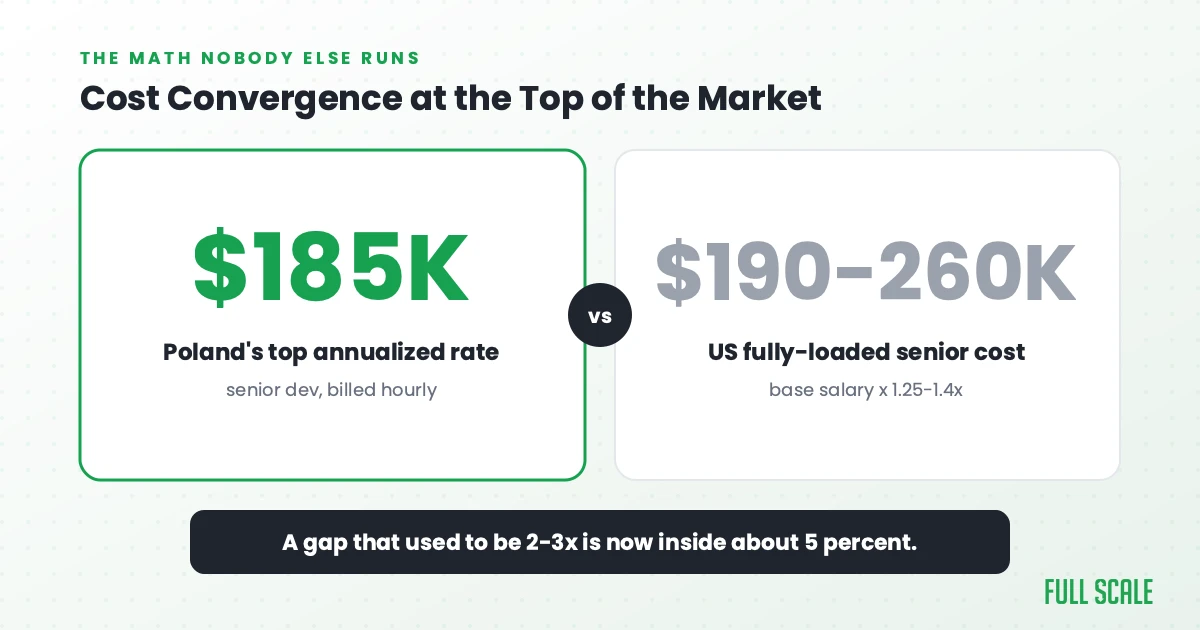
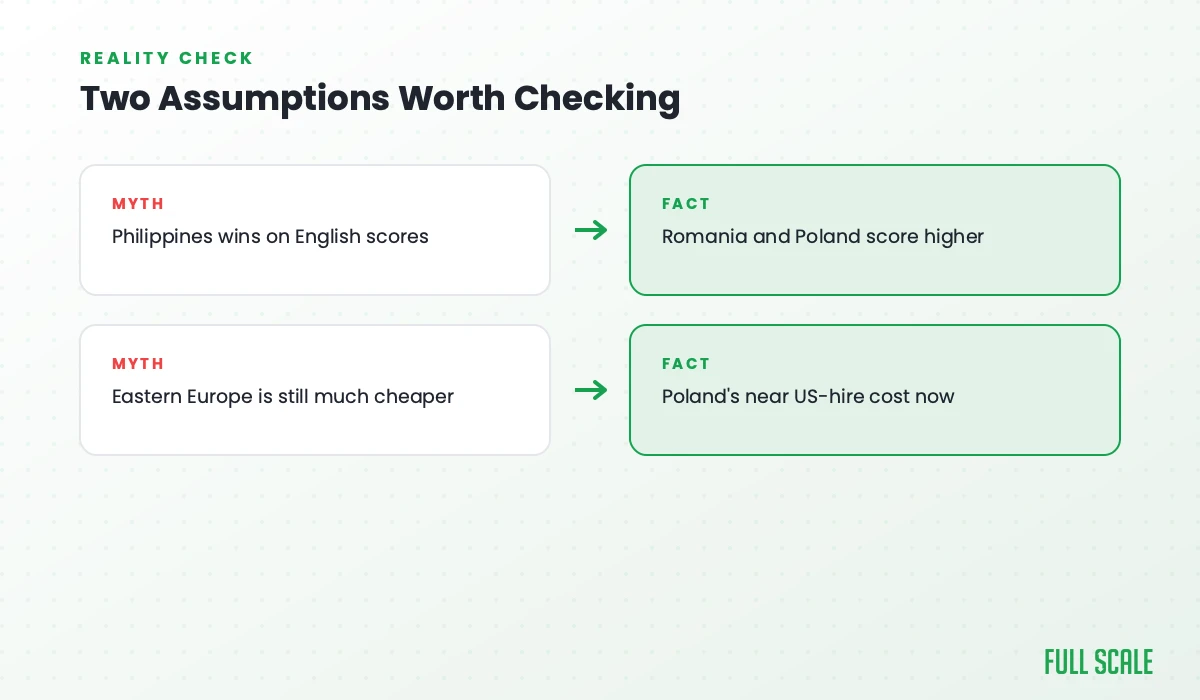
Romania and Ukraine still offer real savings at the low end of their ranges. But "real savings at the low end" is a different pitch than "Eastern Europe is the affordable alternative." That's the pitch every vendor page I mentioned is still running. Demand for AI and cybersecurity skills has pushed senior rates up across the region. Those happen to be the exact roles most companies are trying to staff right now. The arbitrage that justified going offshore in the first place is closing from the top down, and Poland already crossed the line.
This is the same trap I call cheapshoring when it runs the other direction, chasing the cheapest invoice instead of the team that actually works. Here it's chasing an outdated reputation for cheapness instead of checking whether the number still holds up. Either way, the invoice was never the whole story. Neither is the rate card, once you get to how a team actually talks to you.
The Communication Gap Isn't About English Scores
I want to be straight about something most comparisons like this one get wrong, including some of mine on other countries: this isn't a story about English proficiency scores. Romania scores 605 on the EF English Proficiency Index, the highest of any country I cover in our full country-by-country breakdown. Poland scores 600. The Philippines scores 569 nationally, with Manila alone at 603. If you're picking a region purely on that number, Eastern Europe holds its own or wins outright.
The real gap lives in communication style. Eastern European developers tend to communicate directly. If your spec is wrong, you'll hear "this won't work, and here's why" without much cushioning. Filipino developers tend toward a warmer, relationship-first style, built around understanding the person on the other end of the ticket.
Some Western managers hear "relationship-first" and assume it means someone who nods along instead of pushing back. That's the wrong read. It's also the one real objection I hear that has nothing to do with rate. What you actually get is someone who wants to know why you asked for the thing, not just whether it compiles. The Philippines built an entire service and hospitality industry on genuinely caring whether the customer got what they needed. That instinct carries straight into how a Filipino engineer works a ticket: asking the question behind the question, instead of building exactly what was written and quietly hoping it was right.
That only pays off if the developer is also willing to say the spec is wrong out loud, so Full Scale trains for it directly. Courage is one of the five pillars in Product Driven, the book I wrote about what makes engineering teams actually work. It means psychological safety to speak up instead of just nodding along. Our Spartan Training Academy runs on that same idea. Put those two things together and you get people who'll actually tell you when you're wrong, because they care enough to say it and they've been trained to say it out loud.
Where Eastern Europe Genuinely Has the Edge
I'd rather name the places Eastern Europe wins than pretend the whole comparison tilts one way, because it doesn't.
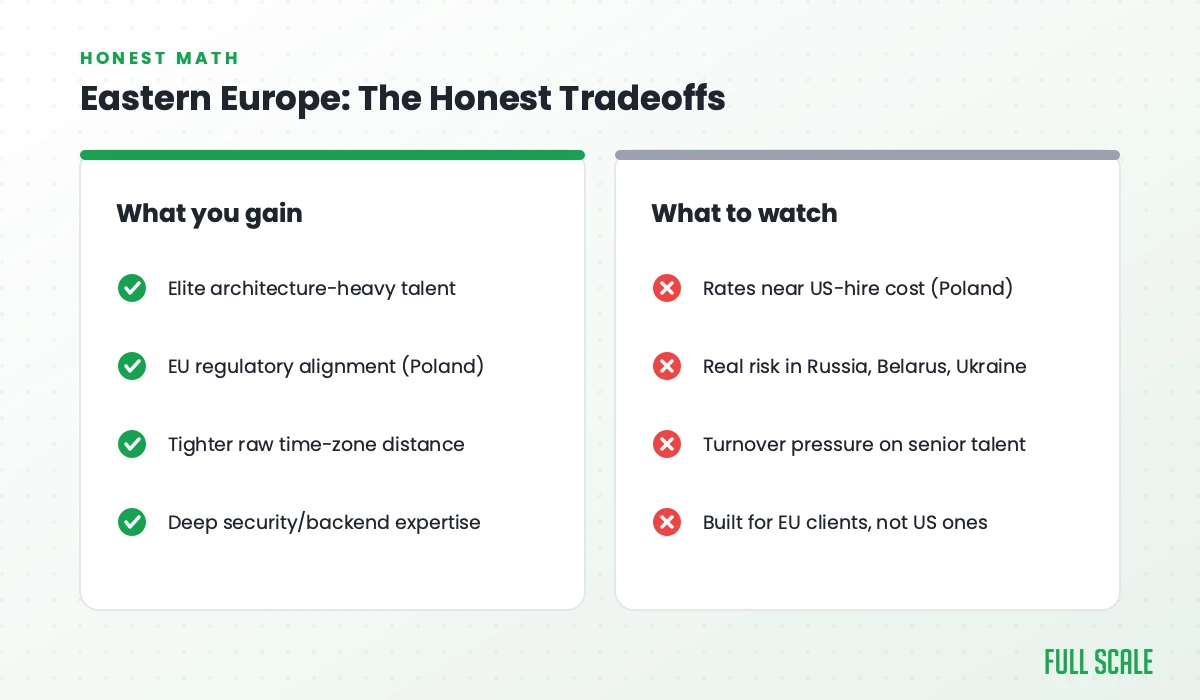
If you need architecture-heavy, security-critical engineering, and you have the in-house muscle to manage a technically opinionated team, Eastern Europe's bench is deep in exactly that skill.
On the clock, Eastern Europe sits roughly six to nine hours from US business hours. That's tighter, in raw distance, than the Philippines' twelve to fifteen. A team that needs a big block of live overlap every day will get more of it from Poland or Romania than from Manila.
I should be straight about that last point too, because most of the vendor pages selling you the Philippines skip it entirely. I won't. Full Scale closes that gap with a shift model, not a trick of geography. Engineers work three in the afternoon to midnight Philippines time, landing them online until roughly noon Eastern. That buys three to four hours of live overlap every day, enough for standups and the conversations that actually unblock people, without asking anyone to work through their own night. Eastern Europe wins on the raw map. The Philippines makes up the distance with a shift model instead. A schedule is something you can fix. The next problem isn't.
What Nobody Selling You Eastern Europe Will Say About Risk
I'd treat Russia and Belarus as off the table for new engagements entirely in 2026, no matter how good the rate looks. That's not a hedge. I hired in Russia myself, watched that engagement work for two years, and I still wouldn't do it again today. The war didn't just make Russia awkward to mention on a sales call. It closed the door on the casual, low-diligence way that engagement got set up in the first place, the exact kind of friend-of-a-friend arrangement that was once normal across the whole region.
Ukraine is a harder case. The talent is real, and a lot of it never left. Ukraine's IT sector still exported roughly $8.2 billion in 2025, up 9.3 percent year over year, and plenty of teams keep shipping excellent work under conditions that would have shut down a less resilient industry. I'm not telling anyone to avoid Ukraine outright. But a developer can get called into military service mid-project, and that's not something you hedge with a better contract clause. Treat continuity risk here the way you'd treat a key vendor's factory sitting in a flood zone: worth pricing in before you sign, not after something breaks.
None of this shows up on a rate card. It shows up six months into an engagement, when the developer who was supposed to ship your next release gets called up, or the office loses power for the third time that month, and the invoice never warned you either could happen.
Retention Comes Down to the Model
Eastern Europe isn't immune to turnover either, and nobody's rate card mentions that one either. Demand for senior talent is fierce enough that the same wage pressure pushing billed rates up is pushing counteroffers up too, and replacing an experienced engineer mid-project costs real money in recruiting, ramp-up, and lost momentum, on top of whatever the invoice already said it would cost.
I won't pretend the Philippines gets this for free just by being the Philippines. The country's broader BPO and IT sector has its own retention problem. Attrition is projected near 20 percent this year. Median tenure sits around 1.8 years industry-wide. Any vendor telling you the Philippines beats Eastern Europe on retention just because of geography is selling the same story I'm warning you about here.
What actually closes that gap is the model, not the country. Full Scale holds 93%+ engineer retention a year out. That beats both the Eastern European industry average and the Philippines' own country-wide number by a wide margin. It comes from things a rate card can't capture. Developers are leveled by scored measurements instead of years served. A customer success manager checks in on the relationship every week. Training keeps people building instead of coasting. The full model explains the mechanics. Retention is a business decision a company makes, not a personality trait a country has.
The Verdict
For a US company building a long-term software team, the Philippines is the steadier bet. That's not because Eastern Europe is weak. It genuinely has the technical-depth reputation and a real edge on raw time-zone distance. Romania even beats every country in this guide on English proficiency. The Philippines doesn't win every category on this page.
What it has is a savings gap that's still real. It has a communication culture built around asking the client the question first. And it has a model that gets retention to 93 percent on purpose, built and run deliberately rather than left to geography. A project that genuinely needs Eastern Europe's technical depth, and has someone in-house who can manage a direct team through real continuity risk, still has a defensible case for going there. For most companies asking me this question, the risk and the rate don't point the direction they once did.
For the wider picture before you commit to any single region, our full breakdown of the best countries for offshore software development covers the rest of the map, including how the Philippines stacks up against India, Latin America, and Vietnam.
Want to see what the model looks like staffed for your own stack? Book a call and we'll walk through it.
Frequently asked questions
Should I switch from an Eastern Europe dev team to the Philippines?
If your Eastern Europe engagement is working, running well, and priced the way it was three years ago, there's no urgent reason to switch. Switch when the invoice has quietly crept toward US-hire territory, when continuity risk in the region has turned into something you actively manage, or when you need a team that flags a bad spec without being asked twice. Those three signals predict a bad engagement. The flag on the invoice doesn't.
Is outsourcing to Eastern Europe still cheaper than hiring in the US?
At the low end of Romania and Ukraine's rate ranges, yes, meaningfully. At the top end, especially in Poland, the math has changed. A senior Polish developer billing $90 an hour annualizes to roughly $185,000, within about 5 percent of a fully-loaded US senior hire's real all-in cost. The old blanket answer, that Eastern Europe is simply cheaper, now depends heavily on which country and which seniority you're pricing.
Is it safe to hire developers in Eastern Europe right now?
Poland and Romania carry no unusual operational risk beyond normal vendor management. Russia and Belarus are a different story: I'd treat both as off the table for any new engagement in 2026, regardless of rate. Ukraine sits in between. The talent is genuinely excellent, and a lot of it never left the country, but the war means real infrastructure risk and the chance an engineer gets called into military service mid-project.
Is Serbia a good place to outsource software development?
Serbia scores 578 on the EF English Proficiency Index, in the "High" band. Senior developers there typically bill $45 to $65 an hour. That puts Serbia in roughly the same territory as Romania and Ukraine: real technical talent, rates that have crept closer to US-hire cost than most buyers expect, and none of Ukraine's specific war-related risk. It's a reasonable regional pick if you need Eastern European technical depth specifically, and the same cost-convergence math still applies at the senior end.
Is Poland a good country for outsourcing software development?
For technical depth, yes. Poland has one of Eastern Europe's largest developer pools, roughly 420,000 strong, a "Very high" EF English score of 600, and genuine EU regulatory alignment. For cost, it's the weakest case in the region: senior developers there bill $55 to $90 an hour, which annualizes to roughly $115,000-$185,000, closing in on a fully-loaded US senior hire's own $190,000-$260,000 range. Poland is the clearest example of Eastern Europe's savings gap closing at the top.
Is Romania a good country for outsourcing software development?
Romania is the strongest all-around pick in Eastern Europe if you need the region's technical depth without Poland's premium. It scores 605 on the EF English Proficiency Index, the highest of any country in this comparison, and senior developers bill $40 to $60 an hour, well below Poland's range. Its developer pool, around 165,000 people, is smaller than Poland's or Ukraine's, so it's a better fit for a focused team than a fast, large-scale build-out.
Is Ukraine a good country for outsourcing software development right now?
The talent is genuinely elite, and much of it never left the country despite the war. The honest complication is risk, not skill: infrastructure disruption and the chance of an engineer getting called into military service belong in your planning, not just your rate negotiation. Senior developers there bill $40 to $65 an hour, competitive with Romania, but that rate doesn't include the cost of a disrupted project six months in.
Eastern Europe vs Asia for outsourcing: which region gives better time zone overlap?
Eastern Europe wins on raw hours. The region sits six to nine hours from US business hours, against the Philippines' twelve to fifteen. A team needing a large daily block of live collaboration will get more of it from Poland or Romania than from Manila. What closes most of that gap in practice is the shift model a staffing partner runs, not the map. It's why Full Scale schedules Philippines engineers from three in the afternoon to midnight local time, specifically to buy overlap with US mornings.