Top BPO Outsourcing Companies in the Philippines and the 8 Types You Need to Know

In this article
- Why the Philippines ended up running so much of this work
- BPO is one slice of a bigger industry, and the terms get mixed up constantly
- The 8 types of BPO and IT-BPM companies in the Philippines
- The second question: how does the company actually engage you
- The cheapshoring trap, specifically for the ITO/software-dev buyer
- Where Full Scale fits, and where it doesn’t
- How to pick the right BPO or IT-BPM partner in the Philippines
- Frequently asked questions
- Build a team that stays
The outsourcing sector is expected to generate around $42 billion in exports this year, is home to roughly 2 million employees, and represents roughly 8.5% of the national economy. It’s projected to reach $59 billion and 2.5 million employees by 2028, according to the association. That’s what every “top BPO companies in the Philippines” article is trying to talk about.
The catch: that number represents eight entirely different lines of business, and all the rankings seem to treat them the same. All the “best BPO companies in the Philippines” articles rank Concentrix, Teleperformance, Accenture, etc. by number of employees. No one ranks them by the work they provide, which is what really matters.
As someone who runs one of these businesses, keep that in mind while reading the rest of this. Since 2018, I’ve grown Full Scale to a 350+ engineering company in the Philippines serving over 80 clients. Prior to that, I co-founded VinSolutions, bootstrapped it to $35M in annual revenue, and sold it. Then I built and sold Stackify. I have been hiring overseas developers for nearly two decades, much of that time spent educating fellow founders on why the #1 ranked “BPO” company is irrelevant to what they’re trying to outsource.
The article explains what each kind of company is called, names the companies that actually operate them, and clearly delineates where my company does and doesn’t fit.
Why the Philippines ended up running so much of this work
A few factors combined to create this situation. The Philippines has one of the largest English-speaking populations in the world and English is taught in schools from the first day. There’s also a cultural inclination towards service, and business customs in the country follow those in the United States. This makes the transition easy for teams working with US clients or teams embedded within US companies’ standup meetings.
The cost of living is relatively low, so the going wage in the country is only a fraction of what it would be in the US. This is where most of the cheapness comes from.
None of that explains why there are eight different businesses hiding under one label, though. That’s just history; different kinds of work were offshored in different eras for different reasons, and the name was never updated.
BPO is one slice of a bigger industry, and the terms get mixed up constantly
What you actually want is called IT-BPM, IT and Business Process Management. That’s the umbrella the Philippine IT-BPM industry officially uses to group all sorts of outsourcing work available here.
Business Process Outsourcing, or BPO, is just one slice within that larger grouping. But almost no one who isn’t inside the industry uses the terms that way, and every list of rankings on the web uses “BPO company” as if it means the whole thing, which is the mix-up that gets a buyer to consider the wrong companies.
So here’s the chart first:
The 8 types of BPO and IT-BPM companies in the Philippines
There are basically 8 types of companies in this space, categorized by what they provide, not how big their marketing budget is.
| Category | Covers | Leaders |
|---|---|---|
| Voice BPO | Call centers, customer service, telemarketing | Concentrix, Teleperformance, Foundever, Sutherland |
| Non-Voice BPO | Back office, chat and email support, VAs | MicroSourcing, Cloudstaff, and others focused on VAs |
| Knowledge Process Outsourcing (KPO) | Financial modeling, legal research, market research | Genpact, WNS Global Services |
| Healthcare BPO | Medical billing and coding, medical transcription, health information management | Access Healthcare, Omega Healthcare |
| Finance & Accounting (F&A) BPO | Bookkeeping, AP/AR, taxes | Genpact, Infosys BPM |
| HR / Payroll BPO | RPO, payroll admin, benefits | ManpowerGroup Philippines, Kelly Services Philippines |
| IT Outsourcing (ITO) | Software development, help desk, infrastructure, QA testing | Full Scale, IBM’s ITO division, and many others in dev |
| Shared services / captive centers | A MNC’s own office in PH, not a third-party arrangement | JPMorgan, Shell Business Operations Manila |
Voice BPO: the companies that own the “BPO” stereotype
Voice BPO is what comes to mind when you think BPO and it’s what every nondescript “top 10” article is ranking. Concentrix is the largest, with an estimated 80,000 to 90,000 employees in the country, after taking over Convergys in 2018. Teleperformance has had tens of thousands of seats since 1996. Foundever is the one that all of those older articles are still calling Sykes. Sykes was the first to open a multinational call center in the country in 1997, was acquired by the Sitel Group in 2021, and rebranded in 2023. If any article you’re reading still refers to Sykes, then it’s old. Sutherland operates a mature, established BPO business with roughly 30,000 employees and is known for its strong training programs. All of these businesses are highly successful at their jobs: answering calls, managing support queues, and processing transactions on a large scale. They are not, however, software companies.
Non-voice BPO: the quiet half of the industry
Then there’s the non-voice work, anything not requiring a headset: data entry, content moderation, email and chat support, and the virtual assistant realm, which has become its own cottage industry in its own right. Companies such as MicroSourcing and Cloudstaff built entire businesses around staffing these roles. Many run on a “seat leasing” model, renting out a desk and a person instead of a whole team. It’s a real category with a genuinely different skill set from voice work, which is exactly why lumping both together under “BPO companies” tells you nothing useful.
Knowledge Process Outsourcing (KPO): the analysts and researchers
This is KPO: Knowledge Process Outsourcing. It’s work that requires more than processing power, it requires brains.
Financial modeling, legal research, actuarial science, and market research all fall under the heading of KPO. All of those require special skills beyond basic customer support skills, and so the price tag on that work is also higher than BPO.
Genpact and WNS Global Services both have major Philippine operations with significant amounts of this work.
Healthcare BPO: a vertical with its own rulebook
They also have their own vertical called medical billing and coding, medical transcription, health information management, and revenue cycle management, due to the issue of compliance.
If you’re dealing with US patients’ data, you need to follow HIPAA rules regardless of where your call center is located. Companies like Access Healthcare and Omega Healthcare built their whole business around that requirement.
It’s not a space you can just jump into from a generic BPO background.
Finance & Accounting (F&A) BPO: the back office running your back office
Bookkeeping, accounts payable and receivable, and tax prep support fall into this category. Companies like Genpact and Infosys BPM operate these functions at scale. Much like KPO, it’s a defined, repeatable business process being executed on your behalf, a distinctly different arrangement from placing an engineer on your product team.
HR / Payroll BPO: staffing the staffing function
This one includes RPO (recruitment process outsourcing), payroll processing, and benefits administration. ManpowerGroup Philippines and Kelly Services Philippines have been doing this in the country for years.
Like F&A, this is a process being handled for you, not a group of people joining your team. There is no “the top HR BPO companies” article on the web, but they exist and the multinationals behind them have been operating for years.
IT Outsourcing (ITO): where Full Scale actually lives
ITO is the technical arm of the IT-BPM mix, which gets subdivided further into its own category:
- Software development & custom application development, where Full Scale fits
- IT help desk & technical support: tiered support, NOC/SOC monitoring
- Infrastructure & managed services: network administration, cloud infrastructure, cybersecurity
- QA & testing services
Large consultancies like IBM or Accenture sell ITO services here as well as their core offerings, with a huge number of smaller shops competing below them for each of these niches.
Software engineering is not the same as a call center, and requires a totally different way of hiring and managing people. An engineer sits in your standup, reads your code, and owns a feature alongside you. That’s a much larger commitment than renting out an office chair.
Shared services and captive centers: a company’s own office, not a vendor
The last category is a multinational that creates a wholly owned in-house Philippine office and staffs it themselves. No vendor. Not really “outsourcing” in any technical sense. JPMorgan has such a captive center, as does Shell, whose Manila-based office takes care of finance, human resources, and technology support needs for the rest of the company. Neither company is servicing outside customers like the ITO firms above are.
The reason you should know about this fourth category is that it explains a trend that trips up a lot of people looking to outsource. If you read a listicle of companies that outsource to the Philippines, and see a well-known brand name listed there, it may actually be that they’ve established a captive center, and not an outsourced BPO. I wrote about why listicles tend to misrepresent these companies here.
The second question: how does the company actually engage you
Most vendors can tell you what they do. They don’t tell you how they’ll work with you, and that second question cuts across all categories above, including inside ITO. There are 3 engagement models out there in the market, and confusing them is the number one reason why a good-on-paper vendor can quickly become a bad experience.
- Seat leasing / call-center. You lease a seat and a worker, thinking of companies like MicroSourcing and Cloudstaff. Good for high-volume, highly replaceable roles. Bad model for a codebase.
- Project-based / scoped delivery. A fixed-price dev shop is handed a project, completes it, and then they move on. Works for a well-defined, one-off build. Not great for something that will need to change with your product.
- Dedicated staff augmentation. A full-time, long-term engineer that becomes part of your team, reporting to you and not a vendor project manager. This is what staff augmentation is and it’s designed for ongoing product work, not a singular deliverable.
Full Scale occupies a very specific location on the entire map: IT-BPM, then IT Outsourcing, then software development, then staff augmentation. For the software development slice specifically, I put together a list of software development outsourcing companies in the Philippines, grouped by whether they staff a team or hand off a project. And that’s what almost no “top BPO companies” list bothers to explain, mostly because most of the companies on those lists simply aren’t like this.
The cheapshoring trap, specifically for the ITO/software-dev buyer
This is where the pricing benefit is actually about people, and it’s the trap that software buyers fall into in particular, but not the other seven sectors.
You may be able to hire a good developer in the Philippines for 50 to 70% less than their US counterpart. This difference isn’t due to a lower cost of skill, since that difference exists purely due to cost of living, something I’ve explained at length before, with my family pay stubs to prove it. The trap is when you allow cost to become the only factor you weigh. I refer to this as cheapshoring and it’s by far the most common way software buyers end up selecting the wrong partner.
When cheap is your only filter, you purchase the cheapest option, which is often a freelancer who disappears mid-sprint, or a project shop charging for 10 staff members while three actually execute the work. You then join the crowd of founders who went to the Philippines once, got screwed, and decided never to return. Nearly every one of these tales has one thing in common: pricing was the sole determinant, and the Philippines simply became the scapegoat.
Where Full Scale fits, and where it doesn’t
Let’s be clear: this is the same type of transparency I expect from anyone trying to sell me something. Full Scale is not a call center, not a KPO company, not a healthcare BPO. We aren’t trying to steal your work from Concentrix or Genpact. We provide software development staff augmentation: we find, hire, and manage senior Filipino developers who become part of your team and take their direction from you. The roadmap is yours. We’re responsible for recruitment, payroll, and retention, plus the boring but necessary work of making sure they actually stay. You can read my full analysis of the differences in Full Scale staff augmentation versus a traditional BPO.
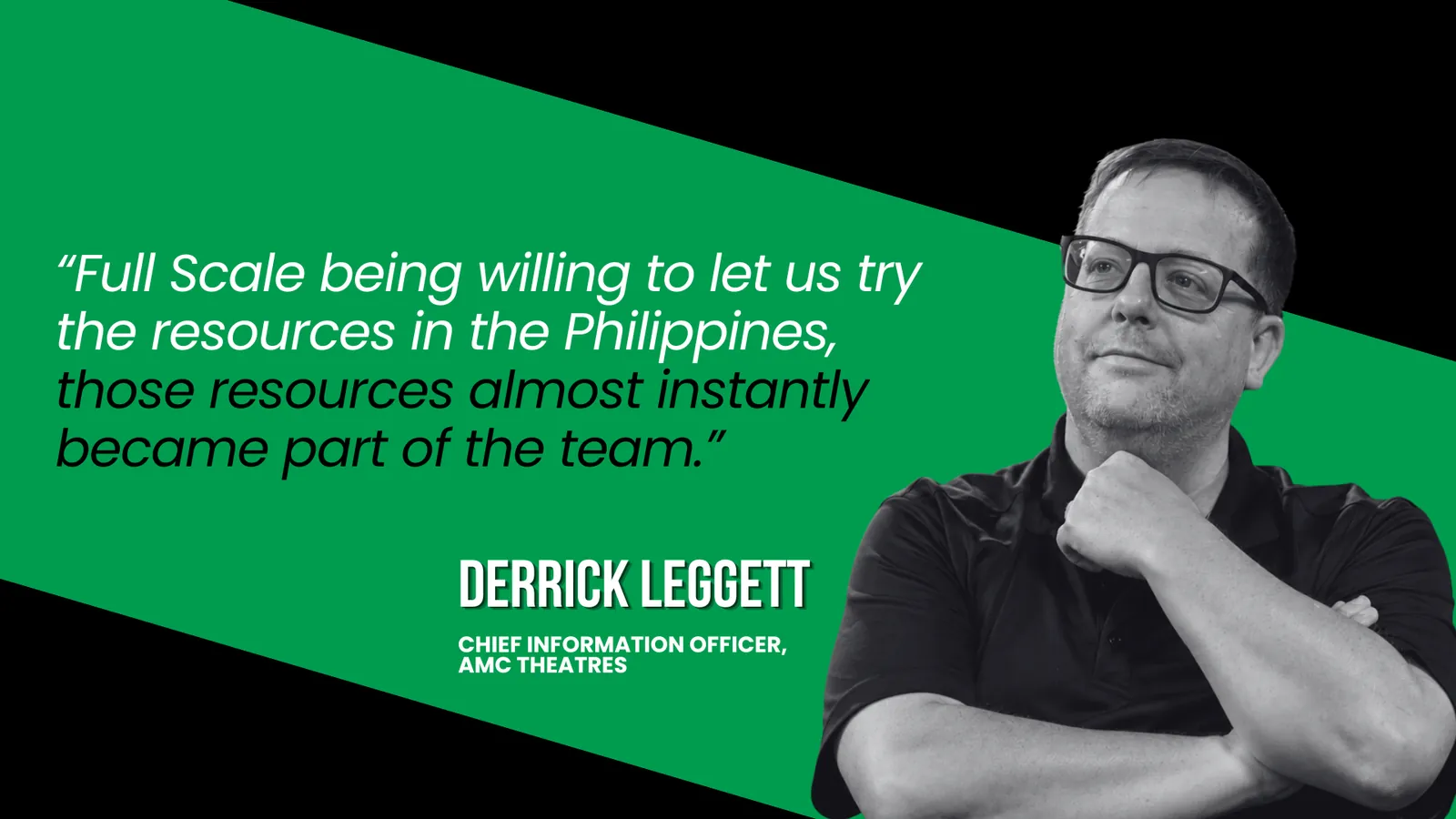
This only applies to a certain kind of engagement: long-term product work, where you want a team that will stick around for years. The best-known example is probably AMC Theatres, whose CIO, Derrick Leggett said, “It’s a fully integrated team. It’s just that some of the people happen to be living in the Philippines.” That’s the business. The developers we provide participate in your standup meetings, they attend your code reviews, they care about the product as much as an in-house engineer does, and that’s exactly why we hire engineers who think like owners rather than ticket closers.
When we’re NOT the right fit is for things like a call center, a KPO engagement, healthcare billing, HR outsourcing or a small project that’s simply something you need to be done, on a fixed budget. That budget could be large, but it has to be fixed (not an on-going team but a fixed deliverable). That is a project shop’s forte, not ours.
Staff augmentation becomes the right fit when you need a long-term team that you know will be there to support the work, no matter what that work may turn out to be next quarter. Staff augmentation is no different than hiring any other in-house employee. For any of the above wrong-fit cases, one of the other seven categories is the right short-list, not us.
Retention is the key metric that distinguishes good software partners from bad ones, no matter what their model is. Call-center attrition rates in the Philippines average around 60% to 70% overall, which is the highest among all industries in the country.
That level of turnover works for a support queue where anyone can take the place of another agent. It’s catastrophic for a software team where the employee that departs takes all the knowledge they gained about your application with them.
Full Scale boasts a 93%+ developer retention rate, and as proof of our commitment to customer trust, we’ve been named to the Inc. 5000 list of fastest-growing private firms for the last five consecutive years.
How to pick the right BPO or IT-BPM partner in the Philippines
- Identify the service first, then consider the pricing. Support services typically indicate voice BPO. Regulated invoicing typically indicates healthcare BPO. Software development typically indicates ITO, particularly staff augmentation. You must know what you need before looking at the logos.
- Determine the business relationship model that best fits the type of work. For continuous product development, the vendor should have a standing team. If the project has a specific deadline and scope, you may consider a project shop. You only rent seats for highly replaceable positions in a high volume.
- Verify the attrition rate before verifying the price. Inquire with each vendor about their attrition rate. Do not be satisfied with a general response. If a vendor cannot provide an accurate figure, treat it as a negative sign.
- Communicate with the actual performers of the work, not just the salesperson. The most frequent problem in this market is a company that hides a layer of workers from view.
- Ask about the ownership of intellectual property and data security. In software development and healthcare BPO, you are often providing code or medical information, not a script. The proper vendor will address this issue in their legal agreements, not during the interview process.
- Request the name of a client whom you can contact. A company name in a case study does not mean much. A client who is willing to discuss issues such as attrition and communication means much more.
- Test the waters with a small project before hiring a full team. Having a brief trial period with an active project allows you to evaluate communication and performance more effectively than a presentation. Consider any vendor that objects to a trial period suspicious.
Get the type and the model right and the Philippines is arguably one of the most promising locations in the world for building your own team.
Don’t bother with that first step and choose purely based on size or cost and you will become the subject matter of a future article detailing how bad outsourcing can be.
Frequently asked questions
What’s the difference between BPO and IT-BPM?
The umbrella term that encompasses the entire Philippine outsourcing industry is IT-BPM (IT and Business Process Management). The term BPO (Business Process Outsourcing) actually refers to a specific sub-sector within IT-BPM, which includes call centers and back office operations. Since most people tend to use BPO and IT-BPM interchangeably, clearing this misconception forms the crux of this guide.
What are the different types of BPO companies in the Philippines?
Broadly speaking, the 8 verticals include Voice BPO (call centers), Non-Voice BPO (back office, chat, virtual assistants), Knowledge Process Outsourcing, Healthcare BPO, Finance & Accounting BPO, HR/Payroll BPO, IT Outsourcing and Shared Services/Captive Centers, which, being technically in-house offices, are not really outsourcing at all.
What are the top BPO companies in the Philippines?
In the voice and customer-experience world, Concentrix, Teleperformance, Foundever (formerly Sykes), and Sutherland are the largest. In enterprise IT and consulting, Accenture and IBM lead. None of these companies build custom software for a living, however, so a software buyer needs a different shortlist entirely, made up of IT Outsourcing firms that specialize in dedicated development teams.
Is the Philippines good for software development outsourcing specifically?
True. The nation has a large supply of English-speaking engineers, a business climate similar to the United States, and labor rates that are 50 to 70% less than in the US. The issue is that most “BPO” rankings tend to rank call centers rather than software teams, so a software buyer has to zero in on the IT Outsourcing portion of the market, and within that, focus on staff augmentation vendors rather than the traditional BPO industry leaders.
How do I know which type of BPO company I actually need?
What is the scope of the project? Does it require support for customers or a high volume of transactions? It’s probably Voice BPO or Non-Voice BPO. Is the business process you’re trying to outsource subject to regulations? Think medical billing or payroll. Then it’s likely a vertical BPO. Are you looking to outsource a software application? That’s IT Outsourcing. Are you looking for ongoing development rather than one-off projects? Consider staff augmentation.
Build a team that stays
When considering BPO companies in the Philippines for software development, what matters is having an engineering team that knows your product and stays with it, not the company with the most agents. And that’s something no ranking can tell you. Schedule a call with our Philippines team to see how it works, learn the cost and find out if we’re a good match for your needs.