
AI Proof Interview Questions for Java Developers

In this article
A developer can explain garbage collection perfectly and still write the service that quietly runs out of memory every Tuesday. That gap, between reciting how the JVM works and reasoning about it when it misbehaves, is exactly what an interview is supposed to expose. Most Java developer interview questions no longer can. Before the interview, though, it helps to get the Java developer job description right. If the stack itself is still open, see .NET vs Java.
Look at the ones teams still lean on. What is the difference between == and .equals(). Explain the contract between equals() and hashCode(). Walk me through how a HashMap works under the hood. Checked versus unchecked exceptions, and when to use each. What does volatile actually do. For two decades those were the standard screen, and they worked when the only place to find the answer was inside a developer’s own head.
That is no longer where the answer lives. A candidate with a chat window open in the next tab can return all of those in seconds, clean and correct. The knowledge has not stopped mattering, you cannot chase a memory leak or reason about a race condition without it, but it has stopped being something you can *screen* on. A tidy answer no longer reveals whether the person earned it on a real service or read it off a screen thirty seconds ago. Fluent recall and hard-won experience used to travel together. AI cut them apart.
And the job underneath moved. AI now writes the getters, the boilerplate, the mapper classes, the routine Java that used to fill a morning, which pushes the scarce part of the work up a level. A senior Java developer is not valuable for typing speed. The value is in the judgment: spotting the transaction boundary in the wrong place, knowing why the heap keeps climbing, telling the abstraction that earns its weight from the one that just adds ceremony, asking whether the service should exist in the shape the ticket describes. As I tell our own teams, the pure coders get replaced by AI and the problem solvers end up running the technology organization.
So the questions have to change with the job. My first Java hire ever was a team in St. Petersburg, back in 2012, who built the Linux monitoring agent for Stackify, the developer-tools company I founded. That agent could not afford a single careless allocation, because a tool that watches production apps cannot itself become the production problem. I learned what good Java judgment looks like by watching people who had it. At Full Scale we now vet every Java developer on exactly that kind of judgment, not on syntax quizzes, before they ever join a client team. This is the question set we use to find the ones who think.
When recall stopped meaning competence
The trivia question rested on a single bet: that recall stood in for skill. If you could explain how generational garbage collection worked, you had probably written enough Java to have earned that knowledge. Recall was a proxy for the real thing.
AI broke the proxy. A developer who has never run a service in production can now explain the G1 collector as fluently as someone who has spent a weekend tuning one. You are not measuring what you think you are measuring. The trivia is not useless to *know*. It is useless to *test*, because everyone passes and passing tells you nothing.
What is left is the part AI cannot do for you. A model will generate a @RestController and a JPA repository in seconds. It will not tell you that the new endpoint loads ten thousand rows into memory on every call, that the transaction is open far longer than it should be, or that the feature does not need to exist. Those are judgment calls, and judgment is the thing you are paying a senior person for.
There is a trap waiting here. Once the syntax is free, the cheapest developer who can pass the puzzle starts to look like a bargain. I have a name for that mistake, cheapshoring, hiring for the hourly rate alone and treating engineers as interchangeable people who produce Java by the line. It never paid off, and it pays off even less now, because the cheap part is the exact part AI already does for free. In a Java system that outlives three product managers, the judgment you skimped on is what you pay for later, with interest.
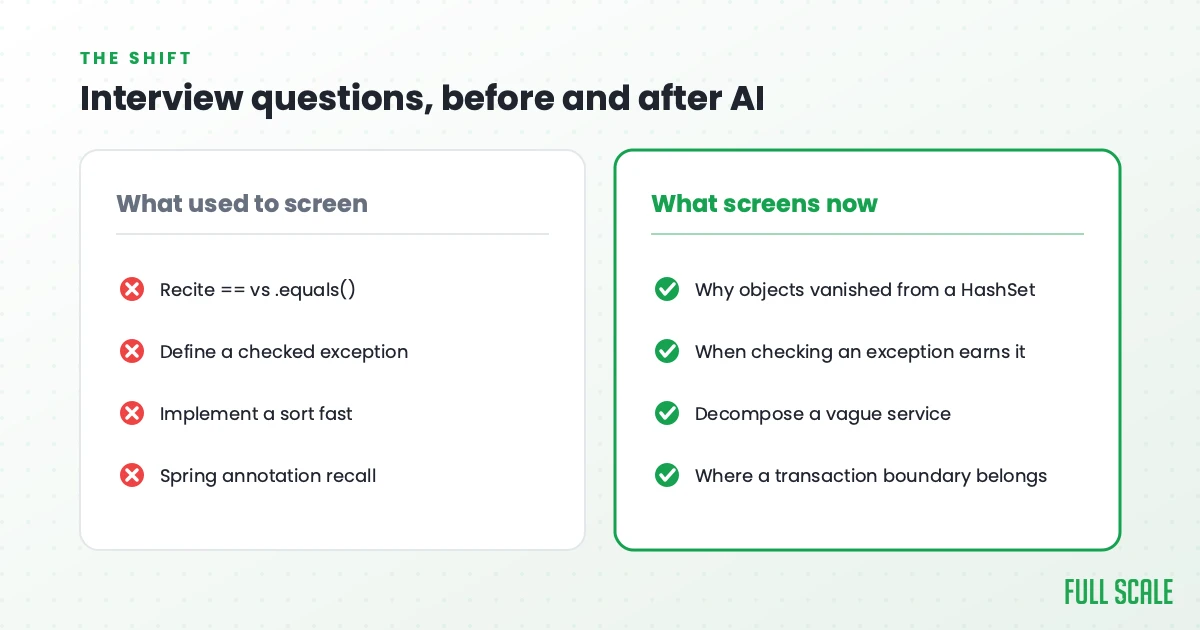
Here is the shift in Java terms:
| What the old questions tested | Why it no longer screens | What to test instead |
|---|---|---|
Reciting == vs .equals() and the hashCode contract | AI answers it instantly; everyone passes | Why two “equal” objects vanished from a HashSet in production |
| Memorized “what is a checked exception” | Free to look up; can’t tell who has shipped | When checking an exception earns its noise and when it is clutter |
| Implement a sort or reverse a linked list | AI writes it; the job is rarely this | How they break down a vague, underspecified service |
Spring annotation recall, like @Transactional | AI fills it in | Where a transaction boundary belongs and why a lazy-load blew up |
What actually separates Java developers now
If recall no longer screens, what takes its place? Five things, and they map to the five groups of questions below.
Architecture and JVM judgment. Whether they can defend a structural choice and name what it costs. Writing Java is not the same as knowing the JVM. Anyone who finished a Spring Boot tutorial can stand up a service. Keeping that service healthy in production means reasoning about how the garbage collector behaves under load, what the Java memory model guarantees when two threads touch the same field, and where in the Spring lifecycle a bean or a transaction actually lives. That is the knowledge a memorized definition only pretends to cover.
Problem-solving on open-ended messes. Real Java work rarely arrives as a clean spec. It arrives as “the service is slow a few times an hour and we don’t know why” or “memory keeps climbing until it falls over.” You want to watch them carve an ambiguous problem into parts, and notice whether they ask what you are really trying to build before they start.
Scaling, performance, and production reality. A service that is fine in a load test can buckle the first time real traffic and real data hit it at the same time. Senior judgment is anticipating that gap, the GC pause, the exhausted thread pool, the query that was fine at a thousand rows and deadly at a million, and designing around it before a pager goes off.
API and service-design sense. Most Java lives behind an interface other teams depend on. The strongest developers think about the people calling their service: how to evolve an API without breaking them, when a change needs a version, and why a technically correct service can still be miserable to integrate with. The Java docs on the platform and its APIs should be a reference they actually reach for, not a thing they once skimmed.
Curiosity and working with AI. When anyone can generate a service class, the developer who asks “should this exist, and what problem does it solve” is worth more than the one who silently builds the ticket. Same with AI output: you want someone who treats it as a draft to review and steer, the way a lead reviews a junior’s pull request.
Under all five sit the three traits we screen hardest for on every stack: communication, curiosity, and courage. Communication is whether they can explain why they put the transaction boundary where they did. Curiosity is whether they are genuinely adapting to how AI changed the craft. Courage is whether they will push back on a design they think is wrong instead of quietly shipping it. We wrote the long version in our book on engineering leadership, and it holds up especially well in Java, where the systems are long-lived and a careless decision compounds for years.
The AI-proof Java developer interview questions
A fair objection first: cannot AI just answer these too? It can. Paste any one of them into a chat window and you will get a confident, plausible response. That is not the point. These hold up in a live interview because the format defeats the paste, not the question. Drill into the *why* with a follow-up, ask them to walk through a decision they actually made on a real service, throw a curveball, and a piped answer falls apart on the second turn while a real one only sharpens. So ask these, then chase the reasoning down a few layers.
Architecture and JVM judgment
1. Pick a Java service you have actually worked on and tell me one architecture decision you would make differently now. A rehearsed answer falls apart the moment you ask why, so chase it. It shows whether they look at their own systems with a critical eye, and whether their opinions are backed by scars or by blog posts.
2. You inherit a Spring Boot codebase where one service class is three thousand lines and half the app depends on it. How do you decide what to pull apart first, and what to leave alone? Strong answers weigh risk against value and resist the urge to rewrite everything. The weaker instinct is to torch it and start over.
3. When would you not reach for microservices, or not add another layer of abstraction? This catches developers who add structure by reflex. Knowing when a monolith is the right call, and what a premature split actually costs in operational pain, is a senior signal.
Working through an undefined problem
4. A service’s average response time looks fine, but a few times an hour it spikes badly. How do you figure out what is going on? This separates the developers who think about GC pauses, lock contention, and tail latency from the ones who only ever look at an average on a dashboard.
5. A feature request lands as one vague sentence from the CEO. What do you do before you write any code? The answer you want is full of questions, not assumptions. The developer who clarifies the problem builds the right thing. The one who guesses builds the wrong thing fast and confidently.
6. Design a nightly job that processes millions of records without falling over or grinding the database to a halt. Talk me through it. Listen for batching, pagination, back-pressure, idempotency so a retry does not double-process, and a plan for what happens when it dies halfway through. This is where naive Java quietly breaks at scale.
Holding up under real load
7. Your service runs fine for a week, then memory creeps up until it throws an OutOfMemoryError. Walk me through how you would find the leak. You want a method: capture a heap dump, compare it over time, find what is holding references it should have released, suspect the obvious caches and listeners. Tool fluency, JFR, a profiler, jcmd, shows up here on its own.
8. Under load, requests start timing out, but CPU usage is low. What is your first hypothesis? The senior instinct goes straight to blocking: an exhausted thread pool, a starved database connection pool, a slow downstream call holding threads hostage. A weaker answer just says “add more servers.”
9. After a deploy, latency jumps, but only on some instances. Walk me through your investigation. You want a systematic approach: compare the bad instances to the good ones, read the traces and GC logs, isolate what differs, reproduce, then ship a fix. Watch whether they reason from evidence or from a hunch.
API and service-design judgment
10. You own an API that three other teams build on. You need to change it. How do you do that without breaking them? A senior developer talks about backward compatibility, additive changes, versioning when it is truly needed, deprecation with a runway, and actually talking to the teams who depend on them. The instinct to consider the caller is the whole point.
11. Your new service does everything the old one did, but the teams that call it say it is “harder to work with.” Why does that happen, and what would you do about it? This is the thesis in one question. It reveals whether they understand that a service can be technically correct and still be a bad experience for the humans integrating with it, and that the difference is design judgment.
Judgment about where AI helps
12. How has AI changed the way you write Java day to day, and where do you not trust it? This is the easiest trait to test and the hardest to fake. A genuinely curious developer lights up and gets specific. The “where do you not trust it” half matters most. Veracode’s 2025 GenAI Code Security Report found that 45% of AI-generated code samples introduced a known security flaw, so a developer who reviews the output, catches the swallowed exception and the unbounded query, and steers it is worth far more than one who pastes it and hopes.
The strongest version of this question is to stop asking and start watching. Hand them a service method an AI generated, a real one with a repository call and a transaction, and ask what they would change before it ships. The developer who spots the N+1 query, the transaction held open across a network call, and the exception that gets quietly swallowed is showing you the exact judgment the job now rewards. The one who says “looks fine” is showing you something too.
Reading the answers: signal versus noise
These Java interview questions only work if you know what you are listening for.
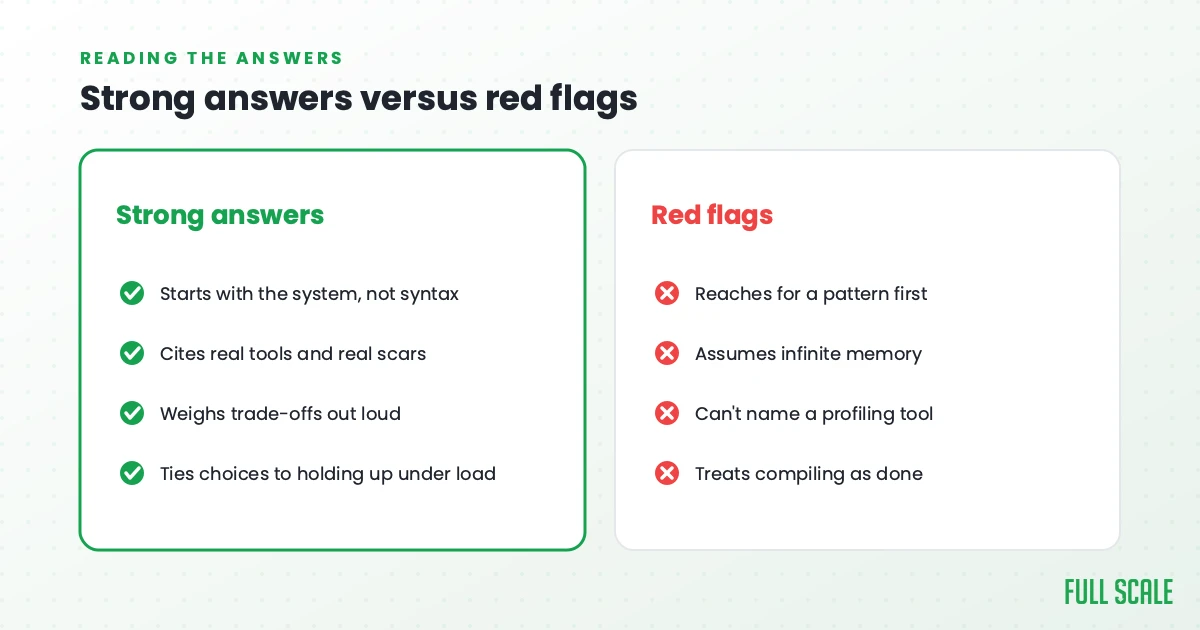
Strong answers start with the system and the failure mode before the syntax. They reference real tools and real scars: a heap dump that finally explained a leak, a GC pause that cost them a weekend, a migration that taught them to respect backward compatibility. They weigh trade-offs out loud instead of declaring one right answer. And they tie technical choices back to whether the service held up under real traffic.
Red flags cluster into a few habits. The candidate reaches for a framework or a pattern before they understand the problem. They assume infinite memory, a fast network, and small data that production never provides. They cannot name the tools they would use to diagnose a slow or leaking service. They treat “it compiles and the tests pass” as “it is done.” And they hand back AI output as finished work rather than a draft to review. None of those are about syntax, which is exactly the point.
How Full Scale screens Java developers
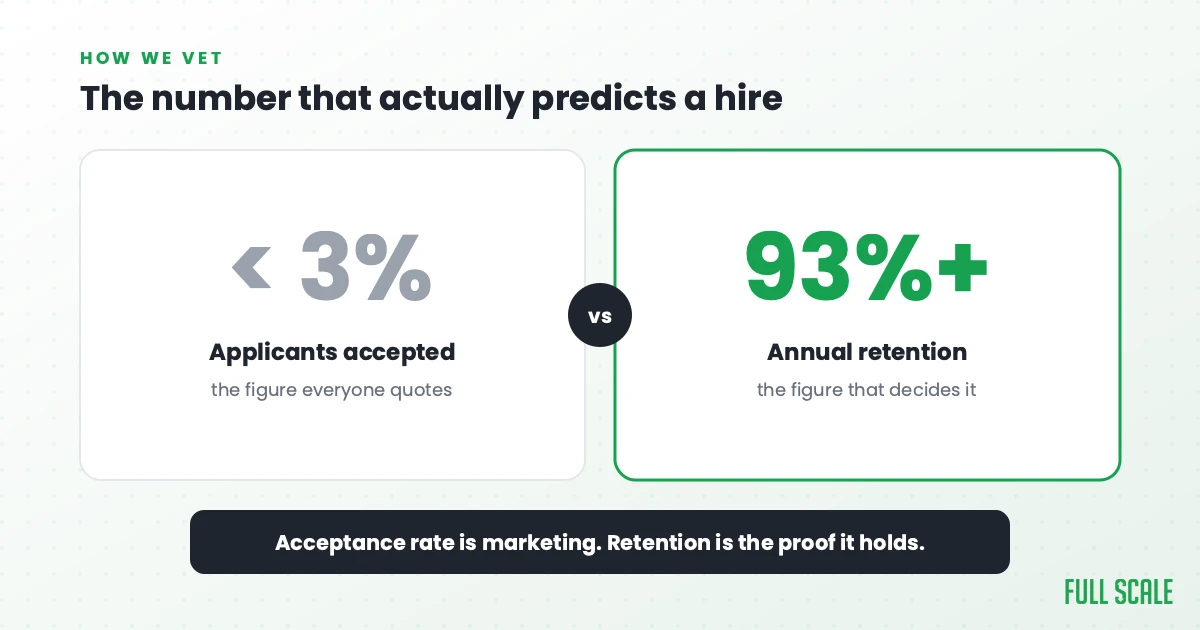
Our own screening is built on exactly this idea, because we put our name behind every developer we place. The technical round is real architecture and debugging work, the kind of problem a live Java service actually throws at you, not a syntax quiz. Around it we check communication, English fluency, work ethic, and whether someone can operate on a distributed team, with background checks thorough enough that we have interviewed candidates’ neighbors. Fewer than 3% of applicants come out the other side. Our full process is written up in our guide to interviewing a software engineer.
I am wary of that 3% number, though, because an acceptance rate is the easiest thing in this business to dress up as marketing, and it is not what makes a hire succeed. What makes a hire succeed is whether the developer stays long enough to learn your codebase and carry its history in their head, which in long-lived Java systems counts for a great deal. So the number I actually trust is retention. Ours runs north of 93%, and we have been at this since 2018. Screening is only worth something if the people who pass it stay.
It is also why we staff integrated teams rather than run a body shop. The engineers we place at AMC Theatres are in the standups and the roadmap conversations next to AMC’s own people, not hidden behind a vendor account manager. That is staff augmentation the way it should work, and it only pays off when you hire for judgment and keep people long enough for that judgment to compound.
If you want the longer version of how we think about Java specifically, our guide to offshore Java development covers the engagement model and the cost math, and you can see the full scope of our Java development services. And if you would rather skip the interviewing and start with developers who have already cleared this bar, you can hire Java developers through us directly.
It comes down to this. The facts are free now, so stop grading people on them. Grade them on the judgment that decides whether your service rides out a traffic spike or pages someone awake at two in the morning. That is what the questions above are built to surface.
Frequently asked questions
Are technical Java questions like garbage collection and the equals/hashCode contract useless now?
The knowledge is not useless. A developer still needs to understand garbage collection, the memory model, and the equals/hashCode contract to debug real problems. What changed is that those topics no longer work as *screening* questions, because any candidate can recite a clean answer in seconds. Use them as a way into a real debugging story instead of as a recall test.
What should I ask a Java developer instead of coding trivia?
Ask open-ended questions that reveal judgment: how they would untangle a three-thousand-line service class, when they would not split into microservices, how they would track down a memory leak or an intermittent latency spike, and how they would change a shared API without breaking the teams that depend on it. Then drill into the reasoning with follow-ups.
Can a candidate just use AI to answer these questions?
You do not try to block it, you make it irrelevant. In a live conversation, follow-up questions expose a pasted answer almost immediately. Ask the candidate to walk through a real decision from their own work, hand them an AI-written service method and ask what they would change before shipping it, and keep chasing the reasoning instead of the conclusion.
What is the difference between a senior and a junior Java developer in the AI era?
Both can generate working Java with AI. The senior knows which generated code to trust, where a transaction boundary belongs, how the service behaves under load, and whether it should be built that way at all. The value moved from writing the code to judging it.
Want a team that has already passed these questions? Book a call and we will walk you through who we would put on your Java work.