
.NET vs Java in 2026: An Honest Guide to Choosing (and Hiring)

In this article
- The 30-second answer
- The platform myth, and what’s actually true in 2026
- Cost: a near-tie, with one expensive trap
- Performance: close enough that it shouldn’t decide it
- The decision that actually matters: hiring
- Where each genuinely wins
- The AI-era wrinkle
- Who builds on each
- Frequently asked questions
- The choice is about your team and your domain
The .NET versus Java debate is stuck in 2014. Half the comparisons you’ll find still frame it as open, cross-platform Java against Windows-locked, proprietary .NET. That dichotomy is dead. Modern .NET is open source, MIT-licensed, and runs first-class on Linux and containers. Both stacks are free, both are fast, and both will happily run your backend for the next decade. So the real decision in 2026 isn’t capability or platform lock-in. It’s domain fit and, more than anything, who you can hire. If you are modernizing an aging system on either stack, see legacy application modernization. If you are on legacy .NET Framework, see our .NET Framework to .NET Core migration guide.
I run Full Scale, and I’ve shipped on both. I built Stackify on .NET, I’ve hired Java developers since my first offshore engagement back in 2012, and two of our anchor clients, AMC Theatres and SOTA Cloud, run on .NET. So here’s the comparison written from the side that actually matters to a CTO: the build decision and the hiring decision, not a feature-checklist tie.
The 30-second answer
- Both are free and both are fast. Modern .NET (now on version 10) is open source and cross-platform. Java (now on JDK 25) runs on free OpenJDK builds. Neither locks you to a platform.
- Java has the larger global talent pool and roughly twice the job postings. It’s the safer hire if you need volume, especially offshore in India.
- .NET is the faster-rising stack with a smoother single-vendor toolchain. C# was TIOBE’s language of the year for 2025, and US salaries for the two are within about one percent of each other.
- The one real cost landmine is Oracle’s Java license, which is avoidable. Pick the wrong Java build and a 500-person company can owe Oracle tens of thousands a year. Pick a free OpenJDK build and it’s zero.
The platform myth, and what’s actually true in 2026
Before anything else, retire the old framing, because it still poisons most comparisons.
Modern .NET has been open source and cross-platform since .NET Core, roughly a decade ago. The current version is .NET 10, a long-term-support release from November 2025, it’s MIT-licensed, and it runs on Linux and in containers as a first-class target. The “Windows tax” against .NET is gone. Anyone still pricing .NET against mandatory Windows Server licenses is costing a platform that hasn’t been the default since around 2014.
Java’s current long-term-support release is JDK 25, from September 2025, and the modern language is a long way from the Java people remember. Virtual threads went final in JDK 21, which lets ordinary blocking code scale for high-concurrency I/O without the async complexity. The garbage collectors are the best in the industry for large, latency-sensitive heaps.
Both shipped major versions on schedule, both are genuinely modern, and both are free if you choose right. That last clause matters more than it sounds, which brings us to cost.
Cost: a near-tie, with one expensive trap
For both stacks, the dominant cost is payroll, and that’s roughly equal. Licensing is effectively zero for both, with a single exception you have to know about.
.NET is free, full stop. MIT-licensed, no per-seat, per-server, or per-employee fee, ever.
Java is free too, as long as you use an OpenJDK build like Eclipse Temurin or Amazon Corretto. The trap is Oracle’s Java SE subscription, which since 2023 is priced per employee, counting your entire headcount, not just your developers. The entry rate is about $15 per employee per month. So a 500-person company that wants Oracle’s Java for ten developers would owe roughly $90,000 a year, versus zero on a free OpenJDK build that comes from the same source code. The “Java is expensive” reputation traces entirely to this one avoidable choice. Avoid it, and cost is a wash.
Performance: close enough that it shouldn’t decide it
At the framework level, both stacks sit in the same top tier, above Node, Python, and Ruby, and below the compiled leaders like Rust and C++. Out of the box, ASP.NET Core tends to beat Spring Boot on raw throughput, but the fastest Java platform frameworks match the fastest .NET. The most common analytical mistake is comparing a heavyweight Spring application against a lean .NET API and calling that “Java versus C#,” when really you’re comparing two frameworks. The language is rarely your bottleneck.
Both stacks have also solved the old cold-start problem from opposite directions. .NET has Native AOT, which compiles ahead of time to startup measured in milliseconds and much smaller images. Java has GraalVM native images and related techniques that do the same. They land in the same place. For a buyer, performance is a tie that shouldn’t drive the decision unless you’re in a genuinely latency-critical niche, where Java’s mature garbage collectors give it a real edge on large heaps.
The decision that actually matters: hiring
Here’s the part the feature-checklist comparisons skip, and it’s the one you’ll feel every quarter.
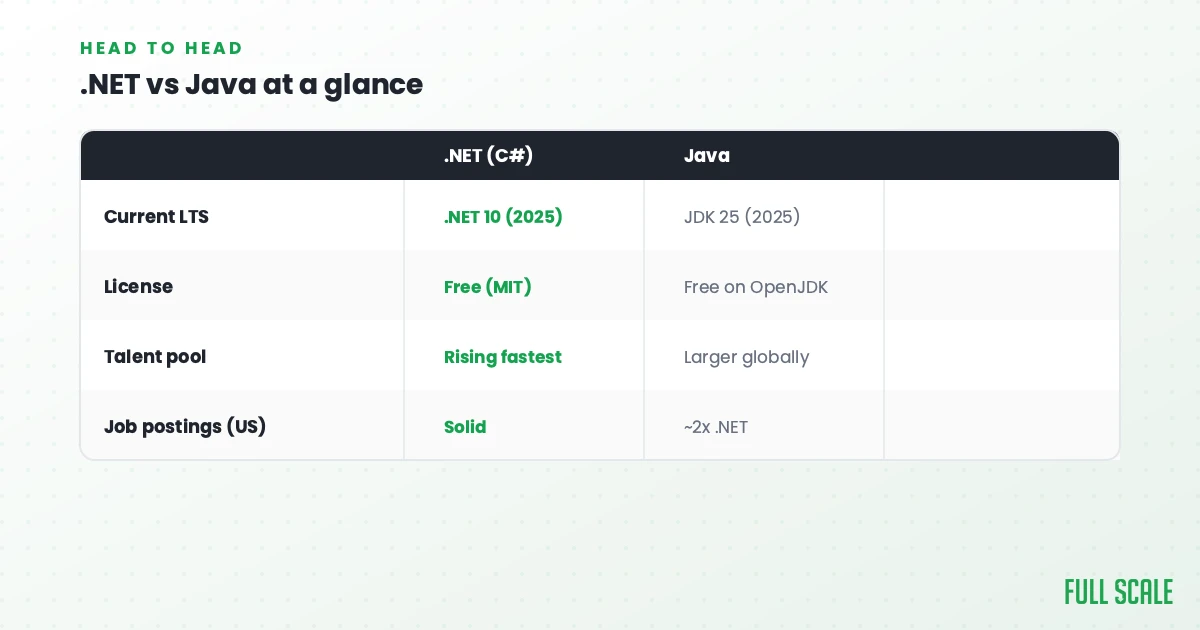
Java has the larger global talent pool. In the 2025 Stack Overflow survey, Java and C# are close in overall usage (Java around 29%, C# around 28%), but Java’s community is bigger worldwide, and Java carries roughly twice the job postings of C#. If you’re hiring at volume, especially offshore in India, where Java talent is deepest, Java gives you more résumés.
C#, though, is the stack with momentum. It was TIOBE’s programming language of the year for 2025, driven by Azure and open-source .NET, and among professional developers in 2025 its usage actually edged past Java’s for the first time. New investment is flowing toward .NET. Java is flat to slightly declining in developer share, though from a very large base, so “declining” here means losing ground slowly, not disappearing.
US salaries for the two are within about one percent of each other, so this comes down to availability, not cost per hire: Java for raw pool size and offshore depth, .NET for a rising, well-supported stack with a simpler toolchain that’s easier to standardize a team around, and easier to find a strong offshore .NET developer for when you’re ready to hire one.
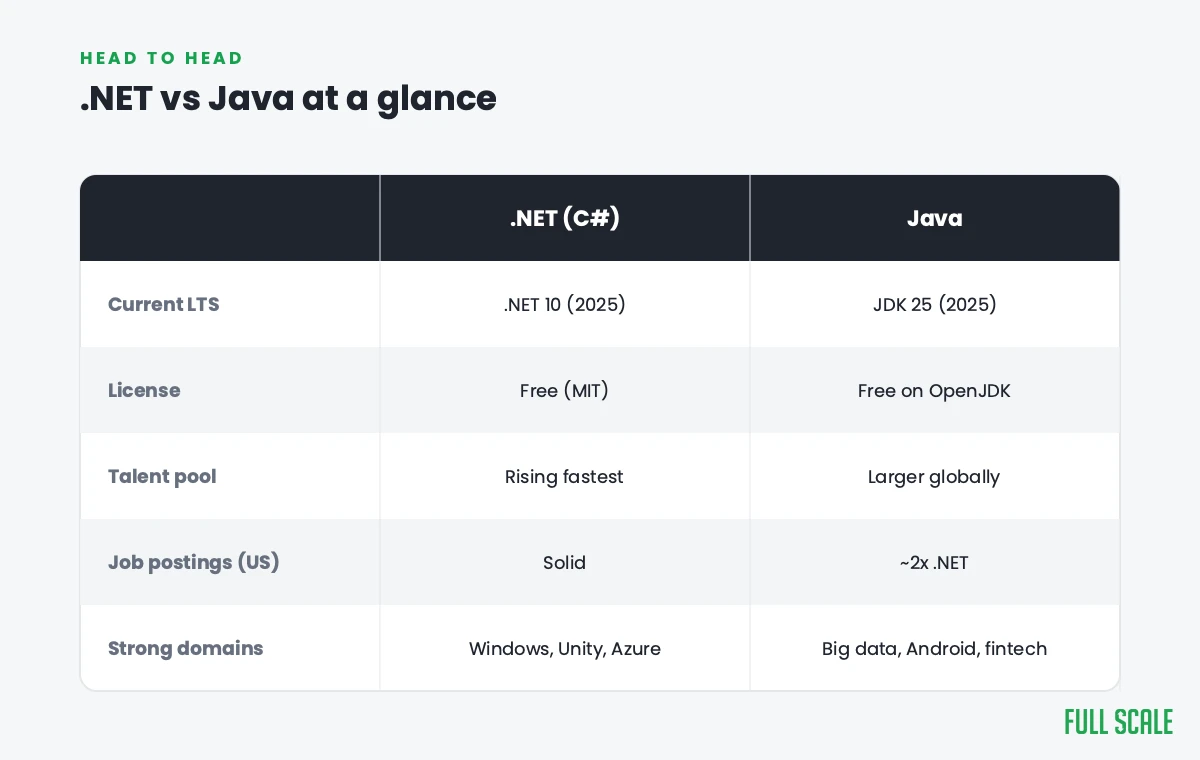
| .NET (C#) | Java | |
|---|---|---|
| Current LTS | .NET 10 (Nov 2025) | JDK 25 (Sep 2025) |
| License | Free (MIT), no asterisks | Free on OpenJDK; Oracle build is paid |
| Talent pool | Large, rising fastest | Larger globally, deepest offshore |
| Job postings (US) | Solid | Roughly 2x .NET |
| Toolchain | One unified stack and CLI | Spring, Quarkus, Micronaut, Maven/Gradle |
| Strongest domains | Windows/LOB, Unity games, Azure | Big data, Android, fintech, enterprise |
Where each genuinely wins
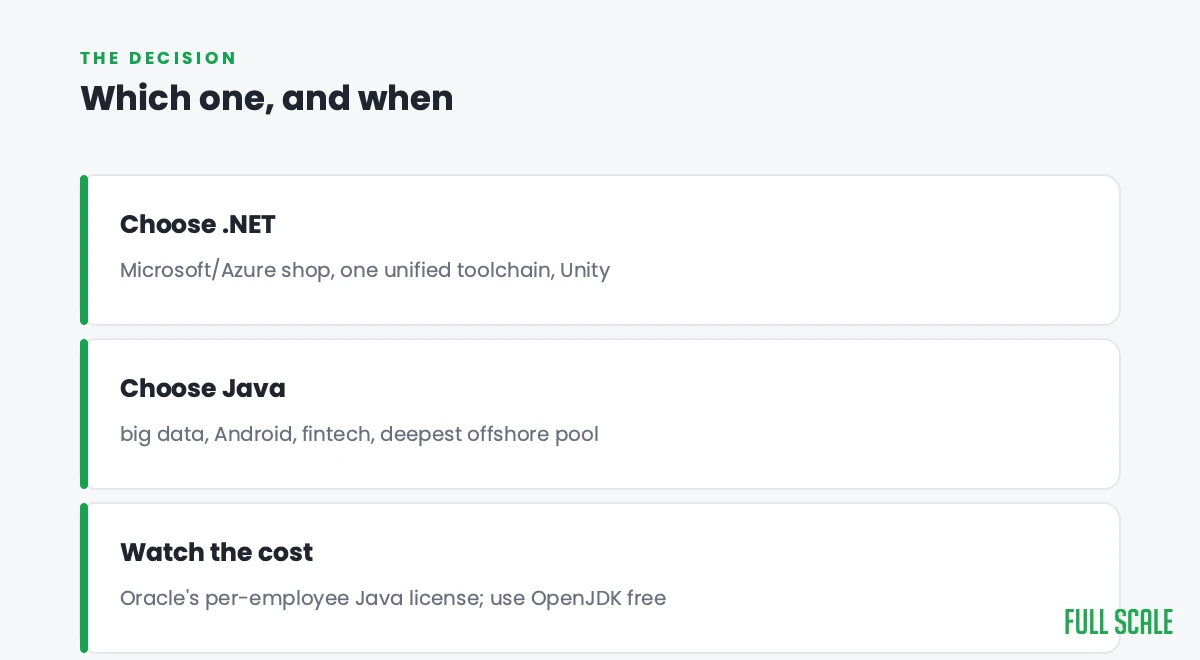
Choose .NET if you’re a Microsoft or Azure shop, you want one unified first-party stack and toolchain that’s easy to standardize a team on, you’re building Windows business applications or Unity games, or you want the smoother ahead-of-time cold-start story today. The single-vendor coherence is a real onboarding advantage.
Choose Java if you live in the big-data and streaming world (Kafka, Spark, and Flink are all built on the JVM), you’re building for Android, you’re in banking or fintech where Java is the incumbent, you need the widest choice of garbage collectors for latency-sensitive systems, or you’re recruiting from the largest global and offshore talent pool. Java also gives you the most framework optionality.
The honest throughline: the real drivers are your team’s existing expertise, your current stack, your hiring market, and your domain fit. They are not raw performance or license cost, because those are close to even.
The AI-era wrinkle
There’s a newer factor worth a sentence. AI coding assistants are strong on both C# and Java, with no meaningful capability gap between them, because both are huge, well-documented languages with decades of public code to train on. So AI doesn’t tip this decision. What it does, here as everywhere, is shift the value from writing the code to judging it. The scarce skill on either stack is now the developer who can architect the system and catch what the AI got subtly wrong, which is exactly what we screen for and write about in our guides to the .NET developer job description and the Java developer job description.
Who builds on each
Java runs Netflix, which operates thousands of Java microservices on the latest JDK, plus the JVM backbones of LinkedIn, Airbnb, Spotify, and most of the banking world. .NET runs large parts of Microsoft itself, including Bing, which reported a major latency win moving to .NET Core, plus Stack Overflow, the canonical C# and SQL Server showcase, and Unity, whose entire scripting layer is C#. Both have serious companies behind them, so neither is a risky bet on durability grounds.
Frequently asked questions
Is .NET better than Java?
Neither is universally better. They’re close on performance and identical on cost if you pick a free Java build. .NET offers a more unified toolchain and is the faster-rising stack; Java has the larger global talent pool, deeper offshore availability, and stronger big-data and Android communities. The right choice depends on your team and domain.
Is .NET still Windows-only?
No. Modern .NET has been open source and cross-platform since .NET Core, about a decade ago. The current version, .NET 10, is MIT-licensed and runs first-class on Linux and in containers. Only the legacy .NET Framework is Windows-only, and it isn’t what you’d build on today.
Which pays more, .NET or Java developers?
In the US they’re within about one percent of each other on average, so pay isn’t a meaningful differentiator. The bigger practical difference is availability: Java has more developers and job postings globally, while C# is the faster-rising stack.
Is Java free?
Yes, if you use an OpenJDK build like Eclipse Temurin or Amazon Corretto. The cost trap is Oracle’s Java SE subscription, which is priced per employee across your whole headcount. Use a free OpenJDK build, which comes from the same source code, and Java costs nothing to run.
Is Java dying?
No. Java’s developer share is flat to slightly declining from a very large base, and C# recently edged past it among professional developers, but Java still has the larger global pool, about twice the job postings, and dominance in big data, Android, and finance. It’s losing ground slowly, not disappearing.
Which is better for a startup?
For most startups it comes down to the team you can hire and the domain you’re in. .NET gives a small team a coherent, single-vendor stack that’s easy to standardize on. Java gives you a deeper hiring pool and the big-data and JVM world. Neither is a wrong answer; match it to your people and your product.
The choice is about your team and your domain
.NET and Java are both excellent, both free, and both fast. The benchmark and feature differences between them will not be what makes or breaks your product. What will is whether the choice fits your domain and whether you can staff it and keep it staffed.
So weigh it on the things that actually vary: your domain (big data and Android lean Java, Microsoft and Unity lean .NET), your hiring market (Java for volume, .NET for a rising pool and a simpler toolchain), and the Oracle license trap on the Java side. Decide on those, not on a throughput chart.
If you’d rather not navigate the hiring side alone, that’s what we do, and we staff both. Talk to us about building your team, and we’ll put pre-vetted .NET or Java developers in front of you who already work the way the AI era demands.