
Offshore Java Development – Hire Trusted, Affordable Talent from the Philippines

In this article
I founded Stackify, an APM and logging platform that instrumented Java applications in production for hundreds of engineering teams. Over the better part of a decade I sat inside the operational layer of the JVM at scale: watching Spring Boot services under load, tracing slow queries through Hibernate, profiling memory leaks in production while Java engineers tried to ship the next feature. That experience shaped how I think about Java talent more than any other part of my career. It also shaped how I think about what a Java developer actually does now.
I have also hired Java engineers in three different parts of the world, going back to 2012. My first Java hire was an accident: I needed Java engineers to write Stackify’s Linux monitoring agent, my Kansas City team were all C# developers, a friend’s dev agency claimed it had Java developers, and the engineers who showed up turned out to be in St. Petersburg. The longer version of the Russia accident that talked me into offshore is on the blog. The short version is that they were excellent, the work shipped, and the experience convinced me that good Java engineers exist in places I had not been looking. That conviction is what eventually became Full Scale. The same holds on the Microsoft side, where teams hire ASP.NET developers from that overlooked talent pool.
Today Full Scale staffs Java engineers in the Philippines for SaaS, fintech, lender, and enterprise teams. Some of them work inside organizations you would know by name. This post is about how that model actually works, and what kills it when companies try to do it badly. If you are evaluating whether to outsource Java development as a project versus running it as a staffed team, I write about that decision in the sibling post.
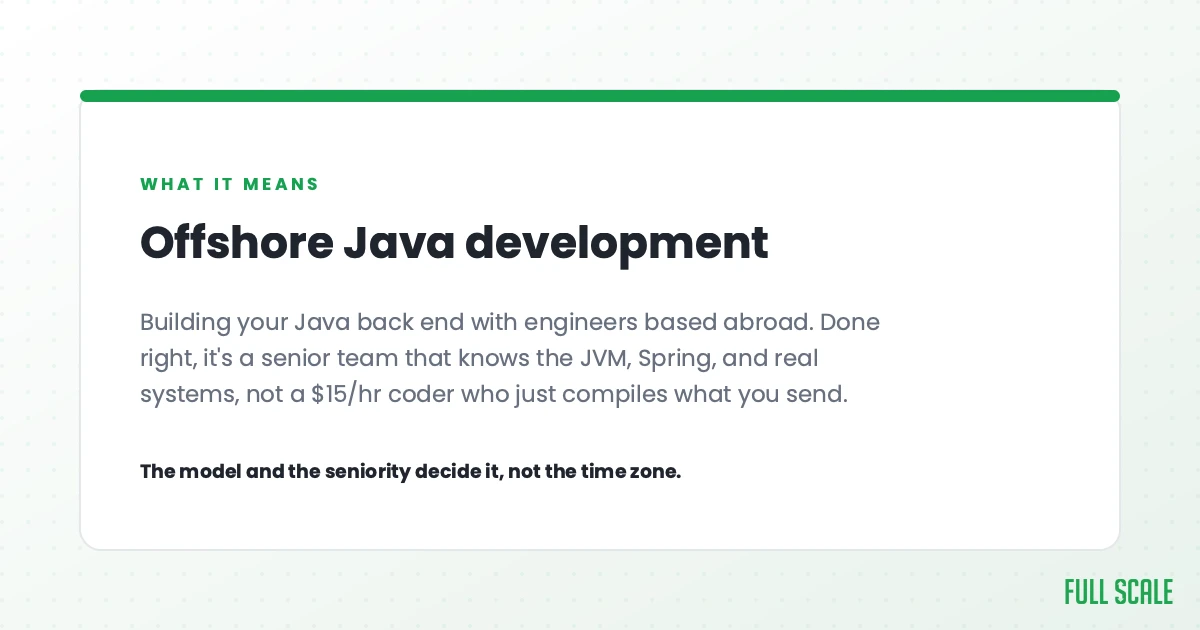
What “Offshore Java Development” Actually Means
The phrase covers two very different models, and confusing them is how most teams end up burned.
Staff augmentation means you add Java engineers to your existing team. They report to your engineering lead, they’re in your standups, they use your codebase, your CI, your code review standards. The developers become an extension of your organization rather than a vendor on the other side of an SLA. This is the model that works for any engagement longer than a few months, and it is what staff augmentation is designed for.
Project outsourcing means you hand a defined scope of work to a shop and they deliver it. For genuinely scoped work: a payments integration with a fixed API, a one-off data migration, a service rewrite with a known endpoint. This can work. For anything that involves ongoing iteration, evolving requirements, or shared engineering judgment, handing it to a project shop and waiting for a deliverable tends to end badly.
Most companies searching for offshore Java development should be looking for staff augmentation, not a project shop. The question is usually “how do I get reliable Java capacity without a full US salary load?” and the answer to that is integrating offshore engineers into your team. Project shops optimize for the handoff. Staff augmentation optimizes for the outcome. How you structure the engagement decides more than the stack does, which is the whole argument of my guide to offshore app development.
The Java stack covers a lot of ground: Spring Boot services, microservices, the JVM itself, Java EE legacy, Kafka and Pulsar pipelines, and the cloud services wrapped around all of it. Some of the most demanding production systems in the world run on it. The engineers who can operate at that level are not concentrated in any one country. Where and how you engage them is the decision that matters.
Why Most Offshore Java Engagements Fail
The failure mode is rarely the code itself. The failure mode is the communication structure.
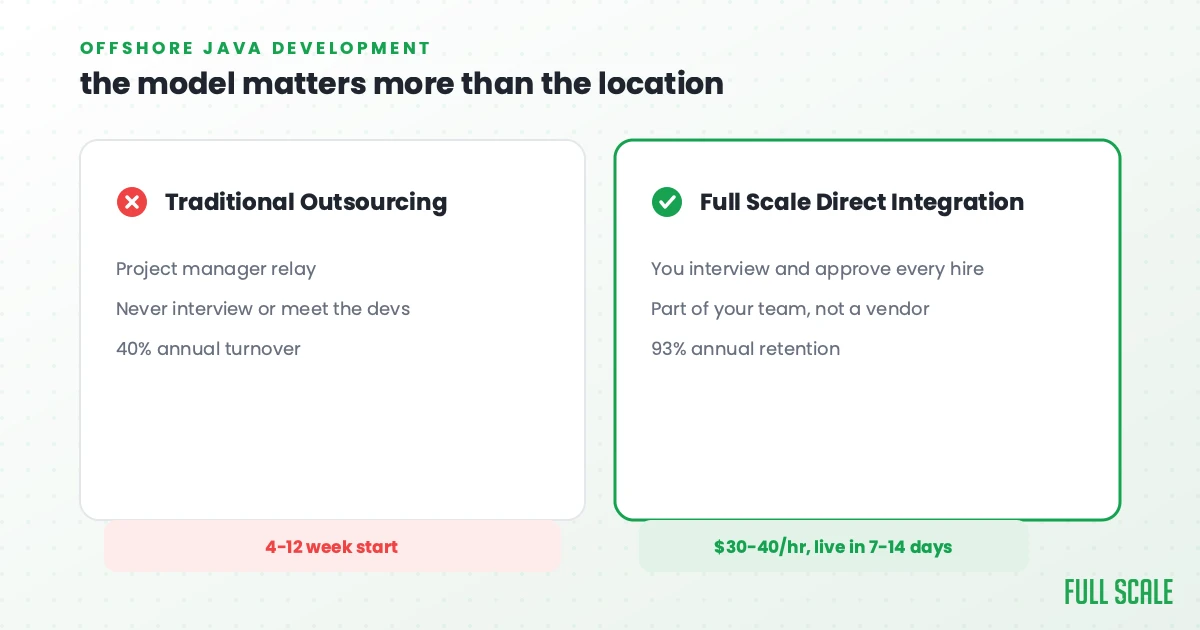
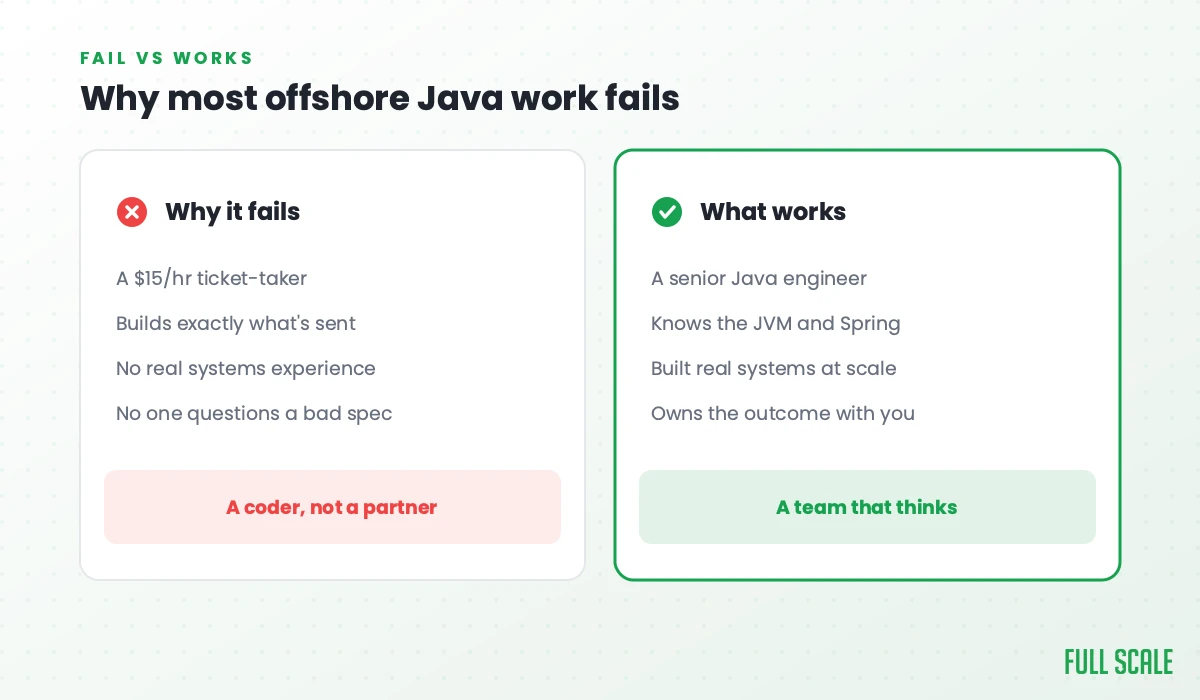
I have talked to founders running offshore Java teams where every interaction routed through a single technical project manager. The engineers never appeared on a call. Every question went through the PM, every answer came back through them, and after three months the client could not name a single developer who was actually writing the code. Sometimes the developers had limited English. Sometimes it was a cultural rule about who was allowed to talk to the client. Either way, you end up with a team you can never actually work with and a relay layer in the way of every decision.
I call this cheapshoring. It happens when cost is the only criterion: when a company picks the cheapest option on a staffing platform or signs with a project shop purely on rate, without checking whether the team can communicate with the people whose product they are building. The cost looks right on the invoice. The engagement falls apart in month two when requirements stop being understood.
Three things kill offshore Java engagements more than anything else:
Hiring for rate over communication. Java is an opinionated platform. It works best with engineers who can read documentation, discuss architectural trade-offs with your team, and push back when a spec doesn’t make sense. If the developer can only communicate through a relay, you do not have a developer on your team. You have a black box producing JAR files.
No technical lead on the client side. A good senior Java developer will flag architectural concerns and call out scope risks. What they cannot do is set the technical vision for your product. If nobody on the client side is reviewing the work and making the daily engineering decisions, the build slides off course. That’s true onshore too. Offshore, it slides faster because the feedback loop is longer.
Treating the engagement as a one-time project. Senior Java engineers become more valuable the longer they work on a system. They learn the deployment pipeline, the on-call patterns, the places technical debt is hiding, the parts of the codebase a new engineer should never touch without supervision. Cycling through project shops means paying the re-orientation tax every time and losing the compounding value of engineers who actually know your system.
What I Look For in an Offshore Java Developer
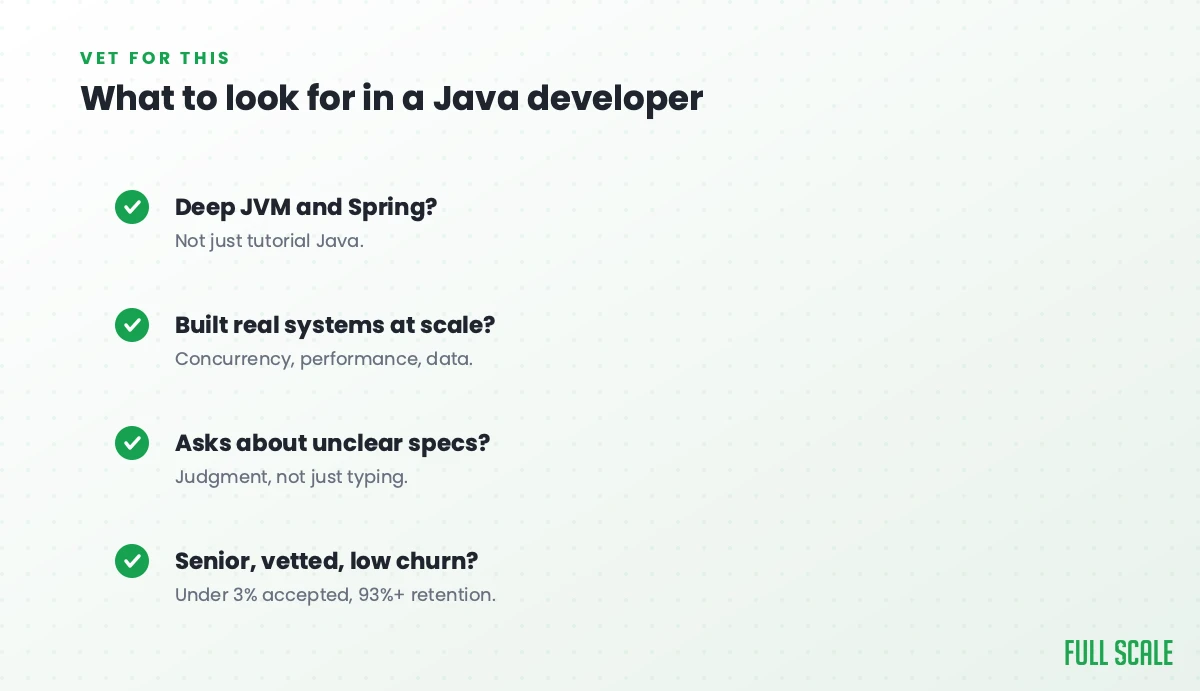
The technical bar matters less than most people think. Senior Java developers in the Philippines are building the same production systems (Spring Boot services, microservices, JVM tuning, AWS and GCP integrations, event-driven pipelines) as engineers anywhere else. The hard part is not finding someone who can write Java. The hard part is finding someone who can operate as a member of your team.
Here is what I evaluate before I put a developer on a client:
Whether I can talk to them directly. Every Filipino engineer Full Scale staffs goes on the client’s Slack, into the client’s standup, and on the client’s video calls from day one. If a partner is gatekeeping access to its own developers, that is a signal about the engineers’ communication level, not about the partner’s professionalism. Direct access is the baseline.
Communication quality as a hard filter. This is rarely the problem in the Philippines: English fluency is high, and the cultural style suits remote engineering. But run the evaluation. The developer should be able to join a technical conversation, ask a clarifying question without prompting, and walk through a bug they are debugging in plain English. If those three things are not present, the rate is irrelevant.
A staffing-model partner, not a project-shop partner. The best offshore Java relationships I have built run for years. The developers become institutional knowledge holders. They know your deployment pipeline, your code review standards, where the technical debt is hiding, and what a senior engineer on your team would push back on. Look for a partner whose model is built around staffing engineers onto your team for the long term, not one whose business depends on closing new project scopes.
Why the Philippines for Java
There are smart Java developers in many countries. I have personally worked with engineers in Russia, Latin America, India, and the Philippines. The reason Full Scale operates specifically in the Philippines is not the hourly rate. It is the combination of attributes that makes a remote engineering team actually function.
For an embedded Java team, what actually determines whether it works is day-to-day communication, not the hourly rate. A senior engineer who is in your standup, reviewing pull requests, and raising a JVM or schema concern before it ships is worth far more than a cheaper one who only ever speaks through a project manager.
The Philippines is the third-largest English-speaking country in the world, so the language barrier in either direction is effectively zero. Filipino developers grew up consuming American culture: the references, the humor, the working style. Onboarding into a US-based engineering team feels familiar from day one. More than fluency, the cultural orientation toward hospitality and service translates directly into engineering work: the engineers genuinely care whether you got what you needed, which is exactly what you want from someone embedded on your team for years.
The Philippine IT-BPM industry generates $40 billion in annual export revenue and employs 1.8 million workers. The Java talent pool is deep. Spring Boot, microservices, JVM tuning, the cloud-native tooling around all of it: Filipino engineers have been building enterprise Java for two decades. The infrastructure for remote engineering work is mature.
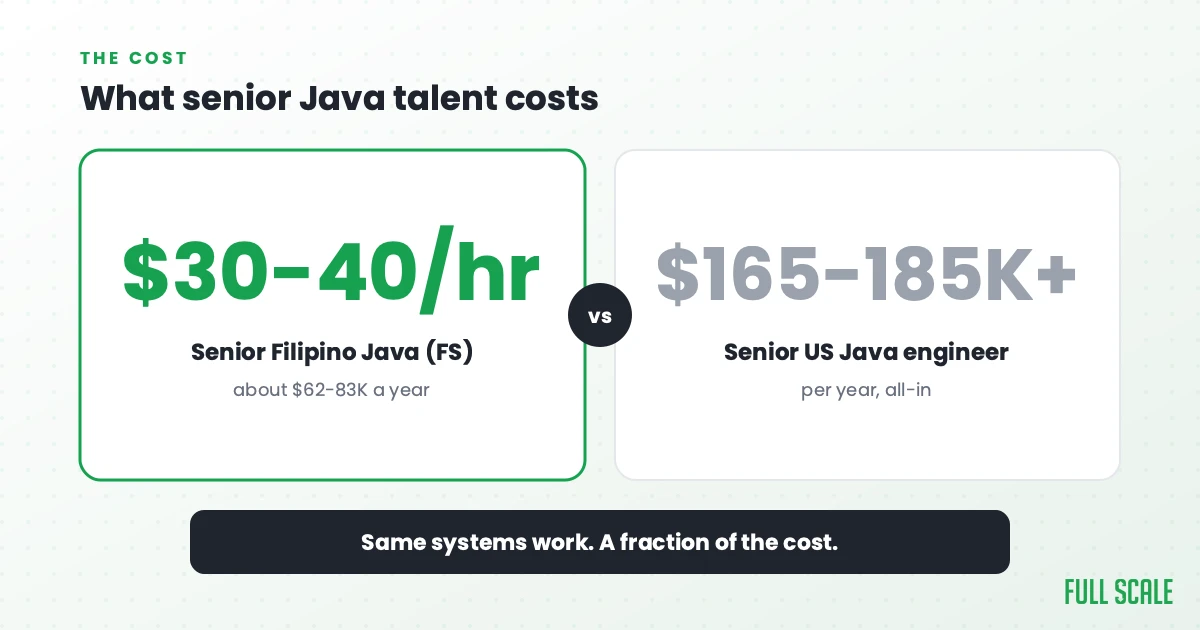
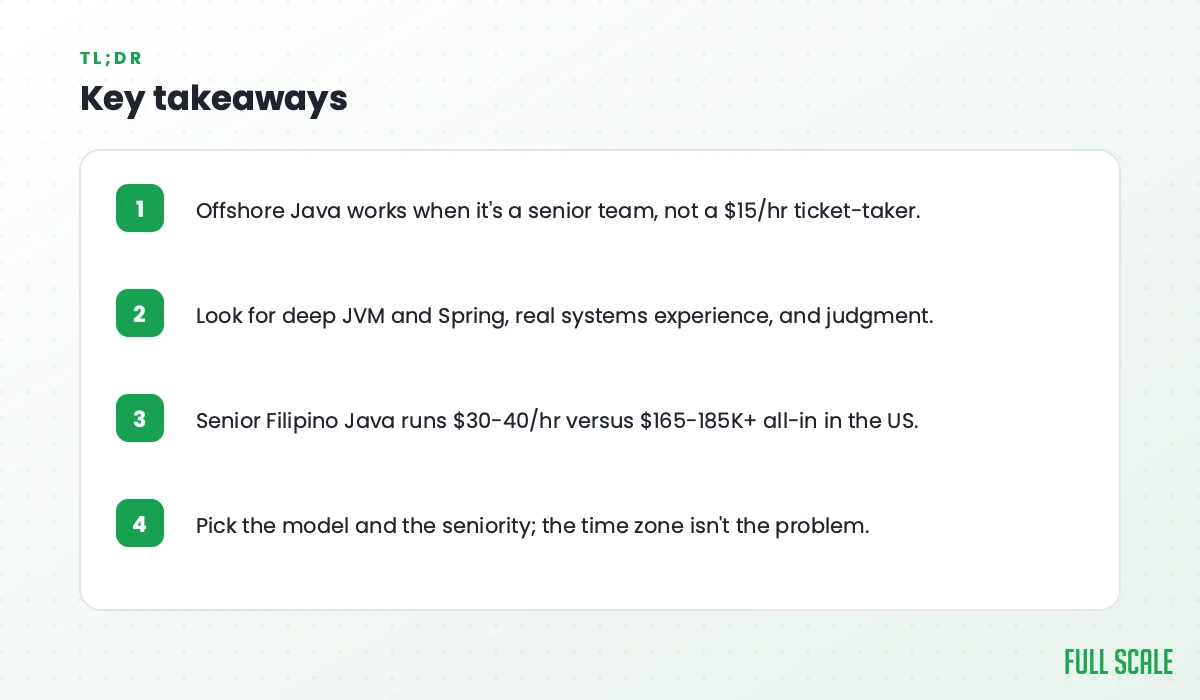
On cost: Full Scale clients typically pay $30 to $40 per hour for a senior Filipino Java engineer. A comparable engineer in the US earns a BLS median of around $133,000 per year in base salary. When you add benefits, payroll taxes, and overhead (what MIT research estimates at 1.25 to 1.4 times the base salary), the all-in cost of a senior US Java developer runs $165,000 to $185,000 or more per year.
| Full Scale (Java, Philippines) | US Senior Java Engineer | |
|---|---|---|
| Hourly / annual cost | $30-$40/hr (~$62K-$83K/yr) | $133K base → ~$165K-$185K all-in |
| Time to staff | ~14 days | 6-12 weeks (typical open search) |
| Recruiting fee | None | 20-25% of first-year salary |
The cost-of-living differential is real, and it is the reason offshore Java development works economically: not because Filipino engineers are less capable. The economics compound over a multi-year engagement: a Java engineer you keep for three years, who already knows your deployment pipeline and where the technical debt is buried, is worth far more than the same role refilled every eighteen months at a US loaded cost.
Most Full Scale clients run a half-day overlap model: Filipino engineers work late afternoon through midnight Manila time, giving three to four hours of shared working hours with a US team. For roles that require real-time customer collaboration, some engineers work full US business hours. Most teams find the half-day overlap is plenty for daily standups, code reviews, sprint planning, and the conversations that have to happen synchronously.
How Full Scale Runs Java Engagements
We vet every Java developer before they go anywhere near a client. That includes a technical assessment against real architectural problems (not syntax quizzes), an English fluency evaluation, and detailed background checks that include physical interviews with a candidate’s neighbors. The process is more thorough than most US hiring funnels, by design.
Once an engineer is on your team, they are in your tools, your standups, and your code reviews. Full Scale runs Customer Success Managers who stay in regular contact with both the client and the engineers, making sure the engagement is producing what the client needs and that the engineers are supported, challenged, and developing. Our developer retention runs at 93%, against the 30 to 40 percent voluntary attrition that is normal in Philippine BPO work. That retention number is not a culture statistic. It is a continuity statistic, and it shows up in how fast your team ships.
One thing that sets Full Scale apart in 2026 is that we treat AI upskilling as a core obligation to every engineer on the bench. We run the Spartan Training Academy, an internal training program with several delivery formats. The Claude Masterclass series runs multiple live sessions a month: one covers bringing Claude Code into the terminal and IDE for real-time debugging, scaffolding, and refactoring; another covers advanced agentic workflows with MCP integrations connecting Claude to GitHub, databases, and Slack. Engineers also get a five-minute training video every week and a thirty-minute deep-dive every other week, most of them recorded by Full Scale engineers themselves. Peer to peer, not top down.
The reason I push it: I do not want to get a year from now and have clients return Java developers because those engineers never learned AI and are now a generation behind. We should have trained them earlier, we would tell ourselves. We refuse to be in that position.
That training arc is also what Product Driven is about: building Java engineers who take ownership of what they are shipping and why, not engineers who produce code when handed a ticket. AI is making the engineering part of the job cheaper. The product thinking is the part that compounds, and that is the difference between a software engineer and a software developer.
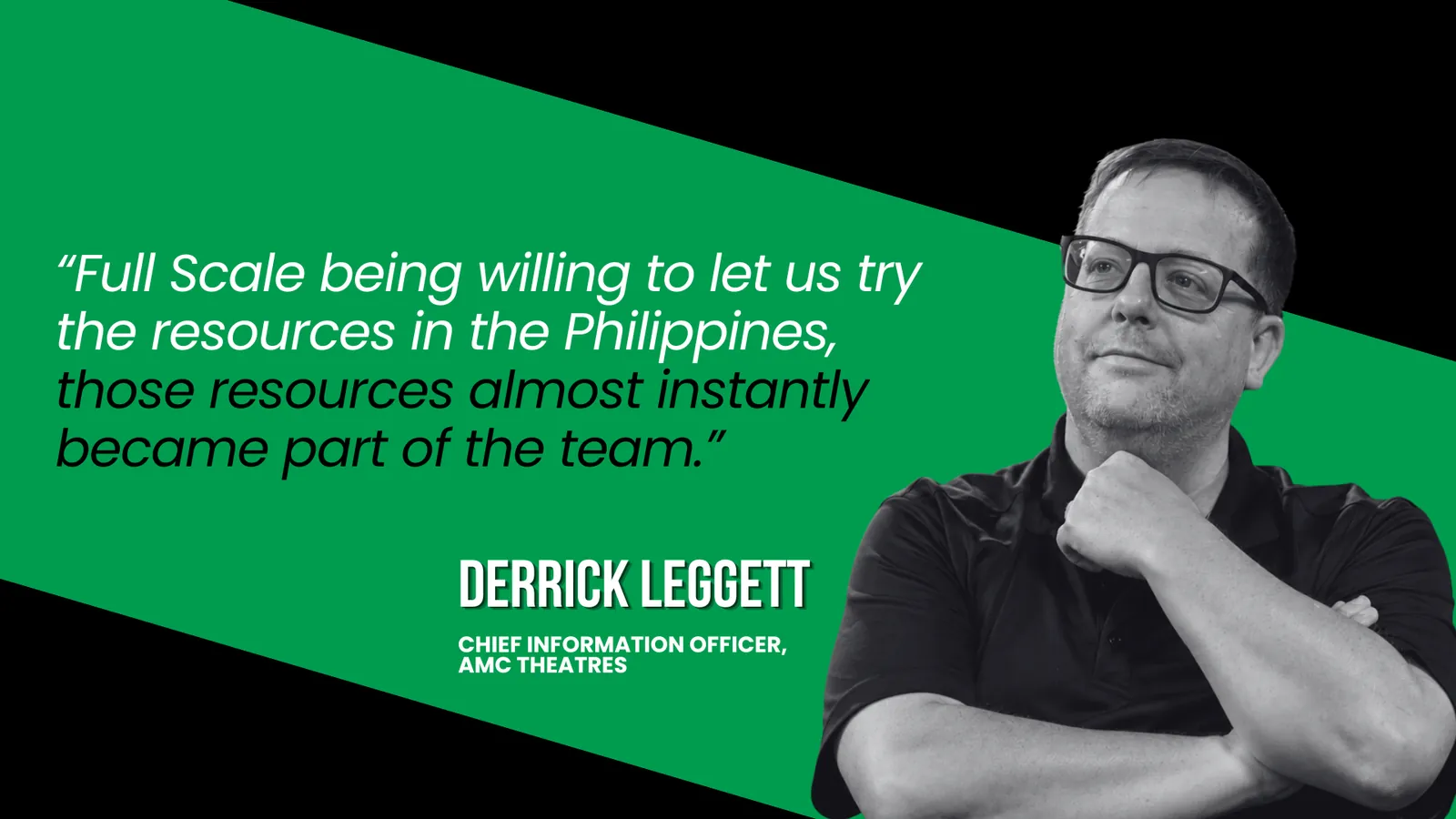
AMC Theatres is one example of the model running at enterprise scale. Their engineering team spans the US, South America, India, and the Philippines, and the Filipino engineers Full Scale placed there work the same standups, the same Slack, the same code reviews as the rest of the team. Derrick Leggett, AMC’s CIO, has built a global engineering organization on the conviction that where a developer sits is irrelevant. What matters is whether they are treated as part of the team.
Frequently Asked Questions
How fast do offshore Java developers onboard?
Onboarding is typically inside 14 days from decision to a developer working in your codebase. Because the engineers join your existing team rather than spinning up a separate project, they are in your standups, your repos, and your code reviews in the first week and ramping on real Spring Boot or JVM work, not waiting on a scoped handoff.
How do you keep Java code quality high across time zones?
Every developer clears a technical assessment against real architectural problems (not syntax quizzes), an English-fluency evaluation, and detailed background checks before they reach a client. Once placed, they work inside your code review and CI standards rather than a parallel vendor workflow, and a Customer Success Manager stays close to both sides so quality and fit surface early instead of at the end of a contract.
How does the half-day overlap with a US team work for Java teams?
Most Full Scale Java engineers work late afternoon through midnight Manila time, giving three to four hours of shared hours with a US team: enough for daily standups, live code review, sprint planning, and the architecture conversations that have to happen synchronously. For roles that need full real-time collaboration, some engineers work full US business hours.
What does Java developer retention look like, and why does it matter?
Full Scale’s developer retention runs at 93%, against the 30-40% voluntary attrition typical in Philippine BPO work. For a Java platform that is a continuity number, not a culture statistic: an engineer who stays for years holds the institutional knowledge (the deployment pipeline, the on-call patterns, where the technical debt is hiding) that a re-hired contractor has to learn from scratch.
Build a Java Team With Engineers Who Actually Know the Stack
Full Scale has been staffing offshore software development teams since 2018. We have placed 700+ developers with clients across 200+ tech companies. Our Java engineers are working inside some of the most demanding engineering organizations in North America, including AMC Theatres, where they are full members of the engineering team.
If you want to understand how we think about building these teams: not just staffing seats but developing engineers who take ownership of the Java product they are building. That is what I wrote about in Product Driven.
If you want to hire Java developers who work inside your team rather than across from it, that is what we staff.
Schedule a call to talk through what the right Java engagement looks like for you.