
Top IT Companies in the Philippines: An IT Outsourcing List by Type

In this article
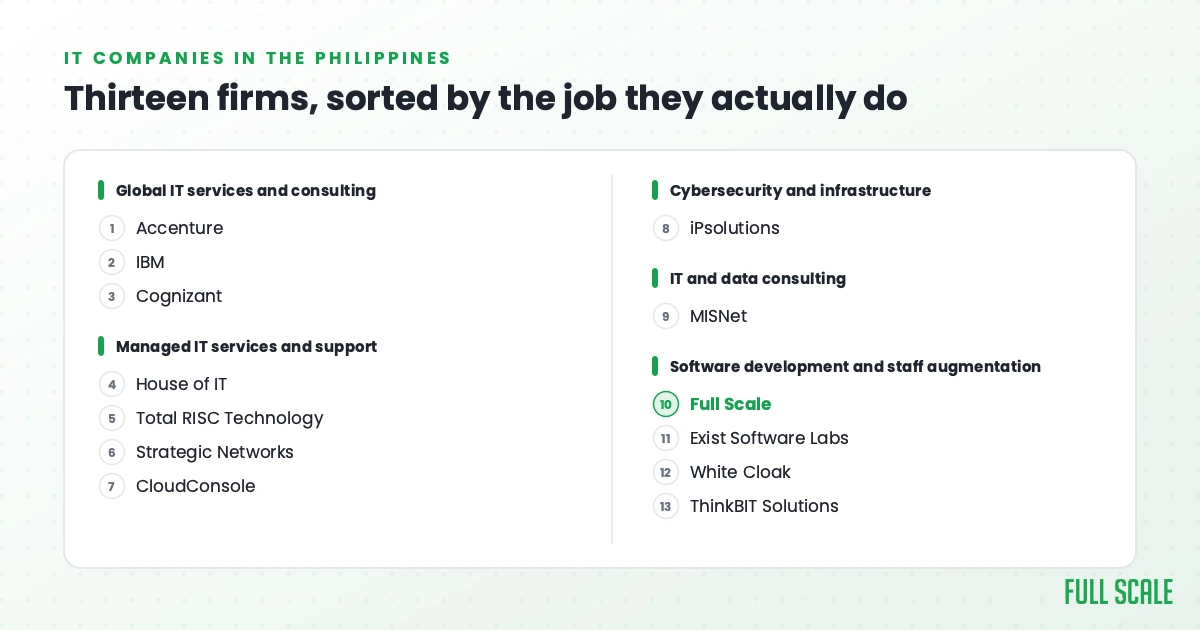
Quick Answer: IT companies in the Philippines fall into five distinct types outsourced for different reasons: global IT services and consulting (Accenture, IBM, Cognizant), managed IT services and support, cybersecurity and infrastructure, IT and data consulting, and software development and staff augmentation. They are not interchangeable, a cybersecurity firm and a staff augmentation partner like Full Scale solve completely different problems, so the right pick depends on which job you actually need done, not just a ranked list.
The problem with every other list of IT companies in the Philippines: they mix four or five completely different kinds of business into one ranked grid. A cybersecurity firm, a help desk provider, and a software development shop are not competitors. They do different jobs. Putting them in one numbered ranking tells you nothing.
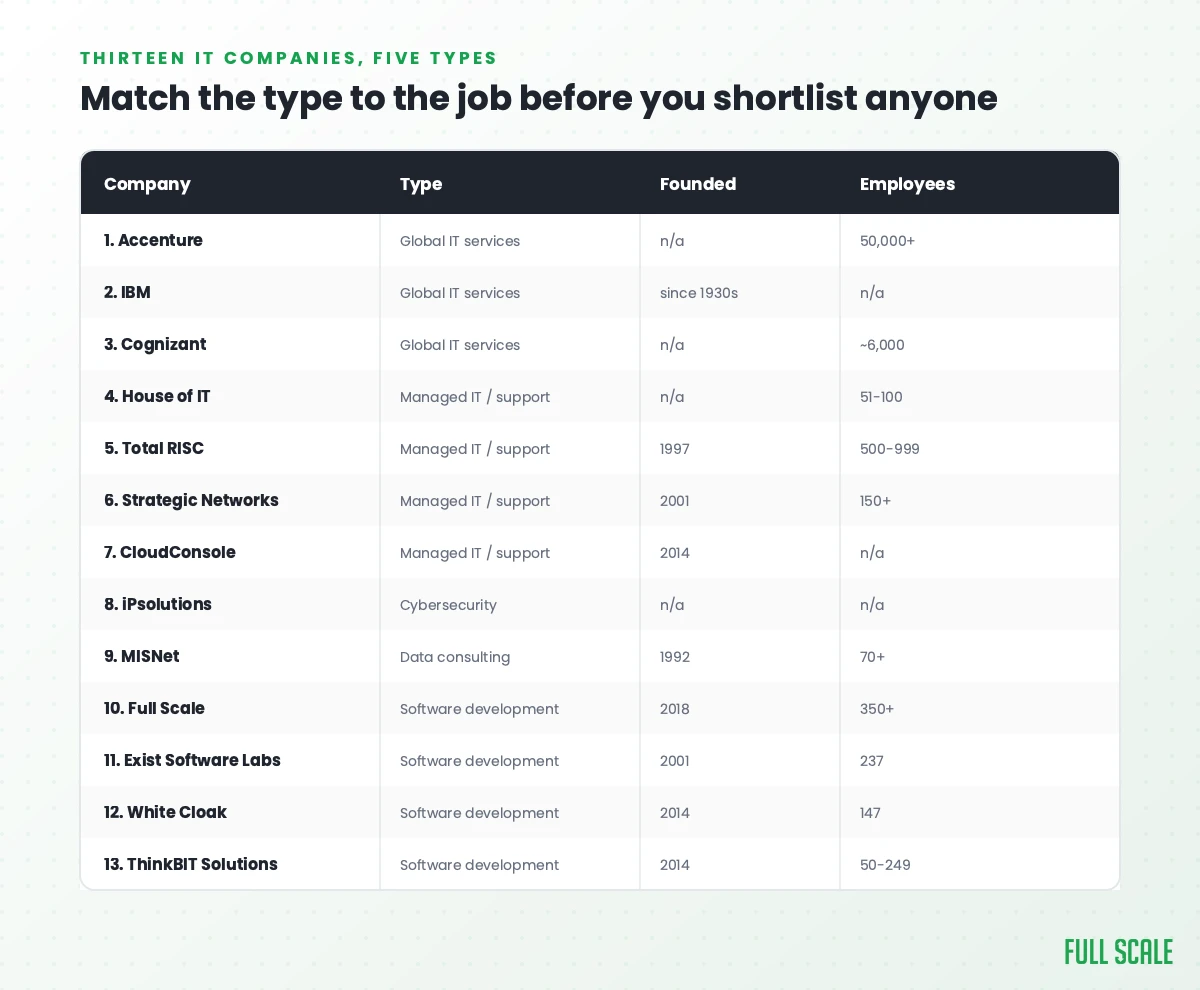
So this list is organized by type. Find the type you actually need, then read the names under it. Full Scale is number 10, in the software development group, so read this as a map rather than a ranking.
| If you need… | The type | Numbers |
|---|---|---|
| A large enterprise program run end to end | Global IT services and consulting | 1-3 |
| Servers, network, and help desk managed day to day | Managed IT services and support | 4-7 |
| Security assessment, monitoring, hardening | Cybersecurity and infrastructure | 8 |
| Data, analytics, and BI work | IT and data consulting | 9 |
| Software built, or an engineering team staffed | Software development and staff augmentation | 10-13 |
Global IT services and consulting
A global IT services firm is a multinational consultancy running delivery centers in the Philippines, usually thousands of staff deep. They are built for large enterprise programs, priced accordingly, and generally the wrong call if you need three engineers next month.
1. Accenture. The largest IT employer in the country by a wide margin. Its own site puts the Philippine workforce above 50,000 people across roughly 22 delivery centers, with the country headquarters in Mandaluyong and major sites in Manila, Cebu, and Ilocos. The work spans cloud, AI, custom software, and enterprise systems. If your project is big enough to need Accenture, you already know it.
2. IBM. In the Philippines since the 1930s, which makes it the longest-running technology company on this list. Offices in Quezon City, Taguig, Santa Rosa in Laguna, Naga, and Cebu, operating as several entities including IBM Philippines, IBM Solutions Delivery, and IBM Business Services. Software, infrastructure, consulting, and business process services for international clients.
3. Cognizant. Roughly 6,000 employees across six delivery centers, five in Metro Manila and one in Cebu, which the company has called its fastest-growing delivery center. Carries ISO 9001, ISO 20000, and ISO 27001 certifications. Strongest on large software engineering and cloud operations programs.
Managed IT services and support
A managed IT services provider runs your technology day to day instead of building it: system administration, network support, help desk, and infrastructure. These firms do not write software. This is the category most searches for “IT solutions provider” in the Philippines are actually after.
4. House of IT. Australian-owned, headquartered in Cebu City with offices in Makati, Clark, and Davao, and 51 to 100 employees. Covers network design, systems integration, project management, and both proactive and reactive desktop support, alongside managed cybersecurity. ISO certified, and serves clients in Australia, the US, New Zealand, and the UK. Client feedback on Clutch concentrates on data protection and network security specifically.
5. Total RISC Technology. Founded 1997, with its global headquarters now in Clark Global City, Pampanga, and 500 to 999 employees. Server, storage, and networking is the core: managed IT, infrastructure deployment, server maintenance, professional consulting, and cloud infrastructure. Partners with IBM, HP, Dell, Cisco, EMC, and NetApp, and serves everything from small businesses to Fortune 500 companies across a dozen-plus sales offices worldwide. The most infrastructure-heavy firm on this list.
6. Strategic Networks. Established 2001, based in Muntinlupa, with more than 150 support personnel. Covers helpdesk, desktop, server, application, and systems support. Worth knowing for one specific reason: it also offers IT staff augmentation and employer-of-record services, so you can put people in the Philippines without standing up your own legal entity. That combination of day-to-day support plus EOR is uncommon in this category.
7. CloudConsole. Founded 2014 with Swedish origins, based in Legaspi Village, Makati. Managed IT services, network security, cloud computing, data backup, and systems administration, with 24/7 IT support. Positions itself for everything from small startups to large enterprises, which is a wide range, so pin down which tier you’d actually sit in before signing.
Cybersecurity and infrastructure
A cybersecurity firm sells a security posture rather than a product: assessment, monitoring, hardening, and incident response, usually delivered on top of licensed vendor tools.
8. iPsolutions. Offices in Metro Manila, Davao, and Cagayan De Oro. Enterprise cybersecurity and hyperconverged infrastructure, built on a vendor stack that includes Sophos, Fortinet, Palo Alto Networks, Sangfor, Dell, and Huawei. Per its own site, the work covers network security, disaster recovery, and vulnerability assessment for government agencies, hospitals, corporations, education, and financial services. If your requirement is a security posture rather than a product, this is the shape of firm you want.
IT and data consulting
An IT and data consultancy works on what your data does rather than what your servers run: warehousing, business intelligence, analytics, and reporting.
9. MISNet. Founded 1992 and headquartered in Makati, with more than 70 consultants and software engineers. The focus is data: data management, data warehousing, analysis, business intelligence, analytics, and dashboards. Says on its own site that it was the first Tableau service provider in the Philippines and the only organization equipped to run the official Tableau training courses locally. A narrow specialty, which is the point.
Software development and staff augmentation
A software development company either builds software for you or places engineers onto your team. This is where most startups and mid-size companies actually land.
10. Full Scale. That’s us. Founded 2018, headquartered in Cebu City, 350+ employees, Clutch 4.7/5 across 7 reviews. We recruit, employ, and manage engineers who then work as part of your team, in your repo, under your direction, rather than behind a project manager. We’ve worked with 200+ clients since 2018 and hold 93%+ developer retention, and we’re Great Place to Work Certified in the Philippines with five straight years on the Inc. 5000. Full stack, web, mobile, and QA.
11. Exist Software Labs. Founded 2001, based in Metro Manila with a second office in Cebu, around 237 employees. An early adopter of Java open-source technologies that has grown into enterprise-grade work: banking and finance platforms, point-of-sale systems, loan origination, and healthcare systems. Named clients on its own site include Robinson Bank, the Philippine Bank of Communications, SM Prime, and Mynt. Institutional clients like that take years of trust to win, which is the real signal here.
12. White Cloak. Founded 2014, Metro Manila, 147 employees, Clutch 4.9/5 across 27 reviews. Built UnionBank of the Philippines’ digital banking portal, a project carrying real regulatory and security weight, and its enterprise client list runs to names like Ayala, Robinsons, and Aboitiz. Staff augmentation is the main service, with managed delivery and AI transformation offered separately, so confirm which one you’re actually buying.
13. ThinkBIT Solutions. Founded 2014, based in the Philippines, 50 to 249 employees, Clutch 5.0/5 across 12 reviews, the highest rating on this list. Custom software, DevOps across AWS, GCP, and Azure, mobile and web builds, and QA. ISO 27001:2022 certified with HIPAA and SOC 2 compliance experience, and named clients include Globe Telecom, UNDP, WHO, and World Vision. The compliance credentials plus that client list make it the pick when regulated data is involved.
For the full software-development shortlist, see software development companies in the Philippines, which covers ten of them with founding year, headcount, and Clutch rating.
How to pick an IT outsourcing company in the Philippines
Three things decide which IT outsourcing company in the Philippines you should hire, and only the third is about price. This is the order Full Scale uses when a prospect turns out to need someone else.
First, what kind of work is it? Software gets built by a software company. Servers get managed by an MSP. Most bad engagements start with a category error, not a vendor error.
Second, do you need people or an outcome? Staff augmentation puts engineers on your team under your direction. A project shop takes a spec and hands back a result. Software outsourcing companies in the Philippines sorts vendors by that split.
Third, and only then, price. Developer pay here runs roughly $15 to $30 an hour against $100-plus in a US city, so you’ve already won the cost argument by looking here at all. Bottom-fishing inside an already cheap market is what I call cheapshoring, and it’s the most common reason companies decide offshore “doesn’t work.”
Frequently Asked Questions
What is the best IT company in the Philippines?
There is no single best one, because they do different jobs. For large enterprise programs, the global consultancies at the top of this list. For system administration, help desk, and network support, a managed IT services firm. For security specifically, a cybersecurity specialist. For building software or staffing engineers, a software development company; Full Scale is one of those, listed at number 10.
What is the difference between an IT company and a BPO in the Philippines?
A business process outsourcing firm was built around call center and support work, and many added software or IT as a side service later. An IT company’s core business is the technology itself, whether that’s software, infrastructure, or security. The Philippines has a lot of both, and most directory lists blur them together.
Is an IT solutions provider the same as a software development company in the Philippines?
No. “IT solutions provider” usually means managed services: help desk, network support, infrastructure, sometimes security. If that’s what you need, look at numbers 4 through 8 above. A software development company builds software, which is a different business entirely.
How much does it cost to hire an IT company in the Philippines?
It depends on the type and the seniority. For software specifically, developer pay runs roughly $15 to $30 an hour depending on experience, well below comparable US rates. Full Scale bills fully-loaded engineers starting at $35 an hour. Managed services and help desk work is more often priced per seat or per device than hourly.
Are IT companies in the Philippines reliable?
The strong ones are, and the country has a deep, English-speaking talent pool. The risk is not the country. It’s picking on price alone, or hiring the wrong category for the job.
Should I hire in Manila, Cebu, or Davao?
It matters less than people think. There is good talent across the country, with more of it in Manila only because the city is larger. Choose on the team and how they communicate, not the map. If you want the detail, we compare which Philippine city to hire in separately.
If you need the software side
Full Scale sits in category 10. If you need engineers who join your team rather than a vendor you hand a spec to, talk to us about hiring developers in the Philippines.