
The Real Cost of Technical Debt (and When It’s Worth Paying)

In this article
- The trillion-dollar number won’t tell you what your debt costs
- Cost one: the slow tax you pay every single sprint
- Cost two: the opportunities you can’t say yes to
- Cost three: the bill that comes due when you sell
- Why driving the cost of technical debt to zero is the bigger mistake
- The other side of technical debt nobody talks about
- How to tell which debt is actually costing you
- When paying down technical debt is worth the money
- Frequently asked questions
- Stop guessing what your technical debt is costing you
Quick Answer: Reducing technical debt lowers development costs when the debt is actively taxing your team: deals lost to missing features, an architecture that can’t survive a scaling push, or a codebase that’s strangling hiring. Pay it down when the math and the moment line up, not on a blanket schedule. CISQ estimates technical debt costs US companies $1.52 trillion a year, and Stripe research puts about a third of developer time lost to maintaining it, so the pay-down decision is a real cost lever, not just engineering hygiene.
At VinSolutions, the CRM I co-founded for car dealers, we hit a point where the product had so many switches and options that no single person on staff knew what all of them did. That sounds like a good problem, a rich product. It wasn’t. It meant every change carried risk. A developer would go in to improve one thing and break two others they didn’t even know were connected. Eventually the whole team gets quietly scared to touch anything, because the downside of breaking something always outweighs the upside of the small fix you were attempting. That’s the maintenance tax nobody prices in when they’re deciding whether to build a custom CRM instead of buying one.
That fear has a price.
It’s one of the cleanest examples I know of the cost of technical debt, and it never showed up on a single budget line. It also shapes when a backend rebuild is worth the risk.
Most articles on this topic open with a trillion-dollar statistic and a tidy metaphor about loans. I’ll give you the numbers, because they’re useful for one thing. But I’ve actually paid this bill, as a four-time founder and CTO, more than once. So this is less a finance lecture and more a field report: what technical debt really costs you, what it doesn’t, and when writing the check to pay it down is the right move.
The trillion-dollar number won’t tell you what your debt costs
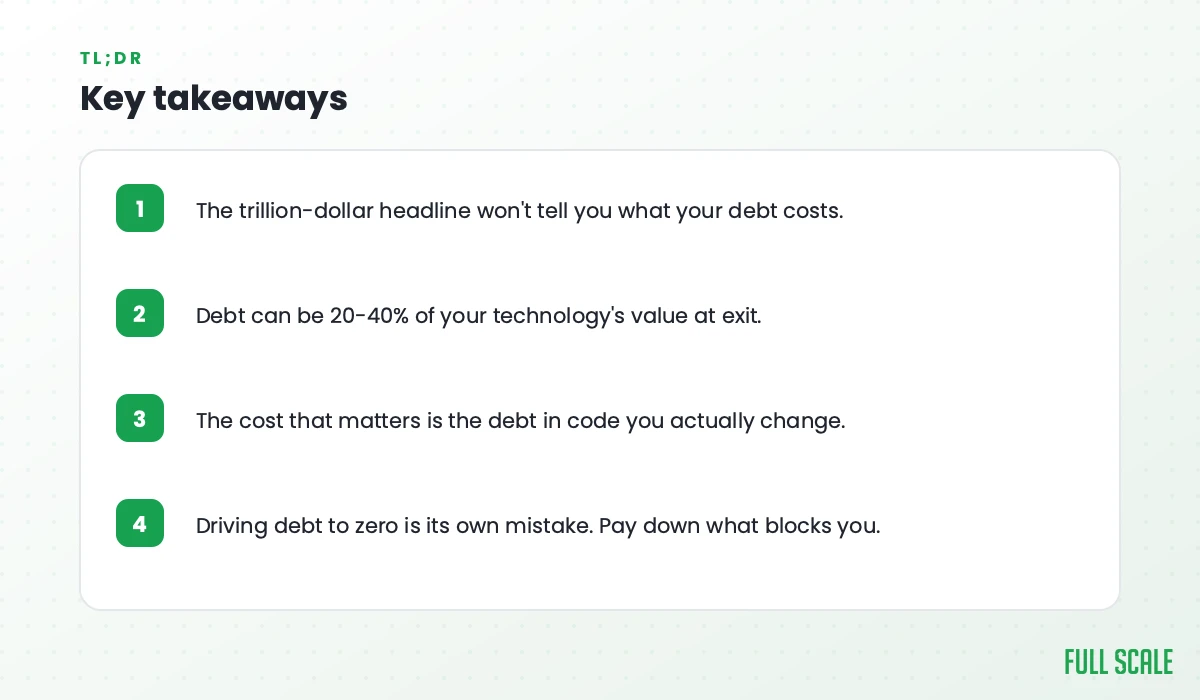
Here are the figures everyone quotes. Poor software quality, including technical debt, accounts for an estimated $1.52 trillion in accumulated debt across U.S. companies, according to the Consortium for Information & Software Quality (CISQ). Stripe found developers spend roughly a third of their time wrestling with technical debt and maintenance instead of building. McKinsey has estimated tech debt at 20 to 40 percent of the entire value of a company’s technology estate.
Those numbers are real. They’re good for exactly one job: getting a CFO to take the conversation seriously.
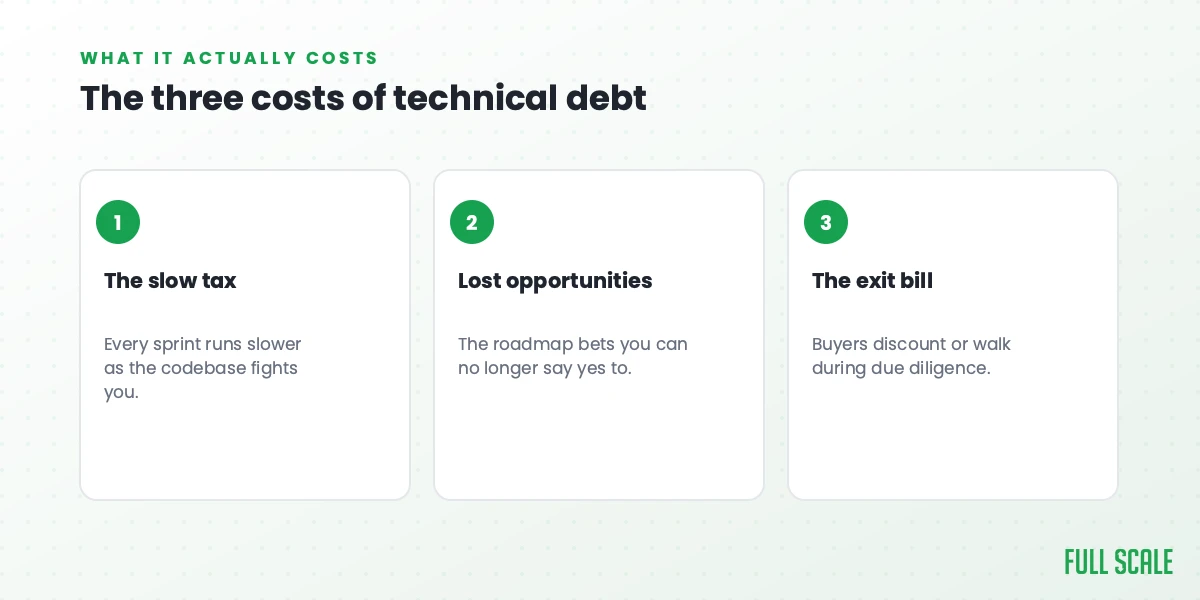
What they can’t do is tell you what your debt costs. A trillion-dollar industry figure is too big to act on. In my experience the cost of technical debt lands in three specific places, and all three are things you can actually feel. It taxes every sprint. It quietly kills opportunities you could have said yes to. And it can hand a chunk of your company’s value to a buyer on the way out. If you want the plain definition of what technical debt is before we dig in, start there. Then come back for the bill. One of the priciest forms of this debt is designing for scale you don’t have yet.

Cost one: the slow tax you pay every single sprint
This is the cost teams feel day to day, and it compounds in a way that catches people off guard.
Software complexity doesn’t grow in a straight line. Add a layer, and the next change isn’t twice as hard, it’s four times as hard. Add another and you’re at eight, then sixteen. The simple-sounding feature on the roadmap turns into a week of careful work and a knot in your stomach about what else might break. That’s interest, charged against shortcuts you took a year ago, and no amount of hustle from the team makes it go away.
Christian Hammer, CEO of Vala AI, framed it well when I had him on my podcast: “Technical debt is wherever technology slows me down instead of helping me.” That’s the test I’d apply. If your stack is slowing your team down more than it’s speeding them up, you’re paying interest whether you’ve named it or not.
The tax shows up in a few predictable places:
- Developer productivity. Engineers burn hours working around old code and ongoing software maintenance instead of shipping features. That’s where the Stripe “one third of their time” figure stops being abstract, and it drags down sprint velocity in ways a burndown chart won’t explain.
- Onboarding. When too much of how the system works lives in a few people’s heads as tribal knowledge, a new hire needs a month or more just to get oriented. I’ve watched a 20-year-old company where two excellent developers had become the bottleneck for everyone, because only they understood the old code.
- Hiring itself. Build on a dying tech stack and you eventually can’t staff it. Go try to hire a Perl or ColdFusion expert in 2026 and watch how that goes.
I dug into this drag in more detail in the engineering productivity paradox, on why the busiest teams often ship the least.
Cost two: the opportunities you can’t say yes to
The cost nobody puts on the invoice is usually the biggest one.
When debt piles up, your software loses agility, and agility is what lets you say yes quickly. A big customer asks for an integration or a change that should take a week. Instead you’re staring at a system so tangled you can’t promise a date. So you hedge. The customer hears the hesitation, and they sign with the vendor who sounded sure.
I see this constantly at Full Scale. A company comes to us already months behind on a release. You look under the hood and the team is slow because it’s fighting its own codebase, or stuck arguing about whether a button should be green while the actual product sits still. The debt didn’t just cost them engineering hours. It cost them the market window. Delivery speed is part of the same equation; a clear DevOps roadmap keeps small fixes from turning into missed market windows.
The most expensive technical debt isn’t the code you have to rewrite. It’s the revenue that walks out the door because you couldn’t move fast enough to catch it.
You will never find that number in a maintenance report. There’s no line item for the deal you came second on. But it is, by a wide margin, the most expensive consequence of technical debt I’ve seen, and it does its damage while the books still look fine.
Cost three: the bill that comes due when you sell
Here’s the cost I almost never see written about, probably because you only learn it by selling a company.
When we sold VinSolutions, we did it without a formal QA team and without a product management team. It worked, because I understood how all of it was supposed to behave and most of that lived in my head. That’s fine right up until you walk out the door. After the acquisition, the buyer had to hire something like 50 people to untangle and document what a small team had been carrying in their heads.
Technical debt is a tax you can defer, but you can’t dodge. If you don’t pay it, eventually someone shows up at the door, and at an exit that someone is the buyer’s diligence team.
It’s one of the quieter challenges CTOs rarely admit to until the deal is on the table. Debt drags out due diligence, suppresses your valuation, and shifts real money to the buyer in the form of remediation they now have to fund. You built the value. The debt quietly hands a slice of it to whoever cleans up after you. So when someone asks me to put a dollar figure on technical debt, I tell them the biggest one I ever saw wasn’t a maintenance cost at all. It was the discount baked into a sale.
Why driving the cost of technical debt to zero is the bigger mistake
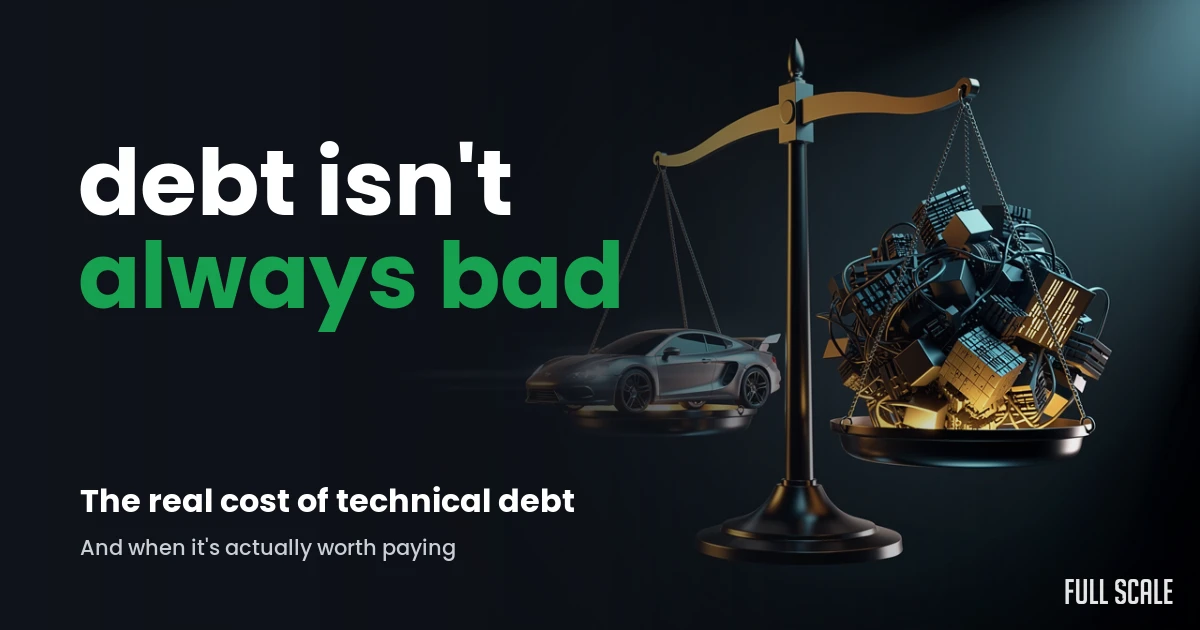
Now the part most articles on this get wrong. They treat every bit of debt as pure loss, a thing to drive to zero. That’s an excellent way to go out of business.
Picture the shopkeeper so busy cleaning the store that he never unlocks the door. You can spend forever perfecting your software, writing flawless documentation, building for the eight billion users you don’t have yet, and never ship a thing.
Some debt is the correct, deliberate call to get to market while the opportunity is still open.
Even great software ships broken, which is why the engineering principles behind good software are about knowing which corners are safe to cut. Early versions of Microsoft Word went out with thousands of known bugs, and most of them never mattered. At Full Scale today, with more than 200 employees, we still run invoicing by hand through spreadsheets. It’s technical debt by any honest definition. We haven’t automated it because it works, and the pain hasn’t grown big enough to justify pulling engineers off something that matters more. That’s a deliberate, defensible decision.
This is core to the Product Driven philosophy I write and talk about. The job was always delivering value, never writing perfect code. So the goal is knowing which debt is actively costing you and which debt is just loose change sitting in a jar on the dresser.
The other side of technical debt nobody talks about
There’s a part of this the trillion-dollar reports never mention, and it’s the part that hit a nerve. A while back I wrote a newsletter issue called My 20-Year Career Is Technical Debt. It became the most popular thing I’ve ever published, and it went viral on Hacker News and Reddit. I think it struck a chord because every engineer who read it saw their own career staring back at them.
The idea is simple. I started out writing Visual Basic 6, then classic ASP, tuning pages for Internet Explorer 6 and Netscape. In 2004 I built a mobile app for Compaq PDAs running Windows CE, with a one-megapixel camera that only took a decent photo when it was cloudy out. At VinSolutions we shipped a slick finance calculator in Silverlight. At Stackify we wrote our own tracing libraries across six languages, which was a staggering amount of work.
Every one of those is gone now, either deprecated, rewritten, or deleted. Apple killed Flash and Silverlight. An open-source standard made our Stackify profiler obsolete. The finance calculator got rebuilt in JavaScript, and it’s honestly not as good as the original.
That’s the other side of technical debt that nobody puts in a slide deck.
Most of the work you do will eventually be thrown away. Given enough time it all gets deprecated, rewritten, or deleted, and the best you can hope for is that your code lives long enough to become someone else’s technical debt.
Why does that matter for the cost conversation? Because it should change how you feel about the debt you carry. If everything rots in the end, a perfect, debt-free codebase doesn’t exist, and chasing it is expensive. The code you’re losing sleep over today will be legacy in five years no matter how clean you keep it, and someone will eventually weigh whether to reengineer it rather than rebuild from scratch. That’s a reason to stop pouring money into fighting imperfection and put it instead toward the debt that’s actually costing you customers and velocity right now. On the Microsoft stack that debt is usually a legacy WebForms app, and the fix is to hire ASP.NET Core developers who can stage the migration safely.
How to tell which debt is actually costing you
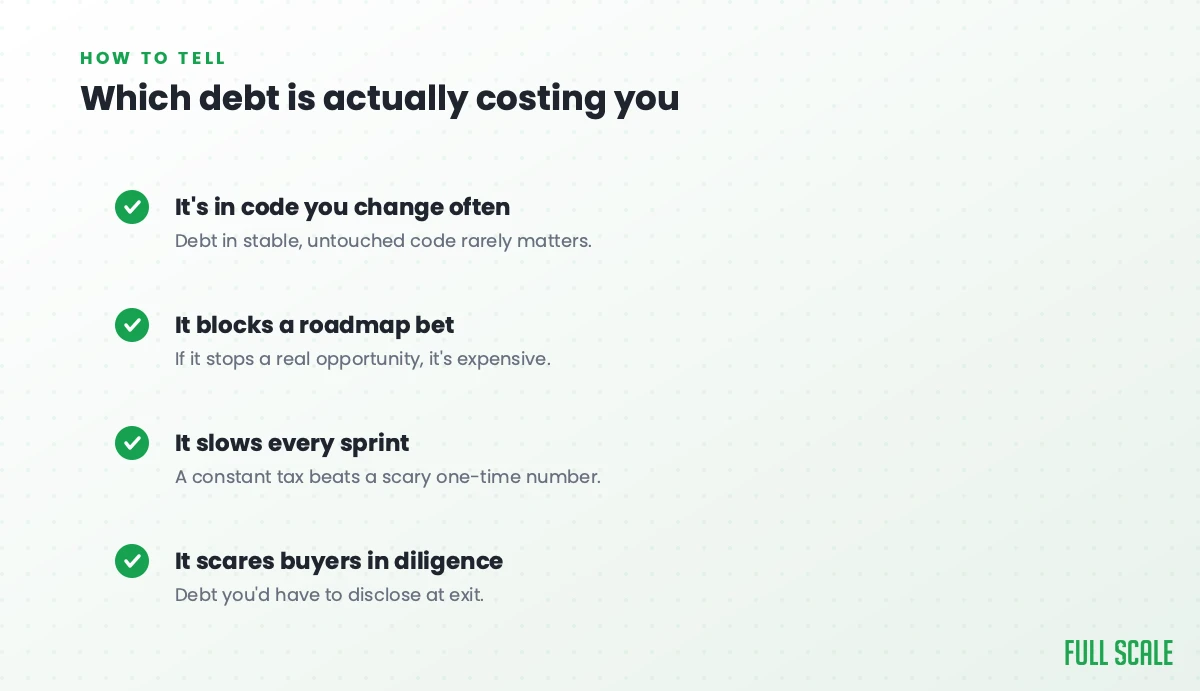
So how do you separate the debt that’s bleeding you from the debt you can safely ignore? I use two simple tests, and neither one needs a consultant or a scoring tool.
The first is a pain index. Rate each piece of debt one to ten on how much pain it actually causes, and be honest about who feels it. Is it hurting a customer, or just annoying a developer? A bug on a fringe edge case, the kind that only fires if someone enters data, deletes it three times, and refreshes, is a two. Hand it an aspirin and move on. A checkout flow that fails for real users is a nine. Stop everything and fix it.
The second test is which bucket the work falls into. I sort every engineering decision into three:
| Bucket | What it means | How to treat the debt |
|---|---|---|
| Have to | Breaks the business or a customer if ignored | Pay it down now, it isn’t optional |
| Need to | A real drag on velocity or hiring, but survivable | Schedule it, chip away every sprint |
| Want to | Cleaner, more elegant, no real impact yet | Leave it, this is usually gold-plating |
Most teams get into trouble by spending “want to” energy on elegance while a “have to” problem quietly costs them customers. The question that cuts through the noise: does this work bring in new users or keep the ones you have?
If the answer is no, you’re probably paying down the wrong debt.
When paying down technical debt is worth the money
Once you know what the debt costs, the spend decision gets a lot easier. Pay it down when the math and the moment line up:
- The pain is reaching customers or revenue. Anything in the “have to” bucket: lost deals, outages, churn from quality problems. This is debt that costs you more every month than the fix would.
- You’re about to scale. Debt that’s invisible at a few thousand users becomes a wall at a million. If a growth push is coming, shore up the architecture that won’t survive it first. I went deeper on this in how to actually scale engineering teams.
- You’re heading into a raise or a sale. Clean up before diligence, not during it. Remediation you do now is worth far more than the discount a buyer applies later.
- It’s strangling your hiring. If you can’t staff your own stack, modernizing stops being a luxury. Our guide to legacy application modernization covers how to do it without betting the company on a full rewrite.
Here’s the honest catch. Paying down debt and shipping new features pull on the same engineers, and there’s never a quarter where hitting pause feels affordable. That tradeoff is exactly why debt piles up in the first place. The most practical answer I know is capacity. When AMC Theatres scaled their engineering org, added capacity let them modernize and keep shipping at the same time instead of choosing between the two.
That’s a lot of what we do at Full Scale. We build offshore development teams in the Philippines, often through an affordable staff augmentation model, that give companies the room to pay down debt while still moving the roadmap, at a cost that makes the remediation actually pencil out. Ignoring the debt never gets cheaper. It just gets cheaper to fix when great engineers aren’t your bottleneck.
Frequently asked questions
What is the cost of technical debt?
The cost of technical debt is the total drag that past shortcuts and aging code put on your business. It shows up three ways: a daily productivity tax as engineers work around old code instead of building, opportunities you can’t capture because your software can’t adapt fast enough, and a hit to your valuation at a raise or sale. Industry studies put the U.S. figure above $1.52 trillion, but the number that matters is what it costs your specific team in slowed delivery, lost revenue, and harder hiring.
How do you measure the cost of technical debt?
Start where it hurts the business, not with a code-quality score. Track how much engineering time goes to maintenance versus new work, how long onboarding takes, how often debt-related bugs reach customers, and which deals or features you’ve lost because you couldn’t move fast enough. A simple pain index, rating each problem one to ten by how much it hurts customers or revenue, tells you more than most automated tools, because it forces you to connect the code back to the money. Some of that maintenance time is pure mechanical editing, the kind a developer fluent in Vim search and replace clears in minutes.
Is all technical debt bad?
No. Some technical debt is a smart, deliberate choice to ship and capture an opportunity while it’s open. Trying to drive debt to zero usually means you never ship at all, like the shopkeeper too busy cleaning to open the store. The goal isn’t perfect code, it’s knowing which debt is actively costing you customers or velocity and which debt is harmless enough to leave alone.
When is it worth paying down technical debt?
Pay it down when the pain is reaching customers or revenue, when you’re about to scale and old architecture won’t survive the growth, when you’re heading into a fundraise or acquisition, or when the debt is making it impossible to hire for your stack. The common thread is that the debt now costs you more each month than the fix would. Debt sitting quietly in a corner with no real impact can usually wait.
How does technical debt affect a company’s valuation?
Heavily, and most founders underestimate it. At an exit, the buyer’s diligence team finds the shortcuts, and the cost of fixing them comes out of your sale price or stretches out the deal. I co-founded a company that sold without formal QA or documentation, and the buyer had to hire roughly 50 people to untangle what a small team had carried in their heads. That cleanup is real money, and it transfers from seller to buyer at the exact moment you have the least leverage.
Stop guessing what your technical debt is costing you
The cost of technical debt is rarely the figure on a maintenance report. It’s the velocity you’ve quietly lost, the opportunities you couldn’t say yes to, and the discount waiting for you at the exit. The teams that win aren’t the ones with zero debt. They’re the ones who know which debt to pay down and how to avoid technical debt before it piles up, with the capacity to act without freezing the roadmap.
If you need that capacity, that’s what we build. Schedule a call with Full Scale and we’ll talk through where your engineering effort is actually going, and how to free up the room to fix what’s costing you the most.