
Healthcare Software Development Outsourcing: What to Send Offshore

In this article
- Healthcare software development outsourcing starts with a PHI map
- Decide whether you're hiring workforce or a business associate
- What the business associate agreement has to say
- PHI access controls for offshore engineers
- Data residency: where PHI lives matters more than where engineers sit
- A vendor diligence checklist for healthcare outsourcing
- What this looks like at Full Scale
- Frequently asked questions
- Map your PHI before you pick a vendor
Quick Answer: Healthcare software development outsourcing is a PHI issue, not a geolocation issue. HIPAA permits offshore development if there is a business associate agreement and the Security Rule requirements are met. Software that only uses test or de-identified data can safely be developed off-shore with minimal added risk. Work touching production records should run inside your own environment. The responsibility for risk management still belongs to you. At Full Scale, the client determines what the access rules are.
Note this is written by a software company, not a law firm. Treat as informational and get your legal team to review your contracts before signing.
HIPAA does not prohibit healthcare software outsourcing. It also does not specify which country the developer is located in. Don't ask whether you can outsource healthcare software development. Ask which activities require access to protected health information. The answer to that question defines who needs a BAA, who has what kind of access, and which workstreams must remain on-premise.
In our earlier blog post, HIPAA-Compliant Software Development, we discuss the classification of developers under HIPAA and why it is not possible to certify a software company for healthcare work. In this article we focus on the next step in the process: determining what work can go offshore, what must stay on-site, and what you must address in your contract.
Healthcare software development outsourcing starts with a PHI map
Categorize your roadmap by data sensitivity before choosing a vendor. Most of it needs less data access than people assume. The safest lever is the data itself.
The HHS Office for Civil Rights (OCR) describes two methods for de-identifying health information, Expert Determination and Safe Harbor, and any information meeting these criteria is no longer considered protected health information. In addition, the OCR's cloud computing guidance states that a cloud provider maintaining only properly de-identified information is not a business associate.
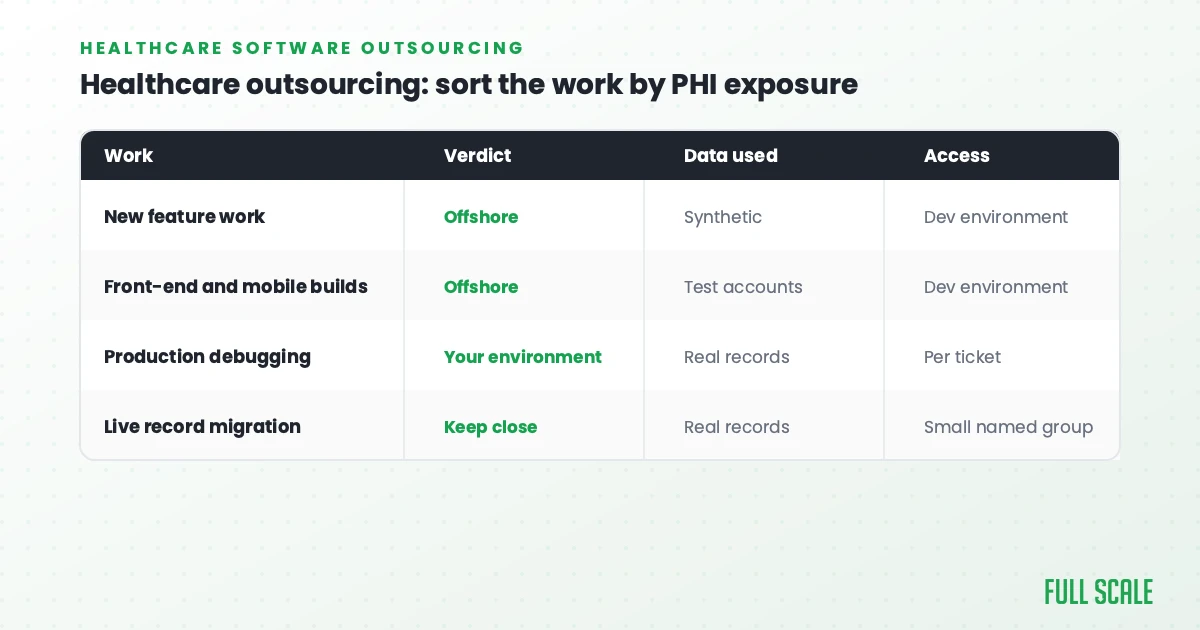
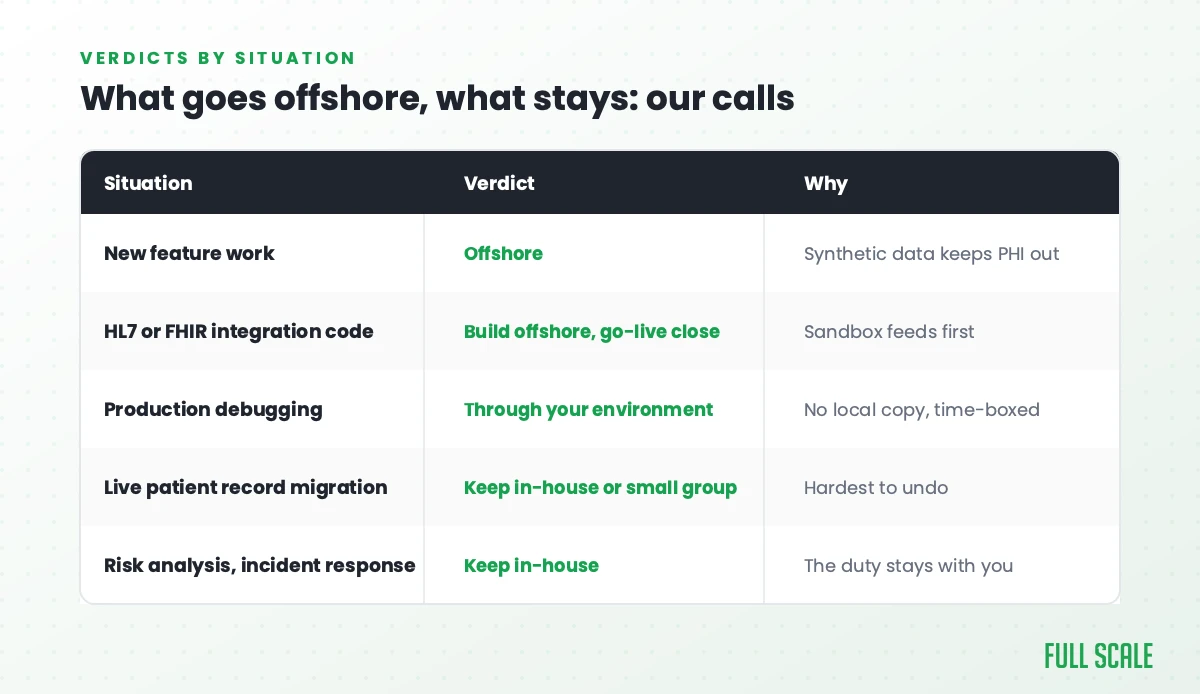
If a development team only works with synthetic or de-identified data, they never handle the actual PHI. At Full Scale, this is the first lever we typically recommend clients consider, and in most cases it is something they have yet to pull. Here is how we categorize the work.
| Situation | Verdict | Why |
|---|---|---|
| New features on a product with a clean dev environment | Offshore | Synthetic or de-identified test data keeps PHI out of the loop |
| Web and mobile front-end builds | Offshore | Screens render test accounts, not real patients |
| HL7 or FHIR integration code | Offshore the build, keep go-live checks close | Write against sandbox feeds, then validate with real feeds in your environment |
| Production debugging that needs real records | Offshore only through your environment | Remote desktop or VPN, no local copy, time-boxed access per ticket |
| Migrating live patient records | Keep in-house, or use a small named group under a BAA | It is the hardest task to undo if something leaks |
| Risk analysis, incident response, security architecture decisions | Keep in-house | The Security Rule puts the risk analysis duty on you, and a vendor can't take it over |
| A whole product built on the vendor's own cloud and laptops | Possible, with the heaviest diligence | You have bought a business associate, so the vendor's program is the one running |
| Medicare Advantage, Part D, or state Medicaid work | Read the contract first | Offshore rules sit in those contracts, not in HIPAA (details in our sibling post) |
Our conclusions represent best guesses based on our experience; your legal team may change some rows for your use case.
Decide whether you're hiring workforce or a business associate
Under HIPAA, a business associate is any entity that uses your PHI "other than in the capacity of a member of the workforce." Your workforce consists of individuals whose actions are under your direct control, paid or unpaid.
That one definition splits healthcare outsourcing into two models. A staff augmentation vendor will integrate their developers into your team, their code goes in your codebase and their work happens during your standups. With a scoped project, a firm builds on its own machines and hands you the result. That makes it a business associate with its own security program. The difference between staff augmentation and a scoped SOW project becomes much more relevant when developing for healthcare, since the vendor type determines which company needs to comply with OCR. You need to sign a BAA either way.
What the business associate agreement has to say
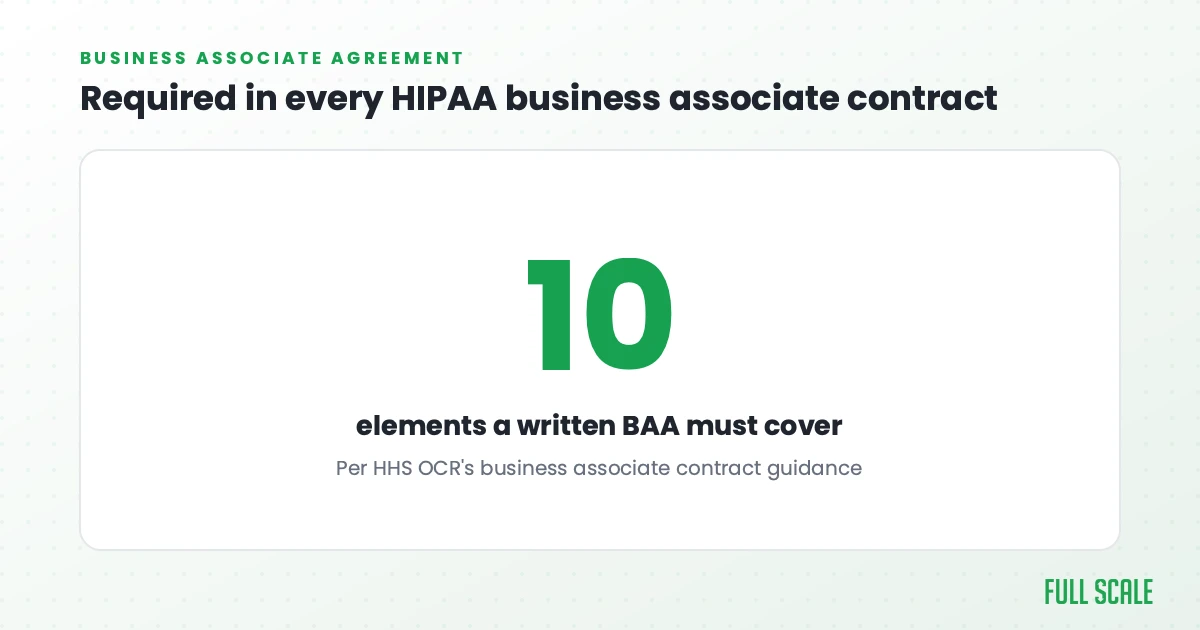
This is the only piece of paperwork in the whole process that regulators will demand to see. No one wants to sign a BAA, but OCR will still read it. The Department of Health and Human Services' Business Associate Contract Guidance spells out what a written agreement must contain. In layman's terms:
- Outline the allowable and required uses of the PHI.
- Prohibit any other uses or disclosures.
- Demand that all necessary security protections be in place, including compliance with the Security Rule when PHI is transmitted electronically.
- Report unauthorized uses and disclosures, including any breaches.
- Assist patients in their right to access, amend, or request an accounting of PHI.
- Require the vendor to be bound by any of the covered entity's obligations under the Privacy Rule.
- Allow HHS to inspect the vendor's books and records.
- Upon termination, return or destroy the PHI, if practicable.
- Ensure that all subcontractors who handle PHI are bound by the same requirements.
- Terminate the contract if the vendor breaches a material term.
Point 9 is the one most likely to require careful reading by overseas purchasers. A vendor may have several subcontractors, such as its cloud hosting provider and its helpdesk, and all of them would be bound by the same restrictions as they receive and retain PHI. OCR's Cloud Computing Guidance states that a vendor who stores PHI is considered a business associate even if it cannot view the data, so your cloud provider requires a BAA regardless of the identity of your software developer.
The sample agreement language is a good starting point, but HHS specifically states that it's not a substitute for a legal opinion and allows you to adopt even more stringent provisions, such as shortening the timeline for breach notification.
Not doing the paperwork costs big money. In OCR's $750,000 settlement with Raleigh Orthopaedic Clinic involved approximately 17,300 patient records were handed to a vendor with no Business Associate Agreement in place. The Director of OCR stated that the settlement was "more than a mere check-the-box paperwork exercise."
PHI access controls for offshore engineers
Build access into the environment. No amount of paperwork can prevent unauthorized entry. The Security Rule's workforce security standard calls for: 1) procedures for authorizing and supervising workforce members; 2) procedures for obtaining reasonable assurances that authorized access is appropriate; and 3) procedures for terminating access when it should no longer be used. These all translate into controls that an engineering leader can audit.
| Control | What to require |
|---|---|
| Who gets in | Access by named role, approved per ticket, with the least access that gets the job done |
| Identity | Your SSO and multi-factor login, not a shared account the vendor manages |
| Where PHI lives | Remote desktop or VPN into your environment, with nothing saved on a laptop in another country |
| Logging | A record of who touched which record and when, kept by you |
| Termination | Same-day access removal when someone rolls off, tested with a real offboarding |
| People | A background check run by someone other than the vendor |
HHS's minimum necessary guidance reinforces this approach by requiring the use of the minimum amount of PHI needed to accomplish the intended purpose. Our engineers will operate within the controls set by the client. We don't offer a standard HIPAA compliance package because each client's infrastructure is unique. The IT Manager at Full Scale will work directly with the client's security team to establish the architecture. This might involve remote desktops, a VPN, client-provided SSO, or a client-supplied laptop sent to the Philippines. All Full Scale employees undergo a third-party background check.
For the record, I am a software engineer. That's what my lawyers told me to say.
What I can say for certain is "HIPAA-compliant developers" is a marketing phrase. A developer is a developer. What matters is what is configured on the machine.
Data residency: where PHI lives matters more than where engineers sit
OCR addresses the offshore issue head-on. A covered entity may use a cloud provider that stores ePHI on servers outside the United States. It has to have a BAA, and the other HIPAA rules still apply.
OCR points out that offshore hosting of storage or services "may increase the risks and vulnerabilities." It can also raise questions about enforceability, so the two parties need to consider that in their risk analysis. That suggests the simplest solution: Store PHI only within a U.S.-region environment you own, with a BAA in place between you and your cloud provider, and let offshore devs interact with that system. In that case, there's no need to store anything anywhere else.
There's one more caveat in the guidance. HIPAA doesn't grant you the right to audit your cloud provider, and OCR recommends asking for such assurance in your contract. The same goes for your software vendor. Any desire for audit rights, deadlines for breach notification, or lists of subcontractors has to be included in the agreement. Medicare Advantage plan rules and rules for state Medicaid programs add another layer to all of this, and we've covered their impact in our HIPAA sibling post.
A vendor diligence checklist for healthcare outsourcing
When you ask for proof, a vendor who's been here before will provide most of what you need within a day.
-
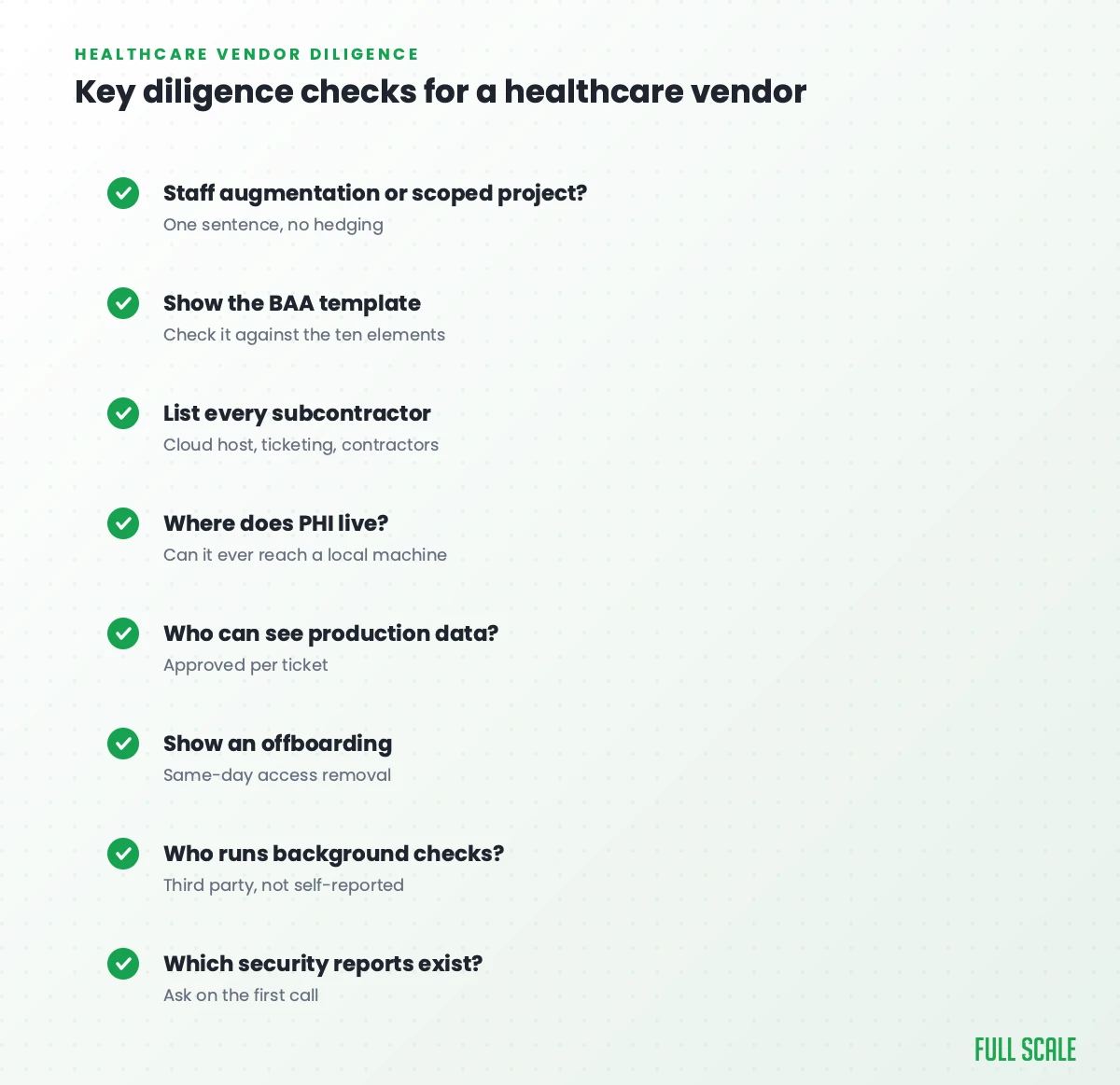
What's the engagement model? Staff augmentation or a scoped project? If they can't tell you in a single sentence, they'll give you the answer in whatever format benefits them.
-
Provide your BAA. Compare it to the list of ten requirements I shared and look for the time limit on reporting a breach.
-
Give me a list of all subcontractors and tools that might interact with PHI. That includes your cloud provider, your help desk, and any other third parties.
-
Where is PHI stored and is it possible for it to be downloaded to an endpoint device? Don't ask if they promise not to; ask how they ensure they don't.
-
Who has access to production data and how is access authorized? The ideal answer is no one at all unless there's a ticket for it.
-
Walk me through an offboarding. You can easily verify their claim about revoking access immediately.
-
Who performs background checks? Self-verification and a third-party screening service are two very different things.
-
Tell me about any previous healthcare engagements. An actual client can explain the scope while maintaining anonymity.
-
Which security compliance reports do you have available? If you require SOC 2 or HITRUST certification from a vendor, state that requirement on the first call. Full Scale holds neither, because our engagements run inside the client's security perimeter.
For questions that aren't healthcare-specific, which include retention, IP, and contracts, use our offshore due diligence checklist and our IP protection framework.
What this looks like at Full Scale
Full Scale places dedicated engineers from across the Philippines onto healthcare teams through staff augmentation, starting at $35 an hour fully loaded. The final rate depends on experience level, skill set, and the team you need.
Work can start in as little as 7 days, and you'll save 50-70% over hiring someone comparable in the U.S. We've staffed teams on SOTA Cloud's cloud-based dental imaging platform, FDA-cleared and used in more than 1,000 dental locations, and on the platform behind NavMD.
Full Scale has signed BAAs. We do not claim HIPAA certification because HHS doesn't certify any persons or products as HIPAA-compliant, and we don't have a SOC 2 or HITRUST report.
To get a sense of the range of healthcare work we've staffed for, start with our healthcare software development page, then healthcare app development and EHR and EMR development.
If things aren't working within two weeks, we'll refund your money. Beyond that, you can drop a developer with 30 days' notice and no long-term contract. Read when it isn't working out for the full details.
If you only hire on the basis of price, that's what I'd call cheapshoring, and in healthcare it's the quickest way to discover what your BAA should've covered. Our developers are educated on the principles in my book, Product Driven.
Frequently asked questions
Can you outsource healthcare software development under HIPAA?
Yes. HIPAA does not prohibit outsourcing software work, including to another country. What it requires is a signed business associate agreement with any vendor that creates, receives, maintains, or transmits protected health information for you, plus Security Rule safeguards on how that information is handled. Engineers who work under your direct control can count as your workforce instead, which changes whose compliance program governs them.
What healthcare software work is safe to send offshore?
Work that does not need real patient data is the safest: new features, front-end and mobile builds, integration code written against sandbox feeds, and testing on synthetic or de-identified data. HHS says information de-identified under the Privacy Rule is not protected health information. Work that needs production records, such as live data migrations, deserves tighter access controls and sometimes stays with your own staff.
Does HIPAA allow protected health information to be stored outside the United States?
HHS's Office for Civil Rights says a covered entity may use a cloud provider that stores electronic PHI on servers outside the US, provided there is a business associate agreement and the other HIPAA requirements are met. OCR also warns that overseas storage can increase risk and complicate enforcement, so it belongs in your risk analysis. Many teams avoid the question by keeping PHI in a US-region environment and letting offshore engineers work through it.
What must a business associate agreement include?
HHS lists ten required elements. They cover the permitted uses of PHI, safeguards including the Security Rule, reporting of unauthorized uses and breaches, access and amendment support, availability of records to HHS, return or destruction of PHI at termination, flow-down to subcontractors, and your right to terminate for a material violation. HHS publishes sample language, but says it does not replace advice from a lawyer.
Is there a HIPAA-certified offshore development company?
No. HHS does not certify companies as HIPAA compliant, and OCR says it does not endorse, certify, or recommend specific technology or products. Full Scale does not hold SOC 2 or HITRUST either, and no vendor can hand you a certificate that moves your HIPAA obligations onto them. What you can verify is how a vendor will handle access, subcontractors, incident reporting, and the business associate agreement.
Map your PHI before you pick a vendor
Order your roadmap based on how much actual patient data you need for each step. You'll see right away which tasks can move offshore this quarter.
For another perspective on that roadmap, talk to Full Scale about your healthcare team and invite your security lead.