CTO Challenges Have Changed: In the AI Era, You Own Product Now

In this article
- The CTO job everyone trained for is the one AI is deleting
- Knowing what to build is the whole job now
- Judgment got more valuable, and AI made it harder
- You can’t be the bottleneck anymore
- Your next hire should think about product, not just code
- AI didn’t kill technical debt, it sped it up
- Own the product, or spend your career managing the symptoms
- Frequently asked questions
- Ready to build a team that thinks like owners?
Quick Answer: The biggest challenge facing CTOs today is that the job has moved from running engineering to owning product. As AI writes more of the code, the scarce skill is deciding what to build and why, and a CTO who stays in pure technical management falls behind. Full Scale CEO Matt Watson, who owned product at each of the three SaaS companies he started, sees five challenges come out of that: knowing what to build, setting the quality bar for AI-written code, not being the bottleneck, hiring product thinkers, and keeping AI-sped technical debt in check.
The usual list of CTO challenges is technical debt, hiring, cybersecurity, budgets, and keeping up with new tools. It reads like a checklist of things to manage, and it misses the one change that actually matters. A lot of this comes down to having a strong technical co-founder or engineering leader you genuinely trust to own it.
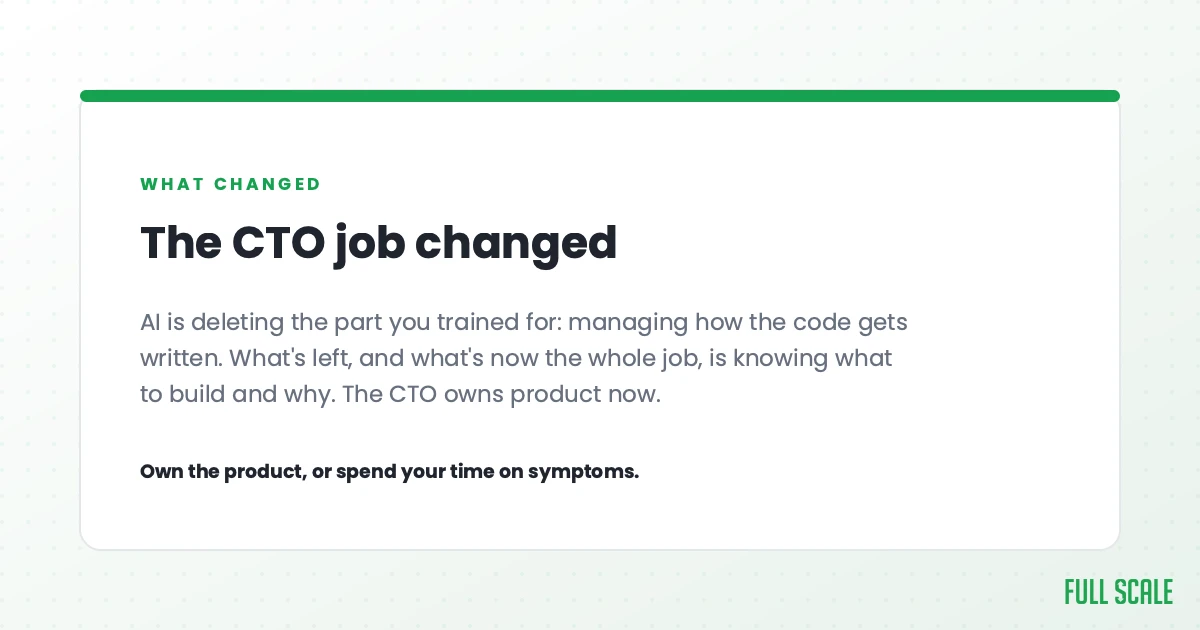
The job itself moved.
I’ve started three SaaS companies, scaled all of them, and exited all of them. I owned product at every one, and that is the single biggest reason they worked. I wasn’t the best coder in the building. I was the person who decided what we built and why. For most of my career, owning product like that was a choice. A CTO could stay in the engine room, run a tight team, ship on time, and be considered great.
That choice is gone now.
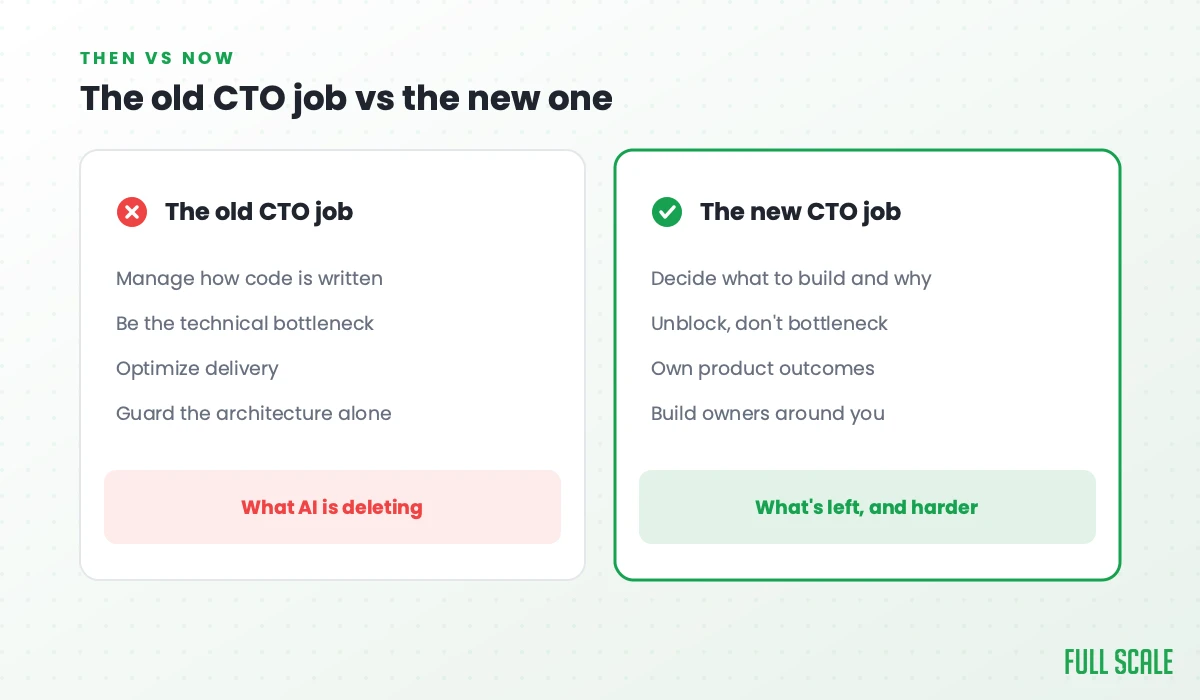
When AI writes most of the code, running engineering well stops being the hard part. Deciding what to build becomes the hard part, and that has always been a product job. The wall between engineering and product, the one a lot of CTOs spent years defending, is coming down. The biggest CTO challenge in front of you is not on the usual list. It is that you were hired to run engineering, and the role quietly turned into running product.
I’m Matt Watson, founder and CEO of Full Scale. I’ve been a software engineer, a CTO, and now a CEO, and I wrote a book called Product Driven about exactly this shift. Here’s what the role looks like now, challenge by challenge. I stepped into the CEO seat at Full Scale after co-founder Matt DeCoursey retired.
The CTO job everyone trained for is the one AI is deleting
A few years ago, the scarcest thing on an engineering team was the ability to write good code fast. That was the bottleneck, so that’s what we hired for, promoted for, and protected.
AI took that bottleneck apart.
Google’s CEO said in 2026 that about 75% of the company’s new code is now AI-generated, up from a quarter of it a year and a half earlier. Microsoft has said as much as 30% of its code is written by AI. I joke with clients that we’re all paying developers to babysit AI now, to review what it writes and steer it toward something useful. It’s an oversimplification, but the direction is real.
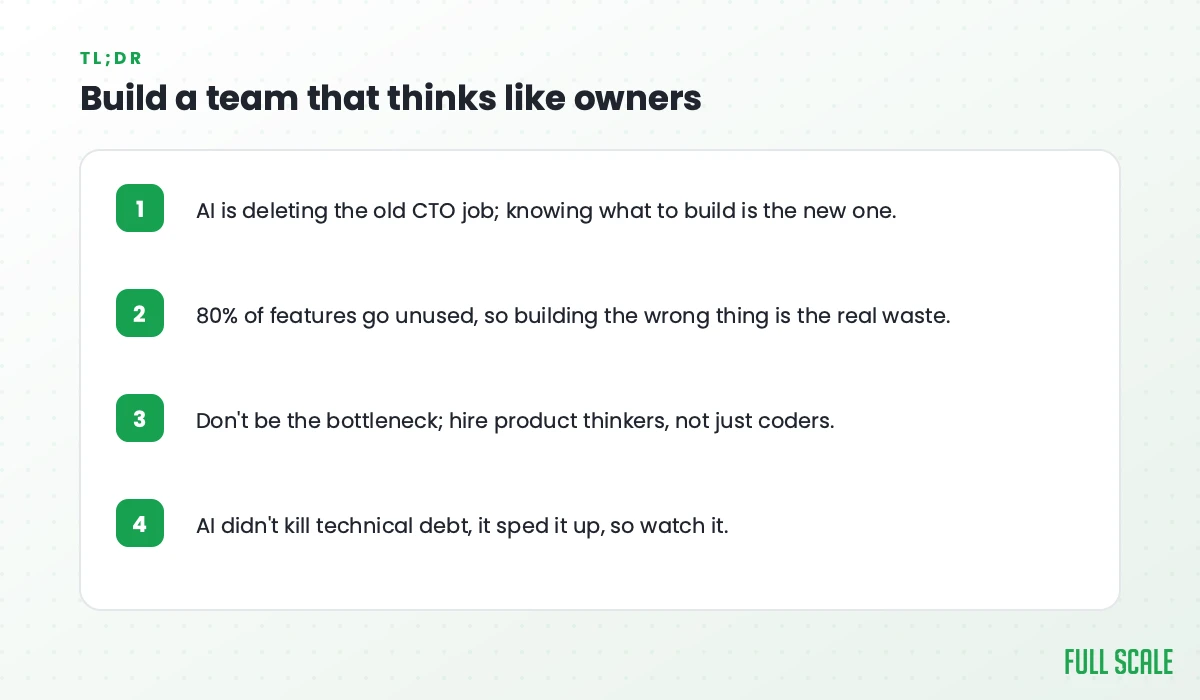
When the build gets cheap, the value moves to whoever decides what to build.
That’s the part AI can’t do for you. It can write the feature. It can’t tell you the feature was a waste of three weeks. Someone with judgment and product sense has to make that call, and at most companies the person with the title to make it is the CTO. Notice that Google still has an engineer review and approve every line the AI writes. The machine got faster. The human’s job got more important, and it moved up the stack toward product.
Knowing what to build is the whole job now
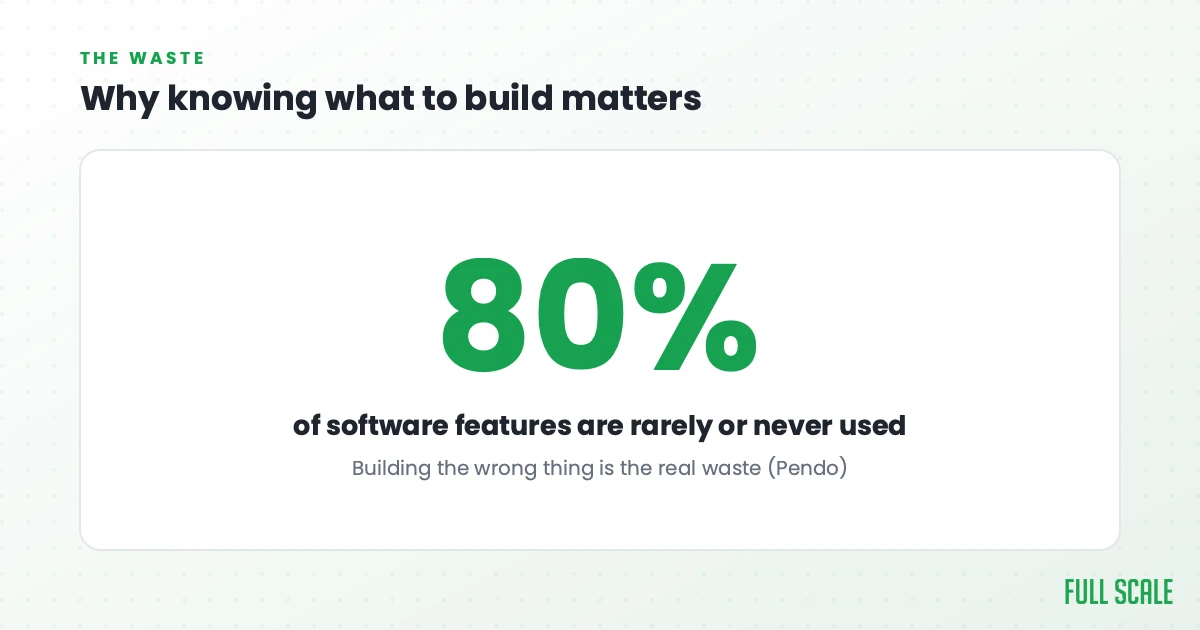
Much of the waste in software comes from building the wrong thing. Pendo found that 80% of features in software are rarely or never used, and estimated the cloud industry pours close to $30 billion a year into building things almost nobody touches. The Project Management Institute found that 47% of projects that miss their goals fail because of poor requirements, not poor execution. The teams built the thing right and still built the wrong thing.
AI makes that worse, not better, because it removes the natural friction that used to slow a bad idea down. When a feature took a month to build, somebody usually asked whether it was worth it. When it takes an afternoon, nobody asks. You just ship more of the wrong thing, faster.
So the CTO’s real job is to be the person who asks.
I learned this the hard way at VinSolutions. As we grew, customer feedback started reaching me through a support person, then through a layer of managers, then through other engineers. Eventually I had four people between me and the customer, and I only really talked to users at trade shows. The product got further from the people using it every time we added a layer. That distance, not a lack of engineering talent, is what kills good products.
You don’t need rockstar developers. You need rockstar requirements.
Most “CTO challenges” lists put roadmap and prioritization near the bottom, as a planning chore. Put it at the top. Deciding what to build, and what to kill, is now the most valuable thing you do.
Judgment got more valuable, and AI made it harder
There’s a myth going around that AI lets you ship without knowing what good looks like. The opposite is true.
AI raises the value of judgment, because somebody still has to catch what it gets wrong.
The data backs this up. In the 2025 Stack Overflow Developer Survey, 84% of developers said they use or plan to use AI tools, but 66% said their biggest frustration is AI answers that are almost right but not quite, and 45% said they lose real time debugging AI-generated code. Veracode tested AI-generated code and found 45% of it carried a known security flaw, and bigger models weren’t any safer. Google’s own DORA research in 2025 put it well: AI amplifies what’s already there. Strong teams get faster. Weak teams ship their problems quicker.
Vibe coding only works if you’ve been coding long enough to know when the AI is wrong.
That standard, the definition of what good looks like, has to come from the top of engineering. It’s your job to set it. I’ve been on the wrong side of skipping it. At Stackify we spent $10,000 sponsoring a developer conference for a big product launch and got zero new customers, because we built something nobody had told us they wanted. The code was fine. The judgment about what to build was missing.
You can’t be the bottleneck anymore
The most productive thing you do as a technical leader is make other people more productive. The least productive thing you can do is sit in the middle of every decision, reviewing and approving everything, so nothing moves without you.
A CTO who is the bottleneck is a CTO doing the wrong job well.
This was my own failure at VinSolutions. I had the product vision, but I forced myself into the operations role of running engineering day to day, and it drained me. The company didn’t need me to be the best engineer or the chief code reviewer. It needed a VP of Engineering to run execution so I could own where the product was going. I held onto the wrong half of the job for too long.
The move is to give your team goals and the why behind them, not tasks.
When AI speeds up the building, the constraint shifts to how fast good product decisions get made. If every one of those decisions has to route through you, you’ve just made yourself the slowest part of a faster machine. Spend your time on the calls only you can make, and get out of the way of the rest.
Your next hire should think about product, not just code
If the scarce skill is deciding what to build, that changes who you hire and how you screen them.
The engineers who run technology organizations from here on out will be the problem solvers, the ones who can decide what’s worth building, because AI is taking over the pure coding work.
I want chefs, not short-order cooks. The best engineers I’ve ever worked with ask the most questions. They push back on a spec that doesn’t make sense. They want to know who the user is and why the work matters. That instinct, not raw coding speed, is what holds its value as AI handles more of the mechanical work. Screen for curiosity and product thinking, not just for who can pass a coding test. When that instinct is missing, you get the communication problems in software development that quietly sink projects, no matter how good the individual coders are.
This is also where a lot of CTOs make an expensive mistake. They go looking for the cheapest developers they can find to keep building at volume. I call that cheapshoring, and it backfires, because more cheap hands don’t fix a team that needs more product judgment. The best developers usually aren’t applying to your job anyway. They already have one, and nobody is letting them go, so you have to recruit them.
When you do need to add real engineering capacity, the model that works is bringing on people who join your team and care about your product, not a vendor on the other side of a wall handing back a finished project. That’s the case for staff augmentation done right: engineers who sit in your standups, learn your product, and stick around long enough to build judgment about it. Infrastructure is no different. When you need to hire a dedicated DevOps engineer, the same rule applies: someone embedded in your standups who owns your pipeline, not a vendor closing infrastructure tickets from the other side of a wall.
AI didn’t kill technical debt, it sped it up
Technical debt is still on every CTO challenges list for a reason. It’s real. But AI changed its shape.
When code is cheap to generate, it’s also cheap to generate badly.
GitClear studied 211 million lines of code and found duplicated code blocks jumped roughly eightfold in 2024 as AI tools took over more of the writing, while real refactoring fell. AI is great at adding code and bad at caring whether the codebase stays clean. That’s a judgment call too, and it’s yours.
The CTO owns the standard that keeps AI speed from turning into AI mess. If you don’t set it, the tools will happily bury you in plausible-looking debt faster than any human team ever could.
Own the product, or spend your career managing the symptoms
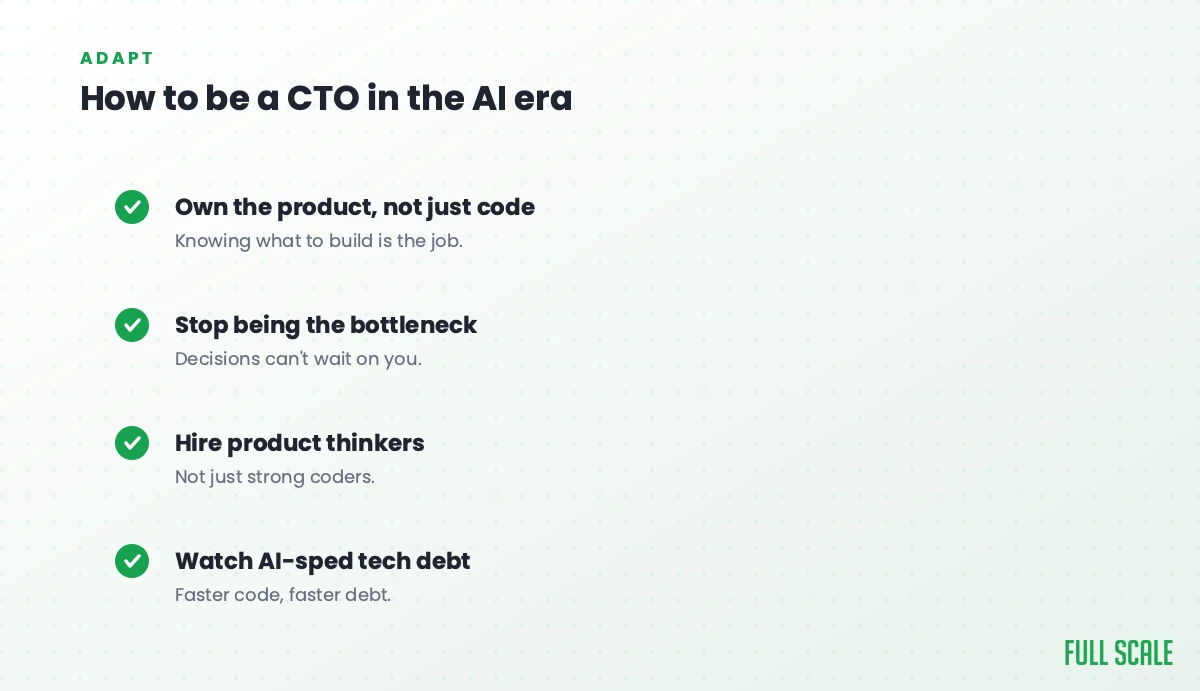
Look back at that list. Knowing what to build. Setting the bar for quality. Getting out of the critical path. Hiring for product sense. Keeping the codebase honest. Every one of them is really the same job wearing a different hat. They are all product ownership.
The CTOs who thrive over the next few years won’t be the ones with the cleanest architecture. They’ll be the ones who accepted that their job is to own what gets built and why, and built a team that thinks the same way. I’ve made the same case from the other chair, that the CEO and CTO jobs are both really product jobs; this is that idea seen from inside engineering.
In my book I call the durable skills the three C’s: communication, curiosity, and courage. Communication, because the work is understanding problems and people. Curiosity, because the job never stops changing and the people who stay curious adapt. Courage, because owning product means making calls you can’t fully prove yet and standing behind them. None of those are things AI takes from you. They’re the part of the job that was always yours. A few engineering leadership podcasts are a decent way to practice them before the job forces you to.
Done isn’t when the code ships. It’s when the customer sees value.
That has been the real definition of the job the whole time. AI just made it impossible to ignore.
Frequently asked questions
What is the biggest challenge facing CTOs today?
The biggest challenge is that the role has shifted from running engineering to owning product. As AI handles more of the actual coding, the scarce and valuable skill becomes deciding what to build and why, which has always been a product responsibility. CTOs who keep treating the job as pure technical management get left behind by the ones who step into product ownership. Part of that shift is making sure the team keeps up, which is why keeping your engineers AI-ready is now core leadership work.
How is AI changing the CTO role?
AI is removing the old bottleneck of writing code quickly, since a large and growing share of code is now AI-generated. That pushes the CTO’s value up the stack toward judgment: knowing what to build, catching what AI gets wrong, and setting the standard for quality. The role moves from managing how software gets built to owning what gets built.
Should a CTO own product?
In most companies today, yes, at least in part. Product ownership is a function more than a title, and someone with real technical judgment has to make sure it’s covered. Whether that’s a CTO, a chief product officer, or a product owner paired with a tech lead matters less than whether the job is actually getting done, a point I unpack in CTO vs CPO. As code gets cheaper to produce, the person deciding what to build holds the scarce skill.
What skills do CTOs need in the AI era?
The durable skills are communication, curiosity, and courage: understanding problems and people, staying adaptable as the tools change, and having the nerve to make product calls you can’t fully prove yet. Technical depth still matters, but on its own it no longer sets a CTO apart. Product judgment does.
Ready to build a team that thinks like owners?
If your engineering org needs people who care about your product the way you do, not a vendor handing back a project, that’s exactly what we build at Full Scale. Schedule a call and let’s talk about what your team actually needs.