
CTO vs. CPO: You’re Asking the Wrong Question

In this article
- CTO vs. CPO, the short version
- What a CTO actually owns
- What a CPO actually owns
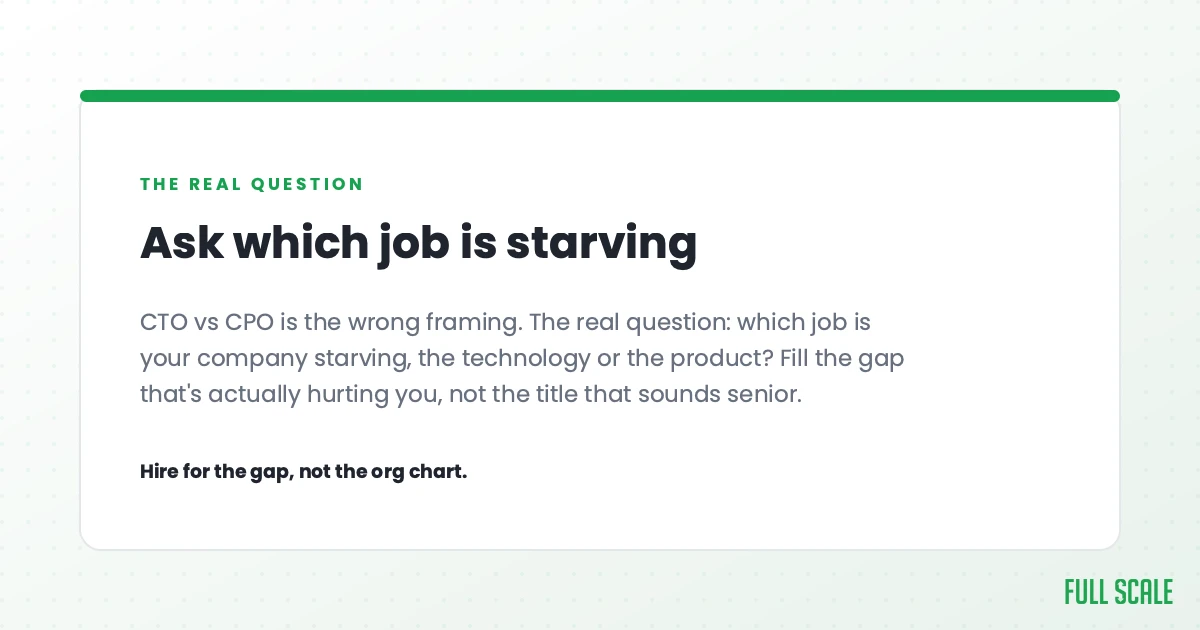
- The real question: which job is your company starving?
- Why founders end up doing both, badly
- The combined role: when a CPTO makes sense
- What these roles cost
- You found the gap. Now you have to fill it.
- Frequently asked questions
Most founders who ask me whether they need a CTO or a CPO are really asking something else. They feel like the product is off, or the engineering is slow, and they’re hoping a title will fix it. The best technical teams push the product owner mindset down to every engineer, not just the person with the title. Founders making this call early often hit an even bigger one first: choosing a technical co-founder to own the product and the engineering.
So they go read a comparison post, see that the Chief Product Officer (CPO) owns the “why” and the Chief Technology Officer (CTO) owns the “how,” nod along, and leave knowing the dictionary definition of two jobs they still can’t decide between. If the real split is internal systems versus the product, the question is whether you need a CIO or a CTO.
It’s the wrong question.
I’ve been on both sides of this. I started as a software engineer, became a CTO, and now I’m a CEO, so I’ve lived the difference between a CEO and a CTO firsthand. I co-founded VinSolutions, the number-one customer relationship management (CRM) software in the automotive industry, and sold it for $147 million in 2011. I held the CTO seat at a company that grew fast, and I got the product-versus-technology split wrong in a way that almost broke me. So before you go hire a C-suite executive to fix a feeling, let me reframe what you’re actually deciding.
CTO vs. CPO, the short version
You came for the difference, so start there.
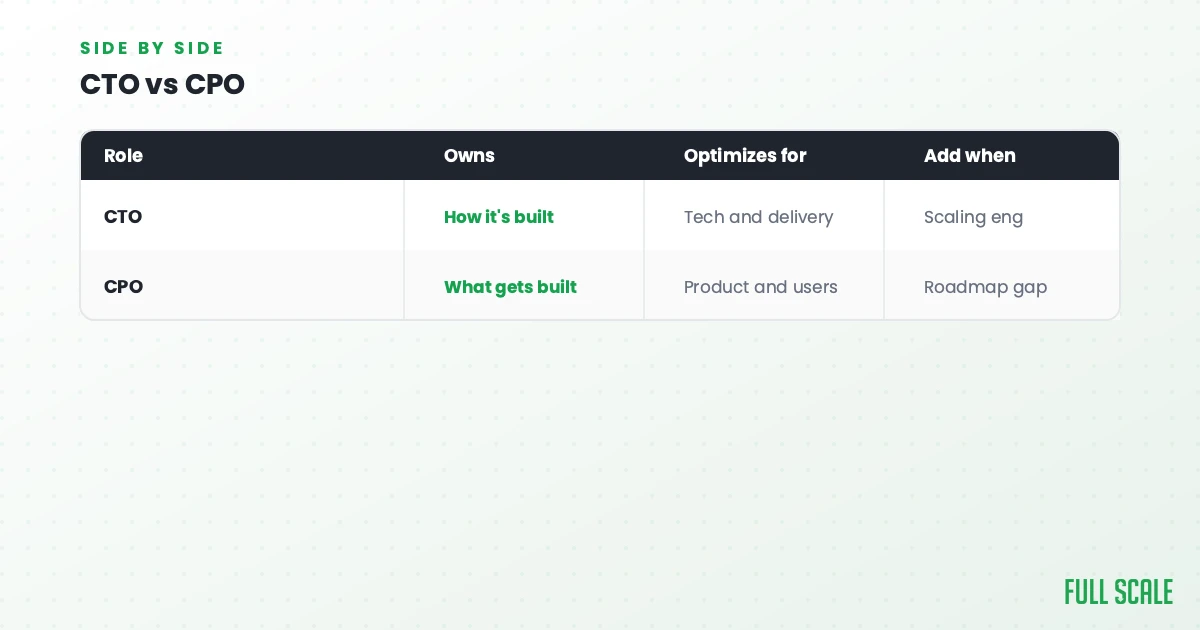
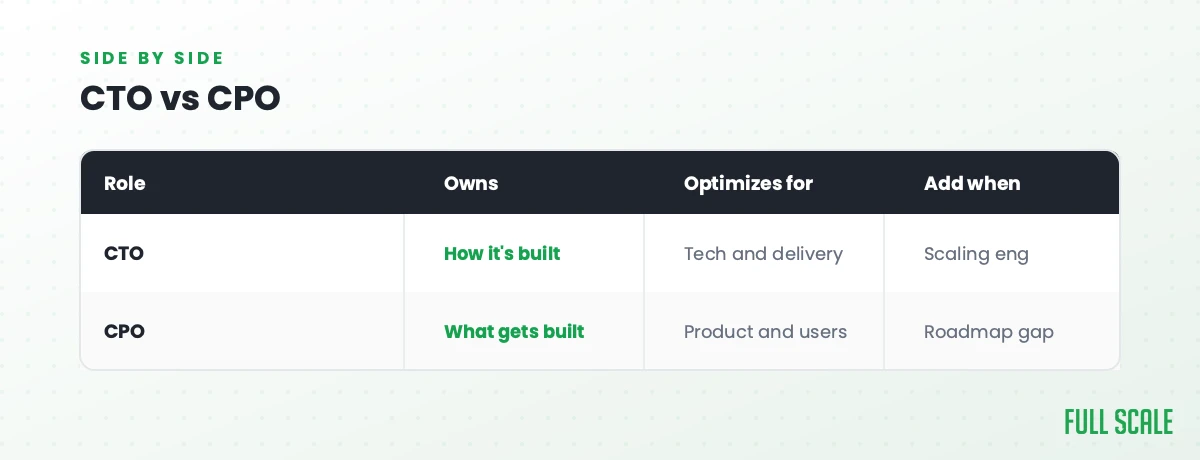
A CTO owns the technology: the architecture, the engineering team, the build, the technical bets, and whether what you’re shipping can scale and stay up. The CTO answers “how do we build this, and can we keep it running.”
A CPO owns the product: the software product roadmap, the customer research, the prioritization, and the call on what to build and why anyone should care. The CPO answers “what are we building, for whom, and why does it matter.”
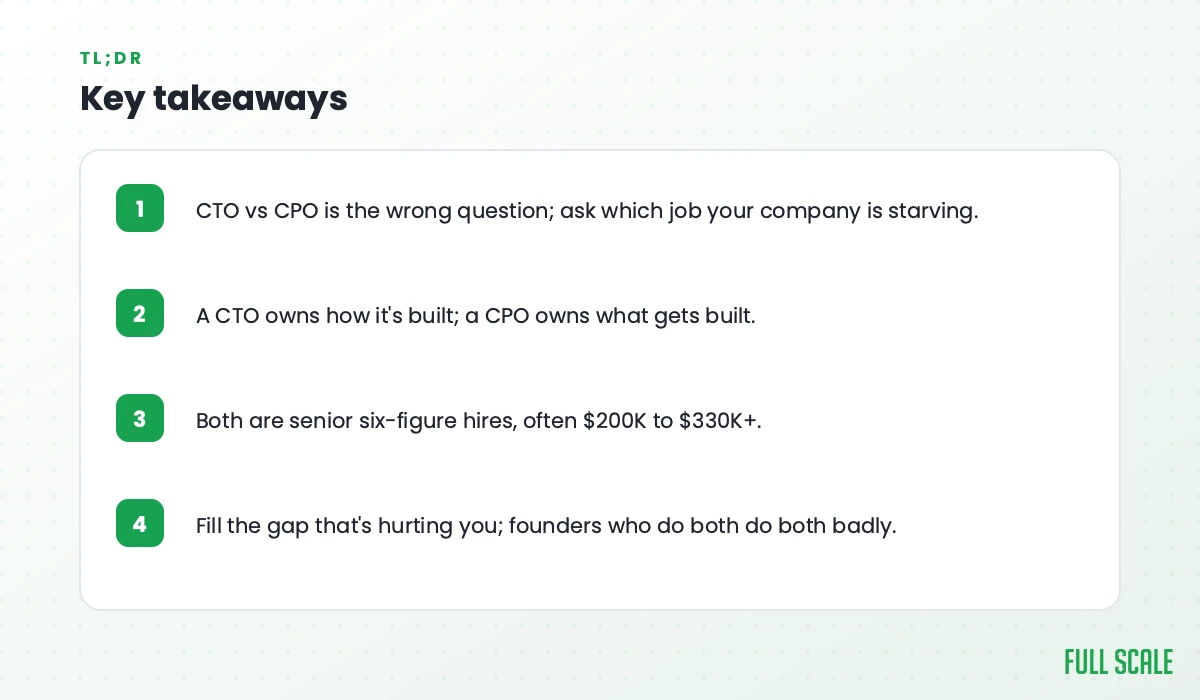
That’s the clean version everyone repeats: the CPO decides what gets built, the CTO decides how. One leader faces the customer, the other faces the codebase, and a good company needs both jobs covered.
Here’s the quick side-by-side most people are looking for:
| CTO | CPO | |
|---|---|---|
| Owns | Technology and engineering | Product and customer outcomes |
| Core question | How do we build it, and can we keep it running? | What do we build, and why does it matter? |
| Closest to | The codebase and the team | The customer and the market |
| Typical background | Software engineering, architecture | Product management, UX, market research |
| Main risk if it’s the wrong hire | Beautiful tech nobody asked for | A great roadmap that never ships |
The split is real, but it hides the decision you’re actually making, which is not “what’s the difference between these two titles.”
What a CTO actually owns
In practice the CTO job is bigger and messier than “the tech person.” A real CTO is making bets you can’t easily undo: the stack you’ll live with for years, the architecture that either scales with you or buckles at your first big customer, the build-versus-buy calls, the security posture, the hiring bar for engineers.
Early on, the CTO is often writing code. Later, the job becomes almost entirely about people and judgment: setting technical direction, keeping the team unblocked, and saying no to shiny rewrites that don’t move the business. The best CTOs translate between the business and the engineering org so neither side is flying blind. At companies with heavy internal systems, part of that judgment belongs to the CIO role instead, which is a different job than either of these.
One thing the CTO is usually not great at, and this matters in a second, is the customer. Most CTOs come up through engineering. They’re closest to the system, not to the person using it. That’s not a knock. It’s just the gravity of the role. It’s also why the biggest CTO challenge today is learning to own the product, not only the system.
What a CPO actually owns
The CPO is the customer’s advocate inside the building. They run the product research, own the roadmap, and decide what makes the cut and what gets cut. When the company wants to chase ten things at once, the CPO is the one whose job is to say no to eight of them.
A good CPO has lived the thing I argue for in my book, Product Driven: they keep the team pointed at what actually matters to the customer instead of just shipping more stuff faster. The trap I’ve watched teams fall into, and fallen into myself, is staying busy without ever asking whether the work mattered to anyone outside the building.
So you’ve got the tech leader who’s closest to the system and the product leader who’s closest to the customer. Now here’s the question that actually decides what you hire.
The real question: which job is your company starving?
Forget the titles for a second. There are really only two jobs underneath all of this.
Someone has to make sure you’re building the right thing. Someone has to make sure you’re building the thing right.
At most early companies, one of those two jobs is going completely unowned, and nobody’s noticed because the founder is unconsciously trying to do both. That’s the decision. Not “CTO or CPO,” but “which of these two jobs is starving right now, and who is actually feeding it.”
I learned this the hard way. At VinSolutions I was the CTO, and I had the vision for where the product needed to go. But as we grew, I forced myself into the operations role of running the engineering org day to day, because someone had to, and it drained me. I was a terrible fit for the work I was spending most of my time on. The company needed a VP of Engineering to run the machine so I could go do the part only I could do, not more of my vision.
I had the title that sounded right and was doing the job that was wrong. If I’d been asking “CTO or CPO,” I’d have missed it entirely, because the gap was a job nobody was doing well, hidden by the fact that I looked busy.
Why founders end up doing both, badly
The reason this is so easy to miss is that in the early days, doing both is the job. As a founder you talk to a customer in the morning and ship a fix that afternoon, with nobody writing tickets or sitting in a roadmap meeting or signing off first. You are the CPO and the CTO and the entire product process at once, and it works, because the company is still small enough to fit in your head.
Then it isn’t. The thing that made you fast early is the exact thing that starts breaking things at scale, and most founders don’t feel the shift until something’s already on fire.
My Stackify COO, Craig, is the one who said it to my face. He told me I was the bottleneck, handed me a copy of Rocket Fuel by Gino Wickman, and basically explained that the visionary and the operator are two different people and I was trying to be both.
The hardest part of scaling isn’t the product or the tech. It’s admitting which of those jobs you should not be the one doing.
That’s the real CTO-versus-CPO question: which job you’re holding onto that someone better than you should own, and which job is quietly going unfilled while you’re not looking. I wrote a whole book about that gap, because I lived it at two companies before I understood it.
The combined role: when a CPTO makes sense
Plenty of companies answer “do I need a CTO or a CPO” with “neither yet, I need one person who covers both.” That role has a name now: the Chief Product and Technology Officer (CPTO), one executive who owns product and engineering together.
I’d go further than calling it an option. In this day and age, I think a good CTO has to be a product person. The old clean line where the CTO minds the architecture and lets someone else worry about the customer doesn’t hold up anymore. A tech leader who can’t think about what the product should do, and why a customer would care, is only doing half the job.
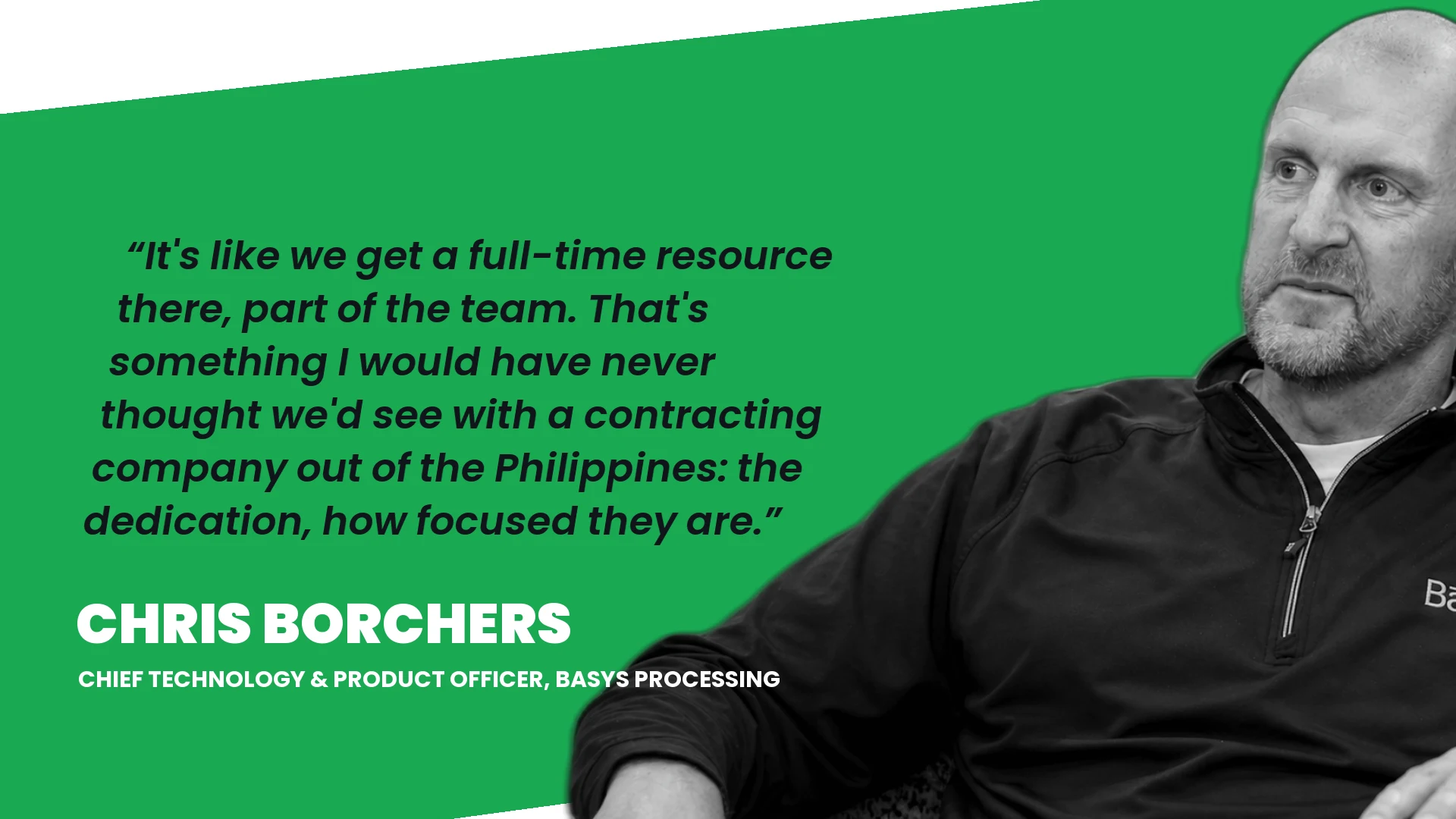
The best example I know is Chris Borchers, the Chief Technology and Product Officer at Basys, who I write about in Product Driven. When he took over, his engineers were heads-down shipping features with no real line of sight to the customer. So he started running demo days where engineers had to explain the problem they solved, not just the feature they built. That’s a technology leader doing the product job: getting the whole engineering org to think in terms of customer outcomes instead of raw output. It’s what the combined role looks like when it actually works.
For a lot of startups, one leader is the honest answer. You can’t justify two C-suite salaries, your product and engineering decisions are deeply tangled, and putting them under one person cuts the friction of two chiefs negotiating across a table. AI is making this more common, not less. As coding assistants make the build faster and cheaper, the scarce job shifts toward deciding what to build, which pushes companies to fuse the product and tech calls under one person who can do both.
In a small company, I think it should almost always be one person. Product and the engineering team need to be run by the same leader so they’re not pointing fingers at each other. When they report to two different chiefs, every wrong feature and every missed date turns into a blame game across the table, with product saying engineering is too slow and engineering saying product keeps changing its mind. Put both under one person and that argument has nowhere to go.
It splits later, in a bigger company. At that size the product job grows past what a single tech leader can carry, and a CPO earns a seat of their own. The CPO ends up deep in product marketing, industry relationships, pricing, and the analyst and customer conversations that the person running a large engineering org simply doesn’t have time for. That’s the point where “do I need both” honestly becomes yes.
The risk is still real either way. You’re betting that one person is genuinely strong at both customer-facing product judgment and deep technical leadership, and that combination is rare. Most people lean hard one way. A CPTO who’s really a product person with a fancier title will let the architecture rot, and one who’s really an engineer will ship technically beautiful software nobody asked for. The combined role works when the person is honestly good at both, or when they know which half they’re weak at and staff under it. It fails when it’s used to avoid admitting that one of the two jobs is going unowned. Same trap as before, just with a longer title.
What these roles cost
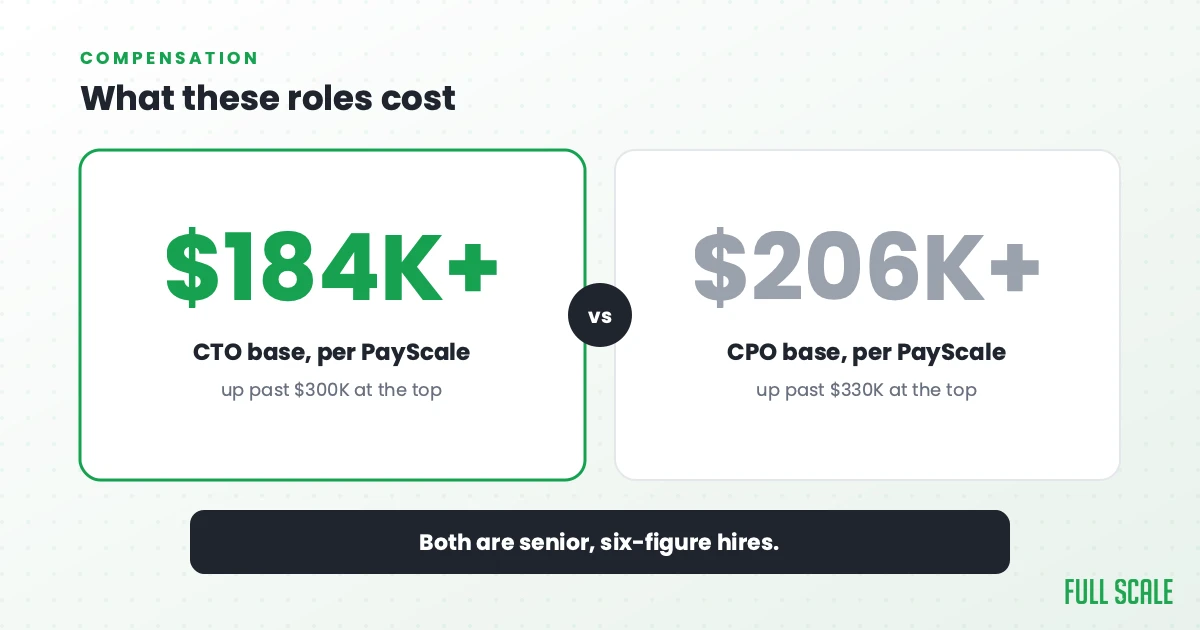
If you do decide you need to hire one of these, know what you’re signing up for. A CTO in the US averages around $184,000 a year per PayScale, though Salary.com puts the figure north of $300,000 once you weight toward larger companies and high-cost metros. A CPO runs a little higher, averaging around $206,000 per PayScale and past $330,000 at the top of the range. Add equity, and a single C-suite hire is one of the most expensive bets a young company makes. (For the full picture, here’s what a CTO actually makes across company sizes.)
That price tag is exactly why the “which job is starving” question matters more than the title. Spending $300,000 on the wrong seat while the real gap goes unfilled is how good companies stall. I’ve seen founders hire a visionary CPO when what they were desperate for was someone to make the engineering org actually ship, and the opposite just as often.
You found the gap. Now you have to fill it.
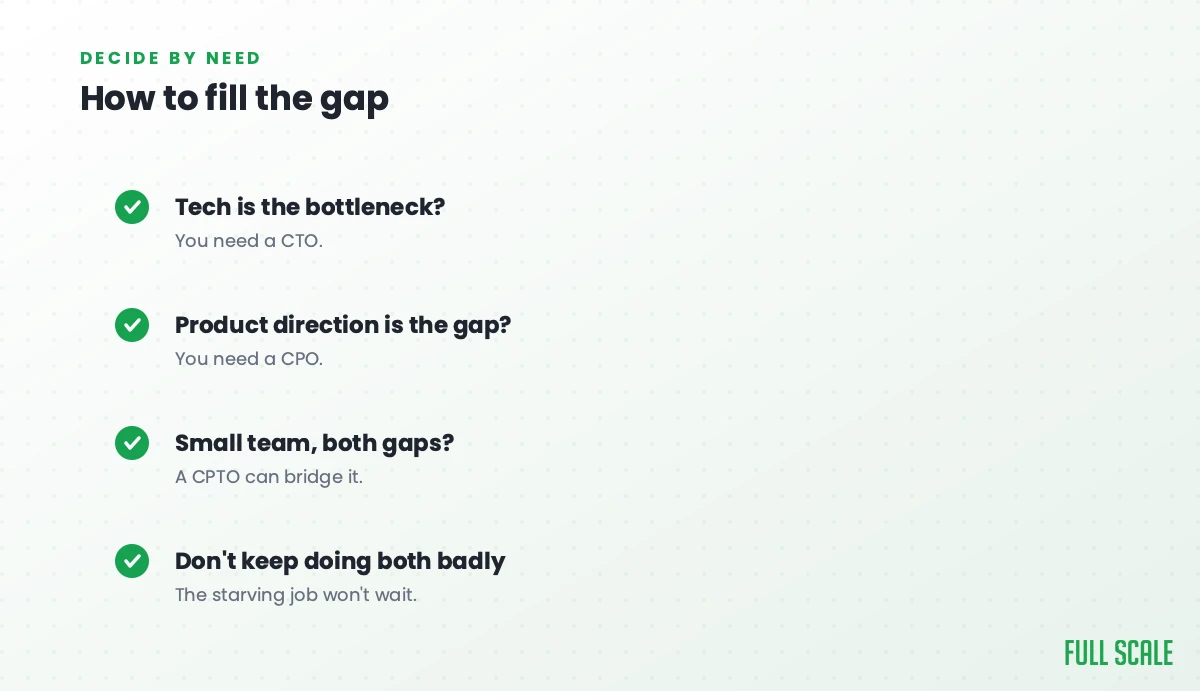
Often the starving job is the product one. Knowing what to build is the hard part, and no amount of engineering speed fixes a roadmap pointed at the wrong things. But sometimes you work through this honestly and the answer is the other way around: the product direction is covered, and what’s actually starving is execution. You don’t have enough strong engineers, or enough senior leadership inside the engineering org, to build the thing right and keep it running.
That second case isn’t a job for a single C-suite title. It’s a team problem, and hiring senior engineers in the US has not gotten any easier or cheaper. A search can sit open for weeks, and the offer often lands 20% above what you budgeted.
This is the gap Full Scale was built to fill. We help companies build dedicated engineering teams in the Philippines through a staff augmentation model, where the developers join your team, follow your process, and report to your technical leadership the way your own employees would. It’s how clients like AMC Theatres scaled engineering without trying to win an impossible US hiring race.
One word of caution if you go this route. Don’t go offshore just because it’s cheap. I call that cheapshoring, and it’s the fastest way to get burned. The point is to fill the gap with people who are actually good, not to find the cheapest bodies you can.
The titles matter less than you think. Figure out which job your company is starving, be honest about whether you’re the one quietly starving it, and then go fill the gap with the right people. That’s the whole game.
Frequently asked questions
What is the difference between a CTO and a CPO?
A CTO owns technology: architecture, the engineering team, and whether the product can be built and kept running. A CPO owns product: the roadmap, customer research, and deciding what to build and why. The CTO handles the “how,” the CPO handles the “what” and “why.” Most companies need both jobs covered, even if they don’t need both titles.
Do I need both a CTO and a CPO?
Usually not at the same time, and rarely early on. Most startups have one of the two jobs covered by the founder and the other one going unowned. Figure out which job is actually starving before you hire a title. Many growing companies put both under one person, a Chief Product and Technology Officer (CPTO), instead of hiring two executives.
What is a CPTO?
A CPTO, or Chief Product and Technology Officer, is one executive who owns both product and engineering. It’s common at startups and growth-stage companies because it removes the friction of two separate chiefs and fits a single budget. It only works if that person is genuinely strong at both the customer-facing and the technical side, or honest about which half they need to staff under.
Which should a startup hire first, a CTO or a CPO?
It depends on where the founder is strong. A non-technical founder who deeply understands the customer usually needs technical leadership first. A technical founder who can build but struggles to decide what’s worth building needs product leadership first. Hire for the job you’re worst at, not the title that sounds most impressive.
How much do a CTO and a CPO cost?
In the US, a CTO averages roughly $184,000 a year and a CPO roughly $206,000, per PayScale, with both ranging well above $300,000 at larger companies and in high-cost metros. With equity, a single C-suite product or technology hire is one of the most expensive commitments an early company makes.