
What Does a Chief Product Officer Do?

In this article
Most companies don’t start with a chief product officer. They start with a founder who owns the product, and then one day the product gets too big, too strategic, or too far from the founder’s desk to run on instinct anymore. That’s usually the moment someone asks whether it’s time to hire a chief product officer (CPO).
I’ve run product at two companies, VinSolutions and Stackify, without ever holding the CPO title. So I have a specific view on what the job actually is, and on when a company needs someone in the chair versus when the title is overkill. This is a plain answer to “what does a CPO do,” plus the part most articles skip: when you actually need one.
Quick Answer: A chief product officer (CPO) is the executive who owns a company’s product: the vision, the strategy, the roadmap, and the outcomes it’s supposed to deliver. The CPO decides what gets built and why, while the CTO decides how it gets built. Most early-stage startups don’t need one; a founder or VP of Product usually covers it until the company outgrows founder-led product, typically past 50 people or a Series A. Full Scale staffs product-minded engineers who can close that gap without a C-suite hire.
What is a Chief Product Officer?
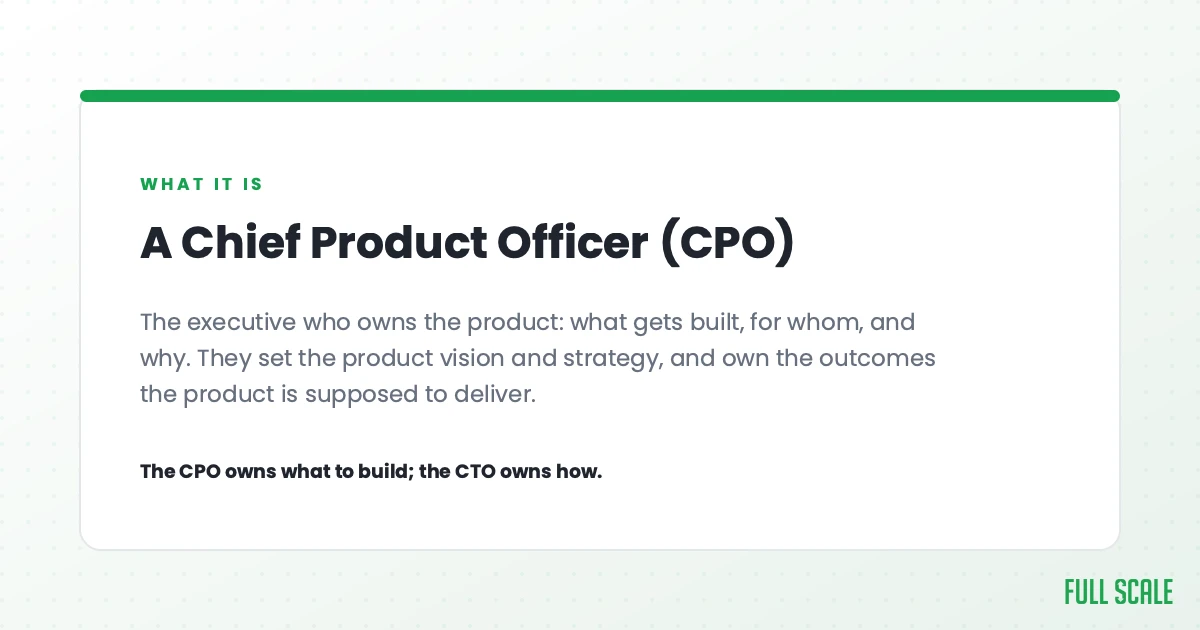
The chief product officer is the executive who owns the product: what gets built, for whom, and why. They set the product vision and strategy, own the roadmap, and are accountable for the outcomes the product is supposed to deliver, not just the features that ship.
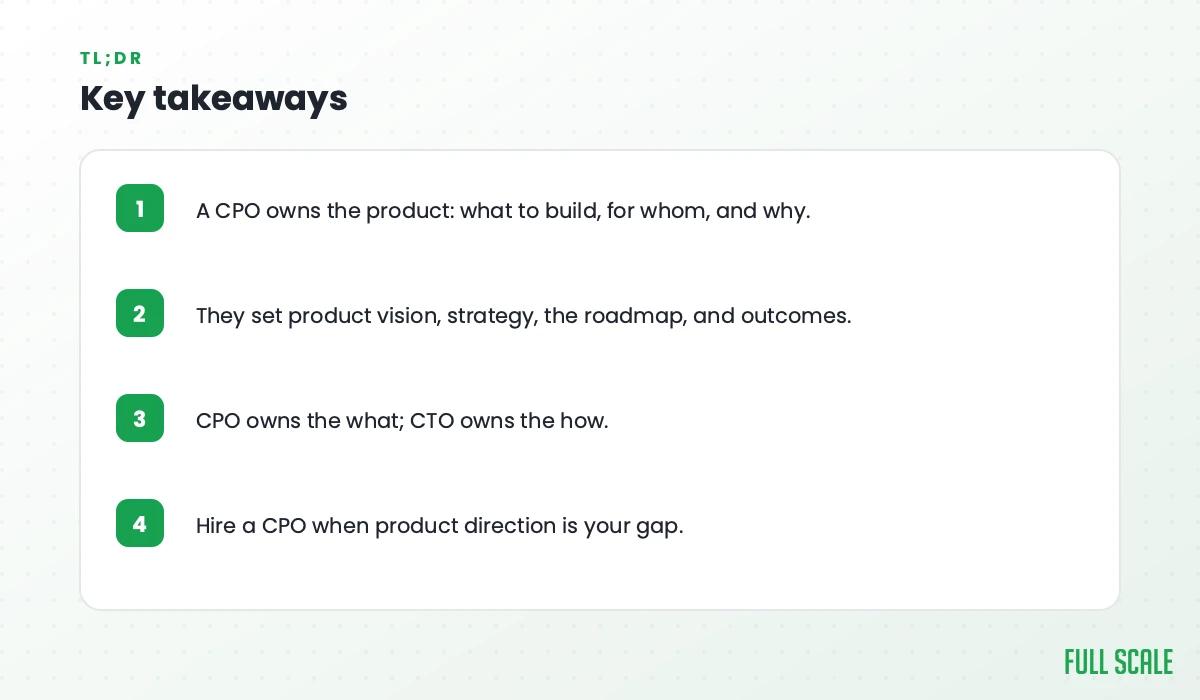
A CPO leads the product organization, usually a team of product managers and designers, and balances what customers want against what the business needs. The CPO owns what to build; the CTO owns how it gets built. The chief technology officer and the CPO are partners, and at a lot of companies one person covers both for a long time.
What does a Chief Product Officer do?
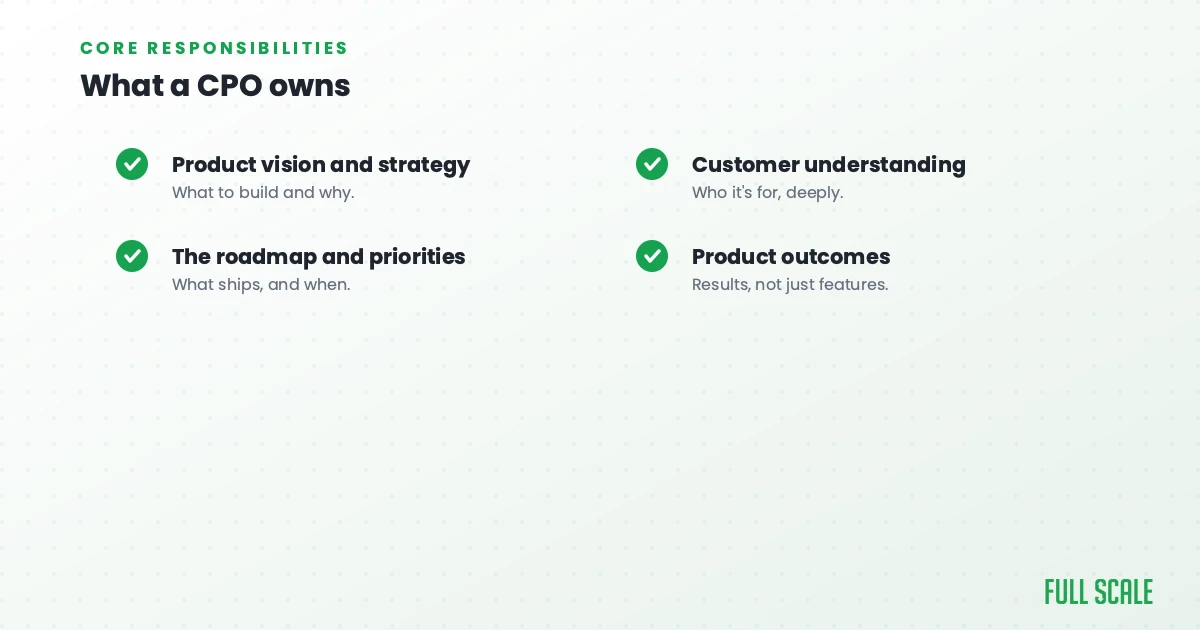
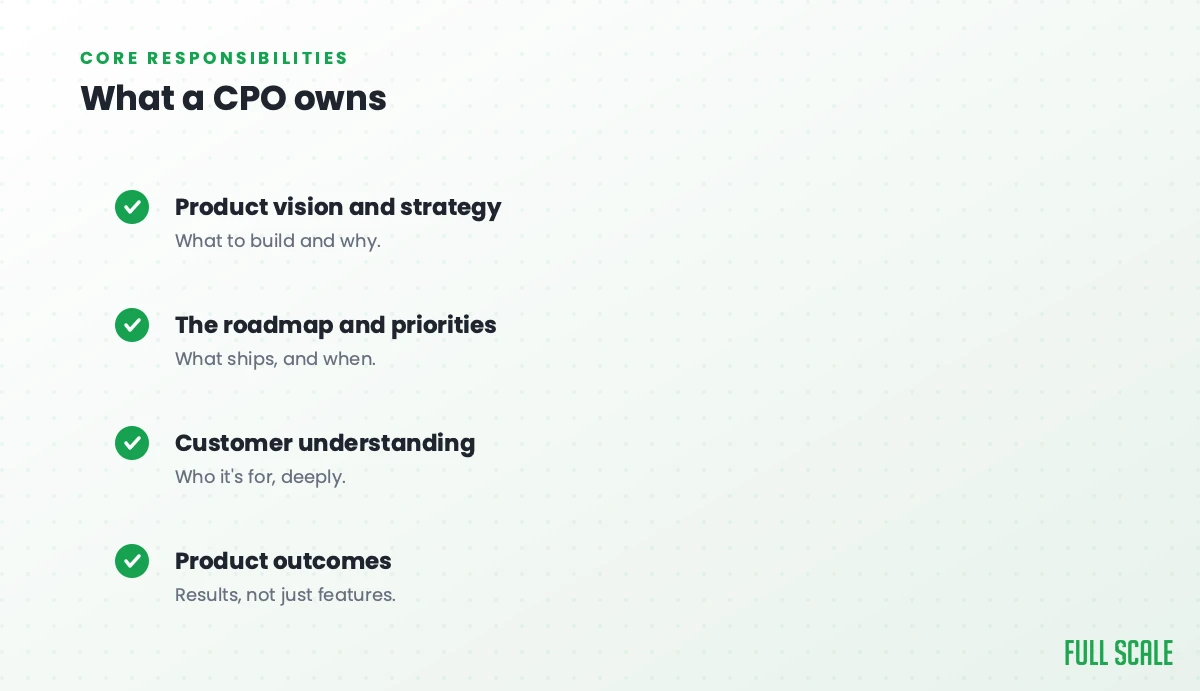
The exact job varies by company, but a CPO’s core responsibilities are consistent. They own:
- The product vision and strategy: what the company is building and why it matters to customers
- The roadmap and priorities: what ships, in what order, and what gets cut
- Customer and market understanding: who the product is for and what problem it actually solves
- Product outcomes and metrics: revenue, activation, engagement, retention, and churn, not just feature delivery
- The product organization: hiring, mentoring, and leading product managers and designers
- Cross-functional alignment with engineering, design, marketing, and sales so the whole company is building the same thing
The thread running through all of it is judgment about what to build. A CPO spends real time in customer discovery and in the data, because most products fail from building the wrong thing well, not from building the right thing badly. Much of that judgment shows up in the product roadmap, which is really a series of bets about what customers need next.
The modern CPO is increasingly measured on business outcomes, not just features shipped, so the role often carries revenue or growth targets. What the job looks like day to day depends on the company. At a B2B SaaS business it leans on a handful of large customers and a sales-informed roadmap, while a consumer or product-led-growth company runs more on usage data and self-serve adoption.
CPO vs CTO vs VP of Product
These three titles get tangled constantly, so here’s the clean version.
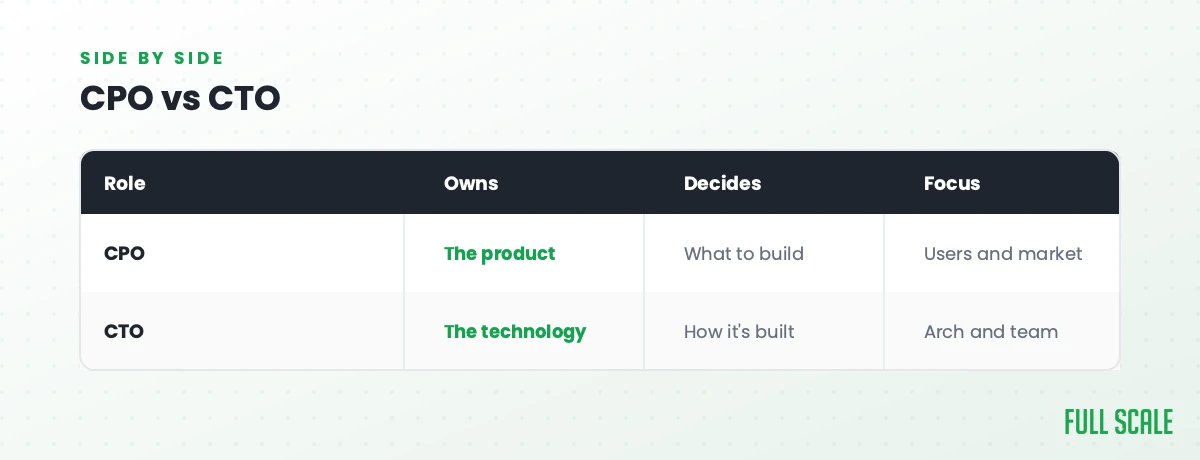
The CPO owns the product, the decision of what to build and why. The CTO owns the technology, the decision of how to build it and the engineering team that does. They’re peers, and we break the split down further in CTO vs CPO. The VP of Product is usually a step below the CPO. They’re a senior operator who runs the roadmap and the product team day to day, often for one product line, without the board-level and profit-and-loss (P&L) accountability a CPO carries. In a smaller company there’s no CPO at all, just a VP or head of product who reports to the CEO, and that’s often the right setup.
When does your company actually need a CPO?
Most early-stage startups don’t need a chief product officer. That’s the part the job-description articles leave out.
In the early days the founder is the product leader, and that’s how it should be. The person closest to the customer and the vision should be making the calls. My rule of thumb: you start needing a dedicated product executive once the company outgrows founder-led product. In practice that’s usually past 50 people or a Series A, when there are multiple product lines, a product team big enough to need real management, and a roadmap too complex for the founder to hold in their head. The executive search firms that place CPOs point to the same growth-stage trigger. But common at scale is not the same as you needing one yet.
I ran product at VinSolutions and Stackify without the title, and the most important thing I learned is that product ownership is a mindset, not a title. One of the best people I ever worked with was a senior developer at Stackify who owned our application performance monitoring support across the open-source languages, Java, Node.js, PHP, and Python. He decided himself which ones we’d support and what “done” meant, and he operated like a product manager and a leader, with no CPO, no VP, just ownership. The product he built that way was part of what we sold when Stackify exited in 2021. If the people building your product already think that way, you may not need an executive to install the discipline. You may need more of those people.
That’s the trap I see most often: a company hires a CPO to fix what is really a capacity or ownership problem. The fix isn’t always another executive. Sometimes it’s adding product-minded engineers who own outcomes, not just tickets, so your existing product leader can actually lead. The version that fails is hiring the cheapest developers you can find and handing them a spec, the mistake I call cheapshoring. Product-driven teams are built the opposite way. When you genuinely have several product lines pulling in different directions and nobody accountable for the whole product, that’s when the executive hire is the right call, and more engineers won’t fix it.
Chief Product Officer salary
A true C-suite CPO is paid like one. Base pay generally runs from the high $200,000s into the $400,000s. Total compensation often lands between $300,000 and $500,000 once bonus and equity stack on top, and higher still at growth-stage and public tech companies. Comparably puts the US average near $287,000 with total compensation around $314,000, and Glassdoor’s figures run higher still once equity is in the mix. As with most executive roles, company stage, location, and equity drive most of the spread: a CPO in San Jose or San Francisco clears far more than one at a similarly sized company elsewhere.
The skills that make a great CPO
A bachelor’s degree is the baseline, and many CPOs add an MBA or a graduate degree, but the credential isn’t what makes the job work. The CPOs who are good at it are strong in four areas.
The first is product judgment: knowing what to build and, just as important, what to say no to. The second is customer and market insight, because a CPO who isn’t close to real customer problems ends up shipping a roadmap built on opinions. The third is data fluency: setting and reading the metrics that show whether a product has found product-market fit or is just adding features nobody uses. The fourth is leadership and communication, since a CPO spends most of their time aligning engineering, design, marketing, and sales around a single direction. Strong in all four, you have a product leader. Missing one or two, you have a senior product manager with a bigger title.
How to become a CPO
The path is long and fairly consistent. It usually starts with learning how to become a product manager, then moving up through senior product manager and director or VP of Product, picking up scope and P&L responsibility at each step. Most CPOs have ten or more years in product by the time they reach the chair, often across more than one industry. The pattern that matters most is range: the best product executives have shipped real products, owned real outcomes, and learned what customers actually do versus what they say they’ll do.
FAQ
What does a chief product officer do in simple terms?
A CPO owns the product: the vision, the strategy, the roadmap, and the outcomes. They lead the product team and decide what the company builds and why, working closely with engineering on how it gets built.
What is the difference between a CPO and a CTO?
The CPO owns what to build and why (the product), while the CTO owns how it gets built (the technology and engineering team). They’re peers, and in smaller companies one person often covers both.
What is the difference between a CPO and a VP of Product?
A VP of Product runs the roadmap and the product team day to day, often for one product line. A CPO carries broader, board-level and P&L accountability for the company’s whole product direction. The VP usually reports to the CPO when both roles exist.
How much does a chief product officer make?
Base pay typically runs from the high $200,000s into the $400,000s, with total compensation often between $300,000 and $500,000 once bonus and equity are included, and higher at growth-stage and public tech companies.
When should a company hire a CPO?
Usually once it outgrows founder-led product, often past 50 people or a Series A, when there are multiple product lines and a product team large enough to need dedicated executive leadership. Before that, a VP or head of product, or the founder, is usually the right call.
What does a chief product officer job description typically include?
A chief product officer job description usually covers setting the product vision and strategy, owning the roadmap and priorities, understanding customers and the market, tracking product outcomes like revenue, activation, and retention, leading the product organization, and aligning engineering, design, marketing, and sales around the same direction.
If product is your gap, start with ownership
A chief product officer is worth it when product direction is genuinely the thing holding the company back. But a lot of “we need a CPO” problems are really “nobody owns the outcome” problems, and those don’t always get solved with a C-suite hire.
At Full Scale, we help tech companies add senior, pre-vetted engineers from the Philippines who think about the product, not just the ticket queue, integrated into your team with predictable monthly billing and your IP fully protected. You can hire product-minded engineers through a dedicated offshore team and give whoever owns your product real capacity to build.
If you want the playbook for building teams that ship what actually matters, my book Product Driven is free to download.